Private Aphrodisias Ancient City Tour
Ask us about a tailor-made visit focused on Roman archaeology, the cult of Aphrodite, the Sebasteion, ancient sculpture and the remarkable stadium.
Request a Private Tour





Hidden in the fertile countryside of southwestern Türkiye, Aphrodisias Ancient City is one of the most remarkable archaeological sites of the Roman world. Located near Geyre in Karacasu, Aydın Province, the city was celebrated in antiquity for its sanctuary of Aphrodite, its brilliant school of marble sculpture and its close relationship with Rome.
Aphrodisias benefited from rich marble quarries only a few kilometers from the city. Local sculptors transformed this stone into statues, architectural decoration and reliefs of exceptional quality, creating an artistic tradition whose works travelled throughout the Roman Empire.
Today visitors can walk through an unusually complete ancient cityscape containing the monumental Tetrapylon, Temple of Aphrodite, Sebasteion, theatre, South Agora, Hadrianic Baths, Bouleuterion and one of the best-preserved ancient stadiums anywhere in the Mediterranean.
Aphrodisias and its ancient marble quarries were inscribed on the UNESCO World Heritage List in 2017, recognizing both the extraordinary architecture of the city and the exceptional artistic tradition created by its sculptors.
A remarkably preserved Greco-Roman city and marble-production landscape.
Explore the famous sanctuary dedicated to a distinctive local form of the goddess Aphrodite.
Discover one of the most important sculpture schools known from the ancient Roman world.
Walk inside one of the largest and best-preserved ancient stadiums ever discovered.
Essential information for planning your visit to the UNESCO-listed ancient city of Aphrodisias.
Geyre, Karacasu district, Aydın Province, southwestern Türkiye.
Open on Google MapsHellenistic, Roman and Late Antique, with major development from the 1st century BC to the 6th century AD.
Inscribed on the UNESCO World Heritage List in 2017.
Aphrodite of Aphrodisias, combining Greek and older Anatolian religious traditions.
Marble sculpture, the Sebasteion reliefs, Tetrapylon and exceptionally preserved stadium.
Allow approximately 3–4 hours for the archaeological site and museum.
Aphrodisias combines archaeology, religion, imperial politics, architecture and sculpture in one unusually well-preserved ancient city.
Aphrodisias was not one of the largest cities of antiquity, but its architecture and artistic achievements gave it an importance far beyond its population. The city became famous throughout the Roman world for two things in particular: the sanctuary of Aphrodite and the extraordinary skill of its marble sculptors.
The nearby marble quarries provided abundant high-quality stone. Instead of importing expensive material from distant regions, Aphrodisian builders and sculptors could obtain marble almost directly from the surrounding landscape. This helped create an unusually rich urban environment filled with monumental façades, statues, portraits and carved architectural decoration.
The city also developed a particularly close relationship with Rome. Aphrodite was connected in Roman mythology with Venus, divine ancestor of the family of Julius Caesar. Political connections with Julius Caesar, Augustus and later Roman emperors helped Aphrodisias obtain important privileges, including favorable political and fiscal status.
Its archaeological survival is equally remarkable. Because the area was relatively isolated from later major urban development, large parts of the ancient city escaped the intensive rebuilding that transformed many other classical settlements.
For visitors exploring our guide to places to visit in Aydın, Aphrodisias is one of the province's essential archaeological destinations and one of the finest ancient cities in Türkiye.
Human activity around Aphrodisias reaches far back into prehistory, but the recognizable classical city developed during the Hellenistic period. By the 2nd century BC, Aphrodisias was emerging as an organized urban community centered on the sanctuary of Aphrodite.
Its fortunes changed dramatically during the late Roman Republic and early Empire. Aphrodisias cultivated connections with powerful Roman leaders and presented its local goddess Aphrodite in a form that could be associated with Roman Venus.
During the reign of Augustus and his successors, the city entered a period of exceptional prosperity. Wealthy local families sponsored temples, porticoes, civic buildings, entertainment structures and statues. These benefactions transformed Aphrodisias into a monumental marble city.
The 1st and 2nd centuries AD saw the construction or expansion of several of its most famous monuments, including the Sebasteion, Stadium, Civil Basilica, Hadrianic Baths and Tetrapylon.
By the later 3rd century AD, Aphrodisias had become the capital of the Roman province of Caria. Unlike many cities that declined sharply during Late Antiquity, Aphrodisias remained an important regional center into the 5th and 6th centuries.
Christianization gradually transformed the city's identity. The Temple of Aphrodite was converted into a monumental Christian cathedral around the late 5th or early 6th century, while pagan images in several parts of the city were altered or deliberately erased.
Urban life weakened considerably after the disruptions of the 7th century. The settlement survived on a smaller scale during the Byzantine and medieval periods before eventually losing its earlier urban importance.
Aphrodisias develops as an organized Hellenistic city around the sanctuary of Aphrodite.
Political connections with Rome strengthen the city's privileges and international status.
The great Sebasteion complex is constructed for Aphrodite and the Julio-Claudian emperors.
Monumental construction flourishes during one of the city's most prosperous periods.
Aphrodisias becomes capital of the Roman province of Caria.
The Temple of Aphrodite is transformed into a Christian cathedral.
Long-term systematic excavations led by archaeologist Kenan Erim begin.
Aphrodisias and its marble quarries are inscribed on the UNESCO World Heritage List.
The identity of Aphrodisias was inseparable from its patron goddess. Yet the Aphrodite worshipped here was not simply identical to the familiar Greek goddess of romantic love and beauty.
Her cult incorporated older Anatolian religious traditions associated with fertility, nature and divine power. The resulting image combined local Anatolian ideas with the classical Greek identity of Aphrodite.
The cult statue was normally shown as a rigid, frontal figure wearing an elaborate decorated garment. Her costume contained symbolic zones and divine imagery very different from the nude Aphrodite familiar from much Greek sculpture.
Copies and variations of the Aphrodite of Aphrodisias have been found across the Mediterranean, demonstrating that the cult's reputation extended well beyond the city itself.
The Temple of Aphrodite stood at the religious heart of the city. An important sanctuary existed here before the great Roman monumental development of Aphrodisias, while the surviving architectural remains reflect several phases of construction and modification.
The temple was surrounded by an elaborate sanctuary complex and approached through the monumental Tetrapylon. Ceremonies, festivals and civic rituals connected Aphrodite directly with the political identity of the community.
One of the most extraordinary chapters in the building's history came with the Christianization of the city. Rather than simply abandoning the pagan temple, builders transformed it into a large Christian church.
Columns were repositioned, walls were constructed and the orientation and internal space of the monument were fundamentally redesigned. UNESCO identifies this conversion as an exceptional example of ancient religious architecture being radically adapted for Christian use.
The sacred area was the central cult place of Aphrodite and a foundation of civic identity.
The temple became part of an increasingly monumental sanctuary during the Roman period.
Around AD 500, the temple was extensively transformed into a cathedral.
Surviving columns and foundations reveal both the pagan temple and later Christian building.
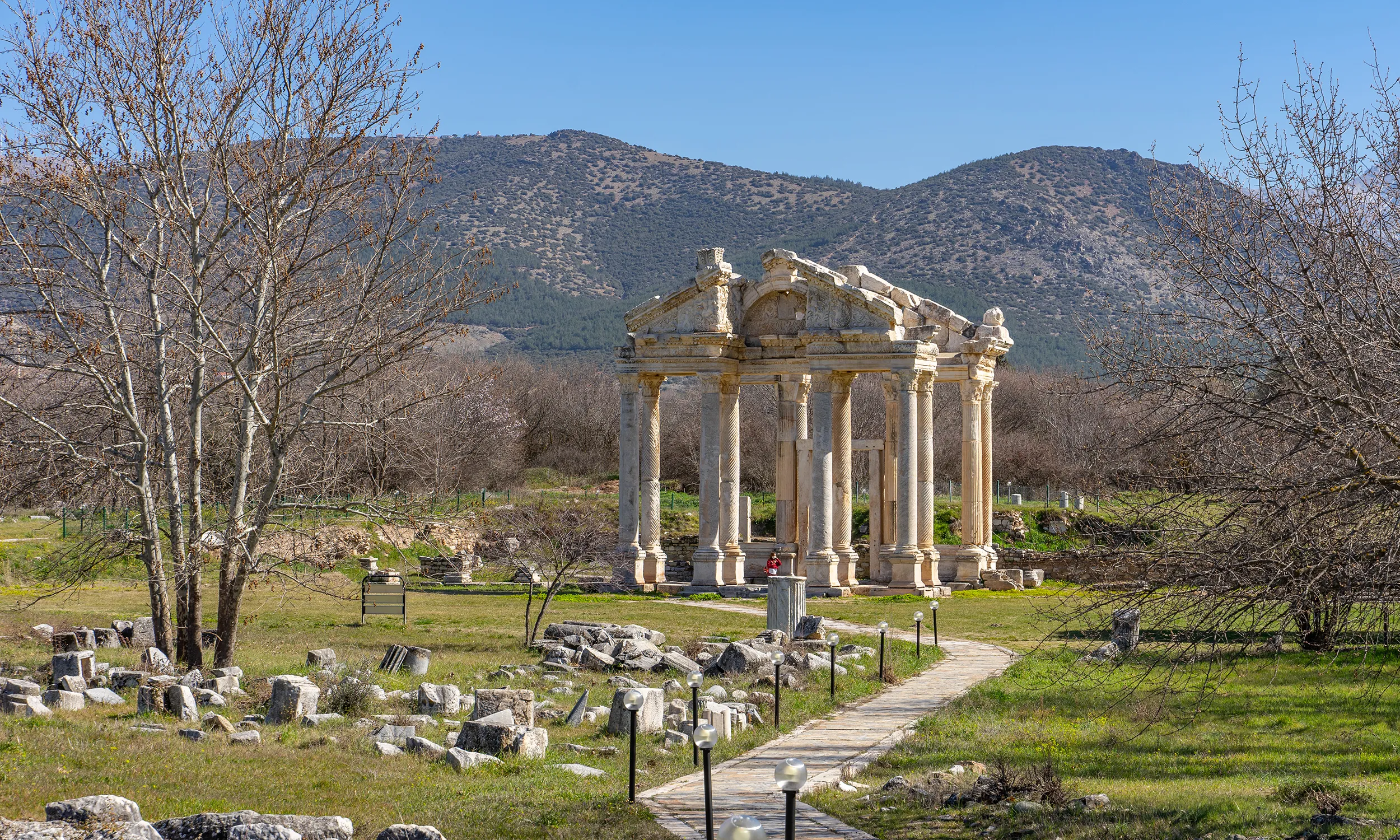
The Tetrapylon is perhaps the most immediately recognizable monument at Aphrodisias. Built during the Antonine period in the 2nd century AD, it formed the monumental entrance from the city's main street into the outer sanctuary of Aphrodite.
The structure contains sixteen columns arranged four by four, supporting richly carved pediments. Its elaborate floral decoration, deep carving and complex architectural design make it one of the masterpieces of Roman decorative architecture in Asia Minor.
The western façade was particularly ornate. Relief decoration included Erotes among acanthus foliage, while an image of Aphrodite originally occupied an important central position. During the Christian period, the pagan image was erased and replaced with a cross.
The monument collapsed in antiquity but many original blocks remained on site. A careful archaeological reconstruction was completed in 1991, using approximately 85% original ancient stone.
The Sebasteion is one of the most extraordinary monuments at Aphrodisias and one of the most important surviving complexes for understanding Roman imperial imagery.
Constructed approximately between AD 20 and 60, from the reign of Tiberius to that of Nero, the complex was dedicated jointly to Aphrodite and the Julio-Claudian emperors.
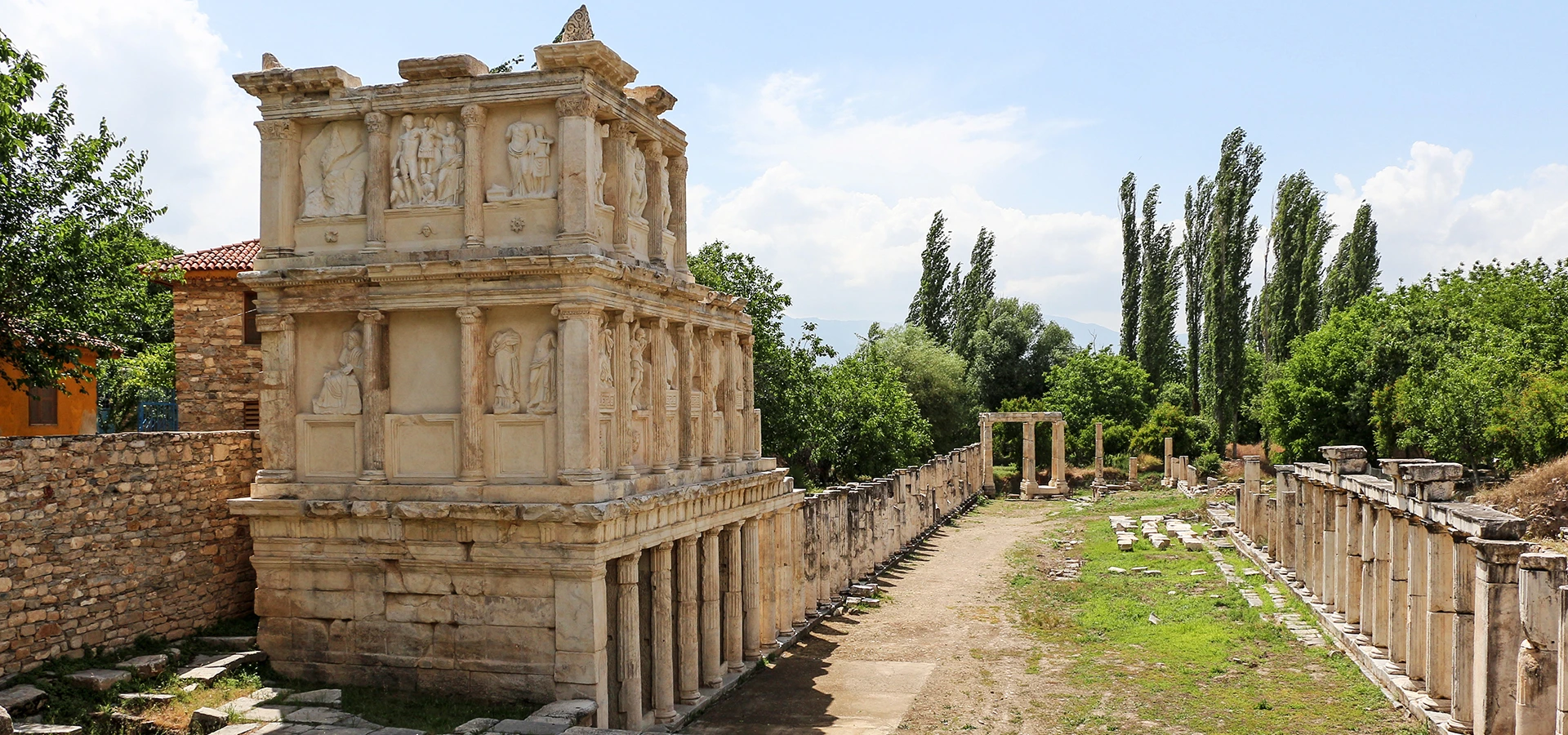
A long ceremonial avenue approximately 90 meters in length was framed by three-storey marble façades. Their architectural levels used Doric, Ionic and Corinthian orders, while the upper storeys carried extensive series of sculpted marble reliefs.
Around two hundred relief panels were originally required for the complete decorative program. More than eighty were recovered during excavation.
Their subjects formed a remarkable visual representation of Roman power. Some panels depicted emperors and imperial family members, others illustrated Greek mythology, while another group personified peoples and territories incorporated into the Roman world.
Reliefs celebrated emperors including Augustus, Tiberius, Claudius and Nero.
Heroes and mythological scenes linked Roman authority with the classical past.
Personifications represented regions and peoples within the Roman imperial world.
The monument demonstrated Aphrodisias' unusually close relationship with imperial Rome.
Aphrodisias became internationally famous for marble sculpture. Local quarries provided excellent material while generations of specialist craftsmen developed a distinctive technical tradition.
Sculptors created imperial portraits, gods, mythological figures, architectural reliefs, funerary monuments and statues honoring important members of the community.
Archaeologists have identified a sculptor's workshop within the city containing unfinished pieces, working fragments and evidence of the production process. Such discoveries make Aphrodisias especially important because scholars can study not only finished masterpieces but also how ancient sculptors actually worked.
Aphrodisian sculptors were active well beyond their hometown, and works associated with their artistic tradition have been identified throughout the Roman Mediterranean.
Nearby quarries provided abundant stone suitable for architecture and detailed sculpture.
Craftsmen developed techniques that were passed through generations of sculptural production.
Roman emperors and prominent citizens were represented in highly accomplished marble portraits.
Monuments such as the Sebasteion combined architecture with extensive narrative sculpture.
Workshop remains reveal stages of carving normally invisible in completed ancient sculpture.
The city's sculptural tradition influenced artistic production far beyond Aphrodisias itself.
At the northern edge of the city lies one of Aphrodisias' greatest archaeological treasures: its enormous ancient stadium.
Built in the later 1st century AD, the structure measures approximately 270 meters long and 60 meters wide. Around thirty rows of marble seating could accommodate approximately 30,000 spectators—far more than the normal population of the city.
Unlike many Greek stadiums with one open end, the Aphrodisias Stadium was enclosed by curved seating at both ends. Its long sides were also slightly elliptical, helping spectators see the events taking place below.
Athletic festivals included running, wrestling, jumping, discus and javelin events. The stadium could also host gladiatorial combats and wild-animal spectacles associated with Roman festival culture.
During Late Antiquity, when traditional Greek athletics declined, the eastern end was modified into an enclosed arena suitable for Roman-style entertainments.
Many seats preserve ancient inscriptions reserving sections for professional associations, important individuals and visitors from neighboring communities.
The ancient theatre stands against the prehistoric settlement mound known as the Acropolis. Its surviving form reflects several phases of construction and rebuilding from the Hellenistic period through Roman times.
During the early Roman Imperial period, wealthy benefactors helped transform the theatre into a monumental marble building appropriate for dramatic performances, civic ceremonies and political gatherings.
The theatre is especially significant for the inscriptions preserved on what is often called the Archive Wall. These texts recorded important documents concerning Aphrodisias' relationship with Rome and the privileges granted to the city.
The monument therefore provides far more than an impressive architectural view. It preserves direct written evidence for the political history of the community.
The enormous space traditionally known as the South Agora is now understood as a monumental urban park centered around a long ornamental pool.
Colonnaded porticoes framed an elongated public space where architecture, water, sculpture and vegetation created an impressive civic environment.
The monumental pool acted as both decorative centerpiece and sophisticated water feature. Excavation and restoration have revealed how carefully the space was engineered and landscaped.
Along the edges of the complex stood elaborate porticoes and architectural façades, while the massive Hadrianic Baths occupied its western side.
A long central basin formed the visual heart of the urban landscape.
Porticoes created shaded architectural boundaries around the public space.
Careful hydraulic planning transformed the area into an elegant monumental park.
A major Roman bathing complex rose immediately behind the western colonnade.
The Hadrianic Baths formed one of the city's largest public bathing complexes. Constructed during the 2nd century AD, they stood beside the western end of the monumental Urban Park.
Roman bath complexes were far more than places to wash. They were centers for relaxation, exercise, conversation, business and social interaction.
The surviving structures preserve massive masonry walls, marble architectural elements and traces of different bathing spaces that once formed a carefully organized sequence of heated and unheated rooms.
Walking through the ruins helps visitors imagine the considerable engineering infrastructure required to supply water, create heated rooms and serve large numbers of citizens.
The Bouleuterion, or council house, was constructed during the later 2nd century AD and served as one of the principal administrative buildings of Aphrodisias.
Its covered auditorium contained rising tiers of seating facing a stage-like architectural setting. Members of the city council could gather here to debate civic affairs and conduct public business.
The building could also accommodate lectures, musical performances and other gatherings, illustrating how civic and cultural activities often shared architectural spaces in Roman cities.
The Civil Basilica was a monumental public building connected with administration, legal activity and commerce.
Construction began during the early Roman Imperial period and its elaborate decoration reflects the same highly skilled marble craftsmanship visible throughout Aphrodisias.
The building is particularly important because inscriptions and architectural evidence reveal how imperial law and civic government operated within provincial Roman society.
Modern conservation and reconstruction projects continue to make the scale and design of the basilica easier for visitors to understand.
Aphrodisias is extensive enough to reward several hours of exploration. These are the essential monuments to prioritize during a first visit.
Photograph the spectacular reconstructed gateway leading toward the sanctuary of Aphrodite.
Explore the religious center that gave the ancient city its name.
Discover one of the Roman world's most important monuments of imperial cult and relief sculpture.
Walk inside the enormous 30,000-seat arena at the northern edge of the city.
See the performance space and inscriptions preserving the city's political relationship with Rome.
Explore the monumental pool and colonnaded landscape of the former South Agora.
Study one of the largest surviving Roman bathing complexes at the site.
Enter the council building where ancient civic government conducted its business.
Understand the legal and administrative institutions of Roman Aphrodisias.
See original sculptures and Sebasteion reliefs protected and displayed close to where they were discovered.
The archaeological museum beside the ancient city is an essential part of any visit to Aphrodisias. Many of the site's most important sculptures are displayed indoors where their remarkable carving can be examined at close range.
The collection includes marble portraits, statues, sarcophagi, architectural sculpture and works associated with the celebrated Aphrodisian school of sculpture.
Particularly important are the original reliefs from the Sebasteion. Together they form one of the most extraordinary surviving visual programs from the Roman Imperial period.
The museum underwent extensive renovation and reopened to visitors on 15 August 2026.
Modern understanding of Aphrodisias is closely connected with Turkish archaeologist Professor Kenan T. Erim, who began systematic excavations at the site in 1961.
For almost three decades, Erim directed excavation, conservation and international research at Aphrodisias. His work brought many of the city's major monuments and sculptures to worldwide attention.
He died in 1990 and was buried at Aphrodisias near the monumental Tetrapylon, the ancient city to which he had devoted much of his professional life.
Research continues today through international archaeological collaboration and ongoing conservation, excavation and publication projects.
Begin near the visitor entrance and museum before moving toward the spectacular Tetrapylon. From here, explore the sanctuary and Temple of Aphrodite, paying attention to the architectural changes associated with its transformation into a Christian cathedral.
Continue north toward the enormous Stadium. Because it lies slightly apart from the central monuments, visiting it early prevents you from accidentally skipping one of the site's most impressive structures.
Return toward the city center and follow the ancient street system toward the Bouleuterion, Agora and Urban Park. Continue to the Hadrianic Baths before exploring the theatre and surrounding monuments.
Finish with the Sebasteion and museum, where the original sculpture provides a powerful conclusion to everything you have seen outdoors.
Aphrodisias Archaeological Site and Museum are located at Geyre, Karacasu, Aydın. The archaeological area is large and mostly outdoors, so comfortable footwear, water and sun protection are important.
As checked in October 2026, the official Turkish Ministry of Culture and Tourism museum listing gives current visiting hours as 08:30–17:30, with the ticket office closing at 17:00. The site is listed as open every day.
Seasonal opening hours can change and extended summer hours may apply during other parts of the year. Always verify the current schedule before making a long journey specifically for the site.
Much of Aphrodisias is exposed archaeological terrain, making weather and daylight important considerations when planning your visit.
Mild temperatures, green landscapes and flowering vegetation make spring one of the finest seasons.
Comfortable temperatures and softer light are excellent for walking and photography.
Arrive early before midday heat becomes intense across the open archaeological landscape.
Temperatures can be high and shade is limited, so carry water and sun protection.
The site is quieter and atmospheric, but rain, cold weather and shorter daylight should be considered.
Lower sunlight creates beautiful shadows across the Tetrapylon, stadium and marble ruins.
Enough only for a fast walk through several major monuments. Not recommended for a first visit.
See the Tetrapylon, Temple, Stadium, Theatre and several central monuments at a brisk pace.
A good minimum for the archaeological site plus a shorter museum visit.
Ideal for most visitors who want archaeology, photography and meaningful museum time.
Excellent for archaeology enthusiasts who want inscriptions, sculpture and architectural details.
A knowledgeable guide makes the Sebasteion, Aphrodite cult and Roman political history significantly easier to understand.
Aphrodisias is one of Türkiye's most photogenic archaeological sites, combining monumental architecture, detailed marble carving and a peaceful rural landscape.
Use a wide composition to capture all four groups of columns and the richly carved pediments.
Photograph along the central axis to emphasize its extraordinary length and curved seating.
Low-angle sunlight reveals fine details in marble reliefs, capitals and inscriptions.
Use long perspectives to show the monumental pool and surrounding colonnaded landscape.
Look closely for carved acanthus leaves, faces, inscriptions and traces left by ancient craftsmen.
Respect current photography restrictions and avoid flash where prohibited.
Aphrodisias is an extensive archaeological landscape. Some visitor areas are relatively level, but ancient paving, gravel, uneven ground and long walking distances can present challenges for visitors with limited mobility.
The major monuments are spread across a large archaeological zone.
Expect gravel, ancient paving, grass and irregular surfaces.
The stadium requires additional walking away from the central monuments.
The indoor museum provides a more controlled environment for viewing important sculpture.
Contact the site directly before visiting to confirm current accessible paths and facilities.
Allow additional time in hot weather and avoid trying to cover the entire city too quickly.
Aphrodisias lies inland from Türkiye's Aegean coast near the village of Geyre in the Karacasu district of Aydın Province. Because the site is away from major rail lines and resort centers, a private vehicle or organized excursion is usually the easiest way to visit.
The journey is approximately 100 kilometers and generally takes around 1.5 hours by road.
Aphrodisias is approximately 110 kilometers from central Aydın.
A private vehicle allows Aphrodisias to be combined naturally with the Denizli and Pamukkale region.
A full-day private excursion is the most comfortable way to visit from the Aegean coast.
The road journey is approximately 210 kilometers and is best planned as a long day trip or overnight route.
The most flexible option for combining Aphrodisias with Karacasu, Pamukkale or other ancient cities.
Aphrodisias can be incorporated into a broader archaeological journey through Aydın and Denizli. Explore our complete Aydın visitor guide for more ideas throughout the region.
Explore the nearby district center known for its traditional pottery and rural Aegean character.
Visit another important ancient city of the Meander Valley with a theatre, library and dramatic topography.
Combine archaeology with the famous white travertine terraces of the Denizli region.
Explore the major Greco-Roman and early Christian city constructed above Pamukkale's thermal springs.
Discover an extensively excavated ancient city near Denizli with monumental streets and early Christian heritage.
Continue toward the wider Meander Valley for ancient cities, museums, mountain landscapes and traditional towns.
Aphrodisias is located near Geyre in the Karacasu district of Aydın Province in southwestern Türkiye.
Aphrodisias is famous for the cult of Aphrodite, exceptional Roman marble sculpture, the Sebasteion reliefs, its monumental Tetrapylon and its enormous ancient stadium.
Yes. Aphrodisias and its associated ancient marble quarries were inscribed on the UNESCO World Heritage List in 2017.
She was a distinctive local form of Aphrodite combining elements of Greek Aphrodite with older Anatolian religious and fertility traditions.
The area has much older prehistoric occupation, but the organized classical city developed mainly during the Hellenistic period, particularly from the 2nd century BC onward.
The city benefited from Roman political privileges, fertile surrounding land, religious importance and nearby high-quality marble quarries that supported a renowned sculpture industry.
The city's goddess Aphrodite could be associated with Roman Venus, legendary ancestor of Julius Caesar's family. Aphrodisias developed particularly close relationships with Caesar, Augustus and later Roman emperors.
The Tetrapylon is the monumental 2nd-century gateway leading toward the sanctuary of Aphrodite. Its reconstructed architecture consists of sixteen columns supporting elaborately carved pediments.
The monument was reconstructed through archaeological anastylosis completed in 1991. Approximately 85% of the blocks used in the reconstruction are original ancient material.
The Sebasteion was a monumental sanctuary dedicated to Aphrodite and the Julio-Claudian Roman emperors. Its architecture carried extensive marble reliefs depicting emperors, mythology and peoples of the Roman Empire.
The complete program originally required roughly two hundred relief panels, and more than eighty were recovered during excavation.
The stadium measures approximately 270 meters long and 60 meters wide.
Its marble seating could accommodate approximately 30,000 spectators.
It hosted traditional athletic contests as well as festivals, gladiatorial fights and animal spectacles. Part of the stadium was later converted into a more compact arena.
Yes. Around the late 5th or early 6th century AD, the temple was extensively transformed into a large Christian cathedral.
Nearby marble quarries supported a highly skilled local school of sculptors. Excavations have also uncovered workshop evidence, unfinished pieces and tools that reveal how Roman sculpture was produced.
Yes. Aphrodisias Museum displays sculptures, portraits, sarcophagi, architectural pieces and important original Sebasteion reliefs discovered at the archaeological site.
The museum reopened on 15 August 2026 following extensive renovation. Visitors should still confirm current access and opening hours before travelling.
As checked in October 2026, the official Turkish Ministry listing gives 08:30–17:30, with the ticket office closing at 17:00. Seasonal hours can change, so verify before visiting.
Most visitors should allow approximately 3–4 hours to explore the archaeological site and museum comfortably.
Yes. Aphrodisias can be reached by road from the Pamukkale and Denizli area and works particularly well as part of a private archaeological excursion.
Yes, although the journey is longer. A private full-day excursion provides the most comfortable option from Kuşadası and the Ephesus region.
It generally receives fewer visitors than sites such as Ephesus or Hierapolis, making it particularly appealing to travelers who prefer quieter archaeological experiences.
Absolutely. Its combination of monumental architecture, extraordinary sculpture, Roman political history, religious transformation and peaceful setting makes Aphrodisias one of Türkiye's most rewarding ancient cities.
Use marked paths instead of crossing excavated or protected archaeological areas.
Avoid climbing columns, walls, statues, stadium seating or unstable ancient masonry.
Repeated physical contact can gradually damage ancient marble surfaces.
Even small fragments may contain archaeological information and must never be removed.
Active archaeological and conservation areas may be temporarily closed for research.
Carry bottles, packaging and all personal waste out of the archaeological landscape.
Discover Aphrodisias with a private licensed guide and comfortable vehicle, with routes designed around archaeology, Roman history, ancient art and your own travel schedule — without compulsory shopping stops.
Explore the Temple of Aphrodite, Tetrapylon, Stadium, Sebasteion, theatre, Urban Park and museum with historical context from a professional guide.
Ask us about a tailor-made visit focused on Roman archaeology, the cult of Aphrodite, the Sebasteion, ancient sculpture and the remarkable stadium.
Request a Private Tour
Continue through the Meander Valley to ancient cities, traditional towns, mountain landscapes and the archaeological heritage of western Türkiye.
View Aydın GuideCombine Aphrodisias with the archaeological landscapes of Aydın and Denizli for a deeper journey through Greek, Roman and early Christian history.
Spend more time examining sculpture, inscriptions, Roman architecture and the transformation of the Temple of Aphrodite.
Plan Your Visit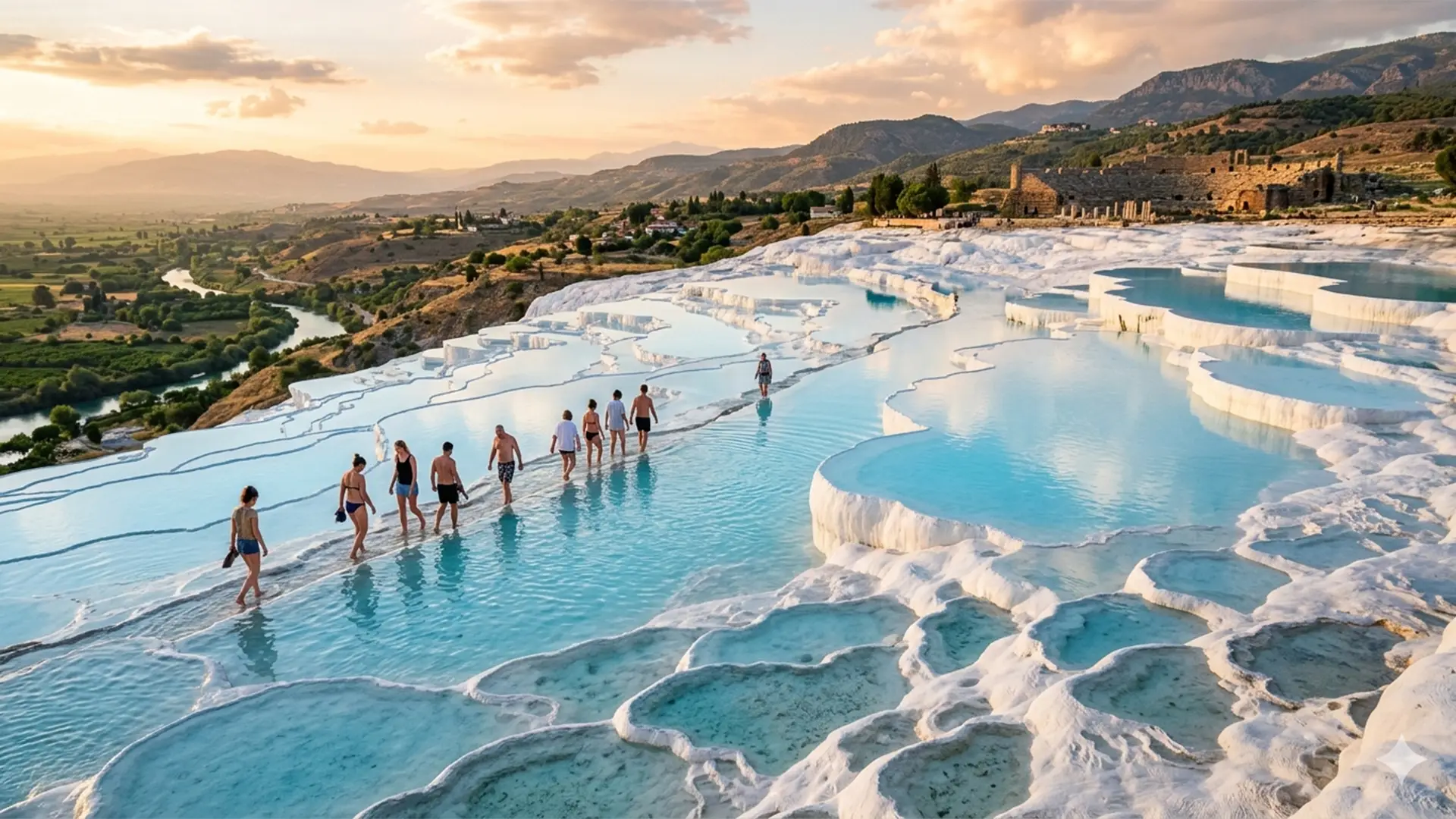
Combine Aphrodisias with the thermal landscape, Roman monuments and early Christian heritage of Hierapolis.
Create a Combined Route
Continue to Nysa and the wider archaeological landscape of the Meander Valley and ancient Caria.
Explore Aydın