Private Birgi Historical Town Experience
Explore the Ulu Mosque, Aydınoğlu tombs, Çakırağa Mansion, traditional streets and Ottoman monuments with time for local food and photography.
Request a Custom Birgi Tour





Birgi is one of the most rewarding historic settlements in İzmir Province because the town is not built around a single monument. Its narrow lanes, gardens, fountains, mosques, tombs, timber-framed houses and monumental mansions form a remarkably coherent historic landscape on the southern slopes of the Bozdağ Mountains.
The settlement became especially important in the 13th and 14th centuries, when it served as a capital of the Aydınoğlu Principality. The most powerful reminder of that period is the Birgi Ulu Mosque, completed in 1312–1313 and famous for its tile decoration, wooden craftsmanship and exceptional kündekâri minbar.
Later centuries added another layer. Çakırağa Mansion, historic residences, Derviş Ağa monuments, traditional courtyards and shaded streets preserve the atmosphere of an Ottoman Aegean town whose economy was connected with agriculture, leather, silk and weaving.
Today Birgi is included on Türkiye's UNESCO World Heritage Tentative List and was recognised as one of the Best Tourism Villages of 2022 by the United Nations World Tourism Organization. It is an ideal destination for travellers interested in architecture, history, photography, local food and slower rural exploration.
Explore the former principality capital through the Ulu Mosque, royal tombs and monuments that shaped medieval Birgi.
Step inside one of the Aegean's finest historic mansions, celebrated for painted interiors, woodwork and city panoramas.
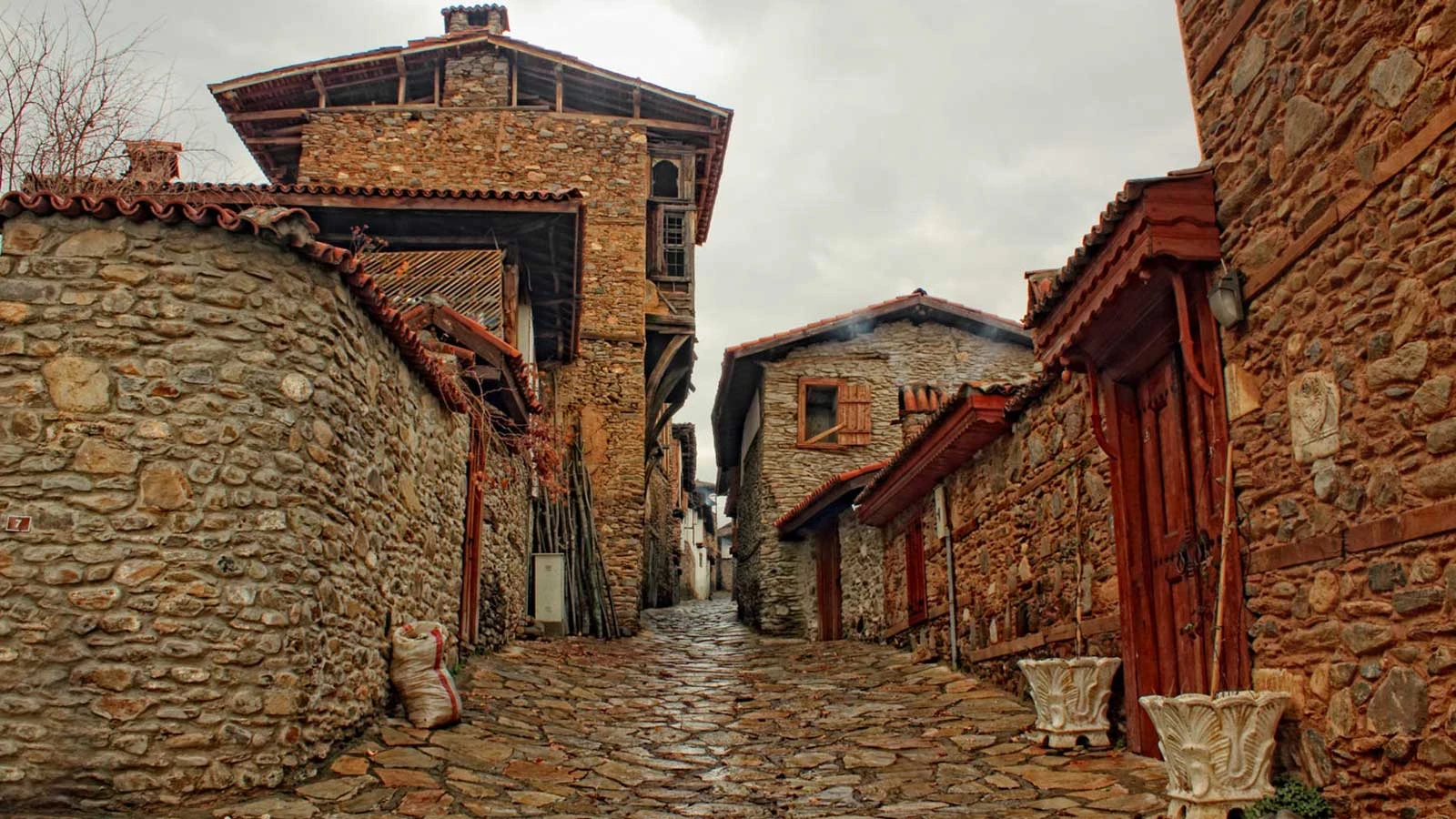
Walk between stone ground floors, timber upper storeys, tiled roofs, high garden walls, courtyards and centuries-old trees.
Combine Birgi with Ödemiş flavours, regional olive oil, local produce, handcrafts and the landscapes of the Küçük Menderes Valley.
Essential information for planning a visit to Birgi's historic centre, monuments, mansions, food stops and surrounding Ödemiş region.
Birgi lies in Ödemiş District, İzmir Province, on the southern slopes of the Bozdağ Mountains.
Birgi served as an important capital of the Aydınoğlu Principality during the Anatolian Beyliks period.
Birgi Ulu Mosque, completed in 1312–1313, is one of the town's most important surviving medieval monuments.
Çakırağa Mansion is celebrated for its timber architecture, painted decoration and panoramic wall scenes.
The Historic Town of Birgi has been on Türkiye's UNESCO World Heritage Tentative List since 2012.
Birgi was named one of UNWTO's Best Tourism Villages in 2022.
Narrow lanes, courtyard houses, stone-and-timber construction and tiled roofs define the historic fabric.
The town sits between mountain slopes, streams, orchards, gardens and the fertile Küçük Menderes basin.
Combine Birgi with Ödemiş köfte, Töngül pide, regional olive oil, potatoes, local breakfasts and seasonal produce.
Silk, weaving, bürümcük fabric, lacework and other traditional crafts are part of Birgi's cultural identity.
Walk slowly through the historic centre; most major monuments are concentrated within a compact area.
April–June and September–October are especially pleasant for walking, photography and nearby countryside.
Birgi is valuable not because of one isolated attraction, but because almost the entire historic centre works together as a cultural landscape.
The first reason to visit is the Aydınoğlu period. Birgi was an important political and cultural centre during the age of the Anatolian principalities, and the Ulu Mosque, tombs and surviving medieval fabric make that history unusually visible.
The second reason is traditional residential architecture. Historic houses line sloping lanes behind high stone walls, with timber-framed upper floors, projecting bays, tiled roofs and gardens that give the town a strong sense of continuity.
The third reason is Çakırağa Mansion. Its interiors, painted ceilings, floral decoration, carved woodwork and famous İzmir and Istanbul panoramas make it one of the region's most memorable examples of Ottoman domestic architecture.
Finally, Birgi works beautifully as part of a wider day or overnight trip. Ödemiş, Gölcük, Bozdağ, Bademli, Lübbey and Tire can all be combined with the town depending on whether your priority is food, mountain scenery, rural life, museums or Ottoman heritage.
Birgi lies in the Ödemiş district of İzmir Province, around 9–10 kilometres from central Ödemiş and roughly 110–120 kilometres from central İzmir depending on the route used.
The settlement sits where the southern slopes of the Bozdağ Mountains descend toward the Küçük Menderes plain. This geography explains the town's sloping streets, abundant gardens, water channels and green setting.
Birgi is compact enough to explore mainly on foot, but its position makes it especially useful for travellers with a car who want to combine the historic town with Ödemiş, mountain villages and nearby natural landscapes.
The Historic Town of Birgi was added to Türkiye's UNESCO World Heritage Tentative List in 2012. Tentative List status is an important step in the World Heritage process, but it does not mean that Birgi is currently an inscribed UNESCO World Heritage Site.
UNESCO's description emphasises the town's long settlement history, Aydınoğlu and Ottoman monuments, traditional houses, historic street pattern and the high level of integrity preserved across the settlement.
Birgi received another major recognition in 2022, when the United Nations World Tourism Organization included it among its Best Tourism Villages. The programme highlights rural destinations that combine heritage protection, community life and sustainable tourism development.
Historic Town of Birgi, submitted by Türkiye in 2012 under cultural criteria.
Monuments and traditional residential areas survive together rather than as isolated heritage fragments.
Birgi contains a large concentration of protected historic buildings, including religious, civic and domestic architecture.
International recognition brought additional attention to Birgi's rural heritage, crafts and sustainability efforts.
The wider Birgi region has been inhabited for thousands of years. In antiquity the area belonged to the cultural geography of western Anatolia and passed through periods associated with Phrygian, Lydian, Persian, Pergamene, Roman and Byzantine rule.
During the Byzantine period the settlement was known as Pyrgion, a name related to the Greek word for tower. The survival of the local Küp Uçuranlar / Pankuduz Tower adds an intriguing physical link to the medieval settlement that preceded Turkish rule.
Birgi's most important political period began with the rise of the Aydınoğlu Principality in western Anatolia. During the 13th and 14th centuries Birgi became a capital and major centre, leaving behind monuments of exceptional artistic quality.
The town came definitively under Ottoman control in the early 15th century. Its importance continued as a regional centre of scholarship, religion, craft production, agriculture, leatherworking and trade. Ottoman houses, mosques, madrasas, baths and fountains gradually transformed the town without erasing its earlier layers.
The result is the Birgi seen today: not a reconstructed heritage village, but a settlement whose medieval and Ottoman history remains embedded in living streets and neighbourhoods.
The Aydınoğulları emerged during the fragmentation of Seljuk authority in western Anatolia. Birgi became one of their most important seats of power and is closely associated with Aydınoğlu Mehmed Bey, founder of the principality.
The dynasty controlled strategic territory extending toward the Aegean coast and became deeply involved in regional trade, warfare and maritime politics. Birgi's monuments show that the inland capital was also a centre of artistic patronage and religious life.
The Ulu Mosque, the tomb of Mehmed Bey and members of his family, and the nearby Sultan Şah / Ümmü Sultan Tomb make it possible to read the early 14th-century principality through surviving architecture rather than only through written history.
Birgi served as an early capital and important administrative base of the Aydınoğulları.
The dynasty commissioned mosques, tombs and educational buildings that shaped the town's monumental core.
The principality linked inland western Anatolia with ports and maritime routes along the Aegean coast.
Birgi preserves some of the strongest surviving examples of Beylik-period art and craftsmanship in the region.
The Birgi Ulu Mosque is the defining monument of the historic town. Inscriptions above its entrances date the building to 1312–1313, when it was commissioned by Aydınoğlu Mehmed Bey as part of a larger complex.
Its plan follows a basilical arrangement with multiple aisles running toward the qibla wall. The bay in front of the mihrab is domed, while the rest of the prayer hall is covered by a timber roof system.
The mosque is especially celebrated for the combination of turquoise and aubergine-coloured tile decoration, carved wooden elements and its magnificent walnut kündekâri minbar. The geometric craftsmanship belongs to the artistic tradition that developed from Seljuk architecture into the Beylik period.
Because this remains an active place of worship, visitors should avoid prayer times when possible, dress respectfully and keep photography discreet when worshippers are present.
Attached to the monumental core around the Ulu Mosque, the Aydınoğlu Mehmed Bey Tomb preserves the memory of the ruling dynasty that transformed Birgi into a principality capital.
The square-plan mausoleum is associated with Mehmed Bey and members of his family, including important Aydınoğlu rulers. Its dome and surviving tile decoration make it a valuable companion to the mosque's better-known interior craftsmanship.
Do not rush past the tomb after seeing the mosque. Together, the two buildings explain the political, religious and dynastic character of early 14th-century Birgi far better than either monument alone.
Near the Ulu Mosque stands the tomb generally known as the Ümmü Sultan or Sultan Şah Tomb. Its inscription dates the monument to 1310 and associates it with Sultan Şah, a member of Aydınoğlu Mehmed Bey's family.
The building is important not only because of its early date, but because it helps reconstruct the monumental environment that was developing in Birgi even before the completion of the Ulu Mosque.
Its restrained architecture contrasts with the richer decoration of the mosque, making the group especially useful for understanding the variety of Aydınoğlu funerary and religious architecture.
Çakırağa Mansion is Birgi's most famous example of Ottoman civil architecture and one of the strongest reasons to allow enough time for the town. The house developed in the late 18th-century tradition of wealthy Aegean residences and later underwent major restoration before opening as a museum.
The mansion rises through a stone-built ground level to timber-framed upper floors arranged around open sofas. Different levels were adapted to seasonal use, while service areas, storage spaces, reception rooms and family rooms reveal the practical organisation of a prosperous household.
The greatest artistic surprise is upstairs. Floral motifs, fruit, geometric ceiling designs and painted city panoramas cover walls and timber surfaces. The famous scenes associated with İzmir and Istanbul are among the most discussed features of the house.
Çakırağa Mansion is operated as a museum. Opening days, seasonal hours and ticket arrangements can change, so travellers coming specifically for the interior should confirm the current museum schedule before leaving İzmir or Ödemiş.
Birgi's residential architecture is not secondary to its monuments; it is one of the main reasons the historic town is internationally recognised. Houses respond closely to the slope, street line, climate and needs of family life.
Many buildings combine masonry lower floors with timber-framed upper levels. High garden walls protect private courtyards, while overhanging upper storeys create shade and visual rhythm along narrow lanes.
The street network feels organic because it follows the topography rather than a rigid modern grid. Small changes in level, fountains, trees, stone walls and unexpected views toward tiled roofs make walking itself the main attraction.
Masonry bases provide strength while lighter timber-framed upper floors create flexibility and projecting façades.
Gardens and enclosed yards were essential domestic spaces for food preparation, storage and family life.
Traditional rooflines form one of the town's most distinctive visual features when viewed from the sloping streets.
Many buildings remain part of an inhabited neighbourhood, so visitors should respect privacy and avoid treating homes as film sets.
The structure popularly known as the Küp Uçuranlar Tower or Pankuduz Tower is one of Birgi's most curious medieval remains. It is generally interpreted as a Byzantine watch or defence tower and is often dated to around the 12th century.
Its importance is strengthened by the old name Pyrgion, related to the Greek word for tower. Some local interpretations therefore connect this surviving structure with the historical name from which modern Birgi may have developed.
The colourful name “Küp Uçuranlar” belongs to local legend rather than archaeology. Stories about mysterious figures flying in jars or vessels have become part of Birgi's folklore and add a memorable oral-history layer to the monument.
Birgi's Ottoman religious landscape is especially visible in the monuments associated with Derviş Ağa. The Darülhadis, also known as the Çukur Medrese, dates to 1657–1658 and was designed around an open courtyard with student cells.
Nearby stands the Derviş Ağa Mosque, built in 1663. Historical descriptions indicate that the surrounding complex once formed part of a much larger urban institution connected with education, trade, lodging and bathing.
The associated historic bath adds another piece to the picture. Seen together, these structures show that Ottoman Birgi functioned as a genuine regional town with institutions supporting scholarship, worship, commerce and daily life.
An open-courtyard darülhadis with student rooms, illustrating Birgi's role as a centre of religious education.
A 17th-century mosque forming part of the same broader religious and urban setting.
The bath reflects the integrated planning of Ottoman neighbourhood and institutional life.
These monuments are best understood as part of a living network of streets rather than as isolated attractions.
The 16th-century Ottoman scholar Mehmed Birgivi is one of the figures most strongly associated with the town. His scholarly and religious career gave Birgi lasting importance far beyond the immediate region.
His burial place in Birgi remains a destination for visitors interested in Ottoman intellectual and religious history. A modern külliye built near the cemetery recalls the educational tradition connected with his name.
When visiting tombs, mosques and religious spaces, dress modestly, speak quietly and remember that these are places of continuing devotion rather than purely touristic monuments.
Part of Birgi's charm comes from the relationship between architecture and landscape. The town is greener than many visitors expect, with mature trees, garden plots, orchards and water running through the settlement.
Traditional houses were built with outdoor life in mind. Courtyards, shaded sitting areas and garden walls created private spaces protected from both summer heat and winter weather.
The mountain setting also explains why Birgi works well beyond the hottest summer season. Spring brings fresh greenery, autumn adds softer light and harvest colours, and winter can give the town a completely different atmosphere.
Birgi's historic economy was not based only on agriculture. The town developed traditions connected with leatherworking, silk production, weaving and textile crafts, supported by its position within regional trade networks.
One of the best-known local textile traditions is bürümcük, a finely textured fabric associated with silk and weaving culture. Decorative needlework and oya also belong to the intangible heritage promoted through local craft initiatives.
For visitors, these traditions matter because they connect the monuments with ordinary economic life. A town of mosques, mansions and scholars also depended on craftspeople, traders, agricultural producers and household labour.
Birgi's food should be understood together with the wider Ödemiş and Küçük Menderes region. The fertile plain and mountain villages produce vegetables, potatoes, olives, dairy products, herbs and seasonal fruit that feed a strong local kitchen.
The district's best-known meat speciality, usually served with bread enriched by the cooking juices and butter.
A distinctive Ödemiş pide with a rich regional filling and a strong local identity.
Olive oil from the local Çekişte variety is one of the recognised products of the Ödemiş area.
The fertile Küçük Menderes plain is famous for potato production, making simple potato dishes surprisingly relevant to local food culture.
Look for local cheese, olives, eggs, tomatoes, preserves, bread, honey and seasonal produce rather than an overly commercial set menu.
A traditional warm-weather treat made by combining stored mountain snow or ice with syrup, especially associated with the Bozdağ region.
Seasonal Aegean herbs and greens appear in home cooking, salads, börek and olive-oil dishes.
Cheese, yoghurt and butter from the surrounding agricultural region are worth looking for at breakfast and local markets.
Mountain and orchard produce changes through the year and often appears in village stalls and homemade sweets.
Leave enough time to sit under the trees rather than treating Birgi only as a checklist of monuments.
Choose clearly labelled regional producers and ask about harvest date, variety and storage.
Local olives are practical gifts, especially when sealed for travel.
Textile traditions are deeply connected to Birgi's historic silk and weaving economy.
Handmade lace and decorative textile work can support local craft traditions when bought directly from producers.
Seasonal fruit, mountain produce and household food traditions appear in small-batch preserves.
Look for labelled local producers from the wider Bozdağ and Ödemiş region.
Simple agricultural products often make more authentic souvenirs than generic gift-shop items.
Small wood, textile and craft items are best purchased from makers or local cooperative shops where possible.
Birgi becomes quieter toward the end of the day. Tour groups leave, light softens across the tiled roofs and the historic streets feel more residential again.
If you stay overnight, use the final hour before sunset for photography and then settle into a simple local dinner or garden café. The atmosphere is very different from a quick midday stop.
Evening entertainment is limited compared with İzmir or coastal resorts, and that is part of the appeal. Birgi is better for conversation, food, walking and early starts than for nightlife.
Fresh greenery, cool walking weather and a quiet atmosphere; rain is still possible.
One of the best periods overall, with long days, green landscapes and comfortable mornings.
Hot in the middle of the day, but shaded streets and gardens help; start early and take a long lunch break.
Excellent for photography, regional produce and combining Birgi with countryside drives.
Quiet and atmospheric, though daylight is shorter and rain can affect walking plans.
A very calm season; check road and weather conditions if combining Birgi with higher Bozdağ routes.
For most first-time visitors, April–June and September–October offer the best balance of comfortable walking, green scenery, good photography and easy regional exploration.
Early morning is ideal for quiet lanes, house façades, fountains and architectural photography before day-trip traffic increases.
Late morning works well for the Ulu Mosque and museum interiors once major sites are open. Build your day around the current opening hours of Çakırağa Mansion.
Midday can be hot in summer, making it a good time for lunch, shaded courtyards and slower indoor visits.
Late afternoon brings the most flattering light to stone walls, timber houses and rooflines. If photography matters, do not leave immediately after lunch.
Drive southeast toward Torbalı, Bayındır and Ödemiş, then continue the short final section from Ödemiş to Birgi.
Birgi is only about 9–10 km away; taxi, local minibus or private vehicle is the simplest connection.
Reach Ödemiş by current regional bus or rail options, then use local transport for the final Birgi connection.
A rental car or private transfer is simplest for travellers with luggage or anyone combining several Küçük Menderes destinations.
The best choice for adding Gölcük, Bozdağ, Bademli, Lübbey or Tire without depending on limited local timetables.
A strong option if you want historical interpretation and a route combining Birgi with regional food, museums or mountain scenery.
Public transport schedules can change seasonally and services between Ödemiş and smaller settlements may be less frequent than city routes. Confirm the final connection on the day of travel if you are not driving.
Walk. The Ulu Mosque, historic streets, tombs, tower and many traditional buildings are relatively close together.
Reach it on foot as part of the historic walking route rather than driving between every monument.
Expect uneven paving, steps and inclines; comfortable shoes matter more than distance.
Use designated areas outside the most sensitive historic streets whenever possible.
A vehicle is useful if you want to combine Birgi with the town centre, museums, market or restaurants.
Gölcük, Bozdağ and rural villages are much easier with a car, taxi or planned transfer.
Enough for the Ulu Mosque, central streets and a quick exterior look at the main historic buildings.
The minimum recommended time for the mosque, Çakırağa Mansion, tower, tombs, coffee and unhurried street walking.
Ideal for a first visit with museums, local lunch, craft shopping and late-afternoon photography.
Lets you experience quiet evening streets and an early morning before day visitors arrive.
Combine Birgi with Ödemiş plus Gölcük, Bozdağ, Bademli or another nearby destination.
A full day or one overnight stay gives Birgi the time it deserves without rushing the architecture.
If Çakırağa Mansion is closed, use the extra time for a deeper architectural walk and continue to Ödemiş's museums or historic Arasta. If nature is your priority, leave Birgi in mid-afternoon and add Gölcük or Bozdağ.
Ulu Mosque, Aydınoğlu tombs, traditional streets and Küp Uçuranlar Tower.
Çakırağa Mansion, Derviş Ağa monuments, crafts, coffee and late-afternoon photography.
Stay in or near Birgi for a quieter experience after most day visitors leave.
Explore Ödemiş town centre, its traditional market culture, museums or historic Arasta.
Try Ödemiş köfte or another district speciality before heading into the mountains.
Choose Gölcük, Bozdağ, Bademli or Lübbey according to weather, season and your interests.
Use side light to reveal the stonework, minaret texture and relationship between the mosque and surrounding streets.
Look for layered views of timber bays, tiled roofs, garden walls, doorways and trees rather than only wide street scenes.
Interior photography rules may change; ask staff before photographing painted rooms or using tripods.
Photograph public and museum spaces freely where permitted, but never enter private courtyards without permission.
Warm light brings out the red roofs, stone walls and timber surfaces particularly well.
Ask before taking close portraits of residents, artisans or worshippers.
Door knockers, carved wood, roof eaves, fountains and wall textures often tell the story better than a single postcard view.
Arrive early for empty lanes and soft light before buses and day-trippers appear.
Birgi is suitable for families because the main historic area is compact and there are frequent opportunities for breaks, food and shaded sitting. Children who enjoy houses, towers and narrow streets often find the town more engaging than a large archaeological site.
Accessibility is more complicated. Historic paving, slopes, steps and threshold changes can make wheelchair and stroller access difficult, while old houses such as Çakırağa Mansion were not designed around modern barrier-free circulation.
Travellers with limited mobility should focus on the flatter central sections, plan drop-off points carefully and contact museums directly if interior accessibility is important.
Historic-looking houses are often still residences. Do not enter courtyards, gardens or doorways without permission.
Do not climb walls, sit on fragile architectural elements or touch decorated timber and painted surfaces unnecessarily.
Keep voices low in mosques and tombs and avoid intrusive photography during prayer or private devotion.
Avoid forcing cars into narrow historic lanes where traffic can damage both the atmosphere and built heritage.
Buy food, crafts and textiles directly from local businesses, cooperatives and makers where possible.
Carry refillable water where practical and avoid leaving disposable packaging in the historic centre or countryside.
Residents, artisans and worshippers are not part of a staged attraction.
An overnight stay spreads tourism spending more widely and lets you experience the town beyond peak visiting hours.
Confirm the museum's current opening day, seasonal hours and ticket rules before travelling specifically for the interior.
Morning is calmer, cooler and better for photography, especially on weekends and holidays.
Expect stone paving, slopes, uneven surfaces and occasional steps throughout the old town.
Small stalls, village producers and traditional businesses may not always be convenient for card payments.
Carry something suitable for covering shoulders and knees and follow local guidance inside active religious sites.
Birgi works best when architecture, food and sitting under the trees are part of the same experience.
Mountain weather can differ from central İzmir, particularly in winter and transitional seasons.
One additional destination is usually enough; trying to fit Birgi, Tire, Gölcük, Bozdağ and Ödemiş into one day becomes rushed.
Çakırağa Mansion deserves more than a ten-minute photo stop if interiors are open.
Late afternoon transforms the timber façades and tiled roofs and is worth waiting for.
The district centre adds museums, traditional food, historic market culture and practical transport connections.
A mountain lake and summer retreat above the Küçük Menderes plain, useful for nature, cool air and a slower afternoon.
A highland settlement and mountain landscape associated with hiking, winter conditions and regional outdoor tourism.
A historic settlement known for rural architecture, local agriculture, nurseries and a strong village atmosphere.
A dramatic hillside settlement sometimes called a “ghost village,” known for its reduced population and surviving historic architecture.
One of the strongest nearby heritage towns, with mosques, markets, hans, traditional crafts and famous local food.
A useful springtime and gardening-focused stop, especially for travellers interested in flowers and the agricultural landscape.
Farther west but easily connected on a multi-day route through southern İzmir Province.
The easiest combination: historic Birgi first, then museums, market streets and Ödemiş köfte in the district centre.
Combine architecture in the morning with lakeside scenery and cooler mountain air in the afternoon.
A strong route for travellers who want history and mountain landscapes in the same day.
Two heritage towns create a rich day focused on mosques, markets, Ottoman urban fabric and regional cuisine.
A quieter rural itinerary with village architecture, agricultural landscapes and local produce.
Suitable for travellers interested in photography and changing patterns of village settlement; road planning is important.
Possible with an early start and private transport, but better as part of a two-day inland İzmir itinerary.
Build a day around Ödemiş, Tire and village producers with heritage stops between meals.
Yes. It is one of the strongest historic-town experiences in İzmir Province, combining medieval monuments, Ottoman mansions, traditional streets and a green mountain setting.
Birgi is famous for its Aydınoğlu heritage, Ulu Mosque, Çakırağa Mansion, traditional houses, historic streets and preserved townscape.
No. The Historic Town of Birgi is on Türkiye's UNESCO World Heritage Tentative List, which is different from full World Heritage inscription.
Birgi was submitted to the UNESCO World Heritage Tentative List in 2012.
Birgi was recognised by UNWTO as one of the Best Tourism Villages of 2022, highlighting rural heritage, community and sustainable tourism development.
Yes. Birgi was an important capital of the Aydınoğlu Principality during the Anatolian Beyliks period.
The settlement is associated with the name Pyrgion, connected with the Greek word for tower.
Birgi Ulu Mosque is the central medieval monument and one of the best-preserved expressions of Aydınoğlu artistic patronage.
Its inscriptions date the building to 1312–1313.
It is especially admired for its tile decoration, timber craftsmanship and walnut kündekâri minbar.
Yes. It remains a functioning place of worship, so visitors should respect prayer times and appropriate dress.
He was the founder and an important ruler of the Aydınoğlu Principality and the patron of Birgi's Ulu Mosque.
It is a historic Ottoman mansion and museum known for timber architecture, painted decoration and panoramic wall scenes of İzmir and Istanbul.
It operates as a museum, but opening days, seasonal hours and ticket rules can change, so check the official museum information before travelling.
It is a medieval watch or defence tower, generally associated with the Byzantine period and local legends surrounding the old name Pyrgion.
Mehmed Birgivi was an influential 16th-century Ottoman scholar whose name became strongly associated with Birgi.
They include a 17th-century darülhadis known as Çukur Medrese, a mosque and an associated historic bath.
Yes. Walking is the best way to see the historic core, although the paving and slopes can be uneven.
A half day is the minimum recommended time; a full day gives much more room for museums, food, crafts and photography.
Yes. It works well as a long day trip, especially by car or private transfer, though an overnight stay gives a calmer experience.
It is roughly 9–10 kilometres from central Ödemiş.
Not for the historic centre itself, but a car is very useful for reaching Birgi and exploring Gölcük, Bozdağ, Bademli or other nearby places.
Try Ödemiş köfte, Töngül pide, regional olive oil, village breakfast products, potatoes, wild greens and seasonal local produce.
Look for olive products, textiles, bürümcük-inspired items, oya, preserves, honey and locally made crafts.
April, May, June, September and October are particularly comfortable for walking and photography.
Yes, but start early, take advantage of shade and avoid planning all outdoor walking during the hottest midday hours.
Yes. The town is quiet and atmospheric, but check mountain weather and road conditions if continuing toward Bozdağ or higher areas.
Very much so. Traditional houses, sloping streets, tiled roofs, timber details and late-afternoon light make it one of the region's best architecture destinations.
Yes. The compact centre, tower, houses and food stops make it manageable, although strollers can be difficult on uneven streets.
Accessibility is limited in parts of the historic centre because of slopes, historic paving, steps and old-building layouts.
Yes. Birgi in the morning and Gölcük in the afternoon is one of the easiest history-and-nature combinations.
Yes, especially with a private vehicle, but start early because both towns deserve several hours.
Visiting only the Ulu Mosque and Çakırağa Mansion. Birgi's greatest strength is the complete townscape, so allow time simply to walk.
A private day can combine architecture, history, local food, photography and mountain scenery without reducing Birgi to a rushed stop between larger attractions.
Tell us whether your priority is architecture, Aydınoğlu history, photography, food, villages or nature, and we can shape the route around your available time.
Explore the Ulu Mosque, Aydınoğlu tombs, Çakırağa Mansion, traditional streets and Ottoman monuments with time for local food and photography.
Request a Custom Birgi Tour
Focus on the medieval principality capital, Ulu Mosque craftsmanship, royal tombs, the Pyrgion tower and Birgi's transition into the Ottoman period.
Request a History-Focused Day
Combine Birgi's historic architecture with Ödemiş food and your choice of Gölcük, Bozdağ or another mountain and village stop.
Plan a Küçük Menderes Day
Continue with our complete İzmir guide for ancient cities, historic towns, coastal destinations, food and day trips across the province.
View İzmir Guide