Private Tarihi Asansör & Karataş Walk
Explore Dario Moreno Street, the historic elevator, Karataş heritage and panoramic views over the Gulf of İzmir with a route shaped around your interests.
Request a Historic İzmir Tour





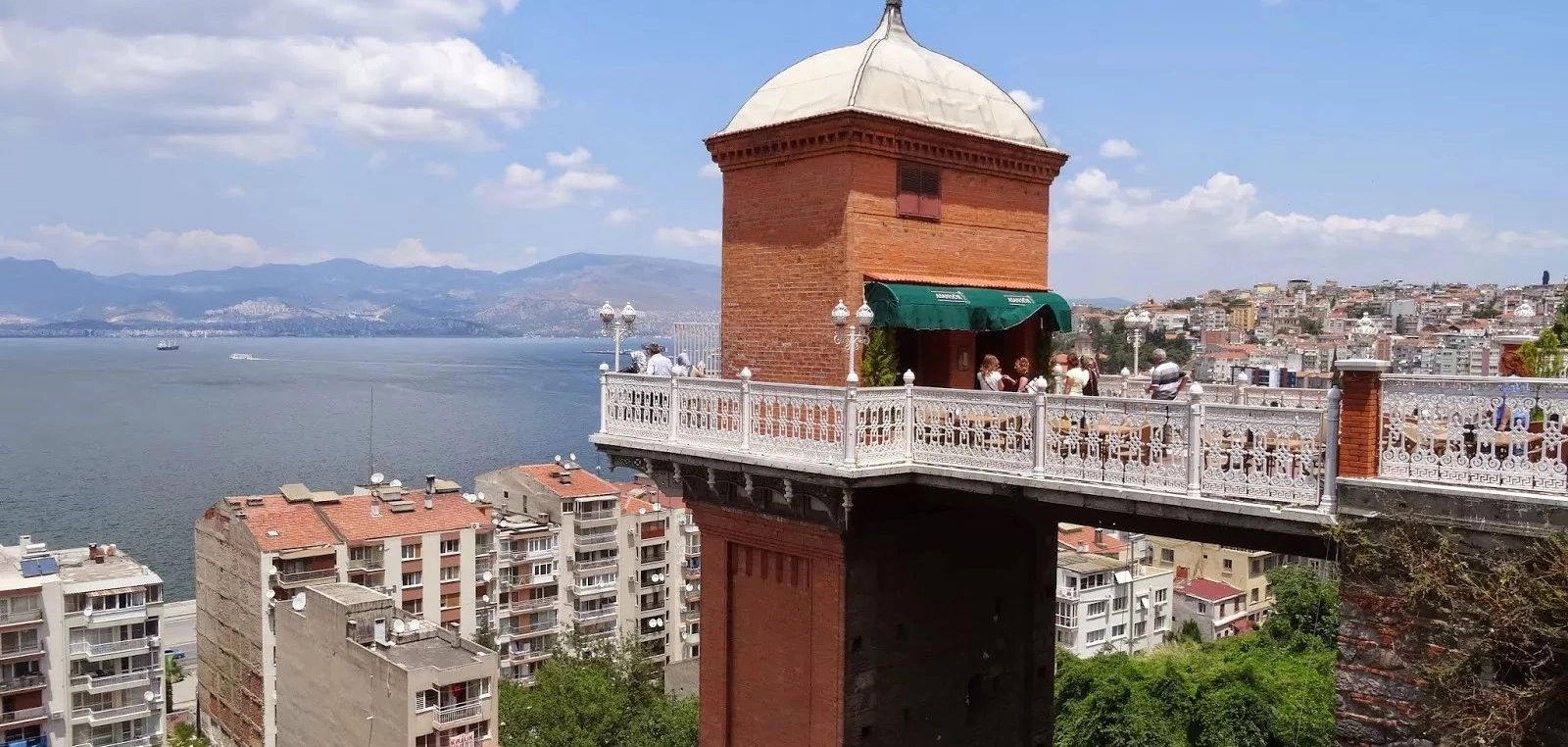
Rising above the historic Karataş neighbourhood, İzmir's Historical Elevator – Tarihi Asansör is one of the city's most recognisable landmarks. It was commissioned in 1907 by Nesim Levi, a local Jewish businessman and philanthropist, to solve a very practical problem: the steep difference in level between the waterfront side of the neighbourhood and the streets above.
Before the elevator existed, residents moving between the lower and upper streets had to climb a staircase of 155 steps. The new tower transformed that daily journey into a short vertical ride, making Tarihi Asansör an early example of urban infrastructure designed not for spectacle, but for ordinary city life.
More than a century later, the elevator still performs that original role. Its stone-and-brick tower connects the lower entrance near Dario Moreno Street with the upper neighbourhood, while the top terrace has become one of central İzmir's favourite viewpoints. From here, the city opens toward the Gulf of İzmir, rooftops, waterfront neighbourhoods and the broad Aegean horizon.
The experience is about more than the lift itself. The colourful houses of Dario Moreno Street, the multicultural history of Karataş, the engineering story of the tower and the extraordinary view from the upper level combine to create one of the easiest and most rewarding stops in İzmir.
See the historic vertical transport tower commissioned by Nesim Levi to connect two levels of the Karataş neighbourhood.
Understand why the elevator mattered: before its construction, residents faced a steep staircase between the lower and upper streets.
Approach through one of İzmir's most photogenic historic lanes, named after the internationally known İzmir-born singer Dario Moreno.
Step onto the upper terrace for sweeping views across the city, the Gulf of İzmir and the Aegean light at sunset.
Essential information for visiting Tarihi Asansör, one of İzmir's best-known historic landmarks and panoramic viewpoints.
Karataş, Konak district, central İzmir, with the lower entrance reached from Dario Moreno Street.
1907, during a period of rapid urban and commercial development in late Ottoman İzmir.
Nesim Levi, a prominent Jewish businessman and philanthropist associated with the Karataş community.
To connect the lower and upper streets of Karataş without forcing residents to climb the steep 155-step staircase.
The tower is commonly described as approximately 56 metres high, rising dramatically against the Karataş slope.
Historic accounts describe early steam and water-powered operation; the elevators have operated electrically since 1985.
A rectangular tower with a stone lower section and brick upper sections, finished with decorative historic details.
The approach street was named for singer Dario Moreno, who lived in this neighbourhood with his mother for a period.
Its panoramic terrace and some of the most memorable sunset views across central İzmir and the gulf.
Access to the elevator and viewing area is free; food and drinks at the upper-level venues are paid separately.
08:00–24:00 daily. Municipal operating hours can change, especially during maintenance or special periods.
Allow 30–60 minutes, or longer if you want sunset, photography, coffee or a relaxed walk through Karataş.
Tarihi Asansör is unusual because it combines everyday infrastructure, historic architecture and one of the finest city views in İzmir in a single compact visit.
The first reason to visit is the engineering story. This was not originally built as a tourist attraction. It solved a real urban problem created by Karataş's steep topography, allowing residents to move between two levels of the neighbourhood without climbing 155 steps.
The second reason is the view. At the upper level, the tightly packed city suddenly opens toward the Gulf of İzmir. Ferries, waterfront districts, rooftops and distant hills create an excellent panorama, especially when the late-afternoon light begins to soften.
The third reason is the historic setting. The elevator stands within Karataş, an area closely connected with İzmir's Jewish community, while the lower approach through Dario Moreno Street adds colourful early-20th-century urban character.
Finally, Tarihi Asansör is easy to combine with other central attractions. It can be a quick stop before continuing along the waterfront, or the beginning of a longer route toward Konak Square, Kemeraltı, Kızlarağası Hanı and the Agora of Smyrna.
Tarihi Asansör stands in the Karataş area of İzmir's Konak district, southwest of Konak Square and the historic Kemeraltı centre. The lower approach is reached through Dario Moreno Street, one of the best-known historic pedestrian lanes in the neighbourhood.
The elevator links the lower part of the district near Mithatpaşa Caddesi with the upper streets around Şehit Nihatbey Caddesi. The difference in level is immediately obvious when you stand at the base of the tower and look upward.
Because the attraction connects two elevations, you can use it practically as part of a walking route rather than simply riding up and down from the same entrance. This is especially useful if your route continues through the upper residential streets or back toward central Konak.
Karataş developed against a steep coastal slope. The lower streets near the shore and the residential streets above were close on a map but separated by a difficult climb in everyday life.
Before the elevator, one of the principal connections was a staircase of 155 steps. For residents carrying shopping, workers moving between districts, elderly people and anyone travelling repeatedly between the two levels, that climb was demanding.
In 1907, businessman Nesim Levi financed the construction of a vertical lift tower to make the connection faster and easier. The result was infrastructure with a strong social purpose: it shortened a difficult pedestrian journey and improved daily movement through the neighbourhood.
That practical function is one reason the building remains so meaningful today. Tarihi Asansör was not designed as a monument first and a transport system second. It became a monument because an ordinary piece of public infrastructure survived, continued working and became part of İzmir's identity.
Tarihi Asansör was completed in 1907 at a time when İzmir was a prosperous and highly international Mediterranean port. Karataş had become an important residential area, particularly for members of the city's Jewish community.
The project was financed by Nesim Levi. Contemporary and later descriptions preserve different details about the earliest machinery, but official local sources agree that the system passed through early non-electric forms of operation before being converted to full electrical operation in 1985.
The building also took on other functions over time. Historical descriptions state that during the First World War period, different floors were used as a casino, photography space and cinema. The tower therefore became part of neighbourhood social life as well as transportation.
In the 20th century the property changed hands and eventually declined. It was donated to İzmir Metropolitan Municipality in 1983, after which restoration and modernisation work returned it to active public use.
A major renewal programme in the early 1990s also improved the surrounding streets. The restored elevator, viewing terrace and Dario Moreno Street became one of the most recognisable heritage ensembles in modern İzmir.
The central idea was simple: instead of forcing pedestrians to climb the slope, the city could move them vertically inside a tower. That solution required a structure tall enough to connect the two street levels and machinery capable of lifting passenger cabins safely through the shaft.
Official and heritage sources describe the early operating system in slightly different ways, referring to steam and water power during the elevator's early history. What is clear is that the system pre-dated modern electrical operation and represented a sophisticated piece of urban technology for its time.
The elevators were converted to electric power in 1985. Today the ride is brief and practical, but knowing the building's technological history transforms it from a convenient shortcut into an important example of early urban engineering.
The tower links streets separated by a dramatic change in elevation without requiring a long road detour.
Two elevator cabins serve the vertical route through the tower and continue to carry residents and visitors.
Historical sources refer to steam and water-powered operation before the introduction of modern electric machinery.
The modernised system has operated electrically since the municipality's restoration and technical renewal.
The Historical Elevator is visually powerful because its architecture expresses its function. The building rises as a tall narrow tower against the slope, creating a strong vertical landmark in a neighbourhood otherwise dominated by streets and houses.
The lower part of the tower is constructed in stone, while the upper sections rise in brick. Brick bands and projecting details divide the façades into distinct levels, giving the structure rhythm despite its great height.
Inside the entrance area, decorative details include floral and geometric motifs. At the top, the terrace extends outward on structural supports and is edged with ornamental metal railings, turning a transport platform into a genuine architectural viewpoint.
The heavy stone base visually anchors the tower at street level and contains the historic entrance zone.
The upper sections are built in brick, creating the warm colour and vertical texture associated with the landmark.
The narrow rectangular form follows the logic of the elevator shafts and emphasises the dramatic rise up the cliff.
Historic ornamental details soften the industrial function and give the entrance a distinctive early-20th-century character.
Openings in the structure provide glimpses outward as the cabins travel between the lower and upper levels.
The upper platform converts the top of the transport tower into one of İzmir's classic panoramic viewpoints.
One of the most important architectural details appears near the lower stone section of the building. A historic inscription records that the elevator was built by Nesim Levi in 1907.
The text appears in French and Hebrew, a detail that reflects the multilingual and multicultural environment of late Ottoman İzmir. French was widely used in international commerce and elite urban life, while Hebrew connects the building directly with the Jewish community of Karataş.
It is easy to miss this inscription if you immediately enter the lift. Pause at the base of the tower and look carefully at the stonework before going inside.
The classic way to approach Tarihi Asansör is through Dario Moreno Street, a short pedestrian lane lined with colourful historic houses, cafés and restored façades.
The street is named after Dario Moreno, the İzmir-born singer and entertainer who built an international career in France and elsewhere in Europe. Official İzmir sources note that he lived in this neighbourhood with his mother for a period.
The street received his name in 1990, transforming the approach to the elevator into a small memorial landscape. Music, photographs and references to Moreno often appear around the lane, while the brightly painted houses create one of central İzmir's most photographed streets.
Walk slowly rather than treating the street only as an entrance corridor. Looking back toward the lower end reveals the narrow urban scale of old Karataş before the elevator tower rises dramatically ahead.
The story of Tarihi Asansör cannot be separated from the history of Karataş. By the late 19th and early 20th centuries, many Jewish families had moved from older quarters of İzmir toward this coastal neighbourhood.
The steep slope created a very specific urban problem. Homes, workplaces, religious buildings and commercial streets were distributed across different elevations, making everyday movement physically demanding.
Nesim Levi's elevator was therefore both an engineering project and a community improvement. Its story belongs to the wider history of Jewish life in İzmir, a history that also survives through synagogues, neighbourhood traditions, family histories and the urban fabric of Karataş and Kemeraltı.
Visitors interested in this heritage should consider combining the elevator with the historic synagogues and Jewish quarter around Kemeraltı, where another chapter of İzmir's Sephardic history can be explored.
The upper terrace is the moment most visitors remember. After the enclosed vertical ride, the city suddenly opens into a broad panorama across the Gulf of İzmir.
Depending on visibility, you can trace the shoreline, watch ferries crossing the bay, look across dense residential districts and see the hills that frame the city. The view is especially effective because it combines the urban foreground with a wide stretch of water.
The broad bay dominates the panorama and gives the terrace its unmistakably Aegean character.
Look downward across Karataş and the dense urban fabric stretching toward central Konak.
Moving ferries create constantly changing points of interest across the water.
On clear days, the opposite side of the gulf and surrounding hills create depth beyond the city centre.
Late-afternoon light softens the buildings and adds warm reflections across the bay.
After dark, the shoreline becomes a band of city lights reflected across the gulf.
Sunset is the most popular time to visit the upper terrace, and for good reason. The west-facing gulf catches the late light beautifully, while the city gradually changes from daylight to evening illumination.
Arrive 30–45 minutes before sunset if photography is important. This gives you time to explore Dario Moreno Street, ride the elevator and find a comfortable position before the terrace becomes busier.
The exact sunset direction changes through the year, so the sun will not always drop directly in front of the terrace. Even so, the warm light across the bay and buildings usually makes late afternoon the most atmospheric period.
The upper level includes food-and-drink venues that make it possible to extend a short sightseeing stop into a relaxed break overlooking the city.
You do not need to buy anything to use the elevator or enjoy the public view, but sitting down for coffee or a meal can be pleasant if you want to stay through sunset or wait for evening lights.
Opening times, menus and seating arrangements for individual venues can change independently of the elevator itself. If a meal with a specific table or sunset timing matters to you, check current restaurant information separately.
The Historical Elevator is included in the European Route of Industrial Heritage – ERIH, a network that documents important sites connected with Europe's industrial, engineering and technological history.
Its inclusion makes sense. Tarihi Asansör is not simply a beautiful old building; it represents an early solution to a transportation problem using mechanical technology within an urban neighbourhood.
ERIH presents the elevator as part of its industrial-architecture and service-and-leisure heritage themes, highlighting the continuing connection between the building's original purpose and its modern public use.
This is different from UNESCO World Heritage status. ERIH is a certified Cultural Route of the Council of Europe and a specialist industrial-heritage network rather than the UNESCO World Heritage List.
Tarihi Asansör continues to function as a public elevator rather than a conventional ticketed museum. Official visitor information currently lists free access and daily operation from 08:00 to 24:00.
Because this is working urban infrastructure, temporary closures can occur for maintenance, technical checks, private events or operational reasons. If the elevator is a must-see part of a tightly timed itinerary, allow some flexibility.
There is no fixed museum route. Most visitors enter from Dario Moreno Street, ride to the upper level, spend time on the terrace and then either return down or continue walking from the upper street.
Best for quiet photographs of Dario Moreno Street and the architecture before the area becomes busier.
Good for clear daytime views and combining the elevator with other central İzmir attractions.
The light becomes warmer and the Gulf of İzmir begins to take on stronger colour and contrast.
The most atmospheric and most popular period; arrive early if you want an unobstructed viewing position.
City lights around the gulf create a completely different panorama and a romantic evening atmosphere.
The elevator is a good all-season stop, although heavy rain, haze or strong wind can reduce the quality of the view.
Enough for a quick ride, a short look from the terrace and return to the lower street.
A good minimum for the elevator, viewing terrace and a few photographs of Dario Moreno Street.
Ideal for most visitors, allowing time to enjoy the panorama without rushing.
Best if you want coffee, architectural photography or time to explore the surrounding Karataş streets.
Combine Tarihi Asansör with the waterfront and a relaxed walk toward central Konak.
Continue to Konak Square, Kemeraltı, Kızlarağası Hanı and the Agora of Smyrna for a broader historic-city route.
Travel southwest along the waterfront toward Karataş, then approach the lower entrance through Dario Moreno Street.
The Konak Tram runs along the coastal corridor and provides a convenient way to reach the Karataş area before continuing on foot.
Numerous municipal bus routes use Mithatpaşa Caddesi; choose a Karataş-area stop and walk the final section.
Ask for Tarihi Asansör or Dario Moreno Sokağı. The lower entrance is the most atmospheric arrival for first-time visitors.
Strong walkers can combine the elevator with a longer waterfront route from Konak, especially in mild weather.
Street parking can be limited in the dense neighbourhood, so using public transport or a taxi is often easier.
For navigation, search specifically for Tarihi Asansör or Dario Moreno Sokağı. Approaching from the lower street gives the best sense of the tower's height and the reason it was built.
The actual elevator ride is short. You enter through the historic lower building, wait for one of the cabins and travel vertically through the tower to the upper level.
The most dramatic moment comes at the top, where the enclosed shaft opens toward the terrace and the Gulf of İzmir. This sudden transition from a narrow historic street to a broad panorama is part of what makes the visit memorable.
Dario Moreno Street provides the most photogenic and historically satisfying approach.
Look for the French and Hebrew text near the lower stone section before entering.
The journey itself takes only a short time and replaces the steep historic climb between the two levels.
Allow several minutes simply to take in the gulf panorama before focusing on photographs.
You can exit into the upper neighbourhood instead of immediately riding back down.
If you want cafés, photographs and the classic lower approach, descend again before continuing.
The building was created specifically to overcome a steep change in level, so the elevator itself can be extremely useful for visitors who would struggle with the historic staircase.
ERIH currently lists accessibility for people with disabilities as available. However, the surrounding neighbourhood contains historic pavements, slopes and narrow streets, and access conditions can differ between the lower entrance, upper street and food-and-drink areas.
Visitors using wheelchairs or travelling with specific mobility requirements should treat this as general guidance rather than a formal accessibility audit and confirm current conditions locally if step-free access is essential.
The Historical Elevator works well for families because the visit is short, visual and easy to explain. Children can immediately understand the central idea: people once had to climb 155 steps, so the neighbourhood built an elevator instead.
The ride itself adds interest, while the terrace gives children a chance to identify ferries, buildings, coastline and hills across the city.
The main practical concern is the terrace and surrounding streets during busy periods. Younger children should stay close to adults, particularly near railings, road crossings and crowded sunset viewpoints.
Use the narrow lane to frame the tower rising behind the colourful historic façades.
The strongest architectural image often comes from directly below, where the vertical scale becomes most dramatic.
Photograph the French and Hebrew text as a detail that connects architecture with the building's social history.
At the top, include rooftops and water together to create depth rather than photographing only the horizon.
Late afternoon gives warmer light across the brickwork, city and bay.
Remain briefly after sunset to capture city lights while there is still colour in the sky.
Early visits make Dario Moreno Street easier to photograph without heavy pedestrian traffic.
Ask before taking close photographs of residents, café staff or individuals in the narrow street.
Dario Moreno Street gives the strongest first impression and explains the tower's scale immediately.
Arrive before the busiest period if you want a clear place at the terrace railing.
The elevator saves the steep climb, but a wider Karataş and Konak visit still involves plenty of walking.
Clear days offer the best gulf views; haze, heavy rain and strong wind can reduce the experience.
Because this is operating infrastructure, temporary technical closures are always possible.
Dario Moreno Street is part of the visit, not simply the path to the elevator doors.
If visiting near sunset, remain long enough to see the transition from golden hour into city lights.
The elevator works especially well before or after Konak Square, Kemeraltı, Kızlarağası Hanı and Smyrna Agora.
This route moves through several layers of İzmir in a compact day: early-20th-century urban engineering, Jewish Karataş, the modern waterfront, Ottoman commercial streets and the ancient Roman city.
The historic pedestrian lane leading directly to the elevator is one of the most photogenic short streets in central İzmir.
Explore the surrounding neighbourhood to understand the steep topography and multicultural history that created the need for the elevator.
See İzmir Clock Tower, Yalı Mosque and the waterfront at the symbolic centre of the modern city.
Continue into İzmir's enormous historic market district for food, shopping, mosques, synagogues, hans and everyday city life.
Visit the restored 18th-century Ottoman trading inn for courtyard architecture, antiques, crafts and Turkish coffee.
Explore the Roman heart of ancient Smyrna, including vaulted galleries, columns and remarkable historic graffiti.
Climb toward the ancient acropolis area for another elevated view over İzmir and a deeper layer of the city's history.
Finish the day beside the Gulf of İzmir with a waterfront walk, sunset atmosphere and evening cafés.
The essential combination and the best short visit if you have less than one hour.
Connect two of İzmir's most recognisable landmarks with a route along the central waterfront corridor.
Pair early-20th-century urban engineering with the dense Ottoman commercial world of the historic bazaar.
Combine panoramic city views with one of İzmir's most atmospheric surviving Ottoman commercial buildings.
Move from modern urban engineering to the archaeological remains of Roman Smyrna in the same day.
Compare two elevated perspectives on İzmir: the historic elevator terrace and the ancient acropolis hill.
Use Karataş as a starting point before continuing toward the historic synagogue quarter around Kemeraltı.
Visit Tarihi Asansör in late afternoon, then continue toward the coast for an evening beside the gulf.
It is a historic public elevator tower in İzmir's Karataş neighbourhood, built in 1907 to connect streets separated by a steep change in elevation.
It was completed in 1907.
It was commissioned by Nesim Levi, a Jewish businessman and philanthropist in İzmir.
It was created to make travel easier between the lower and upper streets of Karataş, which had previously been connected by a steep 155-step staircase.
The historic staircase had 155 steps.
Heritage sources commonly describe the tower as approximately 56 metres high.
It is in Karataş in the Konak district of central İzmir, with the classic lower approach from Dario Moreno Street.
Yes. Official visitor information currently lists elevator and viewing access as free.
Current official visitor information lists 08:00–24:00 daily, although hours can change during maintenance or special periods.
Yes. It continues to operate as a public elevator connecting the two street levels.
Historic accounts refer to early steam and water-powered operation. The system has operated electrically since 1985.
The ride itself is very short; most of the visit time is spent enjoying the architecture, Dario Moreno Street and the upper terrace.
Most visitors need 30–60 minutes, although sunset, photography or a café stop can easily extend the visit.
The terrace overlooks the Gulf of İzmir, the city waterfront, rooftops, ferry routes and surrounding hills.
Yes. Sunset is one of the most atmospheric times, but it is also one of the busiest.
It is the historic pedestrian street leading to the lower entrance of the elevator, named after İzmir-born singer Dario Moreno.
Official İzmir sources state that he lived in this neighbourhood with his mother for a period.
The street received his name in 1990.
A French-and-Hebrew inscription records that the elevator was built by Nesim Levi in 1907.
The multilingual inscription reflects the cosmopolitan character of early-20th-century İzmir and the Jewish community connected with the building.
The tower has a stone lower section and brick upper sections, with historic decorative details around the entrance and terrace.
It is not individually inscribed as a UNESCO World Heritage Site.
Yes. It is included in the European Route of Industrial Heritage network.
ERIH is the European Route of Industrial Heritage, a network of sites connected with Europe's industrial and technological history and a certified Cultural Route of the Council of Europe.
The upper level includes café and restaurant facilities, although individual venue hours and arrangements may vary.
No. The public elevator and viewing area can be enjoyed without making a restaurant purchase.
The elevator itself avoids the historic 155-step climb, and ERIH lists accessibility as available, but surrounding old streets and terraces should be checked for individual mobility needs.
Yes. The short elevator ride, colourful street and panoramic view make it an easy family stop, although children should be supervised closely on the terrace.
Yes. Dario Moreno Street, the tower and the gulf panorama are popular photography subjects.
Morning is best for quieter street scenes, while late afternoon, sunset and blue hour provide the most dramatic panoramic light.
Yes, within current operating hours. Evening visits offer city lights across the gulf and a very different atmosphere from daytime.
Yes, if you enjoy city walking, although public transport or a short taxi ride is more convenient for many visitors.
Yes. The Konak Tram follows the coastal corridor through this part of the city, followed by a short walk into Karataş.
Yes. It is the most atmospheric route and gives the strongest impression of the tower rising above the lower neighbourhood.
Yes. The elevator genuinely connects two street levels, so you do not have to return immediately to the lower entrance.
Good combinations include Konak Square, Kemeraltı Bazaar, Kızlarağası Hanı, the Agora of Smyrna, Kadifekale and the waterfront.
Dario Moreno Street and Tarihi Asansör together make an excellent 30–60 minute stop.
Combine the elevator with Konak Square, Kemeraltı and Kızlarağası Hanı, adding the Agora of Smyrna if you have enough time.
It preserves an early example of vertical urban transport while continuing to serve the neighbourhood more than a century after its construction.
Riding up, taking one photograph and leaving. Spend time on Dario Moreno Street, look at the inscription and architecture, and allow the view to change with the light.
A private İzmir heritage route can connect Tarihi Asansör with Dario Moreno Street, Konak Square, Kemeraltı, Kızlarağası Hanı, the Agora of Smyrna and other historic districts, creating a day that follows the city's multicultural, commercial and archaeological story.
Tell us whether your priority is panoramic views, Jewish heritage, Ottoman architecture, ancient history, local food, photography or a complete historic-centre walk, and we can shape the experience around your interests.
Explore Dario Moreno Street, the historic elevator, Karataş heritage and panoramic views over the Gulf of İzmir with a route shaped around your interests.
Request a Historic İzmir Tour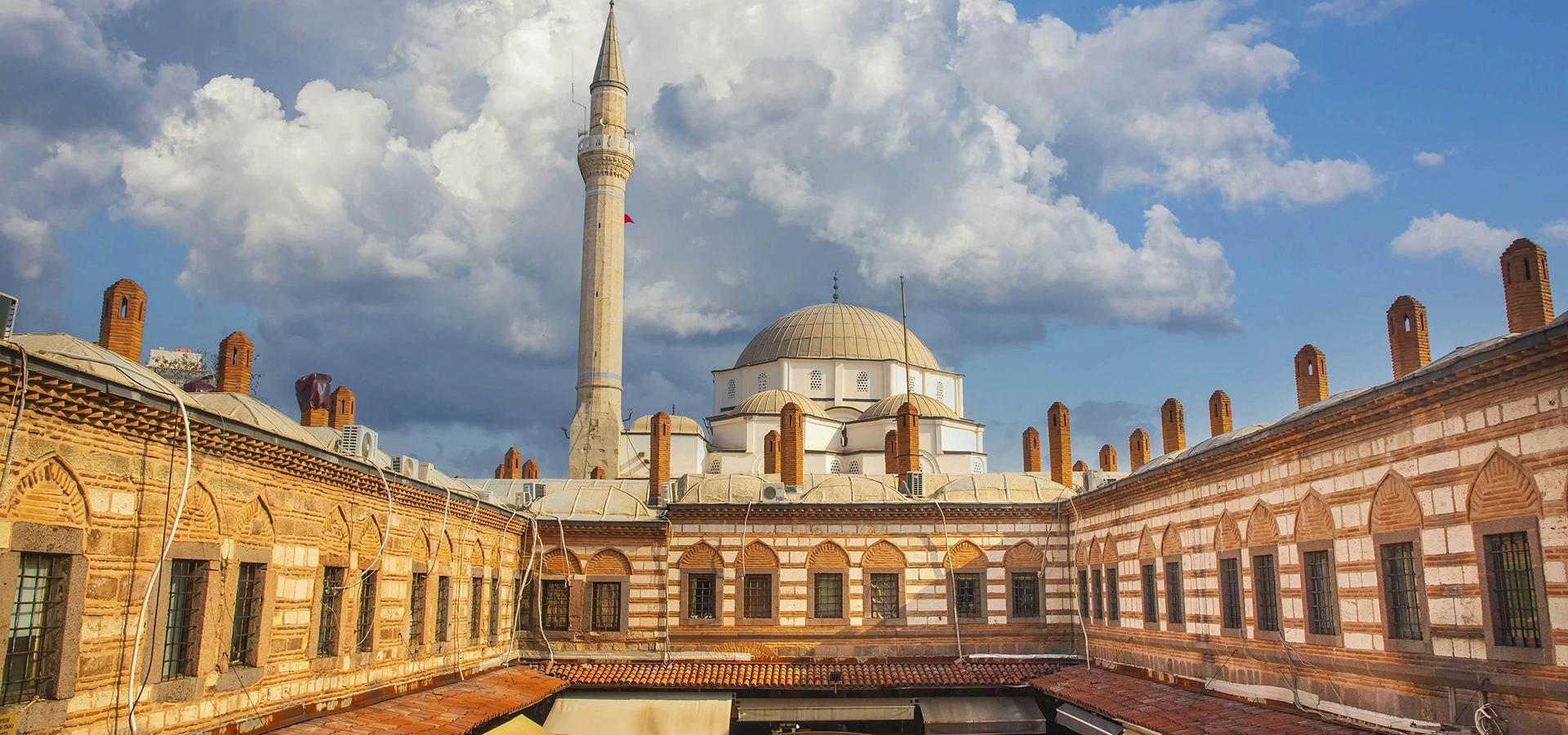
Combine early-20th-century urban engineering with the Ottoman commercial world of Kemeraltı's most famous historic han.
Explore Kızlarağası Hanı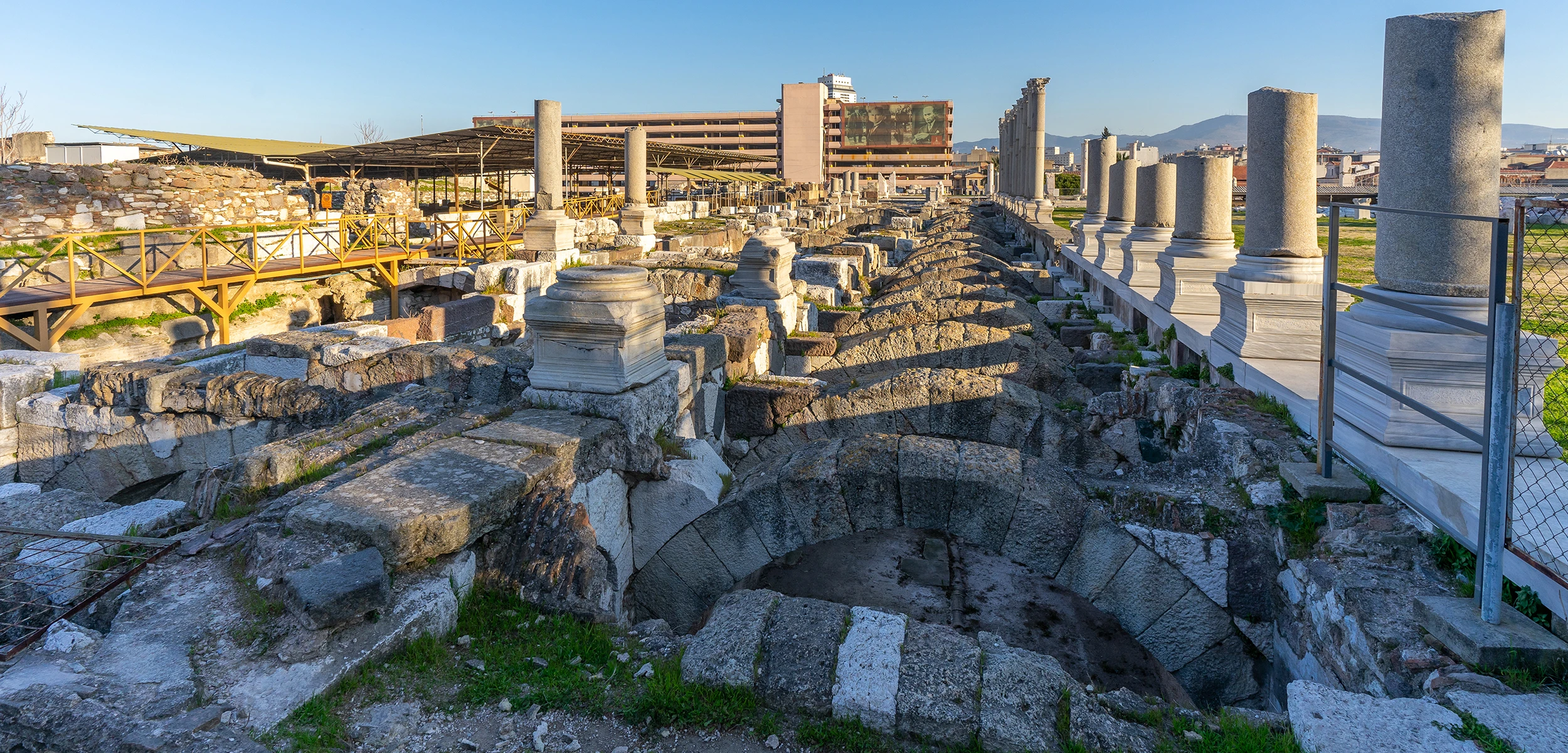
Move from modern urban engineering into ancient Smyrna and explore Roman galleries, columns, inscriptions and city history.
Explore the Agora of Smyrna
Continue with our complete İzmir guide for archaeology, coastal towns, historic neighbourhoods, local food, museums and the best day trips.
View İzmir Guide