Private İzmir Historic Centre Experience
Ask us about a tailor-made city day combining Konak Square, the Clock Tower, Kemeraltı, the Agora, Kadifekale and İzmir's waterfront.
Request a Custom Tour





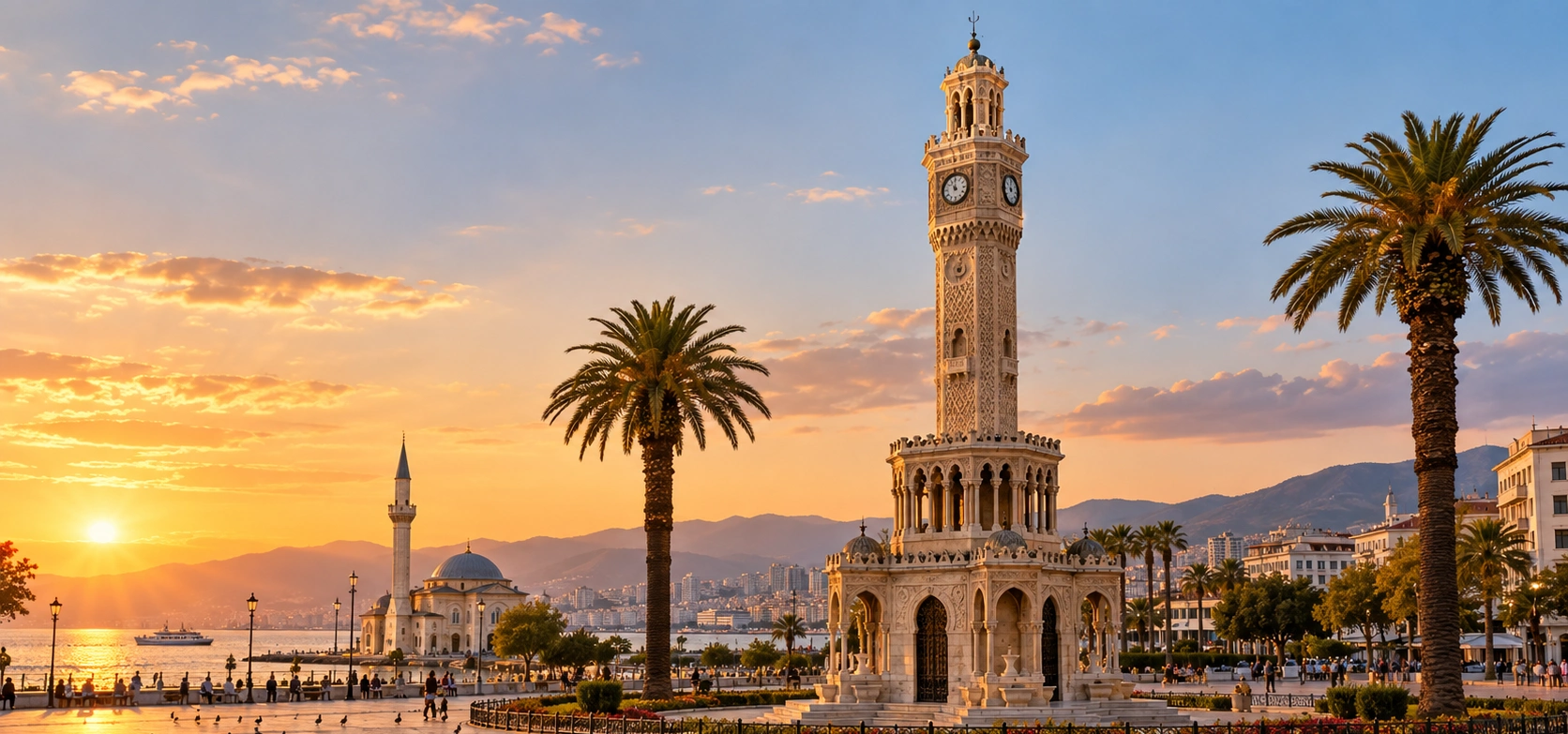
At the centre of Konak Square, only a few steps from the waterfront and the entrance to Kemeraltı Bazaar, rises the monument most closely identified with modern İzmir: the İzmir Clock Tower, or İzmir Saat Kulesi. Elegant rather than massive, it combines a 25-metre clock tower with fountains, carved stonework, horseshoe arches, slender columns and decorative forms influenced by North African and Andalusian architecture.
The tower was built in 1901 to commemorate the twenty-fifth anniversary of Sultan Abdülhamid II's accession to the Ottoman throne. The project was designed and constructed by Raymond Charles Péré, the İzmir-based architect and engineer associated with several important late Ottoman buildings in the city. The monument officially opened on 1 September 1901.
Its setting is just as important as the tower itself. Konak Square developed as İzmir's principal administrative and civic centre during the nineteenth century, shaped by the Government House, the former Sarı Kışla military barracks, Yalı Mosque, the waterfront, transport connections and the commercial world of nearby Kemeraltı. The Clock Tower completed this late Ottoman public landscape and soon became a natural meeting point for residents.
Today the tower is one of Türkiye's most recognisable urban monuments. It has survived political change, the transformation of the waterfront and a damaging 1974 earthquake. Visitors come for the architecture and photographs, but the real pleasure is understanding the tower together with the square around it — a place where Ottoman modernization, republican memory, daily city life and the Aegean waterfront meet within a few hundred metres.
The tower was created for the twenty-fifth anniversary of Sultan Abdülhamid II's accession to the Ottoman throne.
The four-level monument rises from an octagonal base and a white-marble platform in the centre of Konak Square.
The İzmir-based French-born architect and engineer prepared the design and undertook the construction.
More than a timepiece, the tower became one of the city's most familiar meeting points and visual emblems.
Essential information for understanding İzmir's most famous city-centre landmark and the public square surrounding it.
Konak Square in central İzmir, beside the waterfront and immediately next to the historic Kemeraltı district.
The Clock Tower was completed and officially opened on 1 September 1901.
It was built for the twenty-fifth anniversary of Sultan Abdülhamid II's accession to the Ottoman throne.
Approximately 25 metres, rising through four levels above an octagonal base and marble platform.
Raymond Charles Péré, a French-born architect and engineer active in late Ottoman İzmir.
The lower level was designed as a fountain monument, with ornate sebils and water basins around the base.
Four 75-centimetre clock faces allow the time to be read from different sides of the square.
Horseshoe arches, columns and dense surface ornament show strong North African and Andalusian-inspired vocabulary.
The square is one of İzmir's principal civic spaces and an excellent starting point for exploring the historic centre.
The Aegean-facing promenade and Konak transport connections are only steps from the tower.
There is no ticket to see the tower or walk through Konak Square; the monument is primarily viewed from outside.
Allow 30–60 minutes for the tower and square, or several hours when combining them with Kemeraltı, the Agora and nearby historic sights.
The Clock Tower is worth seeing not only because it is photogenic, but because the monument explains how İzmir became a modern Ottoman port city and how Konak developed into the city's civic centre.
The first reason to visit is architectural. The tower is unusually delicate for a public monument: an octagonal fountain base supports a columned gallery, an ornamented shaft, four clock faces and a narrow upper pavilion. The design combines late Ottoman public architecture with horseshoe arches and decorative forms associated with North Africa and Andalusia.
The second reason is historical. When the tower opened in 1901, it stood within a carefully developing governmental landscape that included the Government House, Sarı Kışla, Yalı Mosque and other public buildings. Clock towers belonged to a broader nineteenth-century world in which public timekeeping, municipal administration, transport and new civic spaces became increasingly important.
The third reason is urban. Konak is still one of the easiest places to understand İzmir as a living city. From the tower you can move almost immediately into Kemeraltı Bazaar, walk toward the old port area, continue along the waterfront, board public transport or climb toward the Agora and Kadifekale. Few landmarks in Türkiye function so effectively as both a historic monument and a practical starting point for exploring a city.
Finally, the Clock Tower belongs to everyday İzmir. Residents still use the square as a meeting place; ferries, trams, metro passengers and pedestrians pass nearby; pigeons gather around the monument; and the tower appears constantly in photographs, local imagery and city identity. It is both an architectural object and part of the city's daily rhythm.
İzmir Clock Tower stands in Konak Square, the principal historic civic space of central İzmir. The square lies beside İzmir Bay, at the western edge of Kemeraltı and close to the Government House, Yalı Mosque, Konak Ferry Terminal and major public-transport connections.
This position explains why the area has remained so important. The old commercial city developed inland around Kemeraltı and the former inner harbour, while nineteenth-century administrative buildings and waterfront infrastructure transformed the shoreline. Konak became the point where government, commerce, transport and public ceremony met.
For travellers, the square is one of the easiest orientation points in İzmir. Walk east and you enter Kemeraltı; continue deeper into the historic district and you can reach Kızlarağası Hanı and the Agora. Head north along the bay and you move toward the modern waterfront, Cumhuriyet Square and Alsancak.
Konak is more than the name of a district. For roughly two centuries it has represented the administrative heart of İzmir. The area became increasingly important during the nineteenth century as the Ottoman state created new governmental, military and municipal buildings in major provincial cities.
The square that visitors see today developed gradually rather than according to a single master plan. The Government House, military barracks, prison, hospital, Yalı Mosque, customs and waterfront structures all contributed to a growing public centre. The Clock Tower, added in 1901, gave this urban composition a powerful visual focus.
The square has changed dramatically since then. Some major structures — especially the enormous Sarı Kışla barracks — disappeared during twentieth-century redevelopment, while roads, public transport and open landscaped areas altered the relationship between the buildings. Even so, the Clock Tower and Government House still make the historical function of the space immediately legible.
Konak Square also became a place of public ceremony, political gatherings, celebrations and everyday encounters. That continuity matters: although the physical form of the square has changed, its role as one of İzmir's most symbolic public spaces has remained remarkably strong.
Clock towers existed in the Ottoman world before the nineteenth century, particularly in the Balkans, but they became much more widespread during the late Ottoman period. Their expansion was connected with changing ideas about public time, administration, transport, work schedules and urban modernization.
After the Tanzimat reforms, provincial centres gained government houses, barracks, hospitals, schools, municipal buildings and other institutions that transformed the appearance of urban public space. A monumental clock placed in a central square was both practical and symbolic: it made standardized time visible while announcing a modern civic order.
The twenty-fifth anniversary of Sultan Abdülhamid II's accession in 1901 provided an additional stimulus. Clock towers and commemorative monuments were constructed in different parts of the empire, and İzmir — one of the Ottoman Mediterranean's most important port cities — produced one of the most architecturally ambitious examples.
For this reason the İzmir Clock Tower should not be understood as an isolated decorative object. It belongs to a much larger story about the transformation of public space in the final decades of the Ottoman Empire.
The story of the monument began in 1900, when provincial authorities discussed how İzmir should commemorate the forthcoming twenty-fifth anniversary of Sultan Abdülhamid II's accession. The chosen project was not simply a tower but a fountain with a clock tower visible from all sides, planned for the open space in front of the military barracks.
A construction committee was established and plans were prepared. On 30 January 1901, the building contract was awarded to Raymond Péré, who was also the author of the project. Contemporary municipal research records a contract value of 1,700 Ottoman liras, with additional public fundraising contributing to the cost.
Construction proceeded quickly. By spring 1901 the main structure was substantially complete and work moved toward the clocks, fountains, water supply, lighting and decorative finishes. The project also included plans to landscape the surrounding area so that the new monument would become the visual centre of the square.
The official opening was planned for and held on 1 September 1901, the date associated with the twenty-fifth accession anniversary. From the beginning, therefore, the building combined several functions: commemorative monument, public fountain, clock, urban ornament and civic meeting point.
The Clock Tower was designed by Raymond Charles Péré, a French-born architect and engineer who worked in İzmir during one of the city's most cosmopolitan periods. His career belongs to an urban environment where Ottoman officials, European merchants, Levantine families, engineers, builders and craftspeople all contributed to the architectural character of the port.
Péré's tower demonstrates how freely architectural vocabularies could be combined at the turn of the twentieth century. The monument is Ottoman in its political purpose and civic setting, yet its horseshoe arches and ornamental treatment draw strongly on North African and Andalusian-inspired forms.
The result is not a copy of a single historical style. Instead, it is an eclectic late nineteenth- and early twentieth-century design in which different visual traditions are used to create a monument that feels ceremonial, exotic, vertical and surprisingly light.
This eclecticism is one reason the tower remains so distinctive. It does not resemble a fortress or a massive municipal clock tower; its open galleries, small domes, fountains and patterned surfaces create an almost pavilion-like delicacy.
The tower rises from an 81-square-metre octagonal base set on a four-stepped white-marble platform. From this broad lower level the composition narrows upward through a columned gallery, decorated tower shaft, clock level and final open pavilion.
The lower structure contains fountain elements arranged around the narrow faces of the octagon. Small columns support horseshoe arches and canopies, while carved stone, patterned surfaces and coloured architectural details enrich the monument at pedestrian level.
Above the fountain base, a gallery of slender columns creates a strong horizontal break before the tower rises vertically. The shaft is decorated with lozenge-shaped reliefs and small arched openings, while the clock level projects slightly outward through bands of muqarnas-like stonework.
The uppermost pavilion is narrower and more open, resting on a ring of small columns and capped by a metal roof with a crescent finial. The sequence from heavy base to airy summit gives the tower its characteristic elegance.
The lower platform establishes the eight-sided geometry that organizes the fountains and entrances.
The stepped base distinguishes the monument from the surrounding paving and strengthens its ceremonial presence.
The arches are among the clearest visual links with North African and Andalusian architectural vocabulary.
A ring of slender columns separates the fountain level from the vertical tower shaft.
The tower shaft is richly patterned rather than left as a plain masonry surface.
Four faces allow the time to be read from different directions across the square.
The narrow top stage introduces more open space and keeps the summit visually light.
The tower terminates in a compact roof and crescent finial above the final columned stage.
One of the easiest details to overlook is that the İzmir Clock Tower was conceived from the beginning as a fountain monument. Contemporary planning documents describe a highly ornamented fountain with a clock tower rising above it rather than a clock tower to which water was added as an afterthought.
The narrow sides of the octagonal base contain small baldachin-like sebils supported by groups of slender columns. Their horseshoe arches, basins and fountain arrangements make the lower level much more elaborate than the simple pedestal seen beneath many other clock towers.
The water element had a practical public function, but it also helped transform the monument into a place where people could gather at close range. The tower was not meant to be admired only from a distance; its fountains, shade and position in the civic square connected it with everyday life.
Not every original water feature survives unchanged. Municipal architectural descriptions note that some of the original fountain jets have been lost, which is another reminder that the monument has undergone repairs and modifications during more than a century of use.
Four clock faces, each approximately 75 centimetres in diameter, are mounted around the upper shaft. Their position allows the time to be read from different directions in the square, reinforcing the tower's original role as a public timekeeping monument.
Official tourism sources state that the clock was presented by German Emperor Wilhelm II, connecting the monument with the close diplomatic relationship between Germany and the Ottoman Empire during the reign of Abdülhamid II.
There is, however, an important source nuance. A detailed historical study published by İzmir Metropolitan Municipality notes that although the Wilhelm II gift story appears in later records, the researchers were unable to verify it in the original archival material they examined. For careful historical reading, it is therefore best described as an officially repeated tradition whose primary-source documentation remains uncertain.
The surviving mechanism includes historic components, and the tower's identity as a working clock remains an important part of the monument. It was designed not simply to symbolize time but to provide it publicly to a busy port city.
These arches give the lower level its strongest North African and Andalusian visual character.
Look at the small columns around the galleries and fountains for vegetal decoration and carved detail.
Diamond-shaped reliefs cover large parts of the tower shaft and prevent the tall surfaces from appearing plain.
The transition below the clock faces is enriched by tiered stonework that expands the upper section outward.
The four circular dials are carefully integrated into the decorative programme rather than attached to a plain façade.
The fountain canopies and upper pavilion originally created an even richer silhouette when seen from the square.
The original design incorporated Ottoman imperial arms and Sultan Abdülhamid II's tughra as part of the commemorative programme.
At the summit, the narrow roof and crescent complete the tower's strong vertical composition.
The tower's most serious modern structural crisis came during the 1 February 1974 İzmir earthquake. Official sources record a magnitude of 5.2 and describe significant damage to the upper section above the clock faces.
The main body survived, helped by the way the cut-stone structure had been connected with metal elements during construction. The uppermost stage, however, was damaged and required reconstruction.
The clock famously stopped at approximately 02:04, the time of the earthquake. Repairs were carried out over the following two years and the tower was restored to its familiar appearance.
This episode is worth remembering while looking at the monument today. The Clock Tower is not an untouched object frozen in 1901; it has been maintained, repaired and adapted through earthquakes, political change and more than a century of intense urban life.
The Clock Tower was created for a specific imperial anniversary, yet its meaning soon expanded beyond that original purpose. Its location at the centre of the city's principal public square made it part of everyday movement, meetings, celebrations and memory.
Over the twentieth century the political world that created the tower disappeared, the surrounding square changed and entire buildings were demolished, but the Clock Tower remained. That continuity helped transform it from a commemorative monument into a broader symbol of İzmir itself.
Its visual qualities also contributed. The tower is immediately recognizable, highly symmetrical, easy to photograph and closely associated with the palms, pigeons, open sky and waterfront atmosphere of Konak. As a result, it appears repeatedly in tourism imagery, municipal identity and local visual culture.
For visitors, this makes Konak Square one of those rare places where a monument still performs its historical urban role. People do not travel to a detached museum enclosure to see the tower; they encounter it in the middle of the city exactly where public life continues around it.
Only a short distance from the Clock Tower stands Yalı Mosque, also known as Konak Mosque. Its smaller scale makes it easy to miss beside the open square, yet it is one of the most elegant historic buildings in central İzmir.
Official cultural sources date the mosque to 1754 and associate its construction with Ayşe Hanım, daughter of Mehmet Pasha. The building is especially distinctive for its compact octagonal form and decorative tilework.
The mosque creates an important historical contrast with the Clock Tower. Yalı Mosque belongs to the eighteenth century, while the tower represents the late Ottoman world of 1901. Standing almost side by side, they allow visitors to read different phases of İzmir's urban history within a single view.
Because Yalı Mosque remains a religious building, enter respectfully outside busy prayer periods, dress modestly and avoid photographing worshippers without permission.
The Government House is essential to understanding why Konak became the administrative centre of İzmir. The original nineteenth-century building was constructed in the late 1860s and early 1870s, during a period when provincial government complexes were reshaping Ottoman cities.
The building also became closely associated with the events of 9 September 1922, when Turkish forces entered İzmir and the Turkish flag was raised over the Government House. This gave the square an additional place in the memory of the Turkish War of Independence.
A major fire in 1970 badly damaged the complex. The historic central section was later reconstructed with reference to its original appearance while other surrounding administrative structures changed substantially.
Seen together with the Clock Tower, the Government House makes the original civic logic of Konak much easier to understand: this was a square designed around government, ceremony, public movement and visibility.
One of the great advantages of visiting the Clock Tower is that Kemeraltı Bazaar begins immediately beside Konak Square. This means the monument can serve as the first stop in a much deeper exploration of İzmir's commercial and urban history.
Kemeraltı is not simply a souvenir market. Its dense streets preserve mosques, synagogues, inns, workshops, food businesses and commercial traditions that developed around the old harbour. The district is best experienced slowly, allowing the main shopping routes to lead into smaller lanes and historic courtyards.
A particularly rewarding continuation is toward Kızlarağası Hanı, one of the best-known historic inns in the bazaar, and then onward toward Havra Street, the synagogue district and the Agora of Smyrna.
In practical terms, this makes the Clock Tower an ideal morning starting point: photograph the monument before the square becomes busiest, then continue directly into the shaded streets of Kemeraltı as shops and cafés come fully to life.
Konak's identity is inseparable from the sea. The square sits beside İzmir Bay, and the waterfront offers an immediate change of atmosphere after the dense streets of Kemeraltı.
Ferry connections help explain why Konak remains such an active transport node. Local passengers cross the bay between central districts, while trams, metro services, buses and pedestrian routes bring different parts of the city together around the same area.
A short walk along the shoreline also reveals how much nineteenth- and twentieth-century land reclamation changed İzmir's relationship with the sea. Historic structures that once stood directly beside harbour activity now occupy a very different urban setting.
For travellers, the waterfront is especially pleasant in the late afternoon. The tower can be photographed in warmer light before continuing north toward Konak Pier, Cumhuriyet Square and the longer Kordon promenade.
Walk around the monument rather than viewing it from one side so the geometry of the base becomes clear.
Notice how the lower fountain structures are integrated into the architecture rather than attached separately.
These are among the tower's strongest stylistic connections with North African and Andalusian forms.
Look for the contrast between pale stone and the coloured architectural elements around the lower galleries.
The repeated diamond forms create texture across the tall shaft and change character with the angle of the light.
Move around the square to see how the faces were positioned for public visibility from several directions.
The projecting transition beneath the clocks adds depth and shadow to the otherwise narrow tower.
The small open stage above the clocks makes the summit lighter and more decorative than the main shaft.
Frame the eighteenth-century mosque together with the 1901 tower to show two very different periods of İzmir architecture.
Turn away from the tower itself and study the administrative setting that gave Konak Square its civic importance.
Notice how quickly the broad ceremonial square gives way to the dense commercial streets of the historic bazaar.
The proximity of the bay explains why Konak developed as a meeting point between administration, trade and transport.
Konak Square remains a busy public space rather than a controlled heritage enclosure. Commuters, shoppers, families, students and tourists move around the monument throughout the day, and the tower is still used as a natural meeting point.
The square is open and visually generous, which makes the Clock Tower easy to appreciate from several angles. At the same time, the surrounding traffic, public transport and crowds remind visitors that this is the centre of a large modern city rather than a preserved historic quarter.
The tower itself is primarily an exterior monument. Visitors normally admire the architecture from the surrounding square rather than entering the interior. This means there is no formal museum route and no need to plan around a ticket office.
The experience is strongest when the tower is combined with the neighbourhood. Spend time in the square, look at Yalı Mosque and the Government House, walk into Kemeraltı, then return toward the bay to understand how different pieces of İzmir meet at Konak.
Konak Square is a public urban space and can be visited throughout the day. The Clock Tower is viewed primarily from outside, so there is no standard entrance ticket for seeing the monument.
Because the square is part of the active city centre, the atmosphere changes dramatically by time of day. Early morning is calmer, the middle of the day can be busy with transport and shopping activity, and evening brings local residents back toward the waterfront.
Yalı Mosque and any other active religious buildings nearby follow their own worship schedule. If you plan to enter a mosque rather than simply view the exterior, avoid congregational prayer periods and follow normal mosque etiquette.
Mild weather makes Konak, Kemeraltı and the waterfront comfortable for long city walks.
Long daylight, warm evenings and clear conditions are excellent for photography and combining several nearby sights.
Expect strong heat and bright sun. Visit early or late and use Kemeraltı's shaded streets during the hottest hours.
Warm sea air and softer light make early autumn one of the most pleasant periods for exploring central İzmir.
The square is less dominated by summer heat and can feel more local, though rain and wind become more possible.
İzmir remains easy to visit in winter, but bring protection from rain and strong bay winds.
For most travellers, spring and early autumn provide the best balance of comfortable walking weather, pleasant evenings and good photographic light.
For an uncluttered architectural view, early morning is the easiest time. The square is generally quieter, the stonework can be studied without heavy pedestrian movement and photography is simpler.
Late morning and early afternoon show Konak at its busiest. This is not necessarily a disadvantage: if your goal is to experience the tower as part of a living city, the movement of shoppers, ferries and public transport adds useful context.
For photography and atmosphere, late afternoon into sunset is particularly rewarding. The pale stone becomes warmer, palm trees create stronger silhouettes and the changing light over İzmir Bay gives the square a distinctly Aegean mood.
After dark, artificial illumination can make the tower stand out dramatically from the square. An evening visit works especially well if you are continuing to the waterfront for dinner or a walk.
Use the central rail system to reach Konak and continue on foot toward the square and waterfront.
Konak is served by the city-centre tram corridor, making the Clock Tower easy to combine with the waterfront.
Arriving across İzmir Bay gives one of the most enjoyable approaches and places you close to the square.
Numerous city routes pass through or near the Konak transport hub; check current local routing on the day.
Ask for “Konak Saat Kulesi” or “Konak Meydanı”; the landmark is universally recognized in the city.
Walking is ideal if you are already exploring Kemeraltı, the Agora, Konak Pier or the central waterfront.
Central traffic and parking make driving directly to the square less convenient than public transport or taxi.
Follow the waterfront south by tram, public transport or a longer scenic walk toward Konak.
Enough for a quick photograph and a walk around the tower if you are passing through Konak.
Recommended minimum for studying the architecture, fountains, Yalı Mosque and the main square.
Add the Government House, waterfront context and several different photography angles.
Continue into Kemeraltı and Kızlarağası Hanı before returning toward the bay.
Combine Konak Square, Kemeraltı, the Agora of Smyrna and the historic commercial centre.
Add Kadifekale, the waterfront, Asansör or Alsancak for a broader introduction to central İzmir.
After this short circuit, continue directly into Kemeraltı if you have more time. The transition from ceremonial square to dense bazaar streets is one of the most revealing urban experiences in central İzmir.
Use enough distance to include the entire tower, marble base and open space around it.
A low viewpoint emphasizes the vertical rise from fountain arches to the clock faces and final pavilion.
Photograph horseshoe arches, capitals and carved stone rather than concentrating only on the upper clock.
Position the two landmarks in the same frame to show the layered history of Konak Square.
The square's palms and famous pigeon flocks can add movement and a distinctly İzmir atmosphere.
Photograph the illuminated tower shortly after sunset while detail remains visible in the sky.
Include commuters and pedestrians when you want to show the monument as part of modern city life.
Avoid blocking pedestrian routes or using large equipment where it interferes with normal movement through the square.
Konak Square works well for families because the main monument can be appreciated without a long museum visit or difficult approach. Children often enjoy the fountains, clocks, pigeons, ferries and open space, while Kemeraltı provides snacks and short diversions nearby.
The square itself is largely open and level, although paving changes, kerbs, crowds and transport crossings can affect ease of movement. Travellers using wheelchairs or strollers should use marked crossings and accessible public-transport routes where available.
Because the Clock Tower is primarily an exterior monument, accessibility does not depend on entering a historic interior. This makes it considerably easier to experience than many older buildings with stairs or narrow thresholds.
Summer heat can be the biggest practical challenge for families. There is limited shade immediately around the tower, so early morning, late afternoon and nearby shaded streets are preferable during July and August.
The Clock Tower is protected historic architecture, not a platform for posing or sitting on carved elements.
Avoid touching, entering or placing objects inside historic fountain basins and stonework.
Konak is a busy transport and pedestrian hub; do not block circulation while photographing the tower.
If entering Yalı Mosque, dress appropriately and give prayer and religious use priority.
Public space is not blanket permission for intrusive close-up photography of strangers.
İzmir can be very hot in summer; carry water without leaving single-use waste in the square.
Spend time in independent shops, cafés and traditional businesses rather than treating Konak as a photo stop only.
Metro, tram and ferry access make it easy to visit without adding a private car to central traffic.
Early morning gives the cleanest architectural views before the square fills with daytime movement.
The real value of Konak is the connection between the monument, Kemeraltı, the Government House and the waterfront.
The octagonal design and four clock faces only make sense when viewed from several sides.
Most photographs focus on the clocks, but the sebils and lower arches contain some of the monument's best details.
The open square can feel very exposed around midday from late spring through early autumn.
The tower itself is easy, but a worthwhile visit usually continues for several kilometres through Kemeraltı and the old city.
Beginning here gives the historic-centre route a natural sequence from civic square to bazaar and ancient city.
If you pass through Konak twice in one day, the evening light often gives a completely different view of the tower.
The small tiled eighteenth-century mosque stands directly in Konak Square and provides an immediate architectural contrast with the tower.
The nineteenth-century administrative complex explains why Konak became the civic centre of Ottoman and modern İzmir.
One of Türkiye's great historic commercial districts begins beside the square and rewards several hours of exploration.
A restored eighteenth-century inn in Kemeraltı, now filled with small shops and cafés.
Ancient colonnades, arches and water channels reveal the Roman city beneath the modern centre.
The former customs complex on the waterfront is useful for understanding İzmir's nineteenth-century port economy.
The ancient acropolis above the city provides wider views and connects central İzmir with Hellenistic Smyrna.
Asansör combines urban history with one of the best elevated viewpoints over the bay and central neighbourhoods.
One of the Mediterranean's great ancient cities, with monumental streets, theatres, baths and the Library of Celsus.
Explore the hilltop acropolis, Asklepion and the powerful Hellenistic and Roman history of ancient Pergamon.
A popular Aegean coastal town known for its castle, marina, beaches and easy access to the western peninsula.
Stone houses, narrow streets, cafés and windsurfing culture make Alaçatı one of the best-known destinations near İzmir.
Combine coastal villages, archaeology, local food and vineyards on the peninsula west of the city.
Travel inland to the former Lydian capital, famous for its monumental Roman gymnasium, synagogue and Temple of Artemis.
The streets around Konak and Kemeraltı are among the best places to sample İzmir's everyday food culture. Instead of searching only for formal restaurants, combine the historic walk with bakeries, old lokantas, market stalls and small specialist shops.
İzmir's signature flaky pastry, traditionally eaten at breakfast and often paired with a boiled egg and tea.
İzmir's crisp, sesame-coated ring bread — related to simit but with its own local preparation and identity.
A distinctive local street food served in bread with finely chopped ingredients, herbs, onion and spices.
A famous İzmir sandwich whose modern versions often combine local bread with cheese, tomato and grilled fillings.
A dense semolina dessert strongly associated with İzmir street and bakery culture.
Small pieces of fried dough soaked in syrup, one of the most familiar sweet traditions of the Aegean city.
It stands in Konak Square in central İzmir, beside the waterfront and the entrance to Kemeraltı Bazaar.
The monument was completed and opened in 1901.
It was constructed to commemorate the twenty-fifth anniversary of Sultan Abdülhamid II's accession to the Ottoman throne.
The project was designed and constructed by Raymond Charles Péré, a French-born architect and engineer active in İzmir.
The tower is approximately 25 metres high.
Official descriptions identify the monument as a four-level structure rising from an octagonal platform.
It is an eclectic late Ottoman monument with strong North African and Andalusian-inspired details, especially horseshoe arches and ornamental columns.
Yes. The monument was conceived as a fountain with a clock tower, and sebils and water basins form an important part of the lower design.
There are four clock faces positioned around the upper part of the tower.
Official tourism sources say that the clock was a gift from German Emperor Wilhelm II. A detailed İzmir Metropolitan Municipality historical study notes, however, that researchers could not confirm the claim in the original archival sources they examined.
A magnitude 5.2 earthquake damaged the upper section of the tower on 1 February 1974.
Official accounts state that the clock stopped at approximately 02:04, the time of the earthquake.
Yes. The damaged upper section was repaired over roughly the following two years.
The tower is normally experienced as an exterior historic monument rather than as an interior museum attraction.
No standard tourist ticket is required to see the Clock Tower or walk through Konak Square.
Konak Square is a public city space and can be visited throughout the day.
Early morning is best for quiet photographs; late afternoon and early evening are excellent for warmer light and atmosphere.
Allow 30–60 minutes for the tower and square, or several hours if you continue into Kemeraltı and the historic centre.
It developed as İzmir's principal administrative and civic centre and remains one of the city's most symbolic public spaces.
Yalı Mosque, also called Konak Mosque, is the small eighteenth-century tiled mosque standing beside the Clock Tower in the square.
It is the historic administrative building that helped define Konak as the governmental centre of İzmir during the late Ottoman period.
Yes. The historic Kemeraltı district begins immediately beside Konak Square.
Yes. The Agora can be reached on foot through the historic centre, making it an excellent continuation after Kemeraltı.
Yes. Ferry travel across İzmir Bay is one of the most enjoyable ways to approach the central Konak area.
Yes. Konak is served by the city-centre rail network, with the square a short walk from public transport.
The main square is largely open and level, although kerbs, paving changes, crowds and transport crossings can affect accessibility.
Yes. The open square, fountains, clocks, pigeons and nearby ferries make it an easy short stop for families.
Photograph the full tower, fountain details, horseshoe arches, the clock faces and compositions that include Yalı Mosque, palms or the wider square.
Kemeraltı Bazaar, Kızlarağası Hanı, the Agora of Smyrna, Konak Pier, Kadifekale and Asansör all combine well with the tower.
Its architecture, central location and continuous role in public life transformed a 1901 commemorative monument into the city's best-known visual symbol.
A private İzmir route can begin at the Clock Tower and connect the city's Ottoman civic history with Kemeraltı, ancient Smyrna, panoramic viewpoints and the wider archaeological landscapes of the Aegean.
Tell us whether your priority is Ottoman architecture, ancient Smyrna, Jewish heritage, markets and food, photography or a broader Aegean itinerary, and we can shape the route around your available time.
Ask us about a tailor-made city day combining Konak Square, the Clock Tower, Kemeraltı, the Agora, Kadifekale and İzmir's waterfront.
Request a Custom Tour
Continue with our complete İzmir guide for the city's ancient sites, museums, neighbourhoods, waterfront, food and the best excursions across the province.
View İzmir Guide
Combine your stay in İzmir with a privately guided journey to Ephesus and the major archaeological monuments of the central Aegean.
Request a Private Ephesus Tour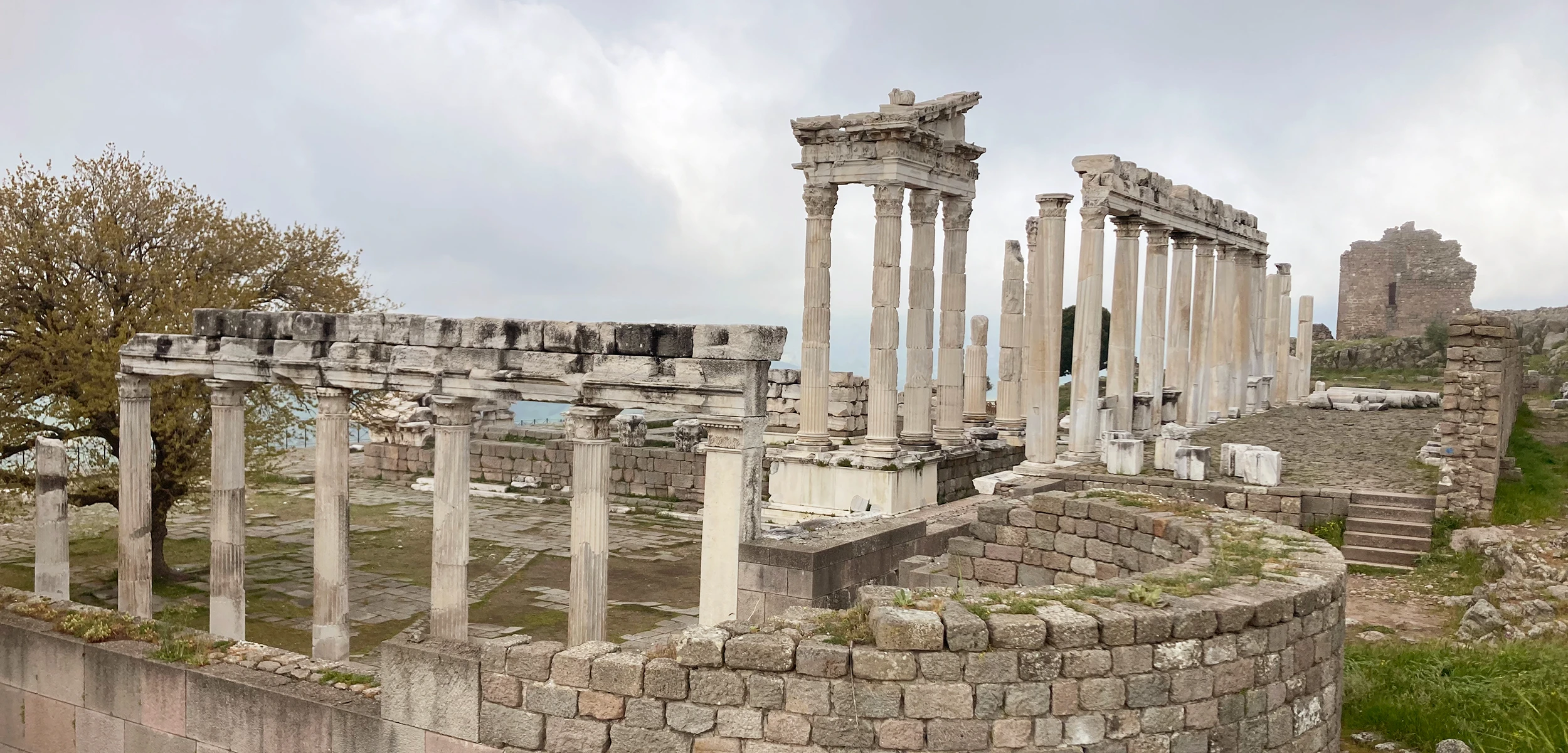
Travel north from İzmir for a private day exploring the Acropolis, Asklepion and the extraordinary Hellenistic and Roman legacy of Pergamon.
Request a Private Pergamon Tour