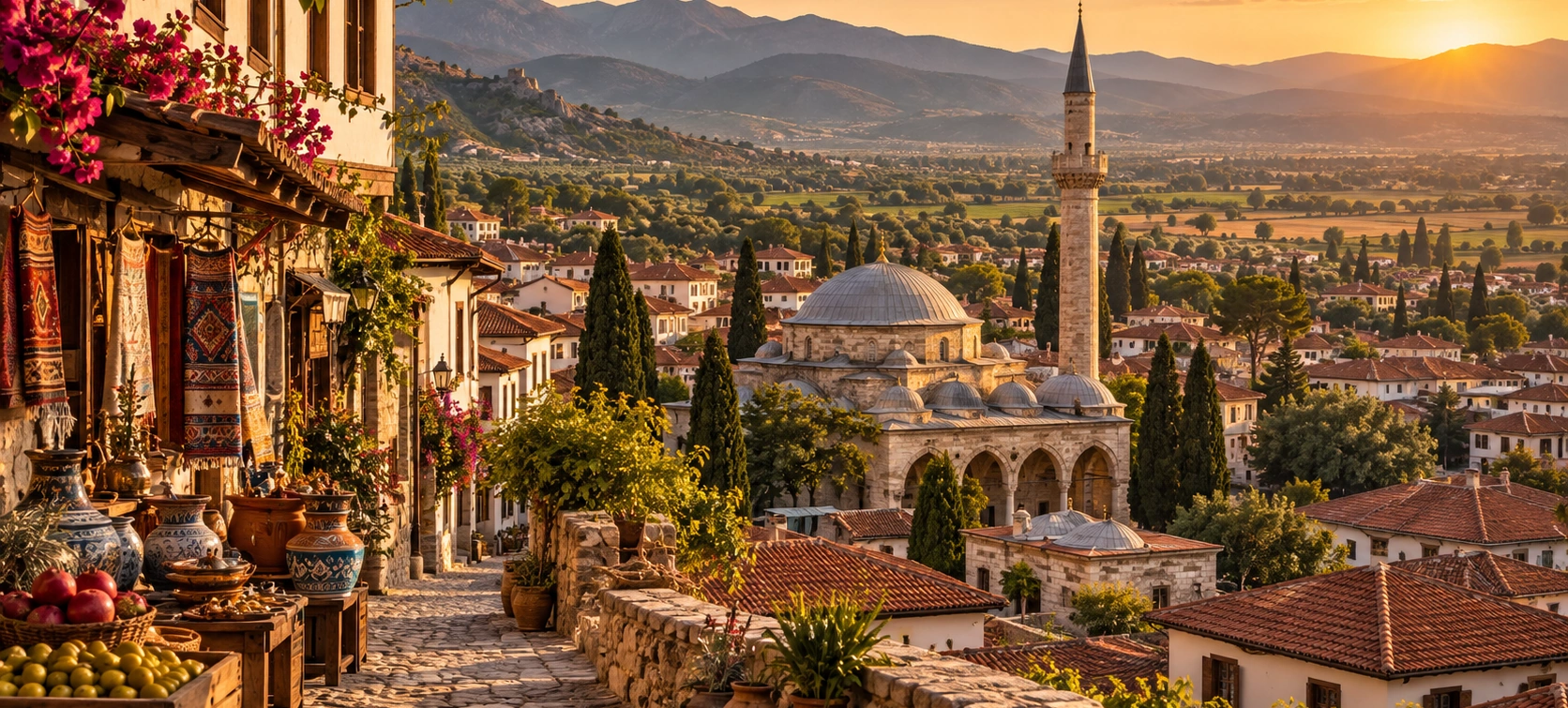
Private Tire Historical Town Experience
Explore Tire's historic mosques, külliyes, bazaar streets, Necip Paşa Library area, City Museum and traditional craft heritage with time for local food.
Request a Custom Tire Tour





Tire is one of the most rewarding inland destinations in İzmir Province, especially for travellers who enjoy historic streets, traditional markets, architecture, crafts and regional food. Rather than being built around one famous monument, Tire reveals itself gradually through mosques, külliyes, libraries, baths, inns, workshops, old houses and a busy commercial centre that still feels genuinely local.
The town developed strongly under the Aydınoğlu Principality in the 14th century and continued to flourish under the Ottoman Empire. Its urban fabric still preserves the memory of a regional centre shaped by religion, education, craft production, agriculture and trade.
Tire is also famous for its Tuesday Market, one of Türkiye's largest traditional open-air markets. More than a shopping stop, market day transforms streets across the centre with local vegetables, wild herbs, dairy products, textiles, needlework, felt, clogs, rope, household goods and many other products.
Add Tire köfte, black-mulberry lor dessert, surviving handicrafts, the Necip Paşa Library, historic mosque complexes and nearby Kaplan Village, and Tire becomes one of the strongest cultural day trips from İzmir, Selçuk or Kuşadası.
Experience a vast weekly market spreading through the town centre with produce, herbs, dairy, textiles, handicrafts and everyday local life.
Explore layers of Aydınoğlu and Ottoman architecture through Ulu Cami, Yeşil İmaret, Karakadı and Yoğurtluoğlu monuments.
Discover Tire's traditions of felt-making, weaving, quilt-making, rope-making, clogs, saddlery, needlework and other historic trades.
Come hungry for Tire köfte, tak tak kebabı, wild greens, dairy products, Aegean mezes and karadutlu lor tatlısı.
Essential information for planning a visit to Tire's historic centre, Tuesday market, museums, monuments, craft streets and surrounding countryside.
Tire lies in southeastern İzmir Province on the edge of the fertile Küçük Menderes Valley, below the hills south of town.
The town preserves important layers from the Aydınoğlu and Ottoman periods, especially mosques, külliyes, baths, inns and libraries.
The famous Tire Market is held on Tuesdays and spreads through much of the central commercial area.
Ulu Cami, Yeşil İmaret, Karakadı Necmettin Mosque and Yoğurtluoğlu Külliyesi are among the major historic monuments.
Necip Paşa Library was built in 1827 and preserves a significant historic book collection.
Tire is known for felt, weaving, quilts, clogs, rope-making, saddlery, needlework and other traditional crafts.
Tire köfte is the best-known local speciality, joined by tak tak kebabı, wild greens, dairy foods and black-mulberry lor dessert.
Regional trains connect İzmir Basmane with Tire; schedules should always be checked for the travel date.
Walk through the historic centre, then use a car or taxi for Kaplan Village, viewpoints and outlying archaeological remains.
The wider district contains ancient rural remains, rock-cut tombs and the monument commonly known as the Theos Mausoleum.
Tire sits between agricultural plains and greener uplands, making food, farming and mountain scenery part of the experience.
Tuesday is ideal for the full market experience; spring and autumn are especially comfortable for walking and regional exploration.
Tire is not a polished open-air museum. Its appeal comes from seeing historic monuments, active commerce and local traditions functioning together inside a real town.
The first reason to visit is architectural depth. Tire contains an unusually dense group of mosques, medreses, tombs, hammams, libraries and commercial buildings from the Beylik and Ottoman periods. Some are monumental; others sit quietly inside ordinary neighbourhood streets.
The second reason is the Tuesday Market. The market is not simply a tourist attraction but an enormous weekly exchange linking the town with surrounding villages and agricultural producers. Wild herbs, vegetables, cheese, yoghurt, olive products, household goods and handmade textiles make it one of the best places to understand the economy and food culture of the Küçük Menderes region.
The third reason is craft continuity. Tire has retained traditions of felt-making, weaving, quilt-making, rope-making, clogs and saddlery more visibly than many modern towns. The City Museum and old commercial streets help connect these crafts with the people who practised them.
Finally, Tire is an excellent base for a wider inland İzmir route. Kaplan Village, Birgi, Ödemiş, Bayındır, Selçuk and Ephesus can all be combined with Tire depending on whether your priority is food, archaeology, markets, mountain scenery or historic architecture.
Tire lies in southeastern İzmir Province, roughly 80–90 kilometres from central İzmir depending on the route used and about 40 kilometres from Selçuk. It occupies the southern edge of the fertile Küçük Menderes Valley, with agricultural land extending north of town and hills rising to the south.
This position has shaped Tire for centuries. The plain supported agriculture and trade, while routes toward Selçuk, Ephesus, Aydın and the inland valleys connected the town with larger regional networks.
The historic centre is compact enough for a walking day, although the full district is much larger. Kaplan Village, viewpoints, ancient rural monuments and some religious sites outside the centre are easier to reach with a vehicle.
The wider Tire district has a long settlement history connected with western Anatolia and the Küçük Menderes basin. Ancient rural remains show that the region was closely tied to the political and agricultural landscapes around Ephesus and the interior of Lydia, although central Tire does not function today as a single excavated ancient city or formal archaeological park.
During the Byzantine period, Tire developed as an important settlement and is recorded as a bishopric in the later medieval centuries. Defensive remains in the Hisarlık area point to the strategic importance of the hills above the plain.
The decisive transformation came in the early 14th century. After Turkish conquests in the region, Tire entered the orbit of the Aydınoğulları around 1310. Under the principality, the town expanded with mosques, medreses, baths, bridges, water systems, markets and religious foundations.
In 1426, Aydınoğlu territory was definitively incorporated into the Ottoman state under Murad II. Tire then became an important administrative and commercial centre, and much of the historic urban fabric visible today took shape through the 15th and 16th centuries and continued to develop in later Ottoman times.
The result is a town whose history is best read through its urban institutions: mosques beside shops, libraries near medreses, baths inside commercial districts, craft streets feeding into bazaars and neighbourhoods organised around religious and social complexes.
Tire's present historic form owes much to the centuries between the 14th and 16th centuries. Scholarly studies of the town show how religious and social complexes helped organise new neighbourhoods while also serving education, worship, charity, trade and urban growth.
During the Aydınoğlu period, Tire became one of the principality's major centres. Mehmed Bey's son Süleyman Bey governed in Tire, and the town developed alongside Birgi and Ayasuluk as part of the political and economic geography of the beylik.
Ottoman rule did not erase that earlier structure. Instead, new mosques, külliyes, shops, baths, libraries and charitable foundations expanded the same urban network. This continuity explains why Tire is especially interesting to travellers who want to see the transition from the Beylik era into early Ottoman architecture without visiting a large imperial capital.
Aydınoğlu rule encouraged the construction of mosques, tombs, medreses, baths and commercial infrastructure.
Tire entered definitive Ottoman rule under Murad II after the final incorporation of Aydınoğlu territory.
New Ottoman foundations strengthened Tire's role as a regional administrative, religious and commercial centre.
Historic monuments still sit within active streets and markets rather than in a separated archaeological zone.
Tire Ulu Cami, also known historically as Cami-i Kebir or Cami-i Atik, is one of the key monuments for understanding the town's medieval and Beylik-period development. Its exact original construction date is not completely settled.
A repair inscription dated 1870 attributes the mosque to Aydınoğlu Cüneyd Bey, who was active in the early 15th century. However, evidence from the surrounding complex and earlier historical references has led researchers to consider the possibility of an older 14th-century phase beneath or preceding the present building.
That uncertainty is part of what makes the mosque interesting. Tire was repeatedly transformed, repaired and expanded, and the Ulu Cami reflects the layered nature of the town rather than a single perfectly preserved construction campaign.
The mosque remains a functioning place of worship. Visit respectfully, avoid prayer times when possible and remember that historical interpretation of its earliest phase is more complicated than a single date on a guidebook label.
The Yeşil İmaret, widely known as the Yahşi Bey Mosque, is one of Tire's most important early Ottoman monuments. The complex is associated with the 15th-century Ottoman administration of the town and with Halil Yahşi Bey, a commander connected with Murad II's period.
Architecturally, the building is especially valuable because its plan belongs to the early Ottoman imaret tradition. The use of a half-dome in relation to the principal dome is often discussed in studies of the development that eventually led toward the great centrally planned Ottoman mosques of later centuries.
The mihrab, domed spaces and surviving decorative details reward a slower visit. Rather than seeing Yeşil İmaret only as another mosque, look at it as part of a period when Tire was being consolidated as an Ottoman regional centre after the end of Aydınoğlu political independence.
The complex usually called Yoğurtluoğlu Külliyesi or Yavukluoğlu Külliyesi is one of Tire's strongest examples of a historic neighbourhood institution. It belongs to the 15th century and includes a mosque and medrese arranged around an open courtyard.
The medrese cells line the courtyard behind arcades, helping visitors imagine how religious education and daily life were organised inside a small Ottoman educational complex. Other associated functions once extended the institution beyond the surviving core.
After a long period of deterioration, the complex was restored in 2005. Today it offers one of the clearest opportunities in Tire to understand how a mosque, school and charitable services once worked together as part of the same urban foundation.
15th century, with later repairs and modern restoration.
Mosque, courtyard, medrese rooms and spaces associated with the wider charitable complex.
The historic complex underwent major restoration completed in 2005.
It shows how education, worship and neighbourhood life were organised around a single foundation.
The Karakadı Necmettin Mosque, also associated locally with the name Kocabıyık Mosque, belongs to one of Tire's most interesting historic complexes. What makes it particularly valuable is the survival of several related institutions rather than a mosque standing alone.
The wider complex includes or historically included a medrese, library, han and hammam. The mosque and medrese preserve important features associated with Tire's 14th-century Beylik-period architecture, while later use and restoration show how these buildings continued to serve the town for generations.
Look closely at the minaret, masonry and the organisation of the courtyard. The complex is an excellent place to understand why Tire's heritage is best explored as an urban network rather than a list of isolated monuments.
The Necip Paşa Library was built in 1827 by Georgian Mehmet Necip Paşa, an Ottoman statesman of the Mahmud II period. It is one of Tire's most distinctive cultural institutions and an important reminder that the town's historic role extended beyond trade and religious architecture into scholarship and book culture.
The collection today contains more than 10,000 books, including valuable manuscripts and early works. Sources about the library highlight important copies of works associated with İbn Sina / Avicenna among its holdings.
The building itself is modest compared with Tire's large mosque complexes, but its intellectual significance is considerable. Access arrangements may differ from those of a standard museum, so visitors specifically hoping to see the interior or rare collections should confirm current visiting conditions in advance.
Tire has two different museum experiences that should not be confused. The state-run Tire Museum is an archaeology and ethnography museum with collections covering ancient material, Ottoman objects, coins, manuscripts and local cultural heritage. The institution began in 1935 and moved to its present museum building in 1971.
Important current note: the official Ministry of Culture and Tourism museum listing currently marks Tire Museum as closed. Travellers should check the official museum page again before visiting, because the status may change after this guide is published.
The municipal Tire City Museum, opened in 2014 inside the restored former municipal building, focuses more directly on the town's local identity. It is designed as a living museum, with displays and workshop spaces connected to traditional occupations and handicrafts.
State archaeology and ethnography museum with major collections, but currently listed as closed by the Ministry.
Municipal museum exploring local history, old occupations, household life and living handicraft traditions.
Use the City Museum to understand the crafts and trades you will encounter later in the bazaar streets.
Museum hours, closure status and ticket arrangements can change; verify them before departure.
Tire's historic centre was shaped as much by commerce as by worship. The old bazaar area contains traces of the infrastructure that supported traders, craftsmen, travellers and neighbourhood life for centuries.
Historic buildings include the Tahtakale Hammam, associated with a late 15th-century complex, together with other surviving or partially surviving baths, inns and commercial structures. Tahtakale's fabric is especially interesting because part of the building has been adapted for craft use and visitor access.
Names such as Kurşunlu Han, Abdüsselam Han and historic bathhouses appear throughout accounts of Tire's commercial heritage. Not every building operates today in a museum-like way, so the pleasure comes from finding fragments of older Tire woven into the active town centre.
Walk slowly. Shop façades, mosque courtyards, small fountains, covered passages and craft streets often tell more about Tire's history than a quick monument checklist.
Tire's domestic architecture is quieter than its mosques but essential to the town's atmosphere. In older neighbourhoods you can still find cumbalı houses, narrow streets, garden walls, tiled roofs, mature trees and small-scale buildings that preserve the rhythm of an inland Aegean town.
The streets change character as you move between the commercial centre and hillside neighbourhoods. Bazaar lanes are dense and active; residential areas become calmer, greener and more irregular as the town rises toward the south.
Because many attractive old buildings remain private homes, photograph responsibly. Do not enter courtyards or open gates simply because a house looks historic, and avoid blocking narrow residential lanes for staged photos.
The Tire Tuesday Market is the town's most famous living tradition and one of the main reasons travellers deliberately schedule their visit for a Tuesday. Official İzmir tourism sources describe a market with more than 1,700 stalls, spreading through a large part of the town centre.
Fresh vegetables, seasonal fruit, wild Aegean herbs, cheese, yoghurt, olive products and other foods connect the market directly with the agricultural villages around Tire. Alongside them are clothes, household goods, needle lace, embroidery, felt, clogs, saddles, rope and other craft products.
The market is at its most atmospheric in the morning, when local shopping is in full flow and food stalls are at their freshest. By midday the streets can become very crowded, especially in spring and during holiday periods.
Do not treat the market as a single square. It spreads through multiple streets, and part of the fun is wandering from produce sections into textile, household and craft areas. Keep some cash, watch your belongings in dense crowds and allow far more time than you would for an ordinary weekly market.
Tuesday.
More than 1,700 stalls according to official İzmir tourism information.
Morning for the freshest produce, strongest atmosphere and more comfortable temperatures.
Herbs, vegetables, dairy, olive products, textiles, needlework, felt and locally made household goods.
Tire's ancient history is different from nearby Ephesus. There is no single excavated ancient city in central Tire arranged as a major archaeological park, but the wider district contains numerous rural remains linked with the long occupation of the Küçük Menderes region.
One of the best-known monuments is the structure commonly called the Theos Mausoleum near Halkapınar. Local tourism sources generally date the monumental tomb to around the 2nd century BCE. The name used in tourism literature should not be treated as proof of a securely identified historical owner.
The district also includes rock-cut tombs and other ancient remains scattered across the rural landscape. These sites require more planning than central Tire's monuments and are best approached with reliable directions, a local guide or private transport.
South of central Tire, Kaplan Village is one of the easiest ways to combine the historic town with a greener rural setting. The road climbs away from the plain toward wooded hills, cooler air and broad views over the Küçük Menderes landscape.
Kaplan is especially popular for leisurely meals and countryside stops. It works well after a morning in the old town or market, when you want to leave the busier streets and spend the afternoon in a quieter environment.
The nearby Tire viewing terrace on the route toward Çukurköy provides another landscape stop, with views over the district and surrounding vegetation. Spring and autumn are especially pleasant, while summer afternoons can be noticeably more comfortable in the hills than on the plain.
Tire is one of the strongest craft destinations in İzmir Province because many traditional occupations remain part of the town's cultural identity. Some survive as active trades, while others are now preserved through museum demonstrations, individual masters and small workshops.
Keçe production has long been part of Tire's craft culture, with felt goods still appearing in the market and heritage workshops.
A historic textile tradition associated with sturdy patterned fabrics and the weaving culture of western Anatolian towns.
Hand-sewn patterned quilts remain one of Tire's most visually distinctive traditional crafts.
Decorated wooden nalın once used in homes and baths became one of Tire's recognisable craft products.
Tire urganı was historically valued for strength and whiteness; the tradition is now preserved in heritage workshops.
Semercilik reflects the agricultural and transport economy that once depended heavily on pack animals.
Oya, embroidery and cross-stitch are especially visible on Tuesday market day among handmade household textiles.
Tarakçı Street and the old commercial centre preserve memories of woodworking and specialised craft streets.
The best way to appreciate these traditions is not simply to buy a souvenir. Ask how an object is made, learn which crafts are still practised locally and choose handmade work directly from artisans or local producers whenever possible.
Food is one of the strongest reasons to visit Tire. The cuisine combines the livestock and dairy traditions of the surrounding countryside with the vegetables, herbs and olive-oil dishes associated with the wider Aegean region.
The town's signature meat dish, traditionally prepared very simply and commonly served with bread or pide, tomato sauce and butter.
A richer serving style in which Tire köfte is combined with pide, sauce and butter for a distinctly local plate.
A local meat speciality traditionally associated with slow cooking and the old food culture of Tire.
Fresh lor cheese paired with black mulberry creates one of Tire's best-known desserts.
Seasonal Aegean herbs appear sautéed, boiled, dressed with olive oil or incorporated into mezes and pastries.
Tire is well known for milk, yoghurt, cheese and other products from the surrounding agricultural region.
Vegetables, olive oil, yoghurt and herbs create lighter dishes that balance the town's famous meat specialities.
On Tuesday, build an informal breakfast from fresh cheese, tomatoes, olives, bread and seasonal produce from the market.
Karadut juice and sherbet are refreshing local flavours to look for, especially in warm weather.
The market changes through the year, so spring herbs, summer fruit and autumn vegetables each create a different food experience.
Tuesday market is the best place to see what is in season across the Küçük Menderes agricultural region.
Choose properly packaged products if you are travelling long distances or flying later the same day.
Look for locally produced items rather than generic machine-made souvenirs.
Traditional patterned quilts make striking purchases, although they are bulkier than most travel souvenirs.
Oya, kanaviçe and other handwork are especially visible among women's craft stalls on market day.
Decorated wooden nalın are distinctive pieces of Tire's historic craft culture.
Ask whether the fabric is locally woven and whether the seller can explain the technique or workshop behind it.
Olive products, preserves, dried foods and sealed regional specialities are easier to transport than fresh market goods.
Tire is busiest during the daytime, particularly on Tuesday. By evening the commercial streets become calmer and the town settles into a more local rhythm.
If you stay overnight, use the evening for a relaxed dinner, a final walk through the centre or a drive toward Kaplan for cooler air and countryside views. Tire is not a nightlife destination in the coastal-resort sense; its strength lies in food, conversation, heritage and early-morning local life.
An overnight stay becomes especially worthwhile if you want to photograph the town early, explore the Tuesday market without rushing, or combine Tire with Birgi, Ödemiş or Selçuk over two days.
Excellent for wild greens, fresh market produce, comfortable walking and green countryside.
Long days and warm weather make this one of the easiest periods for combining town and countryside.
Hot on the plain; start early, use shaded bazaars and historic interiors, then consider Kaplan later in the day.
Excellent for food, photography and regional driving, with softer light and comfortable mornings.
Quieter streets and fewer visitors, though rain can affect walking and market comfort.
A calm period for heritage travel; plan around shorter daylight and winter weather.
For most visitors, April–June and September–October offer the best overall balance. If the Tuesday Market is a priority, however, choosing the correct weekday matters more than choosing the perfect month.
Early morning is the best time for photography, quieter residential streets and a more relaxed start before shops and traffic build up.
On Tuesdays, arrive early enough to experience the market as local shopping gathers momentum. Morning also gives you the widest choice of produce and a better chance to speak with vendors before the busiest hours.
Late morning to early afternoon works well for the Ulu Cami, Yeşil İmaret, Necip Paşa Library area, City Museum and historic bazaar. Build the route around current museum and library access rather than assuming every interior will be open continuously.
Late afternoon is ideal for Kaplan Village, the viewing terrace or residential neighbourhood photography once the market and central streets begin to slow down.
Allow roughly 1.5 hours depending on traffic, route and your starting point in the metropolitan area.
Regional services operate between Basmane and Tire, with a journey of roughly two hours; confirm current times before travel.
Tire is about 40 km away, making it easy to combine with Selçuk or Ephesus by road.
Rental car or private transfer is simplest; some regional rail services also pass through Adnan Menderes Airport on the Tire line.
Regional and local services connect Tire with surrounding towns; timetables should be checked for the specific day.
A useful option for combining Tire with Birgi, Ödemiş, Selçuk or rural archaeology without losing time on connections.
Transport schedules can change. If your plan depends on the Tuesday Market, a specific museum opening or a same-day train connection back to İzmir, verify the current timetable before departure rather than relying on an older travel blog.
Walking is best for the bazaar, Ulu Cami, mosque complexes, craft streets and City Museum.
Expect road closures, crowds and slower movement; park outside the busiest market streets whenever possible.
Use a car or taxi for the climb into the hills and for a relaxed meal or viewpoint stop.
Outlying tombs and monuments require a vehicle and good directions; some are not presented like formal tourist sites.
Wear comfortable shoes for uneven paving, sloping lanes and long periods on foot.
A vehicle gives much more flexibility for Birgi, Ödemiş, Bayındır, Selçuk and Ephesus.
Enough for a short central walk, one or two major monuments and a quick Tire köfte lunch.
Good for key mosques, City Museum, bazaar streets, Necip Paşa Library exterior and a proper meal.
Best first visit, especially on Tuesday: market, monuments, crafts, food and late-afternoon Kaplan.
Useful if travelling by train or if you want early market photography and a slower evening.
Combine Tire thoroughly with Kaplan plus Birgi, Ödemiş, Selçuk or nearby rural archaeology.
A full Tuesday gives the most complete combination of heritage, food, crafts and everyday local life.
If you visit on a day other than Tuesday, replace the market block with a deeper walk through craft streets, historic baths, additional mosques and the City Museum. Check the official status of Tire Museum before adding it to the itinerary.
Tuesday Market if possible, historic bazaar, Ulu Cami and Yeşil İmaret.
Tire köfte, local greens and a black-mulberry or lor dessert.
City Museum, Necip Paşa Library, Karakadı complex and Yoğurtluoğlu Külliyesi.
Kaplan Village for countryside air, dinner and late-afternoon views.
Birgi and Ödemiş for Aydınoğlu architecture, Ottoman houses and another strong regional food experience.
Selçuk and Ephesus for a dramatic contrast between Tire's living Ottoman townscape and classical archaeology.
Photograph layered scenes of produce, hands, baskets, textiles and narrow streets rather than only wide crowd shots.
Use side light to reveal masonry, brick minarets, domes and the relationship between monuments and surrounding streets.
Ask permission before photographing artisans closely, especially while they are working.
Look for projecting upper floors, tiled roofs, doorways, walls, trees and everyday street life.
Late afternoon is strongest for broad views over Tire and the Küçük Menderes plain.
Interior photography rules vary; always ask before photographing manuscripts, displays or restricted spaces.
Request permission for close portraits of vendors, residents, worshippers and craftspeople.
Travel light and keep camera equipment secure when moving through the busiest market lanes.
Tire can work very well for families because the day can mix markets, food, museums, crafts, mosques and countryside rather than requiring hours inside a single archaeological site.
The Tuesday Market can be exciting for children but also extremely crowded. Keep younger children close, agree on a meeting point with older children and avoid pushing a stroller through the densest streets at peak market time if possible.
Accessibility varies considerably. Central streets are generally easier than steep residential lanes, but historic mosques, baths, medrese courtyards and old buildings may include steps, raised thresholds or uneven paving. Travellers with limited mobility should plan drop-off points and confirm museum access directly.
Visit mosques quietly, dress appropriately and avoid intrusive photography during prayer.
Buy handmade work directly from artisans and ask about the process rather than treating workshops only as photo stops.
Do not photograph vendors at close range without permission, particularly when they are serving customers.
Do not climb walls, sit on fragile architectural elements or touch old woodwork and painted surfaces unnecessarily.
Historic-looking houses remain homes; never enter courtyards or open gates without invitation.
Choose local seasonal produce and properly labelled food products when shopping at the market.
Carry a reusable bag and water bottle where practical, especially on market day.
A meal, museum visit or overnight stay spreads spending beyond a quick photo stop.
Tuesday gives the full market experience but also the heaviest crowds, parking pressure and slower traffic.
Morning is cooler, more photogenic and much easier for produce shopping and monument visits.
Cards are common in town, but small market stalls and craft sellers may still be easier with cash.
Expect long walks, uneven historic surfaces and sloping streets in older neighbourhoods.
The official Ministry listing currently shows the state Tire Museum as closed; verify before visiting.
Regional train schedules can change, so confirm both outbound and return services before relying on rail.
Carry clothing suitable for active places of worship and follow any local guidance at entrances.
Tire's food is part of the destination; leave enough time for köfte, greens, dairy and dessert.
Kaplan is an easy extension; combining Tire, Birgi, Ödemiş and Ephesus all in one day is usually too much.
Tuesday market streets can be crowded, so travel light and keep valuables secure.
A green hillside escape directly above Tire, ideal for a relaxed meal, countryside air and late-afternoon views.
One of western Türkiye's finest historic towns, with Aydınoğlu monuments, Ottoman mansions and preserved traditional streets.
A useful regional centre for museums, market culture and famous local dishes such as Ödemiş köfte.
A quieter agricultural town especially attractive during spring flower season and for rural routes through the valley.
Gateway to Ephesus, Ayasuluk Hill, St. John Basilica, the Ephesus Museum and a completely different layer of regional history.
One of Türkiye's greatest archaeological sites and an easy contrast with Tire's living Ottoman and market-town heritage.
A hill village near Selçuk known for traditional houses, narrow lanes, local products and a tourism-focused atmosphere.
Farther east near Ödemiş, these mountain destinations work best on a multi-day Küçük Menderes itinerary.
The easiest combination: historic centre and market first, then a relaxed countryside meal in the hills.
A superb heritage day focused on Beylik and Ottoman architecture, traditional streets and regional food.
Strong for food travellers who want two different market-town experiences in the Küçük Menderes basin.
Combine Tire's bazaars and Ottoman monuments with Ayasuluk Hill, the Ephesus Museum or an evening in Selçuk.
Possible with an early start and private transport, but keep the Tire section focused so both destinations have enough time.
A pleasant agricultural and small-town route, especially during spring flower season.
Build the itinerary around the Tuesday market, City Museum, workshops, Tire köfte and local dairy rather than monument counting.
Use two days for Tire, Birgi and Ödemiş, adding Kaplan or Gölcük according to season and interests.
Yes. Tire is one of inland İzmir's strongest cultural destinations, combining historic architecture, an enormous weekly market, traditional crafts and excellent regional food.
Tire is best known for its Tuesday Market, Tire köfte, historic mosques and külliyes, traditional crafts, Necip Paşa Library and nearby Kaplan Village.
The main weekly market is held on Tuesday.
Official İzmir tourism information describes more than 1,700 stalls spread through a large part of the town centre.
Look for seasonal vegetables and herbs, dairy, olive products, needlework, textiles, felt goods, clogs and locally produced food.
Morning is best for fresh produce, cooler temperatures and seeing the market before the heaviest crowds arrive.
It is Tire's signature meat speciality, traditionally prepared simply and commonly served with bread or pide, tomato sauce and butter.
Karadutlu lor tatlısı, combining fresh lor cheese with black mulberry, is one of the town's best-known desserts.
It is a traditional local meat dish associated with Tire's older cooking culture and is one of the specialities to look for beyond köfte.
Ulu Cami, Yeşil İmaret, Yoğurtluoğlu Külliyesi, Karakadı Necmettin complex, Necip Paşa Library and historic baths are among the highlights.
Its earliest construction history is debated. A later repair inscription associates it with Aydınoğlu Cüneyd Bey, while evidence suggests earlier 14th-century roots may exist.
Yeşil İmaret, also known as Yahşi Bey Mosque, is an important 15th-century early Ottoman monument in Tire.
It is a 15th-century mosque and medrese complex, also known in sources as Yavukluoğlu Külliyesi, restored in the early 2000s.
It is a historic library built in 1827 with a collection of more than 10,000 books, including important manuscripts.
The official Ministry of Culture and Tourism listing currently marks the state Tire Museum as closed. Check again shortly before your visit because the status may change.
It is a municipal living museum opened in 2014, focusing on Tire's local history, old professions and traditional handicrafts.
Felt-making, weaving, quilts, clogs, rope-making, saddlery, needle lace and embroidery are among the town's best-known craft traditions.
Yes. The central historic area is best explored on foot, though a vehicle is useful for Kaplan and outlying rural sites.
A full day is ideal for a first visit. A half day works for the historic centre, while two days allow Tire plus Birgi, Ödemiş or Selçuk.
Yes. It is an easy full-day destination by car, private transfer or regional train.
Yes. Regional trains connect İzmir Basmane with Tire. Timetables change, so check the current schedule before travel.
Current regional services take roughly two hours, depending on the specific train.
Tire is roughly 40 kilometres from Selçuk by road.
Yes, especially by private car, but both destinations deserve time. For a relaxed trip, consider staying overnight or splitting them across two days.
Yes. Tire and Birgi make an excellent heritage-focused route through the Küçük Menderes region.
Kaplan is a green hillside settlement above Tire known for countryside views, restaurants and a cooler rural atmosphere.
It is the name commonly used for a monumental ancient tomb near Halkapınar, generally dated in local tourism sources to around the 2nd century BCE.
Yes. The market, old mosques, craft workshops, tiled roofs, traditional houses and valley viewpoints provide very different kinds of photographs in one day.
Yes, especially if you mix the market, food, museum and countryside. Keep young children close in Tuesday crowds.
Accessibility is mixed. Some central streets are manageable, but historic thresholds, steps, sloping lanes and old buildings can create barriers.
Spring and autumn are especially comfortable. Spring is excellent for herbs and greenery, while autumn offers good produce and softer light.
Coming only for lunch or the market. Tire deserves time for its mosque complexes, craft streets, library, City Museum and hillside landscape as well.
A private day in Tire can combine heritage, food, market culture, crafts and countryside without reducing the town to a quick lunch stop between larger attractions.
Tell us whether your priority is the Tuesday market, Ottoman architecture, Aydınoğlu history, traditional crafts, food, photography or regional countryside, and we can shape the route around your available time.
Explore Tire's historic mosques, külliyes, bazaar streets, Necip Paşa Library area, City Museum and traditional craft heritage with time for local food.
Request a Custom Tire Tour
Build the day around Tire's famous weekly market, traditional crafts, local producers, Tire köfte, wild greens, dairy and black-mulberry flavours.
Plan a Market & Food Day
Combine three of the Küçük Menderes region's strongest heritage and food destinations in a private route designed around history, photography and local cuisine.
Plan a Küçük Menderes Route
Continue with our complete İzmir guide for ancient cities, historic towns, coastal destinations, food and day trips across the province.
View İzmir Guide