Greek writing at the entrance
The inventory describes thirteen Greek inscriptions, eleven above the arched entrance and two lower on the frame. Their presence documents the former congregation’s language.






Stone church architecture recalls the Greek Orthodox community and the mining town’s multi-community past.
An Inscribed 1862 Church in the Mining Town of Akdağmadeni
Greek writing at the entrance · Stone floor
Related Places & Traditions
Akdağmadeni, Yozgat, Türkiye
Architecture & cultural heritage
An Inscribed 1862 Church in the Mining Town of Akdağmadeni
The church in Yeşildere, also known as Tahmaz, belongs to the nineteenth-century history of Akdağmadeni, when lead mining helped shape the growth of a town with a diverse population. The date 1862 is recorded in the building’s inscription. The district became a subdistrict in 1860 and acquired district-centre status in 1871, placing the church within a period of substantial administrative change.
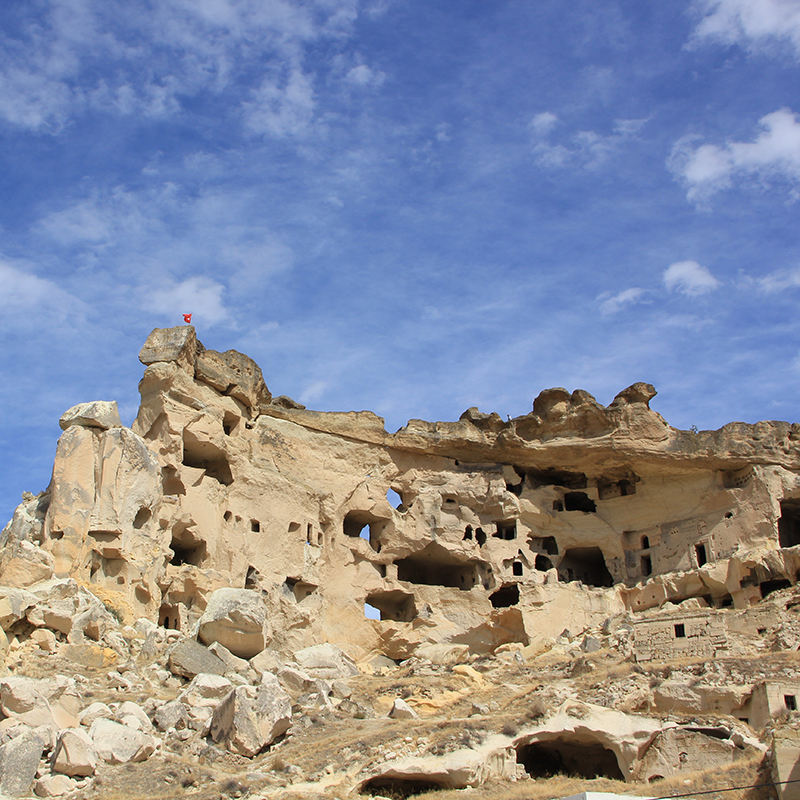
Its rectangular interior is divided longitudinally into three aisles by eight round columns linked by arches and timber ties. The stone-paved floor and the remnants of cross and geometric ornament on plaster provide evidence of its former liturgical function. This is a built masonry church, not a rock-cut sanctuary of Cappadocia. The cultural heritage authority placed the structure under protection on 8 April 1983, decision number 4227.
The district also contains a separate building identified in the inventory as the İstanbulluoğlu Church Mosque. The two records must not be conflated: conversion of a church to mosque use in the district does not by itself establish the later function of the Yeşildere monument.
The inventory describes thirteen Greek inscriptions, eleven above the arched entrance and two lower on the frame. Their presence documents the former congregation’s language.
The sanctuary retains a paved stone floor rather than the bare rock surface familiar from Cappadocia’s carved churches.
Look for cross motifs and geometric forms where historic plaster survives, without touching or entering unsafe areas.
View the exterior stonework and inscriptions from authorised public areas.
Confirm the building’s current use and interior access with the district authorities; respect any worship arrangements.
Forests, a historic mining town, church heritage and Behramşah Castle.
Ruined fortification overlooking the surrounding countryside, part of the medieval defensive heritage of eastern Yozgat.
Extensive upland woodland contrasts with the cultivated open plateau around Yozgat city.
Plan a personal itinerary through Central Anatolia.
Contact Wow Cappadocia