Private Mimar Sinan Heritage Route
Ask us to design a private journey through Babaeski, Lüleburgaz and Edirne, focused on architecture, history and living Ottoman heritage.
Request a Custom Tour





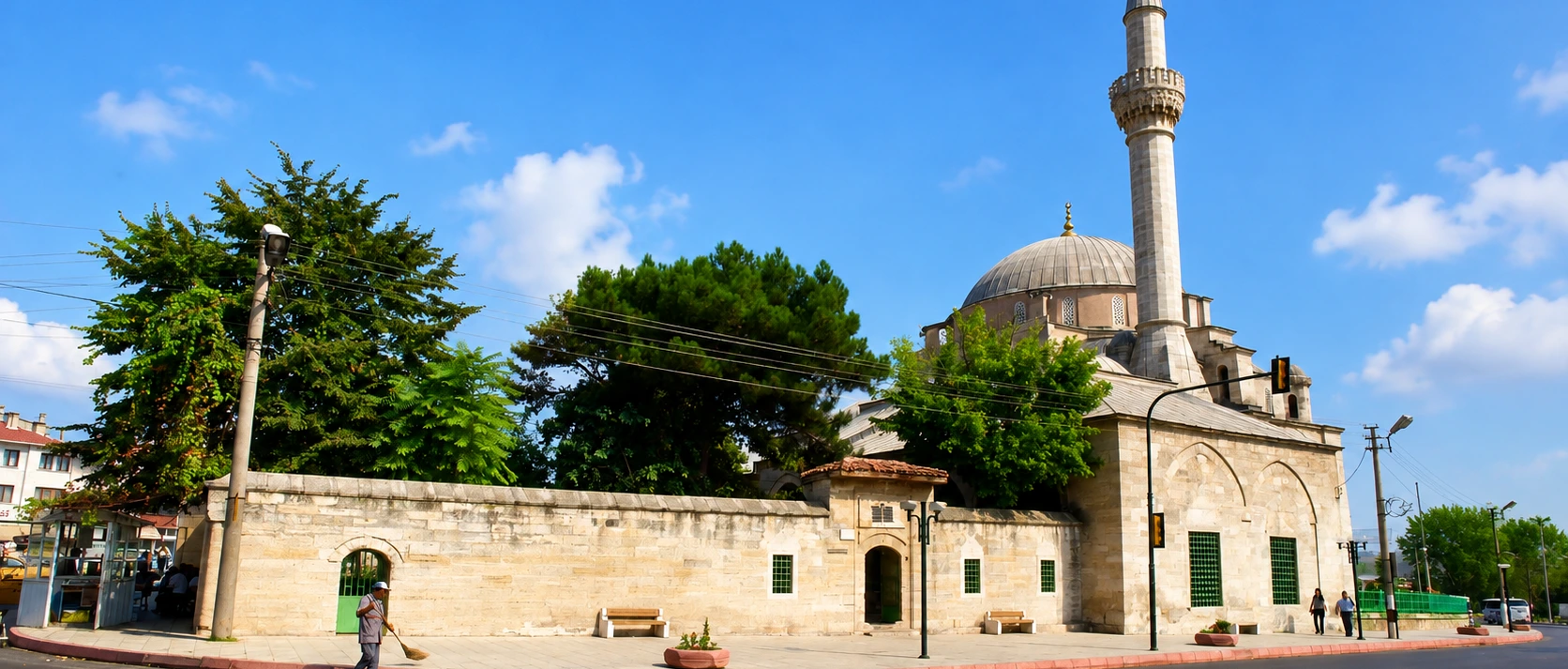
At the eastern approach to Babaeski, beside the historic Istanbul–Edirne route, the Cedid Ali Pasha Mosque rises above the town with a broad lead-covered dome, a slender minaret and an unusually deep double portico.
Also called the Semiz Ali Pasha Mosque, Ali Pasha Mosque, Büyük Cami or Merkez Camii, it was commissioned by Grand Vizier Semiz Ali Pasha and designed by the imperial architect Mimar Sinan during the classical age of Ottoman architecture.
The mosque once belonged to a larger charitable complex that included a madrasa, bathhouse, caravanserai and shops. Most of those structures disappeared after centuries of war, rebuilding and urban change, but the mosque remains an active place of worship and Babaeski's most important monumental landmark.
Inside, Sinan's six-support structural system opens the prayer hall beneath a dominant central dome and five half-domes. Outside, finely cut stone, layered porticoes, a twelve-sided ablution fountain and carefully balanced masses give the building an elegance that rewards slow observation.
For travellers following the Ottoman heritage route through Turkish Thrace, Cedid Ali Pasha Mosque forms a natural bridge between the imperial architecture of Istanbul, the monuments of Lüleburgaz and the great mosques of Edirne.
See one of the master architect's most significant surviving works in Turkish Thrace.
Experience a spacious prayer hall organized around a central dome and five half-domes.
Admire the mosque's distinctive two-layered entrance composition and stone columns.
Visit an active mosque that has served Babaeski for more than four centuries.
Essential information for understanding and respectfully visiting Babaeski's great Ottoman mosque.
Babaeski town centre, beside the historic Istanbul–Edirne road in Kırklareli Province.
Open on Google MapsSemiz Ali Pasha Mosque, Ali Pasha Mosque, Büyük Cami and Merkez Camii.
16th century; published dates vary because the mosque has no surviving original construction inscription.
Mimar Sinan, chief imperial architect of the Ottoman Empire.
Semiz Ali Pasha, grand vizier under Sultan Süleyman the Magnificent from 1561 to 1565.
An active mosque; visitors should avoid prayer times and follow mosque etiquette.
The mosque combines architectural ambition, urban history and a living religious tradition in one of Turkish Thrace's finest Ottoman monuments.
Cedid Ali Pasha Mosque is important first as an authenticated work of Mimar Sinan. Its plan belongs to the family of six-support domed mosques that Sinan explored in several major commissions, yet architectural historians identify the Babaeski building as an exceptional provincial example of the system.
The building also reflects Babaeski's position on the great land route connecting the Ottoman capitals of Istanbul and Edirne with the Balkans and Central Europe. A complex containing worship, education, bathing, trade and accommodation served both the local community and people moving along this busy road.
Although it is sometimes popularly described as a smaller model of Edirne's Selimiye Mosque, the comparison should not be taken literally. Its hexagonal support system and spatial organization are more closely related to a wider group of Sinan's experiments, including Kara Ahmed Pasha Mosque and Molla Çelebi Mosque.
Its survival is equally remarkable. The building underwent a major restoration under Sultan Mahmud II in 1832–33, suffered severe damage during the Balkan Wars and later received several modern conservation campaigns. The reconstructed minaret, restored decoration and repaired lead roofs reveal a monument shaped by repeated acts of care.
Today the mosque remains both a historic building and a functioning sacred space. That continuity gives visitors something a museum cannot provide: an encounter with architecture still serving the purpose for which it was created.
The mosque was commissioned by Semiz Ali Pasha, a leading Ottoman statesman who became grand vizier in 1561 during the reign of Sultan Süleyman the Magnificent. The nickname Semiz, meaning stout or well-built, distinguished him from other Ottoman officials named Ali Pasha; the building is also widely known as Cedid Ali Pasha Mosque.
Its architect was Koca Mimar Sinan, the chief architect responsible for hundreds of Ottoman mosques, bridges, schools, bathhouses and charitable complexes. Sinan's biographical lists record both the mosque and a madrasa at Babaeski.
The precise construction date requires care. Tourism sources commonly give 1555 or 1560, while modern documentary research has connected the complex with records from the 1560s, 1570s and 1580s. An imperial order dated 1585 indicates that work around the outer portico and courtyard was still incomplete at that time.
Because no original construction inscription survives, the safest description is that the mosque is a 16th-century foundation of Semiz Ali Pasha designed by Mimar Sinan, with parts of the wider complex apparently completed or extended after the patron's death in 1565.
An Ottoman grand vizier remembered for his statesmanship and charitable foundations.
The imperial master architect whose long career transformed classical Ottoman design.
The absence of a surviving foundation inscription explains why published construction dates differ.
Historical records securely place the monument within Sinan's classical Ottoman period.
Cedid Ali Pasha Mosque was conceived as part of a külliye—an Ottoman charitable complex in which several institutions worked together to support worship, education, travel and urban life.
Historical accounts and financial records mention a madrasa, bathhouse, caravanserai and shops. These buildings would have made the foundation an important service centre on the Istanbul–Edirne road, welcoming students, townspeople, merchants, pilgrims and other travellers.
The complex belonged to a wider economic network of charitable endowments known as vakıf. The income of Ali Pasha Bazaar in Edirne—also designed by Mimar Sinan—was assigned to support the Babaeski foundation. This connection shows how Ottoman monuments in different towns could function as parts of one financial and social system.
Wars, invasions and later urban development gradually erased the madrasa, caravanserai and commercial buildings. Research indicates that the historic bathhouse associated with the foundation also survived, although it stands separately and has undergone substantial change and restoration.
The principal surviving monument and the spiritual centre of the foundation.
A school recorded in Sinan's lists but no longer standing above ground.
Facilities that supported trade and travellers before disappearing from the urban landscape.
The foundation's historic hamam is associated with the surviving Fatih Hamamı in Babaeski.
An Edirne commercial building whose revenue helped maintain the Babaeski endowment.
The mosque's walled forecourt and fountain preserve a sense of the original institutional setting.
The mosque is built of carefully dressed stone and covered by a dominant lead-clad central dome. Its prayer hall is organized around a hexagonal or six-support system, an arrangement that allows the dome to command the interior while side spaces expand around it.
Five half-domes enlarge the central space: two on each side and one above the projecting mihrab bay. Galleries placed between the structural piers create additional layers without interrupting the visual unity of the hall. Outside, buttressing arches and corner weight towers express how the dome's forces are carried downward.
The entrance façade is especially distinctive. The inner portico rests on columns and is covered by four small domes with a vault over the central entrance. In front of it, a second portico with a sloping timber roof deepens the approach and gives the mosque a broad, welcoming façade.
A single minaret stands at the western side. Its predecessor was destroyed during the Balkan Wars, and the present minaret was reconstructed in the 20th century. The courtyard contains a twelve-sided ablution fountain, while the main and side gates frame views toward the portico and prayer hall.
The lead-covered dome dominates the exterior silhouette and the experience of the prayer hall.
Four lateral half-domes and one above the mihrab extend the central worship space.
The dome is organized over a hexagonal structural scheme unusual among Sinan's provincial monuments.
Finely cut masonry gives the exterior its disciplined classical character.
Two successive layers of shelter create one of the building's most memorable architectural features.
The reconstructed minaret has one balcony and a pointed lead-covered cap.
Allow time to walk through the courtyard, study the porticoes and experience the interior from several angles. The building's beauty lies as much in proportion and spatial rhythm as in decoration.
Look through the principal gate toward the fountain, porticoes and dome to understand Sinan's carefully staged entrance sequence.
The polygonal şadırvan marks the centre of the courtyard and supports ritual ablution before prayer.
Observe the timber-roofed outer arcade and the variation in column capitals near the main entrance.
Small domes and the central vault create a formal transition between the courtyard and prayer hall.
Stand beneath the central dome and follow the sequence of five half-domes that expands the interior.
The prayer direction is emphasized by a projecting bay crowned with its own half-dome.
Galleries between the main supports add usable space while preserving the hall's openness.
The inscription above the western courtyard entrance records Sultan Mahmud II's restoration of 1832–33.
The interior reflects successive decorative campaigns and later conservation work rather than one untouched historical layer.
Buttresses, projecting piers and small weight towers reveal the structural logic of the domed composition.
The mosque seen today is the result of centuries of use, damage and repair. Its history should therefore be read not as a perfectly frozen 16th-century building, but as a living monument whose community repeatedly chose to preserve it.
The most clearly documented Ottoman restoration took place in 1832–33 under Sultan Mahmud II. A ten-line poetic inscription above the western courtyard gate commemorates this work, and some interior decoration may also belong to this period.
During the Balkan Wars of 1911–12, the mosque was badly damaged and its minaret was destroyed. The minaret was rebuilt in 1934. Further restoration followed in 1986–88, including masonry cleaning, pointing, window repairs and conservation or recreation of painted decoration.
Another campaign in 2013 repaired and strengthened the timber structure above the portico and renewed damaged lead coverings. These interventions are part of the monument's biography and explain why different details may belong to different restoration periods.
Major restoration ordered during the reign of Sultan Mahmud II and recorded by an inscription.
Severe damage during the Balkan Wars, including the destruction of the minaret.
Reconstruction of the mosque's single minaret.
Extensive restoration of stonework, windows, plaster and interior decoration.
Repairs to the portico's timber structure and renewal of deteriorated lead roofing.
Maintenance continues because the building remains an active mosque rather than an abandoned ruin.
The mosque stands in central Babaeski, close to the historic Istanbul–Edirne road, and is easy to include in a driving route through Kırklareli and Turkish Thrace. Because it remains an active place of worship, access is shaped by prayer times and religious events.
Non-Muslim visitors are normally welcome outside congregational prayers when the building is open, but entry can be limited during worship, maintenance or special occasions. Check locally on arrival and always follow instructions from mosque staff.
Cedid Ali Pasha Mosque is first a sacred space and only second a visitor attraction. A few simple courtesies allow everyone to appreciate the monument without interrupting its religious life.
Enter between prayers rather than immediately before or during congregational worship.
Cover shoulders and knees; women should cover their hair inside the prayer hall.
Leave footwear at the entrance or carry it in a bag without placing it on the carpet.
Silence phones and avoid loud conversations, calls or recorded commentary indoors.
Never walk directly in front of someone who is praying or occupy the prayer line for photographs.
Architecture may usually be photographed discreetly, but people always deserve privacy.
The mosque can be appreciated throughout the year. For a calm visit and good architectural light, choose a weekday morning or late afternoon outside prayer times.
Often the quietest period for studying the courtyard, porticoes and interior without disturbing worshippers.
Lower light can emphasize the stone façades, lead roofs, arcades and minaret.
Comfortable temperatures suit a longer heritage route through Babaeski, Lüleburgaz and Edirne.
Mild weather and softer light make September and October especially pleasant for architectural travel.
Avoid this period for sightseeing because the mosque is at its busiest weekly service.
Expect larger congregations and prioritize the needs of the worshipping community.
The mosque is compact enough for a short stop, but architecture enthusiasts will benefit from a slower visit.
Enough for a quick exterior view, the courtyard and a brief interior visit when access is available.
The best choice for most visitors, allowing time for the porticoes, dome, galleries and restoration inscription.
Recommended for photographers, architecture students and travellers comparing Sinan's monuments.
Combine the mosque with Babaeski Bridge, the historic Fatih Mosque, bathhouse and town centre.
The layered entrance façade, stonework and domed silhouette make the mosque one of Babaeski's strongest architectural subjects. Photograph discreetly and remember that worship always takes priority over image-making.
Frame the fountain, double portico and central dome together from the main entrance.
Use the repeating columns and arches of the porticoes to create depth and symmetry.
From outside, look for views showing the main dome, half-domes, buttresses and weight towers as one system.
When permitted, a wide view can show the relationship between the dome, side galleries and mihrab bay.
Photograph the 1832–33 inscription carefully without blocking an entrance or touching the stone.
Avoid flash, tripods and intrusive equipment whenever visitors or worshippers are present.
The mosque stands beside the principal east–west road through Babaeski and is straightforward to reach by car. It can be visited as a dedicated stop or as part of a broader route between Istanbul, Kırklareli and Edirne.
The mosque is within the central urban area and can be reached on foot from nearby streets and local businesses.
Babaeski lies roughly 35 kilometres south of Kırklareli city and is easily reached by road.
Travel west along the D100 corridor; Babaeski is approximately 25 kilometres away.
Drive east toward Babaeski; the journey is approximately 55 kilometres depending on the chosen road.
Babaeski is around 150 kilometres from central Istanbul; allow extra time for metropolitan traffic.
Intercity buses and regional services reach Babaeski; continue to the mosque by local transport or on foot where practical.
Babaeski's position between Kırklareli, Lüleburgaz and Edirne makes the mosque an excellent stop on an Ottoman architecture itinerary.
See the historic stone bridge built under Sultan Murad IV on the old imperial road through the town.
Visit another important Babaeski mosque whose inscription records construction under Mehmed the Conqueror in 1467.
Discover the historic hamam associated with the charitable foundation, also known locally as Fatih Hamamı.
Continue to Lüleburgaz for another major Mimar Sinan foundation on the Istanbul–Edirne route.
Explore Selimiye Mosque, the Old Mosque, Üç Şerefeli Mosque, bridges, bazaars and imperial heritage.
Plan a wider journey through archaeological sites, Ottoman monuments, historic towns and regional museums.
See the early Republican sugar-factory landscape and a historic bridge associated with Mimar Sinan and Sokollu Mehmed Pasha.
Visit a smaller Thracian town with the surviving mosque of a 16th-century Sokollu Mehmed Pasha foundation.
It stands in Babaeski town centre in Kırklareli Province, beside the historic road connecting Istanbul and Edirne.
The mosque is an acknowledged work of Mimar Sinan, the chief imperial architect of the classical Ottoman period.
The patron was Semiz Ali Pasha, an Ottoman statesman who served as grand vizier from 1561 until his death in 1565.
It is a 16th-century mosque, but the exact date is disputed. Published sources variously give 1555, 1560 or later dates, and documentary evidence indicates that parts of the complex were still being completed in the later 16th century.
Yes. Cedid Ali Pasha Mosque, Semiz Ali Pasha Mosque and Ali Pasha Mosque refer to the same monument. Local residents may also call it Büyük Cami or Merkez Camii.
It is often described that way in popular tourism material, but it is not a literal copy. Its six-support plan belongs to a broader group of Sinan's architectural experiments and deserves to be understood on its own terms.
Its central dome, five half-domes, hexagonal support system, double portico and carefully balanced exterior masses make it an exceptional provincial example of classical Ottoman mosque design.
Yes. Historical records mention a madrasa, bathhouse, caravanserai and shops associated with the foundation. Most of these structures have disappeared, while the mosque and the historic bathhouse survived.
Yes. It remains a functioning mosque and is used for the five daily prayers, Friday prayer and religious occasions.
Non-Muslim visitors are generally welcome outside prayer times when the mosque is open. Dress modestly, remove shoes and follow local guidance.
Active mosques normally do not charge a sightseeing admission fee. Access may nevertheless be limited during prayers, religious events, maintenance or restoration.
Allow approximately 30–45 minutes for the courtyard, porticoes, exterior and prayer hall. Architecture enthusiasts may prefer an hour.
The minaret was destroyed during the Balkan Wars of 1911–12 and reconstructed in 1934.
The poetic inscription above the western courtyard gate commemorates the mosque's major restoration under Sultan Mahmud II in 1832–33.
Discreet architectural photography is generally acceptable outside worship, but ask if uncertain and never photograph worshippers without permission.
Courtyard thresholds, steps and the requirement to remove shoes may create difficulties. Current access arrangements should be checked locally before visiting.
Nearby heritage includes Babaeski Bridge, Fatih Mosque and the historic bathhouse associated with the Semiz Ali Pasha foundation.
Yes—especially for travellers interested in Mimar Sinan, Ottoman architecture or the historic Istanbul–Edirne road. It is one of the most important monuments in Kırklareli Province.
Pause your visit whenever prayer begins and give the congregation full use of the space.
Avoid leaning on stonework, inscriptions, painted decoration, wooden elements or architectural fittings.
Do not block gates, shoe areas, ablution facilities or paths used by worshippers.
Avoid tripods, bright lights, drones and commercial photography without explicit permission.
Combine your visit with local cafés, shops and nearby heritage rather than treating the mosque as a roadside photograph.
Take all litter away and help preserve the dignity of the courtyard and surrounding streets.
Follow the historic route between Istanbul and Edirne through Mimar Sinan's mosques, bridges, charitable complexes and the towns that grew around them.
Combine Cedid Ali Pasha Mosque with the Sokollu Mehmed Pasha complex in Lüleburgaz and the imperial monuments of Edirne on a tailor-made private route.
Ask us to design a private journey through Babaeski, Lüleburgaz and Edirne, focused on architecture, history and living Ottoman heritage.
Request a Custom Tour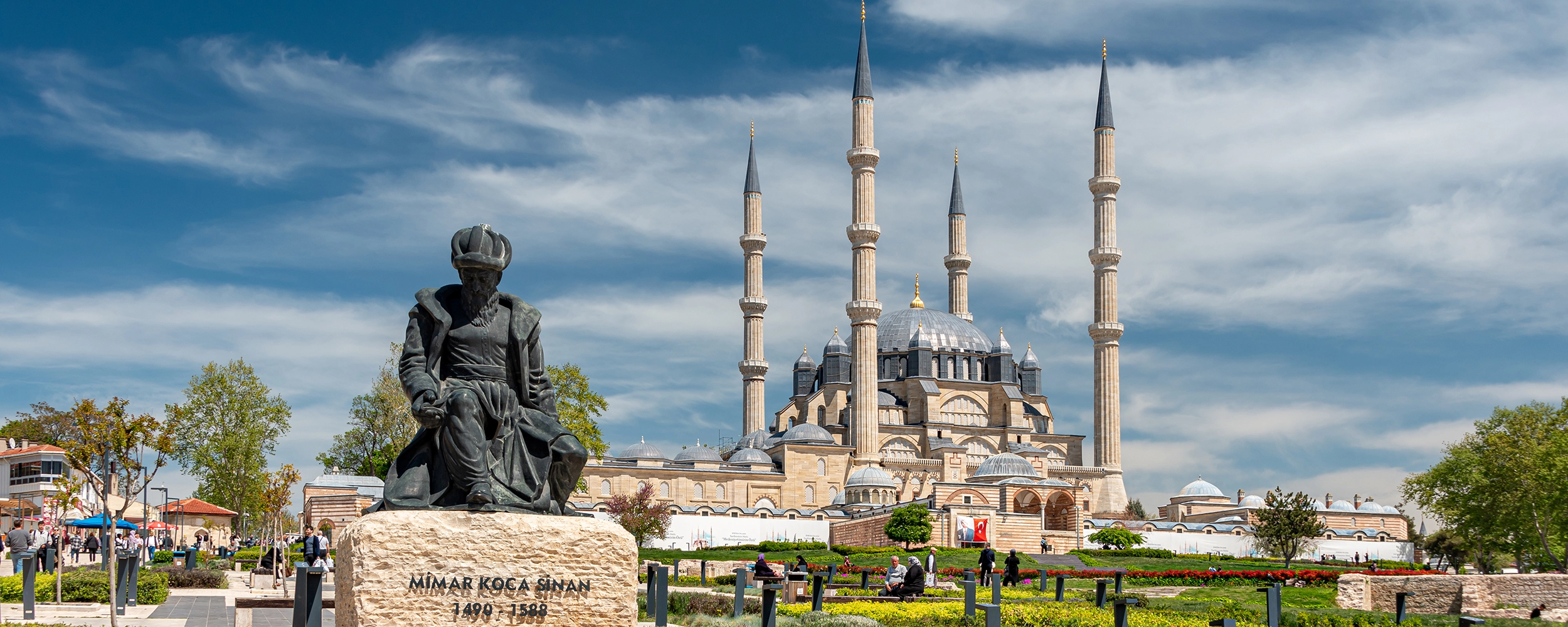
Continue to the former Ottoman capital for Selimiye Mosque, historic bazaars, bridges, palaces and centuries of frontier heritage.
View Edirne GuideDiscover more Ottoman architecture, archaeological sites, historic towns and natural landscapes across the province.
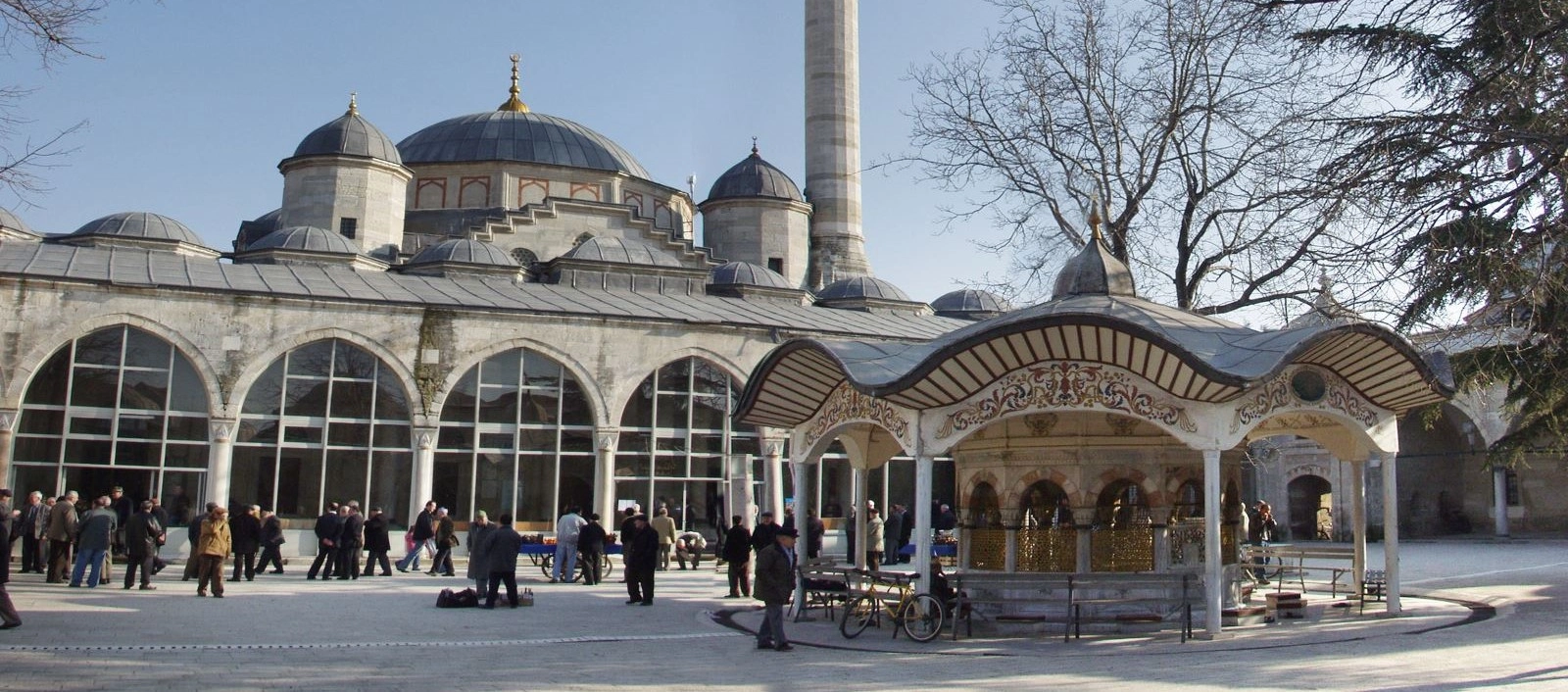
Explore Mimar Sinan's great 16th-century foundation in Lüleburgaz, created for worship, education, commerce and travellers.
Discover the Complex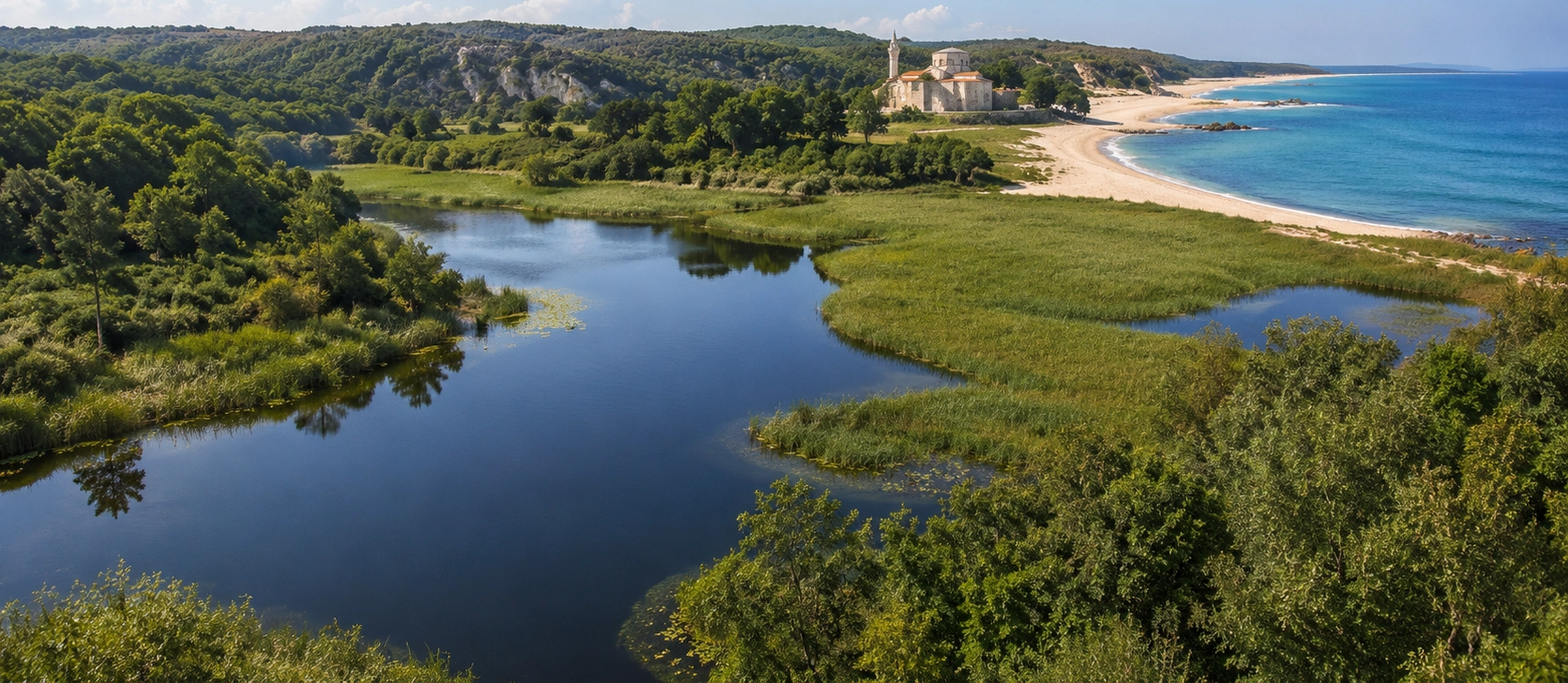
Plan a wider journey through prehistoric settlements, Ottoman monuments, museums, forests, caves and the Black Sea coast.
View Kırklareli Guide
Combine Cedid Ali Pasha Mosque with Babaeski's bridge, Fatih Mosque, historic bathhouse and local town life.
Plan Your Visit