The Great Stone Arch
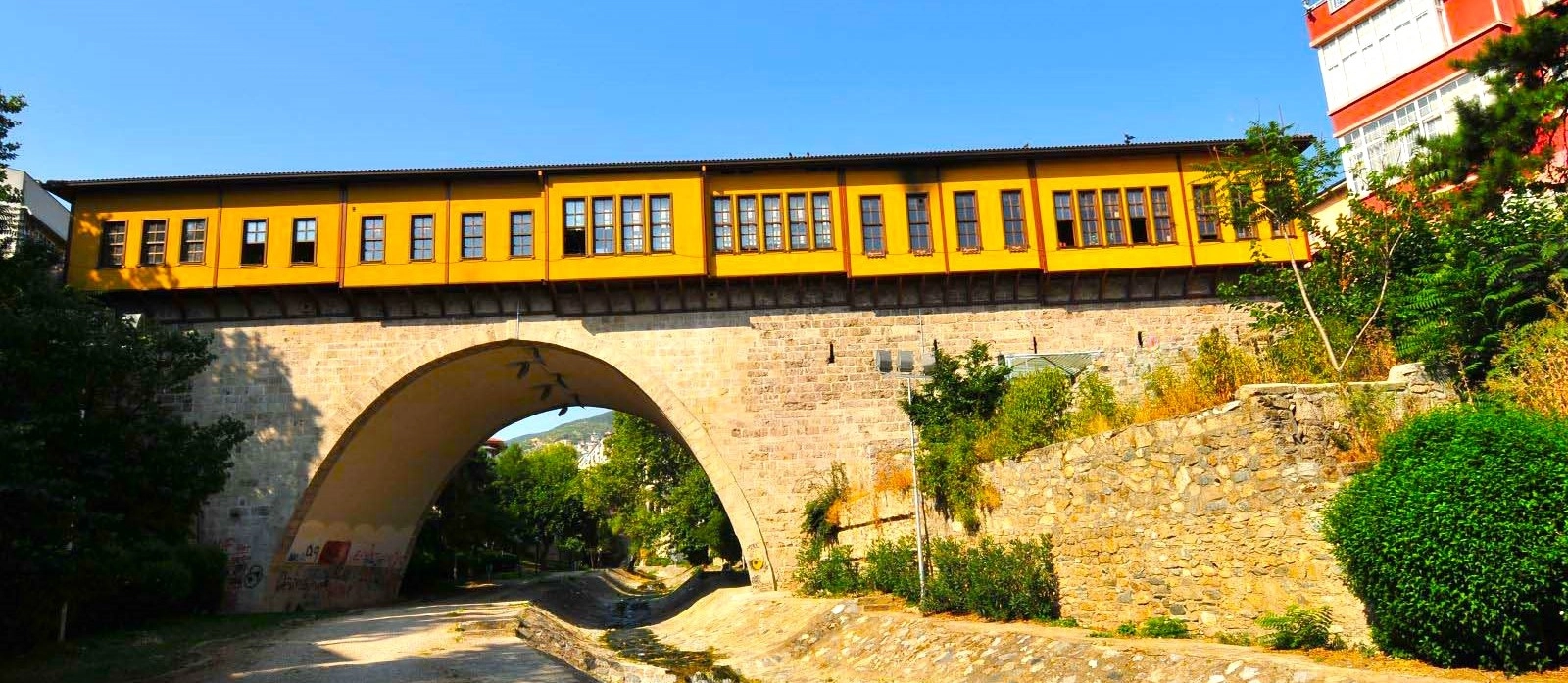
The monumental arch carrying the bridge across Gökdere is the most impressive surviving expression of Irgandı’s engineering.
- Material: Masonry and stone
- Form: Principal single-span arch
- Setting: Gökdere Valley






Crossing the narrow valley of Gökdere, Irgandı Bridge is one of the most distinctive architectural landmarks in Bursa. Unlike an ordinary bridge designed simply to carry travellers from one bank to another, Irgandı was created as both a crossing and a commercial street.
Built in 1442 during the reign of Sultan Murad II, the bridge belonged to the prosperous commercial world of early Ottoman Bursa, when the city stood at the western end of major trade networks connecting Anatolia, Iran, Central Asia and the Mediterranean.
The bridge was commissioned by the wealthy merchant Hoca Muslihuddin, son of Irgandılı Ali. Historical evidence indicates that it was probably constructed by Timurtaş, son of Abdullah, whose name appears in contemporary documentary sources.
The original bridge was far more than a picturesque crossing. Two facing rows of commercial units extended along its deck. Historical reconstructions describe 16 units on each side, forming 31 shops together with a small mescit or prayer room. Vaulted spaces associated with storage and stabling were incorporated beside the great supporting arch.
This combination of bridge, bazaar, workshops, storage and religious space made Irgandı one of the most unusual commercial buildings of the early Ottoman world. Its form reflected the commercial character of Bursa, a city famous especially for silk, textiles, craft production and long-distance trade.
Irgandı survived for centuries but repeatedly suffered from disaster. Flooding damaged it during the eighteenth century, the great Bursa earthquake of 1855 severely affected the structure, and retreating occupation forces destroyed much of the bridge in 1922.
It was reconstructed without its historic bazaar in 1949. After decades of research and conservation planning, a major reconstruction completed in 2004 restored the bridge’s historic identity as a commercial and cultural passage.
Today, the warm-coloured shopfronts, timber bay windows, stone arch, craft workshops and dramatic position above Gökdere have once again transformed Irgandı into one of Bursa’s most atmospheric pedestrian landmarks.
This complete visitor guide explores Irgandı Bridge, its Ottoman history, original bazaar, architecture, shops, trade connections, Evliya Çelebi, earthquake damage, 1922 destruction, modern reconstruction, traditional crafts, Gökdere, Setbaşı, photography, visitor information and the best way to combine the bridge with Green Mosque, Koza Han and Bursa’s historic bazaar district.
Walk across an extraordinary commercial bridge constructed during the reign of Sultan Murad II.
Discover how shops, workshops and a small prayer space once formed an entire commercial street above the river.
See the great stone arch rising dramatically above one of the historic streams descending through Bursa.
Browse workshops associated with ceramics, painting, decorative arts and locally produced handicrafts.
Understand the bridge within the prosperous merchant culture that made Ottoman Bursa an international trading centre.
Combine Irgandı easily with Setbaşı, Green Mosque, Koza Han, Ulu Camii and Bursa’s great historic bazaars.
Essential information for visiting Bursa’s remarkable Ottoman bazaar bridge.
Across Gökdere between Bursa’s historic commercial centre and the eastern neighbourhoods.
Open on Google Maps1442, during the reign of Ottoman Sultan Murad II.
Stone bridge carrying a covered commercial bazaar with shops, a mescit and service spaces.
Allow approximately 30–60 minutes, longer when combining the bridge with Setbaşı and Yeşil.
Discover how a prosperous Ottoman merchant created one of Bursa’s most extraordinary commercial monuments.
Irgandı Bridge belongs to the period when Bursa was one of the most important political and commercial centres of the early Ottoman state.
After the Ottoman conquest of Bursa in 1326, the city expanded rapidly beyond its fortified Byzantine citadel. Mosques, külliyes, markets, caravanserais, hamams and commercial streets gradually transformed the surrounding valleys and hillsides.
One of these expanding routes crossed Gökdere, a stream descending from the slopes of Uludağ and forming a natural division between parts of the developing city.
In 1442, during the reign of Sultan Murad II, the wealthy merchant Hoca Muslihuddin, son of Irgandılı Ali, commissioned an extraordinary bridge at this location.
Documentary evidence suggests that the builder was Timurtaş, son of Abdullah. Instead of creating a simple stone crossing, the project incorporated a complete line of commercial premises above the bridge.
The original arrangement contained 16 units on each side. These are generally described as 31 shops and one mescit, while additional vaulted spaces around the bridge structure served functions associated with storage, animals and commercial activity.
Merchants could therefore cross Gökdere, purchase goods, conduct business, store merchandise and participate in the commercial life of Bursa without leaving the bridge itself.
The monument suffered repeated damage over the following centuries. A major flood partially damaged it during the eighteenth century, while the catastrophic 1855 Bursa earthquake caused much more serious destruction.
During the later nineteenth century, the commercial structures above the bridge took on a different appearance, with rows of timber shops creating a more open bazaar.
Another major disaster came in 1922, during the final stages of the Turkish War of Independence, when retreating occupation forces destroyed part of the bridge.
The damaged crossing was reconstructed in 1949, but without the historic commercial buildings that had made Irgandı so distinctive.
Conservation studies eventually led to a more ambitious reconstruction. The project completed in 2004 restored the concept of the historic bazaar bridge, returning workshops and commercial spaces to the deck.
Irgandı once again became simultaneously a bridge, pedestrian street, craft centre and historic attraction— an identity remarkably close to the principle on which it had been founded more than five centuries earlier.
Look beyond the colourful shopfronts and discover the architecture, trade history and urban landscape behind Bursa’s famous bridge.
The monumental arch carrying the bridge across Gökdere is the most impressive surviving expression of Irgandı’s engineering.
Walking across Irgandı feels more like entering a narrow Ottoman commercial lane than crossing an ordinary bridge.
Restored commercial spaces continue the bridge’s association with craft production and small-scale trade.
Projecting windows and timber-framed upper structures create the picturesque appearance visible from the stream below.
One of the original commercial units at the northeastern end was allocated as a small Muslim prayer space.
Areas beside the supporting arch historically provided storage and facilities connected with merchants and transport animals.
The valley setting reveals why the bridge was both an engineering necessity and a highly visible urban landmark.
Irgandı stands close to Setbaşı and forms an excellent pedestrian transition between Bursa’s eastern monuments and commercial centre.
A bazaar bridge combines two normally separate types of architecture: a bridge carrying traffic across water and a commercial street containing shops or workshops.
Instead of pedestrians simply crossing an exposed roadway, the deck itself becomes valuable urban property. Buildings line the passage, creating a compact shopping street suspended above the river.
The bridge allows pedestrians and goods to cross a natural barrier within the city.
Shops transform the crossing into valuable commercial space rather than a simple piece of infrastructure.
Small workshops allow artisans to manufacture and sell goods within the same urban structure.
Historical accounts indicate that the entrances to Irgandı’s commercial street could once be closed at night.
Vaulted areas associated with the bridge provided useful spaces for goods and commercial support functions.
The inclusion of a mescit demonstrates how worship could be integrated directly into Ottoman commercial environments.
This multifunctional character explains why Irgandı is far more important architecturally than its relatively modest size might initially suggest.
Turkish cultural and tourism publications frequently describe Irgandı Bridge as one of four historic bridges with bazaars, usually comparing it with famous European examples.
The exact worldwide number depends on how terms such as bazaar bridge, covered bridge, inhabited bridge and bridge with shops are defined. Other historic bridges elsewhere also carry buildings or commercial premises.
Bursa’s fifteenth-century Ottoman bazaar bridge combines a stone crossing with rows of commercial premises.
Florence’s celebrated medieval bridge is lined with shops and remains one of Europe’s best-known inhabited bridges.
Venice’s monumental crossing incorporates rows of shops along its elevated pedestrian routes.
The famous covered crossing in Bulgaria combines pedestrian movement with commercial premises.
What matters most is not the precise global ranking. Irgandı is unquestionably an exceptionally rare surviving example of Ottoman commercial bridge architecture and one of the most unusual structures in historic Bursa.
The bridge was commissioned by Hoca Muslihuddin, the son of a merchant remembered as Irgandılı Ali.
A prosperous fifteenth-century merchant who financed the construction of Irgandı Bridge.
Muslihuddin’s father, whose association with the name Irgandı became connected with both patron and bridge.
The bridge was completed in 1442 during the reign of Sultan Murad II.
Historical evidence suggests that Timurtaş, son of Abdullah, was responsible for constructing the bridge.
The ability of a private merchant to finance such a sophisticated piece of urban infrastructure demonstrates the extraordinary wealth generated by commerce in fifteenth-century Bursa.
Historical and architectural research allows the original commercial arrangement of Irgandı to be reconstructed in considerable detail.
Two parallel rows created a narrow commercial street extending across the bridge.
Most units functioned as commercial premises used by craftsmen and merchants.
One unit near the northeastern end served as a small prayer space rather than a shop.
Additional spaces associated with the supporting structure could accommodate merchandise and supplies.
Historical descriptions mention areas associated with horses and the practical requirements of travelling merchants.
Sources describe substantial gates that could close access to the commercial street at night.
Irgandı therefore operated almost like a miniature commercial institution: a market, workshop district, warehouse, crossing and controlled urban gateway contained within a single architectural structure.
The character of Irgandı comes from the contrast between its massive masonry substructure and the much lighter commercial buildings arranged above it.
The structural core belongs to the long tradition of masonry bridge construction used throughout Anatolia.
The principal arch crosses Gökdere with an opening of approximately sixteen metres.
The unusually wide crossing provided sufficient space for two lines of commercial premises and a central passage.
Interior spaces beside the arch increased the practical capacity of the structure.
The reconstructed commercial buildings use timber-framed forms evocative of traditional Bursa architecture.
Bay windows extend outward toward Gökdere, supported visually and structurally by angled braces.
Seen from below, the contrast is particularly striking: a powerful stone arch rises from the valley while the lighter timber-fronted bazaar stretches horizontally across its summit.
Irgandı should be understood within the larger commercial landscape that made Bursa one of the wealthiest cities of the early Ottoman Empire.
Merchants connected Bursa with Anatolia, Iran, Central Asia, the Black Sea and Mediterranean markets.
Raw silk and finished textiles became among the products most strongly associated with Bursa’s international reputation.
Italian trading communities participated in commercial networks linking Bursa with Mediterranean markets.
Long-distance merchants required hans, warehouses, markets, workshops and secure commercial infrastructure.
The great commercial inns surrounding Koza Han formed the heart of Bursa’s international merchant economy.
The bridge extended this commercial culture directly across Gökdere toward the eastern parts of the city.
Walking from Green Mosque through Irgandı toward Koza Han therefore follows not only a sightseeing route, but also one of the historic commercial axes of Ottoman Bursa.
The great seventeenth-century Ottoman traveller Evliya Çelebi visited Bursa and left an enthusiastic description of the commercial life associated with Irgandı.
His account refers to an exceptionally large number of small commercial premises on the bridge. The figure he gives is considerably higher than the number supported by surviving architectural evidence, showing how literary travel descriptions can exaggerate scale while still preserving valuable impressions of activity and atmosphere.
Evliya Çelebi recorded Bursa in his monumental seventeenth-century Seyahatname.
His description confirms that Irgandı was remembered as an intensely active trading environment.
The windows of commercial spaces overlooked Gökdere flowing beneath the bridge.
Historical traditions describe strong gates closing the commercial passage during the night.
For modern visitors, Evliya Çelebi’s account helps restore something architecture alone cannot: the sounds, merchants, animals, crafts, goods and constant movement that once filled the bridge.
The appearance of Irgandı Bridge today is the result of repeated destruction, repair and reconstruction over several centuries.
For this reason, visitors should not assume that every visible element dates physically from 1442. Irgandı is better understood as a historic Ottoman monument whose original concept has been recovered through modern conservation and reconstruction.
For much of the twentieth century, Irgandı lacked the commercial architecture that had historically defined it. The 1949 repair restored the crossing but not its identity as a bazaar bridge.
Old documents, architectural evidence, engravings and photographs were studied to understand earlier forms of the bridge.
Researchers investigated different historical phases rather than treating the structure as architecturally unchanged.
The project returned commercial units to the bridge, recreating its defining historic function.
Timber-framed façades and projecting windows evoke the historic architectural character of Bursa.
Workshops were adapted for artists, craftsmen and visitor-oriented cultural activity.
The bridge became useful urban space again rather than functioning solely as an architectural exhibit.
The success of the project lies in recovering the most important idea behind Irgandı: people should not merely look at the bridge—they should walk through it, enter its shops and experience it as part of city life.
Modern Irgandı is primarily a pedestrian, cultural and artistic destination. Its small commercial spaces are particularly associated with traditional crafts and creative workshops.
Decorative ceramic work reflects Bursa’s proximity to the famous İznik artistic tradition.
Small studios and galleries contribute to the bridge’s identity as an artistic passage.
Traditional Ottoman-inspired visual arts fit naturally within the restored historic environment.
Locally produced objects offer an alternative to mass-produced souvenirs found in larger commercial districts.
Small food and drink venues around the bridge provide opportunities to pause while exploring the area.
Despite its tourism role, Irgandı continues to perform the fundamental function for which it was created: connecting two sides of Gökdere.
Gökdere is one of the streams descending from the slopes of Uludağ through the historic urban landscape of Bursa.
For medieval and Ottoman Bursa, these valleys created both opportunities and obstacles. Water supported fountains, gardens, mills, crafts and daily urban life, while deep channels also required substantial bridges to connect expanding neighbourhoods.
The Gökdere valley historically separated neighbourhoods developing on opposite sides of the stream.
Irgandı helped connect Bursa’s commercial centre with districts developing toward Yeşil and Yıldırım.
The historic valley walls contribute strongly to the dramatic appearance of the bridge from below.
Descending toward stream level reveals the full scale of the masonry arch and projecting shopfronts.
The name Irgandı has generated several explanations over the centuries.
The most important historical connection is with the family of the bridge’s patron: Hoca Muslihuddin was the son of Irgandılı Ali, and this association became attached permanently to the monument.
Other popular explanations attempt to relate the word to Turkish expressions involving movement or shaking, but these interpretations are less secure. For a visitor guide, the safest historical explanation is the documented relationship between the name Irgandı and the patron’s family.
Bursa was inscribed on the UNESCO World Heritage List in 2014 as “Bursa and Cumalıkızık: the Birth of the Ottoman Empire.”
The World Heritage property celebrates the remarkable early Ottoman urban system created through imperial külliyes, commercial institutions, waqf foundations and the villages supporting them.
Irgandı belongs to the wider commercial landscape connecting the bazaar district with Bursa’s eastern neighbourhoods.
Bursa’s historic khans, markets and commercial streets preserve the extraordinary trading environment of the Ottoman capital.
The UNESCO-listed foundation of Mehmed I stands within easy walking distance east of the bridge.
Official Bursa heritage routes regularly include Irgandı alongside the city’s major World Heritage monuments.
Even more importantly, Irgandı helps visitors understand why Bursa became prosperous enough to support the monumental architecture now recognised by UNESCO: trade and craftsmanship formed the economic foundation of the early Ottoman capital.
Very few historic bridges combine transportation and permanent commercial architecture so completely.
The bridge was built in 1442 during the formative period of Ottoman Bursa.
Its founder demonstrates how private commercial wealth contributed directly to urban development.
The shops reflect Bursa’s importance as an international centre of silk, textiles and long-distance trade.
The massive bridge arch solved the practical problem of carrying an important route across Gökdere.
Infrastructure and retail activity were integrated into a single sophisticated structure.
The bridge tells a powerful story of earthquake damage, wartime destruction and modern conservation.
Modern studios and workshops allow Irgandı to continue functioning as an active cultural-commercial passage.
Irgandı is a functioning pedestrian bridge and commercial passage rather than a conventional ticketed museum.
No conventional admission ticket is required simply to walk across Irgandı Bridge.
Visitors can walk through the restored commercial passage and browse individual workshops.
Browsing is generally independent, while individual products, activities or workshops may of course have their own prices.
Public viewpoints and accessible surrounding streets can be enjoyed without a sightseeing admission fee.
Because Irgandı functions as a pedestrian crossing and a collection of independent commercial premises, there is no single museum-style timetable governing every part of the experience.
If visiting specifically to enter workshops or purchase handicrafts, plan your visit during normal daytime commercial hours rather than very early morning or late evening.
Ideal for quieter photography and appreciating the architecture before the surrounding commercial district becomes busy.
A good balance between pleasant light and the likelihood that craft workshops will be open.
Excellent when Irgandı forms part of a longer walking route from Yeşil toward Koza Han and Ulu Camii.
The warm illumination of the bridge can contrast beautifully with the evening sky.
Green vegetation along Gökdere adds colour to photographs of the stone arch and yellow façades.
Wet stone, flowing water and reflections can create especially atmospheric views from stream level.
Irgandı crosses Gökdere close to Setbaşı, between Bursa’s historic bazaar centre and the eastern monuments around Yeşil.
The bridge can easily be reached while walking west from Green Mosque and Green Tomb toward the city centre.
Walk east through Bursa’s historic commercial streets toward Kayhan and Setbaşı.
Central Bursa transport services provide convenient access to the Setbaşı and Gökdere surroundings.
Ask for “Irgandı Köprüsü” or “Setbaşı Irgandı Köprüsü.” The landmark is widely known locally.
Driving through central Bursa is possible, but walking is normally much more enjoyable for exploring the surrounding historic district.
A private guide can connect Irgandı with the wider history of Ottoman commerce, Yeşil, Ulu Camii and the Hanlar district.
The bridge is especially rewarding when approached as part of a continuous historic walk rather than as an isolated photo stop.
Irgandı lies almost perfectly between the imperial monuments of eastern Bursa and the great commercial centre surrounding Koza Han.
This is one of the best walks in Bursa because it explains two sides of the Ottoman capital: imperial patronage in Yeşil and commercial prosperity in the Hanlar district, with Irgandı physically connecting the two landscapes.
Allow time to examine the shopfronts, windows and commercial passage instead of treating Irgandı as a shortcut.
The great stone arch is difficult to appreciate properly from the bridge deck itself.
Small artisan studios help preserve the commercial and creative character of the bridge.
The projecting timber bay windows are among the most attractive architectural features of the restored bazaar.
Green Mosque and Green Tomb are close enough to make the two locations a natural combination.
Walking west connects Irgandı directly with Bursa’s historic silk and bazaar district.
Remember that the bridge is genuinely historic while much of the visible bazaar architecture reflects modern reconstruction.
Daytime makes it easier to explore shops and see architectural details.
If staying nearby, the illuminated bridge offers a very different photographic atmosphere after sunset.
The crossing itself is short, but browsing the bridge and viewing it from Gökdere deserves additional time.
The main bridge passage is pedestrian in character, but the surrounding historic terrain contains slopes, steps and changes in level.
The principal commercial passage is comparatively compact and straightforward to walk through.
Traditional paving and thresholds can require additional care for wheelchairs, walking aids and pushchairs.
The best views from below may involve stairs or sloping paths and are not necessarily accessible to every visitor.
Individual historic-style commercial premises may contain thresholds or limited interior space.
The surrounding streets are busy parts of central Bursa and pedestrian conditions vary between approaches.
Visitors with reduced mobility may find taxi or private transportation useful for minimising longer walks.
Anyone requiring guaranteed step-free access should confirm current local conditions, particularly if planning to descend to lower Gökdere viewpoints.
Irgandı occupies one of the best positions in Bursa for continuing directly to other major Ottoman monuments.
See the extraordinary early fifteenth-century mosque and mausoleum complex of Sultan Mehmed I.
Continue east to one of Bursa’s most important Sufi pilgrimage centres and sacred neighbourhoods.
Explore Bursa’s celebrated historic silk market and the commercial world that made the city internationally wealthy.
Visit Sultan Bayezid I’s monumental twenty-domed Great Mosque in the heart of the historic centre.
Climb to Bursa’s old citadel and the burial places of Osman Gazi and Orhan Gazi.
Discover the great imperial foundation of Bayezid I east of the historic centre.
Explore one of Bursa’s most unusual early Ottoman imperial külliyes.
Plan your complete visit covering mosques, tombs, bazaars, museums, thermal baths, Cumalıkızık and Uludağ.
Irgandı is a historic Ottoman stone bridge over Gökdere in Bursa that was designed not only as a crossing but also as a commercial bazaar containing shops and other facilities.
The bridge was constructed in 1442 during the reign of Ottoman Sultan Murad II.
The project was commissioned by the wealthy merchant Hoca Muslihuddin, son of Irgandılı Ali. Historical evidence suggests that Timurtaş, son of Abdullah, was responsible for its construction.
It is famous because it combines a stone bridge with a commercial street containing shops, making it an exceptionally rare example of historic bazaar-bridge architecture.
Yes. It belongs to the early Ottoman period and was built while Bursa remained one of the most important political and commercial centres of the Ottoman state.
It crosses Gökdere, one of the historic streams descending through Bursa from the slopes of Uludağ.
Yes. Commercial premises were an essential part of the original design rather than a modern addition to an ordinary bridge.
Historical reconstruction identifies 16 units on each side, generally described as 31 shops and one mescit.
There was a small mescit or prayer room associated with one of the commercial units, rather than a large independent mosque building.
Vaulted spaces associated with the supporting structure historically served functions connected with storage, merchants and transport animals.
Historical descriptions indicate that the entrances to the bridge market were equipped with substantial gates that allowed the commercial passage to be secured.
Yes. The famous seventeenth-century Ottoman traveller described the commercial bridge in his Seyahatname, although some of the numbers in his colourful account appear exaggerated.
The catastrophic 1855 Bursa earthquake seriously damaged the bridge and its commercial structures.
The bridge suffered major destruction in 1922 when retreating occupation forces damaged the crossing during the final period of the Turkish War of Independence.
It was reconstructed without its historic bazaar in 1949. A much more extensive reconstruction restoring the commercial character of the bridge was completed in 2004.
No. The monument contains historic structural fabric, but its appearance also reflects extensive repair and modern reconstruction after centuries of flood, earthquake and wartime damage.
The major project restoring the bridge’s historic bazaar identity was completed in 2004.
The bridge is particularly associated with traditional handicrafts, decorative arts, ceramics, paintings and other locally produced artistic goods, although individual businesses can change over time.
Turkish tourism publications commonly describe Irgandı as one of four historic bazaar bridges. However, the precise global number depends on how inhabited and shop-lined bridges are classified. What is certain is that Irgandı is an exceptionally rare Ottoman example.
Well-known European examples include Ponte Vecchio in Florence, the Rialto Bridge in Venice and the covered bridge at Lovech in Bulgaria, along with several other historic inhabited bridges in Europe.
Historical and modern documentation places the width at approximately 11 metres, unusually broad because the bridge needed to accommodate commercial buildings as well as circulation.
The principal bridge arch has a span of approximately 16 metres.
No conventional sightseeing admission ticket is normally required to walk across the bridge and explore its pedestrian bazaar.
The bridge functions as a public pedestrian crossing. Individual workshops, shops and cafés operate according to their own business hours.
Approximately 30–60 minutes is sufficient for walking across, browsing workshops and seeing the bridge from Gökdere.
Late morning is especially convenient because there is good daylight for photography while workshops are more likely to be operating.
The exterior can be particularly attractive after dark when architectural lighting emphasizes the stone arch and shopfronts, although individual businesses may already be closed.
Yes. It is one of Bursa’s most photogenic historic structures, especially when photographed from the lower Gökdere level. Always respect individual shops and people when taking close photographs.
The strongest compositions are generally from below the bridge, where the monumental stone arch, timber shopfronts and Gökdere valley can be seen together.
The best nearby attractions include Green Mosque, Green Tomb, Setbaşı, Koza Han, Ulu Camii and Bursa’s historic bazaar and khan district.
Yes. This is one of the most enjoyable short historical walks in Bursa and naturally continues west toward Koza Han and Ulu Camii.
Yes. The bridge connects naturally with Kayhan and Bursa’s historic commercial centre, making walking the most rewarding way to understand the relationship between the sites.
Irgandı forms part of the wider historical commercial landscape of Bursa and is regularly included in official routes exploring the city’s UNESCO heritage, together with imperial külliyes, the Hanlar district and Cumalıkızık.
Absolutely. Its rare bazaar-bridge design, 1442 origins, dramatic stone arch, traditional workshops, Gökdere setting and excellent position between Yeşil and the historic commercial centre make it one of the most distinctive places to visit in Bursa.
Irgandı is particularly rewarding photographically because the experience from the bridge deck is completely different from the monumental view below.
Capture the complete stone arch with the reconstructed bazaar stretching across its summit.
A diagonal view reveals the projecting timber cumbas and their relationship with the masonry bridge.
Use the narrow central walkway to create symmetrical compositions between rows of historic-style shopfronts.
Craft displays, colourful ceramics and timber windows provide attractive detail photographs.
Closer views from Gökdere emphasize masonry textures and the impressive thickness of the structure.
In spring and summer, surrounding trees create natural framing around the warm-coloured façades.
Water, wet stone and reflections can transform the lower valley into a particularly atmospheric setting.
Evening lighting highlights the arch and creates one of the most memorable night views in historic Bursa.
For the strongest architectural photograph, do not remain only on the bridge. The defining image of Irgandı is usually obtained from Gökdere below or beside the crossing, where both the stone engineering and commercial superstructure become visible at once.
Irgandı Bridge can be included in private Bursa itineraries focusing on Ottoman architecture, historic bazaars, silk trade, traditional crafts, UNESCO heritage and the development of the first Ottoman capital.
Flexible private routes with transportation and professionally licensed guiding.
Explore Irgandı Bridge, Green Mosque and Green Tomb, Koza Han, Ulu Camii, Bursa’s historic hans and traditional bazaar streets with a private licensed guide.
Request This Tour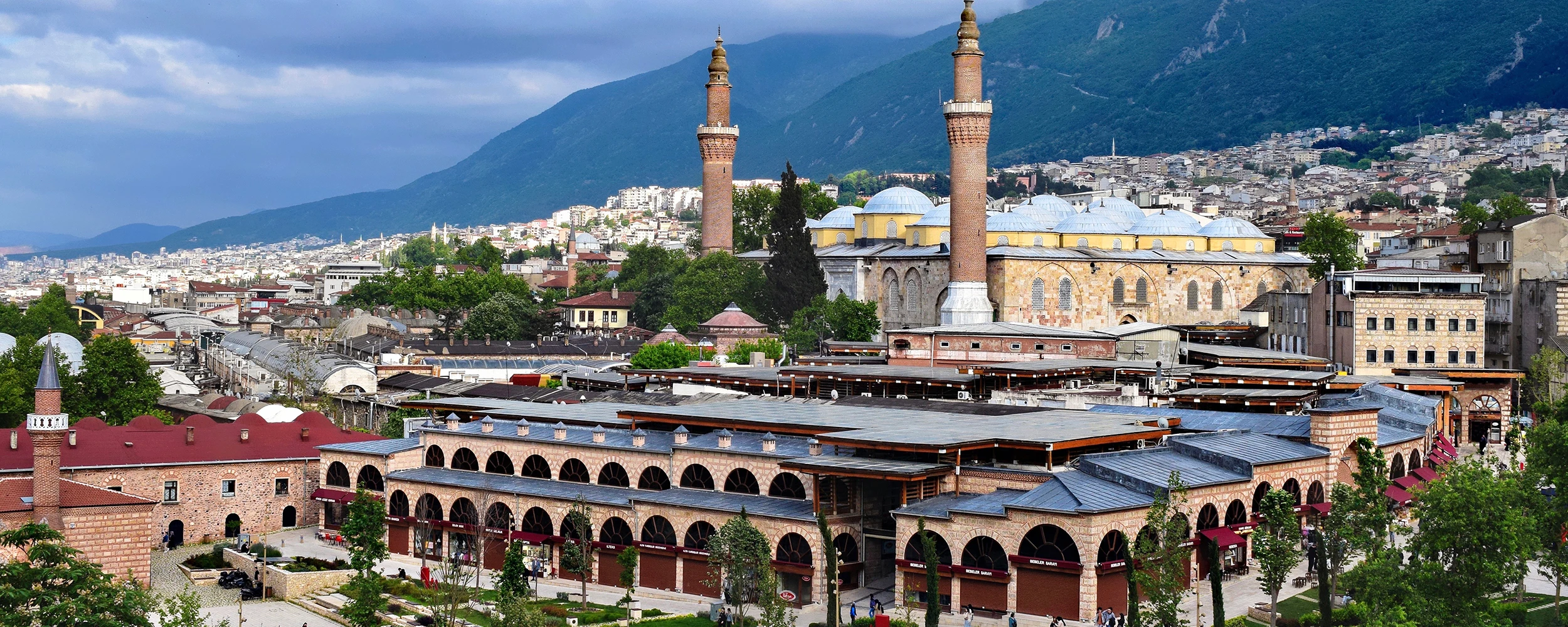
Discover Bursa’s Ottoman monuments, imperial külliyes, historic bazaars, Irgandı Bridge and traditional neighbourhoods before continuing to the UNESCO village of Cumalıkızık.
Request This TourConnect Bursa’s Ottoman commercial heritage with the great historical landscapes of Türkiye.
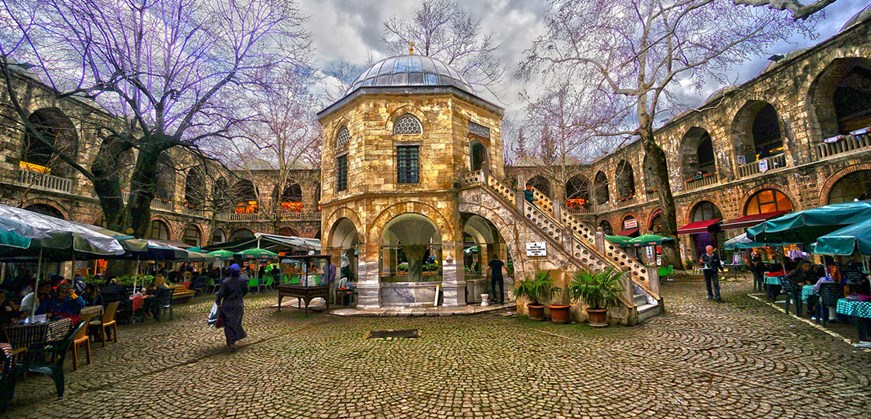
Travel through Istanbul, Bursa, Safranbolu, Hattusha, Cappadocia, Mount Nemrut, Şanlıurfa, Ephesus, Pamukkale, Pergamon, Troy and Gallipoli.
View Tour
Build a private journey connecting Bursa, Edirne and Istanbul, following Ottoman architecture, historic commerce, imperial mosques, bazaars, royal tombs and the evolution of the Ottoman capital.
Design Your Journey