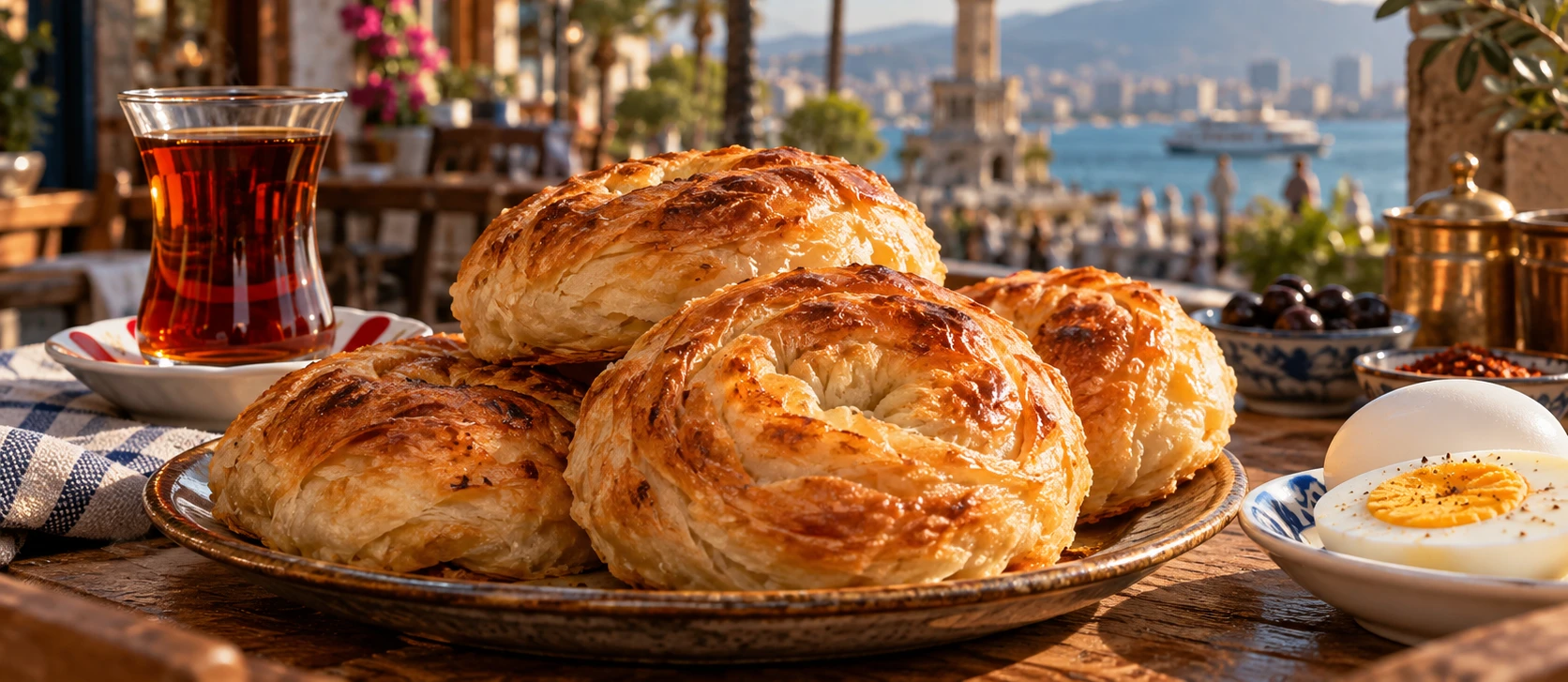
The Iconic Breakfast Pastry of İzmir

İzmir Boyoz – Complete Food Guide

Discover İzmir’s famous golden pastry, its centuries-old story,
distinctive preparation method, breakfast culture, boiled eggs, tea, and local traditions.

Discover İzmir Boyoz

Discover İzmir’s Most Famous Breakfast Pastry

İzmir Boyozu, usually known simply as boyoz, is one of the most recognisable foods of İzmir and one of the city’s defining breakfast traditions. Made from carefully rested, stretched, folded, rolled, shaped, and baked dough, traditional boyoz develops a lightly caramelised golden surface and a tender, layered interior.

For generations, the pastry has been closely associated with everyday life in İzmir. It is sold in bakeries, neighbourhood pastry shops, breakfast cafés, markets, and street-food stands throughout the city. The classic İzmir breakfast combination is wonderfully simple: fresh boyoz, a hard-boiled egg, and hot Turkish tea. This guide explores boyoz history, its officially registered production method, ingredients, texture, geographical-indication status, breakfast customs, modern varieties, visitor tips, and the best ways to experience this unmistakably İzmir tradition.

Golden Layered Pastry

Carefully worked dough creates the soft, flaky and lightly crisp texture associated with authentic İzmir Boyozu.

İzmir Breakfast

Boyoz is traditionally enjoyed in the morning, especially with a hard-boiled egg and a glass of Turkish tea.

Centuries of Tradition

The registered geographical-indication record describes a pastry tradition in İzmir extending back approximately 500 years.

Protected Local Heritage

İzmir Boyozu is officially registered as a geographical indication connected specifically with İzmir Province.

Know Before You Taste

İzmir Boyoz – Quick Facts

Essential information about one of the most characteristic foods of İzmir.

📍

Origin

İzmir on Türkiye’s Aegean coast, where boyoz has become inseparable from the city’s breakfast and street-food culture.

Open İzmir on Google Maps
🥐

Food Type

A round baked pastry made from wheat flour, water, salt, fat, tahini and sunflower oil according to its registered production method.

☕

Classic Pairing

Traditionally eaten for breakfast with a hard-boiled egg and freshly brewed Turkish tea.

🏅

Geographical Indication

Registered by TÜRKPATENT as İzmir Boyozu with geographical-indication registration number 268.


A Pastry Shaped by İzmir

The History of İzmir Boyoz

Explore the multicultural story behind one of İzmir’s most enduring culinary symbols.

İzmir has been a Mediterranean and Aegean trading city for centuries. Turks, Greeks, Jews, Levantines, Armenians, Europeans, and communities arriving from many parts of the Ottoman world all contributed to the city’s complex culinary character.

Within this multicultural environment, boyoz became one of İzmir’s most distinctive baked foods. The official geographical-indication registration describes İzmir Boyozu as a pastry produced in İzmir since the Ottoman period and notes a history extending back approximately 500 years.

Boyoz is frequently associated with İzmir’s historic Sephardic Jewish community. This connection forms an important part of the popular story surrounding the pastry, although Türkiye’s Culture Portal notes that the precise historical origins cannot be documented with complete certainty from currently available information.

What is beyond doubt is the exceptionally strong relationship between boyoz and İzmir. Over time it moved from domestic kitchens into commercial bakeries and eventually became one of the foods most immediately associated with the city.

One name often mentioned in the development of commercial boyoz culture is Avram Usta, remembered as an important figure in popularising professionally produced boyoz in İzmir.

Today, boyoz is no longer simply a bakery product. It represents İzmir’s neighbourhood life, early mornings, bakery counters, cups of tea, conversations around breakfast tables, and the multicultural character that has shaped the city for generations.


What Makes It Special

Distinctive Features of İzmir Boyoz

Authentic İzmir Boyozu is defined by its shape, colour, texture, ingredients, dough-working technique, and connection with the city where it developed.

Round Shape

Traditional İzmir Boyozu has a compact circular form with a characteristic central section created while the rolled dough is shaped by hand.

  • Form: Round
  • Registered diameter: Approximately 7–9 cm
  • Registered thickness: Approximately 2.5–3.5 cm

Lightly Caramelised Surface

Boyoz is baked until its exterior develops a lightly caramelised colour rather than appearing pale and undercooked or excessively dark and burnt.

  • Colour: Golden to lightly caramelised
  • Surface: Baked and gently crisp
  • Avoid: Burnt or raw appearance

Layered Texture

Repeated resting, stretching, folding, rolling, and shaping creates the characteristic layered structure that separates boyoz from ordinary bread rolls.

  • Exterior: Gently crisp
  • Interior: Tender and layered
  • Texture: Neither excessively hard nor overly soft

Repeated Dough Resting

Resting the dough at several stages allows it to relax before stretching and shaping. This contributes to the final texture and makes the dough easier to work.

  • Method: Multiple resting periods
  • Typical stage: Around 10–15 minutes
  • Purpose: Relaxation and easier stretching

Tahini and Pastry Fat

The current registered production method includes a pastry-fat mixture containing tahini. This is spread between prepared dough pieces before further stretching and folding.

  • Ingredient: Pastry fat
  • Traditional specification: Tahini incorporated into the fat mixture
  • Function: Supports richness and layered structure

Sunflower Oil

Small amounts of sunflower oil are used at different stages of the official method, including during dough preparation and before baking.

  • Use: Dough working and finishing
  • Amount: Applied sparingly
  • Role: Helps control the dough surface

Hot Oven Baking

Prepared boyoz pieces are baked in a hot oven until the outer surface becomes lightly caramelised and the dough develops its characteristic structure.

  • Temperature: Approximately 180–200°C
  • Time: Approximately 15–25 minutes
  • Finish: Lightly caramelised colour

Baker’s Skill

The registered method depends heavily on technique. Stretching the dough evenly, folding it correctly, creating the cylindrical roll, shaping the centre, and controlling the oven all require practice.

  • Key skill: Stretching and folding
  • Challenge: Maintaining even thickness
  • Goal: Consistent texture, colour and shape

İzmir Boyozu Geographical Indication

İzmir Boyozu is officially registered by the Turkish Patent and Trademark Office as a geographical indication linked with İzmir Province.

Registration Name

The official registered geographical-indication name is İzmir Boyozu.

Registration Number

İzmir Boyozu carries geographical-indication registration number 268.

Registration Date

The geographical indication was registered on 8 December 2017.

Application Date

The original geographical-indication application was filed on 13 July 2012.

Type

İzmir Boyozu is registered as a Mahreç İşareti, a protected geographical indication.

Registrant

The registration is held by the İzmir Chamber of Commerce.


The registered geographical boundary is İzmir Province. According to the specification, the pastry’s production requires local know-how and all production stages associated with registered İzmir Boyozu take place within this geographical boundary.

The registration defines the product’s ingredients, physical characteristics, dough-resting stages, stretching and folding process, shaping method, baking conditions, and quality-control requirements.

Ingredients Used in Traditional İzmir Boyozu

The registered version of İzmir Boyozu is based on relatively simple ingredients. Its distinctive character comes primarily from the way the dough is repeatedly rested, stretched, layered, folded, rolled, shaped, and baked.

Wheat Flour

Wheat flour forms the foundation of the boyoz dough and provides the structure necessary for stretching and folding.

Water

Water is added to the flour to form the dough. The registered specification defines the water quantity in relation to the amount of flour used.

Salt

Salt seasons the dough and forms part of the traditional registered formula.

Pastry Fat

Special pastry fat is incorporated during the layering process and helps create boyoz’s distinctive richness and texture.

Tahini

The current registered method blends tahini with the pastry fat before the mixture is spread over the dough.

Sunflower Oil

Small quantities of sunflower oil are applied during the dough-working process and before the shaped pastries enter the oven.


The Classic Breakfast Accompaniments

Hard-Boiled Egg The most iconic accompaniment to traditional İzmir boyoz
Turkish Tea Freshly brewed black tea completes the classic İzmir breakfast combination
İzmir Tulum Cheese A regional cheese that can turn boyoz into a more substantial Aegean breakfast
Olives A natural addition to a wider İzmir-style breakfast table
Fresh Tomato and Cucumber Common breakfast additions that provide freshness beside the rich pastry

How Traditional İzmir Boyozu Is Made

The official registered production process is considerably more detailed than simply mixing dough and baking it. Repeated resting, layering, stretching, folding, and shaping create the distinctive structure of İzmir Boyozu.

1. Prepare the Dough Wheat flour, water and salt are kneaded together until a workable dough is formed
2. First Rest The dough is covered with a clean, slightly damp cloth and rested at room temperature for approximately 10–15 minutes
3. Form the Dough Balls The rested dough is divided into portions and shaped into rounded pieces known as bezes
4. Flatten the Dough The dough portions are pressed and opened evenly on the work surface
5. Add the Fat Mixture A pastry-fat mixture containing tahini is spread over one prepared piece of dough
6. Combine the Dough A second ungreased dough piece is placed above the prepared piece and the edges are carefully joined
7. Apply Sunflower Oil Small amounts of sunflower oil are spread over the upper and lower surfaces
8. Rest Again The prepared dough is covered and allowed to rest again before stretching
9. Roll and Stretch The dough is first widened with a rolling pin and then stretched by hand until it becomes thin and evenly distributed
10. Fold the Dough The thin dough is folded inward from different sides to begin creating the characteristic layered structure
11. Form a Cylinder The folded dough is rolled by hand into a long cylindrical form
12. Rest the Cylinder The cylindrical dough is covered again and rested at room temperature
13. Shape Individual Boyoz Pieces are separated by hand and pressed inward at their centres to create the characteristic göbek, or central section
14. Final Rest The shaped pieces are placed on baking trays and allowed another short resting period
15. Finish with Oil A small quantity of sunflower oil is applied before the pastries enter the oven
16. Bake The boyoz is baked at approximately 180–200°C for around 15–25 minutes until the surface becomes lightly caramelised
17. Cool and Serve The pastries are allowed to cool at room temperature and are best enjoyed fresh

What Should Authentic İzmir Boyoz Be Like?

A well-made boyoz is not identical to croissant, puff pastry, bread, or ordinary börek. Its particular combination of shape, layering, richness, softness, and lightly crisp baked surfaces creates its own character.

Outside

The exterior should be baked and lightly caramelised with delicate crispness around some of the folds and edges.

Inside

The interior should feel tender, rich, and layered rather than dense like an ordinary bread roll.

Structure

The pastry should hold its round shape without unwanted crumbling, breaking, or collapsing.

Texture

The registered description specifies a pastry that is neither excessively hard nor excessively soft and breaks down easily in the mouth.

Flavour

The traditional version has a relatively subtle savoury flavour in which baked dough, fat, and light toasted notes remain prominent.

Aroma

Fresh boyoz should carry the warm aroma of baked pastry without burnt, stale, or foreign odours.

Boyoz and İzmir Breakfast Culture

To understand boyoz properly, it helps to experience it not simply as a pastry but as part of an İzmir morning.

Early-Morning Bakeries

Many İzmir bakeries prepare boyoz for morning service, filling neighbourhood streets with the smell of freshly baked pastry.

Boyoz and Egg

A hard-boiled egg is perhaps the most famous companion to boyoz and one of the city’s most recognisable breakfast combinations.

Turkish Tea

Hot black tea cuts through the richness of the pastry and turns a simple boyoz into a classic İzmir breakfast.

Street Culture

Boyoz can be eaten quickly on the way to work, enjoyed standing near a bakery, or served as part of a longer breakfast at a café.

Neighbourhood Tradition

Regular customers often have favourite bakeries where the texture and degree of browning reflect the individual style of the baker.

Simple and Everyday

Part of boyoz’s appeal is its accessibility. It is an everyday İzmir food rather than something reserved only for festivals or special occasions.

Why Is Boyoz Eaten with a Hard-Boiled Egg?

The combination of boyoz and hard-boiled egg is one of the most characteristic features of İzmir breakfast culture. The rich pastry provides carbohydrates and fat, while the egg adds a contrasting texture and makes the breakfast more substantial.

Texture Contrast

The soft boiled egg contrasts with the flaky, layered and gently crisp textures of freshly baked boyoz.

Simple Breakfast

Boyoz and egg create an uncomplicated breakfast that can be eaten quickly without requiring a large table of dishes.

Bakery Tradition

Many places selling traditional boyoz also offer cooked eggs specifically because the two foods are so strongly associated.

Add Turkish Tea

A glass of Turkish tea completes what many visitors recognise as the classic İzmir boyoz experience.

Is Boyoz a Sephardic Jewish Food?

Boyoz is widely associated with the Sephardic Jewish community of İzmir, and this connection has become an important part of the city’s culinary narrative.

Sephardic Jews established a significant community in Ottoman İzmir and contributed deeply to the city’s commercial, social, linguistic, and culinary life. Many descriptions of boyoz therefore connect the pastry with Sephardic baking traditions.

However, Türkiye’s official Culture Portal takes a careful historical position: although some researchers trace boyoz to Sephardic cuisine, currently available information does not allow the exact origin to be stated with absolute certainty.

For visitors, the most useful way to understand boyoz is therefore as a product of İzmir’s multicultural history — a pastry with strong Jewish associations that ultimately became part of the shared culinary identity of the entire city.

Traditional Boyoz and Modern Boyoz Varieties

The most recognisable traditional boyoz is plain, allowing the flavour and texture of the dough itself to remain the focus. Modern bakeries, however, frequently offer additional varieties.

Plain Boyoz

The classic and most representative version, with no filling competing with the layered pastry itself.

Cheese Boyoz

A popular contemporary variation containing cheese and offering a richer, more substantial breakfast.

Spinach Boyoz

Spinach-filled versions can be found at bakeries that offer a wider range of savoury boyoz styles.

Mixed Fillings

Modern bakeries may experiment with vegetables, cheeses, olives, or other fillings according to local demand.


For a first experience, choose a freshly baked plain boyoz. It provides the clearest introduction to the texture and flavour that made the pastry famous before trying contemporary filled versions.

How İzmir Boyoz Is Traditionally Served

Boyoz is at its best when fresh and is normally served without elaborate presentation. Its simplicity is part of the experience.

Fresh Boyoz Serve freshly baked or gently warmed so that the pastry retains its characteristic texture
Hard-Boiled Egg The classic savoury accompaniment and an essential part of the traditional İzmir breakfast experience
Turkish Tea Hot black tea served in a traditional glass is the most characteristic drink pairing
İzmir Tulum Cheese An optional regional addition for a more substantial Aegean breakfast
Olives A natural accompaniment when boyoz is served as part of a larger breakfast
Fresh Vegetables Tomato, cucumber and peppers can add freshness to a full breakfast table

Many İzmir residents keep the meal extremely simple: one or two warm boyoz, an egg, and tea. Visitors do not need an elaborate breakfast spread to experience the tradition authentically.

What Does İzmir Boyoz Taste Like?

Traditional plain boyoz has a savoury, gently rich flavour. Its appeal depends as much on texture as taste: crisp baked edges, soft layers, subtle toasted notes, and the richness created by its carefully worked dough.

Rich but Mild

The pastry is rich enough to feel satisfying without depending on strong spices, herbs, or fillings.

Toasted Notes

The lightly caramelised outer surface develops warm baked flavours and contrasts with the softer interior.

Layered Mouthfeel

The repeated folding and rolling create a more complex texture than ordinary breakfast bread.

Best While Fresh

Freshness matters greatly because the contrast between the outer layers and softer centre becomes less pronounced over time.


Visitors expecting something sweet should remember that classic boyoz is primarily a savoury breakfast pastry. Its flavour is understated, which is exactly why tea, egg, cheese, and other breakfast foods pair with it so naturally.

Where to Eat Boyoz in İzmir

Boyoz can be found across İzmir, from neighbourhood bakeries to historic markets and modern cafés. For travellers, several districts provide particularly atmospheric settings.

Kemeraltı

Combine fresh boyoz and tea with a morning walk through İzmir’s historic commercial heart, traditional shops, inns, markets, and narrow streets.

Konak

The central district surrounding Konak Square provides countless opportunities to combine breakfast with İzmir’s best-known landmarks.

Alsancak

Neighbourhood bakeries and cafés around Alsancak make it easy to enjoy boyoz before walking along Kordon.

Basmane

Historic Basmane offers a more traditional urban atmosphere and access to bakeries serving İzmir’s everyday breakfast foods.

Neighbourhood Bakeries

Some of the most satisfying boyoz experiences are found away from tourist areas at busy local bakeries with regular morning customers.

Street Stands

Boyoz is also associated with simple covered street stands and takeaway counters serving people on their way to work or school.


For the best experience, look for a bakery with a steady morning flow of local customers and trays of boyoz arriving fresh from the oven.

What Is the Best Time to Eat Boyoz?

Boyoz can be eaten throughout the day, but its strongest cultural connection is with breakfast and the early morning.

Early Morning

This is the ideal time to encounter fresh trays emerging from the oven and experience boyoz as part of everyday İzmir life.

Breakfast

Pair boyoz with a boiled egg and tea for the city’s classic breakfast combination.

Mid-Morning

A fresh boyoz also makes an easy snack while exploring Kemeraltı, Konak or Alsancak.

Later in the Day

Boyoz may still be available, but bakery freshness and selection can be better during the morning hours.

Why Freshness Matters

The official geographical-indication specification recommends consuming İzmir Boyozu soon after production. Fresh boyoz offers the best balance between its baked exterior and tender interior.

Fresh Texture

The contrast between delicately crisp exterior layers and softer interior layers is clearest soon after baking.

Better Aroma

Fresh boyoz carries the warm aroma of recently baked dough and lightly caramelised pastry.

Short Storage

The registered specification allows short-term room-temperature storage under suitable covered conditions when immediate consumption is not possible.

Gentle Reheating

Boyoz stored for a short period may be warmed gently before serving to improve its texture.

İzmir Boyoz Visitor Tips

Go in the Morning

Morning offers the best chance of finding boyoz fresh from the oven and experiencing it as part of İzmir’s real breakfast culture.

Start with Plain Boyoz

Try the classic unfilled version first before exploring modern cheese, spinach, or other varieties.

Add a Boiled Egg

The egg is not simply a random side dish; it is one of the defining elements of the traditional İzmir boyoz breakfast.

Order Turkish Tea

A glass of hot tea balances the richness of the pastry and completes the classic combination.

Choose a Busy Bakery

High turnover usually means trays are being baked regularly and the boyoz has spent less time waiting on the counter.

Eat It Fresh

Boyoz is most enjoyable when the surface still has texture and the interior remains tender.

Do Not Expect a Croissant

Although both are layered pastries, boyoz has its own dough technique, shape, texture, flavour, and local identity.

Explore Different Bakeries

Small differences in browning, layering, softness, and size make comparing local bakeries part of the fun.

Other İzmir Foods to Try with Boyoz

Boyoz is only one part of İzmir’s exceptionally varied culinary identity. The city combines Aegean herbs, olive oil, seafood, bakery traditions, street food, regional cheeses, meat dishes, and desserts.

İzmir Gevreği

İzmir’s distinctive interpretation of the sesame-covered bread ring known elsewhere in Türkiye as simit.

İzmir Tulum Cheese

A characteristic regional cheese frequently included in İzmir breakfast tables and an excellent partner for bread and pastries.

Kumru

A famous İzmir sandwich prepared in its characteristic bread and sold in several traditional and modern versions.

Söğüş

One of İzmir’s most distinctive street foods, traditionally prepared with finely sliced offal and fresh accompaniments.

İzmir Köfte

A beloved regional meatball dish generally prepared with potatoes, tomatoes, peppers, and a rich sauce.

İzmir Lokması

Small pieces of fried dough soaked in syrup and closely connected with İzmir’s tradition of community sharing.

Şambali

A dense semolina dessert associated with İzmir street-food culture and traditionally finished with syrup.

Aegean Herb Dishes

Wild greens dressed with olive oil and lemon reveal another side of İzmir’s strongly Aegean culinary identity.

Boyoz vs Croissant – What Is the Difference?

Visitors sometimes compare boyoz with croissant because both pastries can appear layered and rich. Their traditions and preparation methods, however, are quite different.

Origin Boyoz is deeply associated with İzmir, while croissant belongs to a different European baking tradition
Shape Traditional boyoz is compact and round rather than crescent shaped
Dough Technique Boyoz uses its own sequence of resting, stretching, folding, rolling and central shaping
Registered Ingredients Current İzmir Boyozu specifications include a tahini-containing pastry-fat mixture and sunflower oil
Serving Culture Boyoz is strongly associated with boiled eggs and Turkish tea in İzmir breakfast culture
Identity Boyoz functions as a cultural symbol of İzmir rather than simply a generic layered pastry

Boyoz and a Morning in Kemeraltı

One of the most enjoyable ways to experience İzmir is to begin the morning with boyoz and tea before exploring Kemeraltı Bazaar.

The historic commercial district lies behind Konak Square and contains a fascinating network of streets, covered passages, traditional shops, mosques, synagogues, workshops, cafés, restaurants, caravanserais, spice sellers, and market stalls.

A simple morning can begin with fresh boyoz, a boiled egg and tea, continue through Kemeraltı toward the historic Kızlarağası Hanı, and finish with Turkish coffee before exploring the Agora, Konak, or the waterfront.

This combination of food and walking is particularly appropriate because boyoz is not a ceremonial restaurant dish. It belongs to the everyday city — exactly the İzmir visitors encounter while walking through its markets and neighbourhoods.

Why Boyoz Matters to İzmir

Certain foods become so strongly associated with a destination that they function almost like cultural landmarks. For İzmir, boyoz is one of those foods.

Urban Identity

The word boyoz immediately evokes İzmir for many people in Türkiye and has become shorthand for the city’s food culture.

Multicultural Memory

The pastry reflects the layers of migration and cultural exchange that shaped Ottoman and modern İzmir.

Everyday Tradition

Unlike heritage foods encountered only at festivals, boyoz remains part of normal daily life.

Local Pride

Its geographical-indication registration formally recognises the close relationship between the pastry and İzmir.

Street-Food Culture

Boyoz connects bakeries, street stands, commuters, students, markets, and neighbourhood breakfast routines.

Travel Experience

For visitors, tasting boyoz offers an inexpensive and accessible way to participate in a genuine local custom.

Frequently Asked Questions About İzmir Boyoz

What is boyoz?

Boyoz is a traditional round baked pastry strongly associated with İzmir. It is prepared through a detailed process of resting, stretching, folding, rolling, shaping and baking dough until lightly caramelised.

Where does boyoz come from?

Boyoz is closely identified with İzmir on Türkiye’s Aegean coast. Its official geographical-indication registration defines İzmir Province as its geographical boundary.

Is boyoz a Sephardic Jewish food?

Boyoz is widely associated with İzmir’s historic Sephardic Jewish community. However, Türkiye’s official Culture Portal notes that while researchers connect the pastry with Sephardic cuisine, the exact historical origin cannot be stated with complete certainty from available evidence.

How old is İzmir Boyozu?

The official geographical-indication specification describes a tradition extending back approximately 500 years and states that the pastry has been produced in İzmir since the Ottoman period.

Is İzmir Boyozu geographically indicated?

Yes. İzmir Boyozu is a registered geographical indication of Türkiye.

What is the geographical-indication registration number?

İzmir Boyozu is registered with TÜRKPATENT under registration number 268.

When was İzmir Boyozu registered?

The geographical indication was registered on 8 December 2017 following an application submitted on 13 July 2012.

Who registered İzmir Boyozu?

The registration is held by the İzmir Chamber of Commerce.

What ingredients are used in boyoz?

The registered method uses wheat flour, water, salt, pastry fat, tahini and sunflower oil. The exact preparation process is highly dependent on dough-working technique.

Does traditional boyoz contain tahini?

The current registered production specification includes tahini mixed with pastry fat during the dough-layering stage.

Is boyoz sweet or savoury?

Traditional plain boyoz is a savoury pastry. Its flavour is relatively mild and depends heavily on the baked dough, richness, layering and freshness.

Does traditional boyoz have a filling?

The classic version is plain. Modern bakeries also produce cheese, spinach and other filled varieties, but plain boyoz provides the most traditional introduction.

Why is boyoz eaten with an egg?

A hard-boiled egg has become the classic accompaniment to boyoz in İzmir breakfast culture. Together with Turkish tea, it forms one of the city’s most recognisable morning meals.

What do you drink with boyoz?

Freshly brewed Turkish black tea is the most traditional drink to accompany boyoz.

When do people eat boyoz?

Boyoz is most strongly associated with breakfast and early morning, although it can also be eaten later in the day as a snack.

What does boyoz taste like?

Plain boyoz has a mild savoury flavour with rich baked notes, a gently crisp exterior and a tender layered interior.

Is boyoz the same as a croissant?

No. Although both can have layered textures, boyoz has a different shape, ingredient specification, dough-working technique, cultural history and serving tradition.

How big is traditional İzmir Boyozu?

The geographical-indication specification describes a round pastry approximately 7–9 cm in diameter and around 2.5–3.5 cm thick.

How is boyoz baked?

According to the registered method, shaped boyoz is baked at approximately 180–200°C for around 15–25 minutes until the surface reaches a lightly caramelised colour.

Where can I eat boyoz in İzmir?

Boyoz is widely available at bakeries, pastry shops, cafés and street-food stands throughout İzmir. Kemeraltı, Konak, Alsancak and Basmane are particularly convenient areas for visitors.

What is the best time to try boyoz?

Early morning is ideal because bakeries are serving fresh batches and you can experience boyoz as part of İzmir’s traditional breakfast culture.

What should I order with boyoz?

For the classic experience, order a plain boyoz, a hard-boiled egg and Turkish tea. İzmir Tulum cheese, olives and fresh vegetables can be added for a larger breakfast.

Can vegetarians eat boyoz?

Traditional boyoz does not require a meat filling, but individual bakery recipes and the exact type of pastry fat used may vary. Visitors with dietary requirements should ask the bakery directly about ingredients.

Is boyoz vegan?

Do not assume that every boyoz is vegan. Traditional and commercial recipes may use different pastry fats, so ask the bakery about the specific ingredients used before ordering.

Does boyoz contain gluten?

Yes. Traditional İzmir Boyozu is made with wheat flour and therefore contains gluten.

Is boyoz worth trying in İzmir?

For travellers interested in local food culture, boyoz provides one of the simplest ways to experience an everyday İzmir tradition combining culinary heritage, neighbourhood life and the city’s multicultural history.

Best Photos of İzmir Boyoz

Boyoz is a simple food, but bakery trays, flaky textures, Turkish tea, eggs, market streets and İzmir’s waterfront can create wonderful travel-photography opportunities.

Fresh Bakery Tray

Photograph a full tray of golden boyoz as it comes from the oven, showing the natural variations in folds and browning.

Boyoz Close-Up

Break one open carefully to reveal the layered interior while keeping the golden outer surface in the frame.

Boyoz, Egg and Tea

Create the unmistakable İzmir breakfast composition with a pastry, hard-boiled egg and traditional glass of Turkish tea.

Bakery Counter

Capture rows of boyoz, gevrek and other İzmir breakfast foods together to show the wider local bakery culture.

Kemeraltı Breakfast

Combine boyoz with market streets, traditional shopfronts and the historic atmosphere of Kemeraltı.

İzmir Waterfront

Pair a takeaway breakfast with views of the Gulf, Kordon or Konak to connect the food visually with its home city.


Always ask permission before photographing bakery staff or customers, particularly when working close to preparation areas or behind counters.

İzmir Tours and Culinary Experiences

Discover boyoz as part of a private journey through İzmir’s historic markets, waterfront districts, archaeological heritage, Aegean cuisine, Ephesus, villages, vineyards, and coastal landscapes.

Private İzmir Experiences

Custom-designed private touring with professional guiding, comfortable transportation, flexible timing, and opportunities to experience local bakeries, markets and regional food traditions.

Explore More of the İzmir Region

Combine the city’s culinary traditions with ancient Ephesus, charming Aegean towns, archaeological sites, traditional markets and the landscapes of western Türkiye.

Private Ephesus tours from Izmir

Private Ephesus Tours

Travel from İzmir to Ephesus to explore one of the Mediterranean world’s greatest ancient cities, including monumental streets, temples, theatres and the Library of Celsus.

Explore Tours