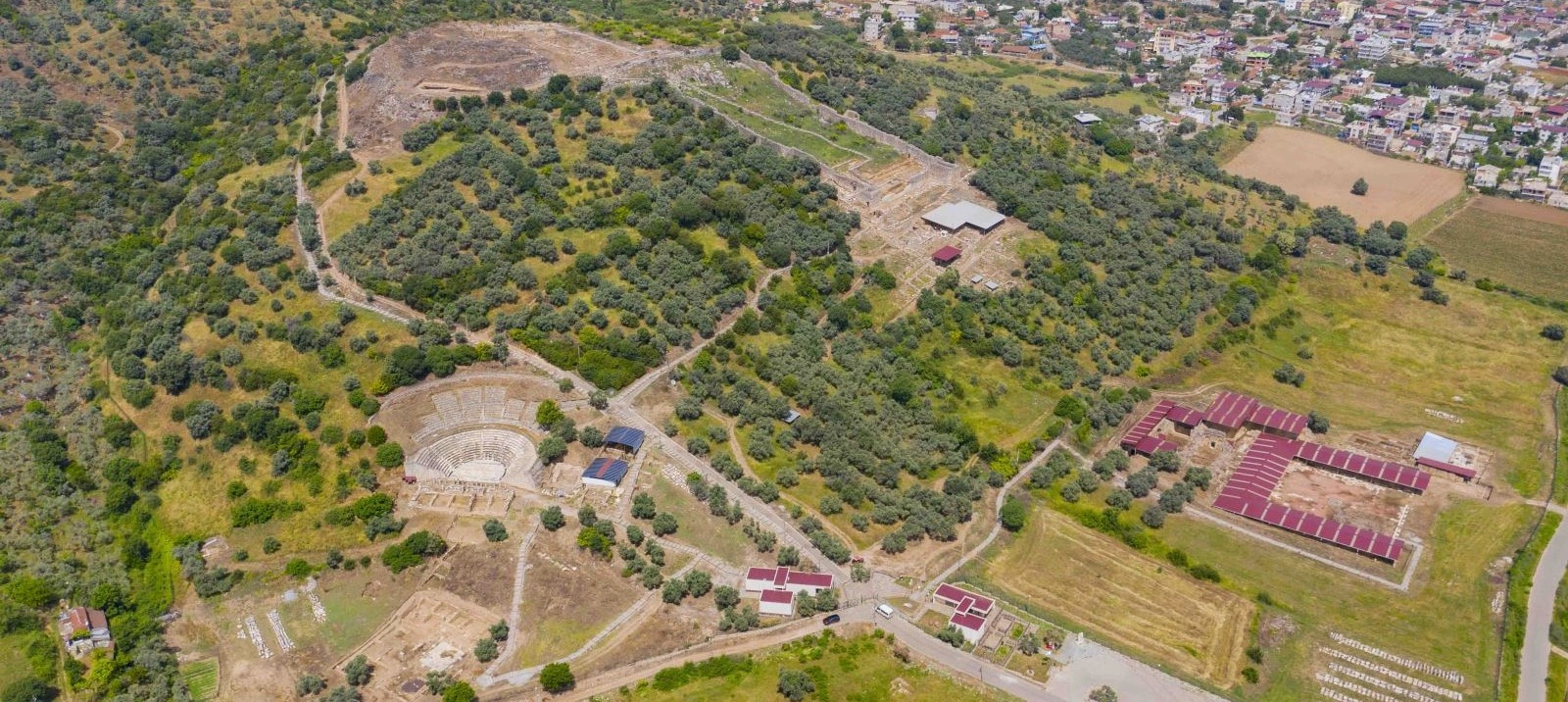
Private Metropolis Ancient City Tour
Explore the theatre, Bouleuterion, stoa, mosaic spaces, Roman houses, baths and acropolis with a private historical focus.
Request a Metropolis Tour





Metropolis Ancient City lies on the western edge of the Torbalı Plain in İzmir Province, between the modern settlements of Yeniköy and Özbey. Its position is one of the keys to its history. The city watched over fertile agricultural land while standing close to the ancient route connecting Smyrna and Ephesus, two of western Anatolia's most important urban centres.
The site is especially valuable because its monuments reveal several layers of ancient civic life at once. Visitors can explore a restored Hellenistic theatre, the Bouleuterion where the city council met, a long stoa, Roman houses, mosaic floors, streets, bath complexes, a gymnasion and the fortified acropolis overlooking the plain.
Metropolis also preserves a much older story. Archaeological evidence from the acropolis reaches back to the Bronze Age, while prehistoric settlement traces have been found in the wider Torbalı region. The city that visitors recognise today, however, took monumental form during the Hellenistic period and flourished especially in the 2nd century BCE under the influence of the Kingdom of Pergamon.
Unlike the enormous scale of Ephesus, Metropolis feels compact and readable. Theatre, council house, houses, baths and streets sit close enough together that travellers can understand how a smaller but prosperous ancient city functioned—politically, socially, economically and religiously—without losing sight of the landscape that supported it.
See one of the site's signature monuments, restored around its marble orchestra and elite front-row seats with strong views across the Torbalı Plain.
Step into the council building where several hundred representatives could gather to debate and make decisions for the ancient city.
Explore the remains of public bathing, exercise and social complexes that reveal how urban life expanded during the Roman period.
Discover decorated domestic and reception spaces with marble paving, colourful wall plaster and mosaics linked with Dionysian and theatrical imagery.
Essential information for understanding the ancient city above the Torbalı Plain before you begin exploring its theatre, council house, baths, mosaics and acropolis.
Between Yeniköy and Özbey in Torbalı district, İzmir Province, western Türkiye.
Ionia, overlooking the fertile Kaystros / Küçük Menderes basin between Smyrna and Ephesus.
Metropolis is traditionally interpreted here as the “City of the Mother Goddess,” connected with the local cult of Meter Gallesia.
The city expanded strongly in the Hellenistic period, especially during the 2nd century BCE under Pergamene influence.
The Hellenistic theatre, later modified under Rome and restored in modern times, with seating for roughly 4,000 spectators.
The 2nd-century BCE Bouleuterion, a council building designed for roughly 350–400 participants.
Upper and lower bath complexes, a gymnasion and palaestra show how the city expanded down the hillside under Roman rule.
Mosaic floors, wall plaster, sculpture and architectural decoration reveal the wealth and artistic character of ancient Metropolis.
Its fertile hinterland, strategic road position and reputation for wine helped support the city's prosperity.
Scientific excavations began in 1989 and continue today, with Prof. Dr. Serdar Aybek leading the project since 2007.
The official museum listing currently shows the site as open and free to enter.
Allow around 2–3 hours for the main archaeological route, longer if you want detailed photography and slower monument study.
Metropolis is one of the best places in the İzmir region to understand how a prosperous medium-sized ancient city actually worked. Its monuments are varied, close together and unusually easy to connect into one urban story.
The first reason to visit is the Hellenistic city centre. Metropolis preserves a theatre, Bouleuterion and stoa that together represent entertainment, government and public gathering. Instead of seeing one isolated monument, you can follow the relationship between the institutions that structured civic life.
The second reason is the site's Roman transformation. As the city expanded down the slope, wealthy residences, streets, shops, baths and exercise spaces appeared around the earlier Hellenistic core. The Peristyle House and mosaic spaces add a domestic scale that helps make the ancient city feel inhabited rather than purely monumental.
The third reason is the landscape. From the upper parts of the site, the Torbalı Plain stretches below. This view explains the city's agricultural wealth and strategic importance on the corridor between İzmir and Ephesus far better than a map alone can do.
Finally, Metropolis remains far quieter than the major archaeological destinations of western Türkiye. That makes it especially rewarding for travellers who want time to look closely at architecture, inscriptions, mosaics and city planning without moving through a large crowd.
Metropolis Ancient City is located in the Torbalı district of İzmir Province, between the modern settlements of Yeniköy and Özbey. The archaeological site occupies a hillside at the edge of the plain, with its acropolis rising above the surrounding agricultural landscape.
Torbalı lies roughly 45 kilometres from central İzmir in regional terms, while the ancient city is about 12 kilometres from Torbalı town centre according to local official information. Road distance varies according to your starting point and current route.
The ancient location was highly strategic. Metropolis stood close to the main corridor between Smyrna and Ephesus, allowing people, agricultural products and commercial goods to move through the region. At the same time, the fertile Kaystros—today Küçük Menderes—basin provided the agricultural wealth that supported the city.
The ancient name Metropolis is traditionally explained at the site as meaning the “City of the Mother Goddess.” In this local context, the name is associated with Meter Gallesia, a Mother Goddess whose cult was connected with the mountain landscape behind the city.
This religious connection is important because the word should not be understood only through its modern English meaning of a very large city. Ancient Metropolis was never one of the Mediterranean's giant urban centres. Its name reflected sacred identity rather than population size.
Archaeological work at Uyuzdere revealed a cult area associated with the Mother Goddess, and excavation at Metropolis first began there in 1989. The sacred landscape therefore forms part of both the ancient city's identity and the modern history of research at the site.
The history of Metropolis is much older than its best-preserved public buildings. Archaeological evidence from the acropolis demonstrates occupation reaching back into the Bronze Age, while the wider Torbalı region preserves even earlier prehistoric settlement traces.
A Greek settlement developed on and around the acropolis during the first millennium BCE, but the city experienced its decisive urban transformation during the Hellenistic period. By the 3rd century BCE Metropolis had taken on a recognisable city form, and during the 2nd century BCE—when the region was strongly connected with the Kingdom of Pergamon—major public buildings including the theatre, Bouleuterion and stoa were constructed.
Under Roman rule, Metropolis continued to prosper on the route between Smyrna and Ephesus. The city expanded down the hillside, and new houses, shops, baths, exercise facilities and streets were built. Repairs and architectural changes after the major earthquake of 17 CE also formed part of this Roman rebuilding process.
In Late Antiquity, Metropolis became a Christian episcopal centre. Over time, changing economic and political conditions caused the settlement to contract toward more defensible parts of the hill, and a fortified zone developed around the upper city.
By the 14th century the region had entered the sphere of the Aydınoğulları Beyliği. The ancient settlement gradually lost its urban role, while population and regional life shifted toward the area that developed into modern Torbalı.
Metropolis is often introduced through its Hellenistic theatre, but the hill had been used long before that monument was built. Excavations on the acropolis have produced material from the Early and Middle Bronze Ages, showing that the location was attractive thousands of years before the classical city reached its peak.
The wider Torbalı area adds an even longer prehistoric context. Official archaeological summaries point to Neolithic settlement traces at places such as Tepeköy, Dedecik and Kuşçuburun. These sites demonstrate that the plain had supported farming communities and local exchange networks long before Metropolis became an urban centre.
A seal associated with the Late Bronze Age / Hittite cultural world has also been recovered from the Metropolis area, illustrating the site's position within the complex political landscape of western Anatolia during the second millennium BCE.
Most visitors will not see monumental Bronze Age architecture standing above ground. This early history survives mainly through excavation layers, ceramics and small finds, reminding us that ancient cities were often built over landscapes already occupied for generations.
The visible identity of Metropolis was created above all during the Hellenistic period. The 3rd and 2nd centuries BCE saw the development of a carefully organised civic centre with public buildings, defensive architecture and formal spaces for politics, performance and community life.
The city's theatre, Bouleuterion and stoa belong to this broad period. Together they formed a powerful statement of civic organisation: citizens watched performances in the theatre, representatives met in the council building and the stoa supported daily social, political and commercial activity.
The Hellenistic city was also strongly defended. Fortification walls protected the acropolis and controlled movement between the upper city, the lower slopes and necropolis areas. Because Metropolis stood on a strategic route, urban defence was closely tied to control of the surrounding landscape.
What makes Metropolis particularly valuable is the survival of this Hellenistic layer beneath later Roman development. In many ancient cities, Roman rebuilding dominates the visitor experience; here, the political and architectural character of the earlier city remains unusually visible.
Metropolis reached a particularly important phase of development during the 2nd century BCE, when western Anatolia was shaped by the power and cultural influence of the Attalid Kingdom of Pergamon.
Official archaeological interpretation connects this period with major civic investment at Metropolis. The theatre, Bouleuterion and stoa illustrate the confidence of a community participating in the prosperous political and cultural networks of Hellenistic western Anatolia.
Pergamene influence did not mean that Metropolis lost its local identity. The city maintained its own civic institutions, cults and elite families while operating within the wider regional system dominated by Pergamon.
After the Attalid kingdom passed to Rome in 133 BCE, Metropolis entered the Roman political world but retained and adapted much of its Hellenistic urban framework.
Roman rule did not replace the Hellenistic city so much as expand and reorganise it. Metropolis continued to benefit from its location on the road between Smyrna and Ephesus, and the growing urban population spread into lower areas of the hillside.
The Roman city included peristyle houses, shops, streets, baths, exercise areas and decorated reception spaces. These remains help reconstruct daily life beyond temples and civic monuments: where wealthy families lived, where residents bathed, where people exercised and where trade took place.
The earthquake that struck western Anatolia in 17 CE affected many cities in the region. Archaeological interpretation at Metropolis connects later repairs and architectural changes with the rebuilding that followed this disaster.
By the 2nd century CE the city had developed into a carefully planned urban environment despite its hillside setting. Public and private architecture, paved routes and bath complexes demonstrate that Metropolis remained economically healthy under the Roman Empire.
Metropolis remained inhabited after the high Roman Imperial period and became an episcopal centre during Late Antiquity. Christian institutions formed part of the changing urban landscape as the religious identity of western Anatolia transformed.
At the same time, the city's physical footprint gradually contracted. Economic pressures, warfare and changing settlement patterns encouraged residents to concentrate in more defensible zones closer to the upper city.
A fortified area developed as older buildings were reused, altered or incorporated into later defensive structures. This process is typical of many Anatolian cities, where the enormous public spaces of the Roman period became harder to maintain as population and political conditions changed.
By the medieval period Metropolis no longer functioned as the broad classical city represented by its Hellenistic and Roman monuments, but occupation continued in and around the ancient landscape before regional life shifted toward later settlements.
The identity of Metropolis is closely connected with the Mother Goddess. Official archaeological interpretation links the city's name with Meter Gallesia, a local form of the ancient Anatolian Mother Goddess associated with the mountain landscape behind the settlement.
A cult area at Uyuzdere produced important evidence for this religious tradition, including a statue associated with the goddess. Scientific excavation at Metropolis began in this sacred area in 1989 before work expanded across the city.
Mother Goddess cults had deep roots in Anatolia and often became connected with mountains, caves, fertility, protection and the natural landscape. At Metropolis, religion was therefore not confined to a single temple building: the surrounding terrain formed part of sacred identity.
For visitors, this connection gives the city name much more meaning. Metropolis was not simply a “mother city” in the modern linguistic sense, but a community whose name and sacred geography were tied to a powerful local goddess tradition.
The theatre is the most immediately impressive monument at Metropolis. It was built into the natural hillside during the Hellenistic period, using the slope to support its semicircular seating area while orienting the audience toward the stage and the open landscape beyond.
The theatre was later modified during the Roman period. The orchestra received marble paving, the stage building was expanded and the monument continued to serve changing forms of public performance and ceremony.
One of its most distinctive features is the group of honorary front-row seats reserved for elite spectators, important visitors and religious or civic dignitaries. Decorative reliefs associated with Zeus and Ares add another layer of meaning to the seating area.
The official Turkish Museums listing currently describes the restored theatre as holding approximately 4,000 spectators. Restoration work carried out in 2000–2001 helped stabilise and present the monument for visitors.
Hellenistic construction with later Roman rebuilding and modification.
Approximately 4,000 spectators according to the current official museum description.
Elite front-row seats, marble orchestra paving and decorative reliefs.
Climb slightly above the cavea to understand both the theatre geometry and its relationship with the plain.
The Bouleuterion was the political heart of the city. In Greek civic life, this was the building where council members gathered to discuss public matters, prepare decisions and manage the practical administration of the community.
The Metropolis Bouleuterion was constructed in the 2nd century BCE. It has an almost square outer plan containing a curved arrangement of stone seating, creating a compact chamber designed for speech, debate and collective decision-making.
Official visitor information gives the building a capacity of roughly 350 people, while some local descriptions round the figure closer to 400. Either way, the scale is very different from the theatre: this was an intimate political space for civic representatives rather than a mass audience.
Standing here is one of the best ways to understand that Metropolis was not simply a collection of monuments. It was a self-governing urban community with councils, benefactors, officials and citizens participating in public life.
The stoa was one of the most flexible buildings in an ancient Greek city. Its long roofed colonnade provided protection from strong sun and rain while supporting political conversations, commercial activity, religious events and everyday social life.
Metropolis' stoa was built in the 2nd century BCE and used two rows of Doric columns to carry its roof. Local official descriptions place it at roughly 67 metres in length, making it one of the defining architectural lines of the Hellenistic civic centre.
Inscriptions on elements of the building record the names of wealthy citizens who contributed financially to its construction. These names are valuable evidence for the ancient system of civic benefaction, in which local elites enhanced public space while also gaining prestige and public memory.
The stoa helps connect Metropolis' political monuments with ordinary daily movement. Not every important activity happened inside a temple or council chamber; many took place in semi-open public architecture like this.
The acropolis occupies the most defensible part of Metropolis and dominates the Torbalı Plain. Official museum information describes an upper-city area of around 16,000 square metres, with archaeological evidence showing occupation beginning in the third millennium BCE.
During the Hellenistic period the acropolis was enclosed with strong fortification walls. Gates controlled movement between the upper city, the urban centre and surrounding funerary zones, demonstrating how defence and city planning were integrated into the hillside.
Metropolis also possessed an important cult of Ares, the god of war. Archaeological and epigraphic evidence connects the city with a sanctuary and strong visual symbols of Ares, including relief imagery in the theatre.
Even where sacred buildings survive only in foundations or fragmentary form, the upper hill remains essential because it reveals why Metropolis was founded here: visibility, defence, control of roads and command over the agricultural plain all come together in one viewpoint.
One of the most memorable decorated spaces at Metropolis lies close to the theatre. Excavation revealed a large Roman-period room with wall painting and mosaic floors, demonstrating the high artistic quality of the city's later urban spaces.
The main mosaic includes imagery associated with Dionysos and Ariadne together with figures connected to Dionysian mythology. Another panel incorporates theatrical masks as well as bird and fish motifs.
Because of its location and imagery, the room has been interpreted as a reception or gathering space related to the theatre environment. The combination of performance symbolism and elaborate decoration would have made it an appropriate place for social activity connected with public events.
The mosaic hall is an important reminder that ancient architecture was once colourful. White stone ruins dominate modern archaeological sites, but elite interiors were often filled with painted plaster, coloured stone, sculpture and patterned floors.
The Peristyle House was discovered on the slope below the theatre and provides one of the clearest windows into private life at Roman Metropolis. Instead of representing government or public ceremony, the building belonged to a wealthy household.
Its plan centres on a broad courtyard paved with marble slabs and surrounded by columns. Rooms opened around this central space, creating a carefully organised domestic environment with both private and reception functions.
Fragments of colourful wall plaster, architectural decoration and rich finds show that the residents invested heavily in the visual quality of the house. The building helps reveal how social status was communicated through interior architecture.
For visitors who have already seen monumental theatres and temples elsewhere, the Peristyle House is especially rewarding because it brings the ancient city down to a human scale: courtyards, rooms, decoration and movement through a private home.
Ancient gymnasia were not simply sports halls. They were places where physical training, education, conversation and civic identity came together. Metropolis possessed a gymnasion that later developed into a larger bath-and-exercise complex.
Archaeological interpretation connects important rebuilding here with the period after the 17 CE earthquake. A bath installation was added to the earlier gymnasion, creating a complex that served both exercise and the Roman social culture of public bathing.
The bath used typical Roman heating technology. Warm rooms could be heated through a hypocaust system beneath the floors, while hollow wall elements helped circulate heat vertically through the building.
The complex is especially interesting because inscriptions connect the gymnasion with named civic figures, including a woman called Alexandra Myrton, whose role offers unusual evidence for women's participation in the public life of Hellenistic Metropolis.
The Lower Bath–Palaestra complex represents the scale of Roman public life at Metropolis. Excavations uncovered a substantial bath building with marble-faced interiors and specially designed stepped pools arranged around its central spaces.
To the east lay a large palaestra—an open exercise courtyard surrounded by colonnaded galleries. Archaeological work has shown that sections of these surrounding walkways were decorated with geometric mosaic floors.
Roman baths were not only places to wash. They functioned as social clubs, exercise centres and meeting places where residents moved through changing temperatures, conversation and recreation.
The lower complex demonstrates how far the city expanded beyond its earlier Hellenistic centre and how Roman urban culture reshaped the lower slopes of Metropolis.
One of the most intriguing details from Metropolis comes from an inscription associated with the gymnasion. It records the name Alexandra Myrton in connection with the administration of the institution.
Gymnasion leadership was a significant civic role because these buildings were central to education, athletic training and public identity. The appearance of a woman in this context is therefore especially interesting and gives Metropolis a human story that is easy to overlook among the larger monuments.
The inscription also reminds visitors that ancient cities were shaped not only by kings and emperors, but by local families, donors, officials and benefactors whose names sometimes survive in stone long after their houses and personal histories have disappeared.
Metropolis is valuable because excavations have exposed not only monumental public buildings but also the infrastructure of everyday life. Streets and lanes connected neighbourhoods across the hillside, while shops and workspaces occupied areas beside the main movement routes.
Archaeologists have also identified a public latrine, water installations and urban service spaces. These remains may look less dramatic than the theatre, but they are essential for understanding how thousands of people lived together in an organised city.
The Roman city developed with a surprising degree of planning despite the slope. Streets intersected around residential and public blocks, and the urban layout adapted the natural terrain rather than simply following it.
When walking between monuments, look at the spaces in between them. Ancient city life happened as much in these connecting streets, shopfronts and service zones as inside the famous buildings themselves.
Metropolis owed much of its prosperity to a combination of fertile land and strategic location. The surrounding Kaystros / Küçük Menderes basin supported agriculture, while the road linking Smyrna and Ephesus brought movement, trade and communication through the region.
The ancient geographer Strabo counted Metropolis among the notable wine-producing places of the Aegean region. Viticulture therefore formed part of the city's reputation, supported by the agricultural potential of the surrounding countryside.
Trade was especially important during the Roman period, when Metropolis continued to grow along the route connecting major cities of the province of Asia. Agricultural goods, local production and services for regional traffic all helped sustain the urban economy.
The result is visible in the archaeology: monumental public buildings, extensive bath complexes, richly decorated houses and mosaic floors all required resources, skilled labour and sustained civic investment.
European travellers Jacob Spon and George Wheler described the ruins in the 17th century, helping identify the archaeological landscape between Yeniköy and Özbey with ancient Metropolis. Later researchers studied inscriptions, topography and the city's ancient geography.
Systematic modern research developed through the work of Prof. Dr. Recep Meriç, who carried out surveys in the 1970s before scientific excavation began in 1989. The first excavation work focused on the Mother Goddess cult area at Uyuzdere.
From 1989 until 2007, excavations were directed by Prof. Dr. Recep Meriç. Since 2007, the project has been led by Prof. Dr. Serdar Aybek, with research expanding across the city's public architecture, houses, streets, baths, sacred areas and wider settlement landscape.
In 2014, Metropolis received official archaeological-site visitor status and opened as an organised örenyeri. Excavation, restoration and conservation have continued alongside public presentation.
Metropolis remains an active excavation and research site. Work continues to refine the chronology of streets, houses, public buildings, water systems and sacred areas while conservation teams protect architecture already exposed to the public.
Recent excavation has continued to produce important sculpture. In December 2025, the excavation team announced the discovery of a Hellenistic marble female head that researchers provisionally suggested may represent Hestia, the goddess associated with the hearth and household. The identification remains interpretive rather than absolute.
Such discoveries are important because they show that Metropolis is not a finished archaeological story. New objects and architectural relationships can still change how individual buildings, cults and neighbourhoods are understood.
Visitors should therefore expect occasional barriers, active conservation shelters or route adjustments. These are part of protecting a site that is still being studied rather than signs that the archaeology is incomplete or neglected.
The best-known monument, with restored seating, marble orchestra and elite front-row seats.
The compact Hellenistic council building where civic representatives met and debated.
A long Doric colonnade used for public gathering, shelter, social activity and civic display.
The fortified upper city with commanding views over the Torbalı Plain and evidence of very early occupation.
Decorated Roman space with theatrical and Dionysian imagery, including masks and mythological figures.
A wealthy Roman residence with marble courtyard paving, columns and traces of painted interiors.
An exercise, education and bathing complex adapted through the Roman period.
A large Roman bath complex with exercise court, stepped pools and mosaic-paved galleries.
Urban routes and commercial spaces that help reconstruct everyday movement through the city.
Hellenistic and later fortifications revealing the strategic logic of the hillside settlement.
Metropolis is particularly rewarding because so many different building types survive within one relatively compact archaeological landscape. The site does not depend on one famous monument; its strength is the way theatre, council house, houses, baths and streets can be read together.
According to the current official Turkish Museums listing, Metropolis Archaeological Site is open every day. The listed opening time is 08:30, closing time is 19:00, and the ticket office closes at 18:00.
The same official listing currently marks the archaeological site as free to enter and open to visitors. Because museum and archaeological-site schedules can change seasonally, it is still sensible to confirm the official listing shortly before a tightly timed visit.
One of the most attractive periods, with green hillsides, wildflowers and comfortable walking temperatures.
Long daylight and clear views make this excellent for a full archaeological visit before peak summer heat.
Very hot and exposed. Visit early in the morning or later in the afternoon and carry plenty of water.
Excellent for photography, warm light and combining Metropolis with Ephesus, Birgi or İzmir.
Quiet and atmospheric, though rain can make stone and earth surfaces slippery.
Cool and peaceful. Choose a dry day and check the weather before travelling.
For most travellers, April–June and September–October provide the easiest balance of comfortable temperatures, clear views and enough daylight to explore the whole archaeological route without rushing.
Morning is the most practical time during the warm season. Temperatures are lower, the climb through the site feels easier and you can study the theatre, baths and acropolis before the strongest sun.
Late afternoon is often best for photography. Side light creates stronger texture on seating rows, columns and wall surfaces, while the plain below takes on warmer colour.
The site is more exposed than it first appears. Even though the monuments are relatively close together, moving between the lower bath complexes and upper areas can become tiring under midday summer sun.
If archaeology is your priority, plan to arrive near opening time. If photography is your priority, allow enough time to complete the route before the official closing hour rather than arriving only for the final light.
Drive south-east toward Torbalı, then continue toward Yeniköy and the signed Metropolis archaeological site.
The site is roughly 12 km from the town centre. A taxi or private vehicle is the simplest final connection.
Travel north toward Torbalı, making Metropolis a logical archaeological stop between Ephesus and İzmir.
The easiest option if you want to combine Metropolis with Ephesus, Birgi, Torbalı or other regional sites.
İZBAN reaches the Torbalı area from İzmir; continue from the town by taxi or local road transport to the archaeological site.
Search specifically for “Metropolis Ören Yeri” or “Metropolis Ancient City, Torbalı” rather than only “Metropolis.”
Metropolis works particularly well as a road-trip stop between İzmir and Ephesus. Its location means you can add a serious archaeological site without making a large detour from the main north–south corridor.
The archaeological site is a walking experience once you enter the visitor area.
Metropolis is built on a hillside, so the route involves noticeable changes in elevation.
Ancient stone, compacted earth and steps can be uneven or slippery after rain.
The principal monuments are close enough to connect logically without leaving designated visitor paths.
Do not leave after the main monument; the council house, baths and houses are essential to understanding the city.
Protective roofs and closed zones preserve mosaics, wall plaster and active research areas.
Enough only for the theatre and a quick look at the nearest central monuments.
A fast first visit covering the theatre, Bouleuterion, stoa and part of the Roman city.
A good standard visit with time for the main civic monuments, houses and bath complexes.
Ideal for archaeology-focused travellers who want to read displays, study mosaics and photograph details.
Best if you combine the site with a relaxed stop in Torbalı or the nearby countryside.
Combine Metropolis with Ephesus, Birgi or another major destination in the Küçük Menderes region.
This combination is especially effective because the two sites are so different. Metropolis explains the life of a smaller regional city, while Ephesus demonstrates the scale and wealth of one of the Mediterranean's great Roman urban centres.
A slightly elevated angle reveals the curve of the cavea and the contrast between marble orchestra and stone seating.
Focus on the honorary seating and carved details rather than photographing only the full theatre.
The compact curved seating inside a square building creates one of the site's strongest architectural compositions.
Use available visitor viewpoints and never cross protective barriers for a closer photograph.
Late-afternoon side light gives stronger depth to column bases, walls and reconstructed architectural lines.
Include the agricultural landscape to show why Metropolis occupied this strategic hillside.
Work with conservation shelters as part of the archaeological story rather than trying to hide them completely.
Avoid standing on walls, seats or architectural blocks for a higher camera angle.
Metropolis can be very engaging for families because its monuments are easy to explain through everyday stories: people watching performances in the theatre, councillors debating in the Bouleuterion, athletes training in the gymnasion and families living around decorated courtyards.
The main challenge is the hillside terrain. Paths, steps and archaeological surfaces are not uniformly smooth, so young children need supervision around edges, loose stone and protected excavation areas.
Visitors with reduced mobility should expect limitations. Some lower parts of the site may be easier than the upper routes, but the combination of slope, stone and ancient levels means that a full step-free visit may not be possible. Confirm current accessible conditions before travelling if this is essential.
In summer, heat is likely to be a greater problem than distance. Water, hats, sunscreen and an early start make the visit much easier for children and older travellers.
Protective fencing usually marks fragile mosaics, excavation trenches or conservation areas.
Ancient masonry can be unstable even when the blocks appear large and solid.
Never move pottery fragments, stone pieces or small archaeological material from the ground.
Stay on designated routes rather than cutting through trenches or protected structures.
Do not touch exposed floors or lean over barriers to improve photographs.
Excavators and conservators may be working during your visit; observe from permitted areas.
The council house, stoa, houses and baths are what make Metropolis unusually complete.
The site is exposed and summer heat can build quickly on the hillside.
Stable footwear is much more comfortable than sandals on ancient stone and sloping paths.
A hat and sunscreen are essential from late spring through early autumn.
The site is compact, but rushing means missing the Roman houses and bath complexes.
The view over the plain explains the city's economy and strategic location.
The official 2026 listing currently shows 08:30–19:00, but seasonal schedules can change.
Useful for mosaic details and sculpture visible from protected visitor routes.
Ephesus, Birgi and İzmir all fit naturally into wider regional itineraries.
A good guide can connect the Mother Goddess cult, Pergamene period and Roman urban expansion into one story.
The natural service base for Metropolis and a useful stop for lunch, transport and local planning.
Compare Metropolis with one of the greatest Roman cities of the Mediterranean world, roughly along the same historic corridor.
Add the Ephesus Museum, Basilica of St. John, Ayasuluk Hill and the Temple of Artemis area.
Continue inland to a beautifully preserved historical town shaped by Aydınoğlu, Ottoman and traditional Aegean architecture.
Use Smyrna, Old Smyrna and Kadifekale to continue the story of ancient western Anatolia north of Metropolis.
A very different Torbalı attraction, known for its major historic automobile and motorcycle collection.
Pair archaeology with a historic hillside village, local architecture and a relaxed afternoon near Selçuk.
Explore the wider agricultural landscape that shaped settlement, transport and economy from antiquity to the present.
The strongest archaeological pairing: a compact Hellenistic-Roman city followed by one of the ancient Mediterranean's great urban centres.
Combine the site with museum collections, Ayasuluk Hill and early Christian or Seljuk heritage.
Move from antiquity into medieval and Ottoman western Anatolia in one highly varied heritage day.
Link the city with Smyrna, Kadifekale and İzmir's archaeological museums for a broader regional story.
A fun contrast between ancient archaeology and 20th-century automotive design, both in the Torbalı district.
Use Metropolis as a stop on the historic corridor between Smyrna and Ephesus.
Focus on theatre design, civic buildings, Roman houses, baths and urban planning.
Visit early or late for theatre geometry, mosaic detail and wide views across the plain.
Metropolis was an ancient city of Ionia in today's Torbalı district of İzmir. Its major remains include a Hellenistic theatre, Bouleuterion, stoa, Roman houses, bath complexes, mosaics, streets and a fortified acropolis.
It lies between Yeniköy and Özbey in Torbalı district, İzmir Province, overlooking the Torbalı / Küçük Menderes plain.
Local official information places the archaeological site at roughly 12 kilometres from Torbalı town centre.
Torbalı is roughly 45 kilometres from central İzmir in regional terms; actual driving distance to the archaeological site depends on your starting point and route.
At this site the name is traditionally interpreted as the “City of the Mother Goddess,” connected with the local cult of Meter Gallesia.
Yes. Archaeological interpretation connects the city's identity with Meter Gallesia and the Mother Goddess cult area at Uyuzdere.
The monumental city developed mainly during the Hellenistic period, but archaeological evidence on the acropolis reaches back to the Bronze Age and the wider region preserves Neolithic settlement traces.
Yes. Official Turkish cultural sources identify Metropolis as a city of ancient Ionia in western Anatolia.
It overlooked fertile agricultural land and stood on the important route connecting Smyrna and Ephesus.
The city expanded strongly in the 3rd century BCE and flourished especially in the 2nd century BCE under the influence of the Kingdom of Pergamon.
The theatre, Bouleuterion, stoa and fortifications are among the clearest surviving monuments of Hellenistic Metropolis.
The current official Turkish Museums description gives an approximate capacity of 4,000 spectators.
Yes. The orchestra received marble paving and the stage building was expanded as performance architecture evolved under Rome.
The front rows include honorary seats associated with elite spectators and decorated with significant carved details and relief imagery.
It was the city council building where representatives gathered to debate and decide public matters.
Official descriptions place its capacity at roughly 350–400 people.
The roofed colonnade provided shelter and space for civic, social, religious, philosophical and commercial activity.
The acropolis overlooks the Torbalı Plain, making the city's defensive position, agricultural hinterland and transport corridor easy to understand.
It is a richly decorated Roman-period space near the theatre with mosaics showing Dionysian and theatrical imagery, including mythological figures and masks.
A wealthy Roman residence organised around a columned courtyard with marble paving, painted walls and richly furnished rooms.
Yes. Important upper and lower bath complexes survive together with a gymnasion and palaestra.
It was a public institution for physical training, education and social life, not simply a sports building.
An inscription from Metropolis names Alexandra Myrton in connection with administration of the gymnasion, providing unusual evidence for a woman participating in civic life.
Yes. Ancient geographical tradition associates Metropolis with the wine-producing landscape of the Aegean region.
It became a Christian episcopal centre in Late Antiquity, then gradually contracted into more defensible upper areas as economic and political conditions changed.
Yes. The city continued into the Byzantine era, although its urban area became smaller and more defensive.
Scientific excavation began in 1989, initially in the Mother Goddess cult area at Uyuzdere.
Prof. Dr. Serdar Aybek has directed the excavation project since 2007.
Yes. Archaeological excavation, research and conservation continue in 2026.
In late 2025, the excavation team announced a Hellenistic marble female head that researchers provisionally suggested may represent the goddess Hestia.
The site received official örenyeri status and opened to organised public visitation in 2014.
The current official Turkish Museums listing marks Metropolis as free to enter.
The official 2026 listing currently shows 08:30 opening, 19:00 closing and 18:00 ticket-office closing.
The current official listing says the site is open every day.
About 2–3 hours is ideal for most visitors who want to see both the Hellenistic civic centre and the Roman residential and bath areas.
The site is manageable for many visitors, but it is built on a hillside and includes uneven archaeological surfaces and changes in elevation.
Full accessibility may be limited by slopes, steps and ancient surfaces. Confirm current conditions if step-free access is essential.
Yes. The theatre, mosaics and stories of ancient politics and bathing can be very engaging, but children need supervision on uneven ground.
Spring and autumn offer the most comfortable walking conditions. Summer visits are best early in the morning or later in the afternoon.
Yes. The two sites make an excellent archaeology day if you start early and use private transport or a well-planned route.
Yes. This creates a varied heritage day moving from Hellenistic and Roman archaeology into medieval and Ottoman Aegean architecture.
A guide is not essential, but historical interpretation adds considerable value because Metropolis is strongest when its theatre, council house, Mother Goddess cult, Roman houses and bath culture are understood together.
Do not miss the theatre, Bouleuterion, stoa, Mosaic Hall, Peristyle House and at least one of the major bath complexes.
Leaving after the theatre. Metropolis becomes much more meaningful when you continue into the council house, domestic areas, mosaics, baths and acropolis landscape.
Think of it as four connected stories: a sacred landscape of the Mother Goddess, a Hellenistic civic city, a prosperous Roman urban community and a later Byzantine settlement that gradually contracted into a defensive hilltop centre.
A private historical route can connect Metropolis with Ephesus, Selçuk, Birgi or İzmir, creating a day focused on Hellenistic city planning, Roman daily life, ancient religion, archaeology, photography or the wider story of western Anatolia.
Tell us whether your priority is archaeology, Hellenistic history, Roman architecture, ancient politics, mosaics, photography or a relaxed regional day, and we can shape the route around your interests.
Explore the theatre, Bouleuterion, stoa, mosaic spaces, Roman houses, baths and acropolis with a private historical focus.
Request a Metropolis Tour
Compare a compact Hellenistic-Roman city with one of the ancient Mediterranean's greatest urban centres in a single historical route.
Explore Ephesus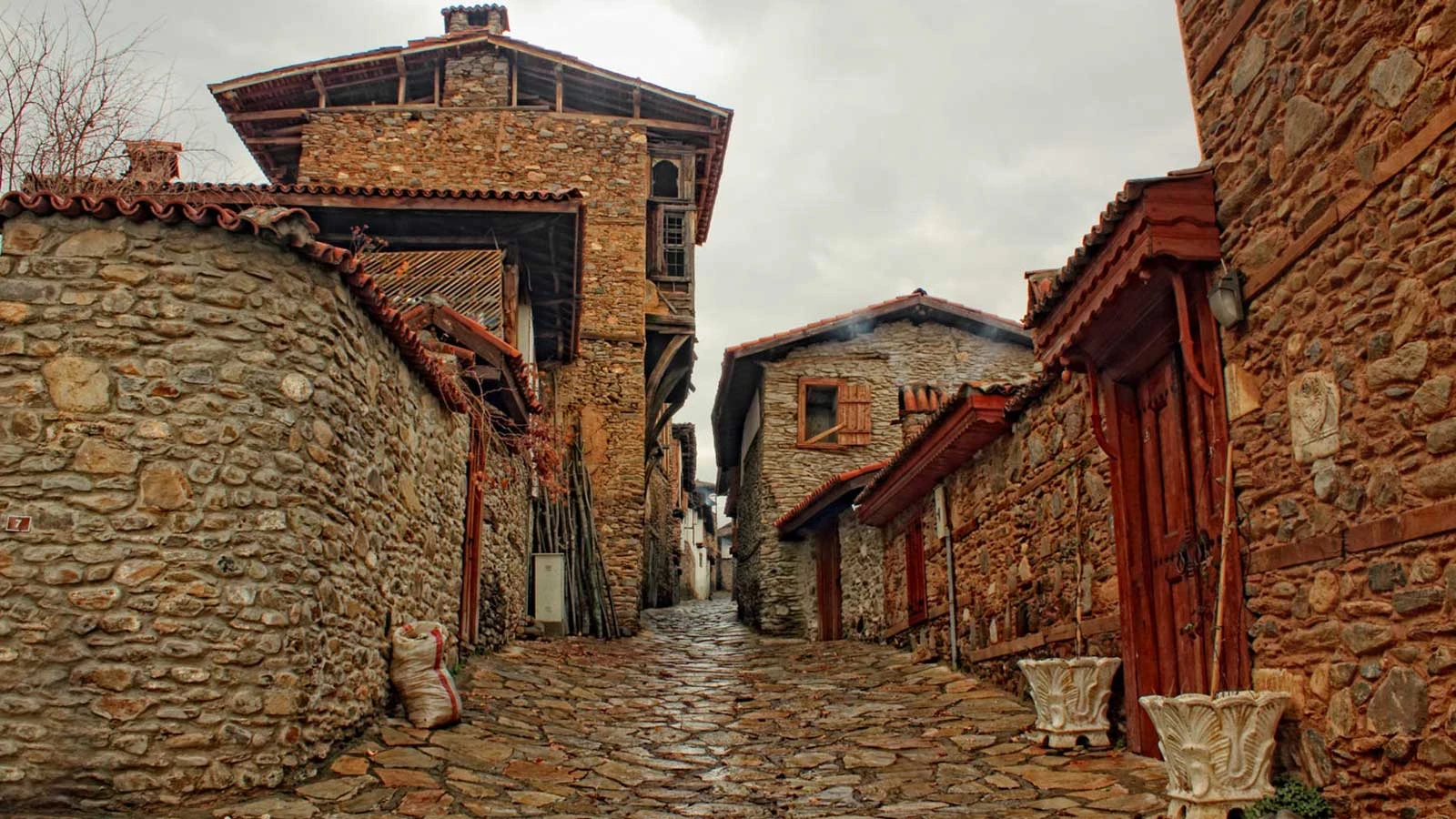
Move from Hellenistic and Roman archaeology into the Aydınoğlu and Ottoman architecture of one of western Türkiye's most atmospheric historic towns.
Explore Birgi
Continue with our complete İzmir guide for ancient cities, historical towns, coastal destinations, local food and regional day trips.
View İzmir Guide