Roman Gods, Early Christianity & 2,000 Years of Sacred History

Red Basilica of Pergamon – Complete Visitor Guide

Discover one of Roman Anatolia's most extraordinary religious monuments,
where Egyptian-inspired cults, Christianity, Judaism and Islam meet within the heart of modern Bergama.

Explore the Red Basilica

Red Basilica of Pergamon – One Monument, Many Religions

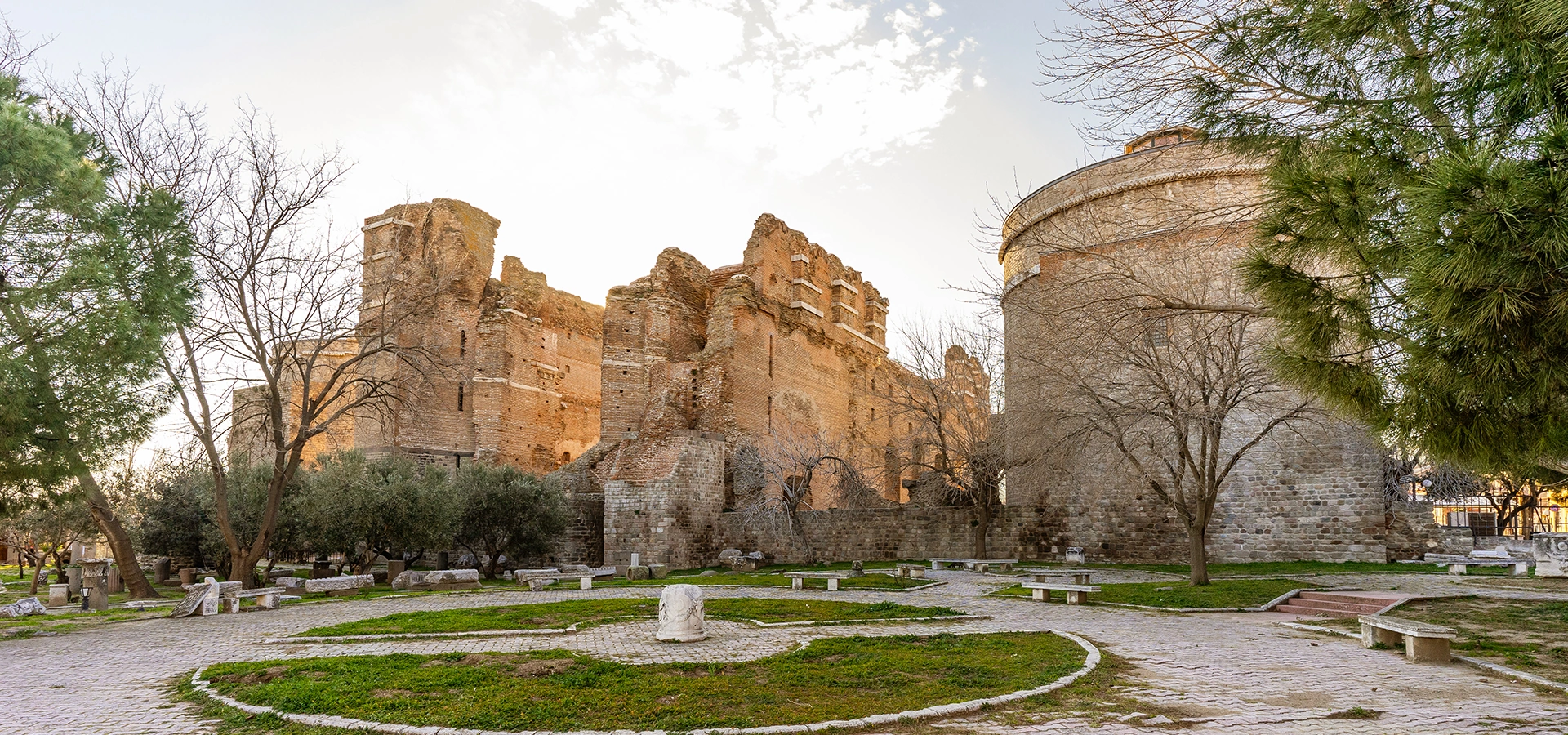
In the centre of modern Bergama in İzmir Province, below the celebrated Acropolis of ancient Pergamon, stands one of the most unusual surviving monuments of Roman Anatolia: the Red Basilica, known locally as Kızıl Avlu and traditionally identified as the Serapeion of Pergamon.

Constructed during the 2nd century AD, probably during the reign of Emperor Hadrian, the enormous Roman sanctuary was traditionally associated with Egyptian deities including Serapis, Isis and Harpocrates.

Its identity, however, is more complex than the familiar description "Temple of Serapis" might suggest. Egyptianising sculpture is unmistakably present, while archaeological research also points toward connections with Hadrian and the Roman imperial cult.

The scale alone is remarkable. The wider sanctuary occupied an area of approximately 270 × 100 metres, while the monumental central building measured roughly 60 × 20 metres.

Even more extraordinary is its engineering. The sanctuary's vast courtyard was constructed across the Selinos River, which Roman engineers channelled through tunnels beneath the complex. Those ancient tunnels remain part of Bergama's urban water system.

Centuries later, the sacred landscape was transformed again. During the Byzantine period, a major Christian church was established within the Roman monument, and the site became closely associated with Pergamon's place among the Seven Churches of Revelation.

Later religious layers included Jewish and Islamic use, making the Red Basilica one of the most powerful physical examples of Pergamon's multi-layered cultural history.

Monumental Roman Sanctuary

Explore one of the largest surviving Roman religious complexes in western Anatolia.

Egyptian-Inspired Cult

Discover the fascinating relationship between Roman religion, Egyptian imagery and imperial power.

Seven Churches of Revelation

Understand Pergamon's importance in early Christianity and the later transformation of the Roman sanctuary into a church.

UNESCO Heritage

The Red Basilica forms part of Pergamon and its Multi-Layered Cultural Landscape, inscribed on the UNESCO World Heritage List.


Know Before You Go

Red Basilica of Pergamon – Quick Facts

Essential information for visiting Kızıl Avlu, one of the most remarkable monuments of ancient Pergamon.

📍

Location

Central Bergama in İzmir Province, western Türkiye.

Open on Google Maps
🏛️

Site Type

Monumental Roman sanctuary later transformed and reused by several religious communities.

📜

Main Period

2nd century AD, probably during the reign of Emperor Hadrian.

🧱

Famous Feature

Massive Roman brick walls that gave the monument its modern name, the Red Basilica.

✝️

Christian Heritage

Later transformed into a major Byzantine church and associated with Pergamon's place among the Seven Churches of Revelation.

🌍

UNESCO

Part of Pergamon and its Multi-Layered Cultural Landscape, UNESCO-listed since 2014.

⏱️

Suggested Visit

Allow approximately 45–75 minutes for a comfortable exploration.

💧

Engineering

The sanctuary was constructed above Roman tunnels carrying the Selinos River beneath the complex.


Where Civilisations Meet

Why Visit the Red Basilica?

Few monuments in Türkiye reveal the transformation of sacred space across Roman, Byzantine, Jewish and Islamic history as clearly as the Red Basilica.

The Red Basilica is not simply another ancient temple. Its importance comes from the extraordinary number of historical worlds contained within the same architectural space.

The monument began as one of Roman Pergamon's greatest religious complexes. Its enormous brick walls, courtyards, circular buildings, Egyptianising sculpture and monumental entrance belonged to an architectural programme unlike anything else in the city.

Later, Christian builders adapted part of the Roman sanctuary into a major church. Over subsequent centuries, other parts of the complex became connected with Jewish and Islamic worship.

This makes the Red Basilica one of the clearest places in Bergama to understand what UNESCO means when it describes Pergamon as a multi-layered cultural landscape.

Here, history is not organised into separate archaeological periods. Roman, Byzantine, Jewish, Ottoman and modern Bergama physically overlap.

What Is the Red Basilica of Pergamon?

The Red Basilica is the modern name given to a vast Roman-period religious complex constructed in the lower city of ancient Pergamon.

The Turkish name Kızıl Avlu literally means "Red Courtyard," a reference to both the enormous courtyard and the distinctive reddish brickwork that dominates the surviving monument.

The complex is also frequently called the Serapeion or Temple of Serapis.

This traditional identification reflects the sanctuary's strong Egyptianising imagery and long-standing interpretation as a place where Egyptian deities were worshipped.

Modern archaeological discussion is more cautious. The monument clearly incorporated Egyptian-inspired religious imagery, but researchers continue to examine exactly how Egyptian cult, Roman imperial ideology and local religious traditions interacted here.

Historical terminology: You will see several names used for the same complex: Red Basilica, Red Hall, Kızıl Avlu, Serapeion and Temple of Serapis. "Red Basilica" and "Kızıl Avlu" are the most useful names for modern visitors.

The History of the Red Basilica

The Red Basilica was constructed during the Roman Imperial period in the 2nd century AD.

Architectural and archaeological evidence places its construction most plausibly within the reign of Emperor Hadrian, AD 117–138, a ruler famously interested in architecture, religion and the cultures of the eastern Mediterranean.

By this period, Pergamon was already an ancient city. It had served as the capital of the powerful Hellenistic Attalid kingdom before becoming part of the Roman world in 133 BC.

Under Roman rule, the lower city expanded dramatically. The Red Basilica belonged to this new monumental landscape, far below the earlier royal Acropolis.

The sanctuary was constructed on an extraordinary scale and incorporated imagery inspired by Egyptian religious traditions.

After the spread of Christianity, the building underwent one of the most dramatic transformations in its history. A large church was created within part of the former Roman sanctuary.

The Red Basilica subsequently became an important monument within Byzantine Pergamon and developed a lasting association with the Christian community of Pergamon mentioned in the Book of Revelation.

During later centuries, parts of the complex continued to serve religious communities, including Jewish and Muslim worshippers.

Roman Construction 2nd century AD
Probable Imperial Context Reign of Emperor Hadrian
Traditional Identification Sanctuary of Egyptian gods / Serapeion
Christian Transformation Major church established during Late Antiquity / Byzantine period
Later Use Jewish and Islamic religious history
UNESCO Status Part of Pergamon World Heritage landscape since 2014

Serapis, Isis and the Egyptian Gods of Pergamon

The Red Basilica has traditionally been interpreted as a sanctuary dedicated to Egyptian deities.

Official archaeological information identifies Serapis, Isis and Harpocrates among the gods probably worshipped within the complex.

These were particularly important within the religious world of the Roman Mediterranean. Egyptian cults had spread far beyond Egypt, appearing in cities throughout Greece, Italy, Asia Minor and other parts of the empire.

Serapis was a Greco-Egyptian deity whose cult combined several Egyptian and Hellenistic traditions.

Isis, one of the most important Egyptian goddesses, became enormously popular throughout the Roman world.

Harpocrates, the Greco-Roman form of the Egyptian child god Horus, was another deity connected with the wider Isiac religious world.

At Pergamon, the architectural programme included striking Egyptianising sculpture, making the connection visually unmistakable.

Was the Red Basilica Really a Temple of Serapis?

Calling the monument simply the Temple of Serapis is convenient, but archaeology suggests the religious story may have been considerably more complex.

The enormous complex unquestionably used Egyptianising imagery, including monumental supporting figures inspired by Egyptian religious art.

However, the surviving evidence does not prove that the sanctuary functioned exclusively as a conventional temple of Serapis.

Research has also identified evidence for the cult of Emperor Hadrian in the immediate area.

Hadrian himself had strong cultural associations with Egypt and frequently incorporated Egyptian themes into imperial architecture and ideology.

The Red Basilica may therefore represent a sophisticated blending of Egyptian religious imagery, Roman imperial cult and local sacred traditions.

Why this matters: Older guidebooks often describe the building simply as a Temple of Serapis. That remains a useful traditional name, but the archaeological interpretation is not completely settled. The safest description is a monumental Roman sanctuary with strong Egyptianising religious associations.

The Extraordinary Scale of the Red Basilica

The sanctuary was conceived on a scale that immediately demonstrates its importance within Roman Pergamon.

Official site information gives the wider complex dimensions as approximately 270 metres long and 100 metres wide.

The central temple building measured roughly 60 metres long and 20 metres wide.

These dimensions are particularly impressive because the monument was constructed not on an empty suburban site, but inside the densely occupied lower city.

Creating such an enormous enclosed sanctuary required major changes to the surrounding urban landscape, including one of Pergamon's most ambitious Roman engineering projects: the redirection of the Selinos River beneath the courtyard.

270 m

Approximate overall length of the sanctuary complex.

100 m

Approximate width of the monumental precinct.

60 × 20 m

Approximate dimensions of the principal temple building.

Lower Pergamon

The sanctuary occupied a commanding position within the Roman city below the Acropolis.

Why Is It Called the Red Basilica?

The answer becomes obvious as soon as you approach the monument.

Unlike many classical temples associated visually with pale marble, the enormous surviving walls of the Red Basilica are dominated by Roman brickwork.

Their deep red-brown colour led local people to call the monument Kızıl Avlu – the Red Courtyard.

The English name Red Basilica reflects both this distinctive appearance and the building's later Christian transformation.

The exposed brick gives the monument an atmosphere very different from the marble architecture visible on Pergamon's Acropolis.

Even in ruined condition, the height, thickness and mass of the surviving walls make it one of Bergama's most visually imposing ancient buildings.

The Selinos River Tunnels

One of the most astonishing features of the Red Basilica is almost invisible.

The sanctuary crossed the course of the Selinos River, the stream that flows through Bergama.

Instead of allowing the watercourse to divide the sanctuary, Roman engineers constructed large underground channels and carried the river beneath the monumental courtyard.

This allowed the vast sacred precinct to function as a visually unified architectural space.

The engineering achievement is especially remarkable because the tunnels continued to form part of Bergama's functioning water infrastructure long after the Roman sanctuary itself had fallen into ruin.

UNESCO identifies this engineering solution as one of the important Roman achievements within Pergamon's cultural landscape.

Selinos River

The ancient stream runs directly through the area occupied by the Roman sanctuary.

Roman Tunnels

Engineers channelled the river beneath the monumental courtyard.

Urban Engineering

The project allowed an enormous sacred enclosure to be constructed across an existing watercourse.

Living Infrastructure

The ancient channels demonstrate how Roman engineering became incorporated into the later city of Bergama.

The Great Courtyard and Monumental Entrance

The Roman sanctuary was organised around a vast walled courtyard that separated the sacred precinct from the surrounding city.

Visitors originally entered through monumental gateways positioned along the western side.

A formal architectural axis led from the entrance toward the massive central sanctuary building.

The courtyard is believed to have been bordered by columned galleries, creating ceremonial routes around the precinct and framing views toward the principal temple.

Although much of this architectural setting survives only as foundations and fragments, the enormous scale of the enclosure remains understandable on site.

The Great Central Hall

The enormous brick structure dominating the complex was the architectural focus of the sanctuary.

Its surviving walls rise dramatically above the archaeological site and continue to dominate the surrounding streets of modern Bergama.

The western façade once contained a monumental entrance, while the interior was designed to create a powerful transition from bright exterior spaces into a more controlled sacred environment.

The monumental dimensions, thick brick walls and limited lighting toward the rear would have given the building an imposing interior atmosphere.

A cult image or other major sacred installation would have occupied the eastern end of the building, although the exact ritual programme remains the subject of archaeological interpretation.

The Twin Rotundas of the Red Basilica

On either side of the great central hall stand two circular buildings, usually described as rotundas.

These structures are among the best-preserved architectural elements of the wider complex and give the Red Basilica its unusually symmetrical appearance.

Their precise ancient functions remain debated, although they clearly formed part of the sanctuary's religious and ceremonial programme.

The rotundas later acquired new functions as the religious landscape of Bergama changed.

UNESCO highlights their later history as part of the site's exceptional continuity of sacred use, including Jewish and Islamic associations.

Look carefully: The circular buildings make much more sense when viewed together with the central hall. The Red Basilica was designed as a large, carefully balanced architectural composition rather than a single isolated temple.

The Egyptianising Caryatids and Supporting Figures

Among the most distinctive discoveries from the Red Basilica are enormous Egyptianising architectural figures.

These sculptural supports combined human forms with Egyptian-inspired costume, hairstyles and religious symbolism.

They were not straightforward copies of pharaonic Egyptian sculpture. Instead, they represent a distinctly Roman interpretation of Egyptian visual culture.

Their presence is one of the strongest reasons the monument became associated with Egyptian cults.

Modern archaeological conservation has reconstructed one of these monumental supports, helping visitors understand how dramatically different the courtyard once appeared.

One reconstructed figure has been interpreted in association with Sekhmet, the lion-headed Egyptian goddess.

Egyptian Inspiration

The figures use visual elements associated with ancient Egyptian religious imagery.

Roman Creation

They belong to Roman-period architecture rather than being imported pharaonic statues.

Architectural Supports

The figures formed part of the monumental architectural decoration of the sanctuary.

Modern Reconstruction

Conservation projects have helped restore the scale and visual impact of part of the original composition.

Passages, Stairs and Substructures

The Red Basilica contains far more than monumental walls visible from ground level.

Parts of the sanctuary were built above subterranean corridors, stairs and structural spaces.

These complicated substructures supported the monumental complex and allowed movement through areas associated with the sanctuary.

Popular interpretations sometimes describe priests moving through hidden passages and speaking through cult statues.

Such stories form part of the modern interpretation of the monument, but they should be treated cautiously unless directly supported by archaeological evidence.

Archaeological caution: The surviving passages are real, but the exact ritual purpose of every corridor, staircase and concealed architectural space cannot always be reconstructed with certainty.

The Red Basilica and Early Christianity

Pergamon occupies an important place in the history of Christianity.

The Christian community of Pergamum is addressed in the Book of Revelation, together with the churches of Ephesus, Smyrna, Thyatira, Sardis, Philadelphia and Laodicea.

The Roman sanctuary that we call the Red Basilica was constructed later, during the 2nd century AD.

This chronology is important. The church mentioned in Revelation refers originally to the Christian community of Pergamon, not necessarily to the physical Red Basilica building itself.

During Late Antiquity, however, the enormous Roman monument was transformed. A substantial Christian basilica was established within the former sanctuary.

The site consequently became closely connected with Pergamon's Christian identity and is traditionally presented among the Seven Churches of Revelation.

Important distinction: The Book of Revelation refers to the Christian community of Pergamon. The monumental Roman Red Basilica was subsequently adapted into a church. It is therefore better to describe the site as being associated with the Seven Churches tradition rather than claiming that the 2nd-century Roman building itself was the original church addressed in Revelation.

The Seven Churches of Revelation and Pergamon

Pergamon is one of the Seven Churches of Asia addressed in chapters 2 and 3 of the Book of Revelation.

The message to Pergamon appears in Revelation 2:12–17.

The text reflects a Christian community living within one of Roman Asia's most prominent religious and political centres.

Pergamon contained numerous sanctuaries, temples and institutions connected with traditional Greco-Roman religion and Roman imperial authority.

For modern visitors following the Seven Churches route through western Türkiye, the Red Basilica has consequently become one of the principal Christian heritage stops in Bergama.

Ephesus

One of the Seven Churches and one of the greatest archaeological cities of the ancient Mediterranean.

Smyrna

The ancient city beneath modern İzmir and another Christian community addressed in Revelation.

Pergamon

The Christian community of ancient Pergamum received one of Revelation's seven messages.

Thyatira

Ancient Thyatira survives within modern Akhisar.

Sardis

The great Lydian capital later became an important Roman city and Christian centre.

Philadelphia

Ancient Philadelphia survives within modern Alaşehir.

Laodicea

The monumental archaeological city near modern Denizli completes the Seven Churches tradition.

What Was the “Throne of Satan” in Pergamon?

The Book of Revelation describes Pergamon using the famous expression "where Satan's throne is".

This phrase has generated centuries of discussion and many modern theories.

Different interpretations have connected it with Pergamon's imperial cult, the monumental Altar of Zeus, the city's temples, Roman political authority or the broader religious environment of ancient Pergamon.

There is no universally accepted archaeological identification of a single monument as the "throne" described in Revelation.

The Red Basilica itself should therefore not automatically be identified as the Throne of Satan.

What can be said confidently is that Roman Pergamon was an exceptionally important centre of political and religious authority, creating a challenging environment for the early Christian community addressed in the text.

Historical caution: Modern claims identifying one particular Pergamon monument as the biblical "Throne of Satan" go beyond what archaeology can establish with certainty.

The Byzantine Church Inside the Red Basilica

The conversion of the Red Basilica into a Christian church represents one of the most dramatic examples of religious transformation in ancient Pergamon.

Rather than abandoning the enormous Roman structure, Christian builders adapted the existing monument.

Architectural additions created a large basilical church within the former sanctuary.

The new church reused Roman walls, materials and monumental space, allowing an earlier sacred landscape to acquire an entirely different religious meaning.

The church is traditionally associated with St John and the Christian heritage of Pergamon.

Today, the surviving mixture of Roman and Byzantine architecture makes the Red Basilica particularly valuable for understanding the transformation of Anatolian cities during Late Antiquity.

Christian, Jewish and Islamic History at the Red Basilica

The later story of the Red Basilica did not end with the Byzantine church.

UNESCO specifically identifies the monument as an exceptional example of continuous adaptation for religious use.

Parts of the former Roman complex became associated with a Jewish synagogue, while another part of the monument developed an Islamic function.

One of the circular buildings eventually became associated with the Kurtuluş Mosque.

As a result, the Red Basilica preserves traces of several religious traditions within a single architectural complex.

This is one of the strongest reasons it plays such an important role in the UNESCO interpretation of Bergama: the monument demonstrates how societies repeatedly reused, adapted and reinterpreted the same sacred landscape.

Roman

Monumental sanctuary incorporating Egyptianising religious imagery and Roman imperial culture.

Christian

The former sanctuary was transformed into a major Byzantine church.

Jewish

A synagogue formed part of the later religious history of the complex.

Islamic

Part of the ancient complex subsequently acquired a continuing mosque function.

The Red Basilica and UNESCO World Heritage

The Red Basilica forms part of Pergamon and its Multi-Layered Cultural Landscape, inscribed on the UNESCO World Heritage List in 2014.

UNESCO recognises Pergamon not simply for individual monuments, but for the extraordinary survival of different historical layers across the same landscape.

Hellenistic royal architecture, Roman engineering, sanctuaries, Byzantine religious buildings and Ottoman urban monuments all coexist around modern Bergama.

Within that story, the Red Basilica has exceptional importance.

It demonstrates both Roman architectural and engineering ambition and the repeated transformation of sacred space by later communities.

World Heritage Property Pergamon and its Multi-Layered Cultural Landscape
Inscribed 2014
Location Bergama, İzmir Province, Türkiye
Roman Significance Serapeion / Red Basilica sanctuary and major engineering complex
Later Significance Christian, Jewish and Islamic continuity of religious use

Exploring the Red Basilica Today

The Red Basilica offers a very different archaeological experience from Pergamon's Acropolis.

The Acropolis rises dramatically above Bergama and feels separated from the modern city.

The Red Basilica, by contrast, stands inside the living urban fabric.

Modern streets, houses and neighbourhoods surround enormous Roman walls that have remained part of Bergama's landscape for almost two millennia.

Begin by stepping back and looking at the scale of the central brick building.

Then examine the courtyard, the circular structures, surviving marble architectural fragments and reconstructed Egyptianising elements.

The site becomes far more meaningful when you remember that the river is running beneath part of the sanctuary.

Finally, look for evidence of the monument's later transformations. The most important story here is not one particular period, but how the same place continued changing while remaining sacred.

Main Hall

Stand beneath the enormous brick walls to appreciate the scale of Roman construction.

Courtyard

Imagine the sanctuary as a huge enclosed ceremonial precinct rather than an isolated temple.

Rotundas

Examine the circular buildings that flank the main sanctuary.

Egyptianising Sculpture

Look for the reconstructed monumental supporting figure and surviving architectural fragments.

Christian Layers

Identify the architectural changes that transformed the Roman sanctuary into a church.

Selinos River

Remember that Roman engineering carries the stream beneath the sanctuary complex.

Photography at the Red Basilica

The Red Basilica is one of the most distinctive architectural photography locations in Bergama.

Western Façade

Use the surviving monumental walls to emphasise the extraordinary height and mass of the Roman building.

Red Brick

Warm morning and afternoon light can bring out the texture and colour of the ancient brickwork.

Rotundas

The circular buildings create excellent architectural compositions beside the rectangular central hall.

Egyptianising Figure

The reconstructed monumental support provides one of the site's most unusual photographic subjects.

Ancient & Modern

Include surrounding Bergama streets to illustrate how the Roman monument survives within the modern town.

Architectural Details

Look for reused marble, brick arches, wall construction and traces of later Christian architecture.

Photography etiquette: Do not climb onto archaeological remains, cross protective barriers or enter restricted areas for photographs. Drone operation around archaeological sites is separately regulated and should never be assumed to be permitted.

Best Time to Visit the Red Basilica

Because the Red Basilica lies within central Bergama, it can be visited comfortably throughout much of the year.

April & May

Spring temperatures are excellent for combining the Red Basilica with the Acropolis and Asklepion.

June

Long daylight hours make full-day Pergamon sightseeing particularly practical.

July & August

Visit the exposed Acropolis early and leave lower Bergama monuments for cooler parts of the day where practical.

September

One of the most comfortable months for archaeological sightseeing in western Türkiye.

October

Generally pleasant for combining ancient sites with walks through Bergama's historic centre.

Winter

Visitor numbers can be much lower, although rain and shorter daylight hours should be considered.

Useful strategy: On hot summer days, visit Pergamon Acropolis earlier in the morning and explore the Red Basilica and central Bergama later, depending on current site opening hours.

How Much Time Do You Need at the Red Basilica?

30 Minutes

Enough for a quick overview of the main hall, courtyard and rotundas.

45 Minutes

A practical visit when combining several major Bergama monuments in one day.

60–75 Minutes

Ideal for visitors who want time to understand the Roman, Christian and later religious layers.

90 Minutes+

Worth allowing for travellers especially interested in archaeology, architecture or biblical history.

With a Guide

A licensed guide can make the monument's complicated chronology and religious transformations much easier to understand.

Full Pergamon Day

Combine the Red Basilica with the Acropolis, Asklepion, Bergama Museum and historic centre.

Accessibility at the Red Basilica

The Red Basilica is located within central Bergama and is considerably easier to reach than the steep Pergamon Acropolis.

Nevertheless, visitors are entering an archaeological site rather than a completely level modern attraction.

Conditions can include uneven stone, gravel, archaeological surfaces, steps and changes in level.

Access to individual parts of the complex may also change during archaeological conservation or restoration work.

Travellers with specific wheelchair or mobility requirements should confirm current conditions shortly before visiting.

Central Location

The monument stands within modern Bergama rather than on the steep Acropolis hill.

Uneven Surfaces

Ancient remains, stone and gravel occur throughout parts of the site.

Historic Structures

Not every surviving Roman or Byzantine space is necessarily step-free.

Check Current Access

Confirm arrangements in advance when step-free access is essential.

Red Basilica Bergama Visitor Information

The Red Basilica archaeological site is located in central Bergama, İzmir Province.

According to the current official Turkish Ministry of Culture and Tourism listing, the site currently opens at 08:30 and closes at 17:30.

The official listing currently shows the ticket office closing at 17:00.

Opening hours, ticketing arrangements and access to individual areas can change because of season, conservation work or operational circumstances.

Always check the official listing shortly before travelling.

Official Site Bergama Kızılavlu
Alternative Names Red Basilica, Red Hall, Serapeion
Location Bergama, İzmir Province, Türkiye
Official Address İslamsaray Bergama Yolu 1. km, 35700 Bergama, İzmir
Current Opening 08:30
Current Closing 17:30
Ticket Office Currently closes at 17:00
Müzekart Listed as valid for eligible Turkish citizens
Suggested Visit Approximately 45–75 minutes
Important: Opening hours, admission arrangements and access to archaeological areas can change. Always check official information immediately before your visit.
Official visitor information: For current opening hours and visitor details, see the Republic of Türkiye Ministry of Culture and Tourism – Bergama Kızılavlu .

How to Get to the Red Basilica

Unlike the mountaintop Acropolis, the Red Basilica stands directly within the modern town of Bergama.

Its central location makes it one of the easiest major Pergamon monuments to incorporate into a walking or driving itinerary.

From Bergama Centre

The Red Basilica lies within the urban centre and can be reached easily from many central areas.

On Foot

Walking can be practical when exploring the historic centre, traditional streets and nearby urban monuments.

Taxi

A taxi is convenient when combining the site with the more distant Asklepion or the Acropolis cable-car area.

Private Vehicle

A car is useful for a complete Pergamon day because the principal archaeological sites are widely dispersed.

Private Tour

A private licensed guide helps connect the Red Basilica with Pergamon's Roman, biblical and UNESCO history.

From İzmir

Bergama can be visited as a full-day historical excursion from İzmir with efficient transport planning.

Planning tip: Pergamon is not one continuous archaeological site. The Acropolis, Red Basilica, Asklepion, museum and historic centre occupy separate locations around modern Bergama.

Red Basilica, Acropolis or Asklepion?

If your schedule allows, the most rewarding approach is to visit all three.

Each monument explains a completely different dimension of ancient Pergamon.

Pergamon Acropolis

Royal power, Hellenistic urban planning, temples, palaces, theatre, library and dramatic mountain views.

Red Basilica

Roman monumental religion, Egyptianising imagery, biblical history and centuries of religious transformation.

Asklepion

Ancient medicine, Asklepios, healing rituals, sacred water, treatment architecture and the world associated with Galen.

Together, these sites transform Pergamon from a collection of spectacular ruins into a much more complete ancient city.

You see where its rulers governed, where people worshipped, where patients sought healing and how the city's sacred spaces continued changing long after the ancient kingdom disappeared.

Places to Visit Near the Red Basilica

The Red Basilica sits within one of Türkiye's richest archaeological and historical landscapes.

Pergamon Acropolis

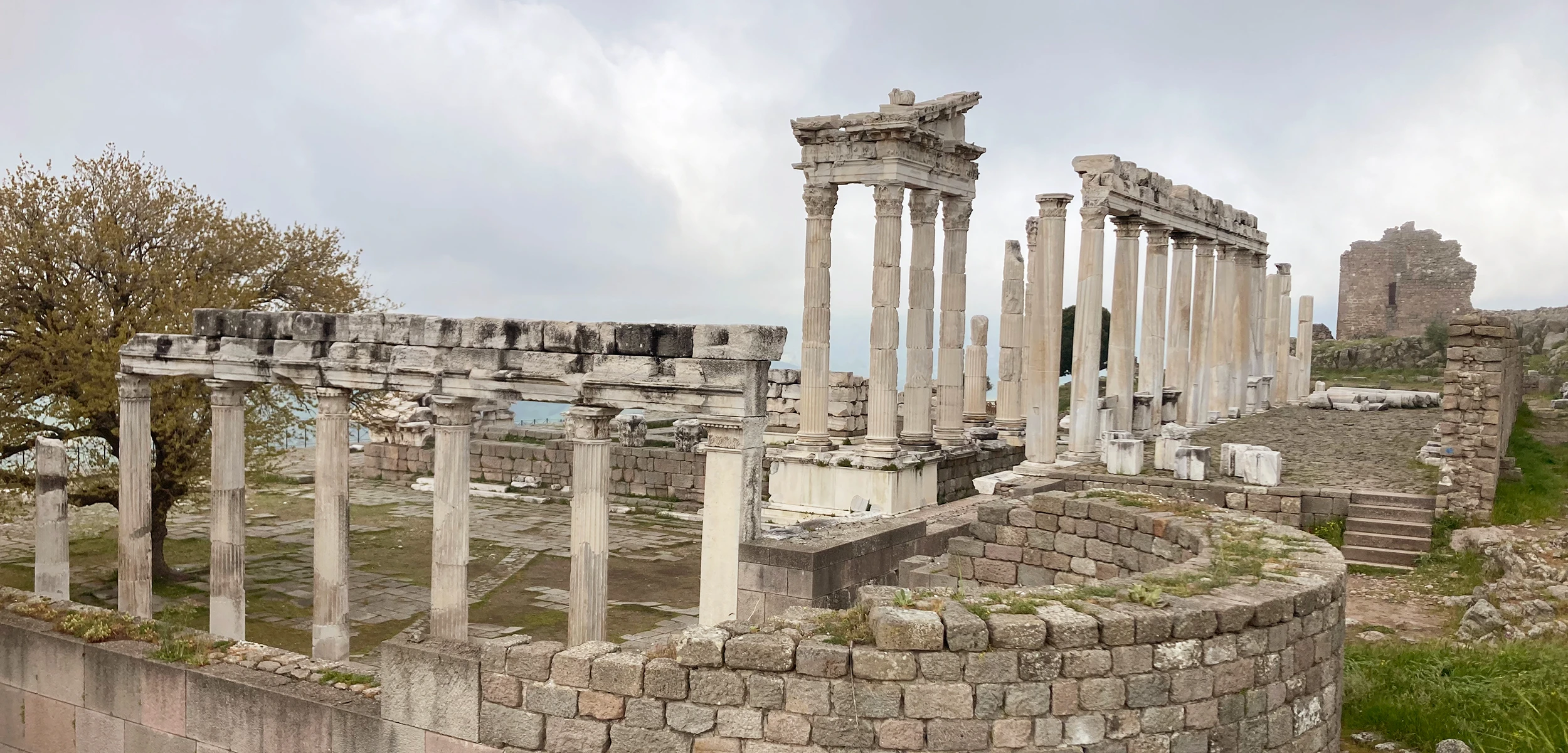
Explore the royal city high above Bergama with its theatre, Trajan Temple, sanctuaries and sweeping views.

Asklepion of Pergamon

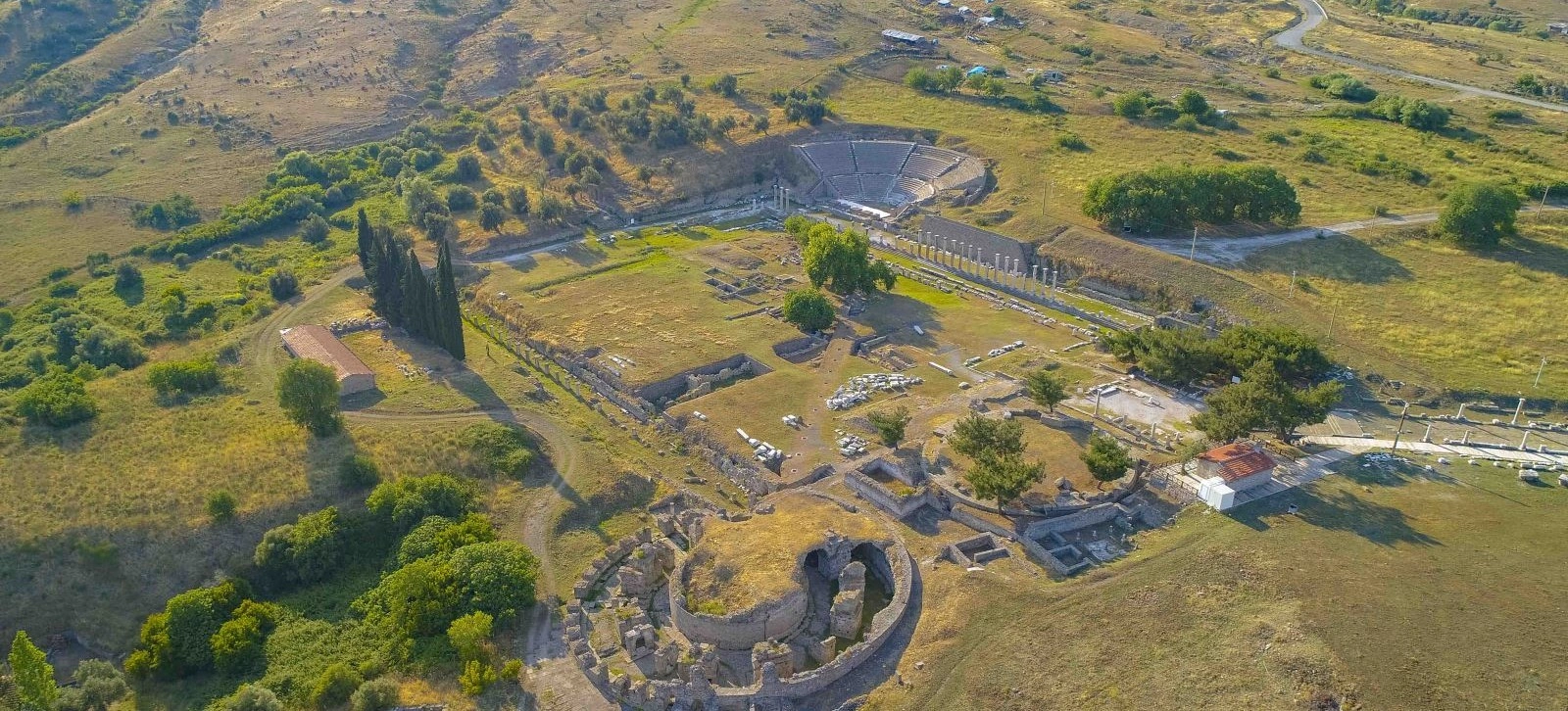
Discover one of antiquity's celebrated healing sanctuaries and the medical world associated with Asklepios and Galen.

Bergama Museum

See archaeological material from Pergamon and its surrounding landscape, including sculpture and everyday objects.

Bergama Historic Centre

Walk through traditional neighbourhoods shaped by Ottoman and modern urban history.

Arasta Bazaar

Explore Bergama's historic commercial quarter and traditional market atmosphere.

Selinos Stream

Follow the historic watercourse that Roman engineers channelled beneath the Red Basilica complex.

Suggested Pergamon & Red Basilica Route

Begin early at the Pergamon Acropolis, especially during warmer months.

Allow approximately 2–3 hours to explore the theatre, Trajan Temple, royal terraces, sanctuaries and surviving remains of the ancient upper city.

Return to central Bergama and continue to the Red Basilica.

Allow around 45–75 minutes to examine the Roman sanctuary, rotundas, Egyptianising sculpture, Christian layers and the extraordinary relationship between the monument and the Selinos River.

After lunch, continue to the Asklepion of Pergamon, where approximately 1½–2 hours allows a comfortable exploration of the ancient healing sanctuary.

If time remains, visit Bergama Museum or walk through the historic streets and traditional bazaar.

Morning Pergamon Acropolis
Late Morning Red Basilica / Kızıl Avlu
Lunch Central Bergama
Afternoon Asklepion of Pergamon
Optional Bergama Museum & historic centre
Total Time Approximately one full day
Why this route works: The itinerary moves from Pergamon's Hellenistic royal centre to its monumental Roman lower city and finally to the healing landscape of the Asklepion, revealing three very different dimensions of the ancient city.

Practical Tips for Visiting the Red Basilica

Look Beyond the Main Walls

The wider complex includes rotundas, courtyard remains and archaeological features that are easy to overlook.

Think in Layers

Roman, Christian, Jewish and Islamic history all contribute to the importance of the monument.

Notice the Brickwork

The enormous Roman brick walls are one of the building's most distinctive architectural features.

Remember the River

The Selinos flows beneath part of the sanctuary through ancient Roman engineering works.

Check Current Hours

Opening times and access conditions can change, so verify official information before travelling.

Bring Sun Protection

Some parts of a full Pergamon sightseeing day can be highly exposed during summer.

Use a Licensed Guide

A knowledgeable guide is especially useful here because the monument combines archaeology, Roman religion and biblical history.

Visit the Asklepion Too

The healing sanctuary provides a completely different perspective on Roman-period Pergamon.

Frequently Asked Questions About the Red Basilica of Pergamon

What is the Red Basilica in Bergama?

The Red Basilica is a monumental 2nd-century AD Roman sanctuary in the lower city of ancient Pergamon. It was later transformed into a Christian church and subsequently acquired additional religious functions.

Where is the Red Basilica?

The monument stands in central Bergama in İzmir Province, Türkiye, below the ancient Acropolis of Pergamon.

Why is it called the Red Basilica?

The name comes from the enormous red Roman brick walls and the large courtyard. Its Turkish name, Kızıl Avlu, means "Red Courtyard."

How old is the Red Basilica?

The surviving monumental complex dates principally to the 2nd century AD and is generally associated with the reign of Emperor Hadrian.

Was the Red Basilica built by Hadrian?

Archaeological and historical evidence places the sanctuary most plausibly during the Hadrianic period. It is therefore commonly described as having been constructed during the reign of Emperor Hadrian.

Was the Red Basilica a Temple of Serapis?

It is traditionally called the Serapeion or Temple of Serapis, and Egyptian deities including Serapis, Isis and Harpocrates are associated with its interpretation. Modern research, however, suggests that its religious identity may also have included important Roman imperial-cult elements.

Which Egyptian gods were worshipped at the Red Basilica?

Official archaeological information identifies Serapis, Isis and Harpocrates among the Egyptian deities probably associated with the sanctuary. The exact ritual programme remains the subject of scholarly study.

How large was the Red Basilica complex?

Official site information gives the wider sanctuary dimensions as approximately 270 × 100 metres, with the main temple building approximately 60 × 20 metres.

What are the two round buildings beside the Red Basilica?

They are monumental rotundas that formed part of the Roman sanctuary. Their precise ancient religious functions are still discussed, and the buildings later acquired new uses.

What are the Egyptian-style statues at the Red Basilica?

The complex contained monumental Egyptianising architectural support figures. They combine Roman architectural practice with imagery inspired by Egyptian religion and visual culture.

Does a river really run beneath the Red Basilica?

Yes. Roman engineers channelled the Selinos River through tunnels beneath the sanctuary precinct, allowing the monumental courtyard to extend across the watercourse.

Is the Red Basilica one of the Seven Churches of Revelation?

Pergamon is one of the Seven Churches of Asia named in the Book of Revelation. The Roman Red Basilica was built after the earliest Christian community mentioned in Revelation, but it was later converted into a major church and became strongly associated with Pergamon's Christian heritage.

Which passage in Revelation mentions Pergamon?

The message to the Christian community of Pergamon appears in Revelation 2:12–17.

Is the Red Basilica the biblical “Throne of Satan”?

There is no universally accepted archaeological identification of the biblical phrase with one particular Pergamon monument. Various interpretations have been proposed, so the Red Basilica should not automatically be identified as the "Throne of Satan."

Was the Red Basilica converted into a church?

Yes. During Late Antiquity, a substantial Christian basilica was created within the former Roman sanctuary.

Was there a synagogue at the Red Basilica?

UNESCO documentation identifies Jewish religious use within the later history of the complex, demonstrating the site's remarkable continuity across different faith traditions.

Is there a mosque at the Red Basilica?

Yes. Part of the wider ancient complex has a later Islamic history, and the Kurtuluş Mosque is associated with one of its circular structures.

Is the Red Basilica part of UNESCO World Heritage?

Yes. It forms part of Pergamon and its Multi-Layered Cultural Landscape, which was inscribed on the UNESCO World Heritage List in 2014.

What are the opening hours of the Red Basilica?

The current official Ministry of Culture and Tourism listing shows opening at 08:30, closing at 17:30 and ticket-office closing at 17:00. Always verify the official listing before travelling because hours can change.

Is Müzekart valid at the Red Basilica?

The current official listing states that Müzekart is valid for eligible Turkish citizens. Check current conditions before your visit.

How long should I spend at the Red Basilica?

Allow approximately 45–75 minutes for a comfortable visit. Visitors especially interested in Roman religion, architecture or biblical history may want longer.

Can I visit the Red Basilica and Pergamon Acropolis on the same day?

Yes. The Red Basilica, Acropolis and Asklepion can all be combined within one well-planned full day, although the sites occupy different parts of modern Bergama.

Is the Red Basilica inside the Pergamon Acropolis?

No. The Red Basilica stands in the lower city within modern Bergama, while Pergamon Acropolis occupies the high hill above the town.

What else should I visit in Bergama?

Major attractions include Pergamon Acropolis, the Asklepion, Bergama Museum, the historic centre and traditional bazaar. Together they reveal the extraordinary depth of Pergamon's UNESCO cultural landscape.

Is the Red Basilica worth visiting?

For travellers interested in Roman architecture, religion, biblical history, archaeology or the transformation of ancient cities, the Red Basilica is one of the most distinctive monuments in western Türkiye.

Private Pergamon & Red Basilica Experiences

Discover Pergamon's extraordinary combination of Hellenistic royal history, Roman architecture, biblical heritage, ancient medicine and UNESCO World Heritage through a private itinerary designed around your interests, your preferred pace and without compulsory shopping stops.

Pergamon Archaeology & Biblical Heritage

Explore the monumental Acropolis, the extraordinary Red Basilica and Pergamon's ancient healing sanctuary with a private licensed guide, connecting nearly two thousand years of history within one remarkable landscape.

Continue Exploring Ancient Pergamon

Discover the royal, medical and religious landscapes that made Pergamon one of the most important cities of the ancient Mediterranean.

Discover More of İzmir Province

Continue exploring western Türkiye through ancient cities, Aegean landscapes and some of Anatolia's most important archaeological heritage.