Private Teos Archaeology Tour
Explore the Dionysus Sanctuary, bouleuterion, Roman theatre, city walls, acropolis and harbour landscape with a private historical focus.
Request a Teos Tour





Teos Ancient City lies just south of modern Sığacık in Seferihisar, on a low peninsula between two ancient harbours. Once one of the twelve cities traditionally associated with the Ionian League, Teos grew into a prosperous maritime centre whose wealth came from trade, agriculture, craft production and the natural resources of its surrounding territory.
The city is most famous for the Sanctuary and Temple of Dionysus, attributed to the celebrated Hellenistic architect Hermogenes. Dionysus was not simply one god among many here. He stood at the centre of Teian religious and cultural identity, and the city became closely associated with performers, musicians, poets and the international guild known as the Artists of Dionysus.
Teos is also much more than a temple site. Across the archaeological landscape you can trace a Roman theatre, one of the city's best-preserved bouleuteria, the agora, an acropolis, monumental Hellenistic fortifications, a large Roman cistern, gymnasium remains and the impressive South Harbour. The ruins are spread among olive trees, fields and low hills, giving Teos a quieter and more atmospheric character than many larger archaeological parks.
For travellers staying in İzmir, Urla, Seferihisar or Sığacık, Teos offers an unusually complete combination of archaeology, Aegean landscape, ancient religion, urban history and maritime heritage — with the living streets and marina of Sığacık only minutes away.
Explore the monumental sanctuary of Teos' patron god, one of the most important Dionysian sacred complexes in ancient Anatolia.
See one of the best-preserved buildings at Teos, used for civic government, education and later musical performances.
Follow the maritime story of a city whose two harbours connected Ionia with the wider Mediterranean and Black Sea worlds.
Combine the ruins with Sığacık Castle, the marina, local food and the coastal landscapes of Seferihisar.
Essential information for understanding Teos before you walk through its temples, civic buildings, walls and harbour landscape.
South of Sığacık, in the Seferihisar district of İzmir Province on Türkiye's Aegean coast.
Ionia, the historic coastal region of western Anatolia.
Permanent settlement is archaeologically documented from the Protogeometric period, roughly the 10th century BCE.
Dionysus, god of wine, theatre, ecstatic ritual, fertility and abundance.
The Sanctuary and Temple of Dionysus, associated with the Hellenistic architect Hermogenes.
The visible theatre is a Roman-period building with an estimated capacity of around 7,000 spectators.
Teos possessed northern and southern harbours, giving the city strong access to Aegean maritime trade.
A fortification circuit approximately 3.8 kilometres long enclosed around 65 hectares.
A civic council building with seating for roughly 800 people and evidence for multiple public uses.
Teos became an important centre for a Hellenistic association of actors, musicians and performers devoted to Dionysus.
Allow about 2–3 hours for the archaeological site, or half a day if you explore slowly and include the harbour area.
Combine Teos with Sığacık, Seferihisar and the surrounding Aegean coast.
Teos rewards travellers who want more than a single famous monument. It is a city where religion, trade, performance, education and civic life can all be read within the same archaeological landscape.
The first reason to visit is the Sanctuary of Dionysus. Teos was one of the ancient world's most important centres of Dionysian worship, and the monumental sanctuary became a symbol of the city's identity. Its architectural history stretches from the Hellenistic period into the Roman Empire, making it especially valuable for understanding how an important sacred complex changed over centuries.
The second reason is the breadth of the ruins. Teos preserves a theatre, bouleuterion, agora, acropolis, temples, fortifications, water infrastructure and harbour installations. Even where buildings survive only in foundations, they form a coherent urban story rather than a collection of isolated monuments.
The third reason is cultural history. Teos was the home of the lyric poet Anacreon and became associated with the Artists of Dionysus. Inscriptions also reveal organised schooling, music education, athletics, public honours, civic decrees and religious ceremonies. Few ancient sites allow visitors to connect architecture with such detailed evidence for how a community actually functioned.
Finally, Teos is simply a beautiful place to walk. Olive trees, low hills and glimpses of the Aegean soften the archaeological landscape, while nearby Sığacık makes it easy to combine serious history with a relaxed coastal afternoon.
Teos Ancient City is located in the Seferihisar district of İzmir Province, immediately south of the coastal settlement of Sığacık. The site lies roughly 60 kilometres southwest of central İzmir and occupies a strategic position between the Gulf of Sığacık to the north and the open Aegean-facing coast to the south.
This geography shaped the city from the beginning. Teos developed on and around a low peninsula dominated by Kocakır Hill, where the acropolis stood. The northern harbour connected the city with the protected waters of Sığacık Bay, while the southern harbour provided another major maritime outlet.
Today the archaeological zone remains relatively open and green. Modern agriculture, olive trees and small roads sit among the ancient remains, while Sığacık Castle, the marina and coastal restaurants are close enough to make Teos an easy half-day excursion.
Teos belonged to Ionia, the ancient region stretching along part of western Anatolia's Aegean coast. Ancient tradition counted Teos among the twelve cities of the Ionian League, a religious and political association whose shared sanctuary was the Panionion.
Its identity, however, was never limited to a simple label. The city stood within a wider Anatolian landscape and maintained strong contacts with nearby centres such as Erythrai, Klazomenai, Lebedos and Ephesus, while its harbours connected it to islands, mainland Greece, the Black Sea and the eastern Mediterranean.
Teos therefore makes an excellent introduction to the idea of an Ionian city as a maritime polis: politically independent for long periods, rooted in local territory, yet constantly shaped by travel, trade, colonisation, warfare and cultural exchange.
Archaeological evidence places permanent settlement at Teos in the Protogeometric period, roughly 1050–900 BCE. Ancient literary traditions preserved several foundation stories and named Athamas as an early mythical founder, while later Ionian colonisation traditions connected the city with settlers arriving from the Greek mainland.
Teos grew rapidly during the Late Geometric and Archaic periods. By the 6th century BCE it was a prosperous city with fortifications, long-distance trade, pottery production and access to valuable stone resources. Its harbour position placed it directly within the expanding commercial networks of the Aegean and eastern Mediterranean.
Around the middle of the 6th century BCE, Teos came under Persian pressure. Herodotus describes how the Persian commander Harpagus attacked the city by building up earth against its walls. Many Teians left rather than submit, and groups of emigrants became associated with the foundation or refoundation of colonies including Abdera in Thrace and Phanagoria on the Black Sea.
Teos later participated in the Ionian Revolt against Persia and sent ships to the Battle of Lade in 494 BCE. During the 5th century BCE it became part of the Athenian-led Delian League. The city's fortunes shifted repeatedly as control of western Anatolia changed between Persian, Macedonian, Seleucid and Attalid powers.
A major revival came during the Hellenistic period. Monumental fortifications were expanded, the Dionysus sanctuary developed, civic institutions flourished and the city became closely linked with the Artists of Dionysus. Under Pergamene and later Roman rule, Teos continued to build and rebuild, leaving the theatre, bouleuterion, temples and water systems that dominate the site today.
The earliest clearly documented settlement at Teos belongs to the Protogeometric period. Although much of this early city remains beneath later occupation, pottery and architectural evidence show that the site was permanently inhabited from the early first millennium BCE.
By the 7th and 6th centuries BCE, Teos had developed into a substantial urban community. The acropolis on Kocakır Hill became a sacred and defensive focus, and evidence from the hill includes the foundations of an Archaic temple commonly described as a Hekatompedon because of its approximate hundred-foot length.
This was also the period when Teos became visible in wider Mediterranean exchange. Pottery, coin circulation, seaborne trade and the exploitation of nearby stone resources all point to an outward-looking community with strong economic connections.
One of the most dramatic episodes in the history of Teos came around 545 BCE, when the Persian commander Harpagus advanced through the Ionian cities. Herodotus describes a siege in which earth was heaped against the city's fortifications in order to overcome its defensive walls.
Rather than remain under Persian control, many inhabitants reportedly abandoned Teos and sailed away. Teian emigrants became strongly associated with Abdera on the Thracian coast, and ancient traditions also connect them with Phanagoria on the Taman Peninsula of the Black Sea.
The movement did not mean the permanent end of Teos. Population returned, the city recovered, and by the early 5th century BCE it was again wealthy enough to provide 17 ships at the Battle of Lade during the Ionian Revolt.
This episode is important because it reveals how mobile ancient communities could be. Teos was not an isolated coastal town; its citizens carried their institutions, religious traditions and civic identity across the Aegean and Black Sea worlds.
The Hellenistic centuries transformed Teos. After the campaigns of Alexander the Great and the struggles of his successors, the city navigated a political landscape dominated by powerful monarchies while preserving much of its own civic identity.
A major earthquake in 304/303 BCE affected the region, and the rebuilding that followed contributed to a new phase of urban development. The great Hellenistic fortification system eventually enclosed around 65 hectares, creating a much larger protected urban area than the earlier acropolis-centred settlement.
During the 3rd and 2nd centuries BCE, Teos became particularly important for its relationship with Dionysus. The sanctuary expanded, royal benefactions and civic decrees were displayed, and the city became a base for the association of professional performers known as the Artists of Dionysus.
The surviving architecture reflects this prosperity: the Dionysus sanctuary, bouleuterion, fortifications and civic spaces all belong to a period when Teos was actively negotiating its place between local institutions and Hellenistic kings.
The Sanctuary of Dionysus is the defining monument of Teos. Dionysus was the city's leading god, associated here with wine, fertility, performance and civic identity. The sanctuary was therefore both a religious centre and a stage for public ceremony.
Ancient architectural tradition associates the temple with Hermogenes, one of the most influential architects of the Hellenistic world and a figure discussed by the Roman architectural writer Vitruvius. Modern archaeological research has shown that the temple's construction history was complex rather than the product of a single building campaign.
The first major phase began around the late 3rd century BCE. The central temple stood on a raised platform and was built in the Ionic order. Later additions transformed the building, and during the reign of Emperor Hadrian in the 2nd century CE the surrounding peristyle was completed, giving the sanctuary a more monumental appearance.
The sacred precinct also included stoas, an altar and a monumental propylon. The entrance structure was added in the Augustan period, and the sanctuary continued to function through major political and religious changes. Rather than imagining one frozen “Hellenistic temple,” it is better to see the Dionysion as an architectural complex that evolved for centuries.
Dionysus, patron god of Teos and deity of wine, theatre, ritual celebration and abundance.
The design is traditionally attributed to Hermogenes, one of the most famous architects of the Hellenistic period.
Ionic, with later Roman-period expansion and restoration.
Temple, altar, ceremonial space, surrounding stoas and monumental entrance gate.
Important work took place under Augustus and later Hadrian.
Conservation, restoration and research have continued around the sanctuary in the current archaeological programme.
Teos holds a special place in the history of ancient performance because it became an important centre of the Artists of Dionysus, a professional association of actors, musicians, poets and other festival performers.
The organisation was active in Teos by the late 3rd century BCE. Its members travelled to festivals, staged performances, maintained religious privileges and operated within a world where theatre, music and worship of Dionysus were closely connected.
The presence of this association gives the city a cultural identity unlike that of many neighbouring sites. The theatre, Dionysus sanctuary and inscriptions should be understood together: Teos was not merely a place where performances occasionally happened, but a city deeply tied to the professional culture of ancient entertainment.
The association did not remain in Teos forever. Political tensions eventually pushed the group through other centres including Ephesus, Myonnesos and Lebedos. Even so, Teos remains one of the most important places for understanding the relationship between Dionysian religion and the performing arts.
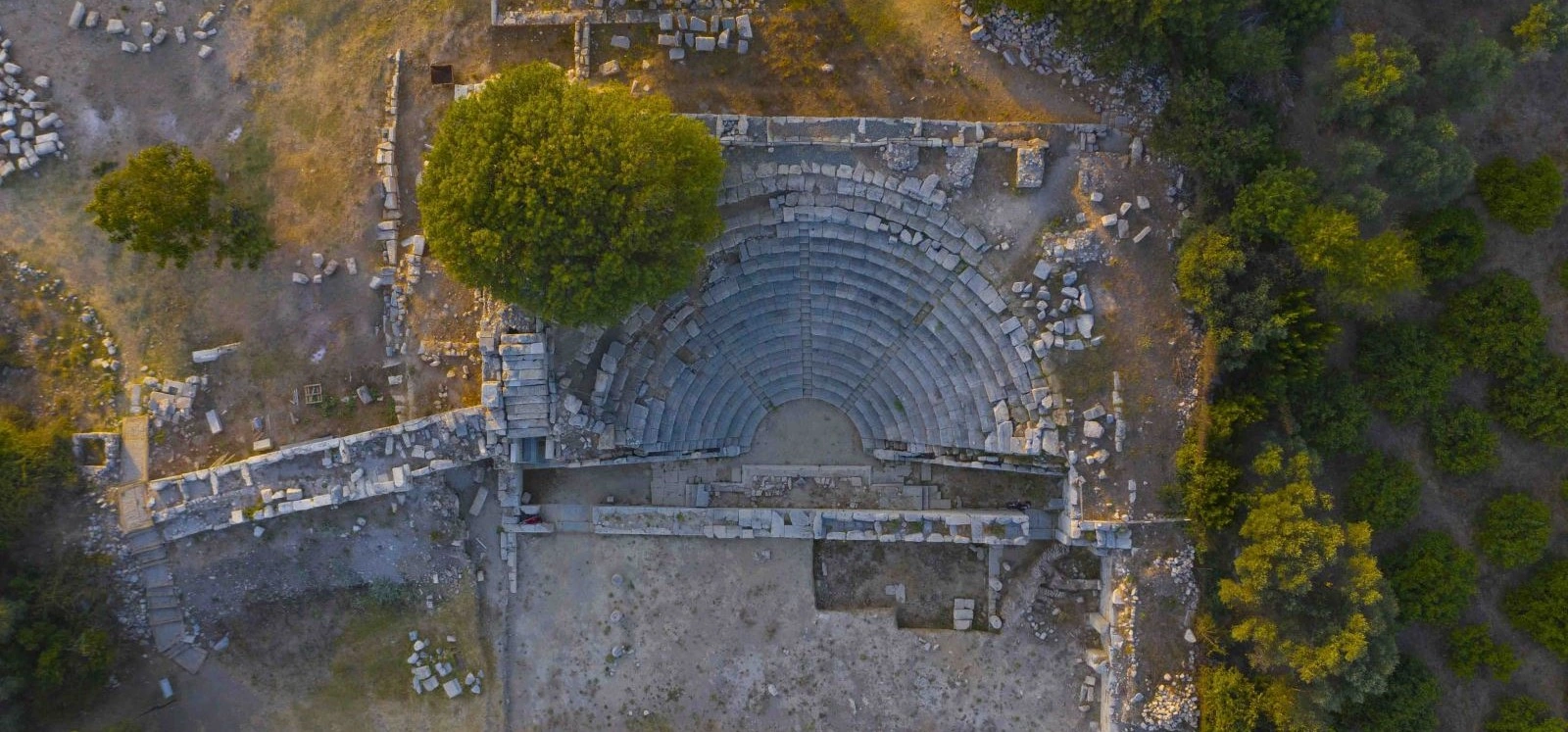
The visible theatre of Teos lies on the southern slope of Kocakır Hill and looks toward the South Harbour. Its position uses the natural terrain while creating a strong visual connection between performance space and the maritime landscape beyond.
Although inscriptions prove that theatrical life existed in Teos before Roman rule, the theatre visible today is understood as a Roman-period building. Archaeologists have not yet found evidence that securely dates the surviving structure to the earlier Hellenistic theatre associated with the Artists of Dionysus.
The cavea measures roughly 86 metres across and the building may have accommodated around 7,000 spectators. The seating was divided into lower and upper sections, while a substantial vaulted circulation system supported parts of the upper cavea.
The stage building acquired a monumental columned façade, probably at least two storeys high. In later phases the orchestra was modified, showing that the theatre continued to evolve rather than remaining unchanged after its first Roman construction.
The Bouleuterion is one of the most impressive surviving structures at Teos. Originally built for meetings of the city council, it stood at the northwestern edge of the agora and formed an important part of the city's administrative centre.
The building was more versatile than its name suggests. Inscriptions show that it also hosted educational activities and general school examinations, while the later addition of a stage indicates that it could function as a music hall or odeon.
The rectangular building had a roof and seating for approximately 800 people. Its cavea contained 17 seating rows divided by stairways, and the capacity was much greater than would have been required for council members alone.
A bouleuterion existed here by the end of the 3rd century BCE, while important modifications were made during the Roman period. Restoration and conservation work has continued in recent seasons, making this one of the key monuments to watch as Teos is gradually presented more clearly to visitors.
The agora formed the social and political centre of Teos, although much of its plan remains less visible than the theatre or bouleuterion. Archaeological and historical observations indicate a large open civic space framed by porticoes and associated public buildings.
One distinctive feature is a surviving heart-shaped Doric corner column, believed to have marked the meeting point of two porticoes. This single architectural element helps visitors reconstruct the larger colonnaded square that once organised daily civic life.
Within the agora stood a small temple now identified as the Temple of Roma and Augustus. Its placement reflects the growing importance of Roman imperial cult in the city and shows how older Hellenistic civic spaces were adapted under Roman rule.
Because the agora remains only partly exposed, it rewards visitors who use the site plan and read the surrounding wall lines carefully. The relationship between the agora, bouleuterion and later defensive walls is one of the clearest examples of how Teos changed through time.
The Acropolis of Teos occupies Kocakır Hill, a rocky height overlooking both the northern and southern harbour landscapes. Before the great Hellenistic city expanded across the surrounding plain, this hill formed the most important elevated centre of the settlement.
At its summit are the foundations of an Archaic building known as the Hekatompedon, named for its approximate hundred-foot length. Construction details suggest a date around the middle of the 6th century BCE.
Nearby foundations are interpreted as an altar associated with the temple, while substantial terrace walls created a level sacred area on the slope. These retaining walls may also have played a defensive role and could be connected with the fortifications described in ancient accounts of the Persian conquest.
The acropolis is especially important because it preserves the earlier city beneath the later fame of the Dionysus sanctuary. It reminds visitors that Teos had already developed sacred architecture and defensive organisation long before its Hellenistic revival.
Teos was protected by several generations of fortifications built across roughly a thousand years. The earliest known defensive phase belongs to the Archaic city, while later Classical, Hellenistic and Late Roman walls responded to changing military and urban conditions.
The most impressive system is the Hellenistic fortification circuit. Construction began after the earthquake of 304/303 BCE and continued through a long period of expansion and rebuilding. The finished circuit stretched for approximately 3.8 kilometres and enclosed around 65 hectares.
Archaeologists have identified towers and monumental gateways along the line, including entrances known as the Dionysus Gate, Herodotus Gate, Necropolis Gate and Gymnasium Gate. The lower walls were constructed from carefully cut stone blocks, while evidence suggests mudbrick was used above.
By Late Roman times, the city had contracted. A much smaller defensive enclosure of around three hectares was created around the bouleuterion and agora using architectural material reused from earlier monuments. The change dramatically illustrates the shrinking scale of the late antique settlement.
Probably concentrated around the acropolis and connected with the Persian siege tradition.
Additional defensive construction protected approaches from land and the northern harbour.
Approximately 3.8 km long, enclosing about 65 hectares.
A much smaller inner defensive zone built with reused architectural material.
Teos owed much of its prosperity to the fact that it possessed two harbours. This allowed the city to exploit different wind and sea conditions while maintaining commercial connections across the Aegean and farther into the Mediterranean world.
The ancient North Harbour lay in today's Sığacık Bay. Ancient writers described it as a protected harbour with a narrow entrance. No major ancient harbour structures remain clearly visible there today, and later construction around Sığacık may have incorporated or covered parts of the earlier facilities.
The South Harbour is archaeologically much more impressive. Its breakwater, pier platform, mooring stones and ancient harbour surfaces make it one of the most informative coastal areas at Teos. Archaeological study suggests that numerous vessels could moor along the pier and that wheeled carts moved goods across the harbour platform.
A partly worked block of the famous local africano or Lucullus marble found near the harbour demonstrates that heavy stone cargo could be shipped directly from Teos. Underwater finds and ballast stones provide further evidence for sustained commercial activity.
Teos was famous not only for wine, poetry and Dionysus but also for its marble resources. Ancient quarries in the surrounding territory produced several distinctive stones, including grey marble and the multicoloured material known in the Roman world as marmor luculleum or africano.
This dramatic stone could contain dark grey, red, brown, green and white veining. It became prized in Roman architecture and decoration, where coloured marbles were used to express status, expense and connections across the empire.
Quarry zones around Karagöl, Taşdibi and other nearby areas preserve ancient extraction traces, cut faces and partly worked blocks. The relationship between these quarries and the South Harbour shows how Teos linked inland production directly with maritime transport.
For visitors interested in the economics of ancient cities, this is a crucial part of the story: monumental buildings were only one expression of wealth. Behind them stood organised extraction, labour, transport and trade networks that connected the Teian countryside to distant consumers.
One of the most remarkable aspects of Teos is the evidence for organised education. The Polythros Gymnasium, located northeast of the acropolis and still largely buried, is known partly through an important inscription dating to the 2nd century BCE.
The inscription describes a foundation that paid teachers and shows that both girls and boys received instruction. Subjects included reading, writing and literature, while separate teachers were employed for music and athletics.
The document even records salaries, giving an unusually concrete glimpse into the financial organisation of education in a Hellenistic city. Music instruction received particularly high remuneration, a detail that feels especially appropriate in a community so closely associated with professional performers and Dionysus.
Educational life also extended into civic buildings. Evidence from the bouleuterion indicates that public school examinations could be held there, showing how teaching, civic identity and public ceremony overlapped within Teian society.
Among the most famous people associated with Teos is the lyric poet Anacreon, born in the 6th century BCE. His surviving poetry and later reputation are closely linked with themes of wine, love, pleasure, music and the refined social world of the symposium.
Anacreon's life also reflects the political instability of the Archaic Aegean. Ancient traditions connect his movements away from Teos with the Persian conquest and the migration of Teian citizens. He later became associated with elite courts elsewhere in the Greek world.
Remembering Anacreon while walking through Teos adds another layer to the site. The city was not only a place of walls and temples; it also produced cultural figures whose work continued to influence poetry long after the ancient city itself declined.
The large Roman cistern in the southwestern part of Teos is one of the site's most useful reminders that ancient cities depended on practical engineering as much as monumental architecture.
Built during the Roman Imperial period, probably in the 1st or 2nd century CE, the rectangular structure is approximately 47 metres long and covered by a barrel vault. Internal arches strengthened the roof and helped divide the reservoir.
Its minimum water capacity has been estimated at more than 500 cubic metres. Thick waterproof mortar lined the lower walls, while openings above helped ventilate the interior and maintain water quality.
The cistern may have supplied nearby bath facilities. Whether or not every connection can be reconstructed with certainty, the structure demonstrates the scale of urban planning required to support public buildings and daily life in Roman Teos.
Teos eventually came under the kingdom of Pergamon and passed to Roman control when the Attalid kingdom was bequeathed to Rome in the 2nd century BCE. It then formed part of the Roman province of Asia.
Roman rule did not erase the city's earlier identity. The cult of Dionysus continued, while new forms of imperial representation appeared. The small Temple of Roma and Augustus in the agora and inscriptions connected with imperial worship illustrate the gradual integration of Teos into Roman political culture.
The theatre visible today belongs to this Roman city, while the bouleuterion was modified and the great cistern built. Public benefactors financed architectural improvements, statues and repairs, helping the city maintain a monumental appearance well into the Imperial period.
Late Antiquity brought contraction rather than sudden disappearance. Teos continued on a smaller scale, and the construction of a compact defensive circuit around the civic centre reveals a city adapting to new conditions. Christian buildings near the harbour show that occupation continued into the Byzantine centuries.
Teos has attracted travellers, architects and archaeologists for more than two centuries. One of the earliest systematic investigations came in 1764–1765, when a team supported by the Society of Dilettanti documented the ruins, especially the Temple of Dionysus.
More formal excavation followed in the 19th century. Richard Popplewell Pullan worked at the sanctuary in 1862, while French researchers carried out additional excavations and surveys in the 1920s.
The first major Turkish excavation campaigns took place between 1962 and 1967 under Yusuf Boysal and Baki Öğün of Ankara University. Work extended beyond the Dionysus Temple to the theatre, agora, acropolis, Hellenistic walls and bouleuterion.
Research continued in later decades, and a major new phase began in 2010 under the Ankara University Teos Archaeological Project. Excavation, architectural documentation, epigraphy, conservation, restoration, geophysics and landscape research now work together to reconstruct the city as a whole.
Temple foundations, restored architectural elements, temenos walls, stoas, altar zone and monumental entrance.
Substantial seating, walls and restored architectural sections belonging to one of Teos' best-preserved civic buildings.
The cavea, vaulted circulation system, orchestra and remains of the stage building.
Long sections of stone fortification, towers and gateways around the ancient urban territory.
Archaic temple foundations, altar area and early defensive or terrace structures on Kocakır Hill.
Fragmentary portico remains, civic-space evidence and the small Temple of Roma and Augustus.
A long barrel-vaulted water-storage structure preserving important Roman engineering.
Breakwater walls, pier surfaces, mooring stones and evidence for commercial maritime activity.
Teos is a site to read across a landscape. Some structures are visually immediate, while others survive as wall lines, foundations or dispersed blocks. A site map and a little patience make a major difference to the experience.
Teos is not a finished archaeological park. It remains an active excavation and conservation landscape, and current research continues to change the interpretation and appearance of major monuments.
The 2026 excavation, documentation, conservation and restoration season began in January under the direction of the Teos Archaeological Project on behalf of the Ministry of Culture and Tourism and Ankara University. Work continues in several major areas, including the Dionysus Sanctuary, theatre, Temple of Roma and Augustus and bouleuterion.
Recent restoration has been especially visible at the Dionysus Sanctuary and bouleuterion. Anastylosis has returned selected original architectural blocks to their documented positions, helping visitors understand the scale and form of monuments that previously appeared mostly as scattered stone.
Because research and conservation are ongoing, temporary barriers, altered walking routes or closed micro-areas may appear during a visit. This is not a disadvantage: it is part of seeing an ancient city while its story is still being reconstructed.
One of the most beautiful periods, with green landscapes, spring flowers and comfortable walking temperatures.
Warm and bright, excellent for photography if you visit before the strongest midday heat.
Hot and exposed. Begin early, carry water and avoid turning the visit into a midday endurance walk.
Excellent for combining archaeology with Sığacık, coastal walks and local food.
Quiet and atmospheric, though rain can make earth paths and archaeological surfaces slippery.
Cool, peaceful and often beautifully clear after winter rain; check weather before travelling.
For most visitors, April–June and September–October offer the easiest balance of good light, comfortable walking and pleasant time in nearby Sığacık.
Morning is the best choice for a serious archaeological visit, especially from late spring through early autumn. Temperatures are lower, the site is quieter and you have enough time to follow the longer walking routes without rushing.
Late morning works particularly well if you plan to continue into Sığacık for lunch. A two- to three-hour archaeological visit followed by the old town and marina creates an easy and balanced day.
Late afternoon can be beautiful for photography, especially around the theatre, walls and olive-covered landscape. However, the archaeological area is spread out, so arriving too close to closing time can prevent you from reaching the South Harbour or more distant monuments.
Because entrance hours can vary seasonally and active archaeological work may affect routes, confirm current official visiting information shortly before arrival.
Drive southwest toward Seferihisar and continue to Sığacık; Teos lies immediately south of the settlement.
The easiest option for combining Teos with Sığacık, Seferihisar, beaches or other peninsula destinations.
Practical from Seferihisar or Sığacık, especially for visitors who do not want to depend on local public transport timing.
Reach Seferihisar/Sığacık using current İzmir-area services, then continue according to the latest local route information.
A convenient coastal drive makes Teos an excellent archaeology stop during a wider Urla–Seferihisar day.
Search specifically for Teos Ancient City / Teos Örenyeri rather than only Sığacık to reach the archaeological entrance.
Road and public-transport details can change, so use current navigation and local transport information on the day of travel rather than relying on old bus numbers or outdated route descriptions.
Most of the archaeological experience is walking between monuments across the open ancient city.
If time is limited, focus on the Dionysus Sanctuary, bouleuterion and theatre before adding the harbour.
Expect stone, gravel, earth paths, agricultural ground and occasional changes in level.
Teos is spread out; a map helps you understand where the acropolis, civic centre and harbour sit in relation to one another.
Olive trees provide some relief, but many monuments and paths remain exposed to the sun.
The South Harbour and outer walls reward visitors who do not rush from one headline monument to the next.
Enough for a quick visit focused on the Dionysus Sanctuary and one or two nearby civic buildings.
A good minimum for the sanctuary, bouleuterion, theatre and a general sense of the urban layout.
Best for most history-focused visitors who also want the acropolis, walls or cistern.
Ideal if you want to include the South Harbour and walk the archaeological landscape without rushing.
Combine Teos with Sığacık Castle, the marina, lunch and a Seferihisar coastal stop.
Allow around 2.5–3 hours at the site, then continue to Sığacık.
This route works especially well because it follows Teos from its sacred and civic centre to its maritime edge, then connects the ancient harbour landscape with the living coastal settlement of Sığacık.
Use restored architectural elements and long temenos lines to give scale to the sacred precinct.
The curved seating and restored walls create strong geometric compositions.
Wide angles from the cavea help connect the monument with the surrounding landscape.
Side light emphasizes the stonework, construction joints and defensive scale.
The best location for combining archaeology, sea, shoreline and maritime atmosphere.
Include trees, paths and fields to capture the character of Teos as an archaeological landscape rather than only a ruin field.
Cleaner light and lower temperatures make early visits easier for wide site views.
Do not move stones, enter closed trenches or climb reconstructed architectural elements for photographs.
Teos can be an excellent archaeological site for families because its story is easy to divide into clear themes: temples, theatre, city government, walls, harbours and ancient school life. Children who enjoy mythology may respond especially well to the connection with Dionysus and the ancient performers who lived and worked here.
The main challenge is distance. Teos is spread across a large landscape, so younger children may tire if the visit includes the full harbour route. A shorter circuit focused on the Dionysus Sanctuary, bouleuterion and theatre is often more practical.
Accessibility varies across the site. Archaeological surfaces, earth paths, stone, gradients and active restoration areas can make a completely step-free visit difficult. Travellers with reduced mobility should confirm current entrance conditions and accessible sections before travelling.
As at every archaeological site, children should be supervised near excavation edges, ancient walls and reconstructed stonework. Climbing monuments can be dangerous and can also damage fragile heritage.
Closed areas may protect active excavations, restoration work or unstable architecture.
Avoid standing on walls, theatre seating edges or reconstructed blocks for photographs.
Never remove pottery fragments, worked stones or other archaeological material.
Shortcutting across archaeological surfaces can damage features that are difficult to see from above.
Teos is also an agricultural and ecological environment with olive trees, fields and coastal habitats.
If excavation or conservation is active, follow all instructions and do not enter work zones.
Teos is much larger than the immediate temple area; understand the route before you begin walking.
The site can become very hot, particularly from June through September.
Expect gravel, ancient stone, dirt tracks and long walks between monuments.
A hat, sunscreen and light clothing are important during the warmer months.
Visitors who focus only on the Dionysus Temple miss one of the most impressive surviving buildings at Teos.
If you have time, the South Harbour explains why Teos became wealthy and internationally connected.
Teos becomes much more vivid when you know about its schools, public decrees, performers and civic benefactors.
Excavation and restoration work may temporarily alter walking routes or access to individual structures.
The old town, castle streets and marina make the perfect contrast to an archaeology-focused morning.
Teos is most rewarding when treated as a city landscape rather than a quick stop for one temple photograph.
Castle streets, marina, local markets and coastal restaurants only minutes from the archaeological site.
The district centre and surrounding villages offer local food, markets and a slower Aegean atmosphere.
A popular nearby coastal stop for swimming after a warm-weather archaeological visit.
Combine archaeology with vineyards, gastronomy, art spaces and the historic peninsula landscape.
A lesser-known Ionian city near Ürkmez, especially interesting for travellers following the ancient coast.
The important sanctuary and oracle of Apollo south of İzmir, ideal for a deeper ancient-Ionia route.
Another major Ionian centre near Urla, famous for archaeology and early olive-oil production.
Continue with Smyrna, Kadifekale, Kemeraltı and the archaeology museums for a broader regional picture.
The essential pairing: archaeology in the morning, castle streets and the waterfront afterward.
A relaxed cultural day combining ancient history with local markets, food and modern Aegean town life.
Excellent for travellers interested in archaeology, wine culture, gastronomy and coastal scenery.
Compare two Ionian cities and explore different approaches to maritime trade, industry and urban development.
A strong religion-focused route linking Dionysian Teos with one of the most important sanctuaries of Apollo in Ionia.
Follow the lesser-visited southern Ionian coastline and the historical relationship between neighbouring poleis.
Build a private route around Teos, Klazomenai and selected smaller sites according to available time.
Visit Teos early, then spend the afternoon around Akkum or another Seferihisar coastal stop.
Teos is an ancient Ionian city near Sığacık in Seferihisar, İzmir. It preserves the Sanctuary of Dionysus, theatre, bouleuterion, fortifications, acropolis, agora, cistern and harbour remains.
Teos lies immediately south of Sığacık in the Seferihisar district, roughly 60 kilometres southwest of central İzmir.
Yes. Ancient tradition counted Teos among the twelve cities associated with the Ionian League.
Archaeological evidence indicates permanent settlement from the Protogeometric period, roughly the 10th century BCE, although ancient foundation myths place its beginnings in legendary time.
Dionysus was the leading god of the city and played a central role in Teian religious and cultural identity.
The sanctuary was one of the most important Dionysian cult centres in Anatolia and its temple is associated with the famous Hellenistic architect Hermogenes.
Its main construction history began in the late 3rd century BCE and continued through later Hellenistic and Roman phases, including important work during the reign of Hadrian.
Ancient architectural tradition, including Vitruvius, associates the temple with Hermogenes. Modern research continues to refine how his design relates to the building's later construction phases.
They were a professional association of actors, musicians, poets and other performers connected with Dionysian festivals. Teos became one of their most important Hellenistic centres.
Theatrical activity existed in Teos before Roman rule, but the theatre visible today is understood as a Roman-period building.
Modern archaeological interpretation estimates a capacity of around 7,000 spectators.
It was the city council building. At Teos it also served educational and musical purposes, making it more than a purely political meeting hall.
Approximately 800 people, considerably more than the number required for ordinary council meetings.
An important Hellenistic inscription indicates that both girls and boys received instruction in reading, writing and literature, while music and athletics were also taught.
Anacreon was a famous 6th-century BCE lyric poet from Teos, remembered especially for poetry associated with wine, love, music and elite social life.
Ancient accounts say the Persian commander Harpagus overcame the city's defences around the mid-6th century BCE. Many Teians left the city and migrated overseas.
Teian migrants were strongly associated with the foundation or refoundation of Abdera in Thrace after the Persian conquest, and traditions also connect Teians with Phanagoria on the Black Sea.
Yes. The city possessed a northern harbour in the Sığacık Bay area and a southern harbour facing the open Aegean.
The South Harbour, where substantial pier, breakwater and mooring remains are still visible.
The territory produced several prized stones, including Teos grey marble and the multicoloured africano or marmor luculleum used widely in Roman decorative architecture.
Major remains include the Dionysus Sanctuary, bouleuterion, Roman theatre, Hellenistic walls, acropolis, agora, Roman cistern and South Harbour.
Yes. Excavation, documentation, conservation and restoration are active, and the 2026 programme includes work in several major monuments.
About 2–3 hours is ideal for a first visit. Allow half a day if you want to include the South Harbour and walk the wider archaeological landscape.
Spring and autumn are usually the most comfortable. Summer visits are best early in the morning because much of the site is exposed.
Yes. They are very close and make one of the easiest archaeology-and-coast combinations in the İzmir region.
Yes for children interested in history and mythology, but the large site involves walking and younger visitors should be supervised around ruins and excavation areas.
Accessibility is limited by archaeological surfaces, earth paths and changes in level. Current accessible routes should be confirmed before visiting.
A guide is not essential, but Teos becomes much richer when its inscriptions, building phases, Dionysian cult, education system and harbour economy are explained in context.
The Dionysus Sanctuary, bouleuterion and theatre are the essential core. If time allows, add the South Harbour for a much fuller understanding of the city.
Treating Teos as a one-monument site. The harbour, civic buildings, walls and inscriptions are just as important as the Temple of Dionysus.
Think of it as four connected stories: Dionysus and religion, civic life and education, maritime trade, and the long transformation from Archaic Ionia to Roman and Late Antique city.
A private historical route can connect Teos with Sığacık, Urla, Klazomenai, Claros or other Ionian sites, creating a day focused on archaeology, religion, maritime trade, architecture or the wider culture of western Anatolia.
Tell us whether your priority is classical archaeology, Dionysian religion, ancient architecture, inscriptions, maritime history, photography or a relaxed archaeology-and-coast day, and we can shape the route around your interests.
Explore the Dionysus Sanctuary, bouleuterion, Roman theatre, city walls, acropolis and harbour landscape with a private historical focus.
Request a Teos Tour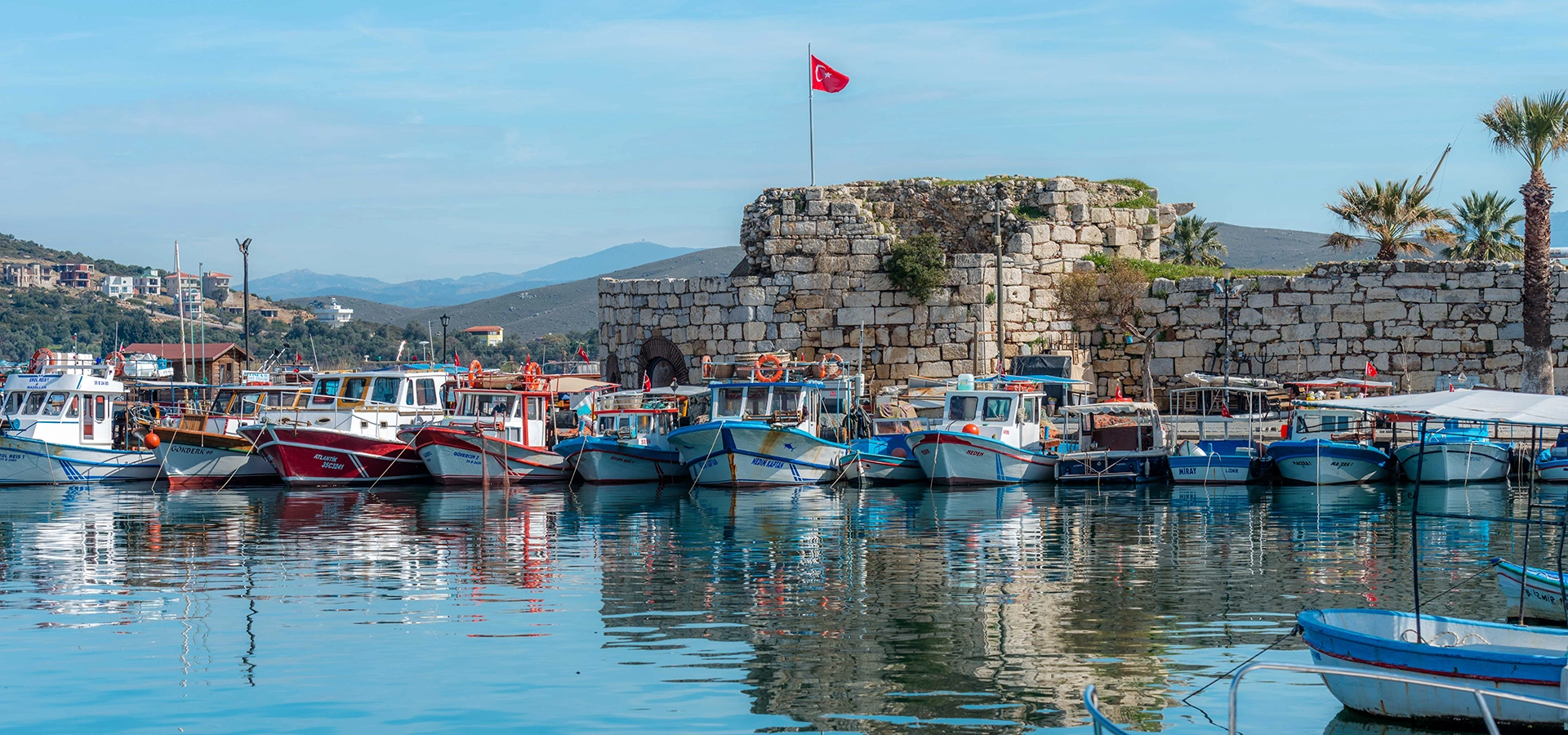
Combine the ancient city with Sığacık Castle, marina, old streets and a relaxed coastal lunch.
Explore Sığacık & Seferihisar
Build a custom day around Teos, Klazomenai, Claros or selected Ionian sites according to your historical interests and travel route.
Plan an Ancient Ionia Day
Continue with our complete İzmir guide for ancient cities, historic districts, coastal destinations, local food and day trips across the province.
View İzmir Guide