Private Aydın & Tralleis Programme
Plan a guided heritage visit with museum time and a Tralleis stop where access is available. Share your dates and interests so we can check the arrangements.
Request Your Private Programme





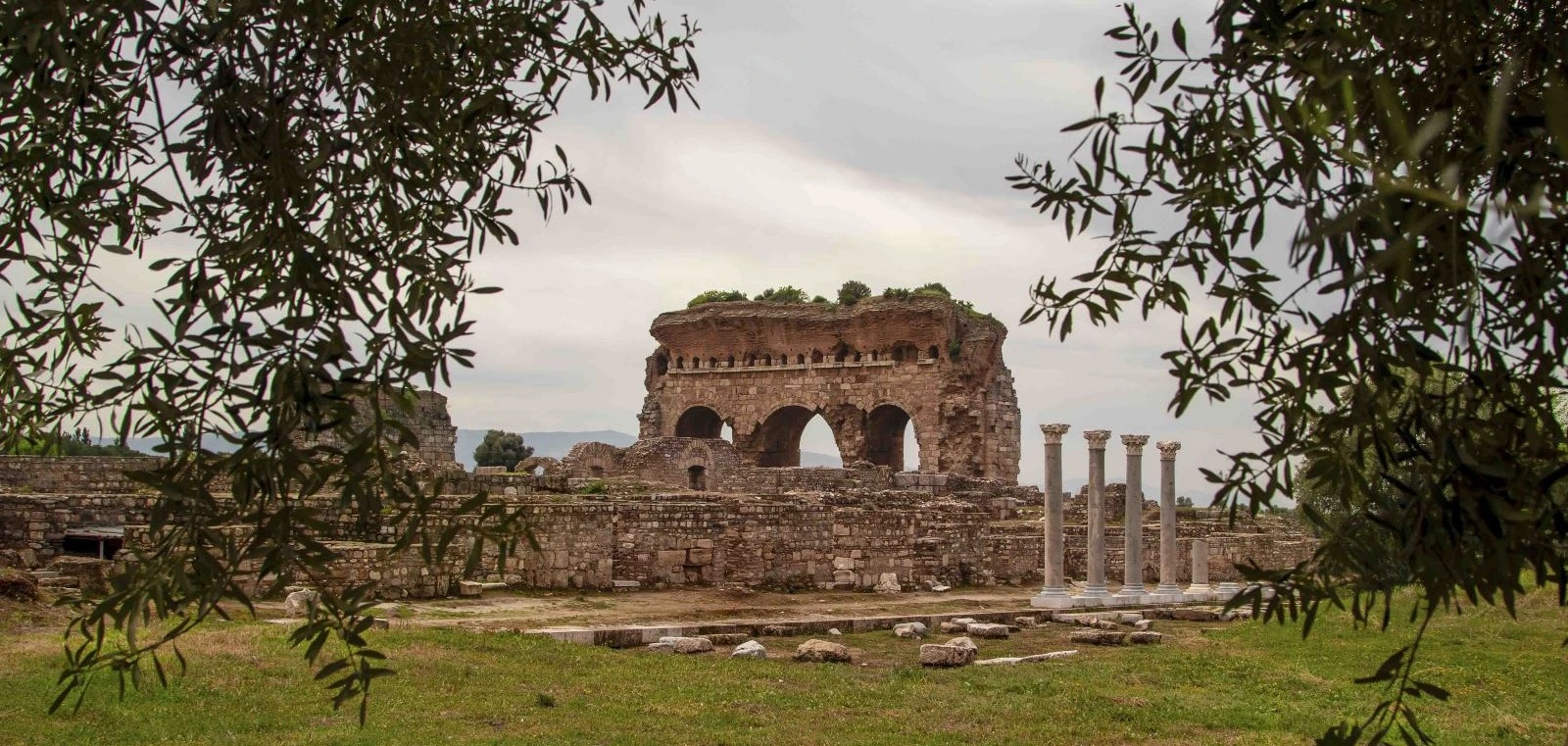
Tralleis Ancient City, also known as Tralles, occupies an elevated archaeological landscape on the northern side of modern Aydın in western Türkiye. Its most recognizable monument is the towering Üç Gözler, or Three Eyes, surviving from a Roman bath-gymnasium complex.
The arches introduce a city with a much wider story. Tralleis belonged to the busy world of the Meander Valley, where roads, fertile land and prosperous communities connected the Aegean coast with inland Anatolia.
Its cultural connections reach beyond the ruins: Anthemius of Tralles helped design Hagia Sophia, while the Seikilos inscription associated with the Aydın area preserves a remarkable ancient song with musical notation.
Archaeological research and conservation continue to reveal the city. Plan any visit around confirmed access arrangements, and include the Aydın Archaeology Museum to explore finds from Tralleis and the surrounding region.
Aydın's distinctive landmark: three monumental openings in the Roman bath-gymnasium remains.
Discover a complex combining bathing, exercise, education and civic display.
Explore the story of Seikilos and an ancient song preserved on stone.
Meet Anthemius of Tralles, one of the designers of Istanbul's great Byzantine monument.
An introduction to the archaeology and cultural heritage of ancient Aydın.
Topyatağı area, Efeler district, on the northern side of Aydın, Türkiye.
Open on Google MapsHellenistic, Roman and Byzantine, with earlier settlement traditions.
Üç Gözler, the monumental remains of the bath-gymnasium complex.
The Seikilos song and Anthemius, a designer of Hagia Sophia.
An active excavation and conservation project; confirm visitor access before travelling.
Allow 45–90 minutes if a site visit is permitted, with extra time for the museum.
The city's surviving architecture belongs to a much larger history of western Anatolia.
The ancient geographer Strabo described Tralleis as a prosperous city with wealthy inhabitants and prominent citizens who held leading positions in the Roman province of Asia. His account gives the ruins a human context: this was a community with influence, resources and intellectual ambition.
The bath-gymnasium makes that civic world especially tangible. A large public complex brought together physical training, bathing and formal spaces where the city could express its identity.
For today's traveller, Tralleis offers an opportunity to connect a famous local landmark with the people, workshops and ideas behind it. Pair the archaeological story with museum collections and the broader landscape described in our Aydın travel guide.
Ancient tradition attributed the foundation of Tralleis to Argives and Thracian Trallians. This is a foundation narrative preserved by ancient writers; it does not establish a precise archaeological founding date.
The city came under Alexander the Great in 334 BC and subsequently passed through the changing political landscape of the Hellenistic kingdoms. Under Seleucid rule it was also known as Seleucia, before becoming associated with the kingdom of Pergamon.
The transition to Roman control followed the end of the Attalid kingdom. Tralleis continued as an important city in Roman Asia, benefiting from its regional position and the resources of its prosperous inhabitants.
A destructive earthquake in the late 1st century BC brought imperial assistance from Augustus. The city adopted the name Caesarea in connection with that restoration, although the name Tralleis remained part of its enduring identity.
During the Byzantine period, Tralleis served as a bishopric. Later political changes and the development of the surrounding settlement transformed the relationship between the ancient plateau and the city that became modern Aydın.
Ancient writers associated the city's origins with Argive and Thracian settlers.
Tralleis came under Alexander during his campaign in western Anatolia.
Seleucid and Pergamene connections shaped the city's political history.
Imperial assistance supported rebuilding after a major earthquake.
Monumental public architecture expressed the city's prosperity.
The city continued as a Christian episcopal centre.
Tralleis lies below the Kestane Mountains, known in antiquity as Mesogis. The modern city of Aydın spreads to its south and west, while the Tabakhane stream, ancient Eudon, lies to the east.
The elevated setting helps explain the city's strategic appeal. Look at the relationship between the plateau, the mountain slopes and the broad plain rather than viewing the arches in isolation.
Strabo placed Tralleis within the road corridor running through the Meander landscape toward Nysa. That geographical account provides a useful way to approach a regional journey: follow the valley and consider how neighbouring cities communicated with one another.
The name Üç Gözler refers to the three great openings in the standing masonry of the bath-gymnasium. Commonly associated with the Roman development of the complex in the 2nd century AD, these remains have become the most familiar image of Tralleis.
Their scale invites you to reconstruct the surrounding building in your imagination. Think of adjoining rooms, decorated interiors and a public complex extending well beyond the surviving arches.
The excavation team identifies the bath-gymnasium as one of the city's major monuments. Its facilities included an exercise area, an imperial hall and a pool, bringing several aspects of ancient public life into one architectural setting.
The gymnasium tradition was associated with training and education. The addition of bath facilities created a complex where physical activity and bathing could form part of the same daily routine.
A useful way to read the remains is to ask practical questions: where would people gather, where would they exercise, and how would they move between rooms? Even modest stretches of wall can become meaningful when considered as parts of a functioning building.
An open training space belonged to the gymnasium's facilities.
A formal component of the complex connected public architecture with civic representation.
Cold, warm and hot bathing spaces formed part of the Roman arrangement.
A substantial basin adds another dimension to the building's bathing and training functions.
On 4 August 2026, Türkiye's Ministry of Culture and Tourism announced the completion of excavation and restoration work on a large ancient pool within the bath-gymnasium's frigidarium, or cold section.
The ministry describes the approximately 2,000-year-old pool as 37 metres long and 12 metres wide. The excavation team considers that it was used by young people receiving education at the gymnasium.
The announcement also identifies the complex's cold, warm and hot sections, known as the frigidarium, tepidarium and caldarium. Together, these discoveries help explain the bathing sequence and the scale of the original building.
Tralleis is associated with a notable sculptural tradition and with the sculptors Apollonios and Tauriskos. Their names connect the city with the wider artistic world of the Hellenistic Mediterranean.
The Farnese Bull tradition is often mentioned in this context. The monumental group preserved in Naples was found at the Baths of Caracalla in Rome; it should not be described as a sculpture excavated at Tralleis.
The city was also known for leather products and red pottery. These crafts offer a different perspective from monumental buildings: consider the production, selling and everyday use of objects alongside the architecture sponsored by wealthy citizens.
Artists and sculptural finds form an important part of the city's cultural reputation.
Red pottery connects the city with ancient production and consumption.
Historical accounts associate Tralleis with leather manufacture.
Read object labels carefully to distinguish finds from different ancient cities.
The Seikilos inscription, associated with the Tralleis area and generally dated to the 1st–2nd century AD, preserves a short Greek song with musical signs above its words.
It is widely known as the oldest surviving complete notated song. Earlier examples of ancient music survive, so its special distinction is the preservation of a complete song together with notation.
The song reflects on the brevity of life and encourages the listener to embrace life while it lasts. Its importance lies in that unusually direct connection between ancient words and a recoverable melody.
The original stone belongs to the National Museum of Denmark in Copenhagen. Keep this location in mind when planning an Aydın museum visit: the local connection concerns the inscription's history and regional heritage.
Anthemius of Tralles, also written Anthemios, is one of the city's most important historical figures. Together with Isidore of Miletus, he designed the great Hagia Sophia built in Constantinople between AD 532 and 537.
This connection gives a journey through western Anatolia an unexpected link with Istanbul. The names of Tralles and Miletus accompany one of the most celebrated buildings of the Byzantine world.
Tralleis is an active archaeological project. In 2024, responsibility for excavation, protection and restoration was assigned to Professor Murat Çekilmez on behalf of the Ministry of Culture and Tourism and Aydın Adnan Menderes University.
The work involves more than uncovering walls. Archaeologists record the relationship between buildings, deposits and objects; conservation teams then assess how exposed remains can be protected.
Approach the site as a developing archaeological landscape. Ask a guide or member of staff which structures have been securely identified, which interpretations remain provisional, and what the current season has added to understanding the city.
The wider city includes evidence of civic buildings, residential spaces and later structures, but the areas available to visitors depend on excavation and conservation arrangements. Ask which remains can be viewed during your visit.
Begin with the landmark arches and their relationship to the surrounding complex.
Use the approved route to understand the building's layout and functions.
Ask whether the restored pool is included in current viewing arrangements.
Look for information explaining the date and purpose of accessible rooms.
Consider how the ancient city occupied the landscape above modern Aydın.
Continue the archaeological story through objects and interpretation indoors.
The Aydın Archaeology Museum displays finds from Tralleis alongside material from other archaeological sites in the province, including Magnesia, Nysa and Alabanda.
The museum's presentation includes a Tralleis section, offering a useful companion to the outdoor remains. Compare objects, inscriptions and sculptural material with the public spaces you have been learning about.
Allow separate time for the museum rather than treating it as a brief stop. Check its current opening arrangements independently, and ask staff about the Tralleis displays you particularly want to see.
Excavation, restoration and visitor arrangements at Tralleis are developing. Before making a special journey, contact the Aydın Provincial Directorate of Culture and Tourism, the museum or the excavation team to confirm whether entry is possible on your chosen date.
Once access has been confirmed, begin with the Three Eyes and follow the route approved by site staff. Pause at a suitable viewpoint to consider the scale of the bath-gymnasium before examining individual rooms.
Include the pool and other excavated spaces only where permitted. Finish with the Aydın Archaeology Museum, allowing time to connect the objects with the structures and people discussed outdoors.
If access to Tralleis is unavailable, build the day around the museum and Aydın's historic centre. A regional archaeology itinerary can then continue to another site whose visiting arrangements have been confirmed.
Confirm access, the meeting point and the areas included in the visit.
Allow 45–90 minutes as a planning estimate, adjusted to the permitted route.
Allow another 1–1.5 hours according to your interests and the available displays.
Choose one additional destination rather than packing several distant sites into the day.
For an outdoor archaeology visit, choose a permitted visiting time that suits the weather and your walking comfort. The following are planning suggestions, subject to current site access.
Consider spring for a walking itinerary through Aydın and the surrounding valley.
A useful season for combining outdoor archaeology with city and museum visits.
Choose an earlier permitted time where possible; bring water and sun protection.
Check the forecast and adapt plans if rain makes outdoor walking uncomfortable.
From an approved viewpoint, use a wide composition to show the three openings together. A second, closer view can explore the texture and proportions of the masonry.
Include surrounding remains where permitted to convey the building's scale. Respect barriers and follow staff instructions on photographing excavations or conservation work.
For museum photography, check the rules for each gallery. Ask in advance about any arrangements needed for professional equipment or commercial filming.
Ask for a description of the current visitor route before booking a visit, especially if you use a wheelchair, have limited mobility or are travelling with a stroller.
Confirm the surface, gradients, steps and walking distance of the permitted route.
Ask how close your vehicle can stop to the authorised meeting or entrance area.
Check the availability of toilets, seating, shade and drinking water.
Request a shorter route or a museum-focused programme where that better suits your needs.
Tralleis is in the Efeler district of Aydın, near the modern city rather than in a remote rural location. Agree the permitted approach and meeting point before setting off.
Arrange a taxi or private vehicle once the site has confirmed access and the correct drop-off point.
Plan a road journey to Aydın, or arrange onward local transport after reaching the city.
Consider an Aydın archaeology day with a museum visit and an itinerary matched to confirmed access.
Include Aydın as a stop in a wider journey through western Anatolia.
Use our Aydın travel guide to choose a wider route. The options below belong to different parts of the province and should be planned according to driving time and confirmed access.
The natural companion for understanding finds from Tralleis and other regional sites.
Add an urban heritage walk and time for local food to your archaeology programme.
Consider an eastern valley route; Strabo described Nysa and Tralleis within the same regional landscape.
Explore another city on the ancient valley corridor with a separately planned visit.
Explore Aphrodisias as a dedicated archaeology day rather than a rushed addition.
Build a longer route around your interests in ancient cities, landscapes and regional culture.
Tralleis is on the northern side of Aydın, in the Efeler district of western Türkiye.
Yes. Both names are used for this ancient city associated with modern Aydın.
Üç Gözler is the local name for the three monumental openings in the surviving bath-gymnasium remains.
Its facilities brought together exercise, education and bathing, with formal spaces within the complex.
Confirm current public access, visiting times and any permission requirements with the local authorities or excavation team before travelling.
Ask the authorities for current admission arrangements and any applicable charge or pass. Confirm entry availability at the same time.
Its excavation and restoration were announced as completed in August 2026. Public viewing must be confirmed separately.
Use 45–90 minutes as an initial estimate if a site visit is permitted. Add separate time for the Aydın Archaeology Museum.
It is a short ancient Greek song preserved with notation on a stone inscription associated with the Aydın area.
The original belongs to the National Museum of Denmark in Copenhagen.
He was one of the two designers of Hagia Sophia, alongside Isidore of Miletus.
The Aydın Archaeology Museum displays material from Tralleis and other ancient sites in the province.
Respect staff instructions, barriers and any temporary closures.
View walls and arches from the permitted areas; avoid climbing or touching fragile remains.
Stones and pottery fragments belong to their archaeological context.
Use designated bins or carry your rubbish away with you.
Ask us to design an Aydın programme with a private licensed guide and comfortable vehicle, tailored to your interests and confirmed site access, without compulsory shopping stops.
Combine the story of Tralleis with museum collections and a route through the wider region.
Plan a guided heritage visit with museum time and a Tralleis stop where access is available. Share your dates and interests so we can check the arrangements.
Request Your Private Programme
Choose ancient cities, regional heritage and landscapes for a longer journey through Aydın and western Anatolia.
View the Aydın Travel Guide