Private Gryneion & Myrina Tour
Ask us about a tailor-made archaeological journey exploring Apollo Gryneios, ancient Myrina, Aiolian history and the coastal landscapes of northern İzmir.
Request a Custom Tour





The ancient city of Gryneion, also written as Gryneum, Grynium or Grynion, once stood on the coast of ancient Aiolis between Myrina and Elaia. Its remains occupy Temaşalık Burnu near modern Yeni Şakran in the Aliağa district of İzmir Province.
Gryneion was never among the largest cities of western Anatolia, but its religious reputation far exceeded its physical size. Ancient writers associated the settlement with a celebrated sanctuary and oracle of Apollo Gryneios, a white-marble temple and a sacred grove whose trees were praised for their beauty and fragrance.
The settlement appears in the records of the Delian League during the 5th century BC. Its political independence eventually ended during the Macedonian advance into western Anatolia, when the commander Parmenion captured Gryneion shortly before Alexander the Great's invasion of the Persian Empire.
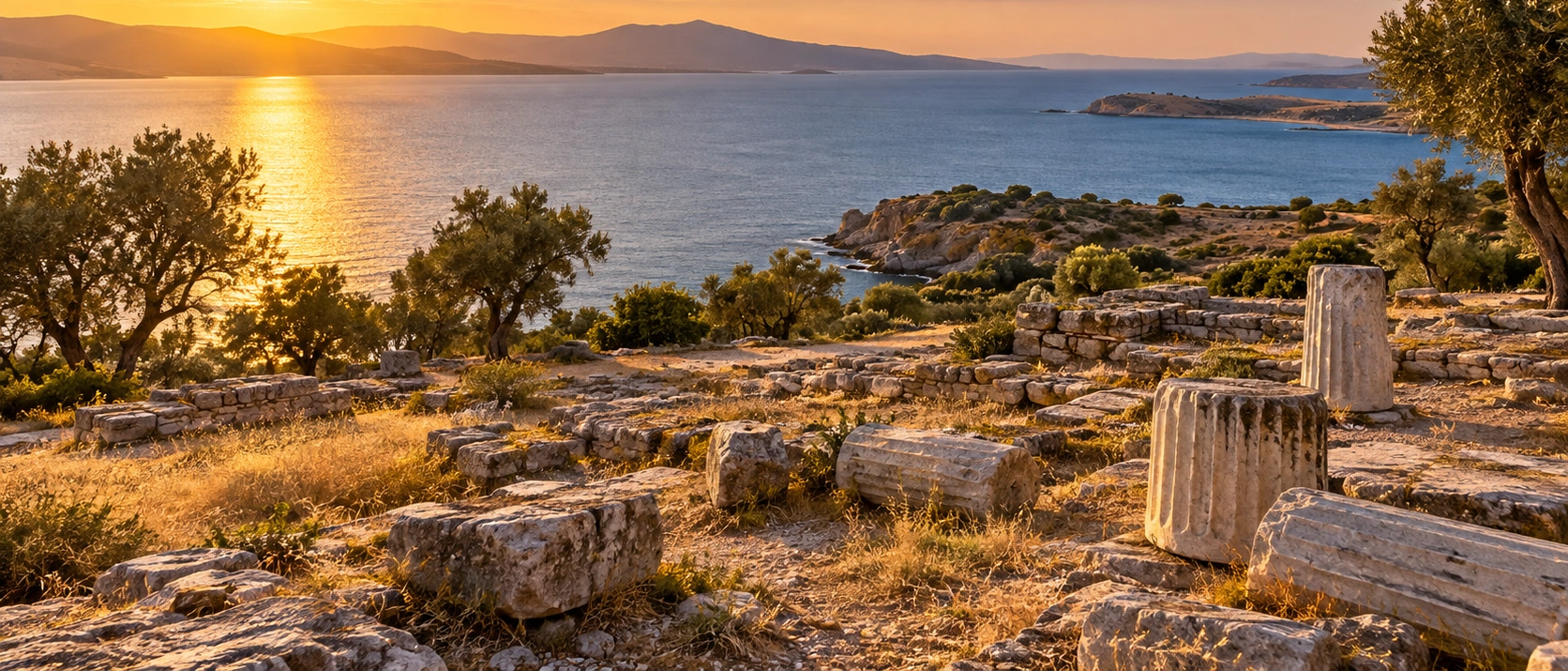
Later Gryneion became closely connected with nearby Myrina, while the sanctuary of Apollo continued to preserve the site's reputation. Today the city is an archaeological landscape rather than a monumental excavated ruin: scattered architectural fragments, ancient wall traces, necropolis evidence and a remarkable coastal setting reveal only part of what remains underground.
Discover the location associated with one of ancient Aiolis' most celebrated sanctuaries of Apollo.
Learn about the prophetic tradition that made Apollo Gryneios famous in the ancient world.
Explore a settlement connected with the network of ancient Aiolian cities along the northern Aegean coast.
See traces of walls, burials and architectural fragments beside the waters of the Çandarlı Gulf.
Essential information about this little-known archaeological site on İzmir's northern Aegean coast.
Temaşalık Burnu near Yeni Şakran, approximately 13 km northeast of Aliağa.
Open on Google MapsAiolis, the historic coastal region extending across parts of northern İzmir and western Anatolia.
Apollo Gryneios, worshipped here in a sanctuary associated with prophecy and a sacred grove.
The ancient oracle of Apollo and a temple described in antiquity as being built of white marble.
Archaic, Classical, Hellenistic and Roman, with evidence continuing into the Byzantine period.
Allow around 45–90 minutes for a careful archaeological and coastal visit.
Gryneion demonstrates how an ancient sanctuary could become famous far beyond the political importance of the settlement surrounding it.
Gryneion occupied an important position on the eastern shore of the Çandarlı Gulf, in a landscape filled with ancient Aiolian settlements. Myrina lay to the south, while Elaia and Pitane were located farther north. The coastline connected these communities with maritime routes leading throughout the Aegean.
Yet Gryneion's greatest distinction was religious rather than political. The sanctuary of Apollo Gryneios became sufficiently famous to be mentioned by several ancient writers. Strabo described an ancient oracle and an impressive sanctuary of white marble, while Pausanias remembered a remarkable sacred grove associated with Apollo.
These descriptions reveal a place that combined architecture, landscape and ritual. Visitors did not simply approach a temple standing in isolation. They entered a sacred environment of trees, coastal scenery, offerings and religious traditions connected with prophecy.
Modern archaeological research is particularly valuable because much of Gryneion remains difficult to interpret above ground. Surface surveys and geophysical investigations are helping archaeologists reconstruct the ancient sanctuary and settlement without assuming that every architectural element mentioned in literary sources can already be identified with certainty.
Gryneion lies on Temaşalık Burnu, a small coastal promontory between Aliağa and Çandarlı in northern İzmir Province. The archaeological area is close to Yeni Şakran and approximately 13 kilometers northeast of Aliağa town center.
The site stands between Akmermer Bay to the north and Mersinli Bay to the south. Archaeological research indicates that the ancient settlement occupied both the promontory and surrounding mainland areas.
The modern İzmir–Çanakkale road passes through the wider archaeological landscape, dividing portions of the ancient site. This modern intervention is one reason why understanding Gryneion requires looking beyond a single concentration of ruins.
Much of Gryneion's fame survives because Greek and Roman authors continued to mention the sanctuary long after the city had lost much of its political importance.
Gryneion is traditionally included among the ancient settlements of Aiolis mentioned in the historical geography of the region.
The geographer describes Gryneion as possessing an ancient oracle of Apollo and a costly sanctuary constructed from white marble.
Pausanias praises the sacred grove of Apollo, remembering cultivated trees and other plants valued for their appearance and fragrance.
By the Roman period, literary descriptions suggest that the settlement itself had greatly declined, while its coastal location continued to be remembered.
Evidence connected with the famous 2nd-century AD orator indicates that the sanctuary retained religious meaning well into the Roman Imperial period.
References to Gryneian Apollo and the Gryneian grove carried the sanctuary's name into Roman literary culture as well as Greek geographical writing.
The precise foundation date of Gryneion remains uncertain. Like other communities of ancient Aiolis, its historical identity became associated with the Aiolian Greek settlement of western Anatolia during the early first millennium BC.
By the 5th century BC, Gryneion appears in the political world of the Aegean. The settlement paid tribute as part of the Athenian-led Delian League, demonstrating that it possessed a recognized civic identity and sufficient economic resources to participate in the alliance.
Following the decline of Athenian power at the end of the Peloponnesian War, western Anatolia again came under strong Persian influence. Gryneion remained within this contested political landscape until the Macedonian expansion toward Asia Minor.
Around 335–334 BC, the Macedonian commander Parmenion, operating ahead of Alexander the Great's major invasion, captured Gryneion. Ancient accounts state that the inhabitants were enslaved. The event marked a major break in the city's independent political history.
During the Hellenistic period, Gryneion increasingly became associated with nearby Myrina. The settlement itself declined in importance, yet the sanctuary of Apollo continued to attract attention and preserved the name of Gryneion in the historical record.
By Roman times, Gryneion seems to have functioned principally as a sacred locality rather than as a powerful independent city. Archaeological material nevertheless demonstrates continued activity in the wider landscape into the Roman and Byzantine periods.
Gryneion develops within the cultural landscape of ancient Aiolis.
The city appears in the tribute records of the Athenian-led Delian League.
Persian power again dominates much of western Anatolia.
Parmenion captures Gryneion during the Macedonian advance into Persian-controlled Anatolia.
Gryneion loses political independence and becomes closely connected with Myrina.
The sanctuary of Apollo remains the principal reason Gryneion continues to appear in historical sources.
The heart of ancient Gryneion was its sanctuary dedicated to Apollo Gryneios. The epithet connected the god directly with the place, making Gryneion part of the wider sacred geography of Apollo in western Anatolia.
Strabo's description is particularly important. He refers to an ancient oracle and an impressive temple built of white marble. Such language suggests that the sanctuary was not merely local: it possessed sufficient prestige to be recognized among the major religious sites of the region.
Apollo was closely associated with prophecy throughout the Greek world. Famous oracular sanctuaries existed at Delphi, Didyma and Claros, while Gryneion represented another important center within this larger tradition.
Precisely how the Gryneion oracle operated is not securely known. Ancient literary references establish its reputation, but archaeological evidence has not yet revealed a complete ritual complex comparable with better-preserved oracular sanctuaries.
The local form of Apollo whose identity became inseparable from Gryneion.
Ancient sources connect the sanctuary with prophetic consultation.
Strabo remembered a prestigious sanctuary constructed from white marble.
Column drums and other stone elements documented around the site may relate to monumental buildings.
Modern investigations have searched below ground for architectural traces associated with the sanctuary.
The temple's complete plan, appearance and chronology remain subjects of archaeological investigation.
One of the most evocative descriptions of Gryneion comes from Pausanias, who remembered a beautiful sacred grove belonging to Apollo. His account describes a planted landscape in which trees were valued not only for fruit but also for their fragrance and appearance.
Sacred groves were important components of Greek religious landscapes. They created a boundary between ordinary space and the territory of the gods, while shade, water, vegetation and carefully maintained trees could become part of the visitor's experience of approaching a sanctuary.
At Gryneion, the combination of a coastal promontory, temple, oracle and sacred vegetation may have created an especially memorable religious setting. Although the ancient grove itself has disappeared, the literary description provides a rare glimpse of how visitors experienced the sanctuary beyond its architecture.
One of the most dramatic episodes in Gryneion's history occurred immediately before the conquests of Alexander the Great. Macedonian forces had already begun establishing positions in western Anatolia while Alexander prepared for his larger expedition against the Persian Empire.
The experienced Macedonian general Parmenion captured Gryneion during these operations, generally dated around 335–334 BC. Ancient accounts state that the settlement was taken by force and its inhabitants enslaved.
The conquest demonstrates the strategic importance of the coastal cities of Aiolis during the opening phase of the Macedonian campaign. Controlling settlements and harbors in the region helped establish a bridgehead before Alexander crossed into Asia in 334 BC.
Gryneion continued to exist afterward, but its independent political position was greatly weakened. In the Hellenistic period it became increasingly connected with Myrina, while its sanctuary rather than its civic power preserved its fame.
Gryneion attracted antiquarian and archaeological interest during the 19th century as scholars attempted to match the descriptions of ancient writers with the physical geography of the Çandarlı Gulf.
Investigations in 1883 included work associated with Aristides Baltazzi and Osman Hamdi Bey. Research in the necropolis produced small ceramic vessels, bronze objects and burials constructed from local stone. Contemporary investigators also noted that the celebrated temple of Apollo could no longer be identified as a standing monument.
Further archaeological observations and rescue work took place during the 20th century. Modern research entered a new phase with systematic Myrina and Gryneion archaeological surface surveys. From 2015 onward, teams documented the settlement, necropolis, architectural material, ceramics and the broader ancient territory.
Researchers identified traces associated with the harbor, fortification walls, a tower, burials and scattered architectural elements. Surface pottery from investigated areas extends across a long chronological span, demonstrating that the landscape remained active for centuries.
Geophysical investigations have also been conducted on Temaşalık Burnu in the search for subsurface remains associated with the famous Apollo sanctuary. Ground-penetrating radar produced geometric anomalies in several areas, including regularly arranged features that researchers have considered potentially relevant to the temple complex.
Early archaeological work explored parts of Gryneion's necropolis and recorded ancient material.
Burials, sarcophagi and associated artifacts reveal aspects of life and death at ancient Gryneion.
Survey teams have recorded ancient wall sections and the remains of a tower near the coast.
Scattered architectural elements offer clues to the monumental structures once standing at the site.
Systematic archaeological documentation has mapped remains across Gryneion and its surrounding territory.
Geophysical surveys have searched below the surface for foundations and possible temple-related architecture.
Gryneion rewards visitors who enjoy archaeology beyond monumental ruins. The surviving landscape is fragmented, but each element helps reconstruct the ancient sanctuary, settlement and coastline.
Walk through the coastal setting where Gryneion developed beside the ancient Elaïtic, modern Çandarlı, Gulf.
Look for surviving stone blocks and column drums connected with the ancient settlement's monumental architecture.
Understand the landscape where archaeological and geophysical research has searched for Apollo's sanctuary.
Sections of ancient defensive masonry and a tower have been documented near the coast.
Burials and sarcophagus remains have been discovered in areas surrounding the ancient settlement.
Look across the gulf and imagine the network of maritime connections linking Gryneion with other Aiolian cities.
Gryneion cannot be fully understood without nearby Myrina Ancient City. The two settlements occupied neighboring parts of the Aiolian coastline and became increasingly connected during the Hellenistic period.
Myrina developed into the more important urban center, while Gryneion's identity became focused increasingly on the sanctuary of Apollo. Ancient geographical sources eventually describe Gryneion within the territory or political sphere of Myrina.
The relationship provides a useful example of how ancient cities changed. Political independence, sacred geography and urban importance were not fixed: one settlement could decline as a civic center while remaining influential because of a sanctuary famous across the region.
Gryneion differs from a formal archaeological park. The remains are spread through an open coastal landscape where archaeological features may be subtle and modern roads and land use intersect with the ancient site.
Expect dry grass, loose stones, uneven earth and rough archaeological ground.
The scattered remains are much easier to identify in good natural light.
Carry drinking water, especially during the hot and exposed summer months.
A hat, sunscreen and lightweight clothing are useful because shade can be limited.
Architectural fragments and pottery belong to the archaeological context and must remain where they are.
Do not cross fences, cultivated fields or restricted areas without clear permission.
The modern İzmir–Çanakkale road passes through the wider ancient landscape.
Visiting the neighboring archaeological landscape makes Gryneion much easier to understand historically.
Begin by viewing the Temaşalık Burnu landscape as a whole. Notice the relationship between the promontory, the bays on either side and the wider Çandarlı Gulf. The coastal geography helps explain why an ancient settlement and sanctuary developed here.
Continue toward the areas where architectural fragments and ancient masonry are visible. Instead of searching for one spectacular monument, look for evidence of different archaeological features: blocks, column elements, wall traces and changes in the terrain.
Then consider the area traditionally associated with the sanctuary of Apollo Gryneios. Modern geophysical investigations are particularly important here because much of the architecture may survive below the modern ground surface.
After Gryneion, continue south toward Myrina Ancient City. Together the two sites tell a much richer story of Aiolian settlement, maritime connections, religion and political change.
Gryneion should be approached as an archaeological landscape rather than a conventional museum complex with reconstructed monuments and extensive visitor infrastructure. Access conditions may vary according to archaeological work, land ownership, vegetation and local arrangements.
The official archaeological and municipal sources consulted for this guide do not provide a standard museum-style timetable or a permanent ticket schedule for Gryneion. Visitors should therefore avoid assuming that every section of the archaeological area is open or intended for public access.
Because Gryneion is largely outdoors and exposed to the Aegean climate, season and time of day strongly influence the experience.
Green vegetation, wildflowers and mild temperatures make spring especially rewarding.
Comfortable temperatures and softer sunlight are ideal for archaeological exploration.
Visit early before the landscape becomes very hot and exposed during midday.
Low sunlight gives better definition to ancient stones, vegetation and the coastal terrain.
Quiet and atmospheric, although rain and wind can make uneven surfaces slippery.
Good visibility makes it easier to appreciate Gryneion's position within the wider Çandarlı Gulf.
A quick look at the coastal setting and the most visible archaeological fragments.
Enough for a relaxed first visit with time to understand the sanctuary landscape.
Ideal for archaeology enthusiasts who want to examine the terrain and surviving details carefully.
Combine Gryneion with nearby coastal stops and Yeni Şakran.
Combine Gryneion with Myrina for a deeper exploration of ancient Aiolis.
Create a broader archaeological journey through the ancient landscapes around Aliağa.
Gryneion is especially attractive for travelers who enjoy photographing the relationship between archaeology and landscape rather than monumental architecture alone.
Use wide compositions to show the archaeological landscape together with the Çandarlı Gulf.
Photograph column drums and stone blocks against dry grasses, olive trees and the sea.
Low-angle light helps reveal texture and weathering on archaeological stones.
Warm light creates strong atmosphere across the coastal landscape.
Include the terrain around a ruin rather than photographing every fragment in isolation.
Never reposition pottery, stones or archaeological material to create a photograph.
Gryneion is not a fully developed archaeological park. Visitors should expect natural and uneven surfaces rather than paved museum routes.
Loose soil, stones, vegetation and changes in level can make walking difficult.
Do not expect continuous paved visitor routes throughout the archaeological landscape.
Exposed terrain can become tiring quickly during hot weather.
Travelers with reduced mobility may prefer to appreciate the landscape from the easiest accessible areas.
Supervise children closely around uneven stones, roadside areas and coastal terrain.
Ancient walls and architectural fragments should never be climbed.
Gryneion lies between Aliağa and Çandarlı, close to Yeni Şakran and the main İzmir–Çanakkale road. A private car, taxi or organized vehicle is generally the easiest way to reach the archaeological area.
Travel north toward Yeni Şakran and Çandarlı; Gryneion lies approximately 13 km from Aliağa.
The archaeological area is very close to the settlement, around the Temaşalık Burnu coastline.
Follow the northern coastal route toward Aliağa and continue in the direction of Yeni Şakran.
A private vehicle provides the easiest flexibility for combining Gryneion with nearby archaeological sites.
A local taxi from Aliağa or Yeni Şakran can be practical when arranging a return pickup in advance.
A knowledgeable guide greatly improves a visit because much of Gryneion's archaeology is not immediately obvious.
Gryneion stands within one of northern İzmir's richest archaeological landscapes. Combining several nearby sites reveals how densely populated the Aiolian coast was in antiquity.
Explore Gryneion's powerful southern neighbor, famous for its extensive necropolis and remarkable terracotta figurines.
Use Aliağa as a base for discovering the ancient cities, coastline and archaeological heritage of northern İzmir.
Travel inland to one of the most impressive hilltop cities of ancient Aiolis, surrounded by the rugged landscape of the Yunt Mountains.
Discover the ancient harbor settlement associated with the maritime network of the Pergamon kingdom.
Stop in the nearby coastal settlement for cafés, food and views across the Çandarlı Gulf.
Continue north to the seaside town known for its historic castle and attractive Aegean waterfront.
Gryneion is located at Temaşalık Burnu near Yeni Şakran in the Aliağa district of İzmir, on the eastern side of the Çandarlı Gulf.
Gryneion was best known for its sanctuary and oracle of Apollo Gryneios and for a sacred grove praised by ancient writers.
Yes. Ancient and modern archaeological sources place Gryneion among the important settlements of the Aiolian region of western Anatolia.
Apollo Gryneios was the local form or epithet of Apollo associated specifically with Gryneion and its famous sanctuary.
Yes. Ancient sources, especially Strabo, describe an old oracle of Apollo at Gryneion. Exactly how its prophetic rituals operated remains uncertain.
The monumental temple described in antiquity does not survive as a standing building. Archaeologists have documented architectural fragments and used geophysical methods to investigate possible buried structures associated with the sanctuary.
Strabo described Gryneion as possessing an ancient oracle and an impressive sanctuary of Apollo constructed from white marble.
Pausanias praised Gryneion's sacred grove of Apollo, describing cultivated trees and vegetation valued for beauty and fragrance.
Shortly before Alexander's major invasion of the Persian Empire, his commander Parmenion captured Gryneion during Macedonian operations in western Anatolia.
Ancient sources describe the settlement as being captured by force and its inhabitants enslaved. However, activity continued at the site afterward, particularly around the sanctuary.
Gryneion eventually lost its political independence and became closely associated with, or dependent upon, neighboring Myrina during the Hellenistic period.
No complete temple stands today. Visitors instead see scattered archaeological remains, while researchers continue to investigate possible buried architecture.
The site has been investigated through archaeological excavations, rescue work, systematic surface surveys and geophysical research at different times.
Visitors can experience the coastal archaeological landscape, architectural fragments, ancient wall remains and areas associated with the sanctuary and necropolis.
Around 45–90 minutes is suitable for most visitors, although archaeology enthusiasts may wish to spend longer studying the site and landscape.
Families can visit, but children should be supervised carefully because the ground is uneven and the wider archaeological landscape is not designed like a modern museum park.
Accessibility is limited because much of the site consists of natural terrain, archaeological ground and areas without dedicated paved routes.
Spring and autumn provide the most comfortable weather. During summer, early morning or late afternoon is preferable to the midday heat.
Yes. The two neighboring sites make an excellent combination and together provide a much deeper understanding of the ancient Aiolian coast.
For travelers interested in Greek religion, Apollo, archaeology and lesser-known ancient sites, Gryneion offers a fascinating contrast to the monumental archaeological cities of western Türkiye.
Never collect pottery fragments, stones, shells or archaeological material.
Even apparently loose fragments may preserve valuable archaeological context.
Do not climb ancient walls, column fragments or archaeological structures.
Do not enter closed archaeological zones, cultivated land or private property.
Take bottles, food packaging and all other rubbish away with you.
Avoid damaging vegetation, disturbing wildlife or creating new paths through sensitive areas.
Discover Gryneion, Myrina and the remarkable archaeological landscapes of northern İzmir with a private itinerary shaped around history, archaeology and your own interests, without compulsory shopping stops.
Follow the story of ancient Aiolis from Apollo's sanctuary at Gryneion to the neighboring city and necropolis of Myrina.
Ask us about a tailor-made archaeological journey exploring Apollo Gryneios, ancient Myrina, Aiolian history and the coastal landscapes of northern İzmir.
Request a Custom Tour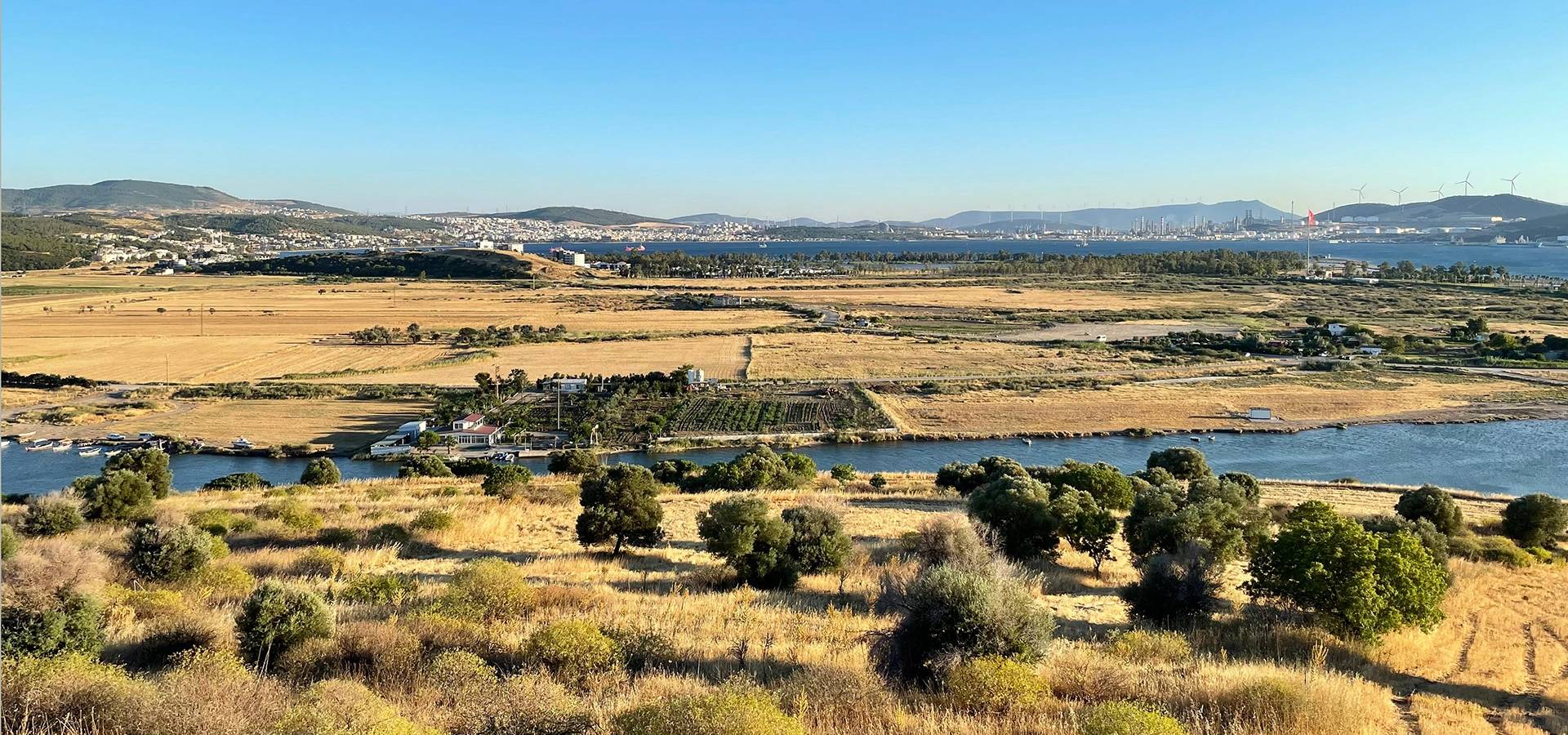
Continue through the ancient landscape to Gryneion's neighboring city, known especially for its extensive necropolis and remarkable terracotta figurines.
Explore MyrinaDiscover the archaeological sites, Aegean coastline and historic settlements surrounding Aliağa.
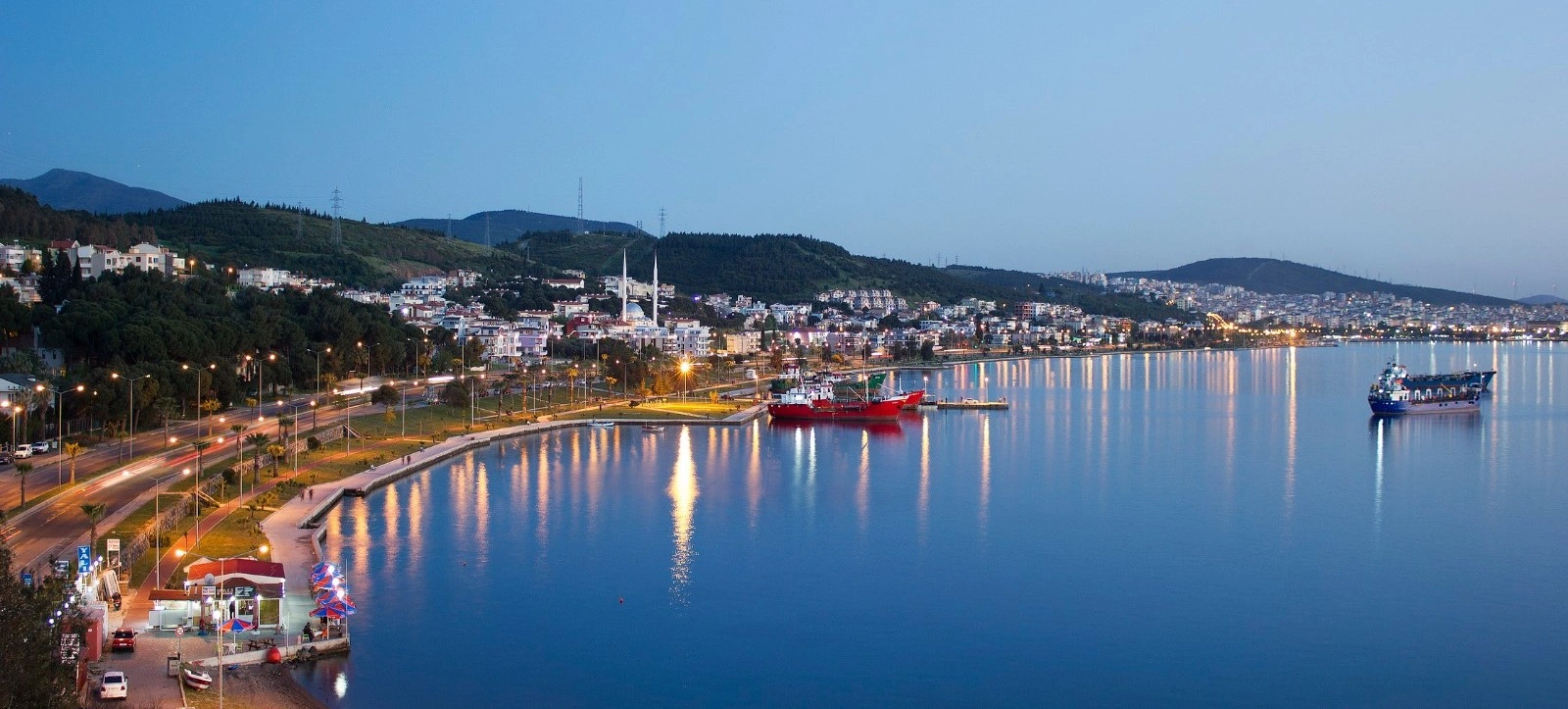
Discover ancient cities, Aegean landscapes, coastal settlements and the surprisingly deep archaeological heritage surrounding modern Aliağa.
View Aliağa Guide
Create a private journey through the ancient cities of İzmir with your own vehicle, professional guide and itinerary designed around archaeology and history.
Plan Your Private Tour