Queen Ada, Alexander the Great & the Mountain Fortress of Caria

Alinda Ancient City – Queen Ada's Carian Stronghold

Discover Alinda above Karpuzlu in Aydın,
where monumental fortifications, a three-storey agora and the story of Queen Ada meet the age of Alexander the Great.

Explore Alinda

Alinda – The Mountain City of Queen Ada and Alexander the Great

Alinda Ancient City, rising immediately above the modern town of Karpuzlu in Aydın Province, is one of the most dramatic archaeological landscapes of ancient Caria.

Its massive fortification walls climb across steep hills overlooking the fertile plain, enclosing a city whose natural setting formed an essential part of its defensive strength.

Alinda entered one of the most famous political stories of fourth-century BC Anatolia when Ada of Caria, a member of the powerful Hecatomnid dynasty, took refuge here after losing control of Halicarnassus.

When Alexander the Great entered Caria in 334 BC, Ada surrendered Alinda to him and established an alliance that would ultimately help restore her authority over the region.

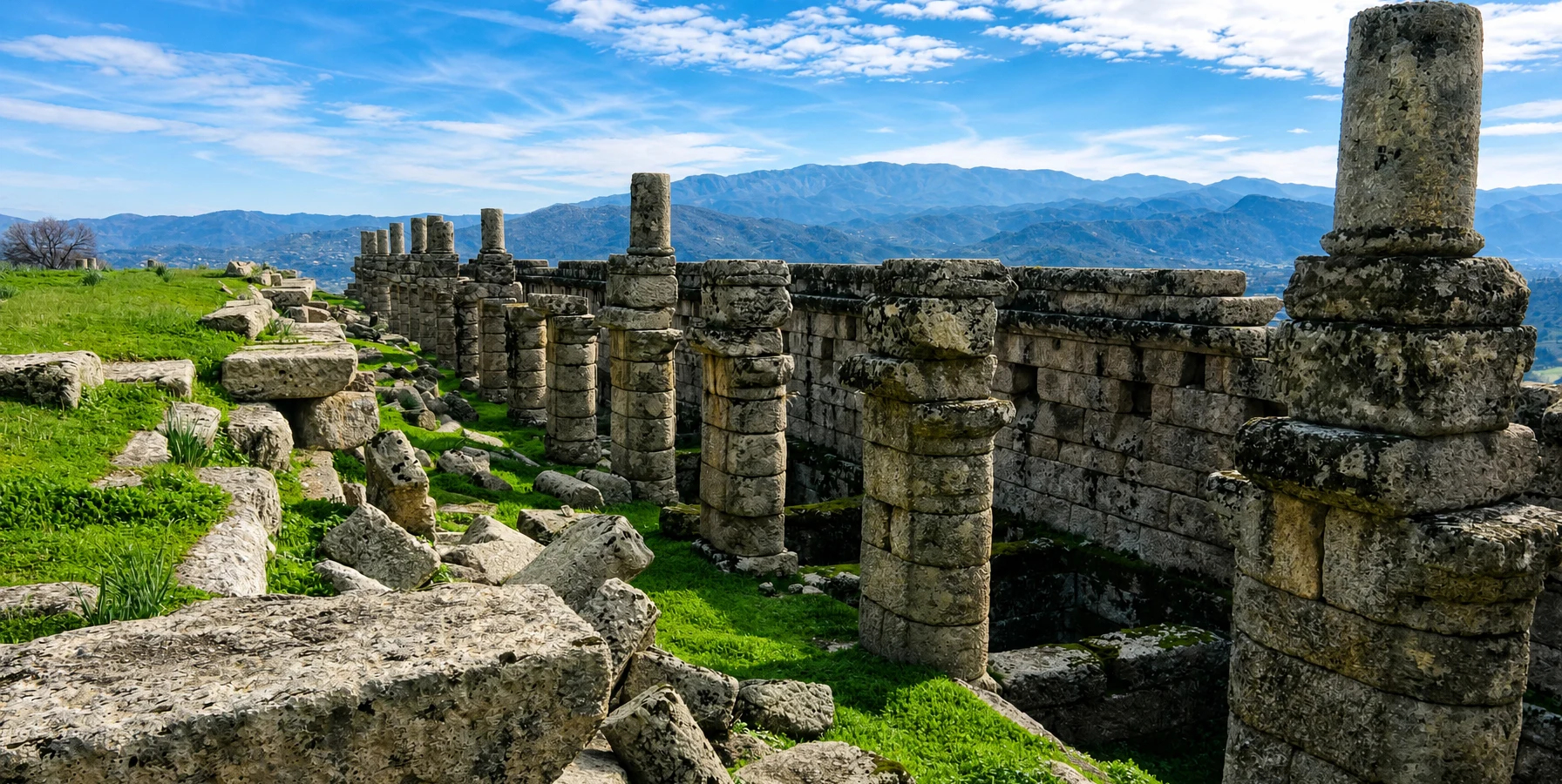
The surviving city is equally remarkable for its architecture. Its monumental agora is supported by an extraordinary multi-level market building almost one hundred metres long, while the hillside preserves a Hellenistic theatre, fortifications, towers, aqueducts, temple remains, ancient streets and extensive burial areas.

Unlike many ancient cities whose modern settlements developed far away from the ruins, Alinda and Karpuzlu remain visually connected. Ancient walls rise directly behind modern houses, and Carian sarcophagi still appear within the wider landscape.

Today Alinda offers an unforgettable combination of archaeology, mountain scenery, military architecture and Hellenistic political history.

Queen Ada

Discover the Carian ruler who transformed Alinda into her political stronghold before forming a remarkable alliance with Alexander the Great.

Great Fortifications

Walk through one of inland Caria's most impressive defensive landscapes, where ancient walls and towers still follow the mountain terrain.

Monumental Agora

Explore an extraordinary terraced civic centre dominated by a nearly 100-metre-long, three-storey market structure.

Hellenistic Theatre

See a remarkably atmospheric theatre built into the natural hillside and later adapted during the Roman period.


Know Before You Go

Alinda Ancient City – Quick Facts

Essential information about one of the most spectacular mountain cities of ancient Caria.

Location

Immediately above Karpuzlu in the interior of Aydın Province.

Open on Google Maps

Ancient Region

Caria, one of the distinctive indigenous cultural regions of southwestern Anatolia.

Famous Ruler

Queen Ada of Caria, daughter of Hecatomnus and sister of Mausolus.

Famous For

Massive fortification walls, towers and an exceptionally defensible mountain setting.

Main Monument

The monumental agora and its extraordinary three-storey market building.

Historic Moment

Ada surrendered Alinda to Alexander the Great during his campaign through Caria in 334 BC.

Caria, Queen Ada and Hellenistic Urbanism

Why Is Alinda Ancient City Important?

Alinda combines one of the great political stories of ancient Caria with an unusually well-preserved fortified urban landscape.

Alinda is important because few ancient sites in southwestern Anatolia preserve such a powerful relationship between topography, defensive architecture and political history.

The city occupies steep elevated terrain above the modern Karpuzlu plain. Its walls, towers and separate fortified sectors transformed the natural landscape into an enormous defensive system.

This strength made Alinda an ideal refuge for Ada of Caria after she was removed from power by her brother Pixodarus around 340 BC.

Only a few years later, the city became part of the history of Alexander the Great when Ada surrendered the fortress to him and asked to establish a familial political relationship with the Macedonian conqueror.

Beyond this famous episode, Alinda possesses exceptional architectural value. Its monumental agora and multi-storey market structure demonstrate highly sophisticated solutions to building a large civic centre on steep terrain.

The theatre, ancient roads, aqueducts, temples, necropoleis and fortifications show that Alinda was not simply a military fortress but a fully developed urban community.

Alinda therefore offers an extraordinary meeting point between Carian identity, Hecatomnid politics, Alexander's conquest, Hellenistic architecture and the mountain geography of inland Anatolia.

The Landscape of Ancient Alinda

Ancient Alinda occupies steep hills immediately north and west of modern Karpuzlu.

The settlement developed across more than one elevated zone, creating a complex urban landscape rather than a single compact acropolis.

The upper fortifications occupy commanding terrain while the lower city contains major public monuments including the agora and theatre.

From elevated areas, visitors can look across the agricultural plain and surrounding mountains of inland Aydın.

This position offered enormous strategic advantages. Anyone approaching the city across the plain could be observed long before reaching its walls.

At the same time, fertile agricultural territory below the hills supplied the economic resources required to sustain a substantial population.

Mountain Stronghold

Steep terrain strengthened the city's natural defences and shaped almost every aspect of its urban plan.

Upper City

Higher fortified sectors provided commanding defensive positions above the main urban centre.

Lower City

Major civic architecture developed on terraces below the highest fortified areas.

Fertile Plain

Agricultural land below Alinda helped support the urban population and regional economy.

Natural Slopes

Architects incorporated the hillside into structures including the theatre and terraced public spaces.

Panoramic Views

The elevated ruins reveal why Alinda was considered one of the strongest positions in ancient Caria.

What Does the Name Alinda Mean?

The ancient name Alinda belongs to the linguistic and cultural landscape of Caria, but its exact meaning is not securely known.

Like many ancient Anatolian place names, it may preserve linguistic elements that developed long before Greek became dominant in written inscriptions throughout the region.

Researchers have attempted to connect Alinda with earlier Anatolian place names known from Bronze Age texts, but such identifications remain debated.

The safest interpretation is therefore to regard Alinda as an ancient regional name whose full linguistic history has not yet been conclusively reconstructed.

Avoid overly simple translations: Unlike some ancient city names whose Greek meaning is clear, no universally accepted translation of the name Alinda exists.

The Earliest History of Alinda

Alinda's history began long before the famous events of the fourth century BC.

The mountains and valleys of inland Caria were inhabited throughout earlier periods of Anatolian history, and researchers have investigated possible Bronze Age connections for the settlement.

One proposed identification links Alinda with an ancient place name preserved in Hittite-period sources.

However, archaeological evidence has not yet established such an identification beyond doubt.

What is certain is that Alinda belonged to a landscape with deep indigenous traditions before the monumental Hellenistic city visible today fully developed.

Its surviving defensive architecture also includes phases that may predate the great transformation associated with Ada and the Hellenistic period.

Important archaeological distinction: Possible Bronze Age connections should not be used to suggest that the monumental agora, theatre and other visible buildings date to the second millennium BC. Most of Alinda's best-known standing architecture belongs to considerably later periods.

Alinda and Ancient Caria

Alinda belonged to Caria, the ancient region occupying much of southwestern Anatolia.

The Carians possessed their own language, religious traditions and political institutions while maintaining close connections with Greek communities along the Aegean coast.

Over centuries, this created a cultural environment in which indigenous Anatolian and Greek traditions interacted continuously.

Alinda's architecture demonstrates this process particularly well.

Its defensive system responds directly to the mountainous geography of inland Caria, while buildings such as the theatre, agora and stoas belong to architectural traditions shared throughout the Hellenistic Mediterranean.

The city therefore represents neither a purely Greek colony nor an isolated indigenous settlement. It was part of the complex cultural world of ancient Caria.

Carian Heritage

Alinda emerged within one of southwestern Anatolia's most distinctive indigenous cultural landscapes.

Greek Influence

Hellenistic architecture and civic institutions increasingly connected the city with the wider Greek-speaking world.

Mountain Geography

Local terrain remained one of the strongest influences on Alinda's urban and defensive character.

Regional Networks

Roads linked Alinda with Alabanda, Mylasa and other communities throughout inland Caria.

Alinda and the Hecatomnid Dynasty

Understanding Alinda's most famous historical period requires understanding the Hecatomnids.

The dynasty took its name from Hecatomnus, whose family ruled Caria under the wider political authority of the Persian Achaemenid Empire during the fourth century BC.

His children included Mausolus, Artemisia II, Idrieus, Ada and Pixodarus.

The family transformed Caria through monumental construction, diplomacy, military organisation and increasingly close engagement with Greek culture.

The most internationally famous member was Mausolus, whose monumental tomb at Halicarnassus became the Mausoleum, one of the Seven Wonders of the Ancient World.

Alinda entered the centre of Hecatomnid politics through Mausolus's sister Ada.

Hecatomnus

Founder of the ruling dynasty whose descendants dominated fourth-century BC Carian politics.

Mausolus

The powerful ruler associated with the transformation of Halicarnassus and the famous Mausoleum.

Idrieus

Brother and husband of Ada, who ruled Caria before his death in 344 BC.

Ada

The Hecatomnid ruler whose loss of Halicarnassus led directly to Alinda's most famous historical chapter.

Queen Ada of Caria and Alinda

Ada of Caria was one of the most remarkable political figures of fourth-century BC Anatolia.

She was a daughter of Hecatomnus and sister of Mausolus, Artemisia, Idrieus and Pixodarus.

Ada married her brother Idrieus, following the dynastic marriage practices of the Hecatomnid royal family.

After Idrieus died in 344 BC, Ada succeeded him as ruler of Caria.

Her rule did not last unchallenged. Around 340 BC, her brother Pixodarus removed her from control of Halicarnassus.

Ada nevertheless retained possession of Alinda.

The city's extraordinary defensive strength allowed her to maintain an independent political base in the Carian interior.

Why Alinda mattered to Ada: Alinda was far more than a place of exile. Its formidable walls, mountain position and control over surrounding territory allowed Ada to remain a significant political force even after losing Halicarnassus.

Why Did Queen Ada Retreat to Alinda?

Alinda was exceptionally well suited to serve as Ada's stronghold.

The city occupied steep terrain protected by extensive walls, towers and naturally difficult approaches.

Unlike an exposed settlement on level ground, Alinda could use the mountain itself as part of its defensive system.

Its elevated position also overlooked fertile territory capable of supporting the inhabitants and maintaining local political influence.

Ada's continued possession of Alinda meant that Pixodarus had not completely eliminated her power.

When the political situation changed dramatically with the arrival of Alexander the Great, Ada was therefore able to negotiate from a position of genuine territorial strength.

Fortified Hills

Multiple defensive sectors protected the settlement at different elevations.

Strong Walls

Massive masonry and towers controlled approaches to the ancient city.

Regional Support

Ada retained political influence among communities within the Carian countryside.

Strategic Position

Alinda gave Ada a secure base from which she could survive the conflict within her dynasty.

Alexander the Great and Alinda

In 334 BC, Alexander the Great entered western Anatolia during his campaign against the Persian Empire.

After victories farther north and the capture of important cities including Miletus, his forces advanced into Caria.

Ada recognised that Alexander's arrival created an opportunity to recover the political position she had lost.

Ancient tradition records that she surrendered Alinda to Alexander.

She also asked to adopt the Macedonian king as her son, creating a powerful symbolic relationship between the conqueror and the Carian dynasty.

Alexander accepted Ada's support.

Following his campaign against Halicarnassus, he recognised Ada as ruler of Caria.

334 BC

Alexander entered Caria during the first year of his campaign in Asia.

Alinda Surrendered

Ada voluntarily placed her stronghold in Alexander's hands rather than resisting the Macedonian army.

Political Adoption

Ancient accounts describe Ada asking to adopt Alexander as her son.

Ada Restored

Alexander ultimately entrusted the government of Caria to Ada after the struggle for Halicarnassus.

A remarkable alliance: The relationship between Ada and Alexander was politically valuable to both sides. Alexander gained the support of an established Carian ruler, while Ada gained the military backing required to recover her regional authority.

Was Alinda Renamed Alexandria?

Historical and archaeological literature has long discussed whether Alinda was temporarily associated with the name Alexandria following Alexander's conquest.

Turkish cultural sources preserve the tradition that Alinda was known for a period as Alexandria.

Other researchers have connected the city with the ancient name Alexandria by Latmos.

The precise identification, however, is not universally accepted.

For this reason, it is better to describe the Alexandria connection as an important historical possibility rather than treating every aspect of the identification as completely settled.

Historical caution: Alexander founded or renamed several cities across his empire. The association between Alinda and an Alexandria is significant, but the exact ancient geographical identification remains debated.

Alinda during the Hellenistic Period

The Hellenistic period transformed Alinda into the monumental city whose architectural character remains visible today.

The difficult mountain terrain did not prevent ambitious construction. Instead, ancient architects used terraces, retaining walls and multi-level structures to create large public spaces.

The agora, market building and theatre belong to this sophisticated urban environment.

The fortifications were maintained and adapted to protect a city that continued to possess regional strategic significance.

Inscriptions and architectural evidence also demonstrate that Alinda participated in the wider administrative and cultural networks of Hellenistic Caria.

Greek became increasingly important in public life while the city continued to occupy a landscape with much older Carian traditions.

The Fortification Walls of Alinda

Alinda's fortifications are among the defining features of the archaeological site.

Ancient walls extend across the ridges and slopes surrounding both higher and lower sectors of the city.

The defensive system follows the natural contours of the mountains rather than imposing a simple geometric enclosure.

Strong towers reinforced strategically vulnerable sections and provided defenders with commanding views over approaches to the settlement.

The walls were constructed from carefully worked local stone, with masonry techniques that demonstrate considerable engineering skill.

Different building phases indicate that the defensive system developed over time rather than being completed in a single construction campaign.

Walking beside these walls is one of the best ways to understand why Alinda could remain in Ada's possession even after she lost control of Halicarnassus.

Mountain Walls

Fortifications follow the natural contours of ridges, slopes and rocky terrain.

Defensive Towers

Towers strengthened vulnerable sectors and provided wide observation across the surrounding countryside.

Multiple Sectors

Separate fortified areas reveal the complexity of Alinda's urban and defensive organisation.

Local Stone

Massive blocks from the surrounding geological landscape gave the fortifications their distinctive appearance.

Strategic Visibility

Approaching movement across the plain could be observed from elevated defensive positions.

Exceptional Survival

Long sections remain sufficiently preserved to communicate the enormous scale of the ancient defence system.

The Upper and Lower Acropolis of Alinda

Alinda developed across two major elevated settlement zones rather than around a single isolated hilltop.

Modern archaeological research distinguishes between higher fortified areas and the lower acropolis containing many of the city's monumental public buildings.

The elevation difference between these sectors helped create a naturally layered urban plan.

The highest areas provided exceptional defensive value, while lower terraces offered more practical space for civic architecture.

This arrangement allowed Alinda to combine military strength with the requirements of a functioning Hellenistic city.

Upper Acropolis

The highest fortified areas offered maximum defensive control over the surrounding landscape.

Lower Acropolis

Important urban structures developed on lower terraces within the fortified city.

Terraced Planning

Ancient engineers created usable civic spaces on naturally steep ground.

Connected Defences

Walls and internal defensive systems linked different elevations into a coordinated urban landscape.

The Agora of Ancient Alinda

The agora is one of Alinda's most important surviving architectural complexes.

It occupies a carefully terraced area within the lower city and formed the centre of commercial, political and social activity.

The central open space was surrounded by architectural elements including stoas, entrances and the remarkable market structure along its southern side.

Creating such a large civic square on steep terrain required substantial engineering.

Instead of simply levelling the entire hillside, Alinda's builders transformed the change in elevation into part of the architecture itself.

The result is one of the clearest examples in Caria of Hellenistic urban design adapting monumental public architecture to a mountain environment.

Civic Centre

The agora brought commerce, public movement and social life together within one monumental space.

Terraced Design

The sloping landscape was transformed into a carefully organised architectural platform.

Stoas

Columned halls provided sheltered areas for movement, meeting and commercial activity.

Ancient Streets

Roads connected the agora with the theatre and other districts of the city.

The Monumental Market Building of Alinda

The most extraordinary structure within Alinda's agora is the monumental building forming its southern side.

Extending for almost 100 metres, the structure was designed across three architectural levels.

The lower floors contained rows of rooms while the upper level communicated directly with the surface of the agora and functioned as a stoa.

This arrangement solved one of the central architectural problems created by Alinda's steep topography.

The structure simultaneously supported the monumental public square above and created usable commercial space below.

Large sections of its masonry remain standing, making the building one of the most visually impressive examples of multi-level Hellenistic commercial architecture in southwestern Anatolia.

Nearly 100 Metres

The market structure extends almost the full length of the southern side of the agora.

Three Levels

Its unusual vertical arrangement took advantage of the natural difference in elevation.

Commercial Rooms

Lower levels contained organised interior spaces suitable for commercial and storage functions.

Upper Stoa

The uppermost level formed part of the monumental architectural frame surrounding the agora.

Terrace Engineering

The building also acted as an enormous retaining structure supporting the civic space above.

Hellenistic Urbanism

The monument demonstrates how architects could transform difficult terrain into sophisticated city planning.

One of Alinda's essential sights: Even visitors with limited time should explore the agora and market building. Together they provide the clearest impression of the wealth, engineering and architectural ambition of ancient Alinda.

The Ancient Streets of Alinda

Recent archaeological documentation has helped clarify the network of streets connecting Alinda's major public monuments.

Stone-paved routes linked the agora with neighbouring districts and helped overcome significant changes in elevation.

One documented route connected the agora directly with the theatre.

Other streets passed alongside monumental buildings and through gateways controlling movement between different sectors of the city.

These roads remind visitors that the surviving monuments were once part of a continuous urban environment filled with houses, workshops, markets and public activity.

The Ancient Theatre of Alinda

The theatre of Alinda occupies the southwestern slope of the lower urban area.

Its seating was constructed against the natural hillside, allowing ancient builders to use the terrain as structural support.

The cavea faces toward the southeast and remains sufficiently preserved to reveal the form of the ancient auditorium.

Architectural characteristics demonstrate strong Hellenistic traditions.

The theatre continued in use during the Roman period and underwent later modifications as the requirements of public entertainment changed.

The stage building survives far less completely than the seating area, but the monument remains one of Alinda's most atmospheric archaeological spaces.

Hillside Construction

The natural slope supported rising rows of ancient spectator seating.

Hellenistic Character

The theatre preserves architectural features associated with the Hellenistic phase of the city.

Roman Use

Later modifications demonstrate continued use of the monument under Roman rule.

Landscape Setting

The elevated position connects theatrical architecture with panoramic views across the surrounding terrain.

The Water System of Ancient Alinda

Supplying a large population with water was especially challenging at a fortified mountain city such as Alinda.

Remains of aqueducts, channels and cistern-related infrastructure demonstrate the engineering required to bring water into the settlement and store it securely.

One of the most recognisable surviving aqueduct structures stands west of the acropolis.

Water management was essential not only for daily life but also for defence.

A fortified city could not survive an extended siege unless adequate water remained available inside its protected territory.

Archaeological investigation continues to improve understanding of how water was transported and distributed across Alinda's different elevations.

Aqueducts

Surviving structures preserve evidence for the transport of water toward the ancient city.

Cisterns

Stored water would have been essential for both everyday life and periods of military danger.

Gravity

Engineers had to control changes in elevation carefully when moving water through mountainous terrain.

Urban Supply

Public buildings, houses and fountains all depended on a reliable water-management system.

The Temples and Sacred Areas of Alinda

Temple foundations survive within the elevated sectors of Alinda.

Unlike the monumental market building and theatre, these sanctuaries are preserved mainly at foundation level and require more archaeological interpretation.

Their precise ancient dedications are not always securely known.

The position of sacred architecture within elevated parts of the city would nevertheless have made temples highly visible components of the urban landscape.

Religion was deeply connected with civic identity, political authority and public festivals throughout the Hellenistic and Roman periods.

Future archaeological investigation may provide more information about the gods worshipped within these sanctuaries and the chronology of their construction.

Archaeological caution: It is better to describe Alinda's surviving structures as temple remains unless a specific ancient dedication is securely established by archaeological or epigraphic evidence.

The Necropolis of Ancient Alinda

Alinda possessed extensive burial areas outside the principal inhabited and fortified zones.

The surrounding landscape preserves rock-cut tombs, chamber tombs, monumental funerary structures and stone sarcophagi.

Some ancient sarcophagi remain strikingly close to the houses and roads of modern Karpuzlu.

This unusual relationship between the ancient necropolis and modern settlement makes the historical landscape particularly visible.

Funerary monuments provide valuable evidence for family identity, social status and changing burial traditions over many centuries.

They also demonstrate that the archaeological city extends far beyond the major walls, theatre and agora.

Carian Sarcophagi

Stone burial monuments survive throughout parts of the southern landscape around the city.

Chamber Tombs

Built and rock-cut burial spaces reveal the diversity of funerary architecture at Alinda.

Monumental Tombs

Elite families used highly visible architecture to preserve social identity and memory.

Modern Karpuzlu

Ancient burial remains can still be encountered remarkably close to the contemporary settlement.

Alinda during the Roman Period

Alinda continued to function as an important urban community after Caria became integrated into the Roman world.

Earlier Hellenistic monuments remained central to city life while existing structures were repaired, modified and adapted.

The theatre, for example, continued to serve public entertainment after architectural alterations.

Civic institutions also participated in the broader political and economic system of Roman Asia Minor.

Alinda continued issuing its own civic coinage during the Roman Imperial period, demonstrating the survival of a strong local urban identity.

The Roman city therefore retained the physical framework created during earlier centuries while adapting it to new political, economic and cultural conditions.

Continuing Urban Life

Alinda remained inhabited and economically active long after the Hellenistic kingdoms disappeared.

Civic Coinage

Locally issued coins expressed the continuing identity and institutions of the ancient city.

Theatre Adaptation

Older entertainment architecture continued to evolve during Roman rule.

Regional Networks

Roads connected Roman Alinda with neighbouring Carian cities and wider provincial trade routes.

The Ancient Coins of Alinda

Coins issued in the name of Alinda provide valuable evidence for the city's political and economic history.

Ancient civic coinage did far more than facilitate commercial exchange.

Images of deities, rulers and local symbols could communicate religious traditions and civic identity across a wide geographical area.

The continued production of Alindan coinage during the Roman Imperial period demonstrates that the city retained important civic institutions even under Roman sovereignty.

For archaeologists, coins also provide chronological evidence for trade, settlement and connections between Alinda and other cities of Asia Minor.

Alinda during the Byzantine Period

Alinda continued to possess significance during Late Antiquity and the Byzantine period.

As Christianity became dominant throughout the Roman and Byzantine world, the religious landscape of Caria changed profoundly.

Alinda became an episcopal centre associated with the ecclesiastical province whose metropolitan seat was at Aphrodisias.

Archaeological research has identified Christian architectural remains, including a basilical church within the wider urban landscape.

These remains demonstrate that Alinda did not simply disappear when the classical pagan world came to an end.

Instead, the ancient city continued to evolve as its religious institutions and patterns of settlement changed.

The Urban Plan of Ancient Alinda

Alinda's urban plan cannot be understood independently of its landscape.

Instead of occupying a level plain, the city spread across steep slopes, terraces and multiple fortified elevations.

The agora occupied one of the principal civic terraces.

The monumental market structure compensated for differences in elevation along its southern side.

The theatre used a natural hillside nearby, while roads linked the entertainment district with the agora and other public spaces.

Temple areas occupied prominent elevated positions.

Fortifications enclosed and divided strategic sections of the settlement, while burial grounds developed outside inhabited areas.

Upper Fortifications

The highest sectors controlled strategic terrain and strengthened the city's defensive depth.

Agora Terrace

The civic centre was carefully engineered into the slope rather than positioned on naturally flat land.

Market Structure

Multi-level architecture supported the agora while creating usable rooms below.

Theatre District

The hillside provided the natural setting required for the spectator seating.

Water Infrastructure

Aqueducts and storage systems supplied a population living across different elevations.

Necropolis

Funerary architecture extended into the landscape outside the principal defensive walls.

The Rediscovery and Archaeological Study of Alinda

The ruins of Alinda attracted the attention of European travellers and antiquarians from the eighteenth and nineteenth centuries onward.

Its enormous walls and highly visible market building made the site impossible to overlook.

Later scholars documented inscriptions, architecture, fortifications and burial monuments in increasing detail.

Unlike some of Türkiye's most intensively excavated archaeological sites, large areas of Alinda have never been exposed through extensive excavation.

This makes archaeological survey, architectural documentation and geophysical research especially important.

Modern programmes have produced increasingly detailed plans of the fortifications, agora, streets, water systems and other structures.

A new programme of archaeological surface research began in 2020, expanding documentation of both visible and buried cultural remains.

Early Travellers

Visitors recorded Alinda's monumental remains long before systematic modern archaeological research began.

Architectural Study

The market building, theatre and fortifications have received detailed specialist investigation.

Surface Survey

Systematic documentation helps reconstruct the city without requiring every structure to be excavated.

Geophysical Research

Ground-based technology can identify buried architectural anomalies without immediately disturbing archaeological deposits.

2020 Research

Renewed fieldwork began a new phase in the documentation and protection of the ancient city.

Future Discoveries

Large areas still contain the potential to transform understanding of Alinda's history and urban development.

Archaeology is continuing: Interpretations of individual structures, dates and ancient routes may change as new research provides additional evidence.

Archaeological Finds from Alinda

Research at Alinda has documented pottery, inscriptions, coins, architectural fragments and numerous objects associated with ancient daily life.

Epigraphic evidence is particularly valuable because inscriptions preserve information that architecture alone cannot provide.

Names, civic offices, administrative structures and religious dedications can all survive through inscribed stone.

Coins add evidence for trade, chronology and civic identity.

Material from the necropoleis provides information about burial customs and social organisation.

Together these finds allow archaeologists to reconstruct a much richer picture of Alinda than its surviving walls alone could provide.

What Is It Like to Visit Alinda?

Visiting Alinda feels less like entering a conventional archaeological park and more like exploring an ancient mountain city that still dominates the modern landscape below.

The ruins begin close to Karpuzlu and rise progressively toward the fortified hills.

The agora and monumental market building provide the strongest immediate impression of ancient urban architecture.

The theatre offers a very different atmosphere, using the natural hillside and surrounding landscape as part of the experience.

Climbing farther into the fortified areas reveals the scale of Alinda's defensive system.

Because monuments are spread across steep terrain, visitors who explore beyond the main structures should allow sufficient time and wear appropriate footwear.

The relative absence of large tourist crowds makes Alinda especially rewarding for travellers interested in archaeology, ancient history and landscape photography.

Agora

Begin with the monumental civic centre to understand the scale and sophistication of Hellenistic Alinda.

Market Building

Walk around the surviving masonry to appreciate how its three levels respond to the hillside.

Theatre

Continue toward the ancient seating area and observe how the monument was integrated into the slope.

Fortification Walls

Higher routes reveal the extraordinary relationship between architecture and natural defence.

Panoramic Views

Elevated positions provide spectacular perspectives over modern Karpuzlu and the surrounding Carian countryside.

Quiet Atmosphere

Alinda generally receives far fewer visitors than major archaeological destinations along Türkiye's Aegean coast.

Best Time to Visit Alinda Ancient City

Alinda is an extensive outdoor archaeological landscape involving considerable walking and elevation, making seasonal conditions especially important.

Spring

Green hills, wildflowers and mild temperatures make spring one of the most beautiful periods to explore Alinda.

Early Summer

Long daylight hours are excellent for archaeology and photography, although midday temperatures begin rising quickly.

July & August

Inland Aydın can become extremely hot, making early-morning visits strongly preferable.

September

Warm conditions usually continue, but the light becomes particularly attractive for landscape photography.

Autumn

Lower temperatures make extended walks through the fortifications much more comfortable.

Winter

The site can feel exceptionally atmospheric and quiet, although rain may make steep natural surfaces slippery.

Summer recommendation: Carry sufficient drinking water, use sun protection and avoid attempting the higher slopes during the hottest part of the afternoon.

Photography at Alinda Ancient City

Alinda is one of the most rewarding archaeological sites in Aydın for photographers interested in combining ancient architecture with dramatic landscape.

The monumental market building provides strong geometric compositions through its long stone façades and repeating openings.

The theatre works particularly well when photographed together with the surrounding hillside.

Fortification walls create leading lines that climb across mountain ridges.

From higher elevations, the modern town of Karpuzlu and its agricultural plain can be framed beneath ancient stonework.

Morning and late-afternoon light reveal the texture of the masonry far more effectively than harsh midday sun.

Market Building

Use the long surviving façade and architectural openings to create powerful perspective compositions.

Theatre

Include both the ancient seating and surrounding mountains to communicate the monument's setting.

Fortifications

Photograph walls and towers as they rise naturally across the rocky terrain.

Karpuzlu Plain

Elevated positions reveal impressive contrasts between ancient stone, modern settlement and cultivated land.

Golden Hour

Low sunlight creates strong texture and shadow across the ancient masonry.

Spring Landscape

Green vegetation and wildflowers create a striking contrast with the grey stone ruins.

Walking Conditions and Accessibility at Alinda

Alinda is considerably more physically demanding than archaeological sites developed around level or fully paved visitor routes.

Steep Slopes

Many archaeological areas occupy elevated terrain and require uphill walking.

Uneven Ground

Expect natural earth, exposed rock, gravel and ancient stone surfaces.

Spread-Out Ruins

The agora, theatre, walls, temples and necropoleis are distributed across a large area.

Walking Shoes

Comfortable footwear with good grip is strongly recommended.

Summer Heat

Shade can be limited on exposed slopes, making water and sun protection essential.

Mobility Limitations

The higher archaeological sectors may be unsuitable for visitors with significant mobility restrictions.

Choose your route according to ability: Visitors who cannot manage steep terrain may still be able to appreciate parts of the lower archaeological landscape, while reaching the higher fortifications requires considerably more walking.

Alinda Ancient City Visitor Information

Alinda rises directly above Karpuzlu in Aydın Province, allowing visitors to experience both the archaeological site and the modern town within the same landscape.

The site is particularly rewarding for archaeology enthusiasts, photographers and travellers exploring the lesser-visited ancient cities of inland Caria.

Ancient Name Alinda
Modern Location Karpuzlu, Aydın Province
Ancient Region Caria
Historic Figure Queen Ada of Caria
Historic Connection Alexander the Great, 334 BC
Main Highlight Monumental agora and three-storey market building
Other Major Remains Fortification walls, towers, theatre, aqueducts, temple foundations, streets, church remains and necropoleis
Recommended Time Approximately 2–3 hours for the principal monuments; longer for extensive exploration of the fortifications
Best Combination Alinda + Alabanda for a full-day ancient Caria itinerary
Before travelling: Visitor access, archaeological work zones and local arrangements can change. Check the latest official information before travelling, especially if you require specific accessibility conditions.

How to Get to Alinda Ancient City

Alinda is located at Karpuzlu in Aydın Province.

The archaeological landscape begins close to the modern settlement and rises across the hills immediately above the town.

A private vehicle is generally the most convenient way to reach Karpuzlu and is especially useful for travellers combining Alinda with other Carian archaeological sites.

From Aydın

Travel south and southeast through the interior of the province toward Karpuzlu.

From Çine

Continue inland toward Karpuzlu through the mountainous landscape separating the ancient Carian cities.

From Alabanda

Alinda and Alabanda can be combined naturally as part of a full-day archaeological route through inland Caria.

From Kuşadası

A longer inland drive through Aydın allows Alinda to be incorporated into a specialised full-day archaeology excursion.

Public Transport

Local bus and minibus connections serve Karpuzlu from Aydın, although schedules should be checked in advance.

Private Vehicle

A private car offers the greatest flexibility for reaching archaeological areas and combining several ancient cities efficiently.

Places to Visit near Alinda Ancient City

Alabanda Ancient City

Discover the Temple of Apollo Isotimos, monumental bouleuterion, theatre and extensive ruins of another major inland Carian city near Çine.

Explore Alabanda →

Karpuzlu

Explore the modern town lying directly beneath Alinda and experience the unusual relationship between contemporary life and the ancient archaeological landscape.

Tralleis Ancient City

Travel toward Aydın to see monumental Roman remains overlooking the Büyük Menderes plain.

Explore Tralleis →

Nysa Ancient City

Continue into the Büyük Menderes Valley to explore a spectacular theatre, library, stadium and monumental Roman urban landscape.

Explore Nysa →

Aphrodisias Ancient City

Discover one of Türkiye's greatest archaeological sites, celebrated for marble sculpture, monumental architecture and the sanctuary of Aphrodite.

Explore Aphrodisias →

Aydın

Explore a province where the ancient regions of Caria, Lydia and Ionia meet within one of western Anatolia's richest archaeological landscapes.

Explore Aydın →

Can Alinda Be Visited in Half a Day?

Yes. A focused visit to Alinda can comfortably fit into approximately half a day if the objective is to explore the principal monuments rather than every section of the fortifications.

Begin with the agora and monumental market building, then continue toward the theatre.

Visitors comfortable with steeper walking can extend the route toward surviving defensive walls and higher viewpoints.

The experience can then be combined with time in Karpuzlu or with a scenic drive through the surrounding Carian countryside.

First Stop

Explore the monumental agora and understand how the market building supports the terraced civic centre.

Second Stop

Continue toward the Hellenistic theatre and examine its relationship with the natural hillside.

Optional Climb

Walk toward sections of the fortification system for panoramic views and a better understanding of Alinda's defensive strength.

Historical Focus

Connect the surviving landscape with the story of Queen Ada and Alexander the Great.

Alinda and Alabanda Full-Day Archaeology Route

One of the most rewarding archaeological combinations in southern Aydın is to visit Alinda and Alabanda together.

Although both cities belonged to ancient Caria, their landscapes and surviving monuments are dramatically different.

Alinda is defined by mountains, fortifications, Queen Ada and its extraordinary terraced agora.

Alabanda developed in a broader agricultural landscape and is especially important for the Temple of Apollo Isotimos, its bouleuterion, theatre and ancient rhetorical tradition.

Exploring both on the same day creates a far more complete impression of the diversity of inland Carian urbanism.

Morning – Alinda

Explore Queen Ada's mountain stronghold, monumental agora, market building, theatre and fortifications.

Scenic Journey

Travel through the inland valleys and mountain corridors connecting Karpuzlu with the Çine region.

Afternoon – Alabanda

Discover Apollo Isotimos, the bouleuterion, theatre and the extensive archaeological landscape near Doğanyurt.

Historical Theme

Compare Carian political identity, Hellenistic architecture and the different ways geography shaped ancient cities.

Photography

Combine Alinda's mountain panoramas with Alabanda's rural archaeological landscape.

Private Guide

A licensed guide makes the route especially rewarding because many structures require historical and architectural interpretation.

Alinda and the Ancient Landscape of Caria

Alinda becomes even more fascinating when viewed as part of the wider history of Caria.

The region contained coastal ports, fertile inland valleys, sacred centres and strongly fortified mountain cities.

Communities such as Alinda, Alabanda, Mylasa, Stratonicea, Amyzon and others remained linked through roads, trade, political alliances and regional religious traditions.

Yet each city developed a very different architectural personality.

Alinda used elevation and military architecture to extraordinary effect.

Neighbouring Alabanda developed across gentler terrain with monumental temples and civic architecture.

Farther inland, Aphrodisias became internationally famous for marble architecture and sculpture.

Together these cities reveal ancient Caria as one of the most culturally diverse and architecturally inventive regions of Anatolia.

Carian Identity

Local traditions remained influential even as Greek language and architectural culture became increasingly widespread.

Mountain Cities

Settlements such as Alinda used elevated terrain for defence, visibility and political control.

Ancient Roads

Valleys and mountain corridors linked inland communities with the Büyük Menderes basin and Aegean coast.

Alinda

Fortifications, Queen Ada and the monumental terraced agora define one of Caria's most distinctive urban landscapes.

Alabanda

A nearby Carian centre known for Apollo Isotimos, public architecture and ancient intellectual culture.

Aphrodisias

A major inland city whose marble resources supported one of the Roman world's greatest traditions of sculpture.

Continue exploring the region with our Aydın travel guide, Alabanda Ancient City guide and Aphrodisias Ancient City guide.

Frequently Asked Questions about Alinda Ancient City

Practical answers about Queen Ada, Alexander the Great, ancient Caria, the agora, fortifications, theatre and visiting Alinda in Karpuzlu.

Where is Alinda Ancient City?

Alinda is located immediately above the modern town of Karpuzlu in Aydın Province, southwestern Türkiye.

Which ancient region was Alinda in?

Alinda was an important city of ancient Caria in southwestern Anatolia.

What is Alinda famous for?

It is especially famous for Queen Ada, its connection with Alexander the Great, powerful fortifications and monumental three-storey market building.

Who was Queen Ada?

Ada was a member of the Hecatomnid dynasty, daughter of Hecatomnus and sister of Mausolus, who ruled Caria during the fourth century BC.

Why did Ada live at Alinda?

After her brother Pixodarus removed her from power around 340 BC, Ada retained Alinda as her principal fortified political base.

What happened at Alinda in 334 BC?

Ada surrendered Alinda to Alexander the Great as he entered Caria during his campaign against the Persian Empire.

Did Queen Ada adopt Alexander the Great?

Ancient tradition records that Ada asked to adopt Alexander as her son, creating an important symbolic and political alliance.

Did Alexander restore Ada as ruler of Caria?

Yes. Following the campaign against Halicarnassus, Alexander entrusted Caria to Ada.

Was Alinda renamed Alexandria?

Turkish historical sources preserve a tradition that the city was known for a period as Alexandria, while the precise identification with Alexandria by Latmos remains debated in scholarship.

What is the most impressive monument at Alinda?

The agora and its almost 100-metre-long, three-level market building form the most remarkable surviving architectural complex.

Why is the Alinda market building unusual?

Its multi-storey design allowed ancient architects to support the terraced agora while creating commercial spaces on the steep hillside below.

Does Alinda have a theatre?

Yes. A substantial Hellenistic theatre survives on the hillside and continued to be used after modifications during the Roman period.

Are the fortification walls still visible?

Yes. Alinda preserves extensive fortification walls and towers across several elevated sectors of the ancient city.

Why was Alinda so difficult to attack?

Its steep mountain terrain, fortified ridges, towers and commanding views over the surrounding plain created an exceptionally strong defensive position.

Are there ancient aqueducts at Alinda?

Yes. Remains of the water-supply system include surviving aqueduct structures and other evidence for ancient water management.

Are there temples at Alinda?

Temple foundations survive within elevated parts of the city, although the dedication of every sanctuary is not securely established.

Does Alinda have a necropolis?

Yes. Burial areas around the city preserve sarcophagi, chamber tombs and monumental funerary architecture.

Was Alinda occupied during the Roman period?

Yes. The city continued to flourish under Roman rule, reused earlier public architecture and continued issuing civic coinage.

Was Alinda a Christian city?

During Late Antiquity Alinda became an episcopal centre, and Christian architectural remains survive within the archaeological landscape.

Is Alinda fully excavated?

No. Large areas remain unexcavated, and archaeological survey and modern scientific research continue to improve understanding of the city.

When did modern archaeological survey resume at Alinda?

A new programme of systematic archaeological surface research began in 2020, building on earlier architectural and archaeological studies.

How long should I spend at Alinda?

Approximately two to three hours is suitable for the principal monuments, while archaeology enthusiasts exploring the higher fortifications may wish to allow considerably longer.

Can Alinda and Alabanda be visited together?

Yes. They make one of the best full-day archaeological combinations for travellers interested in the ancient history of inland Caria.

When is the best time to visit Alinda?

Spring and autumn generally provide the most comfortable conditions. Early morning is preferable during the hottest summer months.

Is Alinda suitable for photography?

Yes. The market building, theatre, fortification walls, mountain scenery and panoramic views over Karpuzlu offer excellent photographic opportunities.

Is Alinda difficult to walk around?

Some lower monuments are relatively straightforward to reach, but exploring the higher fortifications involves steep and uneven terrain.

Is Alinda worth visiting?

Absolutely. Alinda is especially rewarding for travellers interested in Queen Ada, Alexander the Great, Carian history, fortification architecture and quiet archaeological sites away from mass tourism.

Responsible Visiting at Alinda

Do Not Climb

Avoid climbing ancient walls, towers, theatre masonry, sarcophagi or unstable architectural remains.

Respect Barriers

Archaeological research and conservation areas may be closed even when the ruins remain clearly visible.

Leave Artefacts

Never collect pottery fragments, stone, glass, coins or any other archaeological material.

Do Not Move Stones

Moving even small archaeological objects can destroy information about their original historical context.

Respect the Terrain

Remain on safe routes and avoid damaging archaeological walls or natural vegetation while climbing through the site.

Leave No Rubbish

Take bottles, packaging and all other waste away with you.

Archaeological protection: Alinda is a protected archaeological landscape. Ancient architectural fragments and objects must remain exactly where they are found so their archaeological context can be preserved for future research.

Private Tours to Alinda Ancient City

Discover Queen Ada's mountain stronghold, Alinda's monumental agora, three-storey market building, Hellenistic theatre and extraordinary fortifications with a licensed guide and comfortable private transportation, with no compulsory shopping stops.

Your Private Archaeology Journey through Ancient Caria

Follow the story of Queen Ada and Alexander the Great while exploring mountain fortresses, Hellenistic architecture and some of Aydın's least-visited archaeological landscapes at a comfortable pace.