Apollo, Homer and the Sacred Landscape of the Troad

Apollon Smintheion Sanctuary – Complete Visitor Guide

Discover one of the Troad's most remarkable Hellenistic sanctuaries,
where Apollo Smintheus, the Iliad and an ancient sacred road come together.

Discover Apollon Smintheion

Discover the Sanctuary of Apollo Smintheus

Set among the green, water-rich landscape of Gülpınar in Ayvacık, Çanakkale, the Apollon Smintheion Sanctuary is one of the most distinctive archaeological sites of the ancient Troad. Its monumental Ionic temple was dedicated to Apollo Smintheus, an unusual form of Apollo whose name is traditionally connected with mice and whose cult became deeply rooted in the mythology and religious landscape of northwestern Anatolia.

The sanctuary is especially important because of its direct relationship with Homer's Iliad. Apollo Smintheus appears at the very beginning of the epic, when the priest Chryses calls upon the god during the conflict that triggers the poem's opening crisis. Centuries later, the Hellenistic temple at Gülpınar was decorated with sculpted reliefs inspired by the Trojan War, creating one of the ancient world's most fascinating intersections of literature, religion and architecture.

Smintheion was much more than a single temple. Excavations have revealed a sacred road, altar, Roman baths, water channels and reservoirs, a bridge, honorific buildings and residences, while deeper archaeological layers preserve evidence of a Chalcolithic settlement dating back to the fifth millennium BC. The sanctuary was also linked to Alexandria Troas by an ancient sacred route, making it an essential stop for travellers exploring the wider Troad.

Temple of Apollo Smintheus

See the reconstructed remains of a major Hellenistic Ionic temple dating to around 150 BC.

Homer & the Iliad

Explore a sanctuary dedicated to the form of Apollo invoked in the opening lines of Homer's great Trojan epic.

Unique Trojan War Reliefs

Discover sculptural friezes that transformed episodes from the Trojan epic tradition into monumental temple decoration.

The Sacred Road

Follow the archaeological evidence for the ritual route that connected Smintheion with Alexandria Troas and the wider Troad.

Plan Your Visit

Apollon Smintheion – Quick Facts

Essential information for visiting one of the most unusual and historically important sanctuaries of the ancient Troad.

📍

Location

Gülpınar, Ayvacık District, Çanakkale Province, in the southwestern part of the historic Troad.

Open on Google Maps
🏛️

Main Temple

The monumental Ionic Temple of Apollo Smintheus was built around 150 BC in the Hellenistic period.

Visit Duration

Allow approximately 1.5–2 hours for the sanctuary, temple, baths, sacred road and museum display.

Main Highlights

Temple of Apollo Smintheus, Iliad reliefs, sacred road, altar, Roman baths, water systems and archaeological museum display.


From Prehistory to a Great Hellenistic Sanctuary

The History of Apollon Smintheion

Discover how a water-rich corner of the Troad developed from a prehistoric settlement into one of the region's most important religious centres.

The landscape around Gülpınar was occupied thousands of years before the famous Hellenistic temple was constructed. Archaeological excavations at Smintheion have revealed a Middle Chalcolithic settlement dating approximately to 5200–4800 BC, providing valuable evidence for early communities and cultural interaction in western Anatolia and the Aegean.

In later antiquity, this corner of the Troad became associated with the cult of Apollo Smintheus. The sanctuary belonged to a wider sacred landscape traditionally connected with Chryse, a place remembered in ancient literature and closely tied to the opening episode of Homer's Iliad.

The name Smintheus is traditionally interpreted in connection with the ancient word for mouse. In this form, Apollo could be understood as a deity with power over mice, agricultural destruction and disease. The symbolism is complex: the god could both bring destructive plague and protect communities from the forces associated with it.

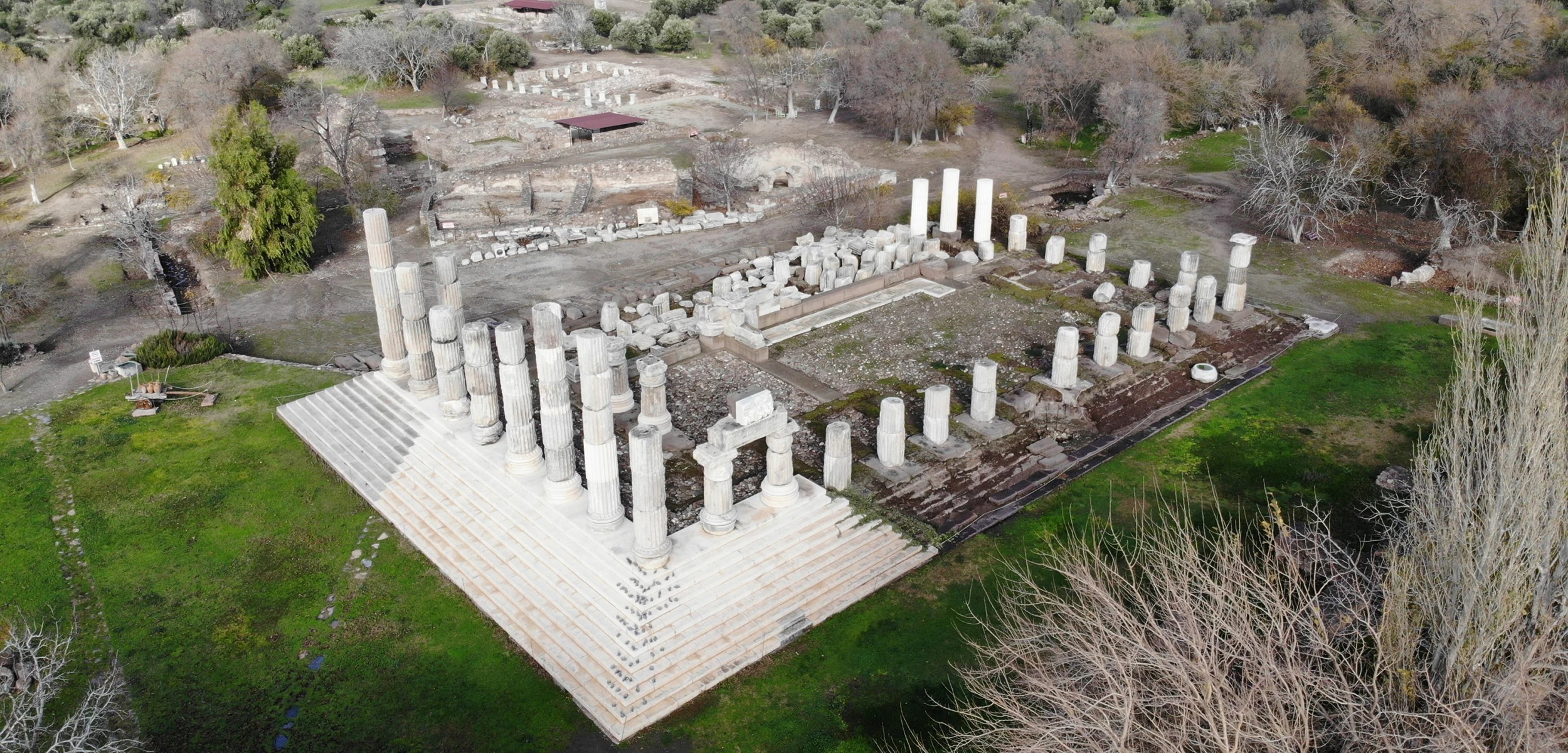
The monumental temple visible today was constructed around 150 BC. Designed in the Ionic order, it used a pseudodipteral plan in which the broad spacing of the surrounding colonnade created the visual impression of a double peristyle without actually using a complete second row of columns.

The temple's greatest artistic distinction was its sculptural decoration. Relief friezes drew their subjects from the Trojan War and the epic tradition surrounding the Iliad. This made the sanctuary not only a cult centre of Apollo but also a monumental expression of the Troad's connection with the stories that made the region famous throughout the ancient Mediterranean.

During the Roman period, the sanctuary continued to develop. Baths, streets, water systems, a bridge, residences and honorific structures were built around the temple, demonstrating that Smintheion functioned as a substantial pilgrimage and ritual complex rather than an isolated rural shrine.

The sanctuary was also physically connected to the surrounding region. Archaeological, geological and epigraphic evidence supports the existence of a sacred road between Smintheion and Alexandria Troas, while dedications and road remains indicate connections with other places in the southwestern Troad.

Modern archaeological excavation began in 1980. Decades of excavation, documentation and restoration have transformed understanding of the site, and work continues today to reveal both the Hellenistic-Roman sanctuary and the much earlier prehistoric settlement beneath it.


What to See

Top Highlights of Apollon Smintheion

Smintheion is a complete sacred landscape rather than a single ruined temple. These are the principal monuments and archaeological areas to look for during your visit.

Temple of Apollo Smintheus

The sanctuary's centrepiece is the great Hellenistic Temple of Apollo Smintheus. Partially restored architectural elements allow visitors to understand the scale, proportion and elegance of the original Ionic structure.

  • Date: Around 150 BC
  • Order: Ionic
  • Plan: Pseudodipteral, with 8 columns on the short sides and 14 on the long sides

Iliad Reliefs & Sculptural Frieze

The temple was decorated with an extraordinary narrative sculptural program inspired by the Trojan War. Surviving slabs preserve scenes associated with the Iliad and the broader Trojan epic cycle.

  • Original program: Approximately 120 metres of relief decoration
  • Surviving discovery: Around 24 metres have been recovered
  • Why important: A rare monumental visualization of Trojan epic narrative

Cult Statue of Apollo

Ancient tradition associates the sanctuary with a monumental image of Apollo Smintheus. A large sculpted leg fragment discovered in the temple has played an important role in reconstructing how the cult statue may once have appeared.

  • Ancient association: Sculptor Skopas of Paros
  • Recovered fragment: A leg section approximately 110 cm high
  • Iconography: Apollo was represented with the mouse symbol linked to the Smintheus cult

Sacred Road

Excavated streets and inscriptions at Smintheion form part of a larger ritual network. Research connects the sanctuary with Alexandria Troas through a sacred route crossing the surrounding Troad landscape.

  • Connection: Smintheion and Alexandria Troas
  • Evidence: Road remains, inscriptions, dedications and a Roman bridge
  • Meaning: Religious movement, pilgrimage and regional communication

Roman Baths

Bath complexes were built within the sanctuary during the Roman period. Their presence reflects the practical and ritual needs of visitors arriving at an important regional cult centre.

  • Period: Roman
  • Function: Bathing, cleansing and visitor facilities
  • Context: Supplied by an extensive system of channels and water storage

Altar & Ritual Area

Like other major Greek sanctuaries, worship at Smintheion centred not only on the temple but also on the altar, where ritual offerings and sacrifices formed part of religious practice.

  • Purpose: Ritual offerings and sacrifice
  • Setting: Part of the main sacred precinct
  • Experience: Helps explain how the sanctuary functioned beyond the temple building

Water Channels & Reservoirs

Gülpınar is naturally rich in water, and the ancient sanctuary developed sophisticated systems to collect, store and distribute it. These installations supported the baths and the large number of people using the sacred complex.

  • Purpose: Water supply for baths and sanctuary life
  • Features: Channels, storage basins and reservoirs
  • Importance: Reveals the infrastructure required by a busy pilgrimage centre

Archaeological Museum Display

A small museum and display area within the archaeological site presents sculptural and architectural finds associated with the temple, including material that helps visitors understand the original frieze program.

  • Highlights: Temple sculpture and architectural fragments
  • Value: Essential for understanding details difficult to see among the ruins
  • Visitor note: Individual display areas can be affected by excavation or conservation work

Homer, the Iliad and Apollo Smintheus

Few archaeological sanctuaries in the Troad are connected so directly with the literary world of the Iliad. Apollo Smintheus appears at the beginning of Homer's epic, linking the god, the landscape of Chryse and the outbreak of plague that sets the poem's human conflict in motion.

Chryses the Priest

The Iliad opens with Chryses, priest of Apollo, attempting to recover his daughter Chryseis from the Greek camp. When he is rejected, he turns to Apollo for divine justice.

Apollo's Arrows

Apollo responds by sending a devastating plague against the Achaean army. His arrows therefore symbolize a divine power that can bring sudden disease and destruction.

Smintheus

The epithet Smintheus is traditionally associated with mice. In ancient religious thought, this connected Apollo with both the destructive forces attributed to mice and the power to protect communities from them.

A Temple that Tells the Story

The later Hellenistic sanctuary transformed Trojan epic into architecture by decorating the temple with reliefs inspired by episodes from the Iliad and the wider Trojan cycle.


This combination is what makes Smintheion extraordinary. Visitors are not simply seeing a temple dedicated to one of the Olympian gods; they are standing within a sanctuary whose identity was deliberately tied to the legendary geography of the Troad and to stories known across the Greek-speaking world.

Why Is Apollo Smintheus Called the “Lord of Mice”?

The unusual mouse symbolism is the feature that immediately distinguishes Smintheion from most other sanctuaries of Apollo. The ancient cult connected the god with the animal represented by the Greek term traditionally understood behind the epithet Smintheus.

Agriculture

Mice could destroy stored grain and cultivated fields. A deity with power over them could be invoked to protect agricultural communities and food supplies.

Disease & Plague

Ancient communities also associated sudden epidemics with divine anger. Apollo's plague-bringing aspect in the Iliad became part of the wider interpretation of the Smintheus cult.

Protection and Destruction

Apollo could embody both sides of divine power: the ability to send calamity and the ability to remove or prevent it when properly honoured.

The Mouse Symbol Today

Modern mouse sculptures placed around the reconstructed temple steps visually introduce visitors to the sanctuary's distinctive cult symbolism.


The mouse should therefore not be understood as a decorative curiosity. It is central to the identity of Apollo worshipped here and helps explain why Smintheion occupied such a distinctive place among the many cults of Apollo in Anatolia.

The Temple of Apollo Smintheus

The Temple of Apollo Smintheus is one of the major monuments of Hellenistic architecture in the Troad. Its design combines a sophisticated Ionic colonnade with a sculptural program that gave the building a strong local and mythological identity.

Ionic Order

The temple used the elegant proportions and carved details of the Ionic architectural tradition, one of the dominant monumental styles of western Anatolia.

Pseudodipteral Plan

The building followed the pseudodipteral concept associated with major Hellenistic temple design: a broad surrounding colonnade created the spatial effect of a dipteral temple without a complete inner row of columns.

8 × 14 Columns

The outer arrangement consisted of eight columns across the short façades and fourteen along the long sides, giving the temple a grand and balanced silhouette.

Epic Sculpture

Reliefs around the monument visualized the Trojan epic tradition, turning the sanctuary into a powerful architectural statement about its location in the homeland of Troy's legendary stories.


Restoration has re-erected selected architectural elements so that visitors can more easily understand the height and rhythm of the original building. The site remains an active archaeological landscape, so reconstruction and display arrangements may continue to evolve.

The Sacred Road from Alexandria Troas to Smintheion

One of the most important discoveries for understanding Smintheion is the evidence for an ancient sacred road linking the sanctuary with Alexandria Troas. This connection transforms the site from an isolated temple into part of a regional network of cities, settlements and sacred places.

Alexandria Troas

The great Hellenistic and Roman port city to the north formed the principal urban centre connected with the sanctuary by the sacred route.

Roman Bridge

Archaeological remains in the Tuzla plain include a Roman bridge associated with the route across the landscape between the city and sanctuary.

Dedications & Inscriptions

Inscribed dedications discovered along and within the sanctuary help reveal the religious character of movement through the region.

A Living Sacred Landscape

The route connected worshippers, festivals and regional communities, showing how religion was experienced through movement as well as through monumental buildings.


For modern travellers, visiting Alexandria Troas and Smintheion on the same day recreates something of this ancient relationship. The two sites complement each other beautifully: one was a major port city, while the other was one of the Troad's most important sanctuaries.

Apollon Smintheion Entrance Fee

According to the current official Ministry of Culture and Tourism admission list, the entrance fee for foreign visitors is €3 per person. MuseumKart is valid for eligible Turkish citizens. Admission rules and prices can change, so travellers planning a future visit should confirm the latest official information shortly before travelling.

Current Foreign Visitor Fee

€3 per person according to the current official museum and archaeological-site fee list.

MuseumKart

The official listing identifies MuseumKart as valid for eligible Turkish citizens.

Guided Visits

Professional guiding is arranged separately and adds considerable value because the site's mythology, sculpture and sacred-road archaeology are easy to miss without context.

Future Changes

Ticket prices, pass conditions and visitor areas may change as national admission policies and archaeological work are updated.

Apollon Smintheion Opening Hours and Best Time to Visit

The current official museum listing shows Apollon Smintheion as open every day. Seasonal schedules can change, so it is wise to confirm the latest official information before a future visit.

Current Opening Time 08:30
Current Closing Time 20:00
Current Ticket Office Closing 19:30
Closed Days Open every day according to the current official listing
Best Visiting Time Morning or late afternoon, especially during the warmer months
Recommended Duration Approximately 1.5–2 hours for a relaxed visit

The sanctuary is greener and more shaded than many exposed archaeological sites, but summer temperatures in the Troad can still be high. Spring and autumn offer particularly pleasant conditions, while early morning and late afternoon light are excellent for photography.

How to Get to Apollon Smintheion

Apollon Smintheion is located at Gülpınar in the Ayvacık district of Çanakkale Province. The sanctuary lies on the southwestern side of the Troad and is best reached by private vehicle, taxi or an organised archaeological tour when combining several regional sites.

From Çanakkale

Gülpınar lies roughly 100 kilometres from central Çanakkale. The most practical route is by road through the southern Troad toward Ayvacık and Gülpınar.

From Assos

The sanctuary is approximately 25 kilometres from the Assos area and can easily be combined with the Temple of Athena and the ancient city on the same touring day.

From Alexandria Troas

Smintheion lies roughly 35 kilometres south of Alexandria Troas, following the modern road through the same landscape once crossed by the ancient sacred route.

By Private Tour

A private vehicle and licensed guide make it easy to combine Smintheion with Assos, Alexandria Troas, Troy, Babakale and other sites across the Troad.

Best Route for Visiting Apollon Smintheion

The sanctuary is easier to understand when visited as a sequence of ritual, architectural and everyday spaces rather than by looking only at the temple. Exact visitor access can change with excavation and restoration work.

1. Begin with the Site Overview Orient yourself within the sanctuary and note how the temple sits in the naturally water-rich valley at Gülpınar
2. Temple of Apollo Smintheus Examine the reconstructed Ionic architecture, column arrangement and broad pseudodipteral plan
3. Museum & Relief Display Study the sculptural fragments and imagery that connect the sanctuary with the Iliad and Trojan epic tradition
4. Altar & Ritual Zone Move beyond the temple itself and consider where sacrifice, offerings and public worship took place
5. Roman Baths & Water Systems Explore the facilities that supported cleansing, bathing and the practical needs of sanctuary visitors
6. Sacred Road Finish with the streets and sacred-route remains that connected Smintheion with Alexandria Troas and the wider Troad

Apollon Smintheion Visitor Tips

Allow More Than a Quick Stop

The temple is only one part of the sanctuary. Give yourself time for the baths, sacred road, museum display and water installations.

Read the Iliad Connection First

Knowing the story of Chryses and Apollo at the beginning of the Iliad makes the sanctuary and its unusual cult identity far more meaningful.

Wear Comfortable Shoes

Expect archaeological surfaces, stone paths and uneven ground around parts of the sanctuary.

Bring Water

Although Gülpınar is a green and water-rich setting, carry drinking water during warm weather and longer archaeological touring days.

Look Beyond the Temple

The sacred road, baths and infrastructure explain how Smintheion functioned as a living sanctuary visited by large numbers of worshippers.

Study the Sculptural Details

The reliefs are central to the importance of the site. Take time to identify figures, armour, gestures and narrative scenes in the display.

Combine It with Alexandria Troas

The two sites were connected in antiquity, making them one of the most historically coherent archaeological combinations in the Troad.

Check Current Access

Excavation and restoration are active, so individual structures or display areas may occasionally have restricted access.

Why Visit Apollon Smintheion?

Smintheion is one of those archaeological sites that becomes more impressive the more you understand it. Its importance comes from the rare combination of mythology, monumental Hellenistic architecture, narrative sculpture, pilgrimage history and a sacred landscape that stretches far beyond the temple itself.

A Sanctuary Inside the Iliad's World

The cult of Apollo Smintheus belongs to the mythological geography introduced at the very beginning of Homer's Trojan epic.

Unique Hellenistic Sculpture

The temple's Trojan War relief program gives Smintheion a special place in the study of ancient narrative art and architectural sculpture.

An Unusual Form of Apollo

The mouse symbolism of Apollo Smintheus reveals a distinctive ancient understanding of protection, agriculture, disease and divine power.

Still Peaceful and Underrated

Compared with Troy or Ephesus, Smintheion is often far quieter, allowing visitors to explore a major sanctuary in an intimate rural setting.

Nearby Attractions

Apollon Smintheion fits naturally into a wider journey through the archaeological and coastal landscapes of the ancient Troad.

Frequently Asked Questions About Apollon Smintheion

Where is Apollon Smintheion?

Apollon Smintheion is in Gülpınar, in the Ayvacık district of Çanakkale Province in northwestern Türkiye. It lies in the southwestern part of the ancient Troad, between the wider archaeological landscapes of Assos and Alexandria Troas.

What does Smintheus mean?

The epithet Smintheus is traditionally connected with the ancient word for mouse and is often translated as “Lord of Mice.” The mouse became the distinctive sacred symbol of Apollo worshipped at this sanctuary.

Why was Apollo associated with mice?

The cult probably combined several ideas. Mice threatened crops and stored food, while ancient religious thought also connected Apollo with epidemic disease. Apollo could therefore represent both destructive divine power and protection from it.

What is the connection between Apollon Smintheion and the Iliad?

Apollo Smintheus is invoked by the priest Chryses at the opening of Homer's Iliad. The later Hellenistic temple at Gülpınar was decorated with reliefs inspired by the Trojan War and the epic tradition surrounding the poem.

When was the Temple of Apollo Smintheus built?

The monumental Ionic temple is generally dated to around 150 BC, during the Hellenistic period.

What architectural style is the temple?

The temple is Ionic and uses a pseudodipteral plan. Its outer colonnade was arranged with eight columns across the short sides and fourteen along the long sides.

Are the Trojan War reliefs still visible?

Important sculptural fragments from the temple have been recovered and are presented through the archaeological display at the site. They are among the most significant finds from Smintheion.

Was the cult statue made by Skopas?

Ancient tradition associates the sanctuary's cult image with the famous sculptor Skopas of Paros. Archaeological fragments and ancient descriptions have been used to reconstruct the appearance of a monumental Apollo Smintheus image.

What is the Sacred Road?

Archaeological and epigraphic evidence indicates that a sacred route connected Smintheion with Alexandria Troas. Remains of roads, dedications and a Roman bridge help reconstruct this ritual landscape.

Is Apollon Smintheion only a temple?

No. The sanctuary also contains remains of an altar, sacred road, Roman baths, water channels and reservoirs, bridge, residences and other structures connected with religious and everyday life.

How old is the earliest settlement at Smintheion?

Excavations have uncovered a Middle Chalcolithic settlement dating approximately to 5200–4800 BC, thousands of years before the Hellenistic sanctuary was built.

How much is the entrance fee to Apollon Smintheion?

The current official Ministry admission list shows a foreign visitor fee of €3. Prices can change, so check the latest official information before travelling.

Is MuseumKart valid at Apollon Smintheion?

Yes. The current official listing states that MuseumKart is valid for eligible Turkish citizens.

What are the opening hours of Apollon Smintheion?

The current official listing shows opening hours of 08:30–20:00 every day, with the ticket office closing at 19:30. Seasonal schedules may change.

How long should I spend at Apollon Smintheion?

Around 1.5–2 hours is comfortable for the main temple, museum display, baths, sacred road and surrounding archaeological structures.

Can Apollon Smintheion and Assos be visited on the same day?

Yes. The two sites are only about 25 kilometres apart and make an excellent combined archaeological route through the southwestern Troad.

Can Apollon Smintheion and Alexandria Troas be visited together?

Yes. This is one of the most historically meaningful combinations in the region because the sanctuary and Alexandria Troas were connected in antiquity by a sacred road.

Is Apollon Smintheion worth visiting?

Absolutely—especially for travellers interested in Homer, the Trojan War, Greek religion, Hellenistic architecture, ancient sculpture and quieter archaeological sites away from the main tourist routes.

Best Photo Spots in Apollon Smintheion

Smintheion combines reconstructed temple architecture, scattered marble, green vegetation and the distinctive mouse symbolism of Apollo's cult, creating several memorable photographic perspectives.

Reconstructed Temple Columns

Use the raised Ionic columns and architectural fragments to communicate the height and rhythm of the original Hellenistic temple.

Mouse Sculptures on the Steps

The modern mouse figures provide a memorable visual introduction to the unusual identity of Apollo Smintheus and work especially well in close-up compositions.

Temple Platform

Wider angles from the approach reveal the relationship between the temple platform, reconstructed columns and surrounding green landscape.

Iliad Relief Details

Where photography is permitted, the sculptural display offers fascinating close views of figures and narrative scenes connected with the Trojan epic tradition.

Sacred Road

Use the ancient paving and receding lines of the route to create photographs that emphasize movement through the sanctuary.

Late Afternoon Light

Softer light brings out the warm tones and carved surfaces of the marble while giving the surrounding vegetation greater depth.


Respect barriers around active excavation and restoration areas, and avoid climbing on ancient architectural blocks for photographs.

Private Apollon Smintheion Tours and Custom Routes

Apollon Smintheion can be included in a private journey through Assos, Alexandria Troas, Troy, Babakale, Çanakkale and the wider archaeological landscape of the Troad.

Private Troad Archaeology Tours

Custom-designed services with private transportation, licensed professional guiding and flexible timing.

Homeric & Trojan War Journeys

Smintheion can be added to private itineraries that explore Troy, the Iliad and the wider legendary geography of the Troad.