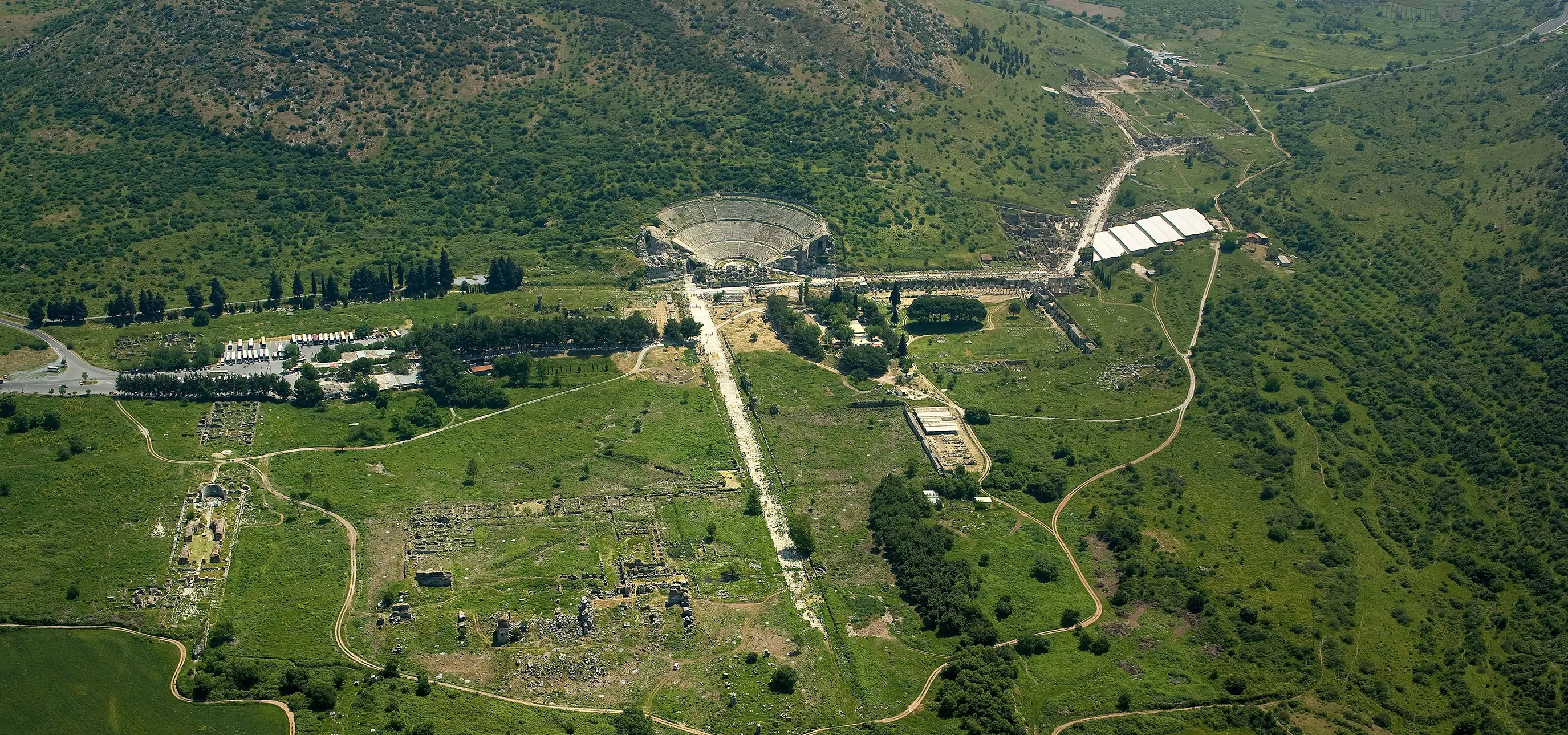
Ephesus Ancient City
Walk the marble streets where many of the museum's sculptures and archaeological objects were originally used and displayed.
Explore Ephesus





Walking through Ephesus Ancient City is one of the great archaeological experiences of Türkiye.
You walk along marble streets.
You stand beneath the reconstructed façade of the Library of Celsus.
You enter the Great Theatre, look into ancient shops, pass temples and explore the remains of houses once occupied by some of the wealthiest inhabitants of Roman Ephesus.
But something is missing.
Most of the statues, small objects, jewellery, coins, cult objects and personal possessions discovered during archaeological excavations are no longer standing where they were found.
Many of the most important discoveries are preserved a few kilometres away in Ephesus Museum in Selçuk.
This is where ancient Ephesus becomes personal.
Here you can stand before the extraordinary statues of Artemis Ephesia, study sculpture that once decorated the city's monumental fountains, see objects used inside the luxurious Terrace Houses, examine coins spanning centuries of history and encounter portraits of emperors, philosophers, gods and ordinary inhabitants of the ancient world.
The museum is especially important because its galleries are not simply arranged as a long chronological sequence.
Many displays are organised around where the objects were found and how they functioned within ancient Ephesus.
That makes the museum one of the best places to understand the ancient city after walking through it.
See the celebrated Great Artemis and Beautiful Artemis statues that preserve the distinctive religious identity of ancient Ephesus.
Discover jewellery, household objects, sculpture and everyday possessions from the elite residences of Roman Ephesus.
See statues and architectural decoration originally created for fountains, temples, public monuments and imperial spaces.
The museum follows the cultural landscape from prehistoric settlement through Greek, Roman, Byzantine, Seljuk and Ottoman history.
Essential information for visiting the archaeological museum in central Selçuk.
Archaeological museum focusing primarily on Ephesus and its surrounding cultural landscape.
Central Selçuk, İzmir Province, western Türkiye.
The monumental statues known as the Great Artemis and Beautiful Artemis.
The museum preserves many small finds, portraits and objects discovered in Ephesus's elite Roman residences.
Important statues from the monumental fountains of Ephesus are displayed here.
Ancient and later coin collections help illustrate the city's long economic history.
The present museum developed from an archaeological depot established in 1929 and opened as a museum in 1964.
The museum expanded in 1976 and received its modern exhibition arrangement during a major renewal completed in 2014.
MüzeKart is currently valid for eligible Turkish citizens.
Audio-guide service is available according to current official visitor information.
Allow approximately 60–90 minutes, or longer if you enjoy archaeology and sculpture.
Visit after Ephesus Ancient City and before or after the nearby Temple of Artemis.
Ephesus Museum is located in central Selçuk and is a completely separate attraction from both Ephesus Ancient City and the digital Ephesus Experience Museum.
Opening hours and admission policies at Turkish state museums can change seasonally or by official decision.
If your itinerary depends on entering close to opening or closing time, check the official museum listing again shortly before your visit.
The museum has its own admission arrangements.
An entrance ticket for Ephesus Ancient City should not automatically be assumed to include the archaeological museum in Selçuk.
Ephesus Ancient City preserves architecture.
The museum preserves many of the objects that once filled that architecture with meaning.
That distinction is important.
When you walk through the archaeological site, you encounter streets, walls, columns, houses, temples, fountains and public buildings.
Inside the museum, you encounter the objects that belonged to those spaces.
You see portraits that once represented emperors and citizens.
You see jewellery and domestic tools connected with daily life.
You see sculptures that once stood beside flowing water in monumental fountains.
You see votive objects connected with religion.
And most importantly, you see representations of Artemis Ephesia, the goddess whose cult helped define the identity of ancient Ephesus.
For travellers interested in archaeology, the museum is not an optional extra.
It is one of the best places for turning the surviving ruins into a complete picture of an inhabited ancient city.
An enormous outdoor archaeological site where you walk through streets, theatres, temples, houses, fountains and public monuments.
An indoor archaeological museum in Selçuk displaying many important portable finds discovered at Ephesus and nearby sites.
You understand architecture, urban planning and the physical scale of one of the great cities of antiquity.
You see sculpture, jewellery, cult objects, coins, household objects, portraits and archaeological finds removed from their original locations for conservation.
For most first-time visitors, seeing Ephesus Ancient City first and the museum afterwards creates the strongest connection between monument and object.
The museum and ruins complement one another rather than competing for the same experience.
The modern museum developed directly from the long archaeological history of Ephesus.
By the early twentieth century, excavations were producing increasing quantities of material that needed secure storage, conservation and scholarly study.
In 1929, an archaeological depot was established in Selçuk to preserve objects discovered during excavations and material collected from the surrounding region.
As archaeological work continued, the collection outgrew its original storage function.
In 1964, the southern section of the present museum building was completed and archaeological material began to be displayed there for visitors.
The institution expanded again in 1976 with construction of a northern section.
Decades of continuing excavation at Ephesus, Ayasuluk and nearby archaeological sites created an ever richer collection.
A major programme of renovation and exhibition redesign eventually transformed the museum again.
In 2014, the museum took on the modern display arrangement that largely defines the visitor experience today.
The result is a museum closely connected with more than a century of archaeological investigation at Ephesus.
Many archaeological museums organise their collections primarily by date.
Ephesus Museum takes a different approach.
Because such a large proportion of its collection comes from one ancient city, objects can often be understood through the places and contexts in which they were discovered.
That allows the museum to reconnect archaeological finds with ancient fountains, houses, temples, cult spaces and civic monuments.
An introduction to Ephesus, its development and the archaeological landscape explored throughout the museum.
Sculpture and architectural material once associated with the spectacular water monuments of Roman Ephesus.
Objects from residences occupied by wealthy members of Ephesian society.
Coinage illustrating political, economic and cultural change across centuries.
A broader chronological journey through the long development of settlement in the region.
Architectural pieces, stone monuments, sculpture, inscriptions and funerary material displayed in an open-air setting.
Religious material illustrating older Anatolian traditions that form part of the cultural background of Ephesus.
Objects associated with the sanctuary that became one of the Seven Wonders of the Ancient World.
The museum's most iconic gallery, centred on monumental representations of the goddess of Ephesus.
Portraits, reliefs and monuments demonstrating the importance of Roman imperial ideology in the city.
The museum contains far more than a handful of famous objects, but several works deserve special attention during a first visit.
A monumental Roman-period image of Artemis Ephesia and one of the defining archaeological treasures of Selçuk.
An exceptionally detailed marble representation preserving the goddess's distinctive Ephesian iconography.
A charming bronze composition showing the youthful god Eros riding a dolphin.
One of the museum's celebrated sculptural works and an excellent example of refined ancient portrait-like modelling.
A portrait representing the famous Athenian philosopher and demonstrating the continuing prestige of classical intellectual culture.
A marble imperial portrait connecting Ephesus with the wider political world of the Roman Empire.
A striking representation of the ancient fertility deity whose imagery reflects attitudes very different from modern conventions.
An important reminder that Ephesus was connected with religious traditions and cultural networks extending far beyond western Anatolia.
Evidence for the presence and popularity of Egyptian religious traditions within the cosmopolitan world of Ephesus.
A marble figure discovered at the Pollio Fountain, represented reclining with the calm physical confidence of idealised ancient sculpture.
No visit to Ephesus Museum is complete without spending time in front of its monumental Artemis statues.
They are among the most instantly recognisable images associated with ancient Ephesus.
They are also easy to misunderstand.
The goddess represented here is very different from the familiar image of Greek Artemis as a youthful huntress carrying a bow.
Artemis Ephesia developed within the particular religious environment of western Anatolia.
Her imagery absorbed local traditions while becoming integrated into the wider Greek and Roman religious worlds.
The result was a highly distinctive divine image.
She stands frontally.
Her body is enclosed within an elaborately decorated garment.
Animals, bees, mythological creatures, architectural elements, zodiac imagery and fertility-related symbolism appear across different representations.
Her appearance communicates power, abundance, cosmic authority and the intimate relationship between goddess and city.
For the inhabitants of ancient Ephesus, Artemis was not merely one deity among many.
She was one of the defining symbols of the city itself.
The monumental statue traditionally known as the Great Artemis is one of the most important objects in the museum.
It was discovered at the Prytaneion of Ephesus, the civic building associated with the sacred fire and important public functions.
The sculpture is a Roman-period representation inspired by the long-established cult image of Artemis Ephesia.
Her elaborate high headdress, or polos, contains architectural and mythological imagery.
Across the body are rows of symbolic forms and panels filled with animals and decorative motifs.
Among the recurring symbols associated with Artemis and Ephesus is the bee, an image deeply connected with Ephesian identity.
Lions, rams, deer, griffins and other creatures further emphasize the goddess's authority over nature.
The statue is not simply beautiful sculpture.
It is a visual document of one of the ancient Mediterranean's most distinctive religious traditions.
The sculpture known as the Beautiful Artemis offers another extraordinary interpretation of the Ephesian goddess.
Created from fine white marble, the figure displays a level of decorative complexity that rewards slow viewing.
The goddess stands rigidly front-facing, her feet together and her arms extending forward.
Her clothing is transformed into a symbolic surface.
Animal figures, ornamental bands and divine imagery cover the sculpture.
A representation of the zodiac appears across the upper part of the figure, connecting Artemis not only with nature but with a wider cosmic order.
Deer stand alongside her, while imagery associated with bees again reinforces her Ephesian identity.
Together, the Great Artemis and Beautiful Artemis provide one of the clearest surviving introductions to the religious world surrounding the Temple of Artemis.
One of the first details visitors notice is the series of rounded forms covering the upper body of Artemis Ephesia.
They are frequently described in popular culture as multiple breasts.
That interpretation has helped create the widespread image of Artemis Ephesia as a fertility or mother goddess.
But the archaeological discussion is more complicated.
Different interpretations have proposed breasts, eggs, fruits, ritual objects or elements connected with animal sacrifice.
There is no universally accepted explanation that resolves every question.
What is clear is that the forms belonged to a much larger symbolic system emphasizing abundance, divine power, nature and fertility.
Looking at the statues closely is therefore much more rewarding than reducing their meaning to one popular description.
The museum is the essential companion to the nearby Temple of Artemis archaeological site.
At the Artemision itself, very little of the colossal temple remains standing above ground.
Inside the museum, objects discovered during excavations help restore some of the sanctuary's lost human dimension.
Votive offerings and other archaeological finds demonstrate that the Artemision was not simply an architectural monument.
It was a living religious sanctuary.
People travelled there, made offerings, participated in rituals and expressed devotion to the goddess across many centuries.
The museum therefore changes the way you understand the ruined temple.
After seeing the objects, the Artemision becomes less like an empty archaeological field and more like the centre of one of antiquity's most influential cults.
Roman Ephesus contained elaborate monumental fountains, known as nymphaea.
These were far more than places for collecting water.
They were architectural displays.
Columns, coloured stone, inscriptions, flowing water and sculpture combined to create some of the most theatrical public spaces in the city.
Important sculptural finds from fountains including Trajan's Fountain, the Pollio Fountain and the fountain of Laecanius Bassus are preserved in the museum.
Representations of gods, mythological figures, river deities, satyrs, Tritons and civic personalities once interacted visually with cascading water and monumental façades.
Inside the archaeological site, many fountains survive mainly as architecture.
Inside the museum, their sculptural programme becomes visible again.
The Fountain of Trajan remains one of the most recognisable monuments along Curetes Street in Ephesus.
Today, visitors see the surviving architectural framework.
In antiquity, the monument was far more colourful and sculpturally complex.
Figures associated with Dionysos, Aphrodite, satyrs and the legendary founder of Ephesus, Androklos, formed part of the fountain's decorative world.
Seeing related sculptural material inside the museum allows visitors to mentally reunite the architectural ruin with the artistic programme that once animated it.
This relationship between object and original location is one of the strongest reasons to visit the museum after the ancient city.
One of the museum's memorable marble sculptures is the Resting Warrior.
The youthful figure is shown reclining, with the body's weight supported on one arm.
Rather than showing a dramatic moment of battle, the sculpture captures a quieter physical pose.
The relaxed body, idealised anatomy and calm facial expression demonstrate the extraordinary skill of ancient sculptors.
The statue was discovered during excavation of the Pollio Fountain.
That context is important.
The figure was originally part of a much broader architectural composition involving water, monumental stonework and public space.
The Terrace Houses of Ephesus preserve some of the most extraordinary Roman domestic architecture in the eastern Mediterranean.
Their mosaics, wall paintings, marble decoration and complex interiors reveal how wealthy Ephesian families lived.
But architecture alone cannot explain a household.
The museum's Terrace House finds bring residents closer to us.
Objects associated with medicine, cosmetics, jewellery, lighting, weaving, music, entertainment, weights, furniture and personal adornment show the practical details of urban life.
Busts, portraits and small sculptures add another layer.
Instead of seeing only decorated rooms, you begin to imagine the people who slept, ate, worked, entertained guests and raised families inside them.
If you visit the Terrace Houses inside Ephesus Ancient City, this gallery is one of the museum sections you should examine most carefully.
Visitors are naturally drawn toward monumental marble statues.
But some of the most revealing archaeological discoveries are much smaller.
A spoon, needle, lamp, cosmetic container, medical instrument or piece of jewellery may appear less spectacular than a statue of Artemis.
Yet these objects record the repeated actions of everyday life.
They reveal how people prepared food.
How they lit their homes.
How they cared for their bodies.
How they dressed.
How they practised medicine.
How they worked with textiles.
How wealth and status could be communicated through personal possessions.
Together, these objects transform Roman Ephesus from a collection of monumental ruins into a city inhabited by real people.
Among the museum's most charming works is the bronze figure of Eros riding a dolphin.
Eros, the youthful god associated with love and desire, appears riding on the back of the marine animal.
The dolphin's raised tail and dynamic body create a strong sense of movement.
Openings around the mouth and eyes indicate that the composition probably interacted with water, making the object part sculpture and part fountain feature.
The work was discovered on Curetes Street and belongs to an artistic tradition popular during the Hellenistic and Roman periods.
Its appeal comes from the combination of mythology, playfulness and technical skill.
Portrait sculpture gives the museum a human presence that the ruined city cannot always provide.
Some faces represent emperors.
Others represent philosophers, gods, priests or members of urban society.
The famous head of Socrates connects Roman Ephesus with the continuing intellectual authority of classical Greek philosophy.
A portrait of Marcus Aurelius connects the city with the imperial government of Rome.
Different hairstyles, clothing, facial expressions and sculptural conventions allow visitors to recognise changing ideals of status and identity.
Stand close to these portraits.
Ancient sculpture often becomes most powerful when you stop seeing it as "old marble" and begin studying the individual face.
Ephesus was one of the most important cities of Roman Asia.
Its public spaces were filled with monuments expressing loyalty, status and political relationships with Rome.
The imperial cult formed an important part of that world.
The museum's displays include material associated with Hadrian, Domitian, Augustus, Livia and other imperial figures.
Reliefs, portraits, busts, altars and sculptural monuments demonstrate how imperial power became embedded in the visual landscape of Ephesus.
These objects were not simply portraits of distant rulers.
They formed part of civic identity, public ceremony and competition for prestige among the cities of Roman Asia Minor.
The gallery therefore provides essential context for monuments you encounter throughout Ephesus Ancient City.
Relief sculpture associated with the monumental architecture of Ephesus reveals how buildings could communicate stories as well as provide physical space.
The Imperial Cult displays include reliefs associated with the Temple of Hadrian and other important civic monuments.
Mythological imagery, figures connected with the foundation traditions of Ephesus and imperial symbolism become easier to study inside the museum than on weathered architectural surfaces outdoors.
Look closely at the depth of carving, folds in clothing, faces and overlapping bodies.
Ancient reliefs were designed to be read visually, often presenting several layers of political and mythological meaning at once.
Material associated with the great Roman imperial monuments of Ephesus also demonstrates the city's connection with events far beyond the Aegean coast.
Reliefs connected with the monument commonly called the Parthian Monument evoke the military and political world of the Roman Empire.
Figures, armour, movement and ceremonial imagery turn carved stone into imperial storytelling.
The reliefs remind visitors that Ephesus was not an isolated provincial town.
It belonged to a vast political system stretching from Britain to North Africa, the Balkans and the eastern Mediterranean.
The religious history of Ephesus did not begin with classical Greek culture.
Western Anatolia possessed much older traditions of sacred landscapes, mother goddesses and local cults.
The museum's Cybele Cult display includes votive stelae connected with discoveries from Panayır Mountain.
These objects provide important background for understanding how Greek, Anatolian and later Roman religious traditions interacted.
This is especially relevant when studying Artemis Ephesia.
Her distinctive Ephesian identity cannot be explained simply by importing the familiar Greek Artemis into Anatolia.
The museum allows you to see a far more complicated history of cultural interaction.
Yes.
Ancient Ephesus was deeply connected with the wider Mediterranean.
Ships, merchants, travellers, officials, soldiers and pilgrims continually moved through the region.
Ideas travelled with them.
Objects connected with Isis and Egyptian religious traditions demonstrate that the spiritual world of Ephesus extended far beyond local cults.
The presence of Egyptian imagery should not surprise us.
Roman cities throughout the Mediterranean absorbed religious traditions from many regions.
Ephesus was particularly well positioned for this cultural exchange because of its importance as a port, commercial centre and pilgrimage destination.
Coins are among the most informative archaeological objects ever produced.
They can carry portraits, divine symbols, city emblems, titles and political messages.
They also travelled.
A coin therefore provides information about economy, government, trade, religion and identity at the same time.
Ephesian coinage frequently used imagery associated with the city's most powerful symbols, including Artemis and the bee.
The museum's coin displays continue across later periods as well, helping visitors trace changes from antiquity into Byzantine and Islamic history.
Do not rush through this section.
The objects are small, but the historical information they contain is enormous.
One of the easiest mistakes to make is to imagine Ephesus as a purely Roman city.
The spectacular ruins certainly preserve Roman urbanism at its most impressive.
But the history of settlement in the region is far older.
The museum's chronological displays place Roman Ephesus inside a much longer sequence.
Prehistoric communities occupied the surrounding landscape.
Greek settlement developed.
Archaic and Classical Ephesus evolved.
The city shifted location and expanded dramatically during Hellenistic times.
Roman Ephesus became one of the great metropolises of Asia Minor.
Christian and Byzantine Ephesus developed new sacred centres.
Settlement gradually concentrated again around Ayasuluk Hill.
Seljuk, Ottoman and modern Selçuk followed.
The museum helps visitors see Ephesus not as one frozen Roman moment but as a landscape repeatedly reinvented over thousands of years.
After concentrating on indoor displays, it is easy to move quickly through the open courtyard.
Do not.
Large stone objects often require more physical space than indoor galleries can provide, making museum courtyards particularly important in archaeological collections.
At Ephesus Museum, the courtyard includes architectural elements, column capitals, funerary monuments, sarcophagi, sculpture and other large archaeological pieces.
Look closely at inscriptions, surface wear, tool marks and decorative details.
These objects often preserve evidence that disappears when viewed from a distance at an archaeological site.
Ephesus was filled with sculpture.
Statues stood inside temples.
They decorated fountains.
They appeared in public squares.
Portraits honoured emperors, officials and benefactors.
Mythological figures transformed buildings into visual narratives.
Much of that sculpture has disappeared from its original architectural context.
The museum allows visitors to see how important three-dimensional art was to the experience of an ancient city.
Pay attention to the marble itself.
Different textures were used for skin, hair, fabric and armour.
Deep drilling could create dramatic shadows.
Polished surfaces could suggest soft flesh.
And although most surviving ancient sculpture appears white today, many works originally included colour.
An archaeological object does not become important simply because it is beautiful.
Its context matters enormously.
Where was it found?
Inside a house?
Beside a fountain?
Within a sanctuary?
Inside a grave?
Was it discovered with coins, pottery or inscriptions?
Was it reused in a later building?
Archaeologists carefully document these relationships because they help explain how objects functioned.
One strength of Ephesus Museum is that many displays preserve this relationship between object and findspot.
The galleries therefore teach visitors how archaeological interpretation works, not merely what ancient art looks like.
The museum also helps explain one of the most fascinating aspects of Ephesus: its changing religious identity.
For centuries, Artemis dominated the sacred landscape.
Her sanctuary attracted worshippers and helped define the city internationally.
During the Roman period, Christianity gradually entered this environment.
The New Testament's Acts of the Apostles describes tension between the preaching of Saint Paul and people whose livelihoods were connected with the cult of Artemis.
Later, Ephesus became one of the major centres of early Christianity.
Christian tradition connected the region with Saint Paul, Saint John and the Virgin Mary.
The Council of Ephesus took place in AD 431.
The Basilica of Saint John eventually became one of the great pilgrimage monuments of Byzantine Ephesus.
Seen together, the museum, Artemision, ancient city and Ayasuluk monuments reveal an extraordinary sequence of religious transformation.
No.
This is an important distinction for visitors planning their itinerary.
A traditional archaeological museum containing genuine ancient objects discovered at Ephesus and surrounding sites.
A modern digital storytelling experience located within the Ephesus archaeological complex.
Ephesus Museum focuses on original archaeological objects, sculpture, religion, coins and everyday life.
The Experience Museum uses immersive technology and audiovisual storytelling to recreate aspects of ancient Ephesus.
The archaeological museum is in central Selçuk. The Experience Museum is inside the Ephesus Ancient City visitor area.
They have separate visitor arrangements, so do not assume that admission to one automatically means admission to the other.
Study the towering headdress, animal imagery, bees and extraordinary symbolic decoration.
Look closely at the zodiac imagery, animals, garment decoration and the controversial rounded forms across the upper body.
Use the Artemision material to imagine the sanctuary as a functioning place of pilgrimage rather than only a ruined monument.
Remember that these statues were originally experienced with monumental architecture and flowing water.
Look beyond monumental art and focus on the personal possessions of Ephesus's wealthy residents.
Study hairstyles, clothing, faces and expressions for clues to Roman identity and status.
Search for recurring symbols of Artemis and Ephesus and notice how imagery changes through time.
Look for the visual language of Roman political authority and civic prestige.
Examine inscriptions, sarcophagi and architectural fragments rather than treating the courtyard only as a passageway.
Notice how Artemis, Cybele, Egyptian cults and Roman imperial religion existed within the same cosmopolitan environment.
Only enough for a fast visit concentrating on the Artemis statues and a handful of major masterpieces.
A practical minimum for seeing the principal galleries without studying every object.
The ideal amount of time for most visitors who want to understand the collection properly.
Recommended for visitors with a strong interest in archaeology, sculpture, ancient religion or Roman daily life.
Combine the museum with the Temple of Artemis, İsa Bey Mosque and Basilica of Saint John.
Add Ephesus Ancient City for one of the strongest archaeology-focused days in western Türkiye.
Both approaches work, but they create different experiences.
You enter the ancient city already knowing many of the objects, gods and artistic traditions connected with the monuments.
You see the original architectural locations first and then recognise their sculptures and objects inside the museum.
Ancient city first and museum afterwards often creates the strongest moment of recognition.
Museum first can provide useful context before carefully studying the archaeological remains.
For most travellers, we recommend: Ephesus Ancient City → lunch in Selçuk → Ephesus Museum → Temple of Artemis → Ayasuluk Hill.
A peaceful choice if you want to begin with archaeological context before visiting surrounding sites.
An excellent escape from the strongest heat after several hours walking through Ephesus Ancient City.
Ideal for finishing an archaeology day after visiting Ephesus and before continuing around central Selçuk.
The indoor galleries make the museum especially useful when rain or cold weather makes outdoor archaeological sites less comfortable.
Combine the museum with the surrounding Selçuk monuments when the archaeological landscape is green and temperatures are comfortable.
One of the easiest seasons for combining indoor and outdoor attractions in a full Ephesus heritage day.
Ephesus Museum is considerably easier to visit for many travellers with mobility limitations than the vast outdoor archaeological site.
The museum underwent major modernisation when its current exhibition arrangement was created, and improved accessibility formed part of that renewal.
Because the principal displays are inside a purpose-designed museum environment, visitors avoid many of the steep, uneven and slippery ancient surfaces encountered at Ephesus.
Visitors with specific mobility requirements should still confirm current access arrangements directly with the museum before travelling.
The museum contains extraordinarily photogenic objects, especially the monumental Artemis statues and Roman sculpture.
When photography is permitted, avoid thinking only about full frontal images.
Photograph individual animals, bees, zodiac symbols and decorative bands to appreciate the density of the iconography.
Side lighting can reveal subtle carving in hair, eyes and facial features.
Photographing from a slight angle can make shallow and deep carving easier to distinguish.
Photograph useful museum labels when permitted so you can identify objects accurately later.
Glass display cases may create reflections, so change your angle rather than placing the camera directly against the glass.
Follow all museum signage regarding flash, tripods, professional equipment and temporary exhibitions.
Unlike Ephesus Ancient City, the museum is located directly within modern Selçuk.
That makes it one of the easiest historical attractions in the region to reach.
The museum is within easy walking distance of many central hotels, restaurants, the bus station and the railway station area.
Continue by taxi, tour vehicle or private transfer into central Selçuk after leaving the archaeological site.
The museum and Artemision are close enough to combine easily within the same central Selçuk itinerary.
Selçuk railway station places visitors close to the town centre and within a practical walking distance of the museum.
Travel to Selçuk by rail or road and combine the museum with Ephesus Ancient City and the surrounding archaeological sites.
Selçuk and Ephesus are easily reached by road, making the museum a practical addition to shore excursions and private Ephesus tours.
Central Selçuk contains an extraordinary concentration of monuments.
Within a relatively compact area, you can move between different civilizations and religious traditions.
The museum preserves archaeological finds from Ephesus.
The Temple of Artemis represents one of the greatest pagan sanctuaries of antiquity.
The Basilica of Saint John represents Byzantine Christianity and pilgrimage.
İsa Bey Mosque marks the medieval Turkish-Islamic landscape.
Ayasuluk Castle rises above them all.
Few small towns allow visitors to encounter such dramatically different periods of history within such a concentrated area.
Visit the archaeological footprint of the sanctuary represented so vividly by the Artemis statues and religious objects inside the museum.
Explore the monumental Byzantine church built over the traditional burial place of Saint John on Ayasuluk Hill.
Discover one of western Anatolia's most important surviving examples of 14th-century Turkish Islamic architecture.
Climb into the fortified landscape above Selçuk and look across the historic Ephesus plain.
Walk through the original streets, monuments and buildings from which many of the museum's objects were excavated.
Continue into the Christian sacred landscape in the hills above Ephesus.
The essential combination for connecting the ancient city's architecture with the sculptures and objects discovered during excavation.
The Artemis statues provide the visual context that makes the ruined sanctuary far easier to understand.
Move from the religious world of ancient Artemis into the Christian pilgrimage landscape of Byzantine Ephesus.
Combine the museum, Temple of Artemis, İsa Bey Mosque and Saint John Basilica within the central Selçuk area.
Explore Ephesus Ancient City, Terrace Houses and the museum with particular attention to Roman urban life.
Combine the ancient city, museum, Artemision and Ayasuluk Hill monuments for the broadest understanding of Ephesus.
Rather than moving quickly from object to object, use the galleries to reconstruct different parts of ancient Ephesus.
This sequence lets you see the archaeological landscape first and then understand its objects inside the museum.
Recognising where objects originally came from makes the museum far more meaningful.
The two monumental Artemis statues deserve close inspection from several angles.
The location where an object was discovered is often as important as the object itself.
A very fast walkthrough misses much of the relationship between the galleries and the ancient city.
During hot summer months, the indoor museum is ideal between outdoor archaeological visits.
The ruined sanctuary makes far more sense once you have seen Artemis Ephesia and the temple finds.
Household objects, coins and tools often reveal more about daily life than monumental sculpture.
Knowing whether an object came from a house, fountain, temple or grave changes its interpretation.
Ephesus Museum in Selçuk and the Ephesus Experience Museum are different attractions.
Opening hours and ticket arrangements at state museums may change seasonally.
The Temple of Artemis, Saint John and İsa Bey Mosque can easily be added to the same visit.
A knowledgeable archaeological guide can connect museum objects with the exact locations you saw inside Ephesus.
Ephesus Museum is located in central Selçuk in İzmir Province, western Türkiye.
No. The archaeological museum is located in central Selçuk, several kilometres from the main archaeological ruins.
No. Ephesus Museum in Selçuk displays genuine archaeological artifacts. The Ephesus Experience Museum is a separate digital attraction inside the ancient-city complex.
It is especially famous for the Great Artemis and Beautiful Artemis statues, as well as Roman sculpture, Terrace House finds, fountain sculpture, coins and objects excavated throughout Ephesus.
The celebrated representations of Artemis Ephesia are displayed in Ephesus Museum in Selçuk.
They are monumental Roman-period representations of Artemis Ephesia, the distinctive goddess worshipped at ancient Ephesus.
The monumental Roman Artemis statues displayed in the museum are representations of the goddess associated with the Artemision cult, but important examples were discovered elsewhere within ancient Ephesus, including the Prytaneion.
The Ephesian cult developed through interaction between Greek religion and older Anatolian traditions, producing a distinctive local divine image unlike the familiar huntress Artemis.
They have often been described that way, but scholars have proposed several interpretations. Their exact meaning remains debated.
Yes. The museum contains an important display dedicated to archaeological finds associated with the Artemision.
Yes. One of the museum's important galleries displays objects discovered in the elite residences known as the Terrace Houses.
Displays include household objects, jewellery, tools, small sculpture, portraits and objects connected with medicine, cosmetics, lighting, weaving and entertainment.
Yes. Sculpture associated with monumental fountains including Trajan's Fountain, the Pollio Fountain and the fountain of Laecanius Bassus forms an important part of the collection.
Yes. The bronze composition of Eros riding a dolphin is one of the museum's well-known works.
Yes. A marble portrait of Socrates is among the museum's celebrated archaeological works.
Yes. Imperial portraits, busts, statues and reliefs form an important part of the galleries dealing with Roman civic and imperial culture.
It displays objects connected with Roman imperial power and worship, including reliefs, portraits and monuments associated with emperors and imperial families.
Yes. Objects connected with figures such as Isis and an Egyptian priest reflect Ephesus's connections with the wider Mediterranean religious world.
Yes. Coin displays help illustrate the economic and political history of Ephesus and later periods.
An archaeological depot was established in Selçuk in 1929. The present museum began displaying collections in its southern section in 1964.
The museum expanded with construction of its northern section in 1976.
A major modernisation programme resulted in the current exhibition arrangement in 2014.
Current official information lists the museum as opening at 08:30 and closing at 20:00, with the ticket office closing at 19:30. Hours can change, so confirm before visiting.
Current official visitor information lists the museum as open every day.
Yes. Current official information states that MüzeKart is valid for eligible Turkish citizens.
Yes. Current official museum information lists audio-guide service as available.
Most visitors should allow approximately 60–90 minutes. Archaeology enthusiasts may easily spend two hours.
Both work, but visiting the ancient city first often makes museum objects easier to connect with their original locations.
Yes. The museum contains sculpture, religious objects and personal possessions that cannot be understood simply by walking through the architectural ruins.
Yes, particularly if archaeology is important to you. Ephesus Ancient City, the museum and the Temple of Artemis can all fit comfortably into a well-planned full day.
Yes. Mythological figures, animals, coins, jewellery and the enormous Artemis statues can make the ancient world easier for children to visualise than architectural ruins alone.
Yes. The museum is located in central Selçuk and is within practical walking distance of the railway station and other central locations.
Yes. The two attractions are close to one another in the central Selçuk heritage area.
The Temple of Artemis, Basilica of Saint John, İsa Bey Mosque and Ayasuluk Castle are the strongest nearby additions.
Ephesus Ancient City, the Terrace Houses, Ephesus Museum and the Temple of Artemis create an exceptionally strong archaeology-focused itinerary.
Yes. Objects from domestic contexts include jewellery, medical and cosmetic instruments, lighting equipment, weaving tools and other possessions used in daily life.
No. The collections cover a much broader historical sequence including prehistoric, Greek, Roman, Byzantine, Seljuk and Ottoman periods.
It preserves many of the portable archaeological discoveries that give human, artistic and religious context to the monumental ruins of Ephesus.
The museum becomes even more meaningful when you visit the archaeological locations where its sculptures, cult objects and everyday possessions were originally used.
Follow the landscape from Roman streets and the sanctuary of Artemis to Byzantine pilgrimage and modern archaeological discovery.
Walk the marble streets where many of the museum's sculptures and archaeological objects were originally used and displayed.
Explore Ephesus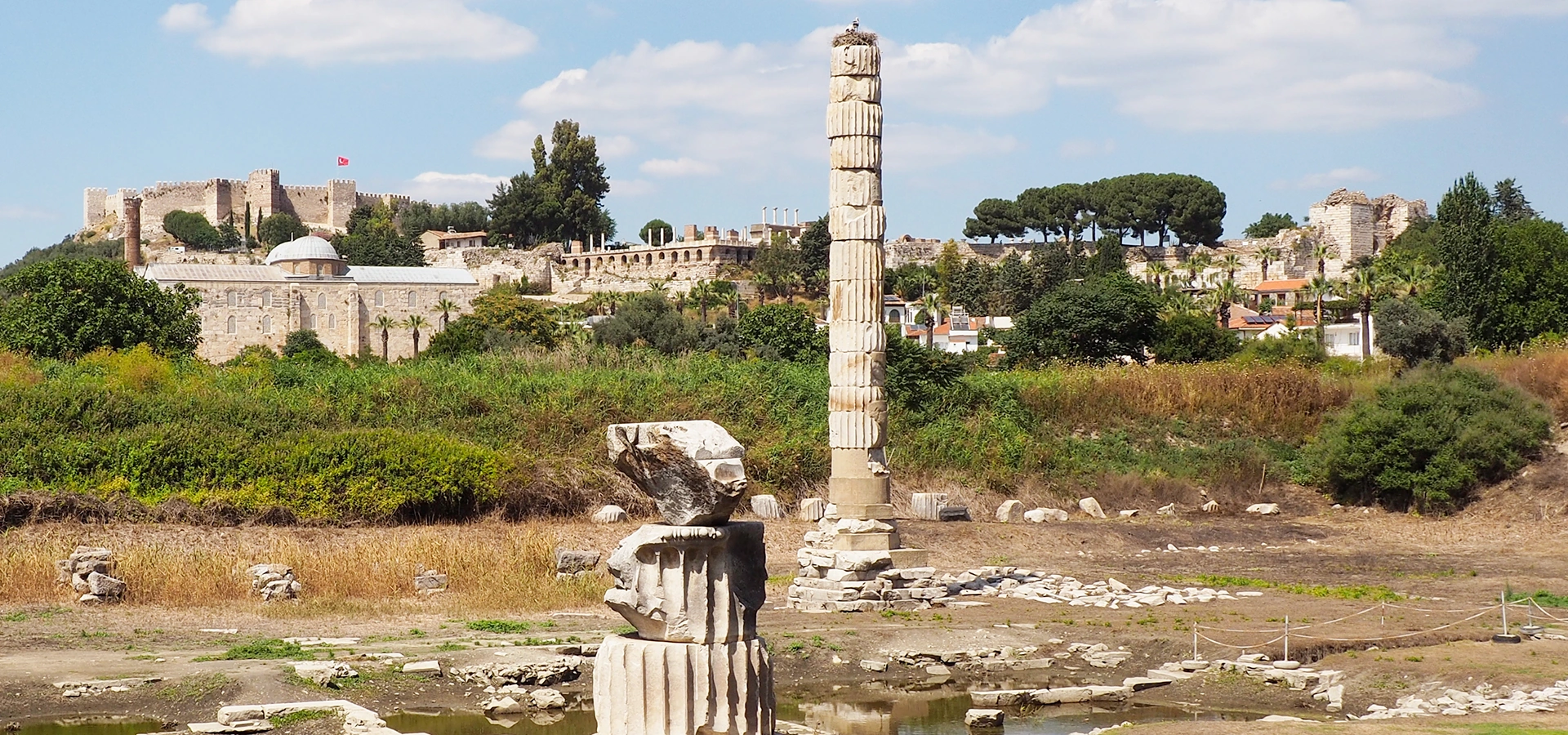
Stand on the archaeological footprint of one of the Seven Wonders and connect the ruined sanctuary with the Artemis statues and votive finds inside the museum.
Explore the Artemision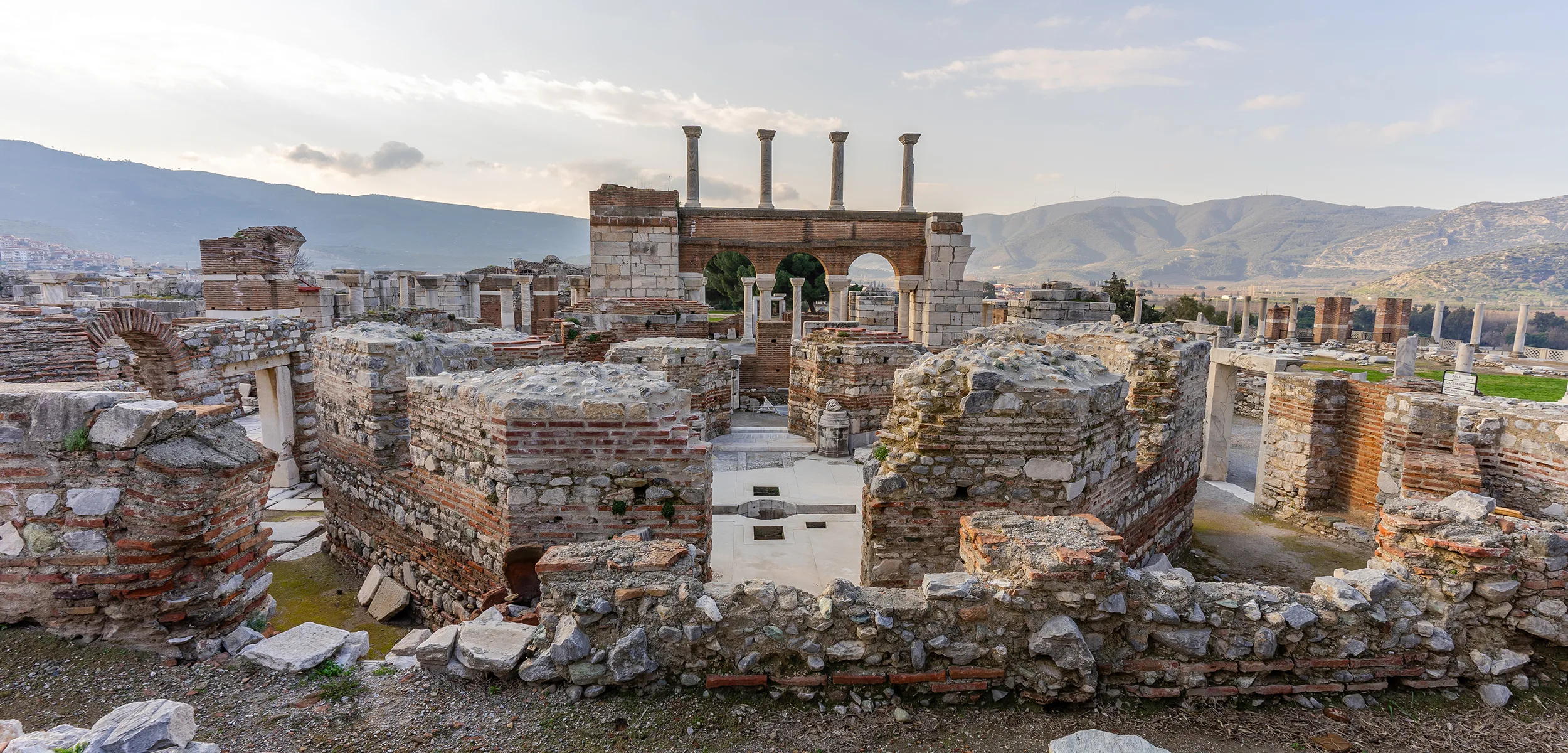
Continue from the religious world of Artemis and Roman Ephesus into one of the region's most important Byzantine Christian pilgrimage centres.
Explore Saint John Basilica
Continue through İzmir Province with ancient cities, archaeological museums, sacred sites, coastal towns, historic districts and regional culture.
View İzmir Guide