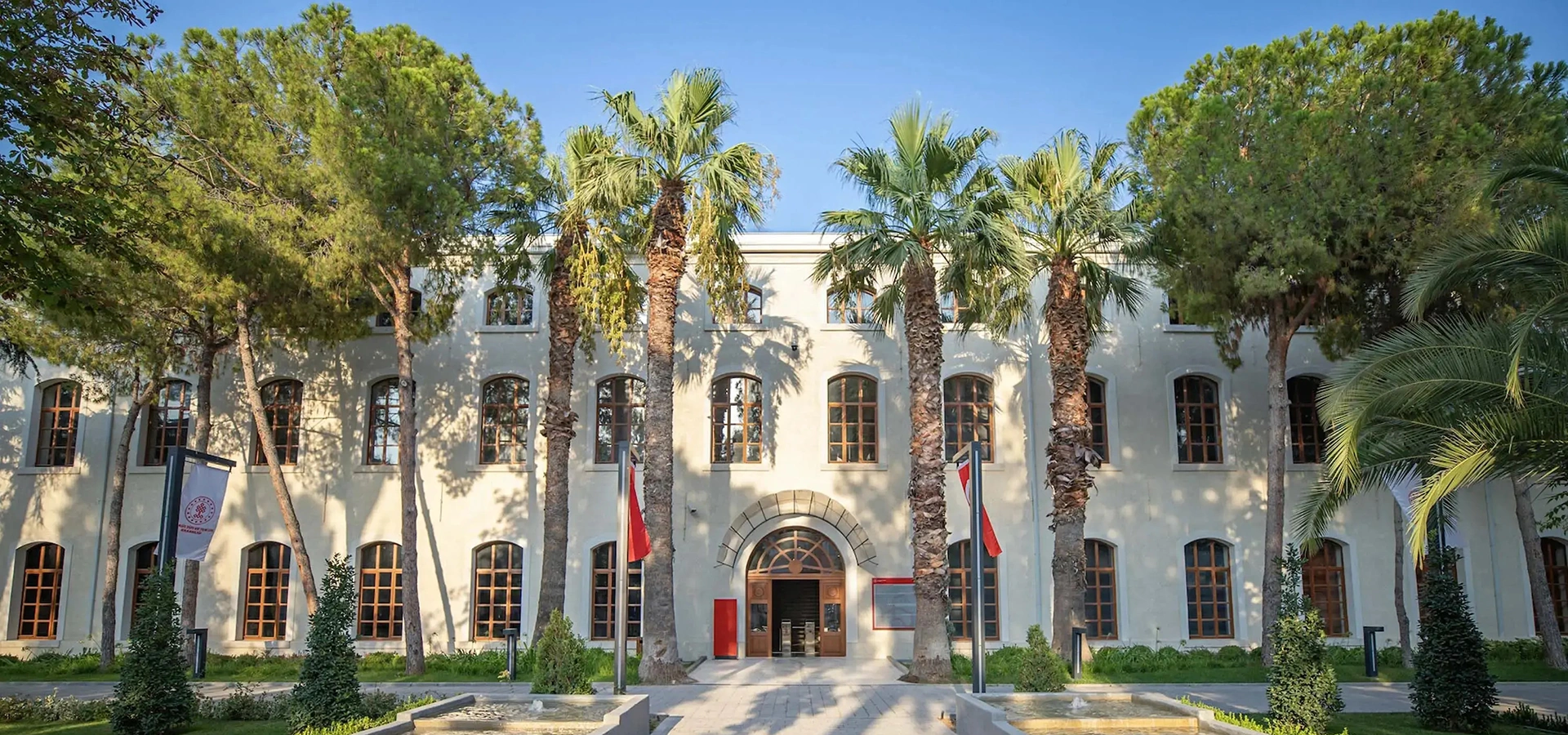
İzmir Kültür Sanat Fabrikası
Explore the restored former Tekel Factory complex with museums, exhibitions, libraries, archaeological collections and cultural spaces.
Explore the Culture Factory





Located between Alsancak and Basmane in the centre of İzmir, Kültürpark is far more than an ordinary city park.
Opened on 1 September 1936, it was conceived during a period when İzmir was rebuilding itself after the devastation of the early 1920s.
Under the leadership of İzmir mayor Dr. Behçet Uz, the site was transformed into a large landscaped public space combining greenery, education, culture, sport, exhibitions and international exchange.
Kültürpark soon became inseparable from the İzmir International Fair — İzmir Enternasyonal Fuarı, which turned the park into one of Türkiye's best-known meeting places for trade, culture and entertainment.
Today visitors can walk beneath mature trees, explore historic gates, see the famous Parachute Tower, attend concerts or performances, visit libraries and exhibition spaces, exercise on the park's running track and discover layers of İzmir's 20th-century history.
It is simultaneously a historic landscape, cultural campus, urban park and living part of everyday İzmir.
Discover a landmark created during İzmir's transformation into a modern 20th-century city.
Explore the historic home of one of Türkiye's most famous and longest-running international fairs.
Enter through Lozan, Montrö, 9 Eylül, Cumhuriyet or 26 Ağustos Gate.
Combine gardens and walking paths with theatres, galleries, libraries, exhibitions and cultural events.
Essential information about one of central İzmir's most important green, cultural and historical spaces.
Kültürpark — often simply called “Fuar” by İzmir residents.
Central İzmir, between the Basmane, Alsancak and Mimar Sinan areas of Konak.
1 September 1936.
Developed under the leadership of İzmir mayor Dr. Behçet Uz.
Approximately 421,000 square metres.
A major urban green space containing a wide variety of mature trees and plant species.
Five principal entrances: Lozan, Montrö, 9 Eylül, Cumhuriyet and 26 Ağustos.
Historic home of the İzmir International Fair.
Approximately 1,850 metres around the park.
The Kültürpark Parachute Tower opened in 1937.
Current municipal policy closes Kültürpark between 00:00 and 06:00 for overnight maintenance.
Allow 1.5–3 hours for a relaxed walk, longer if visiting a museum, library or event.
Kültürpark is one of the best places in İzmir to understand how the city's history, public life, culture and green spaces became connected during the 20th century.
At first glance, it can simply appear to be a large wooded park surrounded by busy central neighbourhoods.
But the landscape contains much more.
Historic gateways, exhibition buildings, theatres, former fair pavilions, monuments, sports facilities and mature gardens reveal the park's original ambition as a place where education, recreation, international exchange and culture could coexist.
Its identity is also inseparable from the İzmir International Fair, which for generations introduced visitors to international products, countries, technology, music, performances and entertainment.
For residents, however, Kültürpark is equally important as an everyday urban landscape.
People come here to walk, run, sit beneath the trees, study in the libraries, attend exhibitions, watch theatre and concerts or simply escape the dense streets surrounding central İzmir.
That combination makes Kültürpark unusual: it is both a historic monument to modern İzmir and a functioning public space still used every day.
Understanding Kültürpark requires looking at what happened to İzmir before the park existed.
Large sections of the city were devastated by the Great Fire of İzmir in September 1922.
Part of the district later occupied by Kültürpark lay within this heavily damaged zone.
Before the fire, portions of İzmir's historic Armenian quarter and the area around Saint Stepanos Church extended across land that would later become part of the park.
During the following years, İzmir faced the enormous challenge of rebuilding damaged neighbourhoods while creating a new urban identity.
One of the important figures in that transformation was physician and politician Dr. Behçet Uz, who became mayor of İzmir.
A further influence came from İzmir journalist Suad Yurdkoru, whose impressions from a 1933 visit to Moscow contributed to discussions about creating a landscaped exhibition and cultural park in İzmir.
The resulting idea went beyond simply creating gardens.
Kültürpark was envisioned as a public environment where people could encounter culture, science, industry, international exhibitions, sport, art and recreation.
The park entered service together with the İzmir fair on 1 September 1936.
From that point onwards, Kültürpark became one of the defining symbols of modern İzmir.
The transformation of this part of İzmir into Kültürpark was particularly symbolic because the site had been deeply affected by the destruction of 1922.
Rather than rebuilding every damaged block according to its previous street pattern, part of the devastated district was eventually incorporated into a radically different urban project.
Trees, exhibition halls, gardens, sports areas, performance spaces and broad pedestrian routes replaced sections of the former built environment.
The park therefore became connected with a larger story of urban reconstruction and changing ideas about how İzmir should function as a modern city.
Visitors walking through the shaded landscape today may find it difficult to imagine how dramatically different this district looked immediately after the fire.
That contrast between destruction and landscape creation remains one of the most important historical dimensions of Kültürpark.
One of the most interesting ideas behind Kültürpark was that the park should provide more than entertainment.
Historical descriptions of the project refer to the ambition of creating something resembling a “public university”.
The idea was that ordinary visitors could encounter new technologies, industries, countries, artistic movements, sports and forms of public culture within the same landscape.
International fair pavilions played an especially important role.
For generations of visitors who had relatively limited opportunities for international travel, the fair allowed encounters with foreign countries, unfamiliar products, new technologies and different cultural traditions.
Museums, exhibition halls, theatres and sporting facilities strengthened the educational dimension of the park.
The addition of modern public libraries in 2025 and 2026 has, in some ways, revived this original educational philosophy.
Kültürpark has five principal entrance gates, positioned around its large perimeter.
Knowing them is useful because the park covers a substantial area and the best entrance depends on where you are coming from and what you want to see.
One of the best-known entrances and useful for reaching İsmet İnönü Art Center and the northern side of the park.
A convenient entrance from the Alsancak and Şair Eşref Boulevard side of central İzmir.
The principal Basmane-side entrance and a practical choice for visitors arriving from Basmane Metro Station.
Provides access to the eastern side of the park and areas near several sporting and performance facilities.
Another important access point and traditionally associated with vehicle access toward the underground parking area.
Choose according to your route rather than treating one entrance as the park's single main gate.
The dense vegetation is one of the features that most distinguishes Kültürpark from the surrounding city.
From its earliest years, the park was planted with a wide range of trees and ornamental species, including plants introduced from outside Türkiye.
Official descriptions record more than 200 valuable tree and plant species within the landscape.
After decades of growth, many of these trees now create substantial areas of shade.
For visitors, this makes Kültürpark particularly pleasant for walking during spring, early summer and autumn.
The vegetation is also historically important.
The intention was not merely to create decorative flowerbeds around exhibition buildings, but to establish a genuine green environment at the centre of a rapidly developing city.
Long-established trees create shaded corridors throughout much of the park.
A broad collection of tree and plant species reflects the park's original landscaping programme.
The dense greenery provides a striking contrast with the surrounding streets of central İzmir.
The extensive tree cover creates habitat for urban bird species and contributes to the park's quieter atmosphere.
Spring growth, summer shade and autumn colour give Kültürpark a different character throughout the year.
The trees themselves form part of Kültürpark's nearly century-long history.
It is almost impossible to separate the history of Kültürpark from the history of the İzmir International Fair — İzmir Enternasyonal Fuarı or İEF.
The origins of İzmir's fair tradition stretch back before Kültürpark itself.
An exhibition of domestic goods held in connection with the 1923 İzmir Economic Congress helped establish a tradition of organised commercial exhibitions in the city.
Further exhibitions followed during the late 1920s and early 1930s.
When Kültürpark opened in 1936, the fair gained a permanent landscaped setting capable of accommodating pavilions, displays, entertainment, performances and large numbers of visitors.
Over the following decades, foreign countries and companies presented products, industrial developments and cultural displays inside the park.
For many visitors, the fair became as much a social and cultural experience as a commercial exhibition.
Concerts, restaurants, entertainment venues, international pavilions and nighttime illumination helped turn the fair into one of the great annual rituals of İzmir life.
Kültürpark continues to host the İzmir International Fair, although the wider structure of exhibition activity in İzmir has evolved and many specialised trade fairs are now held at Fuar İzmir in Gaziemir.
Older generations of İzmir residents often remember Kültürpark through the fair.
Visiting during the İzmir International Fair could mean encountering foreign pavilions, newly manufactured products, machinery, household technology, music, restaurants and entertainment within a single evening.
The fair also became associated with some of Türkiye's best-known performers.
For decades, concerts and nightclub-style venues inside Kültürpark formed part of the city's entertainment culture.
International participation gave the park another dimension.
At a time when international tourism and air travel were far less accessible than today, the fair offered many residents a rare chance to encounter representations of distant countries without leaving İzmir.
This historical role explains why Kültürpark has such a strong place in the city's collective memory.
Among the most recognisable structures inside Kültürpark is the historic Parachute Tower — Paraşüt Kulesi.
Opened in 1937, only one year after Kültürpark itself, the tower reflects the fascination with aviation, sport and technological progress that characterised the period.
Its original purpose was practical as well as symbolic.
The structure encouraged interest in parachuting and aviation, particularly among young people.
Today the tower remains one of the visual symbols most closely associated with the historic fairground.
Kültürpark continues to function as one of central İzmir's principal concentrations of cultural venues.
The programme changes throughout the year, so a walk through the park can look very different depending on whether there is a theatre season, concert, exhibition, festival or major fair taking place.
One of İzmir's major outdoor performance venues, used for concerts, theatre, dance and other cultural events during the warmer months.
A performance and event venue near Lozan Gate used for theatre, concerts, conferences and cultural programmes.
A cultural facility hosting film screenings, performances, talks and other programmes within the park.
The Youth Theatre provides another smaller-scale venue for performances, talks and cultural activities.
A historic fair pavilion that continues to be used for major temporary exhibitions and special cultural projects.
Another surviving part of Kültürpark's fair landscape, periodically used for exhibitions and cultural programming.
Gallery spaces inside the park continue the long relationship between Kültürpark and İzmir's visual arts scene.
Concerts, exhibitions, festivals and performances change frequently, so check İzmir's current municipal culture programme before visiting.
One of the most interesting recent developments inside Kültürpark has been the transformation of former cultural buildings into modern public libraries.
The projects give a contemporary form to the park's original educational ambitions.
Opened in September 2025 in the restored former Painting and Sculpture Museum building inside Kültürpark.
The İlber Ortaylı Library contains literature, history, philosophy, psychology, foreign-language works and books connected with Ortaylı's personal collection.
Opened in April 2026 in a restored former museum building and created as a large contemporary library and study space.
The Hasan Âli Yücel collection includes literature, sociology, history, philosophy, psychology and foreign-language material.
Quiet study spaces, group rooms, computer facilities and digital work areas make the libraries useful beyond conventional sightseeing.
The Kültürpark libraries currently remain open into the evening on their operating days, making them particularly useful for students and researchers.
Visitors specifically planning to use the libraries should check the current municipal library schedule because opening days and hours can change.
Kültürpark has also played an important role in İzmir's museum landscape.
The İzmir History and Art Museum opened inside Kültürpark in 2004 to display archaeological material discovered in İzmir and the surrounding region.
Its collections have included sculpture, architectural pieces, ceramics, coins, glass, figurines and other objects spanning periods from antiquity through the Byzantine era.
Particularly important material has been associated with ancient Smyrna and archaeological sites across western Anatolia.
The use of buildings within this museum complex has changed in recent years.
One former section was transformed into the Hasan Âli Yücel Library in 2026.
For this reason, travellers specifically planning a museum visit should verify the current exhibition arrangement and available sections before making a special journey.
Visitors researching Kültürpark online may encounter older descriptions listing museums and institutions that no longer function in exactly the same way.
The most important example concerns the İzmir Painting and Sculpture Museum.
Although it had a long historical association with Kültürpark, the main museum is now housed elsewhere in İzmir.
Its former Kültürpark building was restored and opened as the Prof. Dr. İlber Ortaylı Library in 2025.
Similarly, part of the İzmir History and Art Museum complex was later transformed into the Hasan Âli Yücel Library.
Kültürpark therefore remains culturally active, but the functions of individual historic buildings continue to evolve.
This is why current information should always be checked when visiting for one particular museum, exhibition or cultural venue.
Older descriptions of Kültürpark often mention a zoo.
This is historically correct — but there is no longer a functioning zoo in Kültürpark.
The original Fuar Zoo was established inside Kültürpark in 1937 and became an important childhood memory for generations of İzmir residents.
By the early 21st century, however, the limitations of maintaining animals within a relatively compact city-centre zoo had become increasingly apparent.
İzmir Metropolitan Municipality therefore developed a much larger naturalistic facility at Sasalı in Çiğli.
The animals were transferred in 2008, and the new İzmir Wildlife Park — İzmir Doğal Yaşam Parkı replaced the historic Kültürpark zoo.
Kültürpark is not only a sightseeing destination.
It remains one of central İzmir's most useful everyday exercise areas.
A roughly 1,850-metre tartan running and walking track follows the park perimeter and is regularly used by local residents.
Its mature trees make exercise here especially attractive compared with running along busy city streets.
The tartan track provides a dedicated route for running and exercise around Kültürpark.
Internal roads and shaded paths make the park suitable for gentle walking as well as organised exercise.
Recent municipal sports stations provide additional opportunities for functional outdoor exercise.
The historic sports complex forms part of Kültürpark's long association with organised physical activity.
Tennis facilities have long formed part of the sporting infrastructure inside the park.
Early morning is one of the best times to experience Kültürpark as a neighbourhood exercise space rather than an event venue.
Entertainment has always been part of Kültürpark's identity.
The park includes a traditional lunapark occupying approximately 13,500 square metres.
Its rides and attractions form part of the lighter, recreational side of the historic fairground atmosphere.
Families should remember that the amusement area operates independently from ordinary access to the public park.
Individual rides, seasonal operating periods and prices may change.
Anyone travelling specifically for the lunapark should therefore confirm current operation before visiting.
Notice how each gate gives the park a different relationship with the surrounding neighbourhood.
One of the most recognisable surviving symbols of early Kültürpark.
The established vegetation is an important historical feature rather than simply a decorative backdrop.
Look for surviving buildings that preserve the atmosphere of Kültürpark's international-fair era.
The performance venue demonstrates how culture and entertainment were integrated into the park landscape.
A continuing example of Kültürpark's role as a major cultural venue.
The İlber Ortaylı and Hasan Âli Yücel libraries represent a new chapter in the park's educational history.
Old structures, signs and spatial arrangements still reveal how the grounds once functioned during major fairs.
Observe how everyday sport coexists with the historic landscape.
Views through the trees reveal the dense modern city that has gradually grown around Kültürpark.
Some historic buildings continue to host temporary exhibitions and cultural projects.
Perhaps the most important thing to observe is how İzmir residents continue to use the park as part of daily life.
Enough for a short walk through one section of the park if you are already sightseeing nearby.
Suitable for seeing several historic landmarks, gardens and one or two principal entrances.
A good minimum for understanding the park's scale and seeing the main historic features without rushing.
Recommended for a relaxed walk including the Parachute Tower, fair architecture and cultural buildings.
Useful if you want to sit in the gardens, visit a library or spend more time exploring the historic landscape.
Allow this if combining Kültürpark with a museum, exhibition, cultural performance or detailed exploration of surrounding Alsancak.
Kültürpark functions as a large public urban park rather than a conventional ticketed attraction.
However, individual museums, libraries, theatres, exhibitions, amusement rides and special events have their own schedules and, in some cases, separate admission arrangements.
Since 1 November 2024, İzmir Metropolitan Municipality has closed the general park between midnight and early morning so maintenance, cleaning and improvement work can be carried out.
Kültürpark's central location makes it one of the easiest major attractions in İzmir to reach by public transport.
Because the park has five gates, there is no single correct arrival point.
Basmane Metro Station provides convenient access to the 9 Eylül Gate on the eastern side of Kültürpark.
The Konak Tram provides useful access from the Alsancak side, including stops around Kültürpark–Atatürk Lisesi and nearby central districts.
Walk inland from Alsancak toward Lozan or Montrö Gate depending on your starting point.
Kültürpark can be reached on foot from the waterfront through central Alsancak.
Numerous ESHOT routes serve Basmane, Montrö, Lozan and surrounding streets.
Tell the driver which Kültürpark gate you need, particularly if attending a specific event or performance.
Driving is possible, but central İzmir traffic can make metro, tram and walking more convenient.
Kültürpark has an underground parking facility; current access and tariffs should be checked before arrival.
One of the most pleasant seasons for greenery, walking and comfortable daytime temperatures.
Long days and active cultural programming make the park lively, although midday temperatures can be high.
The traditional İzmir International Fair period gives Kültürpark an entirely different atmosphere with events and large crowds.
Comfortable weather and mature trees make autumn particularly attractive for walking and photography.
The park remains useful for walking and local life, while indoor libraries and cultural spaces add rainy-day options.
Best for runners, walkers and visitors wanting to experience the park at its quietest.
A good time for a relaxed walk before continuing into Alsancak for dinner or the waterfront at sunset.
Kültürpark becomes much livelier when concerts, festivals or performances are scheduled.
Use the entrances as architectural frames connecting Kültürpark with the surrounding city.
The tower is one of the strongest architectural subjects in the park.
Long perspectives beneath mature trees work particularly well in the morning and late afternoon.
Surviving fair buildings offer details reflecting different periods of 20th-century design.
Walkers, runners, students and families reveal Kültürpark as a living urban space rather than an open-air museum.
Seasonal foliage can make some sections especially photogenic.
During fairs and festivals, nighttime illumination creates a very different visual atmosphere.
Professional photography, performances or temporary exhibitions may have additional restrictions.
Continue into the restored former Tekel Factory complex with museums, libraries, galleries and cultural spaces.
Visit Atatürk's historic İzmir residence directly on First Kordon.
Continue toward İzmir's famous waterfront for cafés, promenades and sunset views across the gulf.
One of the principal public spaces along Kordon and a natural continuation toward the waterfront.
Add another layer of İzmir's religious and multicultural urban history.
Travel much further back in time through the archaeological remains of ancient and Roman Smyrna.
Explore one of central İzmir's most historically layered districts immediately beyond the park.
Combine Kültürpark with the monumental waterfront spaces associated with modern İzmir.
One of the strongest combinations for visitors interested in İzmir's museums, public culture and architectural reuse.
Combine the wooded interior of the city with its open waterfront landscape.
Explore two important places connected with the development of 20th-century İzmir.
Move from planned parkland into one of İzmir's most historically layered central neighbourhoods.
Compare modern Republican-era urban planning with the surviving architecture of ancient Smyrna.
Walk through the park in late afternoon before continuing to Alsancak for dinner and Kordon at sunset.
Kültürpark is large, so entering through the gate closest to your first destination can save considerable walking.
The park's size and numerous side paths make it easy to spend two hours without noticing.
A full circuit together with internal exploration can involve several kilometres of walking.
Your experience can change completely when a major fair, concert or festival is taking place.
Some older guides contain outdated information because several cultural buildings have recently changed function.
The historic zoo closed and its animals moved to İzmir Wildlife Park in Sasalı in 2008.
The trees provide useful shade, but İzmir can still be extremely warm during July and August.
This is especially useful when walking extensively during hot weather or when the park is crowded for an event.
Visit early if you want to see the park primarily as a peaceful green space used by local walkers and runners.
Expect much larger crowds, event-specific hours and possible ticketing arrangements during the İzmir International Fair.
Kültürpark works especially well as part of a larger central İzmir walking day.
The relationship between historic buildings, trees and everyday local life is part of what makes Kültürpark important.
Kültürpark is a large historic urban park in central İzmir containing gardens, cultural venues, sports facilities, exhibition buildings, libraries and the historic grounds of the İzmir International Fair.
It is located in central Konak between the Basmane and Alsancak areas of İzmir.
Kültürpark entered service on 1 September 1936 together with the İzmir fair.
The project was developed under the leadership of İzmir mayor Dr. Behçet Uz, with journalist Suad Yurdkoru also associated with the early concept.
It was intended to provide İzmir with a major green, cultural, educational, exhibition and recreational space while supporting the city's developing international fair.
Yes. Part of the land incorporated into today's Kültürpark belonged to the extensive central İzmir district devastated by the Great Fire of 1922.
The park occupies approximately 421,000 square metres.
There are five principal gates: Lozan, Montrö, 9 Eylül, Cumhuriyet and 26 Ağustos.
The 9 Eylül Gate is the most convenient principal entrance for visitors arriving from Basmane Metro Station.
Lozan and Montrö gates are generally the most practical choices from the Alsancak side.
Kültürpark has hosted the İzmir International Fair since the park opened in 1936 and the two became closely associated in İzmir's modern history.
Yes. The annual İzmir International Fair continues to use Kültürpark, although many specialised trade fairs are now held at Fuar İzmir in Gaziemir.
The Paraşüt Kulesi is a historic tower opened in 1937 to promote interest in parachuting and aviation.
Access arrangements can vary and the tower should not be assumed to be permanently open for climbing. Check current local information if this is the main reason for your visit.
No. The historic Fuar Zoo once operated inside the park, but its animals were transferred to the much larger İzmir Wildlife Park in Sasalı in 2008.
The historic zoo was established in 1937, shortly after Kültürpark itself opened.
Kültürpark has a long museum history and remains associated with İzmir History and Art Museum, although some former museum buildings have recently been adapted for new cultural uses.
The main museum is no longer housed in its former Kültürpark building. That historic building was restored and opened as Prof. Dr. İlber Ortaylı Library in 2025.
Major recent additions include Prof. Dr. İlber Ortaylı Library and Hasan Âli Yücel Library.
It opened in September 2025 inside the restored former Painting and Sculpture Museum building.
The library opened in April 2026 in a restored former museum building inside Kültürpark.
Yes. The newer libraries include reading areas, study spaces and digital facilities. Check their current operating schedules before visiting.
Yes. Kültürpark regularly hosts concerts and performances, particularly at Atatürk Open-Air Theatre and during festivals and major events.
It is one of İzmir's major outdoor performance venues and hosts concerts, theatre, dance and other cultural events.
Yes. A roughly 1,850-metre tartan track around the park is widely used for running and walking.
Yes. The open spaces, walking areas and family-oriented activities make it suitable for children, while the lunapark provides additional entertainment when operating.
Yes. Kültürpark includes a traditional amusement area, although ride schedules and prices are separate from general park access.
Under the current municipal arrangement, visitors can generally enter from around 06:00 after the overnight maintenance closure ends.
The park is currently closed to visitors between 00:00 and 06:00 for overnight maintenance and cleaning.
Ordinary use of the public park does not function like a ticketed museum, but fairs, concerts, amusement rides, museums and special events may have separate admission charges.
Approximately 1.5–3 hours is suitable for most visitors exploring the park itself. Allow longer if attending an exhibition, museum, library or performance.
Morning is best for a quiet walk, while late afternoon works particularly well if you plan to continue into Alsancak and Kordon.
Spring and autumn generally provide the most comfortable walking weather. September is particularly lively because of the İzmir International Fair.
Yes. Basmane Metro Station provides convenient access to the 9 Eylül Gate.
Yes. The Konak Tram serves the surrounding area, with the Kültürpark–Atatürk Lisesi area particularly useful for access from the Alsancak side.
Yes. Kültürpark is within comfortable walking distance of central Alsancak and the Kordon waterfront.
İzmir Kültür Sanat Fabrikası, İzmir Atatürk Museum, Alsancak, Kordon, Basmane and Smyrna Agora all work well in the same central İzmir itinerary.
It combines the story of İzmir's reconstruction after 1922 with the development of the İzmir International Fair, 20th-century urban planning, public culture and the city's modern social life.
Yes. Its gardens, historic structures, libraries, performance venues, architecture and everyday local atmosphere make it worthwhile even when no major event is taking place.
Use Kültürpark as a starting point for discovering the museums, waterfront, historic neighbourhoods and cultural institutions of central İzmir.
Continue from Kültürpark into restored industrial heritage, historic residences, the Alsancak waterfront and the wider history of the Aegean metropolis.
Explore the restored former Tekel Factory complex with museums, exhibitions, libraries, archaeological collections and cultural spaces.
Explore the Culture Factory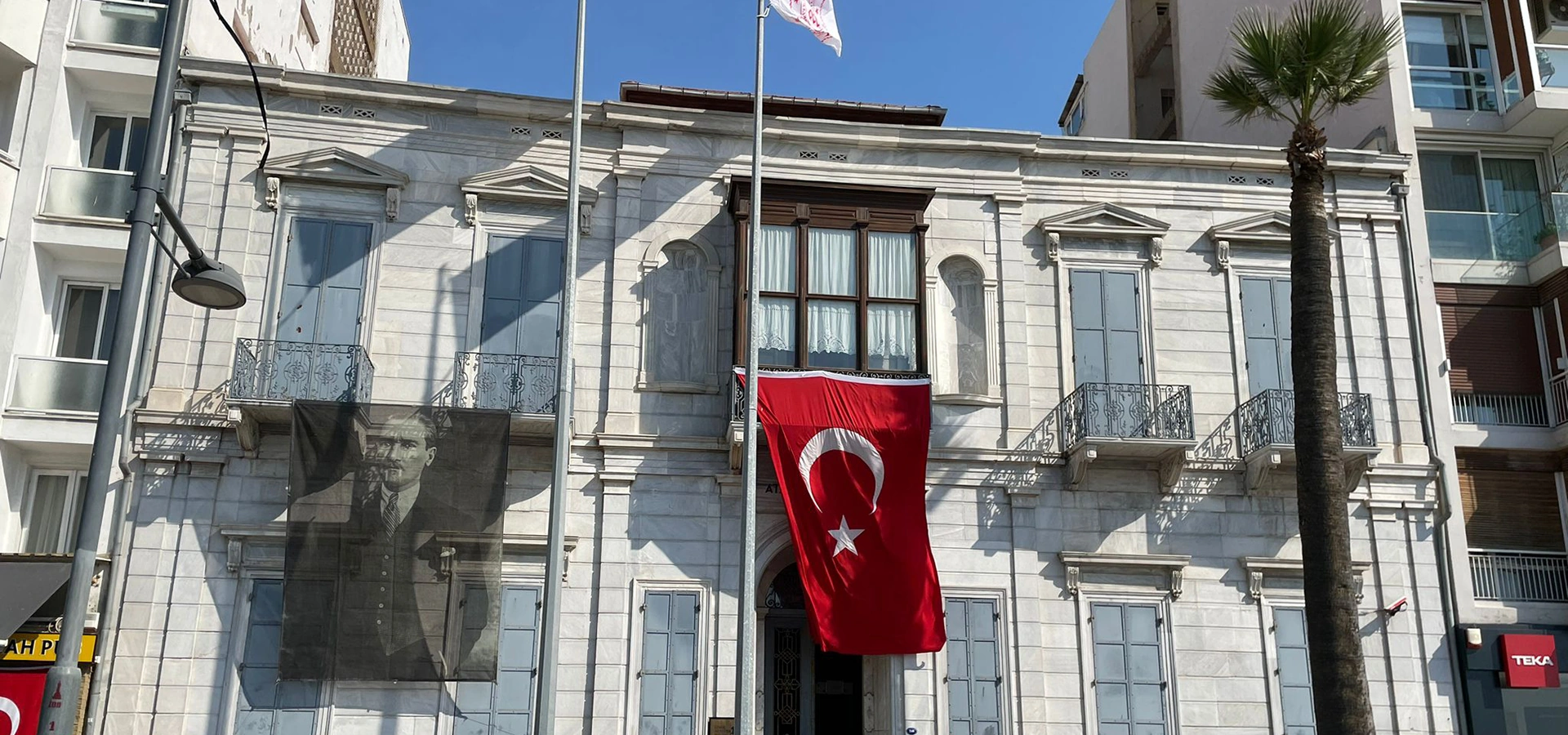
Step inside the historic First Kordon residence associated with Mustafa Kemal Atatürk's visits to İzmir and the early Republican period.
Explore İzmir Atatürk Museum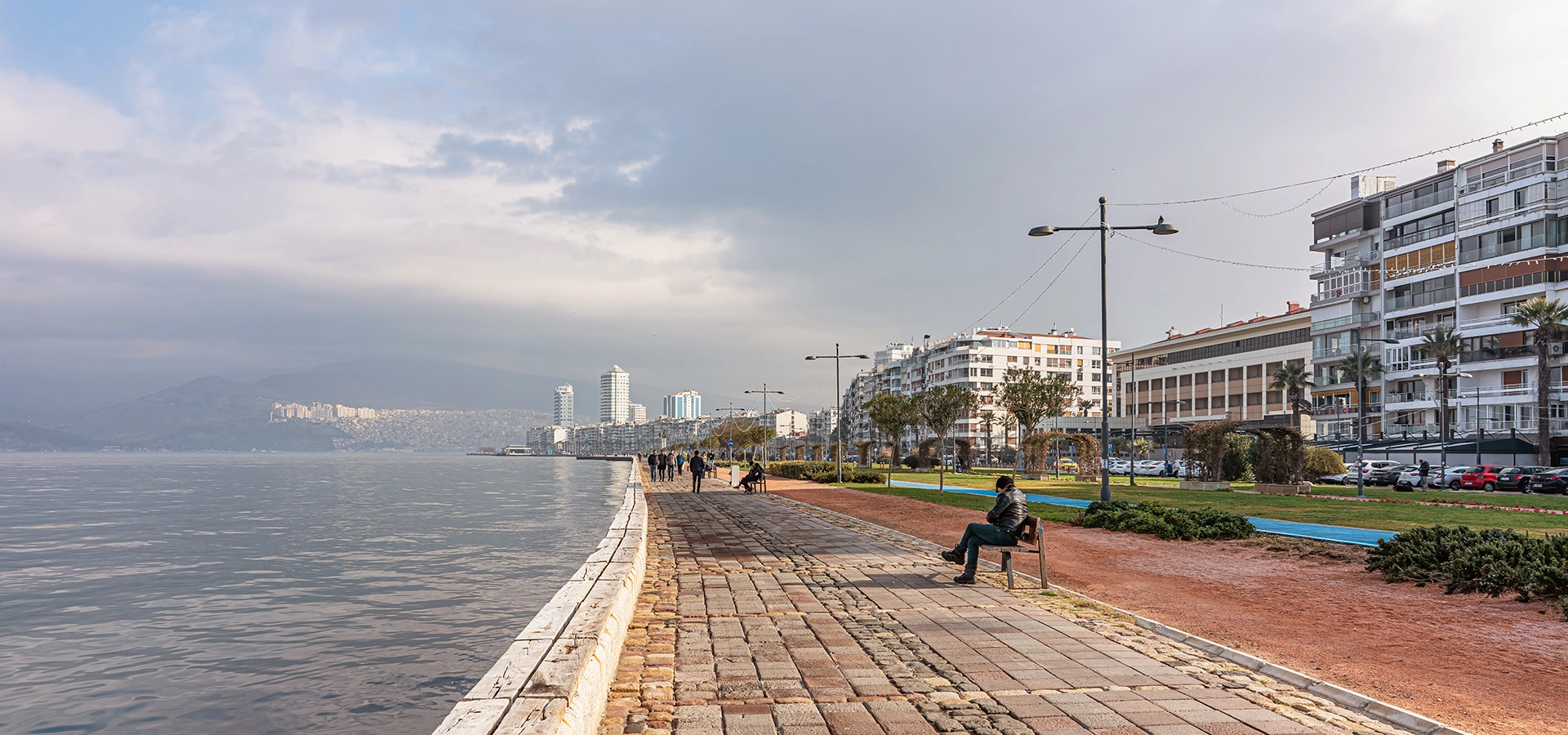
Continue toward İzmir's famous waterfront for palm-lined promenades, historic streets, cafés, restaurants and sunset views across the Gulf of İzmir.
Explore Kordon & Alsancak
Continue with our complete İzmir guide covering archaeology, museums, churches, synagogues, historic neighbourhoods, coastal districts, cuisine and day trips.
View İzmir Guide