Private Byzantine Nymphaion Experience
Discover the Laskaris Palace with a private guide and explore the extraordinary story of John III Vatatzes, the Empire of Nicaea and Byzantine life after the Fourth Crusade.
Request a Private Experience





Among the orchards and modern streets of Kemalpaşa east of İzmir rises the remarkable shell of a medieval building that once belonged to one of the most dramatic chapters in Byzantine history.
Today it is generally known as the Laskaris Palace, the Laskarid Palace, the Nymphaion Palace or locally as Kız Kulesi.
During the thirteenth century, however, Kemalpaşa was known as Nymphaion and became an important imperial residence of the rulers of the Empire of Nicaea—the Byzantine state that emerged in western Anatolia after Constantinople was captured during the Fourth Crusade in 1204.
The palace became especially associated with Emperor John III Doukas Vatatzes, one of the most successful rulers of the Nicaean Empire, who repeatedly stayed at Nymphaion and died there in 1254.
Modern archaeological research has revealed that the palace was far more sophisticated than its surviving walls initially suggest, with evidence for water management, heating and possibly an elite bathing complex within the imperial residence.
Nymphaion became an important imperial residence after Constantinople fell to the Fourth Crusade in 1204.
The powerful thirteenth-century emperor regularly stayed at Nymphaion and died in the palace gardens in 1254.
The surviving rectangular palace represents one of the rare examples of secular late Byzantine architecture in Anatolia.
Recent research has highlighted sophisticated hydraulic installations and possible bathing facilities within the complex.
Essential information about one of the most important surviving monuments of the Empire of Nicaea.
Kemalpaşa, approximately 30 kilometers east of central İzmir in western Türkiye.
Open on Google MapsNymphaion, later commonly known as Nif before becoming modern Kemalpaşa.
Closely associated with the Laskarid rulers of the thirteenth-century Empire of Nicaea.
Primarily associated with the first half and middle decades of the 13th century.
The surviving palace block measures approximately 12 × 26 meters.
One of the rare surviving examples of late Byzantine imperial residential architecture in Anatolia.
The palace preserves a physical connection with the Byzantine emperors who rebuilt imperial power in Anatolia after the catastrophe of 1204.
In April 1204, armies of the Fourth Crusade captured Constantinople, bringing centuries of uninterrupted Byzantine rule in the imperial capital to a sudden end.
Byzantine political power survived in several successor states.
The most successful of these developed around Nicaea—modern İznik—in northwestern Anatolia.
Its emperors gradually consolidated territory, developed new administrative centers and maintained the political ideal that Constantinople would eventually be recovered.
Within this changing imperial geography, Nymphaion became one of the most important residences of the Nicaean court.
The surviving palace in modern Kemalpaşa therefore belongs to an extraordinary historical moment when the Byzantine imperial court temporarily operated from western Anatolia rather than Constantinople.
Modern Kemalpaşa has carried several names through its long history.
The settlement was known in Byzantine times as Nymphaion, a name traditionally connected with water, springs and the nymphs of classical mythology.
In later centuries the name evolved into forms such as Nif, Nymphio and Nimfio.
The settlement occupied an advantageous position east of Smyrna—modern İzmir—close to routes leading inland toward the Hermus/Gediz Valley and Sardis.
Abundant water, fertile agricultural land and the surrounding mountain landscape made the area attractive not only strategically but also as an imperial residence.
The Byzantine name of the settlement corresponding broadly with modern Kemalpaşa.
A later form of the historic name that remained in common use for centuries.
Water, orchards and productive agricultural land surrounded the imperial residence.
Nymphaion stood close to major routes connecting the Aegean coast with inland western Anatolia.
The historical story behind the Laskaris Palace begins with one of the greatest political disasters in Byzantine history.
In 1204, crusading armies captured and looted Constantinople during the Fourth Crusade.
A Latin Empire was established in the former Byzantine capital while Byzantine aristocratic families created competing states elsewhere.
In western Anatolia, Theodore I Laskaris established the political center that developed into the Empire of Nicaea.
Although Nicaea gave the state its modern historical name, imperial government was not restricted to a single city.
The emperors moved between several strategic and residential centers—including Nymphaion.
Constantinople was captured by the Fourth Crusade.
Modern İznik became the principal political and ecclesiastical center of the successor empire.
The settlement developed into an important imperial residence in western Anatolia.
Constantinople was recovered, bringing the Nicaean exile period to an end.
The Laskarid dynasty is closely connected with the creation and consolidation of the Empire of Nicaea.
Its first ruler, Theodore I Laskaris, established a viable Byzantine successor state during the chaotic years following the loss of Constantinople.
His successor and son-in-law, John III Doukas Vatatzes, dramatically strengthened the empire.
John III expanded territory, encouraged agricultural and economic development and brought the Nicaean state increasingly close to achieving its ultimate political goal—the recovery of Constantinople.
Nymphaion became particularly closely associated with his reign.
Founder of the Nicaean imperial state following the fall of Constantinople.
A powerful successor who made Nymphaion one of his favored imperial residences.
Son of John III and another emperor strongly associated with Nymphaion.
The young final representative of the Laskarid imperial line before Michael VIII Palaiologos secured power.
The exact construction history of the Nymphaion Palace has long been discussed by historians and architectural scholars.
Recent scholarship interprets historical evidence as suggesting that construction may have begun during the reign of Theodore I Laskaris and was completed or substantially developed under his successor John III Doukas Vatatzes.
Other studies have traditionally emphasized the reign of John III more strongly when discussing the surviving palace.
It is therefore safest to understand the building as a product of the developing Laskarid imperial court during the first half of the thirteenth century.
Its architecture belongs directly to the period in which Byzantine rulers were establishing new expressions of imperial authority outside Constantinople.
Few historical figures are as strongly associated with Nymphaion as John III Doukas Vatatzes.
John III ruled from 1221/22 until 1254 and transformed the Empire of Nicaea into the strongest Byzantine successor state.
Historical accounts describe Nymphaion as one of his favored residences.
The pleasant climate, water resources, agricultural landscape and strategic location made the settlement particularly suitable for the mobile imperial court.
John III spent repeated periods here and eventually died at Nymphaion on 3 November 1254.
Sources connect his final days with the gardens surrounding the imperial residence, making the landscape around the surviving palace an important historical setting in its own right.
John III Doukas Vatatzes ruled the Empire of Nicaea for more than three decades.
Nymphaion appears repeatedly in accounts of the emperor's movements and court life.
John III became famous for promoting productive estates and economic self-sufficiency.
The emperor died here in November 1254.
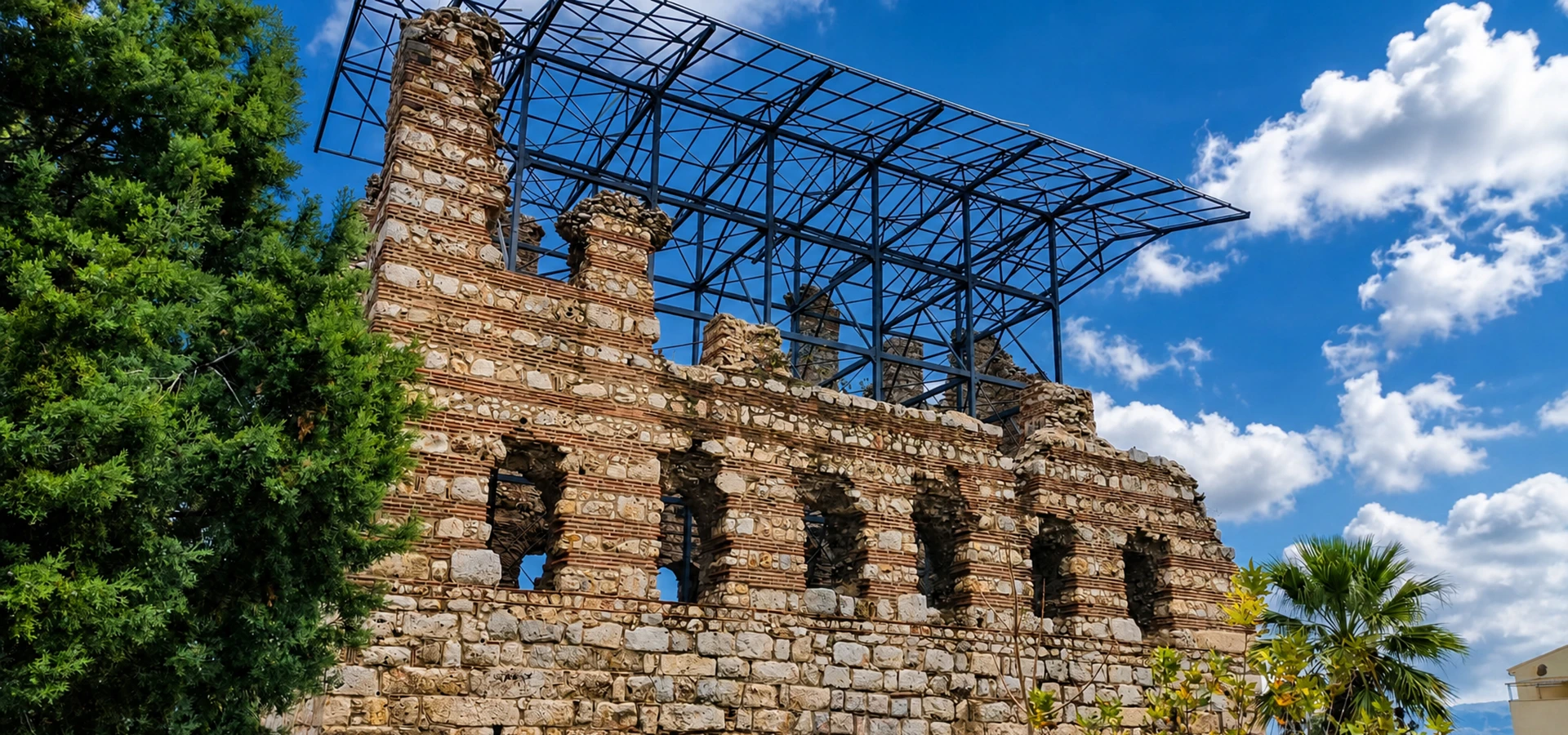
The surviving palace is striking because of its unusually compact, almost tower-like form.
Rather than spreading through numerous courtyards and detached pavilions, the principal surviving structure forms a large rectangular block approximately 12 meters wide and 26 meters long.
The lower sections were constructed using carefully cut stone blocks that give the palace an almost fortified appearance.
Higher levels combine stone and brick masonry, producing the alternating textures characteristic of many Byzantine buildings.
Most wooden floors and internal fittings have disappeared, leaving the exterior walls as a monumental shell.
Traces of arches, pilasters, windows and structural divisions nevertheless allow architectural historians to reconstruct much of the building's original organization.
The principal surviving structure measures approximately 12 × 26 meters.
Large dressed stone blocks create a strong fortified appearance at the base.
Upper masonry uses characteristic Byzantine combinations of brick and stone.
Architectural evidence suggests that the building originally rose through several levels.
The palace's wooden floors and much of its interior architecture have disappeared.
Even so, window openings, wall pilasters and the springing points of arches provide important clues.
Recent architectural analysis suggests that the building may originally have contained four principal levels, each approximately three meters high.
Long exterior walls contain repeated window openings that once illuminated the residential floors.
At the lowest level, narrow openings resembling arrow loops reinforced the building's defensive appearance.
The result would have been an imposing vertical palace rising above its gardens and agricultural landscape.
Heavy stone construction and narrow openings created a strong architectural base.
Larger windows provided light to the palace's residential spaces.
Wooden internal flooring explains why the exterior shell survives more completely than the interior divisions.
Architectural evidence has been interpreted as indicating several floors rising through the surviving walls.
The building should not be imagined merely as a fortified tower occupied by a single emperor.
A Byzantine imperial residence functioned as part of a much larger court environment.
Officials, servants, guards, clergy, messengers, diplomats and aristocratic families moved with the emperor and required extensive supporting infrastructure.
The surviving palace block therefore represented only one element within what must once have been a broader imperial landscape of gardens, service structures, water installations and agricultural estates.
Archaeological discoveries around the palace confirm that activity extended beyond the walls visible today.
The palace provided residential space for the ruler and members of the imperial household.
The mobile government required administrators, military officers and attendants.
Nymphaion became a setting for negotiation, ceremony and international diplomacy.
Gardens, water systems and agricultural land formed part of the wider residential landscape.
One of the most fascinating developments in modern study of the palace concerns water.
Salvage excavations around and beneath the building revealed channels, pipes and architectural features demonstrating that water management formed an important part of the palace.
Terracotta pipes appear to have carried water or served heating and drainage systems through different levels of the structure.
Research has also identified evidence suggesting that part of the lower palace may have contained sophisticated bathing installations.
This transforms our understanding of the building from a simple fortified residence into a far more complex environment connected with imperial comfort, ceremony and the cultivated landscape surrounding Nymphaion.
Recent archaeological scholarship has proposed an especially intriguing interpretation for one feature discovered in the lower part of the palace.
The structure may represent a kolymbos—a term used in Byzantine texts for a type of pool or bathing installation.
The feature has been interpreted as a tholos-shaped or circular bathing pool integrated into the palace's hydraulic system.
If this interpretation is correct, Nymphaion provides rare archaeological evidence for a type of elite Byzantine bathing environment previously known largely through written descriptions.
The interpretation remains part of continuing scholarly discussion, but it has significantly expanded interest in the palace and its relationship with Byzantine water culture.
A Byzantine term connected in scholarly discussion with pools and bathing environments.
Excavations revealed hydraulic features that had not been understood by earlier architectural studies.
The proposed interpretation connects water with imperial comfort, ritual and courtly life.
The discoveries continue to reshape interpretations of the palace's lower level.
The modern urban environment makes it difficult to imagine the landscape surrounding the palace during the thirteenth century.
Historical Nymphaion was celebrated for its water, fertile soil and vegetation.
The palace almost certainly stood within a much broader landscaped and productive estate rather than in isolation.
Gardens served multiple purposes in Byzantine imperial life.
They supplied food and fruit, provided shade and recreation and created carefully controlled landscapes that expressed abundance and royal prosperity.
The death of John III Vatatzes in the palace gardens demonstrates how important these outdoor spaces were to the imperial residence.
Natural springs and hydraulic installations helped shape the character of Nymphaion.
The fertile Kemalpaşa landscape remains famous for agricultural production today.
Gardens provided comfortable outdoor spaces for the emperor and court.
Productive estates demonstrated prosperity, control and imperial order.
Descriptions of Nymphaion have not always agreed about the season in which the imperial court used the residence.
Older publications and tourism descriptions sometimes characterize it broadly as a summer residence or country palace.
More recent scholarship, however, emphasizes historical evidence identifying Nymphaion particularly as a winter residence of the Laskarid court.
The difference illustrates how interpretations of Byzantine palace life continue to evolve as historical texts and archaeological evidence are reconsidered together.
Rather than imagining the palace as a modern holiday residence, it is more useful to understand Nymphaion as one of several important centers within an itinerant imperial court.
Nymphaion was far more than a comfortable imperial retreat.
During the thirteenth century it became a setting for important political, religious and diplomatic events.
The first famous treaty carrying the name of Nymphaion belongs to the early years of the Empire of Nicaea.
Following the Fourth Crusade, both the Byzantine successor state centered on Nicaea and the new Latin Empire sought control of northwestern Anatolia.
After years of warfare, a peace agreement was concluded at Nymphaion in 1214.
The agreement helped stabilize the frontier between the competing powers and allowed Theodore I Laskaris to consolidate his position in Anatolia.
Whether every diplomatic activity associated with Nymphaion took place inside the surviving palace building cannot always be demonstrated, particularly because the exact construction chronology of the palace remains debated.
The treaty nevertheless demonstrates that Nymphaion already held substantial political importance during the early Laskarid period.
Another treaty made Nymphaion famous just months before the Byzantine return to Constantinople.
In 1261, Michael VIII Palaiologos concluded an agreement with the Republic of Genoa.
The Nicaean emperor sought naval assistance against the Latin regime still occupying Constantinople.
In exchange, Genoa received extensive commercial privileges within Byzantine territories.
Events moved faster than expected.
Constantinople was recovered by Byzantine forces later that same year without requiring the major Genoese naval campaign originally anticipated.
The Treaty of Nymphaion nevertheless became an important milestone in the political and commercial history of the eastern Mediterranean.
The imperial associations of Nymphaion continued after the death of John III.
His son Theodore II Laskaris succeeded him in 1254 and maintained the importance of Nymphaion within the imperial landscape.
After Theodore II died in 1258, his young son John IV inherited the throne in an increasingly unstable political environment.
The powerful aristocrat Michael VIII Palaiologos rose rapidly through the government and became co-emperor.
Nymphaion was closely associated with his imperial elevation before the recovery of Constantinople in 1261.
These events transformed the palace landscape into a witness to the transition between the Laskarid and Palaiologan dynasties.
The political world that had created the palace changed dramatically in the summer of 1261.
Byzantine forces entered Constantinople and ended the Latin Empire established after the Fourth Crusade.
Michael VIII Palaiologos returned to the historic capital and reestablished the Byzantine imperial court there.
Nymphaion consequently lost its position as one of the principal centers of an empire without Constantinople.
It did not immediately become irrelevant.
Palaiologan emperors continued to use Nymphaion as western Anatolia became an increasingly important military frontier.
The restoration of Byzantine rule in Constantinople changed the political geography of the empire.
The principal imperial court returned west to the Bosphorus, but Nymphaion remained strategically important.
Byzantine rulers continued to travel through and reside in western Anatolia during military campaigns and administrative journeys.
As Turkish principalities expanded across the region during the late thirteenth and early fourteenth centuries, Byzantine authority gradually contracted.
Nymphaion eventually passed out of Byzantine control and became part of the changing political landscape that produced the Turkish emirates and ultimately the Ottoman period.
The palace survived these transformations even as its original imperial function disappeared.
For generations the monumental ruins were familiar to people living around Kemalpaşa.
The structure became known locally by names including Kız Kulesi—the Maiden's Tower.
European travelers and scholars visiting western Anatolia during the nineteenth century gradually recognized its potential importance.
Early descriptions, drawings and photographs introduced the building to Byzantine architectural scholarship.
Among the important early researchers was Edwin Freshfield, who documented the palace during the nineteenth century.
Turkish Byzantine scholar Semavi Eyice later published a major study of the ruins in 1961, helping establish the identification of the structure as the Laskarid palace of Nymphaion within modern scholarship.
A traditional local name associated with the surviving structure.
Early drawings and descriptions helped document the palace before modern urban development.
Among the early scholars who studied and published the palace ruins.
Published an important scholarly study of the palace in 1961.
For many years, scholars studied the palace primarily by examining its surviving walls and architectural form.
Archaeological investigation eventually provided an entirely new layer of evidence.
Salvage excavations were undertaken around the palace in 2002, followed by further work in and around the lower levels between 2008 and 2012.
Researchers encountered walls, water channels, ceramics, coins and hydraulic features demonstrating that the surviving building belonged to a richer architectural environment.
The discoveries also allowed scholars to reconsider the lower level of the building and investigate its relationship with bathing, water circulation and palace gardens.
Salvage archaeology around the palace revealed previously unknown structures and hydraulic evidence.
Further archaeological work investigated the lower levels and architectural context.
Hydraulic features demonstrated sophisticated management of water around the residence.
Archaeological material helped reconstruct the chronology and occupation of the palace landscape.
The survival of the Nymphaion Palace is remarkable.
Most Byzantine imperial residences were repeatedly modified, destroyed or absorbed into later urban development.
At Kemalpaşa, substantial exterior walls still preserve the scale and architectural character of the thirteenth-century residence.
Centuries of exposure, earthquakes, vegetation, loss of timber structures and changes to the surrounding settlement have nevertheless affected the monument.
Archaeological investigation and conservation are therefore essential for protecting the structure and understanding features that may not be immediately visible to visitors.
The palace is not a vast archaeological complex like Ephesus or Pergamon.
Its significance is concentrated within one extraordinary surviving structure and the historical landscape surrounding it.
Visitors encounter tall Byzantine walls whose missing floors and roof require some imagination to reconstruct.
Understanding the history dramatically changes the experience.
What initially appears to be an isolated medieval ruin becomes the residence of emperors, the center of a mobile court and a witness to the struggle to rebuild the Byzantine Empire after 1204.
The tall surviving shell gives an unusually clear impression of the palace's original scale.
Most wooden floors, furnishings and interior divisions have disappeared.
The medieval palace is now incorporated into the landscape of modern Kemalpaşa.
The building becomes far more meaningful when the history of Nymphaion and the Empire of Nicaea is understood.
Because the palace is primarily experienced outdoors, weather and natural light can make a significant difference.
Green landscapes, blooming vegetation and comfortable temperatures make spring particularly attractive.
Warm weather and long daylight hours work well for combining the palace with other Kemalpaşa sites.
Midday temperatures can become high, making morning and later-afternoon visits more comfortable.
Milder temperatures and softer sunlight create excellent conditions for historical touring and photography.
Rain and colder weather are possible, although the season offers an atmospheric perspective on an imperial residence now understood as an important winter court center.
Lower-angle sunlight can emphasize the textures of stone and brick masonry.
The Laskaris Palace becomes even more rewarding when combined with the extraordinary historical landscape surrounding Kemalpaşa.
The palace rewards travelers willing to imagine what has disappeared.
Look closely at the masonry.
Notice how heavy stone at the lower level gives way to combinations of brick and stone above.
Follow the surviving windows upward and reconstruct the lost floors that once divided the interior.
Then look beyond the walls.
Imagine gardens, irrigation channels, orchards, attendants and imperial officials surrounding the building when the court arrived at Nymphaion.
Most importantly, remember that these emperors considered themselves not rulers of a temporary successor state but the legitimate continuation of the Roman Byzantine Empire.
For them, Nymphaion was part of an imperial landscape waiting for the day Constantinople could be recovered.
The palace is especially photogenic because its tall surviving walls create strong geometric compositions against the surrounding landscape.
Step back where possible to show the impressive height and rectangular mass of the surviving palace.
Closer compositions reveal the different masonry techniques used across the building.
Repeated openings help communicate the multiple levels once contained within the structure.
Early and late daylight can emphasize textures, arches and variations in the masonry.
Include Nif Mountain or the surrounding Kemalpaşa landscape to give the palace geographical context.
Always follow current aviation, archaeological and local regulations before considering drone photography.
The palace is located in Kemalpaşa, approximately 30 kilometers east of central İzmir.
Its relatively accessible location makes it easy to include within a private historical excursion through inland İzmir Province.
Travel east toward Kemalpaşa through the inland corridor connecting İzmir with the Gediz Valley.
A car provides the easiest way to combine the palace with Ulucak Höyük, Nazarköy and Karabel.
The palace lies within the modern Kemalpaşa area and can be incorporated into an exploration of the historic town.
A specialist guide is particularly useful because much of the palace's importance comes from historical context rather than surviving decoration.
Open the palace location in Google Maps.
View LocationKemalpaşa offers an extraordinary sequence of archaeology ranging from Neolithic settlements and Bronze Age kings to Byzantine emperors and living village traditions.
Explore historic Nymphaion, Nif Mountain, orchards and the wider cultural landscape east of İzmir.
Discover one of western Anatolia's most important Neolithic settlements and thousands of years of early village life.
Meet Tarkasnawa, King of Mira, at a monumental Late Bronze Age relief carved into the mountains south of Kemalpaşa.
Discover handmade glass nazar beads and a living craft tradition beneath Nif Mountain.
Continue east toward the spectacular capital of ancient Lydia beneath Mount Tmolus.
Explore traditional towns, flower-growing landscapes and Ottoman heritage in the Küçük Menderes region.
Few routes near İzmir demonstrate the extraordinary depth of Anatolian history as clearly as the landscape around Kemalpaşa.
At Ulucak Höyük, the story begins with farming communities establishing permanent settlement during the Neolithic period.
At Karabel, visitors enter the world of Tarkasnawa and the Bronze Age kingdom of Mira.
At the Laskaris Palace, the historical sequence reaches medieval Nymphaion and the Byzantine emperors who rebuilt imperial power after the Fourth Crusade.
Modern Kemalpaşa and Nazarköy add Ottoman, Republican and living cultural traditions.
Together they create one of the richest historical journeys possible within a short distance of İzmir.
Neolithic village life and the beginnings of settled agricultural communities.
Late Bronze Age kingship, Hieroglyphic Luwian and the kingdom of Mira.
Thirteenth-century Byzantine imperial life and the Empire of Nicaea.
A living town continuing within a landscape occupied for thousands of years.
The palace is important because Byzantine secular architecture survives far less frequently than churches, monasteries and fortifications.
Imperial residences are particularly rare.
Nymphaion preserves evidence not only for architectural design but also for the political geography of the Empire of Nicaea.
Its masonry, internal organization, water systems and archaeological finds reveal how Byzantine emperors created new court environments outside Constantinople during the thirteenth century.
The palace also provides an important comparison with later Byzantine residences, particularly the palace traditionally known as Tekfur Sarayı in Constantinople.
Few Byzantine palaces survive sufficiently well to allow detailed architectural study.
The building demonstrates how emperors maintained courtly authority during exile from Constantinople.
Hydraulic discoveries reveal previously unknown aspects of elite residential life.
The palace contributes to debates surrounding Byzantine residential design and the development of block-shaped palaces.
Nymphaion demonstrates that imperial power during the Nicaean period operated through several important centers.
The monument embodies the remarkable survival and recovery of Byzantine imperial institutions after 1204.
Historic masonry may be unstable and should never be used as a platform or climbing surface.
Conservation fencing and restricted zones protect both visitors and archaeological remains.
Never collect stones, ceramics or other objects from archaeological areas.
Modern scratches and markings permanently damage irreplaceable historic surfaces.
Do not enter trenches, exposed foundations or conservation areas unless officially permitted.
Help protect both the palace and the surrounding historical environment.
The Laskaris Palace is located in Kemalpaşa, approximately 30 kilometers east of central İzmir in western Türkiye.
The settlement was known as Nymphaion. The historic name later developed into forms including Nif before the modern name Kemalpaşa was adopted.
It is the surviving shell of an important thirteenth-century Byzantine imperial residence associated with the rulers of the Empire of Nicaea.
The palace is closely associated with the Laskarid imperial dynasty that ruled the Empire of Nicaea after Constantinople fell during the Fourth Crusade.
Yes. Laskaris Palace, Laskarid Palace, Nymphaion Palace and Nif Palace are names used for the same Byzantine monument in modern Kemalpaşa.
Kız Kulesi, meaning Maiden's Tower, is a traditional local name historically used for the surviving palace structure.
The palace belongs to the thirteenth-century Laskarid period. Recent scholarship connects its construction with the reigns of Theodore I Laskaris and John III Doukas Vatatzes, although the precise construction sequence remains debated.
John III was one of the most successful emperors of Nicaea. He ruled from 1221/22 until 1254 and was particularly closely associated with Nymphaion.
Yes. Historical sources identify Nymphaion as one of his favored imperial residences.
Yes. Emperor John III died at Nymphaion on 3 November 1254.
It was the principal Byzantine successor state established in Anatolia after crusaders captured Constantinople in 1204. Its rulers recovered Constantinople in 1261.
Nicaea—modern İznik—was its principal named political and ecclesiastical center, but the imperial court moved between several residences. Nymphaion became one of the most important of these centers.
Older descriptions sometimes call Nymphaion a summer or country residence. Recent scholarship emphasizes its use as an important winter residence of the Laskarid court.
The principal surviving rectangular building measures approximately 12 meters by 26 meters.
Architectural analysis suggests the building may originally have contained approximately four levels, although most internal floors have disappeared.
Many internal floors relied on timber structures. These organic materials disappeared over centuries while substantial stone and brick walls survived.
The lower level uses large dressed stone blocks, while upper sections combine stone and brick according to Byzantine building traditions.
Archaeological discoveries indicate sophisticated hydraulic and bathing installations within the palace, significantly changing modern understanding of the building.
Recent scholarship has proposed that an archaeological feature in the lower palace may represent a Byzantine kolymbos or specialized pool and bathing installation. The interpretation remains part of continuing research.
Important salvage investigations took place in 2002 and further archaeological work was conducted between 2008 and 2012.
Excavations revealed additional walls, ceramics, coins, water channels and hydraulic installations that substantially expanded knowledge of the palace complex.
A peace treaty between the Empire of Nicaea and the Latin Empire was concluded at Nymphaion in 1214.
Michael VIII Palaiologos concluded an important treaty with the Republic of Genoa at Nymphaion shortly before Byzantine forces recovered Constantinople.
The name is used for important agreements concluded at Nymphaion, particularly the 1214 peace with the Latin Empire and the 1261 treaty between the Nicaean Empire and Genoa.
Yes. Nymphaion was connected with his rise to imperial power and with the diplomatic preparations preceding the recovery of Constantinople.
Nymphaion lost some of its exceptional political importance after 1261 but continued to be used by Byzantine rulers during the Palaiologan period.
It is one of the relatively rare surviving examples of secular and imperial late Byzantine architecture and preserves evidence for residential planning, masonry and hydraulic technology.
The monument can be viewed in Kemalpaşa, but archaeological access, conservation areas and visitor arrangements can change. Check current local conditions before visiting.
A focused visit may take around 30–60 minutes, while travelers interested in Byzantine architecture and history may wish to spend longer studying the structure and surrounding landscape.
A guide is particularly useful because much of the palace's importance comes from the historical events and lost imperial environment rather than surviving interior decoration.
Excellent nearby combinations include Ulucak Höyük, Karabel Rock Relief, historic Kemalpaşa, Nazarköy and Nif Mountain.
For travelers interested in Byzantium, medieval architecture, the Crusades or the lesser-known history of western Anatolia, the palace is one of the most fascinating historical monuments in the Kemalpaşa region.
Explore the forgotten imperial world of Nymphaion and discover the remarkable archaeology of inland İzmir with a private itinerary designed around your interests.
Travel beyond İzmir's famous classical sites and uncover the Neolithic, Bronze Age and Byzantine landscapes hidden beneath Nif Mountain.
Discover the Laskaris Palace with a private guide and explore the extraordinary story of John III Vatatzes, the Empire of Nicaea and Byzantine life after the Fourth Crusade.
Request a Private Experience
Journey across thousands of years from Neolithic Ulucak to Tarkasnawa's Bronze Age Karabel relief and the imperial Byzantine palace of medieval Nymphaion.
Plan Your History Day