Ancient Ionia, Philosophy & the Lost Harbours of the Maeander

Miletus Ancient City – History, Theatre & Things to See

Explore one of the great cities of ancient Ionia,
where maritime power, philosophy, science and monumental architecture came together.

Explore Miletus

Miletus – City of Philosophers, Harbours and Ancient Ionia

Miletus, known in antiquity as Miletos, was one of the most influential cities of the ancient Aegean world. Located in today's Aydın Province near the village of Balat, the archaeological site once stood directly beside the sea at the mouth of the Maeander River.

Today the coastline lies kilometres away. Over centuries, sediments carried by the Büyük Menderes River gradually transformed the ancient gulf into a fertile alluvial plain, leaving the former harbour city surrounded by fields.

Miletus was much more than a trading centre. It became one of the great intellectual centres of the Archaic Greek world and is associated with thinkers including Thales, Anaximander and Anaximenes, whose attempts to explain nature through observation and reason helped shape the early history of philosophy and science.

Visitors today encounter an extraordinary archaeological landscape dominated by the monumental Greco-Roman theatre, together with the Faustina Baths, Bouleuterion, Delphinion, agoras, harbour monuments and remains from Byzantine and medieval Turkish periods.

Great Theatre

Stand inside one of western Anatolia's most impressive ancient theatres, enlarged during the Roman period to accommodate around 15,000 spectators.

Birthplace of Ideas

Discover the city associated with Thales, Anaximander and Anaximenes and the beginnings of Ionian natural philosophy.

Lost Harbours

Imagine a maritime metropolis where today's agricultural plain was once filled with ships, quays and sheltered bays.

Ancient Ionia

Combine Miletus with nearby Priene and Didyma for one of the finest archaeological routes in the Aegean region.


Know Before You Go

Miletus Ancient City – Quick Facts

A practical introduction to one of the most important archaeological sites of ancient Ionia.

Location

Near Balat in Aydın Province, western Türkiye.

Open on Google Maps

Ancient Region

Ionia, on the western coast of ancient Anatolia.

Main Monument

The monumental Greco-Roman theatre overlooking the former harbour landscape.

Ancient Character

A powerful maritime city connected to trading networks throughout the Mediterranean and Black Sea.

Famous For

Thales, Anaximander, Anaximenes and the intellectual tradition known as the Milesian School.

Best Seasons

Spring and autumn offer the most comfortable conditions for exploring the extensive ruins.

Trade, Philosophy and the Transformation of the Aegean Landscape

Why Is Miletus Important?

Few ancient cities combine maritime history, intellectual history, urban planning and dramatic environmental change as powerfully as Miletus.

During the Archaic period, Miletus was one of the leading cities of Ionia. Its access to the sea connected the city with commercial and cultural networks stretching through the Aegean, Mediterranean and Black Sea worlds.

Milesian merchants and settlers participated in the establishment of numerous settlements around distant coastlines, while wealth generated through maritime activity helped support a sophisticated urban and intellectual culture.

Yet the city's greatest legacy may be intellectual rather than commercial. Thinkers associated with Miletus began asking how the natural world might be understood through observation, reason and underlying principles rather than explaining every phenomenon entirely through mythological narratives.

The landscape itself adds another dimension. Miletus was once surrounded by navigable water and harbour basins. Today its ruins stand far inland because the Maeander delta gradually advanced westward.

For travellers exploring the region, Miletus forms an essential part of the archaeological landscape described in our Aydın travel guide.

History of Miletus

The history of Miletus stretches far deeper than the famous Classical city. Archaeological investigations have identified settlement in the area reaching back into the Chalcolithic and Bronze Age.

The settlement appears in connection with the Bronze Age political world of western Anatolia and the Aegean and is commonly associated with the place called Milawanda in Hittite texts.

Ancient traditions later connected Miletus with migrations from Crete and with Ionian settlement. Whatever the exact relationship between legend and historical migration, by the Archaic period Miletus had become one of the most powerful cities of the Ionian world.

Its prosperity depended heavily upon maritime trade. Milesian communities and commercial networks reached across the Aegean and particularly toward the Black Sea, helping make the city internationally connected and culturally cosmopolitan.

Miletus played a central role in the Ionian Revolt against Persian rule. Following the defeat of the Ionian forces, the Persians captured Miletus in 494 BCE, an event remembered by ancient authors as a catastrophe for the city.

The city subsequently recovered and was rebuilt. In 334 BCE, Miletus was captured by Alexander the Great during his campaign against Persian control in western Anatolia.

Miletus continued through the Hellenistic age and later became part of the Roman province of Asia. During the Roman period, extensive monumental construction transformed much of the city centre.

The city remained important into the Byzantine period and became a Christian episcopal centre. Defensive structures were eventually established around the theatre hill as the inhabited area contracted.

During the medieval Turkish period the settlement became known as Palatia and later Balat. It developed under the Menteşe Beylik, leaving significant monuments including the beautiful İlyas Bey Mosque and its associated complex.

Bronze Age

The area's early settlement history reaches back thousands of years before the monumental Classical city.

Archaic Miletus

The city became one of the most powerful commercial and intellectual centres of Ionia.

494 BCE

Miletus was captured by Persian forces following the failure of the Ionian Revolt.

334 BCE

Alexander the Great captured Miletus during his campaign in western Anatolia.

Roman Period

Baths, markets, public buildings and major modifications to the theatre reshaped the city.

Palatia & Balat

The settlement continued through Byzantine and medieval Turkish history long after ancient Miletus.

Miletus and the Birth of Ionian Philosophy

Miletus occupies an exceptional place in intellectual history because of a group of thinkers active during the 6th century BCE.

Rather than relying only on traditional mythological explanations, these Milesian thinkers attempted to identify rational principles behind the structure and behaviour of the natural world.

Their ideas were very different from modern science, yet their approach represented an important development: nature itself could become something to be observed, questioned and explained.

Thales

Traditionally regarded as one of the earliest Greek philosophers, Thales sought underlying explanations for the structure of the natural world.

Anaximander

Developed cosmological ideas concerning the origins and organisation of the universe and is associated with early geographical thought.

Anaximenes

Continued the Milesian search for natural principles that could explain change and material existence.

Hecataeus

The Milesian writer and geographer contributed to early Greek attempts to organise geographical and historical knowledge.

Hippodamus

An influential Milesian associated with systematic approaches to city planning and the organisation of urban space.

Isidore of Miletus

Centuries later, another famous Milesian, Isidore, became one of the architects associated with the great Hagia Sophia in Constantinople.

Why this matters: The Milesian thinkers did not suddenly create modern science. Their importance lies in the growing attempt to understand natural phenomena through rational inquiry, observation and general principles.

The Lost Harbours of Miletus

The modern landscape around Miletus can initially be confusing. The archaeological site appears to sit within a broad agricultural plain, yet virtually every important chapter of the city's ancient history was shaped by the sea.

Ancient Miletus developed on and around a peninsula containing several natural bays and harbour areas. The best known was the Lion Harbour, which opened directly toward the monumental centre of the city.

Ships arriving here entered a landscape of markets, sanctuaries, public buildings and processional routes. Maritime commerce connected Miletus with an enormous geographical world.

The transformation came gradually. Sediment carried by the Maeander River accumulated in the gulf, progressively altering channels, bays and coastlines.

Eventually the ancient harbours became unusable and the coastline moved progressively farther away. Former islands and bays became part of the mainland.

Lion Harbour

One of the principal harbour areas beside the monumental centre of ancient Miletus.

Maritime Trade

Ships connected the city with ports throughout the Aegean, Mediterranean and Black Sea.

Maeander River

Sediment carried by the river slowly reshaped the entire coastal geography surrounding Miletus.

Modern Landscape

Today's fields occupy areas that would have looked completely different when Miletus was an active port.

The Great Theatre of Miletus

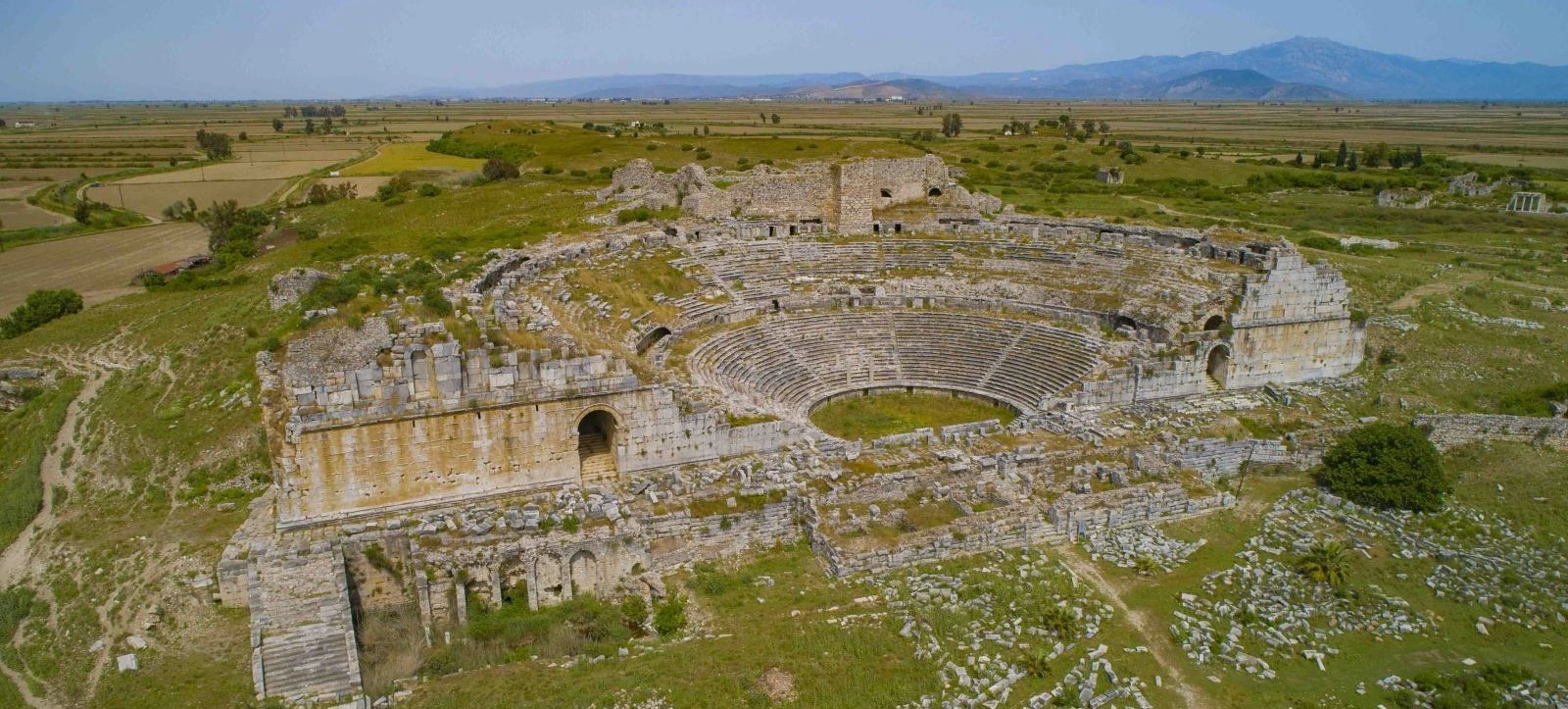
The Theatre of Miletus is the most immediately impressive monument at the archaeological site and one of the great surviving theatres of western Anatolia.

The original theatre developed during the Hellenistic period. Roman rebuilding dramatically enlarged and monumentalised the structure, eventually creating seating for approximately 15,000 spectators.

Visitors can still appreciate the enormous scale of the cavea, the vaulted passages that served the seating areas and the relationship between the theatre and the surrounding city.

In antiquity, the view from the theatre was profoundly different. Instead of looking across today's inland plain, spectators would have been close to the waters and harbour landscape of ancient Miletus.

The theatre continued to influence the city even after performances ceased. During the Byzantine period, defensive structures transformed the upper part of the theatre into a fortified position.

Origins Hellenistic theatre with major Roman rebuilding and enlargement
Roman Capacity Approximately 15,000 spectators
Later Use The theatre area was incorporated into Byzantine fortifications
Best View Climb carefully through the permitted seating areas for a broad view across the ancient city and former harbour landscape

The Urban Plan of Miletus

Miletus is closely associated with Hippodamus of Miletus, one of antiquity's best-known names in the history of urban planning.

Grid-based urban organisation existed before Hippodamus, so describing him simply as the inventor of the grid plan would be misleading. His importance lies instead in the ancient tradition connecting him with a more systematic approach to the organisation of cities.

At Miletus, the monumental centre developed around a network of streets, markets, sanctuaries and public buildings laid out with strong geometric organisation.

Walking between these ruins helps visitors understand the ancient city not as a random collection of monuments but as an organised urban environment.

Look beyond individual monuments: One of the most rewarding ways to experience Miletus is to observe the alignments between streets, agoras, the Bouleuterion, Delphinion and former harbour areas.

The Bouleuterion of Miletus

The Bouleuterion was one of the principal civic buildings of Miletus. Buildings of this type served as meeting places for the city council and could also accommodate other public or semi-public gatherings.

The complex included a monumental entrance, courtyard and roofed auditorium.

The auditorium originally contained 18 rows of seating and could accommodate as many as approximately 1,200 people, although that does not mean the city's council itself necessarily contained that many members.

Its position close to the central avenue and major public buildings underlines the close relationship between civic administration, religion, commerce and public space in ancient Miletus.

Function

A meeting place associated with the civic council and other gatherings.

Auditorium

Originally contained eighteen rows of seating arranged around the central meeting area.

Capacity

The building could accommodate approximately 1,200 people.

Location

Positioned within the monumental civic centre near markets and processional space.

The Delphinion of Miletus

The Delphinion was one of the most important religious spaces of ancient Miletus and was principally associated with Apollo Delphinios.

Its archaeological remains may appear less monumental than the theatre or baths, but its historical importance was enormous. Inscriptions identify the Delphinion as one of the most prominent places in the city.

Religion and civic life met here. The sanctuary stood close to the Lion Harbour and the central urban avenue and formed the starting point for major ritual activity associated with Apollo.

Most importantly, the Delphinion was connected with the ceremonial route leading toward the famous Sanctuary of Apollo at Didyma.

Deity

The sanctuary was principally dedicated to Apollo Delphinios.

Civic Importance

Religious and political life overlapped within this important public sanctuary.

Harbour Connection

The sanctuary stood close to the Lion Harbour and monumental city centre.

Didyma

Processions associated with Apollo departed from Miletus toward the extra-urban sanctuary at Didyma.

Miletus, the Sacred Way and Didyma

Miletus and Didyma should not be understood as completely separate ancient destinations. They belonged to the same religious landscape.

The celebrated sanctuary of Apollo at Didyma lay outside the city, and ritual processions connected the urban centre of Miletus with the sanctuary.

The ceremonial journey began in the area of the Delphinion and ultimately led toward Didyma.

Archaeological research shows that the precise route and development of the Sacred Way changed through time, so the ancient connection should not be imagined as one permanently fixed road in every historical period.

For today's traveller, visiting Miletus and Didyma together restores something of that ancient relationship between city and sanctuary.

Recommended combination: Miletus and Didyma work exceptionally well in the same day. Add Priene for a complete journey through three very different expressions of ancient Ionian culture.

The Baths of Faustina

The Faustina Baths form one of the largest and most visually impressive architectural complexes at Miletus.

The bath complex is traditionally associated with Faustina the Younger, wife of the Roman emperor Marcus Aurelius.

An inscription connects the empress with later maintenance of the complex, although the exact nature of her relationship with the original construction remains uncertain.

The complex demonstrates the scale of public bathing culture in Roman cities. Bathhouses were not simply places for washing; they functioned as important spaces of recreation, social interaction and urban life.

Walk through the surviving chambers slowly and look at how the rooms relate to one another. The scale of the masonry is easier to understand from inside the complex than from a distant viewpoint.

Roman Monument

A major imperial-period bathing complex within the ancient city.

Faustina

Named after Faustina the Younger, wife of Emperor Marcus Aurelius.

Urban Life

Roman baths combined hygiene, recreation and social interaction.

Photography

The surviving walls, chambers and architectural perspectives create some of the site's best compositions.

The Agoras and Public Centre of Miletus

A great trading city required extensive commercial and civic spaces, and Miletus contained several monumental market areas.

The North Market stood close to the Lion Harbour, allowing maritime traffic to connect naturally with commercial activity inside the city.

Farther south, monumental spaces included the South Agora, one of the great public areas of Roman Miletus.

Columns, foundations and fragments can seem difficult to interpret without a plan, but together they reveal the scale of the ancient centre.

The famous monumental Market Gate of Miletus once formed part of this urban environment. Large portions were excavated and reconstructed in Berlin in the early twentieth century.

Reading the ruins: Many structures survive mainly at foundation level. A knowledgeable guide or archaeological site plan can dramatically improve your understanding of this part of Miletus.

The Harbour Monuments of Miletus

Near the former Lion Harbour stand the remains of monumental structures associated with the maritime identity of Miletus.

The Large Harbour Monument had a substantial circular foundation and carried sculptural decoration with strong maritime imagery.

Its precise historical dedication remains debated, but its scale and location show how naval power, civic representation and monumental architecture came together beside the harbour.

This part of the archaeological site is particularly valuable for understanding just how different ancient Miletus would have looked when water reached the city.

St Paul and Miletus

Miletus also appears in the Acts of the Apostles and therefore holds particular interest for travellers following the history of early Christianity in western Anatolia.

According to Acts 20, Paul sailed to Miletus during his journey toward Jerusalem and sent a message to Ephesus asking the elders of the Christian community there to come and meet him.

The resulting farewell address is one of the important Pauline episodes narrated in Acts.

The event also helps us imagine the geography of the Roman province of Asia. Miletus and Ephesus were part of the same connected coastal and road network rather than isolated archaeological sites.

Historical note: The New Testament associates the meeting with Miletus, but the precise location within the ancient city where Paul and the Ephesian elders gathered is not securely known.

Byzantine Miletus

Miletus did not disappear when the ancient pagan city declined. It continued through Late Antiquity and the Byzantine period, although its urban character gradually changed.

Christian churches, episcopal buildings and altered urban spaces demonstrate the continued importance of the settlement.

Among the remains are structures associated with the Great Church, St Michael Basilica and a bishop's residence.

As the ancient city's population and defended area contracted, the theatre hill became increasingly important. Parts of the enormous theatre were eventually incorporated into a fortified Byzantine stronghold.

Christian City

Miletus became an episcopal centre with churches and associated religious buildings.

St Michael Basilica

A Christian basilica developed within an urban block that had previously contained earlier religious architecture.

Theatre Fortress

Later fortification transformed the upper theatre area into a defensive position.

Changing City

Ancient public spaces were reused and adapted as the settlement evolved through Late Antiquity and the Middle Ages.

İlyas Bey Mosque and the Menteşe Period

One of the great pleasures of visiting Miletus is discovering that its history does not end with antiquity.

During the medieval period, the settlement known as Palatia and later Balat became part of the principality of Menteşe.

The beautifully preserved İlyas Bey Mosque was constructed in 1404 and formed part of a larger charitable and religious complex.

The complex included the mosque together with associated buildings, baths and a cemetery.

Ancient architectural materials were reused in later buildings, creating a visible dialogue between the classical city and its medieval successors.

Date

The İlyas Bey Mosque was constructed in 1404.

Founder

İlyas Bey, ruler of the Menteşe principality.

Complex

The mosque belonged to a larger külliye containing additional buildings and baths.

Why Visit

It reveals how the landscape of ancient Miletus remained inhabited and meaningful during the medieval Turkish period.

Miletus Museum

The Miletus Museum stands close to the archaeological site and is highly recommended for visitors interested in understanding what excavations have revealed.

The museum displays objects from Miletus together with finds associated with neighbouring archaeological sites including Priene and Didyma.

Collections include ceramics, inscriptions, coins, jewellery, tools, figurines and sculpture.

Visiting the museum before the ruins can provide useful historical context. Visiting afterward allows you to connect objects in the galleries with monuments and spaces you have just walked through.

Visitor note: Museum and archaeological-site opening arrangements can change seasonally. Check current official information before travelling if museum access is important to your itinerary.

Best Things to See at Miletus

Great Theatre

Begin with the city's most dramatic surviving monument and climb carefully for views across the archaeological landscape.

Lion Harbour Area

Stand where ships once entered the commercial and ceremonial heart of ancient Miletus.

Delphinion

Explore the city's important sanctuary of Apollo Delphinios and the starting point of ritual connections with Didyma.

Bouleuterion

See the civic meeting complex that formed part of the political centre of the ancient city.

Faustina Baths

Walk through one of the largest and most impressive Roman architectural complexes at the site.

Agoras

Explore the remains of the commercial and public spaces that once supported the city's urban life.

Byzantine Remains

Look beyond the Classical monuments for churches, reused structures and defensive architecture.

İlyas Bey Mosque

Complete the story of Miletus with one of the finest surviving monuments from medieval Balat.

Miletus Visitor Information

Miletus is a large archaeological landscape rather than a compact collection of ruins. Allow enough time to walk between the principal monuments and to stop frequently to understand how the structures relate to the former coastline.

Location Near Balat, Aydın Province, western Türkiye
Recommended Visit Approximately 1.5–2.5 hours for the archaeological site, longer when including the museum and medieval monuments
Terrain Ancient stone, earth paths, archaeological surfaces and exposed open areas
Shade Limited across much of the archaeological site
Best Combination Priene + Miletus + Didyma
Photography Morning and late-afternoon light generally provide softer conditions than midday
Before travelling: Entrance fees, opening hours, museum access and permitted visitor routes can change. Confirm current official information close to your travel date.

Suggested Walking Route through Miletus

Begin at the theatre, where the enormous scale of ancient Miletus becomes immediately clear. From the upper permitted areas, pause to look across the plain and imagine the former coastline.

Continue toward the ancient city centre and the area associated with the Lion Harbour, Delphinion and central avenue.

Explore the Bouleuterion and agora areas before moving toward the monumental Faustina Baths.

Complete the archaeological visit with the Miletus Museum and, if accessible within your programme, the nearby İlyas Bey Mosque complex.

Stop 1

Great Theatre and views over the ancient landscape.

Stop 2

Lion Harbour area, Delphinion and central avenue.

Stop 3

Bouleuterion, markets and monumental civic centre.

Stop 4

Faustina Baths and surrounding Roman monuments.

Stop 5

Miletus Museum for sculpture, inscriptions and archaeological finds.

Stop 6

İlyas Bey Mosque and the medieval landscape of Balat.

Priene, Miletus and Didyma

One of the finest archaeological day trips in western Türkiye combines Priene, Miletus and Didyma.

Although geographically close, the three places offer completely different experiences.

Priene

A beautifully planned Hellenistic city built on the slopes beneath Mount Mycale, with dramatic views across the Maeander plain.

Miletus

The great harbour metropolis of Ionia, associated with philosophy, maritime trade and monumental public architecture.

Didyma

The extraordinary sanctuary and oracle of Apollo, dominated by one of the largest temples of the ancient Greek world.

Together, they reveal three interconnected aspects of ancient Ionia: the planned city, the maritime metropolis and the great sanctuary.

Best Time to Visit Miletus

Miletus can be visited throughout much of the year, but the experience changes considerably with the season.

Spring

One of the best periods for walking, archaeology and enjoying the green landscape of the Maeander plain.

Early Summer

Usually excellent for travel, although temperatures become increasingly strong around midday.

High Summer

Expect powerful sun and high temperatures. An early start is strongly preferable.

Autumn

Excellent for archaeological touring as the most intense summer heat begins to ease.

Winter

Quieter conditions can be rewarding, although rain and wet archaeological surfaces require additional care.

Time of Day

Earlier morning or later afternoon usually provides more comfortable temperatures and softer photographic light.

Photography at Miletus

The theatre provides the most dramatic compositions at Miletus, particularly when photographed together with the broad landscape behind it.

Higher viewpoints also help communicate one of the city's most important stories: the astonishing difference between the present agricultural plain and the ancient maritime landscape.

The Faustina Baths work well for architectural photography, with massive walls, doorways and interior spaces creating strong depth and perspective.

Elsewhere, isolated columns, marshy areas, wild vegetation and distant mountains can create quieter images that capture the atmospheric scale of the archaeological site.

Theatre

Use the curve of the seating and surrounding landscape to emphasise scale.

From Above

Higher permitted areas reveal the relationship between monuments and the former harbour plain.

Faustina Baths

Doorways, masonry and surviving chambers provide strong architectural compositions.

Late Afternoon

Lower-angle light can add texture to ancient stone and soften the exposed landscape.

Accessibility and Walking at Miletus

Miletus requires more walking than its open landscape may initially suggest. Distances between monuments, archaeological surfaces and limited shade should all be considered when planning a visit.

Ancient Surfaces

Expect uneven stone, earth, gravel and archaeological terrain.

Theatre

Climbing the seating involves substantial steps and uneven ancient masonry.

Heat

The open site can become very hot during summer afternoons.

Footwear

Supportive walking shoes are preferable to sandals with smooth soles.

Water

Carry drinking water, particularly during warmer months.

Private Touring

A private vehicle and guide can make a combined Priene–Miletus–Didyma day easier to pace according to mobility and interests.

How to Get to Miletus

Miletus lies in Aydın Province near Balat, between the wider Söke plain and the Didim region.

From Kuşadası

Miletus can be visited by road as part of a private archaeological journey south through the Maeander region.

From Didim

The archaeological site can be combined easily with the Temple of Apollo at Didyma.

From Priene

Priene and Miletus form a natural archaeological combination within the lower Maeander landscape.

From Bodrum

Miletus can be included while travelling north toward Didim, Söke, Kuşadası or the Ephesus region.

Private Vehicle

The simplest option when combining several archaeological sites within a single day.

Guided Tour

A licensed guide is particularly valuable at Miletus because much of the ancient urban plan requires interpretation.

Planning tip: Rather than visiting Miletus alone, consider combining it with Priene and Didyma. The route creates a much stronger understanding of ancient Ionia.

Places to Visit near Miletus

Didyma

Visit the monumental Temple of Apollo and discover the sanctuary historically connected with Miletus.

Priene

Explore a remarkable planned ancient city beneath Mount Mycale overlooking the Maeander plain.

Lake Bafa

Discover one of the region's most dramatic natural and archaeological landscapes around ancient Latmos.

Heracleia at Latmos

Explore ancient walls, temples and Byzantine heritage within the extraordinary landscape beside Lake Bafa.

Kuşadası

Continue to the Aegean coast with our Kuşadası travel guide.

Tralleis

Explore ancient Aydın and the monumental Three Eyes in our Tralleis Ancient City guide.

Aphrodisias

For a longer archaeological journey through Aydın Province, continue with our Aphrodisias Ancient City guide.

Aydın

Plan a wider journey through the province with our Aydın travel guide.

Frequently Asked Questions About Miletus

Where is Miletus Ancient City?

Miletus is located near Balat in Aydın Province in western Türkiye, within the lower Büyük Menderes region and close to Didim and Söke.

Why is Miletus famous?

Miletus was one of ancient Ionia's leading maritime cities and is particularly famous for its philosophers, extensive trading connections, monumental theatre and relationship with the sanctuary of Apollo at Didyma.

Who were the philosophers of Miletus?

The city is closely associated with Thales, Anaximander and Anaximenes, three important early thinkers who attempted to understand nature through rational explanation.

Was Miletus once beside the sea?

Yes. Miletus was an important harbour city. Sediment deposited by the Maeander River gradually transformed the gulf and pushed the coastline farther west, leaving the ruins inland today.

What happened to the ancient harbours of Miletus?

The progressive accumulation of river sediment altered the coastline and eventually made the ancient harbour areas increasingly difficult to use.

How big was the Theatre of Miletus?

The theatre developed from a smaller Hellenistic structure and was extensively enlarged during the Roman period, when it could accommodate approximately 15,000 spectators.

What are the Baths of Faustina?

They are a large Roman bath complex traditionally associated with Faustina the Younger, wife of Emperor Marcus Aurelius.

What is the Delphinion?

The Delphinion was an important sanctuary of Apollo Delphinios and one of the central religious and civic spaces of ancient Miletus.

Was Miletus connected to Didyma?

Yes. Miletus and the Sanctuary of Apollo at Didyma were closely connected through religious institutions and ceremonial processions.

Did St Paul visit Miletus?

The Acts of the Apostles records that Paul came to Miletus and summoned the elders of the church at Ephesus to meet him there.

What is the İlyas Bey Mosque?

It is a beautiful mosque built in 1404 during the Menteşe period and forms part of the medieval history of Miletus, when the settlement was known as Balat.

How long do I need at Miletus?

Allow approximately 1.5–2.5 hours for a comfortable exploration of the principal archaeological monuments. Add additional time for the museum and medieval monuments.

Can I visit Priene, Miletus and Didyma in one day?

Yes. They form one of the best archaeological day routes in western Türkiye and can comfortably be combined with private transportation and sensible timing.

When is the best time to visit Miletus?

Spring and autumn are particularly comfortable. During summer, visiting early in the morning is preferable because the archaeological site has extensive exposed areas.

Is a guide worthwhile at Miletus?

Yes. Although the theatre and baths are immediately impressive, many of the city's harbour areas, streets, sanctuaries and civic buildings are much easier to understand with archaeological interpretation.

Responsible Visiting at Miletus

Stay on Visitor Routes

Follow marked or permitted paths and respect any areas closed for excavation or conservation.

Do Not Climb Ruins

Ancient masonry can be unstable and climbing can damage both the monument and the visitor.

Leave Archaeology in Place

Never remove pottery, stone fragments or any archaeological material from the site.

Respect Excavation Work

Miletus remains an active archaeological research landscape rather than a completed museum display.

Carry Your Waste

Help protect the archaeological landscape by disposing of rubbish responsibly.

Respect Later Heritage

Remember that Byzantine and medieval Turkish monuments are equally important chapters in the long history of Miletus.

Private Tours to Miletus

Discover Miletus with a licensed private guide and comfortable vehicle, with an itinerary designed around archaeology, history, photography and your preferred pace, without compulsory shopping stops.

Your Private Ancient Ionia Journey

Combine Miletus with Priene, Didyma, Kuşadası or other archaeological destinations across western Türkiye.