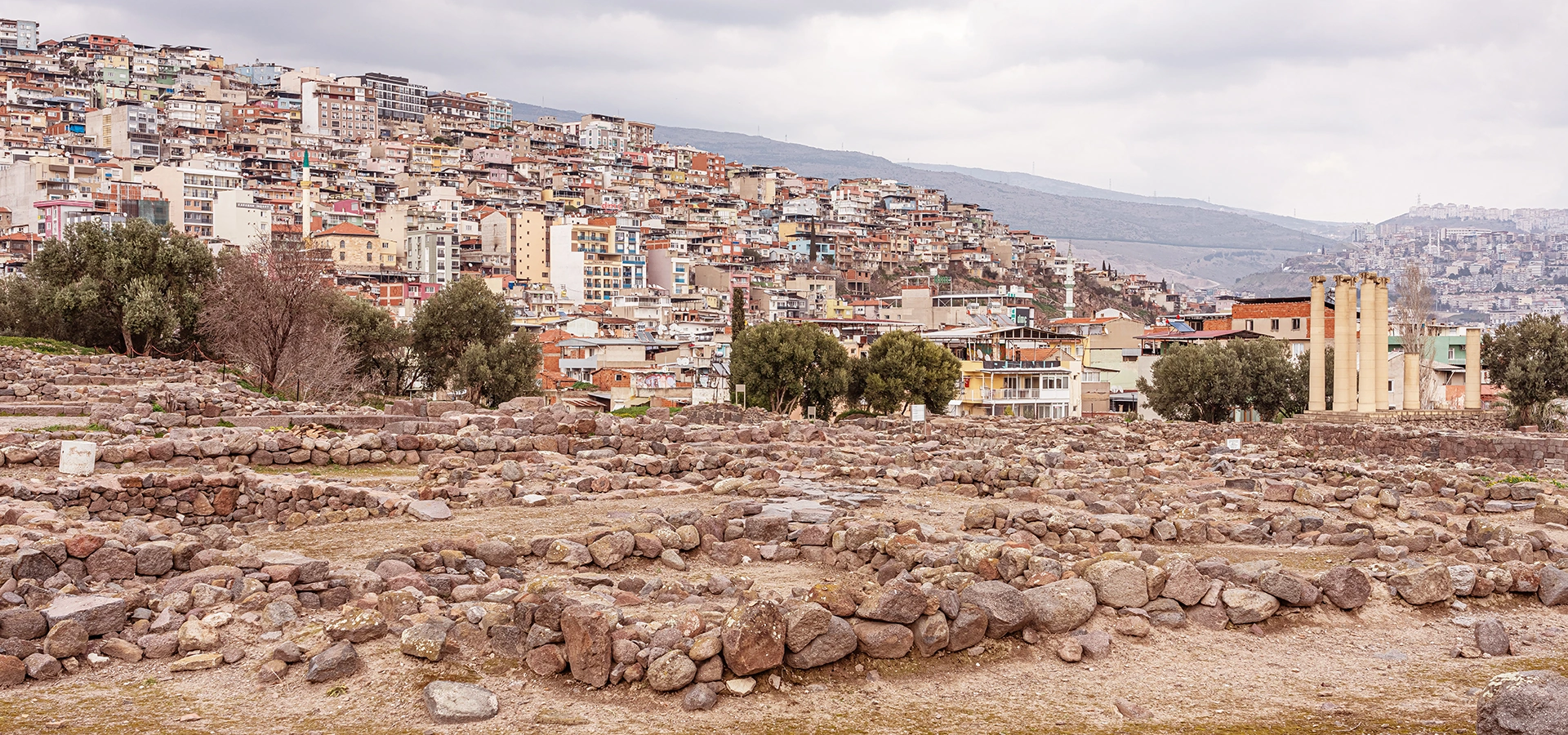
Old Smyrna – Bayraklı
Continue İzmir's story at the ancient settlement of Smyrna, where important remains reveal the city's development during the Iron Age and Archaic periods.
Explore Old Smyrna





Most visitors encounter İzmir through the civilizations of the Classical, Hellenistic and Roman worlds.
But beneath the modern city lies a much older story.
In the middle of the Bornova Plain, archaeologists have uncovered settlements showing that people were living here at least 8,500 years ago.
The oldest known settlement is Yeşilova Höyük, where Neolithic communities established a permanent village around the 7th millennium BC.
Several centuries after Yeşilova was abandoned, settlement shifted to nearby Yassıtepe Höyük.
There, by the Early Bronze Age, the archaeological record reveals something dramatically different: fortifications, planned buildings, storage areas, production spaces, trade and increasingly complex urban life.
Together, Yeşilova and Yassıtepe tell one of İzmir's most important archaeological stories — the transformation from early farming village to organised town.
They also make it possible to look beyond monuments and temples and ask more intimate questions: What did İzmir's earliest inhabitants eat? What did they grow? How did they build their homes? What animals lived around them? How did they trade? And when did village life begin turning into city life?
For travellers interested in archaeology, early agriculture, prehistoric Anatolia and the origins of cities, this is one of the most revealing places in İzmir.
Yeşilova preserves evidence of settlement in the Bornova Plain beginning around 6500 BC.
Neolithic Yeşilova reveals the farming, domestic life, production and beliefs of İzmir's earliest known settled communities.
Yassıtepe shows the development of a fortified and increasingly organised Early Bronze Age settlement around 5,000 years ago.
An active excavation, visitor centre and reconstructed prehistoric environments bring thousands of years of history into the present.
Essential information for visiting İzmir's remarkable prehistoric settlement area in Bornova.
Yeşilova Höyük and Yassıtepe Höyük.
Bornova district, İzmir.
Approximately 8,500 years ago, around 6500 BC.
İzmir's earliest known prehistoric village settlement.
An important Early Bronze Age settlement associated with İzmir's earliest organised urban life.
Archaeological work at Yeşilova began in 2005; Yassıtepe excavations began in 2010.
Assoc. Prof. Dr. Zafer Derin of Ege University.
Yeşilova Höyüğü Ziyaretçi Merkezi.
Visits are organised with archaeologist guidance and advance appointment is strongly recommended.
Visitor access is generally offered free of charge according to current public visitor information.
+90 (534) 278 61 84.
Allow approximately 1.5–3 hours for a meaningful guided visit.
Yeşilova is an active archaeological research site rather than a conventional walk-in museum, so planning ahead is important.
This appointment system is an important part of the experience rather than an inconvenience.
Unlike archaeological sites where visitors simply follow a fixed path, Yeşilova has developed a model in which the archaeology is explained by people closely connected with the site.
That makes the visit particularly valuable for anyone who wants to understand what archaeologists actually discovered and how they interpret it.
İzmir is famous for ancient Smyrna, Roman remains and the great archaeological landscapes of the Aegean.
Yeşilova takes the story much further back.
Thousands of years before monumental Greek and Roman cities appeared, people were already building homes, cultivating crops, raising animals, making pottery and establishing permanent communities on the Bornova Plain.
That makes Yeşilova especially valuable because it introduces visitors to ordinary human life at the beginning of settled society.
There are no monumental marble theatres here.
There are no imperial temples or triumphal arches.
Instead, archaeology reveals houses, ovens, tools, food remains, pottery, animal bones and traces of production.
These smaller discoveries can sometimes tell us more about everyday life than monumental architecture.
Nearby Yassıtepe then moves the story forward several thousand years.
By the Early Bronze Age, the settlement had developed fortifications, organised building plans, storage systems, specialised production and extensive trade connections.
Visiting the two sites together therefore allows you to follow an extraordinary transformation: from İzmir's earliest village to one of its earliest organised towns.
Understanding the word höyük makes sites such as Yeşilova and Yassıtepe much easier to appreciate.
A höyük is an archaeological settlement mound formed when people repeatedly build, occupy, abandon, destroy and rebuild settlements in approximately the same place.
Over centuries and millennia, collapsed walls, floors, rubbish, ash, pottery, soil and new construction gradually accumulate.
The result can become an artificial hill containing layers of human history.
Archaeologists excavate these layers carefully because the position of an object is often almost as important as the object itself.
A pot, wall, hearth or burial only becomes historically meaningful when researchers understand which layer it came from and what surrounded it.
At Yeşilova and Yassıtepe, this layered archaeology allows researchers to reconstruct different stages in the development of life on the Bornova Plain.
Yeşilova should not be understood as an isolated mound.
It forms part of a much broader archaeological landscape in the Bornova Plain.
Official archaeological information identifies an approximately 1,200-metre-wide prehistoric settlement area including Yeşilova Höyük, Yassıtepe Höyük and İpeklikuyu Höyük.
Today this ancient landscape lies within the modern metropolitan city.
Roads, housing, universities and urban development surround archaeological deposits that were created thousands of years before İzmir existed in anything resembling its modern form.
This contrast is one of the most striking elements of a visit.
You are not travelling into a remote archaeological landscape.
You are discovering deep prehistory inside one of Türkiye's largest modern cities.
Yeşilova transformed archaeologists' understanding of İzmir's past.
Before its identification, the known history of permanent settlement in the city was generally thought to extend back roughly five thousand years.
The prehistoric remains at Yeşilova demonstrated that the story was much older.
The site was identified in 2003, and systematic archaeological excavations began in 2005.
From 2008 onward, excavations continued on behalf of the Ministry of Culture and Tourism and Ege University under the direction of archaeologist Assoc. Prof. Dr. Zafer Derin.
The results pushed İzmir's known settlement history back to approximately 6500 BC.
What initially appeared to be another archaeological site in the urban landscape became one of the key places for understanding the prehistoric Aegean.
The earliest settlement at Yeşilova dates to approximately 8,500 years ago.
This places the community within the Neolithic period, when farming, animal husbandry and permanent settlement were reshaping human life across Anatolia.
Yeşilova eventually spread across a substantial area, with archaeological deposits covering more than 70,000 square metres.
The people who lived here were not simply wandering through the Bornova Plain.
They built houses.
They cultivated crops.
They kept domesticated animals.
They hunted and gathered wild resources.
They produced pottery and tools.
They participated in networks through which materials travelled considerable distances.
In other words, Yeşilova represents a community that had committed itself to a settled way of life.
Archaeology at Yeşilova has revealed domestic structures built using materials available in the local environment.
Stone was used in foundations and lower wall construction, while mud and other organic building materials formed much of the superstructure.
These were functional homes designed for daily village life rather than monumental buildings.
Inside and around the houses, archaeologists have identified traces connected with food preparation, storage, craft production and other domestic activities.
The arrangement of structures also helps researchers examine how neighbours lived together and how space was organised within the prehistoric settlement.
At the Visitor Centre, reconstructed prehistoric buildings help transform archaeological wall lines into something visitors can imagine as real homes.
One of the most fascinating aspects of Yeşilova is that archaeology can reconstruct parts of the prehistoric diet.
Plant and animal remains indicate a mixed economy based on farming, animal husbandry, hunting, gathering and aquatic resources.
Cultivated cereals formed an important component of the developing agricultural economy.
Barley was among the crops associated with early farming communities in the settlement.
Pulses helped broaden the plant-based diet of the inhabitants.
Domesticated livestock provided meat and other resources for village life.
Cattle formed part of the managed animal economy.
Hunting remained important alongside farming and animal husbandry.
Fish remains demonstrate the continued importance of aquatic food resources.
Shellfish provide another reminder that prehistoric communities exploited a much wider environment than the immediate village.
Modern Bornova is densely urbanised.
The landscape encountered by the first Yeşilova settlers was completely different.
The plain provided fertile ground, freshwater resources, vegetation and habitats supporting a wide range of animals.
Archaeological evidence includes species that would be extraordinary to imagine within metropolitan İzmir today.
Among the most striking are remains associated with large predators, including the Anatolian leopard.
Such finds help archaeologists reconstruct an environment in which human communities lived much closer to wild landscapes than modern city residents do.
The natural resources of the plain were one of the reasons permanent settlement became possible.
Permanent village life did not mean isolation.
Materials recovered at Yeşilova demonstrate connections extending beyond the immediate Bornova Plain.
Obsidian is particularly important.
This volcanic glass was prized throughout prehistory because it could be fractured into exceptionally sharp cutting edges.
Since good obsidian sources are geographically limited, finding the material at archaeological sites allows researchers to explore prehistoric exchange networks.
Other stone materials also reached Yeşilova from outside the local area.
These discoveries show that even during the Neolithic period, people, objects and ideas were moving through networks linking different parts of Anatolia and the Aegean.
Archaeology can reconstruct houses and food relatively directly.
Belief is more difficult.
Objects associated with ritual behaviour must therefore be interpreted cautiously.
At Yeşilova, figurines, decorated pottery and archaeological contexts around domestic features have provided clues about symbolic and ritual practices.
Female imagery occurs among the finds, while certain animals also appear to have carried meanings extending beyond their practical role as food or predators.
Researchers have drawn particular attention to the leopard or panther, whose imagery appears to have remained significant over long periods.
These discoveries offer fascinating possibilities, but prehistoric belief systems cannot simply be reconstructed by attaching modern labels to isolated objects.
The strongest interpretation comes from studying the object, its archaeological context and similar discoveries together.
Yeşilova's prehistoric settlement did not continue unchanged forever.
Official archaeological accounts indicate that the main Yeşilova settlement was abandoned around 5700 BC.
The precise causes behind major prehistoric settlement changes can be complex.
Environmental conditions, water systems, social change, economic choices and movement of communities can all affect where people choose to live.
Approximately three centuries later, new communities established themselves nearby at Yassıtepe.
This shift is crucial because Yassıtepe eventually records a very different type of social organisation.
The story of prehistoric İzmir was moving from village life toward something increasingly urban.
Yassıtepe lies only a short distance from Yeşilova.
Yet the archaeological story it preserves represents a major transformation.
Excavations begun in 2010 revealed substantial remains from the Early Bronze Age and later periods.
By approximately five thousand years ago, Yassıtepe contained evidence for a settlement that was planned, defended and economically organised.
Instead of viewing the site simply as another prehistoric village, archaeologists describe it as a crucial stage in the emergence of urban life in İzmir.
The settlement included substantial houses, storage areas, production spaces and fortifications.
Its inhabitants cultivated agricultural products, worked metal, produced valuable pottery and participated in trade networks extending beyond the Bornova Plain.
Yassıtepe provides an excellent example of how modern appearance can be misleading in archaeology.
The archaeological mound originally accumulated to a height approaching seven metres.
Today much of that height is visually concealed because the surrounding plain gradually filled with sediments deposited by nearby streams.
The visible mound therefore appears much lower and flatter than its archaeological depth would suggest.
Modern construction has also transformed the surrounding landscape.
Part of the prehistoric settlement lies beneath later development, making protection of the surviving archaeological zone particularly important.
The importance of Yassıtepe lies not simply in its age.
It lies in the increasing complexity visible in the archaeological plan.
The Early Bronze Age community organised buildings and activity areas within a defended settlement.
Recent excavations describe fortifications, storage areas, workshops, production spaces and structures interpreted in connection with ritual activity.
Long rectangular buildings with substantial stone walls form an important part of the settlement architecture.
This was therefore a community in which large-scale storage, craft production, agricultural surplus and defence had become increasingly important.
These features are among the reasons archaeologists associate Yassıtepe with the beginning of organised urban life in İzmir.
Yassıtepe has increasingly been compared with the earliest settlement phases of Troy.
The comparison does not mean the two sites were identical.
Rather, they developed during broadly comparable periods within the Early Bronze Age world of western Anatolia and the Aegean.
Both reveal increasingly organised settlements with substantial architecture, storage, craft activity and regional connections.
The archaeological team has therefore used the memorable comparison of Yassıtepe as an “İzmir Troy” to communicate its significance to the wider public.
For visitors, the comparison helps place Yassıtepe within a much larger prehistoric world that existed long before the famous Homeric narratives associated with later Troy.
Yassıtepe reveals a society capable of producing and storing more than was needed for immediate daily survival.
Large storage vessels indicate the management of substantial quantities of agricultural produce.
Specialised ceramics and metalworking provide evidence for skilled production.
The surrounding fortifications suggest that the settlement's population considered its community and resources worth protecting.
Trade routes connected the Bornova Plain with inland western Anatolia, while connections toward the Aegean opened wider maritime possibilities.
These networks made Yassıtepe part of an economic landscape extending well beyond İzmir.
Some of Yassıtepe's most fascinating discoveries concern foods that remain inseparable from the identity of the Aegean today.
Archaeological investigation has identified traces connected with grapes and figs.
Evidence from containers and plant remains indicates that grapes were not simply eaten fresh.
They were processed in different ways, with archaeological interpretations including dried grapes, grape syrup and wine-related production.
During the 2026 excavation season, archaeologists also reported approximately five-thousand-year-old olive stones.
Grapes, figs and olives therefore appear together in the prehistoric agricultural record — three crops that would remain central to western Anatolian food and trade for millennia.
Archaeologists have uncovered buildings containing large storage jars and other vessels.
These structures provide direct evidence for organised food storage.
Materials associated with the storage areas include agricultural produce and marine resources.
The ability to collect, process and store food in quantity represents an important stage in economic development.
It also raises larger questions.
Who controlled the stored products?
Were they intended for household consumption, redistribution, trade or all three?
Such questions are helping archaeologists move beyond describing individual objects and toward reconstructing the social structure of the settlement.
The Early Bronze Age takes its name from one of the period's most important technological developments.
At Yassıtepe, metal objects and evidence of bronze production form part of the settlement's archaeological record.
Finds include objects such as axes and pins, while production evidence indicates that metalworking was part of local economic life.
Bronze required access to raw materials, technical knowledge and specialised craftsmanship.
Its presence therefore adds another dimension to Yassıtepe's increasingly complex economy.
The inhabitants were no longer simply cultivating crops and maintaining households.
They were participating in specialised systems of production and exchange.
Pottery is among the most important categories of evidence recovered from Yassıtepe.
Thousands of years after organic containers have disappeared, ceramic vessels can survive as complete objects or as countless fragments.
Their shape, fabric, surface treatment and decoration allow archaeologists to identify chronology, cultural connections and possible functions.
Some vessels were practical containers for food and liquids.
Others appear to have had specialised social or ritual functions.
Recent excavations have uncovered unusual vessels decorated with motifs interpreted in connection with female imagery.
Such discoveries provide evidence not only for craftsmanship but also for the symbolic world of Yassıtepe's inhabitants.
The archaeological story of Yassıtepe is still developing. Excavations continued in 2026 and produced important new evidence.
Olive stones discovered during the 2026 campaign added another major Aegean crop to the agricultural record already represented by grapes and figs.
Burials interpreted by the excavation team in connection with Mycenaean traders provide evidence for links extending into the wider Aegean world.
Two cylinder seals recovered from one burial provide additional clues concerning status, exchange and long-distance relationships.
Jewellery and specialised vessels discovered with burials help researchers investigate wealth and social identity.
A space with unusually large numbers of drinking vessels has been interpreted as a possible reception area associated with the settlement's leadership.
The continuing excavations strengthen evidence for storage, production, trade and organised economic activity within the settlement.
Because these interpretations are based on active archaeological research, future excavation and laboratory analysis may refine parts of the picture.
That is one of the most exciting reasons to visit Yeşilova and Yassıtepe: the history is still being discovered.
One of the most intriguing parts of recent research concerns connections between Yassıtepe and communities elsewhere in the Aegean.
Archaeologists have identified burials interpreted as being associated with people connected to the Mycenaean cultural world.
The dead were placed within large ceramic vessels and accompanied by grave goods.
Objects included jewellery and containers that may have held liquids such as oil or wine.
These discoveries fit a wider picture in which Yassıtepe participated in networks extending toward the islands and maritime Aegean.
Such contacts should not necessarily be imagined as modern migration or national identity.
Prehistoric societies were connected through overlapping systems of trade, travel, marriage, technology and cultural exchange.
Yassıtepe's cemeteries provide evidence for the way inhabitants treated the dead.
Some individuals were buried inside large ceramic containers known as pithoi.
Bodies could be placed in a contracted position, while vessels containing food or drink and personal objects were deposited as grave goods.
The excavation team has connected certain decorative motifs, including imagery associated with pregnancy and female symbolism, with possible ideas of regeneration or rebirth.
Such interpretations remain archaeological reconstructions rather than written explanations from the people themselves.
Nevertheless, burial practices provide some of the most powerful evidence available for investigating prehistoric concepts of identity, memory and the afterlife.
Earthquakes have shaped the history of İzmir for thousands of years.
Yassıtepe contains remarkable archaeological evidence of this reality.
The settlement was destroyed and rebuilt repeatedly during the Early Bronze Age.
Around 2800 BC, a particularly destructive earthquake appears to have caused a major break in occupation.
Archaeologists have identified deformation in ancient walls consistent with strong horizontal movement.
Some structures appear to have been abandoned so abruptly that inhabitants may not have been able to remove all of their belongings.
For modern visitors, this creates an extraordinary connection between ancient and contemporary İzmir.
The same geological forces that affect the Aegean today were influencing life on the Bornova Plain five thousand years ago.
Neither Yeşilova nor Yassıtepe represents a single moment frozen in time.
The wider archaeological zone contains traces belonging to multiple periods.
Yeşilova is particularly important for the Neolithic period, while Yassıtepe provides major evidence for the Early Bronze Age.
Later activity continued intermittently across the landscape.
Archaeological evidence extends through later prehistoric phases and into periods associated with the classical and Roman worlds.
This long sequence demonstrates how attractive the Bornova Plain remained as a place for farming, movement and settlement.
The Visitor Centre plays a central role in making prehistoric archaeology understandable.
Opened with the support of Bornova Municipality, the centre combines archaeological interpretation with educational activities.
Instead of presenting Yeşilova only as an excavation trench, the complex helps visitors imagine how the settlement functioned as a living community.
Displays explain the chronology, discoveries and daily life of the prehistoric communities.
Recreated prehistoric structures help visitors understand what houses may have looked like above their surviving archaeological foundations.
Guided visits introduce the archaeological remains within the context of an active research project.
Educational programmes allow younger visitors and organised groups to encounter archaeology in a more interactive way.
The centre also functions as a cultural venue hosting temporary exhibitions and events.
Archaeologists and specialist staff provide explanations that connect individual finds with the larger historical story.
One challenge at every prehistoric site is that the surviving archaeological remains are usually incomplete.
Stone foundations may survive, while walls, roofs, wooden supports and household objects have disappeared.
Visitors looking at excavated wall lines therefore have to imagine much of the original building.
The reconstructed village at Yeşilova helps bridge that gap.
Buildings inspired by archaeological evidence show how prehistoric architecture may have appeared when walls rose to full height and roofs covered domestic spaces.
This is particularly useful for families and visitors encountering Neolithic archaeology for the first time.
The reconstruction should be understood as an educational interpretation rather than a claim that every missing architectural detail is known with certainty.
See archaeological layers connected with some of the earliest settled communities in İzmir.
Examine the surviving architectural traces from prehistoric domestic life.
Visualise what Neolithic structures may have looked like when complete.
Learn about pottery, tools, figurines, food remains and other discoveries connected with daily life.
Use interpretive exhibits to understand chronology and the excavation process.
When access arrangements permit, discover the archaeological area associated with İzmir's earliest organised urban settlement.
Depending on season and access, visitors may encounter an archaeological site where investigation is still continuing.
Experience the striking contrast between prehistoric remains and the contemporary city surrounding them.
Prehistoric sites can be difficult to understand without explanation.
At first glance, one stone wall can look very much like another.
An archaeologist can explain why one wall belongs to a house, why another represents a later reconstruction, and why a small change in soil colour may indicate a floor, hearth or destruction layer.
Guidance also helps separate what archaeologists know from what they are still investigating.
That distinction is particularly important at an active excavation such as Yassıtepe, where each season can introduce new evidence.
The experience therefore offers something very different from simply walking through monumental ruins.
It introduces visitors to archaeology as a process of asking questions, testing interpretations and building history from physical evidence.
Yes — particularly for children interested in archaeology, history or how people lived in the distant past.
Yeşilova was developed not only as an excavation but also as an educational archaeology centre.
The reconstructed village makes the subject easier to visualise, while workshops and organised programmes can introduce archaeological methods in an engaging way.
School and educational groups form an important part of the site's visitor programme.
Families visiting independently should contact the centre in advance to confirm what activities are available on their chosen day.
Suitable only for a brief overview of the Visitor Centre and principal archaeological story.
A reasonable minimum for a guided introduction without rushing excessively.
Ideal for most visitors interested in both the archaeological remains and interpretive displays.
Better for archaeology enthusiasts who want time for detailed explanations and both Yeşilova and Yassıtepe where access permits.
Combine Yeşilova with another Bornova attraction or continue toward Old Smyrna at Bayraklı.
Combine Yeşilova and Yassıtepe with Old Smyrna and İzmir's archaeological museums.
One of the most comfortable periods for moving between the Visitor Centre and outdoor excavation areas.
Archaeological fieldwork may be especially visible, but İzmir's midday heat can be intense.
Milder temperatures make outdoor archaeological visits particularly pleasant.
The Visitor Centre remains valuable, although rain can affect outdoor conditions and site access.
Usually the most comfortable period during hot weather and excellent for organised archaeological visits.
Active archaeology can make the site particularly fascinating, although research work may also restrict access to individual areas.
The archaeological landscape offers excellent opportunities for documentary photography.
Wide photographs are useful for showing how archaeological walls and trenches fit together.
The reconstructed prehistoric architecture provides some of the most visually accessible images at the site.
Closer views can reveal changes in masonry, occupation levels and archaeological depth.
Including surrounding urban development creates a powerful image of 8,500 years of settlement in the same landscape.
Confirm photography rules before photographing individual archaeological objects or temporary exhibitions.
Always follow staff instructions around archaeologists, equipment and areas under active investigation.
The archaeological area lies within metropolitan Bornova and is reachable from central İzmir by public transport, taxi or car.
Because the Visitor Centre is not located directly beside one of İzmir's principal tourist squares, planning the final part of the journey is useful.
Use İzmir Metro to reach the Bornova area, then continue toward Yeşilova by local bus or taxi.
Public information identifies ESHOT services 59 and 159 among the routes serving the Yeşilova/Yassıtepe area.
Use the Yeşilova Höyüğü or Yassıtepe stops according to the area you are visiting and the current route arrangement.
Ask for “Yeşilova Höyüğü Ziyaretçi Merkezi, Bornova.”
Approach through Bornova and follow local signs toward Yeşilova Höyüğü and the archaeological area.
Arrange your appointment first so that transport time is not wasted arriving when a guided visit cannot be provided.
The Visitor Centre is a modern purpose-built cultural facility, but the archaeological areas themselves contain outdoor surfaces and active excavation terrain.
Ground conditions can include uneven paths, soil, archaeological trenches and temporary working areas.
Visitors with reduced mobility should therefore contact the centre before travelling and explain their specific requirements.
Staff can advise which parts of the site are accessible and how the guided route can best be organised.
Yeşilova and Yassıtepe remain research sites.
That means normal museum behaviour is not always enough.
Excavation trenches can contain fragile remains and uneven surfaces.
Even apparently ordinary pottery fragments can contain important archaeological information.
Temporary restricted areas often protect newly excavated or vulnerable remains.
Research objects and newly excavated material may have specific photography restrictions.
Flat, comfortable footwear is much better than formal shoes for archaeological terrain.
During summer, bring water, sun protection and a hat for outdoor portions of the visit.
Continue İzmir's settlement story at the ancient city of Smyrna, where the Iron Age and Archaic city developed beside the Gulf.
Explore archaeological collections covering the wider history of İzmir and western Anatolia.
Continue with major archaeological and ethnographic collections presented within İzmir's restored historic industrial complex.
Explore another layer of Bornova's history through surviving Levantine mansions and historic neighbourhood architecture.
Combine the archaeological visit with cafés, restaurants and the lively modern district surrounding Ege University.
Continue toward Konak, Kemeraltı, the ancient Agora, Kordon and the wider historic city.
The essential combination for understanding the transition from Neolithic village life to Early Bronze Age urbanism.
Follow İzmir's story forward from prehistory to the developing city of the Iron Age and Archaic period.
Combine archaeological context in the field with museum collections from İzmir and western Anatolia.
Visit Yeşilova in the morning before continuing to the Agora and historic centre.
Combine the prehistoric settlement with historic Bornova neighbourhoods and surviving Levantine heritage.
Yeşilova, Yassıtepe, Old Smyrna and one archaeological museum create a powerful chronological journey.
Arrange your Yeşilova appointment in advance and use the visit as the beginning of a chronological journey through İzmir's history.
The official visitor information emphasises appointment-based guided visits.
A rushed 30-minute stop will not do justice to an archaeological story spanning thousands of years.
The archaeological areas contain outdoor and uneven surfaces.
Bornova can become extremely hot during the middle of the day.
A hat, sunscreen and light clothing are valuable during outdoor archaeological visits.
The greatest advantage of the guided model is access to people who can explain what the archaeological evidence actually means.
Individual trenches or routes can change according to excavation and conservation work.
The importance lies in the age, archaeology and human story rather than towering standing architecture.
This chronological order makes İzmir's later urban development much easier to understand.
Ask before photographing temporary exhibitions, newly excavated finds or research areas.
The reconstructed village and educational approach make prehistory accessible to younger visitors.
Yassıtepe remains under active investigation, so the story may expand with every excavation season.
Yeşilova Höyük is a prehistoric archaeological settlement in Bornova containing some of the earliest known evidence for permanent human settlement within modern İzmir.
The earliest settlement dates back approximately 8,500 years, to around 6500 BC.
It pushed the known history of settled life in İzmir thousands of years further into the past and provides detailed evidence for Neolithic farming and village life.
It is currently regarded as the oldest known prehistoric settlement area within the modern city and is frequently described as İzmir's first known village.
The archaeological importance of the site was identified in 2003.
Systematic excavations at Yeşilova began in 2005.
The excavation programme is directed by Assoc. Prof. Dr. Zafer Derin of Ege University.
It is especially important for the Neolithic period, although the wider archaeological sequence includes later periods as well.
They farmed crops, raised animals, hunted, gathered wild resources, fished, made pottery and tools and participated in exchange networks.
Archaeological evidence includes cereals and pulses such as wheat, barley and lentils.
Domesticated animals included sheep, goats, cattle and pigs.
Yes. Hunting remained part of the prehistoric economy alongside agriculture and animal husbandry.
Yassıtepe is a nearby archaeological mound containing important Early Bronze Age remains associated with İzmir's earliest organised urban settlement.
The two archaeological areas are only several hundred metres apart within the wider prehistoric settlement zone of the Bornova Plain.
Systematic archaeological investigation at Yassıtepe began in 2010.
The Early Bronze Age settlement shows planned architecture, fortifications, specialised production, storage and trade on a scale beyond a small farming village.
Its major Early Bronze Age settlement is broadly contemporary with the earliest phases of Troy, and archaeologists use the comparison to explain Yassıtepe's importance within western Anatolian urban development.
Yes. Archaeological evidence includes defensive walls surrounding parts of the settlement.
Yes. Archaeological evidence points to connections with inland western Anatolia and the wider Aegean world.
Metal objects and evidence connected with bronze working form part of the archaeological record.
Archaeological evidence includes grapes, figs and, in the 2026 excavations, approximately five-thousand-year-old olive stones.
Some vessels and grape-related remains have been interpreted in connection with wine and other processed grape products, although specific archaeological interpretations continue to be studied.
Recent burials have been interpreted by the excavation team as evidence connected with Mycenaean traders and wider Aegean exchange networks.
A major earthquake is believed to have caused significant destruction, with deformation still visible in some ancient walls.
Yes, but official information recommends arranging the visit in advance because tours are normally organised with archaeologist guidance.
You should not rely on being able to arrive without prior arrangement. Contact the Visitor Centre before travelling.
Current public visitor information describes access as free, although visitors should confirm arrangements when making their appointment.
Excavation-project information has listed the site as open around 08:30–17:00 daily, but appointment arrangements and archaeological work can affect access, so confirm before travelling.
There is a purpose-built Visitor Centre containing interpretive exhibitions and educational spaces beside the archaeological area.
Yes. Reconstructed prehistoric buildings help visitors visualise what the settlement may have looked like when occupied.
Yes. Its reconstructed village, educational programmes and archaeology activities make the site particularly suitable for families and school groups.
Allow around 1.5–3 hours depending on the guided programme and whether your visit includes Yassıtepe.
Yes. Yeşilova's Neolithic settlement predates the Greek, Hellenistic and Roman remains normally associated with historic İzmir by several thousand years.
The earliest Neolithic settlement at Yeşilova is thousands of years older than the Early Bronze Age phases for which Troy is famous. Yassıtepe, however, is broadly contemporary with early Troy.
Old Smyrna at Bayraklı is an excellent next stop because it allows you to continue the chronological story of İzmir into the Iron Age and Archaic periods.
For anyone interested in archaeology, prehistory or the origins of İzmir, it is one of the city's most important and least conventional historical experiences.
After discovering İzmir's first village and earliest urban communities, follow the city's story forward through Old Smyrna, archaeological museums and the historic centre.
Build a chronological journey from Neolithic Yeşilova to ancient Smyrna and the archaeological collections of modern İzmir.
Continue İzmir's story at the ancient settlement of Smyrna, where important remains reveal the city's development during the Iron Age and Archaic periods.
Explore Old Smyrna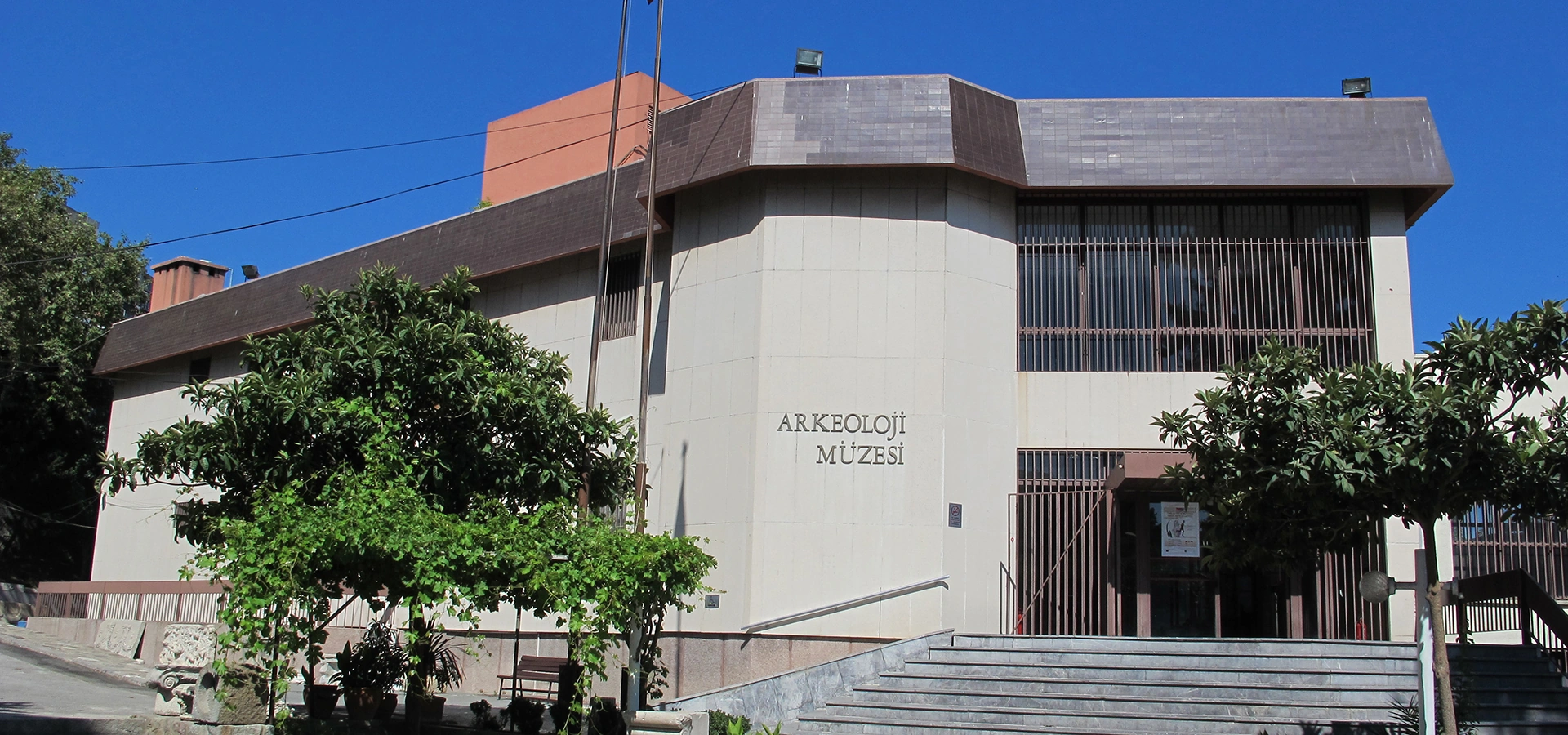
Explore archaeological finds from İzmir and western Anatolia and place the region's ancient civilizations into a broader historical context.
Explore the Archaeology Museum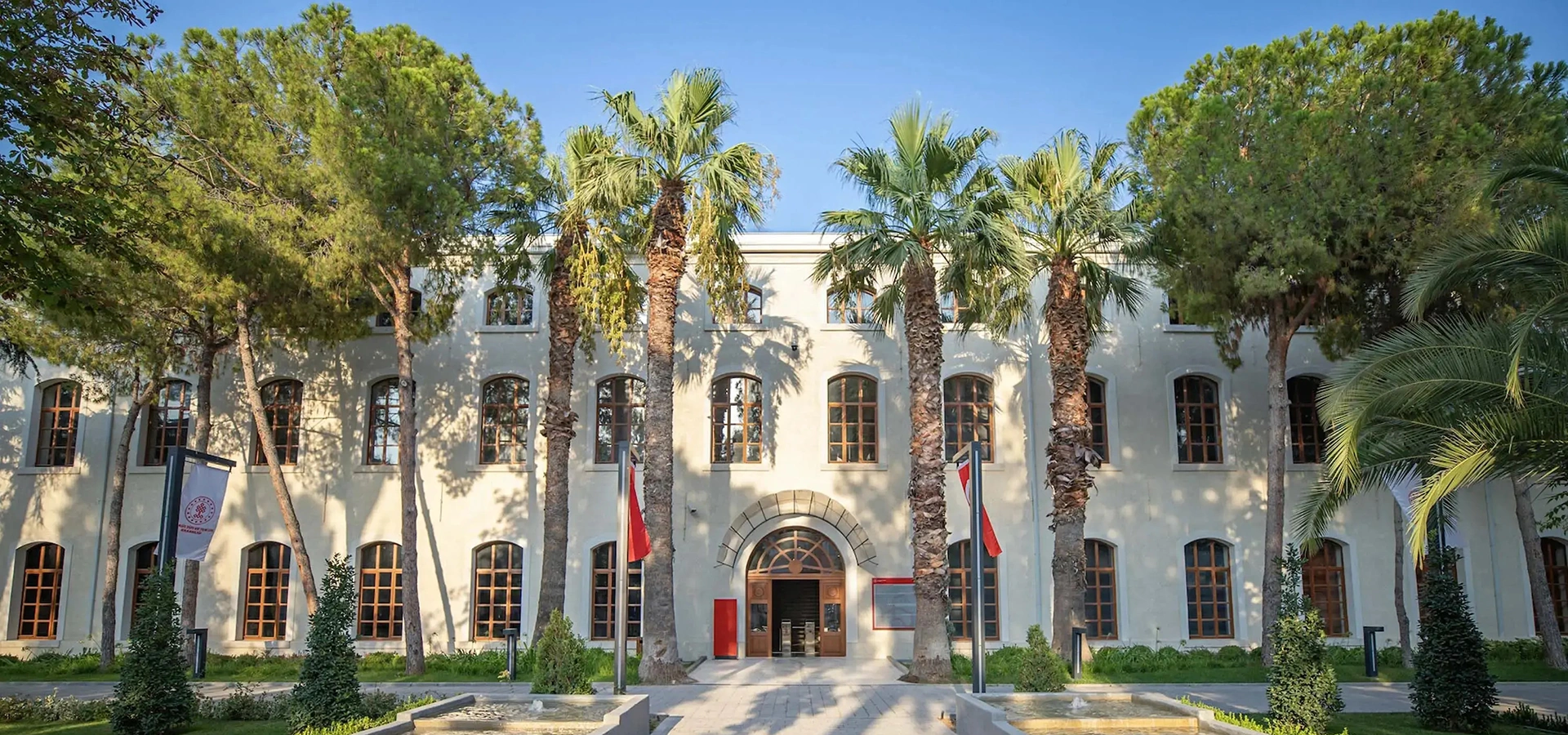
Discover archaeological and ethnographic collections inside one of İzmir's most impressive restored historic industrial complexes.
Explore Kültür Sanat Fabrikası
Continue with our complete İzmir guide covering prehistoric settlements, ancient Smyrna, museums, historic districts, churches, synagogues, coastal towns, cuisine and day trips.
View İzmir Guide