Oracle of Apollo, Sacred Way & Monumental Ancient Ionia

Didyma & the Didymaion – Temple of Apollo, Oracle & Things to See

Discover one of the ancient world's greatest oracular sanctuaries,
where colossal Ionic architecture surrounded the sacred Oracle of Apollo.

Explore Didyma

Didyma – Oracle of Apollo and the Monumental Didymaion

Didyma, located in modern Didim in Aydın Province, was one of the most celebrated religious sanctuaries of the ancient Aegean world. Unlike Miletus, Ephesus or Priene, Didyma was not primarily an independent ancient city. It was a sanctuary closely connected with the powerful Ionian city of Miletus.

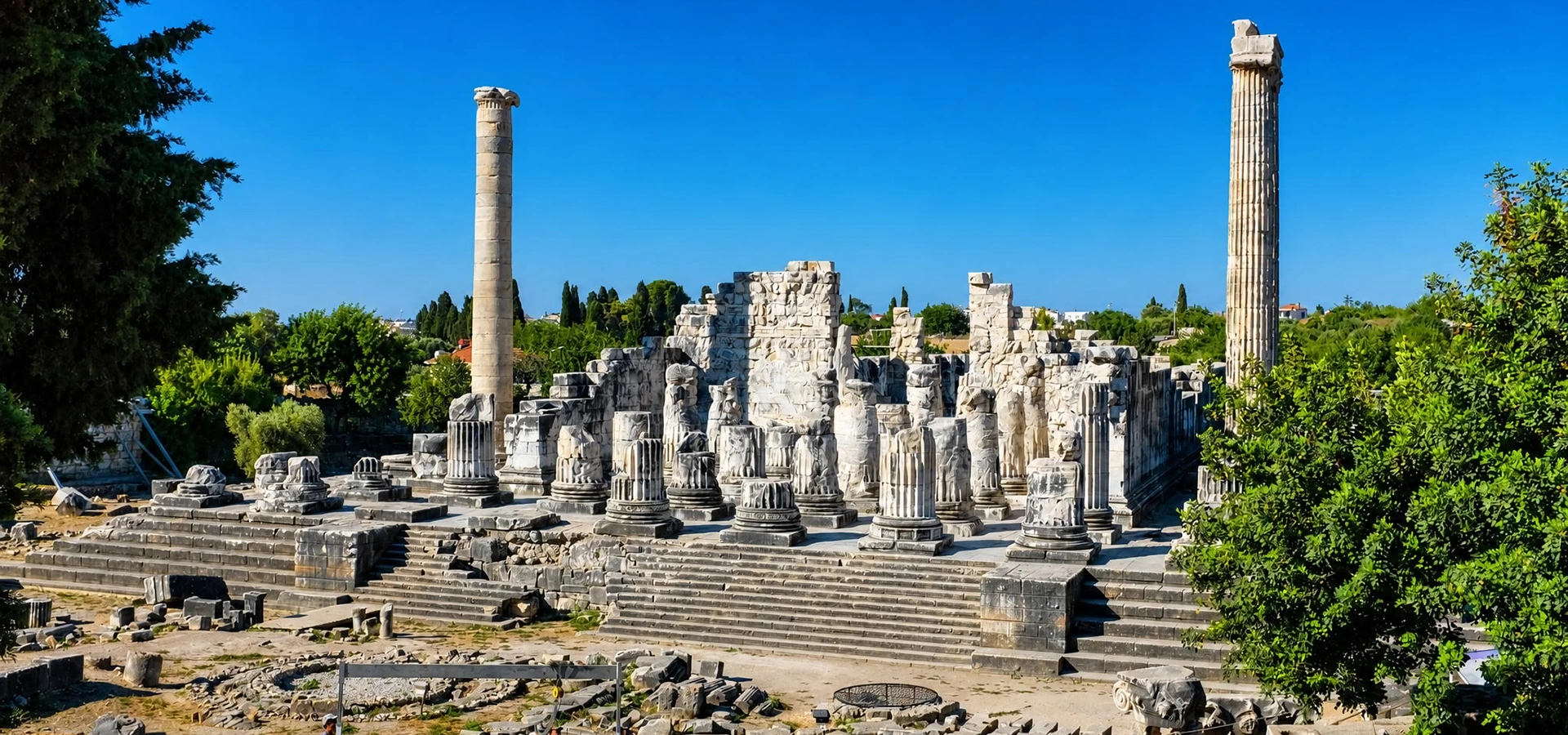
At the heart of the sanctuary stood the extraordinary Temple of Apollo, commonly called the Didymaion. Its enormous Ionic columns, monumental stairways, mysterious vaulted passages and vast open-air inner court created one of the most dramatic sacred buildings of antiquity.

Didyma was especially famous for its oracle of Apollo. Cities, rulers and individuals sought divine guidance here, making the sanctuary an important religious and political centre whose influence reached far beyond the Milesian Peninsula.

Today visitors can descend into the temple's remarkable interior, walk between gigantic column drums, examine the famous Medusa reliefs and imagine the ritual processions that once approached Didyma from Miletus along the Sacred Way.

Oracle of Apollo

Discover one of antiquity's most renowned centres of prophecy, where Apollo's guidance was sought for religious, civic and political questions.

Colossal Temple

Walk through an enormous Ionic sanctuary whose surviving columns rise almost twenty metres above the archaeological site.

Sacred Way

Follow the story of the ceremonial route that connected Didyma with Miletus and formed part of major religious processions.

Medusa & Ancient Design

See monumental Gorgon imagery and discover rare ancient architectural drawings preserved on the unfinished walls of the temple.

Know Before You Go

Didyma & the Didymaion – Quick Facts

A practical introduction to one of the greatest sacred landscapes of ancient western Anatolia.

Location

Didim, Aydın Province, western Türkiye.

Open on Google Maps

Main Monument

The monumental Ionic Temple of Apollo, traditionally known as the Didymaion.

Famous For

One of the most important oracles of Apollo in the ancient Mediterranean world.

Ancient Connection

Didyma was an extra-urban sanctuary closely connected with the city of Miletus.

Temple Scale

Approximately 109 metres long and 51 metres wide at the upper temple platform.

Best Seasons

Spring and autumn provide the most comfortable conditions for exploring the exposed sanctuary.

Religion, Architecture and the Power of Prophecy

Why Is Didyma Important?

Didyma combines monumental architecture with one of the ancient world's most influential traditions of prophecy.

The significance of Didyma lies first in its role as a major sanctuary of Apollo. For centuries, people travelled here to participate in religious ceremonies, dedicate offerings and seek answers from the god through the sanctuary's oracle.

Its importance was inseparable from Miletus. The powerful Ionian city maintained a deep religious relationship with Didyma, and ceremonial processions linked urban civic life with Apollo's extra-urban sanctuary.

The architecture reflects this importance. The surviving Hellenistic and Roman temple was planned on an extraordinary scale, with colossal Ionic columns surrounding an interior unlike that of an ordinary Greek temple.

Instead of containing a conventional enclosed inner chamber, the Didymaion enclosed a vast open-air sacred courtyard. Within it were the sacred spring associated with the oracle and a smaller shrine known as the naiskos.

Didyma is therefore important not simply because its ruins are enormous. It preserves a rare combination of religion, ritual movement, architecture, prophecy, engineering and ancient construction history.

For travellers exploring the wider province, Didyma forms an essential part of the archaeological heritage introduced in our Aydın travel guide.

Didyma or Didymaion – What Is the Difference?

The terms Didyma and Didymaion are often used interchangeably in modern travel writing, but they are not exactly the same.

Didyma refers to the wider sanctuary and sacred settlement connected with Apollo and Miletus.

The term Didymaion is commonly used specifically for the monumental Temple of Apollo at Didyma.

This distinction also helps explain why calling Didyma simply an "ancient city" can be misleading. The sanctuary certainly developed buildings, roads, religious institutions and later settlement, but its ancient identity was fundamentally that of a major extra-urban sacred centre belonging to the Milesian world.

Didyma

The wider sanctuary and sacred landscape associated with Apollo.

Didymaion

The monumental Temple of Apollo dominating the sanctuary.

Miletus

The powerful Ionian city historically connected with the sanctuary and its cult.

Modern Didim

The contemporary town surrounding the archaeological landscape of ancient Didyma.

Useful distinction: When visiting Didyma, you are exploring one of antiquity's great sanctuaries rather than a conventional archaeological city filled with theatres, agoras and domestic districts.

History of Didyma

The religious history of Didyma began long before the construction of the enormous temple visible today.

Archaeological evidence shows that sacred activity developed at the site during the early history of the Milesian Peninsula. By the Archaic period, the sanctuary of Apollo had become internationally important.

During the 6th century BCE, an impressive Ionic temple was constructed at Didyma. Its scale reflected the increasing wealth of Miletus and the prestige of Apollo's oracle.

The sanctuary experienced a major break following the Persian suppression of the Ionian Revolt and the destruction of Miletus in 494 BCE. Ancient traditions associate this period with the destruction or plundering of the earlier sanctuary and the interruption of the oracle.

The oracle was revived in the later 4th century BCE following the Macedonian conquest of western Anatolia. A completely new and much larger Temple of Apollo was then planned.

Construction of the enormous Hellenistic Didymaion extended across generations. Work continued through the Hellenistic and Roman periods, yet the colossal project was never fully completed.

Roman emperors and benefactors continued to support the sanctuary. The Sacred Way was renewed, monumental decoration was added and Didyma remained an active religious centre well into the imperial period.

With the spread of Christianity in Late Antiquity, the sanctuary's religious role changed. A Christian basilica was eventually constructed within the great open courtyard of the former Temple of Apollo.

Early Sanctuary

Religious activity at Didyma predates the monumental temples known from later antiquity.

6th Century BCE

A major Archaic Ionic temple reflected the growing fame of Apollo's oracle.

494 BCE

The Persian suppression of the Ionian Revolt brought a major disruption to Miletus and Didyma.

Late 4th Century BCE

The oracle was revived and planning began for the colossal new Temple of Apollo.

Hellenistic & Roman Periods

Construction and embellishment continued for centuries without the temple ever being completely finished.

Late Antiquity

Christian occupation transformed the sacred interior and introduced a basilica within the former temple.

The Oracle of Apollo at Didyma

Didyma was famous throughout antiquity because it contained an important oracle of Apollo.

An oracle was much more than a place where individuals attempted to predict the future. In the ancient Greek world, divine consultation could influence political decisions, laws, colonisation, warfare, religious practice and major personal choices.

Apollo was particularly associated with prophecy. At Didyma, the sanctuary's sacred spring played an important role within the religious traditions surrounding the oracle.

Visitors seeking divine guidance would encounter a highly organised sacred institution involving priests, religious officials, sacrifices, purification and formal procedures.

The exact mechanism through which the Didyma oracle operated changed over time and is not completely understood. Ancient evidence refers to prophets and sanctuary personnel, but modern reconstructions should therefore avoid imagining one fixed ritual system throughout the entire history of Didyma.

What is certain is that the oracle became sufficiently prestigious for rulers, cities and communities from across the ancient Mediterranean to seek Apollo's guidance here.

Apollo

The principal deity of the sanctuary and the divine source of its prophetic authority.

Sacred Spring

A spring within the temple's sacred inner courtyard was closely associated with the sanctuary and its oracle.

Consultation

Questions could concern communities, rulers, religious matters or individual decisions.

Wider Influence

Didyma's reputation extended far beyond the territory of Miletus.

Important archaeological caution: The sanctuary's prophetic traditions survived for many centuries, but the precise sequence of ritual actions and the role of individual officials may have changed through time.

The Branchidae and the Oracle of Didyma

The early history of Didyma is closely connected with a priestly family known in ancient sources as the Branchidae.

Ancient tradition linked the family with Branchos, a legendary figure associated with Apollo and the establishment of prophetic authority at the sanctuary.

The Branchidae became closely identified with the operation of the oracle during the Archaic period.

Their history after the Persian destruction of Miletus became the subject of dramatic and sometimes contradictory ancient stories. Some accounts accused the priestly family of cooperation with Persia, while later traditions described their relocation far to the east.

Because these narratives were written in different periods and often carried strong political or moral messages, they should not all be accepted uncritically as straightforward historical fact.

Branchos

A legendary figure remembered as an important early servant or beloved of Apollo.

Priestly Tradition

The Branchidae were associated with the administration of the early oracle.

Archaic Didyma

Their name became deeply connected with the sanctuary before the Persian Wars.

Ancient Stories

Later accounts of their fate combine history, political memory and legend.

The Temple of Apollo – Architecture of the Didymaion

The surviving Temple of Apollo was designed on a scale intended to communicate extraordinary religious prestige.

The temple measured roughly 109 metres by 51 metres at the upper level of its stepped platform and was surrounded by a monumental double colonnade.

The enormous Ionic columns reached approximately 19.7 metres in height. Even the surviving column drums lying across the site make it immediately clear that every architectural component belonged to a building of exceptional dimensions.

From outside, the Didymaion resembled an enormous conventional Greek temple. Inside, however, the architecture became radically different.

Instead of a normal enclosed cella, visitors encountered a sophisticated arrangement of vestibules, monumental staircases and narrow vaulted corridors descending into a vast open-air adyton.

This unusual design allowed the architects to preserve the ancient sacred area and spring deep within the centre of the monumental new building.

Style Monumental Ionic temple with a double surrounding colonnade
Approximate Size About 109 metres long and 51 metres wide at the upper temple platform
Column Height Approximately 19.7 metres
Interior A vast open-air adyton reached through descending vaulted passages
Architects Ancient tradition associates the design with Paionios of Ephesus and Daphnis of Miletus
Completion Construction continued for centuries but the temple was never completely finished

The Adyton of the Didymaion

The most surprising experience at Didyma comes when visitors move from the monumental exterior into the interior of the temple.

The central sacred area, generally called the adyton, lies significantly below the surrounding temple platform.

Instead of being covered by a conventional roof, this enormous inner space was open to the sky.

Towering walls surrounded the courtyard, creating the remarkable impression of standing deep within a monumental architectural enclosure while still remaining outdoors.

The design was directly connected with the sacred character of the sanctuary. The ancient spring and smaller shrine of Apollo had to remain accessible inside a building whose external form rose far above the original ground level.

For modern visitors, the transition between bright exterior colonnades, darker passages and the open inner court is one of the most memorable architectural experiences in western Türkiye.

Open to the Sky

The sacred inner courtyard was intentionally not roofed like the cella of a conventional Greek temple.

Lower Level

The floor of the adyton lies well below the level of the surrounding monumental temple platform.

Sacred Space

The sanctuary's spring and inner shrine were located within this protected central area.

Monumental Walls

High walls created a dramatic architectural boundary around the sacred courtyard.

The Vaulted Passages of the Temple of Apollo

Two narrow sloping passages are among the most distinctive architectural features of the Didymaion.

They descend from the elevated eastern part of the temple toward the much lower level of the adyton.

Their function was partly practical: the architects needed a way to connect spaces constructed at dramatically different levels.

Yet their architectural effect is equally important. Moving through the enclosed passage creates a powerful transition from the monumental exterior world into the secluded sacred interior.

The contrast between darkness inside the passage and sunlight flooding the open courtyard beyond gives modern visitors a strong sense of how carefully movement through the sanctuary was controlled.

Notice the change in level: The unusual passages make much more sense when you remember that the temple platform was constructed high above the older sacred ground preserved within the adyton.

The Sacred Spring and Naiskos

At the heart of the Didyma sanctuary lay a sacred spring associated with Apollo and the prophetic traditions of the oracle.

The precise ancient position and appearance of every element cannot now be reconstructed with complete certainty, but archaeological and literary evidence makes the spring fundamental to understanding the unusual temple design.

Within the open courtyard also stood a smaller temple-like structure known as the naiskos.

This inner shrine belonged to the most sacred zone of Didyma and was associated with the cult of Apollo.

The contrast must have been extraordinary: a relatively small sacred building standing inside an enormous open court surrounded by walls and, beyond them, a forest of gigantic Ionic columns.

Sacred Spring

A natural water source formed an essential part of the religious identity of Didyma.

Naiskos

A smaller shrine stood within the enormous open-air adyton.

Apollo

The central sacred space was devoted to the prophetic god whose oracle made Didyma famous.

Architecture & Ritual

The unusual temple plan was shaped by the need to preserve and monumentalise this ancient sacred core.

The Sacred Way from Miletus to Didyma

Didyma cannot be fully understood without its connection to Miletus.

A ceremonial route traditionally known as the Sacred Way linked the city with Apollo's sanctuary and provided the setting for religious processions.

The journey represented much more than transportation between two places. It transformed movement through the Milesian landscape into a ritual experience connecting civic identity, religion and sacred geography.

The traditional reconstruction gives the route a length of roughly 17 kilometres, although archaeological research has demonstrated that its exact course was not necessarily identical in every historical period.

Near Didyma, sections of the ancient road and associated monuments help visitors imagine the ceremonial approach toward the sanctuary.

The route was embellished with sculptural monuments, including seated figures traditionally associated with the Branchidae and other members of the Milesian elite.

During the Roman imperial period the Sacred Way continued to receive attention, and inscriptions document major work connected with the emperor Trajan.

For today's traveller, visiting both Didyma and Miletus Ancient City restores the relationship between sanctuary and city that shaped the region for centuries.

Miletus

The ceremonial connection began within the religious landscape of the Milesian city.

Processions

Religious festivals transformed the road into a ritual route followed by priests and participants.

Monuments

Statues and sacred installations marked parts of the ceremonial approach toward Didyma.

Changing Route

Modern archaeological research suggests that sections of the Sacred Way developed and changed through time.

Important archaeological note: The Sacred Way should not be imagined as one perfectly preserved road whose entire course remained unchanged from the Archaic period to Roman times. Research continues to refine our understanding of its development.

The Medusa Head of Didyma

Among the most photographed architectural fragments at Didyma are the enormous carved Gorgon or Medusa heads.

These sculptures formed part of the rich architectural decoration added to the monumental sanctuary during the Roman period.

In Greek and Roman visual culture, the terrifying face of a Gorgon could function as an apotropaic symbol — an image intended to repel danger or evil.

The scale of the surviving carvings reflects the monumental dimensions of the temple itself. Details that now sit at eye level on the archaeological ground were originally designed to be seen from far below.

Their dramatic eyes, facial features and flowing hair were therefore carved boldly so that the image remained visually powerful when incorporated high into the temple architecture.

Gorgon

Medusa belonged to the mythological group of terrifying female figures known as the Gorgons.

Protection

Gorgon imagery was widely used in antiquity as a powerful protective symbol.

Roman Decoration

Monumental Gorgon heads formed part of later decorative programmes at the Temple of Apollo.

Photography

The surviving carved heads are among the most recognisable photographic subjects at Didyma.

Why Was the Temple of Apollo Never Finished?

One of the most fascinating facts about the Didymaion is that its enormous construction programme was never fully completed.

This should not be interpreted as a short-lived failed project. Construction continued over several centuries, and completed parts of the sanctuary were actively used while work continued elsewhere.

The sheer scale explains part of the problem. Individual marble columns approached twenty metres in height and required enormous resources to quarry, transport, shape, raise and decorate.

Political changes, wars, financial pressures and shifting priorities repeatedly affected the long building programme.

Today the incomplete state of some architectural elements is actually one of Didyma's greatest archaeological advantages.

Unfluted column shafts, unfinished mouldings and construction marks allow visitors and researchers to study stages of ancient architectural production that would normally have disappeared beneath final finishing.

Generational Project

The temple was constructed and modified across many generations rather than during a single building campaign.

Enormous Cost

Quarrying and erecting colossal marble architecture required extraordinary financial and human resources.

Visible Construction

Some columns and architectural blocks preserve unfinished surfaces and working marks.

Archaeological Value

Its unfinished condition provides rare evidence for ancient design and construction methods.

The Ancient Architectural Drawings at Didyma

Didyma preserves one of the most remarkable pieces of evidence for understanding how ancient architects designed monumental buildings.

Extremely fine lines were discovered incised into surfaces of the adyton walls.

These were not decorative graffiti. Research demonstrated that many belong to architectural working drawings connected with the construction of the temple itself.

Profiles of columns, mouldings and other architectural elements could be laid out at large or even full scale directly onto prepared wall surfaces.

Normally such temporary construction drawings would disappear when a building received its final polishing.

At Didyma, however, portions survived precisely because large parts of the enormous temple remained unfinished.

Working Drawings

Fine incised lines preserve parts of the design process used by ancient architects and masons.

Full-Scale Details

Some architectural profiles were laid out directly on large wall surfaces.

Construction Evidence

The drawings provide exceptional information about ancient geometry, measurement and stone design.

Preserved by Incompletion

Because sections of the temple were never given their final finish, temporary construction marks survived.

Look very carefully: Many ancient construction lines are extremely fine and can be difficult to identify without specialised interpretation. Their importance lies not in visual drama but in the extraordinary information they preserve about ancient architectural practice.

Didyma during the Roman Period

Didyma remained an important sanctuary after western Anatolia became part of the Roman world.

Construction on the enormous Temple of Apollo continued, while new architectural decoration and infrastructure enriched the sacred landscape.

Roman emperors recognised the political and religious prestige of important Greek sanctuaries, and Didyma benefited from imperial attention.

The Sacred Way linking the sanctuary with Miletus was renewed under the emperor Trajan, demonstrating that the ceremonial connection between city and oracle remained meaningful centuries after the earliest processions.

Roman-period architectural decoration included monumental sculptural elements such as the famous Gorgon heads now displayed among the ruins.

The oracle continued to function during the imperial period, preserving Didyma's reputation as a place where human decisions could be placed before Apollo.

Didyma in Late Antiquity and the Christian Basilica

The religious landscape of Didyma changed dramatically as Christianity expanded through the Roman Empire.

The sanctuary did not simply vanish immediately. Like many important sacred places, Didyma passed through a long period of transformation.

During approximately the 5th or 6th century CE, a Christian basilica was constructed within the open courtyard of the former Temple of Apollo.

The Hellenistic naiskos was dismantled as the sacred interior was reorganised for Christian worship.

The basilica was later badly damaged, and today the visitor mainly experiences the monumental Classical structure surrounding the area where these later transformations occurred.

This Christian phase is nevertheless essential to understanding Didyma as a place that continued to carry religious meaning long after the ancient oracle had ceased to function.

Religious Change

The ancient sanctuary entered a new phase as Christianity became dominant in Late Antiquity.

Basilica

A Christian church was built inside the monumental open courtyard of the former temple.

Naiskos

The earlier inner shrine was dismantled during the Christian transformation of the sacred space.

Continuity

The reuse demonstrates how sacred places could retain importance while religious traditions changed.

Best Things to See at Didyma

Colossal Ionic Columns

Stand beneath the surviving columns and examine the enormous drums, bases and capitals scattered across the sanctuary.

Temple Stairway

The broad stepped approach immediately communicates the extraordinary scale of the Didymaion.

Vaulted Passages

Descend through the unusual corridors that connect the elevated temple architecture with the lower sacred courtyard.

Open-Air Adyton

Enter the extraordinary inner court where the sacred spring and naiskos once formed the heart of Apollo's sanctuary.

Monumental Staircase

Study the great interior staircase linking different levels of the complex architectural arrangement.

Medusa Heads

Look closely at the enormous Gorgon reliefs that once formed part of the temple's architectural decoration.

Unfinished Column

Notice how unfinished stone surfaces reveal the sequence of ancient column preparation and finishing.

Ancient Construction Marks

The temple preserves rare evidence for architectural planning and full-scale working drawings.

Sacred Way

Explore the archaeological relationship between the sanctuary entrance and the ceremonial route toward Miletus.

Christian Layers

Remember that the temple interior was later transformed by the construction of a Late Antique basilica.

Didyma Visitor Information

Didyma is more compact than Miletus but rewards a slow visit because its architecture needs to be experienced from several different levels.

Do not simply photograph the standing columns from outside and leave. The most unusual features of the Didymaion become clear only after entering the monumental interior.

Location Didim, Aydın Province, western Türkiye
Recommended Visit Approximately 1–2 hours for a comfortable archaeological visit
Terrain Stone paving, monumental steps, uneven ancient surfaces and archaeological ground
Shade Limited across significant parts of the archaeological area
Best Combination Priene + Miletus + Didyma
Photography Morning and late-afternoon light reveal the texture and scale of the marble more effectively than harsh midday sun
Before travelling: Entrance fees, opening hours, restoration work and permitted visitor routes can change. Check current official information close to your travel date.

Suggested Walking Route through Didyma

Begin outside the temple and pause before climbing into the monument. From here the surviving columns and enormous stepped platform provide the clearest impression of the building's external scale.

Walk around the outer architectural fragments and examine the colossal column drums, bases, capitals and decorative blocks.

Continue toward the entrance and descend through one of the remarkable vaulted passages.

Enter the open-air adyton and take time to understand why the floor sits so far below the surrounding temple platform.

Examine the area associated with the naiskos and sacred spring, then study the monumental interior staircase and architectural wall surfaces.

Finish with the Medusa reliefs and the surviving remains connected with the Sacred Way and later phases of the sanctuary.

Stop 1

Exterior platform and panoramic view of the colossal Ionic temple.

Stop 2

Column drums, bases, capitals and unfinished architectural elements.

Stop 3

Descending vaulted passage into the sacred inner complex.

Stop 4

Open-air adyton, sacred spring area and location of the naiskos.

Stop 5

Monumental interior staircase and ancient architectural working surfaces.

Stop 6

Medusa reliefs, Sacred Way area and later archaeological layers.

Priene, Miletus and Didyma

One of the finest archaeological journeys in western Türkiye combines Priene, Miletus and Didyma.

The three sites lie within the same wider historical landscape, yet each offers a completely different experience.

Priene

A remarkably coherent Hellenistic city built on the slopes of Mount Mycale with dramatic views over the Maeander landscape.

Miletus

The maritime metropolis associated with philosophy, trade, political history and monumental Roman architecture.

Didyma

The great extra-urban sanctuary where Apollo's oracle and colossal temple shaped the religious identity of the Milesian world.

Together they reveal three complementary dimensions of ancient western Anatolia: the planned city, the maritime metropolis and the monumental sanctuary.

Read more about the middle stop of this route in our Miletus Ancient City guide.

Best Time to Visit Didyma

Didyma can be explored during much of the year, but temperature and sunlight strongly affect the experience.

Spring

One of the best seasons, combining comfortable walking temperatures with greener surrounding landscapes.

Early Summer

Excellent for clear weather and photography, although midday temperatures become increasingly strong.

High Summer

Expect powerful sun and significant heat. Earlier morning or later afternoon is strongly preferable.

Autumn

A particularly pleasant period for combining Didyma with Miletus, Priene and other archaeological sites.

Winter

The site can be atmospheric and quiet, although wet marble and ancient steps require additional care.

Time of Day

Lower-angle morning and afternoon light is excellent for revealing Ionic fluting, carved reliefs and architectural depth.

Photography at Didyma

Didyma is one of the most photogenic archaeological sites in the Aegean because enormous architectural elements survive at dramatically different heights.

The famous standing pair of Ionic columns provides the classic image, especially when photographed against a clear sky.

Do not limit yourself to the exterior. The vaulted passages produce excellent compositions using strong contrasts between dark interiors and bright openings.

Inside the adyton, use the enormous staircase and surrounding walls to communicate scale.

The fallen column drums are equally important. A person standing nearby can help reveal just how enormous each component of the temple really was.

The Medusa reliefs work particularly well for close architectural details, while lower-angle light helps bring out the modelling of the carved stone.

Standing Columns

Use the surviving columns against the sky to communicate the monumental vertical scale of the temple.

Adyton

Wide compositions show the extraordinary depth of the open sacred courtyard.

Vaulted Passages

Frame the sunlit courtyard through the darker stone corridors for strong depth and contrast.

Medusa

Photograph the carved Gorgon head from several angles to capture its dramatic facial modelling.

Column Drums

Low viewpoints emphasise the extraordinary diameter and weight of the fallen architectural elements.

Late Afternoon

Warm, lower-angle light reveals carving, fluting and weathered marble surfaces particularly well.

Accessibility and Walking at Didyma

Didyma is geographically more compact than many ancient cities, but the monument itself contains major changes in level.

Ancient Steps

The temple contains large stairways and uneven ancient stone surfaces.

Adyton Access

Exploring the inner temple may involve descending and climbing significant changes in level.

Stone Surfaces

Expect polished marble, rough masonry, archaeological paving and occasional loose surfaces.

Heat

The exposed marble sanctuary can become extremely hot during summer afternoons.

Footwear

Supportive shoes with reliable grip are preferable, particularly when ancient stone is wet.

Private Touring

A private itinerary makes it easier to adjust the pace when combining Didyma with Miletus and Priene.

How to Get to Didyma

The archaeological sanctuary of Didyma lies within modern Didim in Aydın Province, south of the lower Büyük Menderes region.

From Didim

The Temple of Apollo lies within the modern urban area and is easily reached from the coastal districts of Didim.

From Miletus

Didyma forms the natural continuation of a visit to Miletus and recreates the ancient relationship between city and sanctuary.

From Priene

Priene, Miletus and Didyma can be combined into a full archaeological journey through the ancient Milesian landscape.

From Kuşadası

Didyma can be reached by road as part of a private full-day journey through the southern archaeological sites of Aydın Province.

From Bodrum

Travellers heading north from Bodrum can combine Didyma with Miletus, Lake Bafa or the wider Söke region.

Private Vehicle

Private transportation is the most practical option when visiting several archaeological sites during the same day.

Planning tip: Didyma becomes significantly more meaningful when visited together with Miletus, because the relationship between the oracle and its parent city is central to understanding the sanctuary.

Places to Visit near Didyma

Miletus

Discover the great Ionian harbour city, monumental theatre and intellectual heritage in our Miletus Ancient City guide.

Priene

Explore one of the most impressive surviving examples of a planned Hellenistic city beneath Mount Mycale.

Lake Bafa

Discover a dramatic landscape where mountains, wetlands and archaeological heritage meet.

Heracleia at Latmos

Walk among ancient fortifications and Byzantine remains within the extraordinary landscape beside Lake Bafa.

Didim Coast

Combine archaeology with the beaches, bays and Aegean coastline surrounding modern Didim.

Kuşadası

Continue north toward one of the region's main coastal bases with our Kuşadası travel guide.

Tralleis

Explore the monumental remains of ancient Aydın in our Tralleis Ancient City guide.

Aphrodisias

For a longer archaeological journey across the province, continue with our Aphrodisias Ancient City guide.

Aydın

Plan a wider journey through the province with our Aydın travel guide.

Frequently Asked Questions About Didyma and the Didymaion

Where is Didyma?

Didyma is located in modern Didim in Aydın Province on the western coast of Türkiye, south of Miletus and the lower Büyük Menderes region.

What is the Didymaion?

The Didymaion is the monumental Temple of Apollo at Didyma, one of the largest and most unusual Ionic temples of the ancient Mediterranean world.

Was Didyma an ancient city?

Not in the same sense as Miletus, Ephesus or Priene. Didyma was primarily a major sanctuary belonging to the religious territory of Miletus, although settlement and additional buildings developed around it through time.

Why is Didyma famous?

Didyma is famous for the Oracle of Apollo, its enormous unfinished Temple of Apollo, the open-air adyton, sacred spring, Sacred Way and monumental architectural decoration.

What was the Oracle of Didyma?

The oracle was a religious institution through which Apollo's guidance was sought concerning public, political, religious and personal questions.

How was Didyma connected with Miletus?

Didyma was one of the most important sanctuaries within Milesian territory. Religious processions connected Miletus with Didyma along the ceremonial route traditionally known as the Sacred Way.

How large is the Temple of Apollo at Didyma?

The upper temple platform measured approximately 109 metres long and 51 metres wide, while the colossal Ionic columns rose to around 19.7 metres.

Was the Temple of Apollo ever completed?

No. Construction continued during the Hellenistic and Roman periods, but the enormous building programme was never completely finished.

Why is the interior of the Temple of Apollo open to the sky?

The unusual architecture preserved a sacred inner courtyard at a lower level within the monumental temple. The adyton therefore remained open rather than becoming a conventional roofed cella.

What was inside the adyton?

The sacred inner courtyard contained the area associated with Apollo's sacred spring and a smaller temple-like shrine known as the naiskos.

What are the tunnels inside the Temple of Apollo?

They are long vaulted passages that descend from the elevated eastern part of the temple to the much lower floor of the open-air adyton.

What is the Medusa head at Didyma?

The famous carved Gorgon heads belonged to the monumental architectural decoration of the sanctuary. Gorgon imagery was commonly understood as a protective symbol in Greek and Roman art.

What was the Sacred Way?

The Sacred Way was a ceremonial route connecting Miletus and the sanctuary of Apollo at Didyma. It was used for religious processions and developed through several historical phases.

Who were the Branchidae?

The Branchidae were a priestly family associated in ancient tradition with the early administration of Apollo's oracle at Didyma.

Are there ancient architectural drawings at Didyma?

Yes. Fine incised lines on unfinished surfaces of the temple preserve rare architectural working drawings associated with the design and construction of the Didymaion.

Was there a Christian church inside the Temple of Apollo?

Yes. During Late Antiquity, a Christian basilica was constructed within the great inner courtyard of the former sanctuary.

How long do I need at Didyma?

Allow approximately one to two hours for a comfortable visit, particularly if you want to study the interior architecture, Medusa reliefs and archaeological details rather than simply view the temple from outside.

Can I visit Priene, Miletus and Didyma in one day?

Yes. The three sites form one of the finest archaeological day routes in western Türkiye and can be combined comfortably with private transportation and sensible timing.

When is the best time to visit Didyma?

Spring and autumn are particularly comfortable. During high summer, earlier morning or later afternoon is preferable because the sanctuary receives strong sun.

Is a guide worthwhile at Didyma?

Yes. The monument is visually impressive even without explanation, but its open adyton, sacred spring, oracle, Sacred Way and unusual architectural design become far more meaningful with historical interpretation.

Responsible Visiting at Didyma

Stay on Visitor Routes

Follow permitted archaeological paths and respect areas closed for excavation, restoration or conservation.

Do Not Climb Ruins

Ancient column drums and architectural blocks can be unstable, and climbing can damage both the monument and the visitor.

Protect Ancient Surfaces

Never scratch, mark or touch delicate carved surfaces or architectural working drawings.

Leave Archaeology in Place

Never remove fragments of marble, pottery, stone or any other archaeological material.

Respect Restoration Work

Didyma remains an active archaeological and conservation landscape rather than a completed museum display.

Carry Your Waste

Help preserve the sanctuary and surrounding modern community by disposing of rubbish responsibly.

Private Tours to Didyma

Discover Didyma with a licensed private guide and comfortable vehicle, with an itinerary designed around archaeology, history, photography and your preferred pace, without compulsory shopping stops.

Your Private Ancient Ionia Journey

Combine Didyma with Miletus, Priene, Kuşadası, Lake Bafa or other archaeological destinations across western Türkiye.