Elongated Köfte
İzmir Köfte is generally shaped into long oval or finger-like meatballs rather than the smaller round form visitors may expect.
- Shape: Long and oval
- Texture: Tender and substantial
- Role: Main protein of the dish






İzmir Köfte is one of the best-known dishes associated with İzmir and one of the most comforting examples of traditional Turkish home cooking. Long oval meatballs are prepared with seasoned minced meat, arranged with potatoes and often peppers, then finished together in a savoury tomato-based sauce.
The dish combines two familiar ingredients — köfte and potatoes — but the characteristic İzmir preparation transforms them into something more than a simple plate of fried meatballs. The ingredients are brought together in a tray or cooking dish so that the meat, potatoes, vegetables and tomato sauce gradually absorb each other’s flavours.
The result is rich without being complicated: tender meatballs, soft potatoes, sweet tomato, fragrant peppers and a lightly spiced sauce. It is the kind of dish found not only in restaurants and traditional esnaf lokantası establishments, but also in family kitchens throughout Türkiye.
The köfte are traditionally shaped into elongated or oval pieces rather than small round balls.
Potato wedges or slices cook alongside the meatballs and absorb the savoury tomato sauce.
Fresh tomato or tomato paste provides the characteristic colour, moisture and comforting flavour.
İzmir Köfte is closely associated with everyday Turkish cooking, traditional restaurants and family meals.
Essential information about one of İzmir’s most familiar traditional dishes.
İzmir and the wider traditions of western Turkish and Aegean home cooking.
Open İzmir on Google MapsA cooked meatball dish served with potatoes, tomato sauce and usually peppers.
Minced meat, onion, bread, parsley, spices, potatoes, tomato and peppers.
Served hot as a substantial lunch or dinner, usually with plenty of tomato sauce.
A simple combination of meatballs, vegetables and tomato became one of İzmir’s best-known regional dishes.
Köfte occupies an enormous place within Turkish cuisine. Across the country, different towns and regions have developed their own ways of seasoning, shaping, grilling, frying, simmering or baking minced meat.
İzmir Köfte belongs to the family of tray-style meatball dishes in which köfte is cooked together with vegetables and sauce. Its defining companions are potatoes and tomato, frequently joined by green peppers.
The meat mixture itself is intentionally straightforward. Minced meat is combined with grated or finely prepared onion, bread, parsley and seasonings such as black pepper and cumin. The mixture is kneaded thoroughly before being formed into characteristic elongated pieces.
Traditionally, the potatoes and meatballs may first be lightly fried. This develops flavour and helps the ingredients keep their shape before they are transferred to a tray or pan.
Tomato or diluted tomato paste is then turned into a light sauce and poured around the meatballs and potatoes. The dish is finished until everything becomes tender and the sauce develops its characteristic savoury richness.
One reason İzmir Köfte became so widely loved is its practicality. It uses familiar ingredients, can feed several people from one tray and offers meat, vegetables and sauce in a single comforting dish.
Today the name İzmir Köfte is recognised throughout Türkiye, appearing in family kitchens, traditional restaurants, workplace cafeterias and classic esnaf lokantaları.
The identity of the dish comes from the way meatballs, potatoes, vegetables and tomato sauce are cooked together.
İzmir Köfte is generally shaped into long oval or finger-like meatballs rather than the smaller round form visitors may expect.
Potatoes are essential to the classic character of İzmir Köfte and are generally cut into wedges, rounds or substantial slices.
Tomato gives the dish its characteristic colour and creates the savoury cooking liquid surrounding the meatballs and potatoes.
Peppers are commonly arranged between the meatballs and potatoes, adding fragrance, colour and a distinctly Turkish character.
Onion is incorporated into the meatball mixture, helping provide moisture and savoury depth.
Fresh parsley lightens the meat mixture and adds the herbal note familiar in many traditional Turkish köfte recipes.
Seasoning is generally restrained enough for the flavour of the meat and tomato to remain central.
The ingredients are ultimately cooked together, allowing the flavours of meat, potato, pepper and tomato to combine.
The Turkish word köfte describes an enormous family of meatball and minced-meat preparations. İzmir Köfte is the name given to a particular dish in which seasoned elongated meatballs are cooked together with potatoes and a tomato-based sauce.
It should therefore not be imagined simply as grilled meatballs served beside French fries. The sauce and combined cooking process are important parts of its identity.
The meatballs may be lightly fried first, but they are subsequently cooked with potatoes and tomato sauce.
Meat, potatoes and vegetables combine to create a satisfying main course in a single cooking dish.
The sauce distinguishes İzmir Köfte from many grilled or dry meatball preparations.
The meatballs are commonly shaped into elongated oval pieces.
Unlike some Turkish street foods, İzmir Köfte is a warm, comforting sit-down meal.
Its identity is closely connected with everyday family cooking and traditional restaurants.
Recipes vary slightly from kitchen to kitchen, but the classic structure remains remarkably recognisable.
The traditional method builds flavour in stages before allowing all the ingredients to finish cooking together.
The elongated shape is one of the easiest visual clues distinguishing İzmir Köfte from many other Turkish meatball dishes.
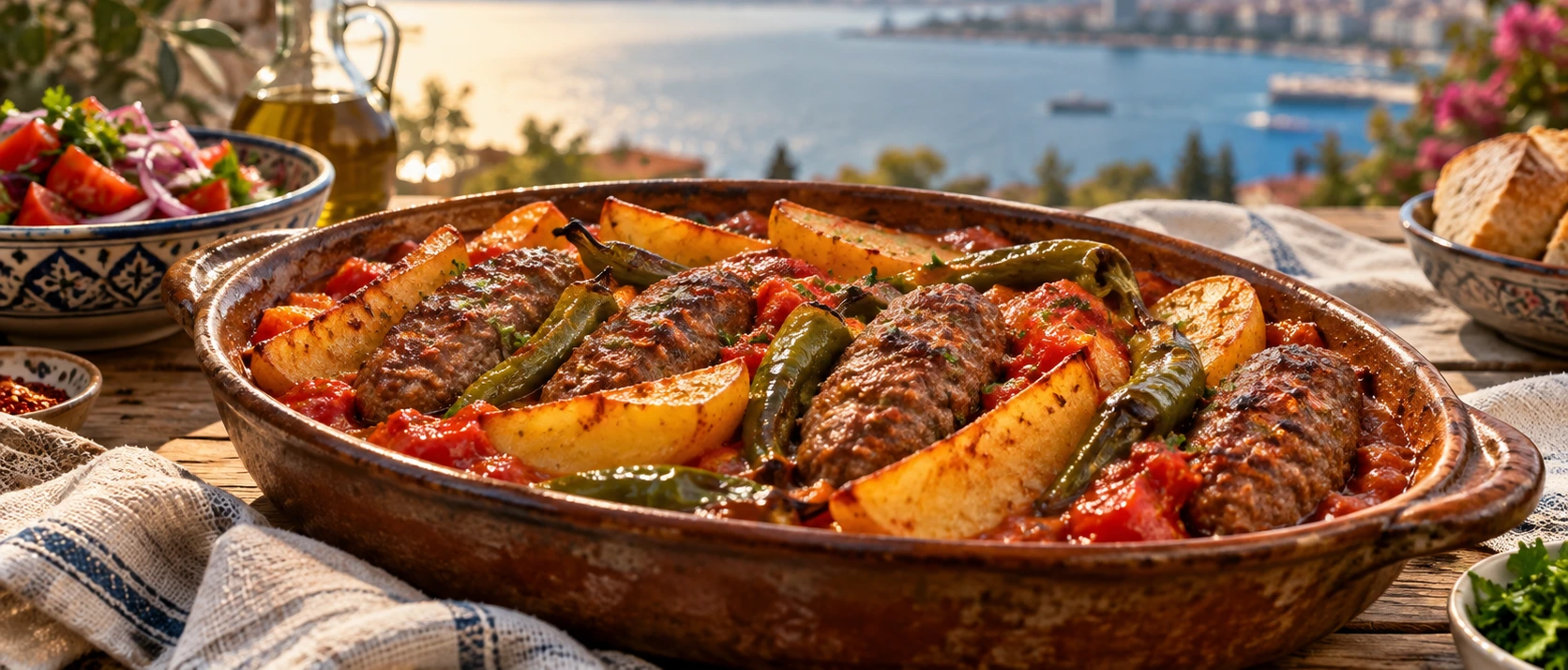
Long oval köfte arranged beside potato wedges create the classic presentation associated with the dish.
A moderately thin shape allows the meatball to cook efficiently while remaining substantial.
The meatballs fit naturally between potatoes, peppers and tomatoes in a cooking tray.
The shape provides plenty of surface for browning and contact with the tomato sauce.
Visitors expecting small spherical meatballs will immediately notice the more elongated Turkish style.
Shape, potatoes and tomato sauce together form the visual signature of İzmir Köfte.
Potatoes are not simply placed beside the finished meatballs. They are an integral part of the dish and share the same cooking environment and sauce.
Potatoes take on the flavour of tomato, meat juices and peppers as the dish cooks.
Their mild flavour balances the richer seasoned meatballs.
Lightly frying them first can preserve some structure while the inside becomes tender.
The combination of potatoes and meat turns the dish into a filling main meal.
Potato wedges arranged between elongated meatballs are immediately recognisable.
The best flavour develops when potatoes and köfte finish cooking in the same tomato sauce.
The sauce is one of the most important differences between İzmir Köfte and a plate of ordinary grilled meatballs.
Both approaches can be encountered. The essential point is that the prepared meatballs, potatoes and tomato sauce finish cooking together.
The arranged tray is baked until the vegetables soften and the sauce concentrates around the meatballs.
A covered pan can also be used to gently finish the meatballs and potatoes in their tomato sauce.
Traditional methods frequently brown the potatoes and meatballs briefly before the final cooking stage.
Regardless of technique, the ingredients should ultimately taste as though they belong together rather than being separate components.
The final cooking period allows tomato sauce to penetrate the potatoes and surround the meatballs.
Home cooks naturally adjust the exact frying, baking and sauce methods according to preference.
The flavour is familiar, comforting and savoury rather than intensely spiced. Much of its appeal comes from how the individual ingredients work together.
The köfte provide the central meat flavour, seasoned gently with onion, parsley and spices.
Potatoes absorb tomato sauce and meat juices while retaining their mild comforting character.
Cooked tomato brings acidity and natural sweetness that prevent the dish from feeling overly heavy.
Green peppers contribute fragrance and a slight vegetal bitterness that balances the sauce.
Cumin provides a recognisably Turkish köfte aroma without dominating the plate.
The combined cooking process creates a sauce carrying flavours from every component.
İzmir Köfte is normally served hot with both meatballs and potatoes on the plate and enough tomato sauce to keep everything moist.
İzmir Köfte belongs equally comfortably in a family kitchen and in a traditional restaurant.
Large trays make it practical for family meals and allow portions to be prepared together.
Traditional working-day restaurants often serve dishes such as İzmir Köfte from trays of freshly cooked food.
Restaurants may use more carefully arranged individual portions and a richer presentation.
Amounts of cumin, parsley, tomato and pepper naturally vary between households.
Some cooks prefer wedges while others use thick rounds or slices.
Seasoned meatballs, potatoes and tomato remain at the heart of the dish in every version.
Unlike İzmir’s grab-and-go street foods, İzmir Köfte is most naturally enjoyed as a sit-down meal.
Traditional restaurants frequently serve meatball and vegetable dishes as part of a substantial midday meal.
Its warm, comforting character makes İzmir Köfte particularly suitable for an evening meal.
One large tray can conveniently provide several servings for the table.
The hot tomato sauce and potatoes make the dish especially comforting in autumn and winter.
There is no strict season; its ingredients are familiar enough for the dish to appear throughout the year.
A smaller serving can form part of a wider exploration of İzmir cuisine.
Because İzmir Köfte is a traditional cooked meal rather than a specialist street food, travellers may encounter it in several different types of restaurant.
Traditional restaurants serving prepared daily dishes are among the most natural places to look for home-style İzmir Köfte.
The historic market area offers numerous opportunities to explore traditional Turkish and İzmir food culture.
The historic centre provides convenient dining options close to the Clock Tower, Kemeraltı and waterfront.
A broad range of restaurants makes the district useful for visitors staying around central İzmir.
Simple family-run restaurants away from the main sightseeing districts may offer particularly homestyle versions.
Because dishes can rotate, check the day’s prepared-food display rather than assuming İzmir Köfte is always available.
The basic structure of İzmir Köfte is straightforward, but individual recipes can vary considerably.
Traditional İzmir Köfte is a minced-meat dish and is therefore neither vegetarian nor vegan.
Breadcrumb or stale bread is commonly mixed into the köfte and therefore normally introduces gluten.
Potatoes are a core ingredient and are commonly fried or partially fried before final cooking.
Fresh tomato, tomato paste or a combination may be used depending on the recipe.
Cumin and black pepper are common, but individual restaurants and households may season differently.
Always confirm ingredients directly with the establishment if you have a serious allergy or medical dietary restriction.
An esnaf lokantası or restaurant specialising in Turkish home cooking is an excellent setting for trying the dish.
Traditional restaurants often display the foods prepared that day, so İzmir Köfte may be easy to recognise by sight.
The tomato sauce is an essential part of the experience rather than something to drain away.
The dish is designed around the combination of meat, potato and tomato rather than each component separately.
Plain yoghurt or cacık provides a refreshing contrast to the warm cooked dish.
A traditional lunch restaurant can be one of the most authentic settings for a home-style serving.
Every kitchen has its own balance of spice, tomato, pepper and potato.
A traditional lunch fits naturally between Kemeraltı, Konak, the Agora and İzmir’s waterfront.
İzmir Köfte represents the home-cooking side of İzmir cuisine, while the city also offers an extraordinary collection of bakery foods, street dishes, sweets, seafood and Aegean vegetable traditions.
İzmir’s famous layered pastry and one of the defining flavours of breakfast in the city.
An exceptionally crisp sesame bread ring that forms part of the classic İzmir morning.
Distinctive sesame-covered bread transformed into one of the city’s best-known sandwiches.
İzmir’s characteristically finely chopped interpretation of Türkiye’s famous grilled offal speciality.
A remarkable cold preparation of cooked lamb-head meats, tomato, onion, parsley and cumin.
Fried dough soaked in syrup and strongly connected with İzmir’s tradition of sharing food with the community.
A dense semolina-based syrup dessert sold in traditional sweet shops across the city.
Seasonal wild greens prepared with olive oil reveal the lighter plant-based side of regional cuisine.
International visitors often encounter Turkish cuisine first through kebabs, grilled meats and street food. İzmir Köfte reveals a different tradition: the everyday tray dishes prepared in homes and neighbourhood restaurants.
This style of cooking is built around familiar ingredients and efficient use of the oven or stove. Meat provides richness, potatoes make the meal substantial, vegetables contribute freshness and tomato creates enough sauce for everything to cook together.
The result is not designed around elaborate presentation. Its appeal comes from comfort, aroma and the satisfaction of serving a complete hot meal directly from one cooking dish.
For travellers interested in understanding what people actually eat beyond famous restaurant specialities, dishes such as İzmir Köfte provide an important window into everyday Turkish food culture.
For travellers exploring central İzmir, Kemeraltı provides an excellent setting for combining sightseeing with traditional food.
The historic commercial district extends behind Konak Square through a maze of market streets, inns, mosques, synagogues, workshops, cafés, sweet shops and restaurants.
Walk through İzmir’s historic commercial heart before stopping for a traditional lunch.
Look for an esnaf lokantası serving hot dishes from the day’s menu.
Continue with Turkish coffee at one of the historic cafés around the market.
Şambali or lokma offers a completely different taste after the savoury main course.
The Clock Tower and waterfront provide a natural continuation after lunch.
End the day beside the Gulf with a waterfront walk toward Alsancak.
A traditional lunch is easy to combine with the historic centre, archaeological sites and İzmir’s waterfront.
The importance of İzmir Köfte comes partly from how ordinary its ingredients seem. It demonstrates how regional food identity can emerge from technique and combination rather than rare ingredients.
The dish belongs naturally to ordinary lunches and dinners rather than only to celebrations.
Recipes pass easily between generations because the ingredients and techniques are accessible.
İzmir Köfte has moved comfortably from domestic kitchens into traditional restaurant culture.
Elongated meatballs, potatoes and tomato sauce create an instantly identifiable presentation.
Hot sauce, potatoes and tender meatballs give the dish the reassuring character associated with home cooking.
The name İzmir Köfte is familiar far beyond İzmir and can be encountered throughout Türkiye.
No. Although the dish carries İzmir’s name and forms part of the city’s traditional culinary identity, İzmir Köfte is prepared throughout Türkiye.
Its popularity is easy to understand. The ingredients are widely available, the preparation can feed a family efficiently and the combination of meatballs, potatoes and tomato appeals to many different tastes.
For this reason, visitors may encounter İzmir Köfte in restaurants far from the Aegean coast. Nevertheless, eating it while travelling through İzmir gives the dish an additional regional context alongside the city’s markets, local produce and other culinary traditions.
It should also be distinguished from other famous köfte traditions in İzmir Province, particularly Tire Şiş Köfte, which has its own ingredients, preparation and culinary identity.
A traditional lunch fits naturally into a day exploring central İzmir.
Discover our complete city guide covering history, markets, waterfront districts, museums and local cuisine.
Explore İzmir’s historic commercial heart filled with inns, shops, cafés, workshops and food traditions.
See the city’s famous landmark standing at the centre of historic Konak Square.
Discover İzmir’s civic heart beside the Gulf, ferry terminals, Clock Tower and Kemeraltı.
Explore the remarkable Roman archaeological remains of ancient Smyrna within the modern city.
Walk along İzmir’s celebrated waterfront promenade with Gulf views, lawns, cafés and sunset scenery.
Experience lively streets, restaurants, cafés, historic buildings and the waterfront.
Explore one of central İzmir’s older neighbourhoods above Kemeraltı.
İzmir Köfte is a traditional Turkish dish made with elongated seasoned meatballs, potatoes and a tomato-based sauce, often with green peppers.
Traditional recipes use minced meat. The exact type and fat content can vary between recipes and establishments.
The dish is associated with İzmir and is widely known throughout Türkiye under the name İzmir Köfte.
The meatballs are commonly shaped into elongated oval or finger-like pieces rather than small round balls.
Yes. Potatoes are one of the characteristic ingredients and cook together with the meatballs and tomato sauce.
Yes. Fresh tomato, tomato paste or a combination can be used to prepare the characteristic sauce.
Green peppers are a common traditional addition and are often arranged in the cooking tray with the meatballs and potatoes.
Cumin, black pepper and salt are among the seasonings commonly used in the köfte mixture.
Fresh chopped parsley is commonly incorporated into the meatball mixture.
Yes. Onion is commonly grated or finely prepared and mixed directly into the köfte.
Traditional recipes commonly use stale bread interior or breadcrumb in the meatball mixture.
The meatballs and potatoes are often lightly fried or browned before being finished together with tomato sauce.
It can be finished in the oven, although stovetop methods also exist. The important feature is that the meatballs, potatoes and sauce finish cooking together.
Normally it is aromatic rather than hot. Cumin and black pepper provide warmth, while the green peppers used are usually not intensely spicy.
It is savoury and comforting, combining seasoned meat, soft potatoes, sweet-acidic tomato sauce and aromatic peppers.
It can be, but potatoes are already an important part of the dish, so rice is not essential. Bread, salad or yoghurt are common accompaniments.
Fresh bread, plain yoghurt, cacık and seasonal salad all work particularly well beside the dish.
Ayran, mineral water or ordinary water are simple traditional-style choices.
No. Traditional İzmir Köfte is based on minced meat.
No. The traditional dish contains meat and is therefore unsuitable for a vegan diet.
Traditional meatball mixtures commonly contain bread or breadcrumbs and therefore usually contain gluten. Always confirm ingredients directly if you have a medical dietary restriction.
Traditional Turkish restaurants, esnaf lokantaları and neighbourhood restaurants are good places to look for İzmir Köfte, although availability may depend on the daily menu.
Not usually. Unlike kumru, kokoreç or söğüş, İzmir Köfte is primarily a cooked sit-down meal associated with home kitchens and traditional restaurants.
Not exactly. İzmir Köfte refers to a specific dish in which elongated meatballs are cooked with potatoes and tomato sauce rather than simply grilled or fried and served alone.
No. Tire Şiş Köfte is a separate İzmir Province speciality with a different preparation based on minced meat formed around skewers and traditionally served with tomato sauce.
Yes. It is particularly well suited to home cooking because several portions can be prepared together in one pan or oven tray.
For travellers interested in regional Turkish home cooking, İzmir Köfte provides an excellent contrast with İzmir’s better-known bakery and street-food specialities.
The deep red tomato sauce, golden potatoes, green peppers and browned meatballs give İzmir Köfte particularly warm and inviting colours.
Photograph the dish before serving to show the repeating arrangement of meatballs, potatoes and peppers.
A closer angle captures the texture of the browned meatballs and tomato-coated potatoes.
Include enough sauce in the frame to communicate that this is much more than dry grilled köfte.
Place an elongated meatball beside a golden potato wedge to highlight the dish’s characteristic pairing.
Fresh bread, yoghurt or ayran can help create an authentic Turkish lunch-table composition.
A traditional lokanta background can visually connect the dish with everyday Turkish food culture.
When photographing inside a restaurant, avoid disturbing other diners and ask permission before including staff or customers in the image.
Discover İzmir Köfte as part of a private journey through historic markets, traditional restaurants, neighbourhoods, waterfront districts, street-food culture and archaeological heritage.
Custom-designed private touring with professional guiding, comfortable transportation, flexible timing and opportunities to discover İzmir through its markets and regional cuisine.
Explore Kemeraltı, traditional restaurants, historic inns and market streets while discovering İzmir Köfte, boyoz, gevrek, kumru, söğüş and Turkish coffee.
Request This Tour
Combine Konak, Kemeraltı, the Agora, historic neighbourhoods and the waterfront with opportunities to discover the home cooking and street foods of İzmir.
Request This TourCombine İzmir’s culinary traditions with ancient Ephesus, Çeşme, Alaçatı, archaeological sites, traditional markets and the landscapes of western Türkiye.

Travel from İzmir to Ephesus to explore one of the Mediterranean world’s greatest ancient cities, including monumental streets, temples, theatres and the Library of Celsus.
Explore Tours
Create a personalised route combining İzmir, Çeşme, Alaçatı, Ephesus, Şirince, Foça, Bergama, Tire, vineyards, markets and regional cuisine.
Design Your Journey