A Living Textile Tradition of Thrace

Karacakılavuz Weavings – Traditional Textile Art of Tekirdağ

Discover colorful geometric motifs, centuries-old weaving knowledge
and one of Tekirdağ's most distinctive traditional handicrafts.

Discover Karacakılavuz Weavings

Karacakılavuz Weavings – Threads of Thracian Heritage

In the countryside northwest of Tekirdağ, the settlement of Karacakılavuz preserves one of the region's most distinctive traditional textile arts.

Known as Karacakılavuz Dimi Dokuması, these colorful handwoven textiles combine the structural technique of dimi weaving with decorative cicim work to create richly patterned surfaces filled with geometric, floral and symbolic motifs.

The weaving tradition is closely connected with families who settled in Karacakılavuz during the late nineteenth century after migrating from villages in present-day Bulgaria. Alongside agriculture and animal husbandry, weaving became an important part of domestic life, supplying households with rugs, saddlebags, prayer rugs, cushions and other practical textiles.

Today, Karacakılavuz weaving represents far more than a decorative craft. It is a living expression of migration, memory, women's craftsmanship and rural culture in Thrace, protected through geographical indication registration and continued by local artisans.

Traditional Handweaving

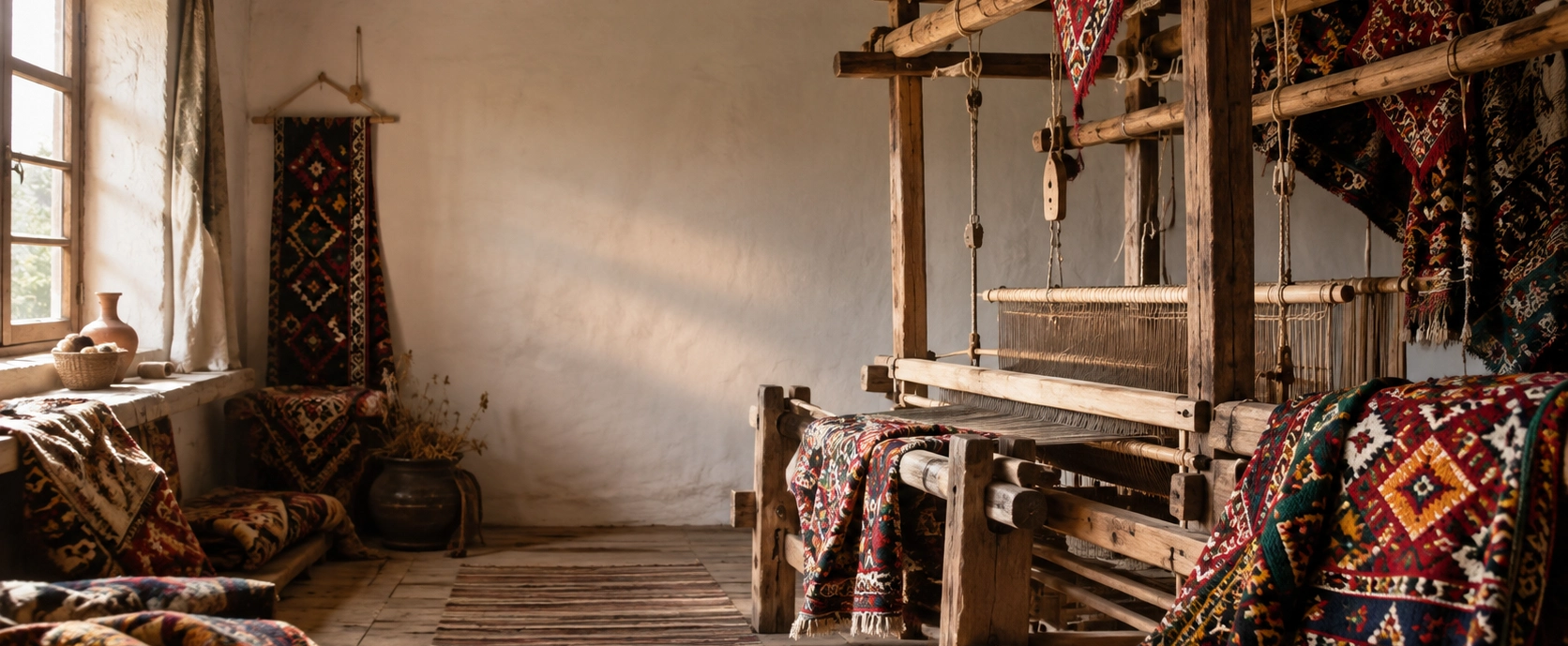
Discover textiles produced on distinctive four-pedal wooden looms traditionally known as a düzen.

12 Traditional Motifs

Look for regional patterns including ram's horn, peacock, oak branch, stars and snowflakes.

Geographical Indication

Karacakılavuz Dimi Dokuması has been officially registered as a protected geographical indication.

Living Cultural Heritage

Experience a craft passed between generations and closely connected with the identity of rural Tekirdağ.

Know the Tradition

Karacakılavuz Weavings – Quick Facts

Essential information about one of Tekirdağ's most important traditional handicrafts.

📍

Origin

Karacakılavuz is a rural neighborhood in the Süleymanpaşa district of Tekirdağ Province.

Open Karacakılavuz on Google Maps
🧶

Craft

Traditional handwoven textiles combining dimi weaving with decorative cicim techniques.

🪡

Traditional Loom

The textiles are woven on four-pedal wooden looms traditionally known locally as a düzen.

🏅

Protected Heritage

Karacakılavuz Dimi Dokuması received geographical indication registration in 2019.


Migration, Memory and Craft

The Story of Karacakılavuz Weaving

A textile tradition carried across the Balkans and preserved in the countryside of Tekirdağ.

Karacakılavuz's weaving tradition cannot be separated from the history of the community itself.

The modern settlement grew substantially when Turkish families from villages around Sevlievo in present-day Bulgaria arrived in the area during 1884–1885.

The newcomers earned their living primarily through agriculture and animal husbandry, but they also continued textile traditions learned from previous generations.

Weaving served very practical purposes. Families needed textiles for everyday rural life, including sacks, cradles, rugs, prayer rugs and saddlebags. At the same time, weaving provided a productive activity during periods when agricultural work was less demanding and could also generate additional household income.

Knowledge was traditionally transmitted within families, particularly between generations of women. Patterns, techniques and local terminology became part of the cultural identity of Karacakılavuz.

Over time, the brightly colored textiles developed a reputation beyond the settlement itself and became one of the best-known examples of traditional handweaving associated with Tekirdağ.

Understanding the Craft

What Makes Karacakılavuz Weaving Special?

The identity of the textiles comes from their weaving method, strong colors, traditional motifs and distinctive regional craftsmanship.

Dimi Weaving

The structural foundation of the textile is created using dimi, or twill weaving, producing the characteristic woven surface on which decoration can be developed.

  • Technique: Dimi / twill
  • Structure: Four-harness weaving
  • Role: Creates the textile foundation

Cicim Decoration

Decorative motifs are worked across the dimi foundation using cicim techniques, producing colorful patterns that stand prominently against the woven background.

  • Technique: Cicim
  • Purpose: Decorative patterning
  • Character: Colorful and geometric

The Four-Pedal Loom

Traditional weaving takes place on a substantial wooden loom known locally as a düzen, historically made using woods such as oak and hornbeam.

  • Local Name: Düzen
  • Pedals: Four
  • Traditional Material: Wood

Traditional Motifs

Twelve principal regional motifs are formally associated with Karacakılavuz Dimi weaving, ranging from animals and plants to stars and symbolic geometric forms.

  • Number: 12 principal motifs
  • Subjects: Nature, animals and symbols
  • Style: Strong geometric interpretation

Bright Colors

Contrasting reds, yellows, greens, blues, blacks and lighter backgrounds give many traditional Karacakılavuz textiles their immediately recognizable appearance.

  • Character: Vivid
  • Effect: Strong contrast
  • Materials: Wool and cotton yarns

Functional Folk Art

Traditional pieces were not originally created simply for display. They were woven for everyday use inside rural homes and for carrying or storing household goods.

  • Examples: Rugs and prayer rugs
  • Household Use: Curtains and cushions
  • Portable Items: Saddlebags and bags

Balkan Heritage

The weaving tradition reflects the cultural memories carried by families who migrated from the Balkans to Thrace during the late Ottoman period.

  • Migration: Late 19th century
  • Region: Bulgaria to Thrace
  • Heritage: Passed between generations

Living Tradition

Karacakılavuz weaving continues to be taught and produced today, helping preserve both traditional techniques and the cultural identity connected with them.

  • Status: Living craft
  • Preservation: Local artisans and training
  • Importance: Cultural continuity

How Karacakılavuz Textiles Are Woven

Creating a traditional Karacakılavuz textile requires considerably more preparation than simply passing a shuttle backwards and forwards across a loom.

The yarn must first be prepared and organized for the warp. Threads are arranged carefully before being transferred onto the loom, passed through the harness system and then through the reed.

Traditional Karacakılavuz dimi weaving uses a four-harness, four-pedal system. The relationship between the pedals and warp threads allows the weaver to create the characteristic twill structure.

The patterned motifs are then developed over this woven ground using cicim decoration. The result is a textile in which structural weaving and decorative patterning become part of the same composition.

1. Prepare the Yarn

Wool or cotton yarn is organized and prepared before the warp is created.

2. Prepare the Warp

The warp threads are carefully measured and arranged before being transferred to the loom.

3. Thread the Loom

Threads pass through the four-harness system and through the reed according to the traditional method.

4. Weave the Dimi Ground

The pedals and shuttle work together to create the distinctive twill foundation.

5. Build the Motifs

Decorative colored yarns create traditional motifs using cicim techniques over the woven ground.

6. Finish the Textile

The completed weaving may become a rug, prayer rug, cushion, wall decoration, bag or another textile object.

The Traditional Düzen Loom

One of the most fascinating elements of Karacakılavuz weaving is the loom itself.

The traditional loom is known locally as a düzen. It is a substantial wooden structure equipped with four pedals and the components required to control, separate and tension the warp threads.

Rather than being a simple decorative object from the past, the loom represents the accumulated technical knowledge required to transform loose yarn into a strong patterned textile.

Traditional Name Düzen
Type Four-pedal handloom
Harnesses Four
Traditional Woods Oak and hornbeam
Main Technique Dimi weaving
Decorative Technique Cicim

The 12 Traditional Karacakılavuz Motifs

Official geographical indication documentation identifies 12 principal regional motifs associated with Karacakılavuz Dimi Dokuması.

Their names reveal how closely traditional textile design was connected with the world surrounding the weavers: domestic animals, plants, weather, household objects and familiar forms all became sources of inspiration.

Köpek Ayağı

The “dog's foot” motif transforms a familiar animal form into a compact geometric pattern.

Koçboynuzu

The ram's horn is one of the best-known forms in Anatolian textile tradition and appears in Karacakılavuz's regional vocabulary.

Koyungözü

The “sheep's eye” motif reflects the close relationship between traditional rural life and animal husbandry.

Kar Taneleri

Snowflake-inspired forms introduce repeating geometric patterns into the textile surface.

Meşe Dalı

The oak branch motif draws directly upon the natural environment and plant forms familiar to rural communities.

Tavus Kuşu

The peacock becomes a stylized decorative form interpreted through colorful woven geometry.

Kilitler

Repeating lock-like forms create strong geometric rhythm across the composition.

Üç Güller

The “three roses” motif brings stylized floral imagery into the traditional pattern vocabulary.

Ayva Göbeği

A locally named motif inspired by the form associated with quince fruit.

Beygir Nalı

The horseshoe motif reflects an object once encountered constantly in traditional village life.

Yıldızlar

Star forms provide some of the tradition's most immediately recognizable repeating geometric designs.

Kandiller

The lamp motif transforms another familiar object into a rhythmic textile pattern.


Important: The traditional names listed here follow the terminology recorded for Karacakılavuz Dimi Dokuması. Similar forms may appear elsewhere in Anatolian weaving traditions under different local names.

Five Traditional Composition Styles

Karacakılavuz textiles are not decorated randomly. Traditional designs can be organized according to several established composition schemes that determine how motifs are distributed across the woven surface.

Horizontal

Motifs and decorative elements develop across the textile in horizontal arrangements.

Vertical

Pattern elements are organized along strong vertical lines or bands.

Scattered

Individual motifs are distributed across the field rather than concentrated around a single center.

Central

The composition develops around a dominant central motif or geometric arrangement.

Mihrab

A directional composition associated particularly with prayer-rug designs.

Yarns and Colors

Traditional Karacakılavuz weaving is strongly associated with the visual impact of brightly colored wool and cotton yarns.

Historic and documented production has used both naturally colored and aniline-dyed yarns, allowing weavers to develop the vivid contrasts that characterize many surviving examples.

Against lighter or darker backgrounds, red, green, yellow, blue, white and black can be combined into complex geometric arrangements that remain clearly visible even from a distance.

Wool

Wool provides texture, warmth and strong color within many traditional woven pieces.

Cotton

Cotton yarn is also part of the documented material tradition of Karacakılavuz weaving.

Strong Contrasts

Bright colors placed beside darker tones allow motifs to remain clearly defined.

Pattern First

Color choices work together with geometric structure to make traditional motifs immediately visible.

What Is Made with Karacakılavuz Weaving?

One of the most interesting aspects of the tradition is its practicality.

Karacakılavuz textiles historically belonged to everyday domestic life rather than existing only as works of art. Their patterns decorated objects that families used, carried and displayed inside their homes.

Kilims & Rugs

Large woven surfaces bring traditional Karacakılavuz color and motifs into the home.

Prayer Rugs

Mihrab-style compositions are particularly suitable for traditional prayer-rug designs.

Saddlebags

Heybe-style bags reflect the practical rural origins of the weaving tradition.

Cushion Covers

Smaller woven surfaces allow traditional motifs to become part of everyday interior decoration.

Curtains

Traditional weaving has also been adapted for decorative textile use inside the home.

Wall Decorations

Patterned textiles and panels allow the craft to be displayed as folk art.

Nazarlık

Small decorative pieces provide another way of preserving traditional weaving techniques and patterns.

Bags

Contemporary artisans can adapt the traditional woven surface to practical modern accessories.

Karacakılavuz Weaving and Geographical Indication

The cultural importance and distinctive production method of the weaving tradition received formal recognition when Karacakılavuz Dimi Dokuması was registered as a Turkish geographical indication.

The application was submitted in 2018 by the Tekirdağ Provincial Directorate of Culture and Tourism, and the registration was completed on 30 October 2019.

Its status is a Mahreç İşareti, identifying a product whose reputation, characteristics or traditional production are closely connected with a defined geographical area.

Registered Name Karacakılavuz Dimi Dokuması
Registration Number 467
Registration Date 30 October 2019
Type Mahreç İşareti
Product Group Traditional weaving
Geographical Area Süleymanpaşa district, Tekirdağ
Registrant Tekirdağ Provincial Directorate of Culture and Tourism

A Living Part of Turkey's Cultural Heritage

Karacakılavuz weaving is important not simply because the finished textiles are beautiful.

The craft preserves knowledge: how to prepare the warp, how to operate the loom, how to construct a dimi surface, where additional threads must pass, how motifs are counted and how patterns are remembered without reducing the tradition to industrial production.

Karacakılavuz weaving has also been recorded within Turkey's Intangible Cultural Heritage National Inventory, reflecting the importance of preserving the knowledge and skills behind the objects themselves.

This makes each authentic handwoven piece part of a much larger story about cultural continuity in Thrace.

Why this matters: Preserving traditional weaving means preserving the knowledge of the artisan as well as the finished textile. Without people who understand the loom, yarn preparation, motifs and techniques, the physical objects alone cannot keep the tradition alive.

Women and the Survival of Karacakılavuz Weaving

Like many traditional textile arts across Anatolia and the Balkans, Karacakılavuz weaving has historically been closely connected with women's domestic knowledge and craftsmanship.

Skills could pass from mother to daughter and from experienced weavers to younger members of the community. In this way, learning to weave also meant learning the patterns, terminology and cultural memories attached to the craft.

Modern courses and preservation projects continue this process in a more organized form, giving new generations an opportunity to work directly with traditional looms and techniques.

For visitors, watching an experienced artisan at a loom reveals something that photographs of finished textiles cannot: the extraordinary amount of concentration, counting, coordination and patience hidden inside every pattern.

Visiting Karacakılavuz

Karacakılavuz lies in the rural interior of the Süleymanpaşa district, approximately 30–32 kilometers from central Tekirdağ by road.

The journey offers a very different perspective from Tekirdağ's Marmara coastline. Here the landscape is dominated by agricultural fields, villages and the broad countryside of eastern Thrace.

Karacakılavuz should not be approached like a conventional museum attraction with guaranteed opening hours and permanent demonstrations. It is a living settlement where weaving activities, workshops, courses and opportunities to meet artisans may vary.

Travelers specifically hoping to see a loom in operation or purchase locally produced weaving should therefore confirm current arrangements before making a special journey.

Province Tekirdağ
District Süleymanpaşa
Location Rural interior northwest of central Tekirdağ
Distance from Tekirdağ Approximately 30–32 km by road
Main Interest Traditional handweaving and rural cultural heritage
Suggested Visit Approximately 1–2 hours when a weaving visit is arranged
Best Transport Private car or organized private vehicle

Visitor note: Workshops, demonstrations, courses and sales are not necessarily available every day. Confirm locally before traveling specifically to see weaving production.

Buying Karacakılavuz Weavings

An authentic Karacakılavuz textile can be one of the most meaningful souvenirs from Tekirdağ because it supports a living regional craft rather than simply reproducing a generic Turkish design.

When purchasing a piece, ask about its origin, whether it was woven locally and which traditional technique or motif has been used.

Handwoven textiles naturally vary. Slight irregularities are not necessarily faults; they can reflect the individual work of the artisan and distinguish handmade production from industrially manufactured fabric.

Ask Who Made It

Knowing the artisan or workshop adds meaning and helps establish the origin of the textile.

Look at the Technique

Traditional Karacakılavuz weaving combines the dimi foundation with decorative cicim work.

Learn the Motif

Ask the maker to identify the traditional motif or composition used in the piece.

Expect Variation

Handmade textiles may show small variations in tension, pattern and finishing.

Check the Label

Products marketed under the registered geographical indication should follow the appropriate labeling requirements.

Support Local Craft

Buying directly from genuine producers helps traditional weaving remain economically sustainable.

Photography of Karacakılavuz Weaving

Traditional weaving provides excellent photographic subjects, from the geometry of finished textiles to the complex arrangement of threads on a working loom.

Artisan at the Loom

Photograph the relationship between the weaver's hands, shuttle, pedals and developing textile.

Traditional Motifs

Close-up photographs reveal the counting, symmetry and small details hidden inside individual patterns.

Color and Texture

Side lighting can emphasize raised decorative threads and the texture of wool and cotton.

The Düzen

Wider photographs of the wooden loom help explain the technical complexity behind the finished textile.

Yarn Preparation

Tools, spools and prepared yarn tell the story of the process before weaving actually begins.

Finished Pieces

Photograph several textiles together to highlight differences in color, motifs and composition.


Photography etiquette: Always ask permission before photographing artisans closely, particularly when visiting a working environment rather than a formal tourist attraction.

How to Get to Karacakılavuz

Karacakılavuz is situated inland from Tekirdağ in the northern countryside of the Süleymanpaşa district.

The settlement can be approached from Tekirdağ using roads through the agricultural interior, including connections in the direction of Banarlı or routes toward the Muratlı side of the district.

For travelers interested specifically in traditional weaving, a private vehicle provides the greatest flexibility because it allows a Karacakılavuz visit to be combined easily with cultural attractions in central Tekirdağ.

From Tekirdağ Approximately 30–32 km
Direction Inland, northwest of central Tekirdağ
Travel Environment Thracian agricultural countryside
Recommended Transport Private car or organized vehicle
Can Combine With Central Tekirdağ's museums, Ottoman monuments and regional cuisine

Karacakılavuz & Tekirdağ Day Itinerary

Morning Begin in central Tekirdağ and explore the city's cultural attractions
Late Morning Drive through the Thracian countryside toward Karacakılavuz
Midday Visit a weaving workshop or cultural activity if arranged in advance
Early Afternoon Examine traditional motifs, looms and locally produced textiles
Afternoon Return toward Tekirdağ and continue exploring museums or Ottoman heritage
Evening Finish with Tekirdağ meatballs, seafood or another regional specialty

This combination works particularly well for travelers who want to experience both the monumental heritage of Tekirdağ and the less visible traditions preserved in its surrounding villages.

Karacakılavuz Visitor Tips

Arrange Ahead

If seeing weaving is your main reason for visiting, confirm that an artisan, workshop or cultural activity will be available.

Allow Time to Watch

A weaving demonstration becomes much more interesting when you have time to understand how the loom and pattern work together.

Ask About Motifs

The names of traditional patterns are one of the most memorable parts of the Karacakılavuz tradition.

Respect Working Artisans

Remember that a loom demonstration may also be someone's genuine working environment.

Ask Before Photographing

Always request permission before taking close portraits or photographing people at work.

Buy Authentic Pieces

When possible, support local producers rather than purchasing generic machine-made imitations.

Examine Both Sides

Looking at the reverse of a textile can help you understand how decorative threads have been incorporated.

Notice the Loom

Do not focus only on the finished textile—the traditional four-pedal düzen is part of the cultural heritage too.

Combine with Tekirdağ

The village can comfortably form part of a broader day exploring the cultural heritage of the province.

Travel with Flexibility

Rural craft experiences do not always operate according to fixed tourist schedules.

Learn the Story

The migration history behind the weaving makes the textiles far more meaningful than their appearance alone suggests.

Choose Meaning Over Size

A small authentic handmade piece can carry more cultural value than a large mass-produced souvenir.

Combine Karacakılavuz with Cultural Tekirdağ

Many travelers know Tekirdağ primarily for its Marmara coastline and food, but Karacakılavuz reveals another side of the province.

A journey here introduces visitors to the rural traditions of Thrace and demonstrates how cultural heritage survives not only in archaeological sites, mosques and museums but also in skills practiced by living communities.

A morning devoted to central Tekirdağ's monuments and museums can therefore be followed by an afternoon exploring Karacakılavuz's weaving heritage.

Explore the City

Begin with Tekirdağ's waterfront, monuments, museums and historic neighborhoods.

Understand the Region

Use the museum collections to place local traditions within the wider history and culture of Tekirdağ.

Meet Living Heritage

Continue inland to discover a cultural tradition that survives through knowledge rather than monumental architecture.

Return for Dinner

Finish the day in Tekirdağ with regional food beside the Sea of Marmara.

Frequently Asked Questions About Karacakılavuz Weavings

What are Karacakılavuz weavings?

Karacakılavuz weavings are traditional handwoven textiles associated with Karacakılavuz in Tekirdağ's Süleymanpaşa district. Their best-known form is Karacakılavuz Dimi Dokuması.

Where is Karacakılavuz?

Karacakılavuz is a rural neighborhood of Süleymanpaşa in Tekirdağ Province, approximately 30–32 kilometers from central Tekirdağ by road.

Why is Karacakılavuz famous?

The settlement is particularly well known for its traditional handweaving, colorful motifs and distinctive combination of dimi and cicim techniques.

What is Karacakılavuz Dimi Dokuması?

It is a traditional textile whose foundation is woven using dimi techniques and whose decorative motifs are worked using cicim techniques.

What type of loom is used?

Traditional Karacakılavuz weaving uses a four-pedal wooden loom known locally as a düzen.

What materials are used?

Documented Karacakılavuz Dimi weaving uses wool and cotton yarns, traditionally producing strongly colored and highly patterned textiles.

How many traditional Karacakılavuz motifs are there?

The official geographical indication specification identifies 12 principal regional motifs.

What are the traditional motifs?

They include Köpek Ayağı, Koçboynuzu, Koyungözü, Kar Taneleri, Meşe Dalı, Tavus Kuşu, Kilitler, Üç Güller, Ayva Göbeği, Beygir Nalı, Yıldızlar and Kandiller.

What products are made from Karacakılavuz weaving?

Traditional products include rugs, prayer rugs, saddlebags, curtains, cushion covers, wall decorations and nazarlık pieces, while contemporary artisans may also adapt the textiles into bags and other objects.

Is Karacakılavuz weaving geographically protected?

Yes. Karacakılavuz Dimi Dokuması is registered in Turkey as a geographical indication under registration number 467.

When was Karacakılavuz Dimi Dokuması registered?

Its geographical indication registration was completed on 30 October 2019.

What type of geographical indication does it have?

Karacakılavuz Dimi Dokuması is registered as a Mahreç İşareti.

Why did weaving become important in Karacakılavuz?

The craft supplied rural households with useful textiles while also allowing families to continue skills passed down through generations and generate additional income.

Where did the weaving tradition come from?

The tradition is closely associated with families who settled in Karacakılavuz after migrating from villages in present-day Bulgaria during the late nineteenth century.

When did migrants settle in Karacakılavuz?

Historical cultural sources record significant settlement by migrant families from Bulgaria during 1884–1885.

Is Karacakılavuz weaving still practiced?

Yes. Local artisans and cultural initiatives continue to preserve and teach the traditional weaving techniques.

Can visitors watch Karacakılavuz weaving?

Opportunities may be available through local artisans, courses or cultural activities, but they should be confirmed in advance because regular tourist demonstrations are not guaranteed.

Can I buy Karacakılavuz weaving?

Locally produced textiles may be available from artisans or cultural initiatives. Availability varies, so visitors looking for a specific piece should check before traveling.

How can I recognize authentic Karacakılavuz weaving?

Ask about where the textile was produced, the weaving technique, the traditional motif and whether the product is connected with the registered geographical indication.

What is cicim weaving?

Cicim is a decorative weaving technique in which additional colored yarns are incorporated into a woven ground to form motifs and patterns.

What is dimi weaving?

Dimi is a twill-based weaving structure. In Karacakılavuz, it forms the ground over which traditional cicim motifs are applied.

What are the traditional composition styles?

Karacakılavuz textiles can use horizontal, vertical, scattered, central and mihrab-style composition schemes.

Is Karacakılavuz weaving part of intangible cultural heritage?

Yes. Karacakılavuz weaving has also been recorded within Turkey's national inventory of intangible cultural heritage.

Is Karacakılavuz worth visiting?

It is particularly worthwhile for travelers interested in textiles, folk art, rural culture, traditional craftsmanship and the migration history of Thrace.

How long should I spend in Karacakılavuz?

Around one to two hours can be suitable for a pre-arranged weaving visit, although the total time will depend on the activity and whether you are meeting local artisans.

Can Karacakılavuz be visited from Tekirdağ?

Yes. Its location within the Süleymanpaşa district makes it suitable for a half-day excursion or for inclusion in a full-day Tekirdağ cultural itinerary.

Do I need a car?

A private vehicle is the most convenient option for travelers combining Karacakılavuz with central Tekirdağ and other attractions around the province.

What can I combine with Karacakılavuz?

The weaving village combines particularly well with central Tekirdağ, the Archaeology and Ethnography Museum, Rákóczi Museum, Rüstem Pasha Mosque and the city's regional food experiences.

Why are Karacakılavuz textiles culturally important?

They preserve traditional weaving knowledge, regional motifs, the memory of Balkan migration and skills that have been passed between generations in rural Tekirdağ.


Karacakılavuz & Tekirdağ Private Experiences

Karacakılavuz can be included in a tailor-made private journey focused on Tekirdağ's traditional crafts, rural heritage, historic monuments and regional cuisine.

Private Karacakılavuz Cultural Experience

Travel beyond Tekirdağ's famous waterfront and discover a traditional textile heritage preserved in the countryside of Thrace.

Traditional Crafts & Cultural Tekirdağ

Create a private cultural route connecting living village traditions with the historic attractions of central Tekirdağ.