Ancient Heracleia, Sacred Latmos & the Lost Gulf of the Aegean

Bafa Lake Nature Park & Heracleia Ancient City

Discover one of western Türkiye's most extraordinary landscapes,
where ancient ruins, sacred mountains, Byzantine monasteries and wildlife meet beside a legendary lake.

Explore Bafa Lake & Heracleia

Bafa Lake & Heracleia – Where Archaeology Becomes Landscape

Between the Aegean towns of Söke and Milas lies one of the most remarkable combinations of nature, archaeology, mythology and rural landscape in western Türkiye: Bafa Lake Nature Park and the ancient city of Heracleia by Latmos.

The scenery appears almost timeless.

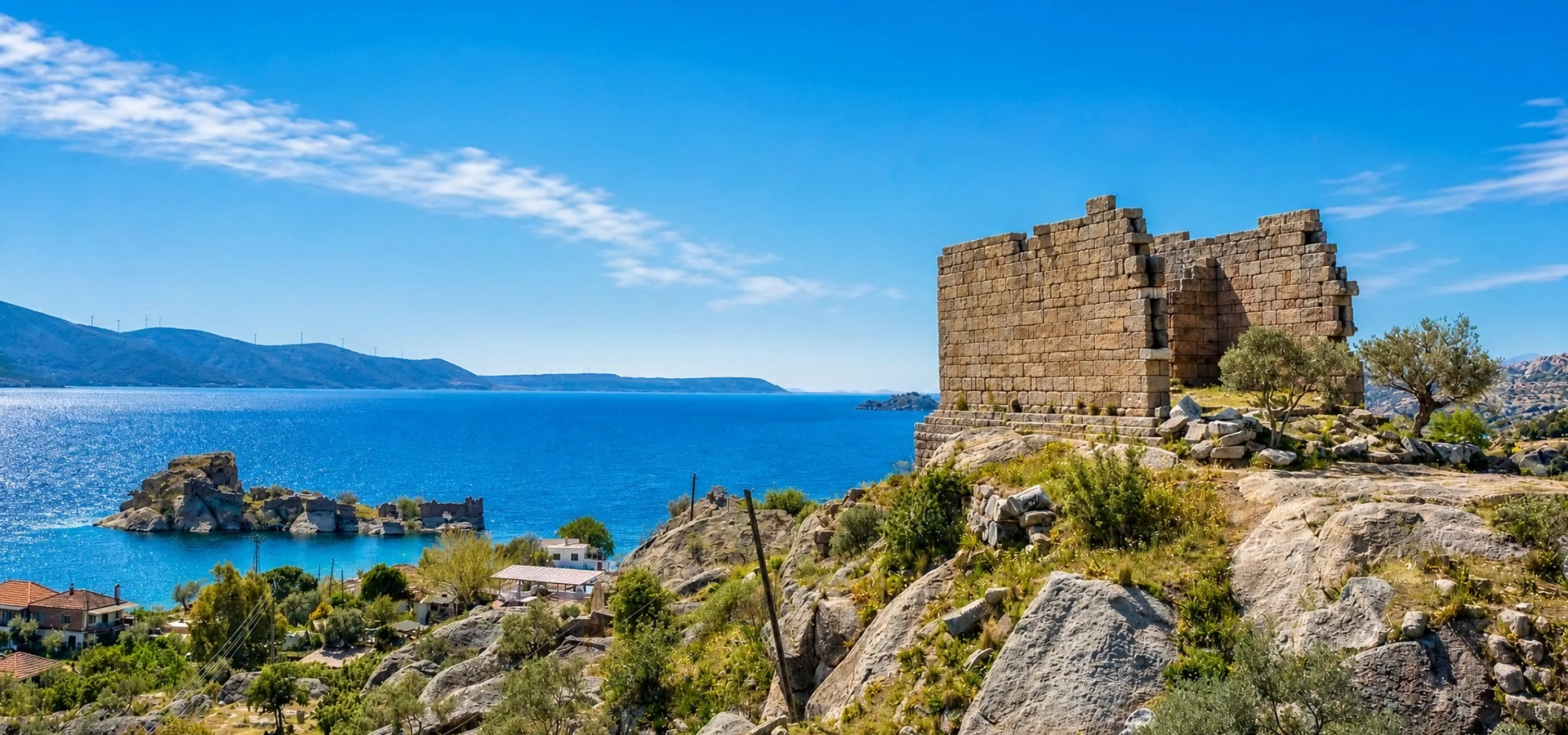
Ancient walls disappear between olive trees, enormous weathered boulders rise above village houses, Byzantine ruins stand on islands in the lake and the dramatic Beşparmak Mountains — ancient Mount Latmos dominate the eastern horizon.

Yet the lake itself tells an even more extraordinary story.

Bafa was not always an inland lake. In antiquity, this landscape formed part of the Latmian Gulf, an inlet connected directly with the Aegean Sea.

Over centuries, sediments carried by the Büyük Menderes River gradually transformed the coastline, separating the gulf from the sea and creating the lake visible today.

Along its eastern shore stands Kapıkırı Village, built directly among the remains of Heracleia Ancient City.

Here, visitors can walk between houses, olive groves and ancient monuments while discovering Hellenistic fortifications, the Temple of Athena, the agora, theatre and the legendary Sanctuary of Endymion.

Beyond the ancient city, the wider Latmos landscape preserves prehistoric rock paintings, Byzantine monasteries, hermit caves, historic paths and sacred landscapes stretching deep into the mountains.

Ancient Heracleia

Explore a Hellenistic city where monumental walls, temples and civic buildings survive among the houses and olive groves of modern Kapıkırı.

Bafa Lake Nature Park

Discover a protected wetland landscape supporting rich birdlife, endemic plants, islands and dramatic mountain scenery.

Sacred Mount Latmos

Follow a cultural landscape associated with ancient mythology, prehistoric communities and centuries of Byzantine monastic life.

A Lost Aegean Gulf

Stand beside a lake that was once connected directly with the sea and understand how the Büyük Menderes reshaped the entire coastline.


Know Before You Go

Bafa Lake & Heracleia – Quick Facts

Essential information about Bafa Lake Nature Park, ancient Heracleia, Kapıkırı and the extraordinary archaeological landscape of Mount Latmos.

Location

Kapıkırı and Bafa Lake, between Söke in Aydın Province and Milas in Muğla Province.

Open on Google Maps

Protected Landscape

Bafa Lake Nature Park was established in 1994 to protect approximately 12,281 hectares of natural and cultural landscape.

Ancient City

Heracleia by Latmos, an important Carian and Hellenistic city built beside the ancient Latmian Gulf.

Mountain

The Beşparmak Mountains rising above the lake were known in antiquity as Mount Latmos.

Wildlife

The protected area supports extensive wetland habitat and hundreds of recorded bird species.

Best Experience

Combine ancient Heracleia, Kapıkırı, lakeside scenery, birdlife and the Latmos landscape in one relaxed visit.

Nature, Archaeology and Mythology in One Landscape

Why Is Bafa Lake & Heracleia So Important?

Few destinations in western Türkiye reveal so clearly how geography, human settlement, religion and nature can remain connected across thousands of years.

Bafa Lake cannot be understood simply as a natural attraction, and Heracleia cannot be understood simply as an archaeological site.

They form a single cultural landscape.

The lake explains why ancient settlements developed here. The mountains explain why the region became sacred. The transformation of the coastline explains why maritime cities eventually lost their harbours.

Later, isolation and difficult terrain helped transform Latmos into one of western Anatolia's important Christian monastic landscapes.

Even earlier, prehistoric communities left painted human figures among the granite formations of the mountains.

The result is an extraordinary concentration of prehistoric art, Classical archaeology, mythology, Byzantine heritage, traditional villages and protected wetland ecosystems.

How Was Bafa Lake Formed?

One of the most fascinating aspects of Bafa Lake is that its present landscape is relatively young in geological and historical terms.

During antiquity, the lake formed part of the Latmian Gulf, an eastern extension of the Aegean Sea.

Heracleia, Miletus, Myus and other settlements in the region therefore developed within a maritime environment very different from the modern landscape.

The transformation occurred because the Büyük Menderes River continuously deposited enormous quantities of sediment across its lower valley.

Over centuries, these alluvial deposits pushed the coastline progressively westward.

Eventually the former gulf became separated from the open sea.

What had once been maritime water gradually became the enclosed lake now known as Bafa Gölü.

Ancient Latmian Gulf

The landscape once opened directly toward the Aegean and supported maritime settlements and harbours.

Büyük Menderes

Sediment carried downstream gradually accumulated across the ancient gulf.

Changing Coastline

The shoreline moved westward as former bays and harbour areas became increasingly shallow.

Modern Bafa Lake

The enclosed remnant of the ancient gulf now forms one of the most distinctive lake landscapes of the southern Aegean.

Look at the landscape like an archaeologist: When standing at Heracleia, imagine ships approaching where the lake lies today. Understanding that transformation completely changes the way the ancient city is experienced.

Bafa Lake Nature Park

The natural and cultural importance of Bafa Lake led to the establishment of Bafa Gölü Tabiat Parkı — Bafa Lake Nature Park in 1994.

The protected landscape covers approximately 12,281 hectares and includes the lake together with important sections of its surrounding environment.

The lake itself covers roughly 6,700 hectares and reaches a maximum depth of approximately 25 metres.

Its setting is exceptionally dramatic.

The Beşparmak Mountains rise immediately to the north and east, while lower mountain landscapes and plains extend toward the south and west.

Olive groves, tamarisk, pine woodland, rocky slopes, wetlands and open water create a surprisingly diverse ecological mosaic.

Protected since 1994

Nature Park status protects an important landscape containing both ecological and cultural heritage.

12,281 Hectares

The protected area extends well beyond the open water and includes significant surrounding habitats.

Mountain & Wetland

Few nature parks combine such extensive lake habitat with steep rocky mountain terrain.

Living Cultural Landscape

Villages, olive cultivation, ancient monuments and traditional paths remain part of the modern environment.

Wildlife & Birdlife at Bafa Lake

Bafa Lake is particularly important as a habitat for birds.

Open water, reed beds, shallow shoreline zones, rocky islands and surrounding mountain habitats create feeding, resting and breeding opportunities for many species.

Official nature conservation inventories record more than 260 bird species within the wider protected area.

Pelicans, cormorants, herons, raptors and numerous migratory waterbirds may be encountered depending on season and conditions.

The landscape also supports reptiles, mammals and a surprisingly rich diversity of plants.

This biodiversity is one reason Bafa should be experienced slowly rather than treated only as a viewpoint beside the highway.

Waterbirds

Shallow areas and quieter shorelines provide feeding and resting habitat for many migratory and resident species.

Pelicans

Pelicans are among the most recognisable large birds associated with the wider Bafa and Büyük Menderes wetland landscape.

Cormorants

Cormorants can often be associated with the lake's productive aquatic environment and rocky resting places.

Birds of Prey

The mountains surrounding Bafa provide habitat for raptors as well as wetland species.

Reptiles & Mammals

The protected area also supports diverse terrestrial wildlife beyond its better-known bird populations.

Native Flora

Olive landscapes, tamarisk, pine woodland and endemic plants contribute to the ecological richness of the park.

Bring binoculars: Even visitors primarily interested in archaeology may discover that birdwatching becomes an unexpected highlight of the Bafa Lake experience.

The Islands of Bafa Lake

Five principal islands are identified within Bafa Lake: İkiz Ada, Menet Adası, Kapıkırı Adası, Kahve Asar Adası and Uyuz Ada.

These small islands add dramatically to the visual character of the lake.

More importantly, several preserve remains associated with the Byzantine defensive and monastic landscape that developed around Latmos.

From the shore at Kapıkırı, ancient and medieval masonry can sometimes appear almost to rise directly from the water.

The effect makes Bafa Lake feel less like a conventional archaeological destination and more like an enormous open-air historical landscape.

The lake is part of the archaeological story: Structures visible on islands and along the shoreline demonstrate that settlement, defence and religious life extended far beyond the central ruins of Heracleia.

Heracleia Ancient City

The ruins of Heracleia by Latmos stand within and around modern Kapıkırı Village on the eastern shore of Bafa Lake.

Although geographically close to the ancient Ionian world, Heracleia is generally understood through its strong Carian historical and cultural connections.

The settlement was originally associated with the name Latmos.

It later became known as Heracleia, taking its name from the mythological hero Herakles.

The city reached particular prominence during the Hellenistic period, when monumental walls enclosed the rugged slopes above the ancient gulf.

Its strategic setting offered access to maritime trade while the surrounding mountains provided natural defence.

Today, the remains are unusually atmospheric because the modern village did not develop beside the ruins.

It developed inside them.

The History of Heracleia by Latmos

Settlement around Mount Latmos extends far deeper into the past than the monumental ruins visible at Heracleia today.

The region's prehistoric paintings demonstrate human activity in the mountains thousands of years before the Classical city flourished.

By the first millennium BC, a settlement known as Latmos had developed within this culturally Carian landscape.

During the Persian period the region came under the authority of the Carian dynast Mausolos, whose rule reshaped many cities throughout southwestern Anatolia.

Following the campaigns of Alexander the Great, political control changed repeatedly during the Hellenistic period.

The fortified city visible today developed most dramatically during this era.

Official regional heritage sources associate an important expansion of its city walls with Lysimachos around 287 BC.

During the Roman period Heracleia continued to exist, but the progressive silting of the Latmian Gulf gradually weakened the maritime advantages that had supported regional prosperity.

As the landscape became increasingly isolated from the sea, the role of the settlement changed again.

By the Byzantine period, Latmos had become famous not for maritime commerce but for Christian religious communities, monasteries and hermits.

Ancient Latmos

The earliest historical city inherited the name of the sacred mountain dominating the region.

Carian World

Heracleia developed within the cultural and political landscape of ancient Caria.

Hellenistic City

Monumental fortifications and an organised urban plan transformed the settlement.

Roman Period

Heracleia continued to occupy an important regional position even as its maritime geography changed.

Byzantine Latmos

The mountains later became an important centre for churches, monasteries and ascetic communities.

Modern Kapıkırı

The living village now occupies the ancient city and gives Heracleia its distinctive character.

The City Walls of Heracleia

Heracleia's fortifications are among the most impressive features of the archaeological site.

The wall circuit stretches for approximately 6.5 kilometres across extremely rugged terrain.

Ancient builders did not attempt to ignore the landscape.

Instead, the fortifications climb hills, cross rocky slopes and incorporate the natural topography into a sophisticated defensive system.

Approximately 65 towers strengthened the circuit.

Large, carefully cut rectangular blocks demonstrate the high standard of Hellenistic masonry employed in the city's defences.

Some sections remain remarkably dramatic today, particularly where stone walls meet the enormous natural boulders for which Latmos is famous.

6.5 km Circuit

The extensive walls enclosed a much larger area than the compact modern village might initially suggest.

65 Towers

Regular defensive towers strengthened vulnerable sections and provided wide views across the surrounding landscape.

Hellenistic Masonry

Carefully shaped blocks demonstrate the engineering ability invested in the city's defence.

Natural Defence

Steep slopes, giant rocks and mountain ridges became part of the defensive strategy.

Do not judge Heracleia only from the village centre: Some of the most impressive fortification remains extend onto the surrounding slopes, revealing the true scale of the ancient city.

The Urban Plan of Heracleia

Heracleia demonstrates an intriguing contrast between strict urban planning and extremely irregular natural terrain.

The Hellenistic city was organised according to a grid-based plan with streets and urban blocks arranged systematically across the slopes.

Applying such an organised system to the rocky landscape of Latmos required significant engineering and adaptation.

Public buildings occupied important terraces while residential areas extended across the slopes within the defensive walls.

The surviving remains allow visitors to see how ancient planners negotiated between geometry and geology.

This relationship between architecture and landscape is one of the most fascinating aspects of Heracleia.

The Temple of Athena

The Temple of Athena is one of the most recognisable monuments within Heracleia.

It stands on elevated rocky ground overlooking the former harbour landscape.

The temple belongs to the Hellenistic period and was constructed in the templum in antis architectural form.

Although modest in scale compared with the enormous sanctuaries of nearby Didyma or Ephesus, its setting gives it exceptional visual power.

Ancient masonry stands directly against massive natural rock formations while Bafa Lake stretches into the distance below.

The location demonstrates how deliberately sacred architecture was integrated with the dramatic scenery of Latmos.

One of the classic Heracleia photographs: Look for viewpoints where the stone remains of the Athena Temple can be photographed with Bafa Lake and the surrounding mountains behind them.

The Agora of Heracleia

Immediately east of the Athena Temple lies the ancient agora, the principal civic and commercial gathering place of Heracleia.

In Classical and Hellenistic cities, the agora was far more than a marketplace.

It functioned as a centre of daily communication, commercial exchange, public administration and civic identity.

At Heracleia, the terrain required the agora to be carefully terraced.

Parts of the southern side were constructed on two levels, and sections of ancient walls and shop spaces remain visible.

Although the monumental architecture is fragmentary today, understanding the function of this area helps transform scattered masonry into the living centre of an ancient city.

The Theatre, Bouleuterion & Public Buildings

Heracleia contained the civic buildings expected of an important Hellenistic and Roman city.

Among the surviving remains are the theatre, bouleuterion, bath structures and other public architecture.

The theatre lies toward the northeastern part of the ancient settlement.

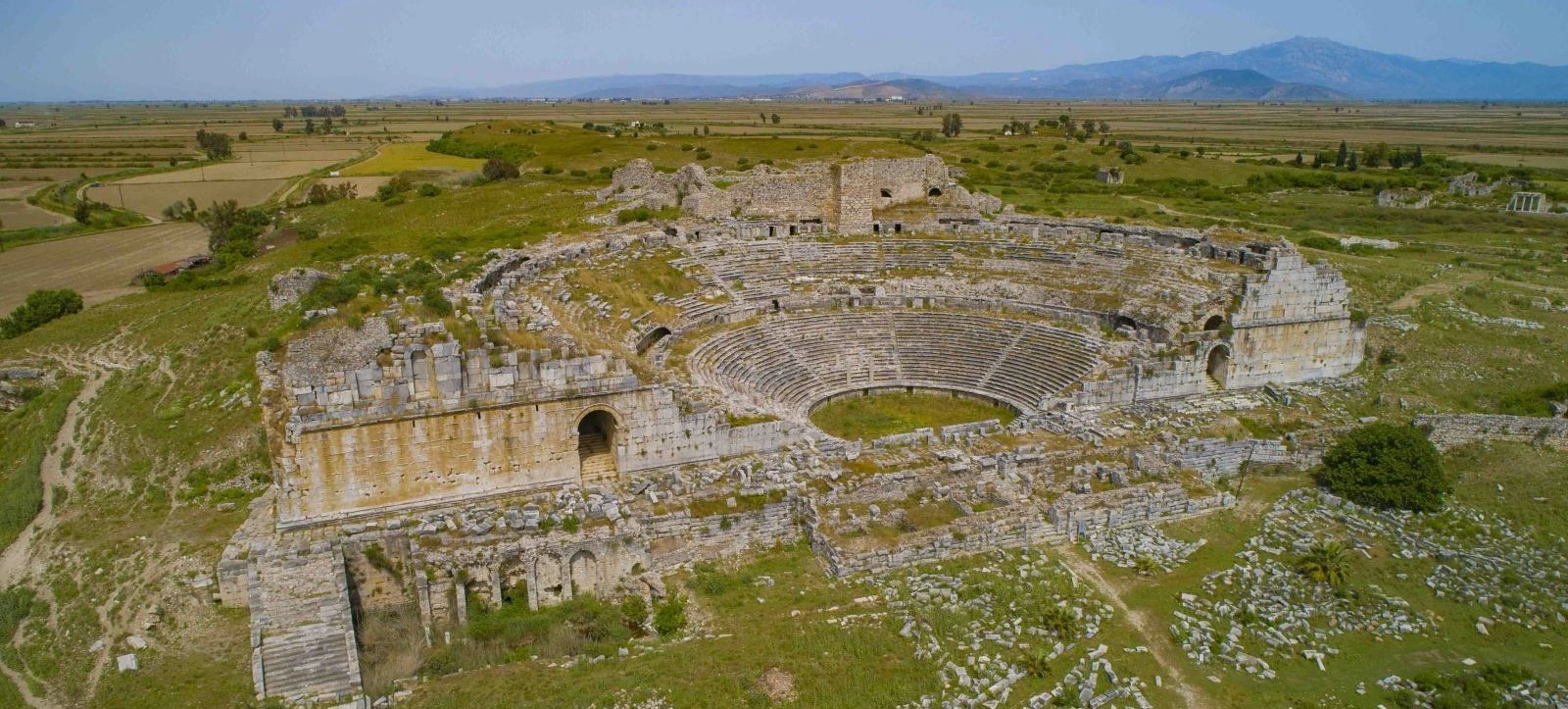
Although much of the seating has been disturbed, sections of the cavea and walls belonging to the stage structure remain visible.

The bouleuterion or council building represents the political dimension of urban life, where local civic decisions could be discussed by representatives of the community.

Theatre

The surviving cavea and stage remains reveal the city's tradition of public performance and assembly.

Bouleuterion

The council building belonged to the administrative and political centre of the city.

Baths

Public bathing formed an important part of social and civic life during the later history of Heracleia.

Urban Terraces

Buildings were adapted carefully to the steep and rocky slopes surrounding the civic centre.

Endymion, Selene & the Mythology of Latmos

Few ancient landscapes are as closely connected with mythology as Mount Latmos.

According to Greek tradition, Endymion was an exceptionally beautiful young shepherd associated with the mountains.

The moon goddess Selene fell deeply in love with him.

Different versions of the myth explain what happened next in different ways, but Endymion ultimately entered an eternal sleep in which his youth and beauty would never disappear.

Selene could then descend from the night sky to visit him.

The story connected the moon, sleep, love and the mysterious mountainous landscape of Latmos.

An ancient sanctuary dedicated to Endymion survives near Heracleia.

Its unusual architectural form and powerful natural setting make it one of the most evocative places associated with the myth.

Endymion

A beautiful mortal traditionally associated with shepherding and the sacred landscape of Latmos.

Selene

The ancient Greek goddess and personification of the Moon who fell in love with Endymion.

Eternal Sleep

The myth preserves the idea of Endymion sleeping forever while remaining eternally young.

Latmos

The mountain itself became inseparable from the legend and remained a sacred landscape for generations.

Visit the sanctuary with the landscape in mind: The Endymion story becomes much more powerful when experienced beneath the giant rocks of Latmos rather than treated only as mythology in a book.

Mount Latmos – Today's Beşparmak Mountains

The rugged mountain landscape surrounding the northeastern shore of Bafa Lake is known today as the Beşparmak Mountains.

In antiquity it was Mount Latmos.

Its immense rounded rocks, narrow valleys, natural shelters and isolated peaks create one of western Anatolia's most distinctive mountain environments.

The mountain was sacred long before Christianity reached the region.

Ancient routes crossed its slopes toward sanctuaries and settlements, while mythology connected the mountain permanently with Endymion and Selene.

Thousands of years earlier, prehistoric communities had already painted human figures within rock shelters.

Centuries later, Byzantine monks transformed caves and remote valleys into places of worship and contemplation.

Few mountains in Türkiye preserve so many overlapping layers of sacred history.

Prehistoric Latmos

Rock paintings demonstrate human use of the mountain landscape thousands of years before Heracleia flourished.

Mythological Latmos

Ancient tradition permanently connected the mountain with Endymion and the moon goddess Selene.

Classical Latmos

Settlements, sacred routes and fortified landscapes developed around the mountain and ancient gulf.

Christian Latmos

Monks, hermits and religious communities established churches and monasteries throughout the remote terrain.

The Prehistoric Rock Paintings of Latmos

Among the greatest archaeological treasures of the wider Bafa landscape are the prehistoric rock paintings of Mount Latmos.

Many are dated to approximately 8,000 years ago.

They are particularly important because their subjects differ from the hunting imagery commonly associated with prehistoric rock art elsewhere.

Instead, many Latmos compositions focus on human beings, couples, families and social interaction.

Male and female figures appear repeatedly, often painted using red pigment.

These images provide extraordinary evidence for the communities that inhabited or moved through the mountains long before the rise of Classical civilisation.

The paintings are distributed across the wider Latmos range and should not be imagined as a conventional museum or compact archaeological site.

Reaching individual locations can involve mountain paths, difficult terrain and local route knowledge.

These paintings are extremely fragile: Never touch, wet, trace or apply anything to prehistoric pigments. For more remote sites, travelling with an experienced local guide is strongly recommended.

The Byzantine Monastic Landscape of Latmos

The decline of ancient maritime commerce did not mean the end of human importance around Latmos.

During the Byzantine period, the remote terrain became attractive to Christian monks and hermits seeking isolation.

Between approximately the seventh and ninth centuries, the region developed into an important religious landscape.

Churches, monasteries, chapels, defensive structures and hermit shelters spread across the mountains and islands.

Natural caves and enormous rock formations often became incorporated directly into religious architecture.

The ruins visible around Bafa Lake therefore belong to several very different historical worlds: Hellenistic Heracleia below, Byzantine monasteries above and prehistoric paintings deeper in the mountains.

Mountain Monasteries

Religious communities established monasteries in isolated valleys and beneath massive natural rock shelters.

Hermit Caves

Natural shelters provided ideal locations for monks seeking solitude away from settled communities.

Island Ruins

Several islands in Bafa Lake preserve remains associated with Byzantine religious and defensive activity.

Frescoes

Fragments of Byzantine religious painting survive in parts of the wider monastic landscape.

Yediler Monastery

One of the best-known Byzantine monuments in the wider Latmos landscape is Yediler Monastery.

The complex lies within the rugged Beşparmak Mountains and is reached on foot rather than as part of an ordinary roadside archaeological visit.

Its secluded position immediately explains why monastic communities were drawn to this landscape.

Rock shelters, narrow paths, olive groves and vast granite formations create a setting that feels profoundly removed from the modern world.

The surrounding area also preserves additional religious remains and traces of fresco decoration.

Yediler requires more time: Do not treat the monastery as a quick extension of a short Heracleia visit. Mountain walking conditions, heat and route-finding should all be considered before setting out.

Kapıkırı Village

One of the most memorable aspects of Heracleia is the relationship between archaeology and modern Kapıkırı Village.

Ancient walls do not sit behind a single fence separated from everyday life.

They appear between houses, gardens, olive trees, village roads and animal enclosures.

Modern buildings and ancient stonework occupy the same landscape.

This makes Heracleia fundamentally different from highly reconstructed archaeological sites.

Visitors encounter the city gradually: a section of wall beside a path, a monumental block beneath an olive tree, a temple overlooking village roofs and Bafa Lake appearing unexpectedly between ancient stones.

Kapıkırı remains a living community, so visitors should always remember that they are walking not only through an archaeological site but also through people's neighbourhood and agricultural landscape.

Living Heritage

Village life continues directly among structures belonging to the ancient settlement.

Olive Groves

Traditional olive cultivation contributes strongly to the character of the landscape.

Lakeside Setting

Kapıkırı offers some of the most beautiful close-range views over Bafa Lake.

Ancient Stones Everywhere

Archaeological remains appear throughout the settlement rather than only in one monumental zone.

What Is It Like to Visit Bafa Lake & Heracleia?

Visiting Heracleia feels very different from exploring a large organised archaeological site such as Ephesus or Aphrodisias.

There is less separation between monument and landscape.

The experience is closer to walking through a historical environment that has continued evolving for thousands of years.

Begin among the village lanes of Kapıkırı and look for the Temple of Athena, agora and other central remains.

As you move outward, sections of city wall reveal the immense scale of the ancient settlement.

Between monuments, Bafa Lake constantly reappears.

Above everything rise the extraordinary boulders and ridges of Mount Latmos.

Explore Kapıkırı

Begin with the village and central remains of Heracleia.

Find Athena Temple

Visit one of the city's best-preserved monuments and enjoy its elevated position above the lake.

Walk toward the Walls

Follow sections of the enormous Hellenistic defensive system into the surrounding terrain.

Visit Endymion

Connect the archaeological landscape with the mythology of Selene and the sacred mountain.

Watch the Lake

Leave time simply to experience the changing light, birdlife and mountain reflections.

Stay for Late Afternoon

The rocky landscape becomes particularly atmospheric as the temperature drops and the light softens.

Photography at Bafa Lake & Heracleia

Bafa Lake is one of the most visually distinctive archaeological landscapes in western Türkiye.

Rather than a single famous monument, the attraction comes from the way different elements overlap: water, mountains, ancient masonry, village houses, olive trees, birds and enormous granite rocks.

The ruins around Kapıkırı provide endless opportunities for combining foreground archaeological details with the lake beyond.

Morning light can produce calm reflections across the water, while late afternoon reveals texture in the rocks and ancient walls.

Athena Temple

Use the temple and surrounding rocks as foreground elements against Bafa Lake.

Lakeside Ruins

Ancient and Byzantine structures close to the water create some of the area's most distinctive compositions.

Kapıkırı Village

Photograph the relationship between village houses, olive groves and archaeological remains.

Latmos Rocks

The enormous rounded formations of the Beşparmak Mountains provide extraordinary natural backgrounds.

Birdlife

Longer lenses can reveal another side of Bafa through waterbirds and birds of prey.

Reflections

Calm weather can produce beautiful reflections of ruins, islands and mountains across the lake.

Sunrise & Sunset at Bafa Lake

Light transforms Bafa Lake continuously.

Early morning can bring quiet water, misty mountain layers and particularly peaceful conditions around Kapıkırı.

During the day, the strong Aegean sun emphasises the contrast between pale ancient stones, dark olive trees and blue water.

Late afternoon softens the landscape and reveals the textures of the granite formations surrounding Heracleia.

As evening approaches, reflections across the lake can turn the archaeological shoreline into one of the most atmospheric scenes in the region.

Travellers interested in photography should consider allowing significantly more time than would be required simply to inspect the principal monuments.

Walking & Hiking around Bafa Lake

Walking is one of the best ways to understand the relationship between Heracleia and Mount Latmos.

Short walks around Kapıkırı reveal ancient monuments and sections of the fortification system.

Longer mountain routes lead toward Byzantine sites, prehistoric rock paintings and remote landscapes within the Beşparmak range.

Parts of the wider area also connect with the Carian Trail, one of Türkiye's major long-distance walking routes.

Mountain routes should not be underestimated.

Terrain can involve exposed rock, loose surfaces, steep sections and limited shade.

Village Walk

Ideal for visitors concentrating on the central monuments of Heracleia and Kapıkırı.

City Walls

Longer walks reveal the extraordinary scale of Heracleia's defensive circuit.

Latmos Trails

Mountain paths connect olive groves, archaeological remains and remote natural landscapes.

Carian Trail

Sections of the long-distance route pass through the wider Bafa and Latmos landscape.

Guided Routes

A knowledgeable guide is particularly useful for prehistoric paintings and isolated Byzantine sites.

Carry Water

Summer heat and exposed mountain terrain make adequate water, sun protection and suitable footwear essential.

Visiting Bafa Lake & Heracleia with Children

Bafa can be an excellent destination for families because history is visible within a real landscape rather than confined entirely to museum displays.

Children can follow ancient walls, look for towers, watch birds on the lake and imagine the time when ships travelled through the ancient Latmian Gulf.

The myth of Selene and Endymion also provides an accessible introduction to ancient mythology.

Families should remember, however, that archaeological terrain can be uneven and some areas involve exposed rocks, slopes and limited shade.

Find the Towers

Challenge younger visitors to identify surviving sections of Heracleia's ancient fortifications.

Imagine the Sea

Explain that the modern lake was once part of a gulf connected with the Aegean.

Tell the Endymion Story

The legend of the moon goddess and the eternal sleeper gives the mountain landscape an unforgettable story.

Watch for Birds

Binoculars can turn a historical visit into a wildlife experience as well.

Accessibility at Heracleia & Bafa Lake

Visitors should expect Heracleia to be considerably less uniform than a modern museum environment.

The ancient city lies across uneven natural terrain within and around a living village.

Stone paths, rocky surfaces, gradients and irregular archaeological areas can create difficulties for visitors with limited mobility.

Some lakeside viewpoints and parts of Kapıkırı are easier to experience than the more distant fortification or mountain routes.

Village Roads

Some central areas can be approached relatively easily through Kapıkırı.

Uneven Ground

Ancient monuments frequently involve natural rock, stone surfaces and rough paths.

Mountain Terrain

Remote Latmos sites require significantly greater physical mobility and walking ability.

Plan Selectively

Visitors with mobility concerns can still enjoy the lake and selected archaeological viewpoints without attempting demanding trails.

How Long Do You Need at Bafa Lake & Heracleia?

Bafa can be visited briefly, but its greatest strength is the depth and variety of the landscape.

1 Hour

Suitable only for a short lakeside stop, village views and a glimpse of the central archaeological remains.

2 Hours

Enough for Kapıkırı, the Temple of Athena, selected ruins and several lakeside viewpoints.

3–4 Hours

Recommended for a more meaningful Heracleia visit including mythology, city walls, photography and relaxed exploration.

Full Day

Ideal for combining Heracleia with nature observation and additional exploration of the Latmos landscape.

Multiple Days

Best for serious hikers, photographers and travellers seeking prehistoric paintings, Byzantine monasteries and remote mountain routes.

Photography Visit

Allow extra time if you want to experience changing morning or evening light over the lake.

Bafa Lake & Heracleia Visitor Information

The principal archaeological area of Heracleia lies within and around Kapıkırı Village on the eastern side of Bafa Lake.

Visitors should remember that this is simultaneously a protected natural landscape, archaeological environment and living village.

Access arrangements, archaeological work, road conditions and individual walking routes can change, so travellers planning remote mountain sites should confirm local conditions before setting out.

Destination Bafa Lake Nature Park & Heracleia by Latmos
Village Kapıkırı
Provinces Aydın & Muğla, Türkiye
Nature Park Established in 1994
Protected Area Approximately 12,281 hectares
Lake Depth Up to approximately 25 metres
Ancient City Heracleia by Latmos
Principal Ancient Sites Athena Temple, Agora, city walls, theatre, bouleuterion and Endymion Sanctuary
Wider Heritage Prehistoric rock paintings, Byzantine monasteries, island ruins and Mount Latmos
Recommended Time Approximately 3–4 hours for Heracleia; longer for wider Latmos exploration
Best For Archaeology, nature, mythology, hiking, photography and birdwatching
Before visiting: Wear good walking shoes and carry water, particularly during warm weather. Remote mountain sites should be approached with appropriate route knowledge and preparation.

How to Get to Bafa Lake & Heracleia

Bafa Lake lies beside the principal road corridor connecting Söke and Milas.

The lake itself is easily visible from sections of the main road, but travellers visiting Heracleia need to continue toward Kapıkırı Village on the eastern shore.

Heracleia is approximately 39 kilometres from Milas according to regional cultural heritage information.

A private vehicle provides the greatest flexibility, particularly when combining the site with Miletus, Priene or other destinations in the Büyük Menderes region.

From Milas

Travel north toward Bafa and turn from the main Söke–Milas road toward Kapıkırı and Heracleia.

From Söke

Travel south toward Bafa Lake before continuing around the lake toward the Kapıkırı access road.

From Bodrum

Bafa makes an excellent archaeological and nature excursion when travelling north from the Bodrum region.

From Kuşadası

The route can be combined particularly well with Priene, Miletus and the landscapes of the Büyük Menderes valley.

Private Vehicle

The most practical choice for combining archaeological sites and allowing time for photography around the lake.

Guided Excursion

A private guide adds considerable value when interpreting the complicated relationship between Heracleia, Latmos, mythology and the changing coastline.

Places to Visit near Bafa Lake & Heracleia

Miletus Ancient City

Explore one of the greatest cities of ancient Ionia and discover the landscape transformed by the same Büyük Menderes sedimentation that created Bafa Lake.

Explore Miletus →

Priene Ancient City

Walk through one of the finest surviving examples of ancient Greek urban planning on the slopes of Mount Mycale.

Explore Priene →

Didyma

Discover the monumental Temple of Apollo and one of the most important oracle sanctuaries of the ancient Mediterranean.

Explore Didyma →

Old Doğanbey Village

Experience traditional stone architecture and a beautifully preserved historic settlement overlooking the Büyük Menderes landscape.

Explore Old Doğanbey →

Dilek Peninsula National Park

Combine mountain scenery, forests, beaches and wildlife in one of the most spectacular protected landscapes of the Aegean coast.

Explore Dilek Peninsula →

Aydın

Continue exploring ancient cities, mountain landscapes, traditional villages and the rich history of the Büyük Menderes region.

Explore Aydın →

Bafa Lake & Heracleia Half-Day Route

A half-day visit works well for travellers who want to understand Heracleia without attempting the more demanding mountain sites of Latmos.

Begin in Kapıkırı and explore the central archaeological area before walking toward selected fortification remains and lakeside viewpoints.

The route combines archaeology, mythology and natural scenery without requiring a strenuous full-day hike.

Kapıkırı Village

Begin among the traditional houses and archaeological remains of the living settlement.

Athena Temple

Visit one of Heracleia's best-preserved monuments overlooking Bafa Lake.

Agora & Civic Centre

Explore the heart of the ancient city and understand its urban organisation.

Endymion Sanctuary

Discover the mythology linking the ancient city with sacred Mount Latmos.

City Walls

Walk toward an accessible section of Heracleia's extraordinary Hellenistic fortifications.

Bafa Lake Viewpoint

Finish with time for photography and quiet observation beside the lake.

Bafa Lake, Heracleia & Miletus Full-Day Route

Travellers with a full day can connect Bafa Lake with the wider historical transformation of the Büyük Menderes landscape.

Begin at Heracleia while morning temperatures are comfortable.

Explore Kapıkırı, the Temple of Athena, agora, Endymion Sanctuary and selected fortification remains.

After enjoying the lake, continue toward Miletus Ancient City.

The combination is historically fascinating because both places were profoundly affected by the same process: the silting and transformation of the ancient Aegean coastline by the Büyük Menderes River.

Morning – Heracleia

Explore the principal monuments while learning how the ancient city developed beside the Latmian Gulf.

Kapıkırı & Bafa Lake

Allow time for village life, nature, birdlife and photography around the eastern shoreline.

Endymion & Latmos

Connect the archaeological ruins with the mythology and sacred geography of the mountains.

Afternoon – Miletus

Continue to one of the most influential cities of ancient Ionia and explore its monumental theatre and civic remains.

Changing Coastline

Understand how ancient harbours became inland landscapes as the Büyük Menderes delta expanded.

Private Vehicle

A private vehicle makes this route significantly more comfortable and allows flexible photography and rest stops.

Bafa Lake and the Ancient Büyük Menderes Region

Bafa Lake occupies one of the most historically fascinating transition zones in western Anatolia.

To the north and west lay major centres of Ionia, including Miletus and Priene.

To the south and east stretched the wider cultural landscape of Caria.

Heracleia stood close to this cultural boundary while maintaining a strongly Carian historical identity.

The Büyük Menderes linked inland Anatolia with the Aegean, while the Latmian Gulf provided maritime access to communities surrounding the lake.

As sediment transformed the gulf, the fortunes of many ancient cities changed with it.

This makes Bafa one of the best places in Türkiye to understand that ancient history was shaped not only by kings, wars and empires but also by rivers, mountains, coastlines and environmental change.

Continue exploring the region through Miletus, Priene, Didyma and our complete Aydın travel guide.

Frequently Asked Questions about Bafa Lake & Heracleia

Practical answers about Bafa Lake Nature Park, Heracleia Ancient City, Kapıkırı, Mount Latmos, wildlife, mythology and visiting the region.

Where is Bafa Lake?

Bafa Lake lies in western Türkiye between Aydın and Muğla provinces, close to the main road connecting Söke and Milas.

Is Bafa Lake in Aydın or Muğla?

Both. The lake and protected landscape extend across the Aydın–Muğla provincial boundary, while Heracleia and Kapıkırı lie on the Milas side in Muğla Province.

Is Bafa Lake a national park?

No. Its official protected status is Bafa Lake Nature Park — Bafa Gölü Tabiat Parkı.

When did Bafa Lake become a Nature Park?

Bafa Lake Nature Park was officially established in 1994.

How large is Bafa Lake Nature Park?

The protected nature park covers approximately 12,281 hectares.

How deep is Bafa Lake?

Its maximum depth reaches approximately 25 metres.

Was Bafa Lake once part of the Aegean Sea?

Yes. The lake developed from the ancient Latmian Gulf, which became separated from the Aegean as sediments carried by the Büyük Menderes River transformed the coastline.

Where is Heracleia Ancient City?

Heracleia by Latmos lies within and around Kapıkırı Village on the eastern shore of Bafa Lake.

Is Heracleia an Ionian or Carian city?

Although it stood close to the geographical boundary of Ionia, Heracleia's historical and cultural character is generally associated strongly with ancient Caria.

What does Heracleia mean?

The city's later name derives from Herakles, the famous hero of ancient Greek mythology.

What was Heracleia called before?

The earlier settlement was associated with the name Latmos, derived from the mountain dominating the region.

What can I see at Heracleia?

Major remains include the Temple of Athena, agora, theatre, bouleuterion, fortification walls, towers and the Sanctuary of Endymion.

How long are Heracleia's city walls?

The Hellenistic fortification circuit extends for approximately 6.5 kilometres.

How many towers did Heracleia have?

The defensive circuit is traditionally recorded as having approximately 65 towers.

Who was Endymion?

Endymion was a beautiful young man associated with Mount Latmos who became the beloved of Selene, the ancient goddess of the Moon.

What is Mount Latmos called today?

Ancient Mount Latmos is now generally known as the Beşparmak Mountains.

Are there prehistoric paintings near Bafa Lake?

Yes. The wider Latmos Mountains preserve important prehistoric rock paintings, many of which are considered to be around eight thousand years old.

What do the Latmos rock paintings show?

Many depict human figures, couples and scenes associated with social life rather than concentrating primarily on hunting scenes.

Are there Byzantine monasteries around Bafa Lake?

Yes. Latmos became an important Byzantine monastic landscape, and remains of churches, monasteries and religious structures survive in the mountains and on islands within the lake.

What is Yediler Monastery?

Yediler is one of the best-known Byzantine monastic sites in the Beşparmak Mountains and is reached by hiking through the wider Latmos landscape.

Is Bafa Lake good for birdwatching?

Yes. The nature park supports extensive wetland habitat and more than 260 recorded bird species.

Is Bafa Lake good for photography?

Absolutely. The combination of lake reflections, ancient ruins, giant rocks, olive groves, village life and mountain scenery makes Bafa exceptionally photogenic.

How long should I spend at Heracleia?

Approximately three to four hours provides a comfortable introduction to Heracleia and Kapıkırı, while a full day is better if you also want to explore the wider landscape.

Can I visit Heracleia and Miletus on the same day?

Yes. They make an excellent combination and together reveal how sediment from the Büyük Menderes transformed the ancient coastline.

Can I combine Bafa Lake with Priene and Miletus?

Yes, although visiting all three properly creates a long archaeological day. A private vehicle is strongly recommended for a comfortable itinerary.

Is Heracleia suitable for children?

Yes, particularly for children interested in castles, mythology and nature, although parents should supervise carefully around uneven archaeological and rocky terrain.

Is Heracleia wheelchair accessible?

Accessibility is limited in many areas because the ancient city occupies rocky and uneven terrain. Some village and lakeside viewpoints are easier to reach than distant archaeological remains.

Do I need hiking shoes?

Comfortable walking shoes are strongly recommended for Heracleia, while proper hiking footwear is preferable for longer routes into the Latmos Mountains.

Is Bafa Lake worth visiting?

Absolutely. Bafa combines an ancient city, protected wetland, spectacular mountain scenery, mythology, prehistoric art and Byzantine heritage within one of the most unusual landscapes of western Türkiye.

Responsible Visiting at Bafa Lake & Heracleia

Protect Archaeological Remains

Never climb unstable walls, move ancient stones or remove archaeological material.

Never Touch Rock Paintings

Prehistoric pigments are exceptionally fragile and can be permanently damaged by touching, wetting or rubbing.

Respect Village Life

Kapıkırı is a living community. Respect private property, gardens, livestock and residents.

Protect Wildlife

Observe birds quietly and avoid approaching nesting or resting areas unnecessarily.

Stay on Established Paths

Following recognised routes protects vegetation, archaeological remains and visitors themselves.

Leave No Trace

Take all rubbish away and help protect the lake, mountains and olive landscapes.

Bafa is more than an archaeological site: Protecting this landscape means respecting ancient monuments, prehistoric art, wildlife, water, vegetation and the communities that still live among them.

Private Bafa Lake & Heracleia Tours

Discover Heracleia, sacred Mount Latmos and the changing landscape of the Büyük Menderes with a licensed guide and comfortable private transportation.

Your Private Journey through Heracleia & the Ancient Latmian Gulf

Combine archaeology, mythology, nature and photography in a private itinerary designed around your interests and available time.