Private Old Doğanbey & Büyük Menderes Tour
Walk through the historic stone village of Old Doğanbey before exploring the landscapes, wetlands and wildlife of the Büyük Menderes Delta at a relaxed private pace.
Request Your Private Old Doğanbey Tour





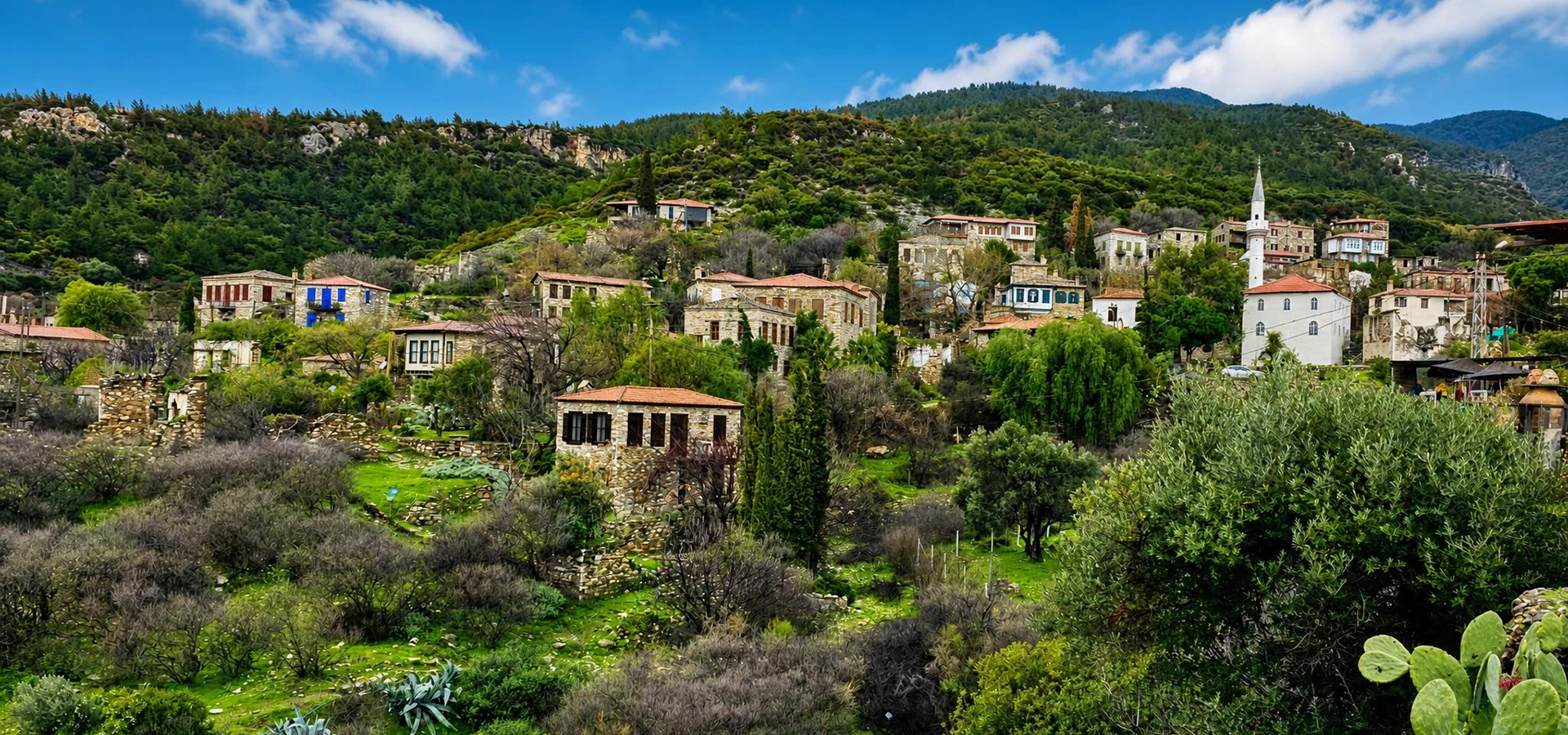
Old Doğanbey Village, known historically as Domatia, is one of the most distinctive historic settlements in Aydın Province. Built against the southern slopes of the Dilek Mountains, the ancient Mount Mycale, the village overlooks the extraordinary wetlands and plains of the Büyük Menderes Delta.
Its character is completely different from the coastal resorts of the Aegean. Narrow stone-paved lanes climb between traditional houses, old fountains, former shops and religious buildings, while trees and Mediterranean vegetation soften the architecture.
For centuries, the village was shaped by communities living between the mountains, agricultural plains and Aegean coast. Its best-known architectural fabric dates principally from the late Ottoman period, when the settlement was inhabited predominantly by an Anatolian Greek community.
Following the population exchange between Greece and Türkiye in the early Republican period, new Turkish families settled in the village. Decades later, most residents moved downhill to the more accessible settlement now known as Yeni Doğanbey – New Doğanbey.
Today, restored houses and carefully preserved streets have given the old village a new life while retaining the extraordinary atmosphere created by its mountain setting, stone architecture and complex cultural history.
Discover the former settlement historically known as Domatia, a name connected with the Greek word for rooms.
Explore narrow streets lined with traditional stone houses, fountains and buildings reflecting the village's late Ottoman heritage.
Understand a village transformed by the twentieth-century population movements between Greece and Türkiye.
Enjoy a remarkable location between the Dilek Mountains and the wetlands of the Büyük Menderes Delta.
Essential information about one of the most atmospheric historic villages in the Söke and Büyük Menderes region.
Southwest of Söke on the southern slopes of the Dilek Mountains, overlooking the Büyük Menderes Delta in Aydın Province.
Open on Google MapsDomatia, a name traditionally connected with the Greek word for rooms and the arrangement of early domestic spaces.
Stone houses, narrow lanes, historic fountains, late Ottoman architecture, restoration and peaceful village scenery.
The village rests against the Dilek Mountains, historically known as Mount Mycale.
The Büyük Menderes Delta, one of western Türkiye's most important wetland landscapes.
History, architecture, walking, photography, cultural landscapes and quiet exploration.
Few villages in western Türkiye combine architectural heritage, population history and protected natural landscapes so closely.
The significance of Old Doğanbey lies not in a single monument but in the survival of an entire cultural landscape.
Stone houses follow the mountain slope rather than a rigid street plan. Narrow lanes pass beneath garden walls, old trees and balconies. Fountains, former shops and religious structures recall a time when the village supported a much larger permanent community.
Its historical story is equally important. The settlement experienced the profound demographic transformations that affected many communities around the Aegean following the collapse of the Ottoman Empire and the population exchange between Greece and Türkiye.
Later abandonment created another dramatic chapter. When much of the population moved downhill toward agricultural land and easier transportation, the old settlement became remarkably quiet.
Restoration eventually brought many buildings back into use, producing the carefully preserved village encountered today.
Perhaps most importantly, Old Doğanbey cannot be separated from its surroundings. The village stands between the mountains of the Dilek Peninsula and the wetlands of the Büyük Menderes Delta, giving it one of the most memorable settings of any historic settlement in the Aegean region.
Old Doğanbey was historically known as Domatia.
The name is commonly connected with the Greek word domatia, meaning rooms. This interpretation is especially interesting because traditional houses in the settlement developed through groups of individual domestic spaces arranged around courtyards and adapted to the steep terrain.
The historic settlement developed on the southern side of the Mycale mountain landscape, where natural water sources, defensible terrain and access to agricultural and coastal resources encouraged habitation.
Its position also placed the village within an extraordinary historical region containing ancient Priene, Miletus, Myus and Didyma.
The name Doğanbey gradually replaced Domatia, but the historic name remains an important part of the village's cultural identity.
The traditional Greek name associated with the settlement before it became known as Doğanbey.
Domatia is commonly interpreted as meaning rooms, reflecting a basic unit of traditional domestic architecture.
The settlement developed along a steep slope rather than across the agricultural plain below.
Ancient cities, Ottoman settlements, Aegean islands and the Maeander Valley all formed part of the village's wider geographical world.
Before the population exchange, Domatia was inhabited largely by an Anatolian Greek community.
The village's residents participated in the mixed economy characteristic of many Aegean settlements, making use of mountain slopes, olive groves, agricultural land and coastal resources.
The surviving historic fabric reflects a prosperous and organised settlement rather than an isolated collection of farmhouses.
Homes were accompanied by shops, fountains, community buildings and places of worship. Together they created a compact village centred upon narrow pedestrian streets.
Much of the architectural character visible today developed during the later Ottoman centuries and represents the cultural world shared across both sides of the Aegean.
Traditional masonry buildings follow the steep natural contours of the mountainside.
Narrow pedestrian lanes linked homes, fountains, shops and communal spaces.
The cultural landscape formed part of a wider world linking western Anatolia with nearby Aegean islands.
Many surviving buildings display architectural characteristics associated with the final centuries of Ottoman rule.
The most profound transformation in the modern history of Doğanbey occurred during the compulsory population exchange between Greece and Türkiye following the Greco-Turkish War.
The Greek Orthodox inhabitants of Domatia departed for Greece during the exchange period of 1923–1924.
Muslim families arriving from the Balkans, particularly from the wider Thessaloniki region, subsequently settled in the village.
The buildings remained, but the population, language, religious traditions and everyday culture of the settlement changed dramatically.
This history gives Old Doğanbey an importance that extends far beyond architecture. Its empty doorways, fountains and reused houses are physical reminders of one of the great population movements of the twentieth-century Aegean.
The population exchange transformed communities throughout Greece and Türkiye.
The village's Greek Orthodox inhabitants left for Greece during the exchange period.
Muslim families arriving from the Balkans settled in the former houses of Domatia.
The architectural fabric survived while the village acquired an entirely new social identity.
The families who settled in Doğanbey after the population exchange gradually encountered practical difficulties associated with the historic mountain settlement.
Its narrow and steep lanes were difficult for modern agricultural equipment and vehicles, while the principal farming areas lay on the flatter land below.
Infrastructure and opportunities for expanding the old village were also limited.
During the twentieth century, and particularly by the 1980s, residents increasingly relocated to a new settlement on lower and more accessible terrain.
The new community became known as Yeni Doğanbey, while the historic mountainside settlement became Eski Doğanbey – Old Doğanbey.
The old settlement was beautifully positioned but increasingly inconvenient for modern village life.
Much of the productive farmland lay across the plains below the historic village.
The movement toward the new settlement was largely completed during this period.
The modern village developed on flatter land closer to roads and agricultural activity.
After most permanent residents moved away, Old Doğanbey entered a period of remarkable quiet.
Many buildings stood empty and gradually deteriorated, while vegetation reclaimed gardens, walls and abandoned plots.
The village nevertheless retained something extremely valuable: its historic street pattern and a substantial collection of traditional buildings had survived.
From the late twentieth century onward, architects, academics, artists, professionals and heritage-minded owners began acquiring and restoring properties.
Conservation controls were introduced to protect the historic character of the settlement, which is recognised as an urban conservation area.
The result is the remarkable village visible today: historic stone architecture surrounded by gardens, mature trees and Mediterranean vegetation.
The relocation to Yeni Doğanbey left much of the old settlement without permanent residents.
The architectural and landscape value of the village attracted increasing attention toward the end of the twentieth century.
Numerous houses have been restored and returned to use.
The historic village is protected for the cultural significance of its streets, buildings and wider settlement pattern.
Architecture is the principal reason many travellers first become interested in Old Doğanbey.
Traditional houses were constructed primarily from locally available stone and arranged according to the steep contours of the mountainside.
Rather than forming wide planned streets, buildings stand along narrow lanes, stairways and irregular passages adapted to the natural terrain.
Many historic houses contain two principal levels. Ground floors were traditionally associated with storage, animals and practical household functions, while upper levels contained living spaces.
Courtyards, garden walls, wooden elements and tiled roofs contribute to an architectural language found across many historic settlements of the eastern Aegean.
Stone taken from the surrounding mountain landscape forms the visual foundation of the village.
Many traditional residences separate practical ground-floor spaces from upper living areas.
Protected outdoor spaces were an important component of domestic life.
Traditional roof forms introduce characteristic warm colours above the grey and ochre stone walls.
The village street system follows the mountain rather than imposing a regular grid.
Buildings, streets and small squares create an intimate environment designed primarily for pedestrians.
Old Doğanbey is best experienced slowly and on foot.
The principal pleasure comes not from rushing between monuments but from noticing the small architectural details scattered throughout the settlement.
Stone-paved lanes curve around houses and disappear behind garden walls. Old fountains occupy street corners, while steps climb between different levels of the village.
Doorways, lintels, window surrounds and sections of older masonry reveal differences between restored properties and surviving historic fabric.
Flowers, vines, figs, olives, plane trees and Mediterranean vegetation frequently soften the stone surfaces and make the village particularly attractive during spring.
Irregular historic streets are among the village's most distinctive visual characteristics.
Historic water structures recall the importance of communal fountains in everyday village life.
Stone walls create intimate passages while separating private courtyards from public lanes.
Look closely at doorways, windows, rooflines and differences in stonework rather than focusing only on entire houses.
Old Doğanbey was once a functioning village with religious, educational, commercial and social buildings in addition to private houses.
Surviving or documented structures include former places of worship, a chapel, fountains, shops and community buildings associated with the settlement's earlier population.
These structures are important because they reveal the difference between Old Doğanbey and a collection of picturesque holiday homes.
The historic settlement once contained the institutions required by an active permanent community.
Some buildings have subsequently acquired new functions, while others survive primarily as part of the village's protected architectural heritage.
Christian religious buildings recall the Greek Orthodox community that lived here before the population exchange.
Commercial buildings demonstrate that Domatia supported an active local economy.
Water infrastructure formed an essential element of daily village life.
Educational and civic structures help reconstruct the social world of the former settlement.
A restored historic building in Old Doğanbey has served as a visitor information and interpretation facility associated with Dilek Peninsula–Büyük Menderes Delta National Park.
Its presence reflects the unusual position of the village within one of Türkiye's most important protected landscapes.
Interpretive material has traditionally introduced visitors to the natural environment, biodiversity and cultural heritage of the national park and delta.
The building itself also contributes to the historic atmosphere of the settlement.
Few historic villages in western Türkiye occupy a more dramatic geographical position.
Immediately behind Old Doğanbey rise the slopes of the Dilek Mountains, the western continuation of the mountain system known in antiquity as Mycale.
Below the village, the landscape opens toward the great alluvial plain and wetlands formed by the Büyük Menderes River, the ancient Maeander.
The contrast is extraordinary. Rocky mountain slopes and Mediterranean woodland stand above reed beds, lagoons, salt marshes and agricultural plains.
This meeting of cultural and natural landscapes makes Old Doğanbey especially rewarding for travellers interested in more than architecture alone.
The historic village is protected by steep mountain terrain immediately behind the settlement.
The great river of western Anatolia reaches the Aegean through the delta below the village.
Lagoons, marshes and shallow waters create internationally important habitats for birds and other wildlife.
Olive, pine, carob, laurel and other species contribute to the rich natural setting.
A small watercourse known as Şarlak Stream passes through the Old Doğanbey landscape and contributes to the distinctive vegetation of the village.
Water availability helped support the settlement and encouraged the growth of large plane trees and other moisture-loving plants alongside the more typical Mediterranean vegetation.
The combination of stone buildings, water, shade and mature trees creates several of the village's most atmospheric corners.
Seasonal water levels naturally vary, and the appearance of the stream can change considerably according to rainfall.
Large trees create shade and contrast beautifully with the historic stone architecture.
The character of the stream changes with rainfall and seasonal conditions.
Moisture supports vegetation that differs from the drier slopes surrounding the village.
Water, foliage, stone walls and historic buildings create particularly attractive layered compositions.
The Büyük Menderes Delta is fundamental to understanding the setting of Old Doğanbey.
The river known to the ancient world as the Maeander transported immense quantities of sediment toward the Aegean over thousands of years.
This process created the vast plains and wetlands visible below the village and profoundly changed the coastline around ancient cities such as Priene and Miletus.
Today the delta contains lagoons, marshes, shallow waters, mudflats and agricultural landscapes supporting an exceptional diversity of birds.
Depending on season and conditions, the wider wetland system can host flamingos, pelicans, herons, egrets, cormorants, ducks, waders and birds of prey.
The river gave the English language the word “meander” because of its famously winding course.
Lagoons, mudflats and shallow water provide important feeding and resting environments for birds.
Sediment carried by the river transformed the geography surrounding ancient Priene and Miletus.
The delta is one of the region's most rewarding landscapes for patient wildlife observation.
Old Doğanbey lies within the extraordinary landscape associated with Dilek Peninsula–Büyük Menderes Delta National Park.
The relationship is unusual because the protected area combines both cultural heritage and highly sensitive natural habitats.
North of the mountains, the national park is best known for forested Aegean bays such as İçmeler, Aydınlık, Kavaklıburun and Karasu.
South of the mountain ridge, the environment becomes completely different. Here the dominant landscape is formed by Old Doğanbey, the Büyük Menderes wetlands, lagoons and broad agricultural plains.
Visiting both sides reveals why the national park represents much more than a collection of beaches.
Forests, mountains, clear Aegean water and sheltered swimming bays dominate the landscape.
Historic villages, wetlands, agricultural plains and the Büyük Menderes Delta create a completely different experience.
The mountainous spine connects the northern and southern landscapes geographically.
Nature conservation and historic preservation meet unusually closely around Old Doğanbey.
Observe the traditional masonry architecture that gives Old Doğanbey its unmistakable character.
Walk through narrow streets climbing naturally between houses, gardens and walls.
Look for surviving water structures once essential to daily village life.
Discover surviving traces of the Christian community that inhabited Domatia before the population exchange.
See the restored historic building associated with interpretation of the national park and surrounding natural heritage.
Follow the greener sections of the village landscape associated with its historic watercourse.
Mature trees add shade, scale and atmosphere to the stone-built environment.
Look uphill toward the rugged slopes of the ancient Mycale mountain landscape.
Look outward toward the broad wetlands and agricultural plains of the Büyük Menderes region.
Photograph old doors, windows, masonry, roof tiles, garden walls and other details often missed on a quick visit.
Compare the old mountain settlement with the newer village created on the lower plain.
Continue toward the coast and experience the fishing and wetland landscape south of the Dilek Peninsula.
Old Doğanbey is relatively compact, but travellers interested in architecture and photography should allow enough time to explore slowly.
The historic village is best experienced on foot because many lanes are narrow, steep and unsuitable for ordinary traffic.
Begin close to the principal approach to the historic village and continue on foot into the old settlement.
Rather than searching immediately for one specific monument, spend your first few minutes observing how the houses have been constructed into the slope.
Continue toward the historic centre, passing stone houses, fountains, mature trees and surviving community structures.
Visit the area around the restored visitor building when accessible and then explore some of the quieter side streets.
Look for views opening downhill toward the Büyük Menderes Delta and uphill toward the Dilek Mountains.
Finish slowly rather than retracing the route immediately. Changing direction through the village often reveals completely different architectural compositions.
Enter the historic settlement and appreciate the overall mountain setting.
Walk through the principal stone lanes and examine restored traditional houses.
Look for historic fountains and surviving communal architecture.
Explore the area around the historic visitor and interpretation building.
Follow quieter lanes toward Şarlak Stream and areas of denser vegetation.
Finish with views toward the Büyük Menderes Delta before continuing toward Karina or another nearby destination.
Old Doğanbey occupies an exceptional position within the cultural geography of southern Aydın.
Within a relatively compact region, travellers can move between ancient Greek cities, Ottoman village architecture, protected wetlands and the Aegean coastline.
The historic village landscape of stone houses, narrow streets and layered Greek and Turkish heritage.
An extraordinary ancient city built against the slopes of the same wider Mycale mountain landscape.
A great ancient harbour and intellectual centre whose coastline was transformed by the sediments of the Maeander.
Home to the monumental Temple of Apollo and one of the ancient Mediterranean's great oracular sanctuaries.
Protected mountains, forests, wildlife and clear Aegean bays north of the village.
Wetlands and lagoons created by the river that shaped the entire historical geography of the region.
Continue exploring with our Aydın travel guide, Dilek Peninsula National Park guide, Priene Ancient City guide, Miletus Ancient City guide and Didyma & Didymaion guide.
Old Doğanbey can be visited throughout the year, but every season creates a different atmosphere.
Perhaps the most beautiful period, with green vegetation, wildflowers and comfortable temperatures for walking.
Long daylight and increasingly warm conditions make it easy to combine the village with the coast and nearby archaeological sites.
Bright Aegean light is excellent for travel, but midday heat can make steep stone streets uncomfortable.
Warm weather frequently continues while conditions become more comfortable for combining walking and coastal exploration.
Soft light and quieter conditions are particularly attractive for architecture and landscape photography.
The village becomes especially quiet and atmospheric, while the surrounding wetlands can be rewarding for birdwatching.
Old Doğanbey is one of the most rewarding architectural photography locations in the Aydın region.
Wide-angle compositions work well in narrow streets, but some of the strongest images are often created by isolating smaller details.
Look for old doors, window frames, climbing plants, roof tiles, fountains and the contrast between rough masonry and colourful flowers.
Elevated areas can provide broader compositions combining the historic village with the delta landscape below.
Changing light can dramatically alter the appearance of the stone. Early or late daylight usually produces greater texture than harsh midday sun.
Use the narrow streets as natural leading lines through architectural compositions.
Small historic details often communicate the village's character more effectively than wide views.
Vegetation introduces colour and softness against the traditional masonry.
Include the Dilek Mountains to show how closely the settlement is connected with its terrain.
Longer lenses can compress the village foreground against the plains and wetlands beyond.
Low-angle sunlight accentuates the texture of old walls, roof tiles and uneven streets.
The peaceful character of Old Doğanbey is one of its greatest attractions, but that atmosphere survives only when visitors behave respectfully.
Although the village contains important historic architecture, many restored properties are privately owned.
A picturesque courtyard visible through a doorway is not automatically open to visitors.
Keep noise low, remain on public lanes, avoid obstructing entrances and never enter houses, gardens or private terraces without permission.
Do not assume restored historic houses are public attractions.
The quietness of the village is part of its character and should be respected.
Request permission before taking identifiable photographs of residents.
Gates, gardens and courtyards should be treated as private unless clearly marked otherwise.
Old Doğanbey was developed centuries before modern accessibility requirements and its historic street pattern reflects the steep natural landscape.
Historic paving can be irregular and may become slippery when wet.
Several lanes involve noticeable gradients and steps.
Carry water and avoid unnecessary exertion during the hottest part of summer afternoons.
Supportive footwear is much better suited to the village than smooth-soled sandals.
Some sections can be difficult for travellers with reduced mobility because of slopes, steps and uneven surfaces.
The village rewards slow exploration, so there is little reason to rush through difficult sections.
Old Doğanbey lies southwest of Söke in the southern landscape of the Dilek Peninsula.
The village is approximately 30 kilometres from Söke, although exact driving distance depends on the chosen route and starting point.
A private vehicle provides the greatest flexibility, particularly when combining the village with Priene, Karina, the Büyük Menderes Delta or other surrounding attractions.
Travel toward the southern Dilek Peninsula and Doğanbey area, continuing toward the historic upper settlement.
Allow roughly an hour or more depending on traffic and route, making Old Doğanbey suitable for a full-day southern Aydın excursion.
The village can be combined naturally with Miletus or other destinations around the lower Büyük Menderes region.
Priene and Old Doğanbey form one of the most rewarding history-and-landscape combinations in southern Aydın.
Driving provides the easiest way to continue toward the delta, Karina and archaeological sites.
Drive carefully on narrower local roads and respect current parking and vehicle restrictions around the historic settlement.
Explore wetlands, lagoons and open landscapes immediately below the Dilek Mountains.
Continue toward the coastal landscape at the edge of the delta for a completely different perspective on the region.
Discover the forests, wildlife and Aegean coastline protected within one of western Türkiye's great national parks.
Visit one of the finest surviving examples of ancient Greek urban planning beneath Mount Mycale.
Explore one of the ancient Mediterranean's great cities and understand how the Maeander transformed the regional coastline.
Visit the monumental sanctuary and Temple of Apollo south of the ancient city of Miletus.
The principal modern town of the lower Büyük Menderes plain and the most practical regional transport centre.
Combine the quiet heritage landscape of Old Doğanbey with the major Aegean resort and cruise destination farther north.
A particularly rewarding private excursion combines Old Doğanbey with Priene and the Büyük Menderes Delta.
Begin at Priene during the cooler morning hours and explore the ancient city beneath Mount Mycale.
Continue toward Old Doğanbey and spend time walking through the historic stone village.
Afterwards descend toward the Büyük Menderes Delta and Karina, where the landscape changes from mountain architecture to open wetlands and coastal scenery.
This combination reveals nearly every major element that makes southern Aydın exceptional: archaeology, historical migration, traditional architecture, mountains, river geography and wildlife.
Priene Ancient City before the strongest midday heat.
Drive through the changing landscape toward Old Doğanbey.
Explore the historic village, architecture and shaded lanes at a comfortable pace.
Continue toward Karina and the Büyük Menderes Delta.
Allow time for landscape stops rather than treating the drive simply as transportation.
Travellers with a longer day can continue toward Miletus or another selected destination.
Practical answers for planning a visit to the historic village of Domatia in Aydın.
Old Doğanbey is located in Söke district of Aydın Province on the southern slopes of the Dilek Mountains overlooking the Büyük Menderes Delta.
The historic village was known as Domatia before becoming known as Doğanbey.
The name is commonly connected with the Greek word meaning “rooms,” traditionally associated with the arrangement of domestic spaces in the settlement.
Before the population exchange, Domatia was inhabited predominantly by an Anatolian Greek Orthodox community.
The Greek Orthodox inhabitants left during the compulsory population exchange between Greece and Türkiye in the early 1920s.
Muslim families arriving from the Balkans, including the wider Thessaloniki region, settled in the village following the exchange.
Residents gradually moved from the steep historic settlement to a new village on lower and more accessible land. The original settlement therefore became known as Eski Doğanbey, or Old Doğanbey.
The relocation process developed over time and was largely completed during the 1980s when residents moved to Yeni Doğanbey.
No. Many historic buildings have been restored and the village now contains privately owned residences as well as heritage and visitor facilities.
Local stone was readily available from the surrounding mountain environment and became the principal construction material of the traditional village.
Yes. The historic settlement is recognised as a protected urban conservation area and restoration is subject to heritage controls.
The village lies within the wider protected landscape of Dilek Peninsula–Büyük Menderes Delta National Park.
Vehicle access within the historic core is limited by extremely narrow streets and heritage considerations. Visitors should follow current signs and parking arrangements and explore the village primarily on foot.
Around 1.5 to 3 hours is comfortable for most visitors interested in walking and photography. Allow longer when combining the village with the delta or nearby archaeological sites.
The village itself is an open historic settlement rather than a conventional ticketed archaeological site. Access conditions for individual buildings or facilities may differ.
Comfortable walking shoes are strongly recommended because the historic streets can be steep, irregular and slippery in places.
Families can enjoy the village, but children should be supervised on steep streets, uneven paving and around any watercourses or roadside areas.
Accessibility is limited in many parts of the historic village because of steep gradients, steps and uneven stone surfaces.
Spring and autumn provide especially pleasant walking conditions. Early morning and late afternoon are excellent for photography throughout much of the year.
Yes. Stone houses, historic streets, flowers, mature trees, mountain scenery and views toward the Büyük Menderes landscape provide outstanding photographic subjects.
Architecture visible from public streets can generally be photographed, but many properties are private homes. Do not enter courtyards or photograph residents closely without permission.
Şarlak is the watercourse passing through the village landscape and helping support the greener vegetation found around parts of the settlement.
Yes. The village is exceptionally well positioned for combining cultural heritage with the nearby delta landscape.
Flamingos can occur within the wider Büyük Menderes wetland system depending on season and conditions, although sightings cannot be guaranteed.
Yes. Priene and Old Doğanbey make an excellent combination because both are closely connected with the Mycale mountain landscape.
Yes. With private transportation, Old Doğanbey, Priene and Miletus can be included within a carefully planned full-day itinerary.
Karina is the coastal and fishing landscape reached beyond Doğanbey toward the edge of the Büyük Menderes Delta.
The village lies approximately 30 kilometres from Söke, depending on the precise route and starting point.
Yes. Travellers interested in history, traditional architecture, photography and quiet cultural landscapes will find Old Doğanbey one of the most distinctive destinations in southern Aydın.
Both preserve historic Aegean architecture, but Old Doğanbey is much quieter and is particularly remarkable for its protected mountain-and-wetland setting overlooking the Büyük Menderes Delta.
Never enter courtyards, gardens or houses unless you have clearly received permission.
Avoid loud music, shouting and unnecessary disturbance in residential areas.
Do not climb walls, move architectural fragments or damage stonework for photographs.
Do not collect flowers, branches or other natural material from the protected landscape.
Observe birds and other animals from a distance, particularly around the sensitive Büyük Menderes wetlands.
Take rubbish with you and help preserve the unusually peaceful character of the historic settlement.
Discover Old Doğanbey with comfortable private transportation and a flexible itinerary combining historic architecture, Priene, the Büyük Menderes Delta and selected archaeological or natural destinations without compulsory shopping stops.
Combine Old Doğanbey with Priene, Miletus, the Büyük Menderes Delta, Karina, Dilek Peninsula or other selected destinations according to your available time and interests.
Walk through the historic stone village of Old Doğanbey before exploring the landscapes, wetlands and wildlife of the Büyük Menderes Delta at a relaxed private pace.
Request Your Private Old Doğanbey Tour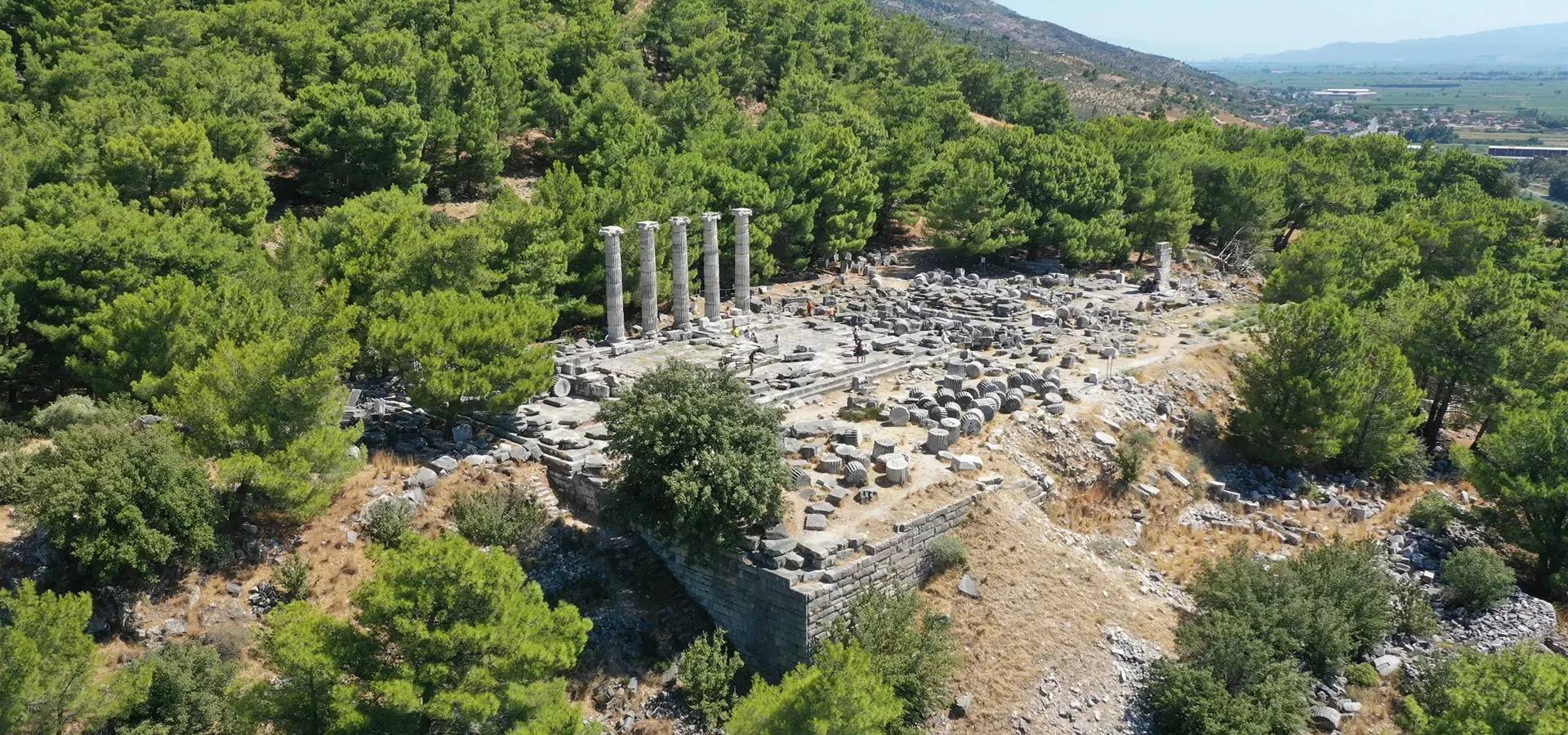
Connect ancient Ionia with Aegean village history by combining Priene, Old Doğanbey and the Büyük Menderes Delta within one carefully designed private excursion.
Design Your Private Aydın Journey