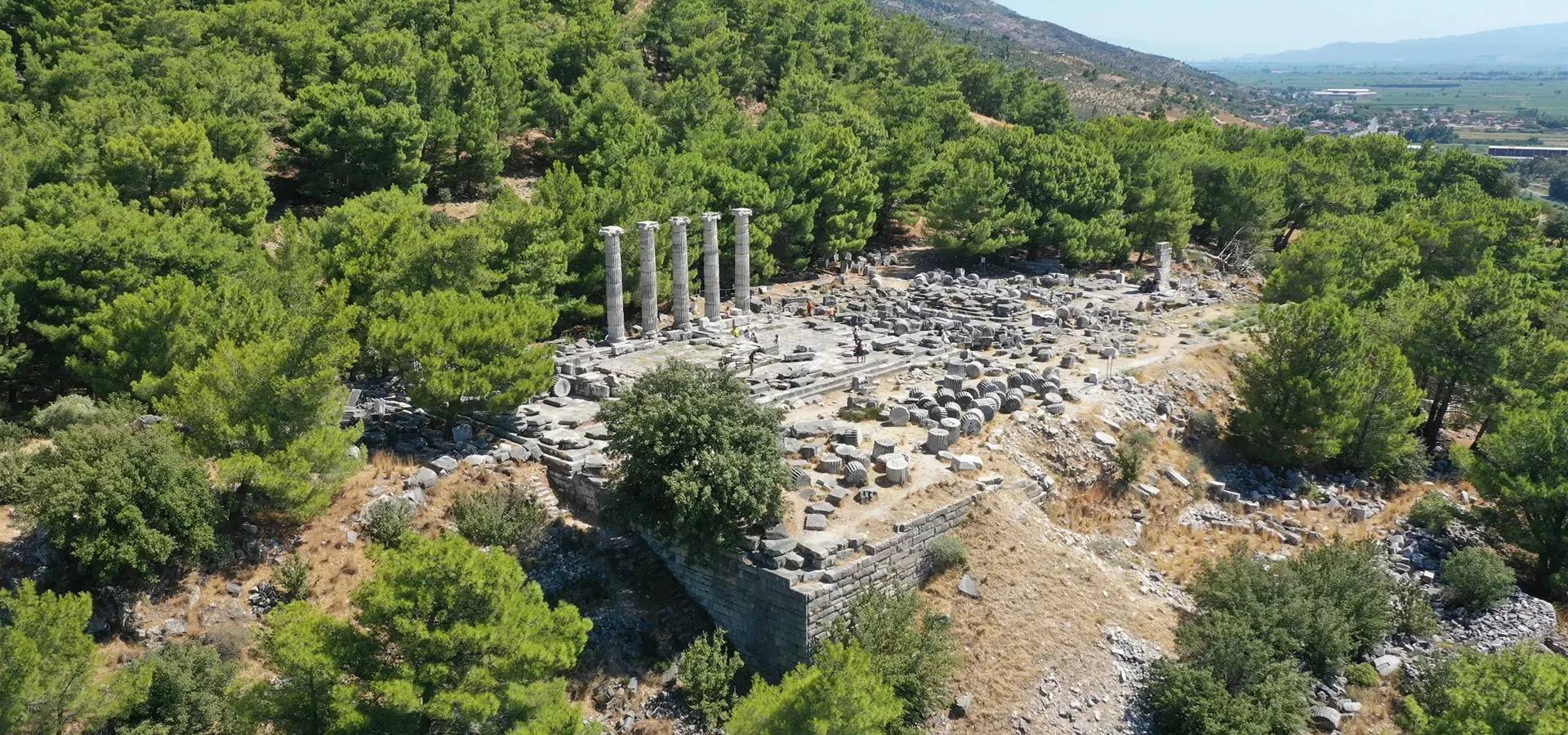
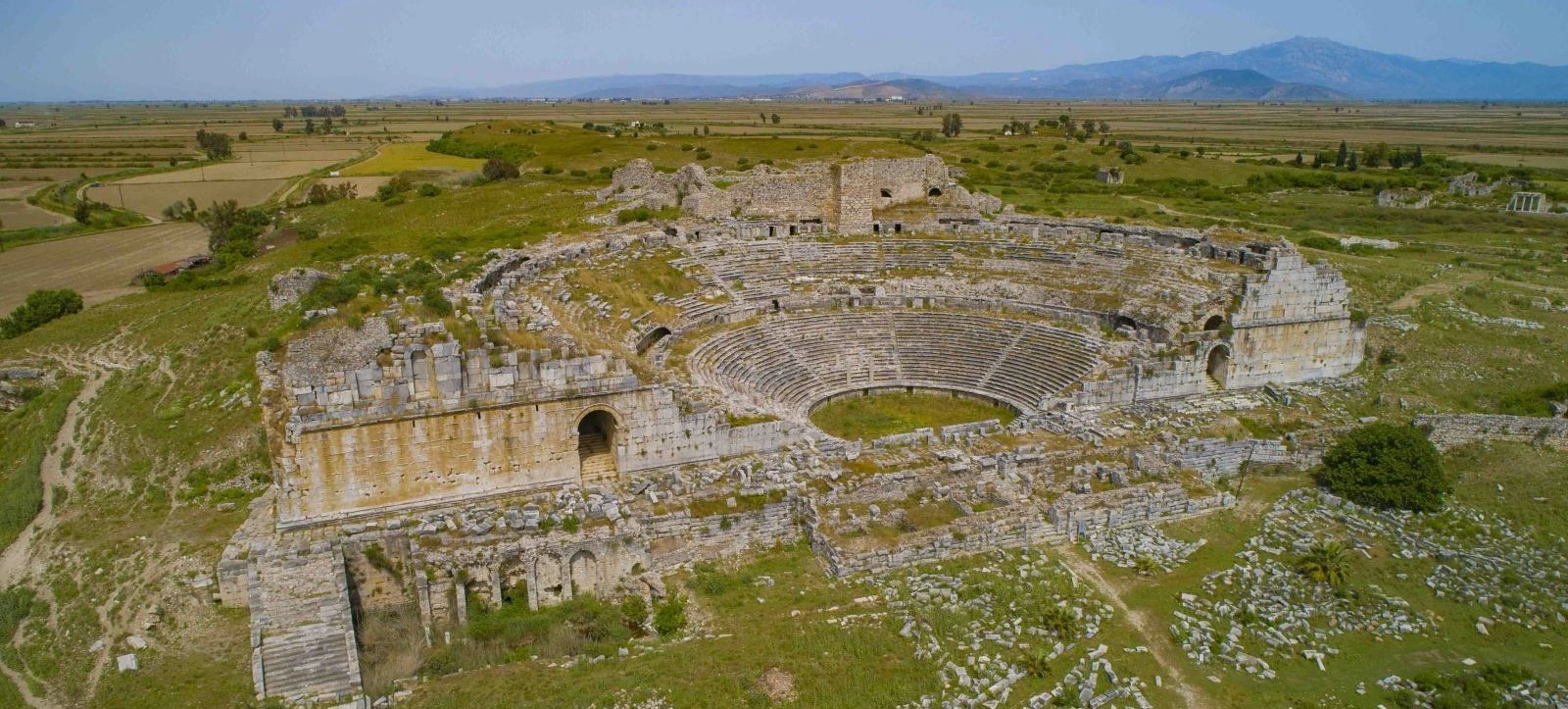
Temple of Athena, Ancient Urban Planning & Mount Mycale

Priene Ancient City – Temple of Athena, Theatre & Things to See

Discover one of the ancient world's finest planned cities,
dramatically terraced beneath Mount Mycale above the Maeander plain.

Explore Priene

Priene – The Planned Ionian City beneath Mount Mycale

Priene, located near modern Güllübahçe in Söke, Aydın Province, is one of the most remarkable ancient cities of western Türkiye. Built across a steep slope beneath Mount Mycale, the surviving city presents an unusually clear picture of how a Greek city could be organised during the Late Classical and Hellenistic periods.

Priene is especially famous for its carefully ordered grid plan. Streets, residential blocks, public buildings and sanctuaries were fitted into a rational urban framework despite the difficult mountain terrain. Broad east-west streets followed the terraces, while steeper north-south streets often became monumental stone stairways.

At the centre of the city stood the elegant Temple of Athena Polias, designed by the celebrated architect Pytheos. The temple became closely associated with Alexander the Great, whose dedication to Athena was recorded in an inscription after his arrival in western Anatolia in 334 BCE.

Today visitors can explore the theatre, agora, bouleuterion, residential quarters, sanctuaries, gymnasia and city walls while enjoying extraordinary views across the former landscape of the Maeander Gulf.

Ancient City Planning

Walk through one of the clearest surviving examples of a carefully organised Greek grid city adapted to mountainous terrain.

Temple of Athena

Discover the great Ionic sanctuary designed by Pytheos and associated with the famous dedication of Alexander the Great.

Ancient Theatre

Enter a remarkably preserved Greek theatre where marble seats, the orchestra and elements of the stage architecture remain visible.

Mount Mycale Views

Look across the vast Maeander plain from a city that originally overlooked a very different ancient coastal landscape.

Know Before You Go

Priene Ancient City – Quick Facts

A practical introduction to one of the most important archaeological cities of ancient Ionia.

Location

Güllübahçe, Söke, Aydın Province, western Türkiye.

Open on Google Maps

Famous For

Exceptional ancient city planning, the Temple of Athena Polias and remarkably preserved public buildings.

Setting

Built on terraces approximately 370 metres above sea level on the southern slopes of Mount Mycale.

City Plan

A rectangular grid traditionally described as Hippodamian planning, carefully adapted to steep terrain.

Ancient Identity

An important Ionian polis and member of the wider political and religious world of ancient Ionia.

UNESCO Status

Priene Archaeological Site has been on Türkiye's UNESCO World Heritage Tentative List since 2018.

Urban Planning, Architecture and Life in an Ancient Greek Polis

Why Is Priene Important?

Priene preserves far more than individual monuments — it preserves the structure of an ancient city.

The extraordinary importance of Priene lies in the relationship between its buildings and its complete urban organisation.

Many ancient archaeological sites are dominated by individual monuments constructed during different periods. At Priene, visitors can understand how streets, houses, temples, markets, political buildings, theatres and educational facilities functioned together within a carefully planned city.

The city was organised according to a regular rectangular street system often called the Hippodamian grid. Yet Priene is particularly impressive because this geometrical organisation was imposed upon an extremely steep natural landscape.

Rather than destroying the mountain topography, the planners adapted the city into a sequence of terraces. Major east-west streets followed more level contours while north-south connections climbed dramatically through stone stairways.

Priene is also important for the remarkable preservation of its domestic architecture. Residential blocks reveal courtyards, reception spaces, household rooms and changing patterns of private life across several centuries.

The city therefore offers an exceptional archaeological opportunity to study not only monumental architecture but also urban planning, politics, religion, education, infrastructure and everyday life.

For travellers exploring the wider province, Priene forms an essential part of the archaeological heritage introduced in our Aydın travel guide.

The City Plan of Priene

One of the first things to understand about Priene is that the city was not allowed to grow randomly across the mountainside.

The settlement visible today was organised according to a remarkably systematic rectangular grid. Streets intersected at right angles, creating regular city blocks known as insulae.

This type of city planning is frequently described as Hippodamian, after the famous urban theorist Hippodamos of Miletus. It is better understood as part of a wider Greek tradition of rational urban planning rather than assuming that Hippodamos personally designed Priene.

What makes Priene exceptional is the way this geometrical plan was fitted onto the steep slopes of Mount Mycale.

The principal streets running approximately east-west could follow the natural terraces and therefore remained comparatively level.

Many of the streets crossing them from north to south climbed steeply up the hillside and were constructed partly as stone stairways.

The result is one of antiquity's most visually understandable urban systems: from several viewpoints, visitors can still read the relationship between individual city blocks and the larger plan.

Rectangular Grid

Streets crossing at right angles divided Priene into organised blocks for houses and public buildings.

Mountain Terraces

Public and residential areas were constructed on artificial and natural terraces across the steep hillside.

East-West Streets

Major routes followed the contours of the mountain and provided the city's easiest horizontal movement.

Stepped Streets

Many north-south connections became steep stairways because of the dramatic difference in elevation.

Look at the city, not only the monuments: Priene becomes much more interesting when you pay attention to streets, intersections and terraces. The organisation of space is itself one of the site's greatest archaeological monuments.

History of Priene

The history of Priene extends further back than the impressive ruins visible on the mountainside today.

Ancient literary sources mention Priene by the 7th century BCE, and the city belonged to the wider cultural and political world of the Ionian cities of western Anatolia.

The location of the earliest settlement remains more difficult to reconstruct than that of the later city. Changes in the landscape of the Maeander valley, shifting coastlines and limited archaeological evidence have made the earliest topography of Priene an important subject of continuing research.

The city represented by the present archaeological remains was laid out during the 4th century BCE.

This new settlement was constructed according to an ordered urban plan beneath Mount Mycale, with carefully positioned residential areas, sanctuaries and civic buildings.

In 334 BCE, during his campaign against the Persian Empire, Alexander the Great became associated with the completion of the Temple of Athena Polias. A famous inscription recorded his dedication of the temple to Athena.

During the Hellenistic period Priene passed through changing regional political circumstances involving the major kingdoms that competed for control of western Anatolia.

The city eventually came within the Roman sphere. Unlike nearby cities such as Ephesus and Miletus, however, Priene did not develop into an enormous Roman imperial metropolis. This comparatively limited later monumental transformation helped preserve important aspects of its earlier urban fabric.

During Late Antiquity and the Byzantine period, settlement and Christian religious life continued at Priene, which became an episcopal centre.

Over time, the changing Maeander landscape, reduced political importance and other regional developments contributed to the decline and eventual abandonment of the settlement.

Archaic Period

Priene appears in ancient traditions as one of the Ionian cities of western Anatolia.

4th Century BCE

The surviving city was created as a carefully organised settlement beneath Mount Mycale.

334 BCE

Alexander the Great became associated with the Temple of Athena Polias and its famous dedicatory inscription.

Hellenistic Period

Priene developed within the changing political world of the Hellenistic kingdoms of western Anatolia.

Roman Period

The city continued under Roman rule without losing the fundamental structure of its earlier urban plan.

Byzantine Period

Christian occupation continued and Priene became an episcopal centre before the settlement was eventually abandoned.

Mount Mycale and the Ancient Landscape of Priene

Priene's dramatic landscape is not simply a beautiful background. It is essential for understanding the history of the city.

The settlement was built high on the southern slopes of Mount Mycale, known today as Samsun Dağı. The elevation offered natural protection and extraordinary visibility across the surrounding countryside.

The plain visible below Priene today looks very different from the ancient landscape.

During antiquity, the coastline extended much farther inland and the lower Maeander region contained bays, channels and coastal environments associated with the Maeander Gulf.

Over many centuries, the Büyük Menderes River deposited enormous quantities of alluvium across the region.

This gradual silting transformed former marine environments into the broad agricultural plain visible today and pushed the coastline progressively westward.

The same environmental process affected other ancient centres including Miletus, whose famous harbours also became separated from the sea.

Mount Mycale

The mountain provided both a dramatic backdrop and an important defensive advantage.

Ancient Coastline

The lower plain below Priene was once connected with a coastal landscape very different from the modern agricultural basin.

Maeander River

Alluvial deposits gradually transformed the ancient gulf and moved the coastline farther away.

Modern View

Today's panoramic landscape is the result of thousands of years of geological and human change.

The Temple of Athena Polias

The Temple of Athena Polias is the most celebrated monument of Priene and one of the most important examples of Ionic architecture in ancient Anatolia.

The sanctuary occupied a commanding terrace overlooking the city and the landscape below.

The temple was designed by the architect Pytheos, whose name is also connected with the celebrated Mausoleum at Halicarnassus.

Its design became famous for the clarity and carefully calculated proportions of its Ionic architecture.

The temple stood on a rectangular platform and was surrounded by a single colonnade. The eastern approach led visitors toward the pronaos and sacred interior containing the cult of Athena Polias — Athena as protector of the city.

Only a small number of reconstructed columns rise today, but they remain among the most recognisable images of Priene.

The terrace itself is equally important. Standing beside the temple and looking across the Maeander plain provides one of the finest combinations of architecture and landscape anywhere in ancient Ionia.

Dedication Athena Polias, the protective Athena of the city
Architect Pytheos, one of the most celebrated architects of the 4th century BCE
Architectural Order Ionic
Date Construction began during the 4th century BCE
Alexander Connection Alexander the Great's dedication was associated with the temple in 334 BCE
Setting A monumental terrace overlooking the ancient city and Maeander landscape

Alexander the Great and Priene

One of Priene's strongest connections with world history comes from Alexander the Great.

Alexander crossed into Asia Minor in 334 BCE and began dismantling Persian control of the Greek cities of the western Anatolian coast.

During this campaign he became closely associated with the sanctuary of Athena Polias at Priene.

A famous marble inscription recorded that King Alexander dedicated the temple to Athena Polias.

Evidence associated with the temple also records financial support connected with its completion, while another important inscription preserves elements of an edict concerning Priene and surrounding territories.

The inscriptions are particularly valuable because they create a direct archaeological connection between the city and one of the most famous figures of the ancient world.

The original inscription fragments discovered during 19th-century investigations are now preserved in the British Museum in London.

334 BCE

Alexander entered western Anatolia during the opening phase of his campaign against the Persian Empire.

Athena Polias

The principal monumental sanctuary of Priene became closely associated with Alexander's patronage.

Temple Dedication

An inscription explicitly records Alexander's dedication of the temple to Athena Polias.

British Museum

Important inscribed blocks from the Temple of Athena are preserved today in London.

Why the inscription matters: Unlike later legends about famous rulers, the Priene inscription is direct archaeological evidence connecting Alexander with the city and its principal sanctuary.

The Ancient Theatre of Priene

The Ancient Theatre of Priene is one of the most rewarding monuments to explore because much of its basic architectural form remains easy to understand.

Constructed during the 4th century BCE, the theatre was integrated into the slope of the city and continued to develop through later periods.

The semicircular seating area, or cavea, looked toward the orchestra and stage structures below.

The theatre is traditionally estimated to have accommodated approximately 5,000 spectators, an impressive capacity in relation to the size of Priene's citizen population.

Particularly memorable are the prestigious stone seats positioned near the orchestra. These were reserved for important officials, priests and honoured members of the community.

Architectural remains of the stage building reveal how the theatre evolved from its earlier Greek form while continuing to function into later antiquity.

The theatre demonstrates that performances were not merely entertainment. The Greek theatre was connected with religion, civic identity, festivals and public community life.

4th Century BCE

The earliest monumental theatre belongs to the great period of Priene's planned urban development.

About 5,000 Seats

The auditorium could accommodate a substantial portion of the city's population.

Honorary Seats

Distinguished stone seats close to the orchestra were reserved for privileged spectators.

Stage Architecture

Surviving elements help explain the relationship between actors, performance space and audience.

The Agora of Priene

The agora formed the principal civic centre of Priene.

Positioned within the organised city plan, this open public area functioned as a meeting place where political, commercial and social activities could overlap.

Stoas and public buildings created architectural boundaries around the central space and provided sheltered areas for movement, conversation and business.

The deliberate positioning of the agora demonstrates how the planners of Priene reserved prominent central blocks for communal institutions rather than private houses.

Walking through the agora today helps restore a sense of Priene as a living city rather than simply a collection of temples and ruins.

Public Space

The agora was one of the principal gathering places for Priene's citizens.

Commerce

Trade and everyday economic activity formed an important part of the life of the central district.

Stoas

Covered colonnades created sheltered circulation and framed parts of the public square.

Urban Centre

The agora occupied a carefully planned position among Priene's major civic institutions.

The Bouleuterion and Civic Government of Priene

Among Priene's most important public buildings is the bouleuterion, the council house associated with the political administration of the city.

The building contained stepped seating arranged around a central area, creating an enclosed environment suitable for meetings and civic discussion.

Here members of the city council could debate administrative, financial, diplomatic and religious matters affecting the polis.

The monument is particularly valuable because it gives physical form to the political institutions that underpinned Greek urban society.

Close to the bouleuterion were other civic structures, including buildings associated with magistrates and the ritual life of the community.

City Council

The bouleuterion provided a formal meeting place for representatives involved in governing Priene.

Stepped Seating

The interior arrangement allowed participants to face a central speaking and ceremonial area.

Civic Centre

Its position near the agora reflects the close relationship between politics and public urban space.

Greek Polis

The monument helps visitors understand the institutions behind the everyday functioning of an ancient city-state.

The Ancient Houses of Priene

Priene is exceptionally important for the study of ancient Greek domestic architecture.

Because the city plan and residential quarters survive so clearly, archaeologists have been able to reconstruct how houses were organised within individual city blocks.

Residential blocks were divided into separate properties containing rooms arranged around courtyards and circulation spaces.

Many houses included a principal living or dining area, reception spaces and rooms used for household activities.

An important room known as the andron could be associated with male social gatherings and formal drinking occasions.

Yet houses changed repeatedly through time. Walls were moved, properties were joined or subdivided and rooms acquired new functions as household needs changed.

This makes Priene particularly useful because it preserves evidence not merely for an ideal city plan but for the practical realities of people actually living inside it.

Courtyard Houses

Many homes were organised around interior open spaces that brought light and air into the household.

Andron

Certain houses contained formal reception rooms associated with social gatherings and dining.

Residential Blocks

Private houses occupied carefully defined plots within the city's regular grid.

Changing Homes

Archaeology shows that houses were repeatedly altered as families and patterns of urban life changed.

Do not rush through the residential quarter: Priene's houses are among the site's greatest archaeological treasures because they reveal how ordinary urban space worked beyond the spectacular temples and public monuments.

Sanctuaries and Religious Life at Priene

Although the Temple of Athena dominates modern impressions of Priene, the religious life of the city involved numerous deities and sacred areas.

Different sanctuaries occupied carefully chosen locations across the urban landscape and reflected the varied religious needs of the community.

Athena Polias

Athena was worshipped as protector of the city in Priene's most celebrated monumental sanctuary.

Demeter

A sanctuary of Demeter occupied an elevated area and was connected with religious traditions involving agriculture, fertility and community.

Zeus

The city contained a sanctuary dedicated to Zeus, reflecting the broader religious traditions of the Greek polis.

Egyptian Gods

Later religious life also included cults associated with Egyptian deities, illustrating Priene's connections with the wider Hellenistic world.

The Gymnasia of Priene

Priene contained important facilities traditionally identified as the Upper and Lower Gymnasia.

In the Greek world, a gymnasium was much more than a place for physical exercise.

It was connected with the education and social development of young citizens, combining athletics with intellectual and civic culture.

Training areas, rooms and open courts allowed young men to exercise, study and participate in institutions that helped prepare them for adult citizenship.

The gymnasia therefore provide another important dimension to Priene: the city was designed not only around religion and politics but also around education and civic identity.

Athletics

Physical training formed an important part of Greek education and public life.

Education

Gymnasia were connected with broader intellectual and cultural instruction rather than sport alone.

Young Citizens

The institutions played an important role in preparing younger members of the community for civic adulthood.

Urban Planning

The presence of major educational facilities demonstrates the variety of public functions included within Priene's city plan.

Water Supply and Infrastructure at Priene

Building an organised city on a mountainside required far more than temples and streets.

Priene needed reliable systems for supplying water, managing runoff and maintaining daily urban life.

Springs in the higher landscape could provide water that was transported toward the settlement through carefully constructed systems including clay pipelines.

Water distribution and drainage were integrated into the wider street network.

These systems demonstrate another important principle of Priene's urban planning: monumental design and practical engineering were considered together.

Mountain Springs

Natural water sources above the city contributed to Priene's urban water supply.

Clay Pipelines

Terracotta pipes carried water through parts of the planned settlement.

Drainage

Street infrastructure helped manage water flowing through the steep urban landscape.

Urban Engineering

Infrastructure demonstrates the practical sophistication hidden beneath Priene's monumental architecture.

The City Walls and Gates of Priene

Priene's dramatic natural position gave the city considerable defensive advantages, but fortification walls were still an essential element of the urban landscape.

The city was protected by a substantial circuit of walls adapted to the irregular mountain terrain.

Access was controlled through several gates connecting Priene with surrounding roads, agricultural territory and neighbouring communities.

The fortifications extended beyond the regularly planned residential areas and incorporated strategically important sections of the rocky slopes above the city.

Mountain Defence

Steep natural slopes strengthened Priene's defensive position.

Fortification Circuit

Stone walls protected the organised city and strategically important terrain around it.

City Gates

Controlled entrances connected the polis with routes through the surrounding landscape.

Upper Terrain

Fortifications extended into the rocky landscape above the main urban terraces.

Priene during the Roman and Byzantine Periods

Priene did not disappear with the end of the Hellenistic period.

The city continued under Roman rule, and existing buildings were repaired, modified and reused.

Unlike major Roman metropolitan centres such as Ephesus, however, Priene was not overwhelmed by enormous imperial building programmes.

This relative continuity is one reason why the earlier form of the city remains so archaeologically understandable.

Christianity brought another major transformation.

During the Byzantine period Priene became an episcopal centre, and Christian buildings were incorporated into the ancient urban landscape.

Settlement gradually contracted before the site was eventually abandoned, leaving the ancient terraces beneath Mount Mycale to become an archaeological landscape.

Roman Priene

The city remained inhabited and adapted existing Greek buildings to changing needs.

Urban Continuity

Priene retained much of its earlier city structure rather than becoming a completely transformed Roman metropolis.

Christianity

New religious traditions gradually reshaped parts of the ancient city.

Byzantine Bishopric

Priene became an episcopal centre during its later Christian history.

Best Things to See at Priene

Temple of Athena Polias

See Priene's architectural masterpiece and enjoy the extraordinary panorama from its monumental terrace.

Ancient Theatre

Explore the remarkably preserved auditorium, honorary seats, orchestra and stage architecture.

Agora

Walk through the civic and commercial heart of the ancient city.

Bouleuterion

Enter the council house where important political discussions once shaped the life of the polis.

Residential Houses

Study courtyards, rooms and property divisions that reveal everyday life inside an ancient Greek city.

Stepped Streets

Climb streets transformed into monumental stairways as the regular grid confronts the steep mountain slope.

Sanctuary of Demeter

Explore another important part of Priene's diverse religious landscape.

Gymnasia

Discover spaces connected with education, physical training and the social formation of young citizens.

City Walls

Notice how defensive architecture follows the difficult natural topography around Priene.

Maeander Panorama

Pause at elevated viewpoints to understand how dramatically the ancient coastal landscape has changed.

Priene Visitor Information

Priene rewards visitors who allow enough time to explore slowly.

The archaeological area is not enormous compared with cities such as Ephesus, but its steep terrain means that the visit involves considerably more climbing.

Location Güllübahçe, Söke, Aydın Province, western Türkiye
Recommended Visit Approximately 2–3 hours for a comfortable archaeological visit
Terrain Steep stone streets, stairs, terraces, uneven archaeological surfaces and mountain paths
Elevation The ancient city rises to approximately 370 metres above sea level
Best Combination Priene + Miletus + Didyma
UNESCO Included on Türkiye's UNESCO World Heritage Tentative List
Before travelling: Opening hours, admission fees, excavation activity, restoration work and permitted visitor routes can change. Check current official information close to your travel date.

Suggested Walking Route through Priene

Begin at the archaeological entrance and gradually climb into the ancient city rather than attempting to reach the highest monuments immediately.

Use the first surviving streets to observe the fundamental principle of the urban grid. Notice how level roads intersect much steeper stepped routes.

Continue toward the theatre, where the preserved seating and stage area offer one of the clearest introductions to public life in Priene.

From the theatre district, move toward the Temple of Athena Polias. Allow time on the terrace both for the architecture and for the panorama across the Maeander plain.

Continue into the civic centre to explore the agora and bouleuterion.

Then spend time within the residential quarters. This is where the logic of the city becomes especially clear because individual houses remain connected to the larger street system.

Depending on time, continue toward the gymnasia, additional sanctuaries, city walls and higher archaeological areas before descending toward the entrance.

Stop 1

Ancient streets and first views of Priene's rectangular urban grid.

Stop 2

Ancient theatre, honorary seats and stage architecture.

Stop 3

Temple of Athena Polias and panoramic Maeander viewpoint.

Stop 4

Agora, public stoas and civic centre.

Stop 5

Bouleuterion and institutions of city government.

Stop 6

Residential quarters, stepped streets, gymnasia and additional sanctuaries.

Priene, Miletus and Didyma

One of the finest archaeological journeys in western Türkiye combines Priene, Miletus and Didyma.

Although the three archaeological sites belong to the same broader landscape, each reveals a completely different dimension of ancient Ionia.

Priene

The planned city — a compact Greek polis where streets, houses, temples and civic institutions remain remarkably easy to understand.

Miletus

The maritime metropolis — an influential Ionian city associated with trade, philosophy, politics and monumental Roman architecture.

Didyma

The sacred sanctuary — home of Apollo's famous oracle and one of the ancient Mediterranean's greatest Ionic temples.

Together they reveal three complementary dimensions of ancient western Anatolia: the organised polis, the maritime metropolis and the monumental sanctuary.

Continue your archaeological journey with our Miletus Ancient City guide and Didyma & Didymaion guide.

Best Time to Visit Priene

Priene can be visited throughout much of the year, but the steep terrain makes weather conditions more important here than at many flatter archaeological sites.

Spring

One of the best seasons, with comfortable temperatures, greener slopes and excellent conditions for walking.

Early Summer

Clear weather and long daylight are excellent for photography, although midday temperatures begin to rise.

High Summer

The climb can become demanding in strong heat. Earlier morning visits are especially valuable.

Autumn

A particularly pleasant season for combining Priene with Miletus and Didyma in a full archaeological day.

Winter

The site can be wonderfully quiet, but wet stone steps require additional care.

Time of Day

Morning and late-afternoon light reveal the terraces and surrounding mountain landscape especially well.

Photography at Priene

Priene is one of western Türkiye's most rewarding archaeological sites for photography because ancient architecture, forest and mountain scenery constantly overlap.

The classic photograph is the Temple of Athena Polias, where reconstructed Ionic columns rise against Mount Mycale and the open landscape.

The theatre offers another excellent composition. Higher seating levels reveal the complete curve of the auditorium together with the remains of the stage building.

Stepped streets are especially effective for communicating Priene's unusual topography.

Residential districts reward more detailed photography: doorways, walls, courtyards and intersections create quieter images that show the scale of everyday ancient life.

Finally, use the views across the Maeander plain to tell the larger environmental story of Priene and the ancient coastline.

Athena Temple

Use the surviving Ionic columns together with the surrounding landscape to communicate Priene's architectural setting.

Theatre

Photograph from the upper seats to capture the geometry of the auditorium and stage area.

Stepped Streets

Strong leading lines reveal how dramatically the city climbs the mountainside.

Ancient Houses

Lower viewpoints and architectural details help reveal courtyards, thresholds and domestic spaces.

Maeander Plain

Wide landscapes demonstrate the extraordinary relationship between Priene and the transformed ancient coastline.

Lower-Angle Light

Morning and afternoon light creates stronger shadows across walls, stairways and Ionic architectural details.

Accessibility and Walking at Priene

Priene requires more physical effort than many archaeological sites because the ancient city rises steeply across the slopes of Mount Mycale.

Steep Climb

Reaching the principal monuments requires sustained uphill walking.

Ancient Stairways

Many original streets contain long sequences of uneven stone steps.

Uneven Surfaces

Expect ancient paving, exposed rock, loose archaeological surfaces and irregular pathways.

Summer Heat

High temperatures make the climb significantly more demanding during summer afternoons.

Footwear

Supportive walking shoes with reliable grip are strongly recommended.

Private Touring

A private itinerary allows additional time and a more comfortable pace when Priene is combined with Miletus and Didyma.

Important accessibility consideration: The character of Priene is inseparable from its steep terraces and ancient stairways. Visitors with limited mobility should check current access conditions before travelling and plan the visit according to individual requirements.

How to Get to Priene

Priene Ancient City is located near Güllübahçe in the Söke district of Aydın Province, approximately 15 kilometres from central Söke.

From Söke

Priene lies southwest of Söke near Güllübahçe and is easily incorporated into a journey through the lower Maeander region.

From Kuşadası

Priene can be reached comfortably by road and is an excellent archaeological excursion from the Kuşadası region.

From Miletus

Priene and Miletus form natural consecutive stops when travelling through the archaeological landscapes south of Söke.

From Didyma

Priene can be combined with Didyma and Miletus to create one of the finest ancient-history routes in the Aegean.

From Bodrum

Travellers approaching from the south can combine Priene with Didyma, Miletus and Lake Bafa on a longer archaeological journey.

Private Vehicle

Private transportation is the most practical option when combining several archaeological sites during the same day.

Planning tip: Priene involves considerably more climbing than Miletus or Didyma. If visiting all three on the same day, it is usually sensible to explore Priene while temperatures and energy levels are still comfortable.

Places to Visit near Priene

Miletus

Continue to the great Ionian harbour metropolis with our Miletus Ancient City guide.

Didyma

Discover Apollo's monumental oracle and extraordinary Ionic sanctuary in our Didyma & Didymaion guide.

Lake Bafa

Explore a remarkable landscape where wetlands, mountains and ancient archaeology meet.

Heracleia at Latmos

Discover ancient walls and Byzantine heritage within the spectacular mountain landscape beside Lake Bafa.

Kuşadası

Continue toward one of the Aegean coast's principal visitor bases with our Kuşadası travel guide.

Tralleis

Explore the monumental archaeological heritage of ancient Aydın in our Tralleis Ancient City guide.

Aphrodisias

For a longer journey across Aydın Province, continue with our Aphrodisias Ancient City guide.

Aydın

Plan a wider journey through the province with our Aydın travel guide.

Frequently Asked Questions About Priene Ancient City

Where is Priene Ancient City?

Priene is located near Güllübahçe in the Söke district of Aydın Province in western Türkiye, on the southern slopes of Mount Mycale.

Why is Priene famous?

Priene is famous for its remarkably clear ancient city plan, Temple of Athena Polias, Greek theatre, bouleuterion, agora, residential houses and dramatic mountain setting.

Was Priene a Greek city?

Yes. Priene was an Ionian Greek polis of western Anatolia and belonged to the broader cultural and political world of ancient Ionia.

When was Priene built?

Priene has an earlier history, but the carefully planned archaeological city visible today was developed during the 4th century BCE.

What is the Hippodamian plan at Priene?

It is the regular grid system in which streets intersect at right angles to create organised city blocks. Priene is one of the clearest surviving examples of this form of ancient Greek urban planning.

Did Hippodamos of Miletus personally design Priene?

The Priene plan is traditionally described as Hippodamian because it follows the rational grid-planning tradition associated with Hippodamos. Direct personal authorship should not be assumed simply from the use of the term.

Who designed the Temple of Athena at Priene?

The Temple of Athena Polias was designed by Pytheos, an important 4th-century BCE architect also associated with the Mausoleum at Halicarnassus.

What was Alexander the Great's connection with Priene?

Alexander became associated with the Temple of Athena Polias during his campaign in western Anatolia in 334 BCE. A surviving inscription records his dedication of the temple to Athena Polias.

Where is the Alexander inscription from Priene today?

Important inscribed marble blocks from the Temple of Athena Polias are preserved in the British Museum in London.

How old is the theatre at Priene?

The theatre was constructed during the 4th century BCE and underwent later modifications while retaining important elements of its Greek architectural form.

How many people could the Priene theatre hold?

The ancient theatre is generally estimated to have accommodated approximately 5,000 spectators.

What is the bouleuterion at Priene?

The bouleuterion was the council house where members of the civic council could meet to discuss the political and administrative affairs of the city.

Are ancient houses preserved at Priene?

Yes. Priene preserves extensive residential areas that provide exceptional evidence for courtyard houses, household organisation and everyday life in a Greek city.

Why are some streets in Priene stairways?

The city was built according to a regular grid on a steep mountain slope. Streets crossing the contour lines therefore had to climb sharply and were constructed partly as stone stairways.

Was Priene originally close to the sea?

The ancient lower Maeander landscape contained coastal environments much closer to Priene than the modern shoreline. River sediment gradually transformed the gulf into the broad plain visible today.

Is Priene a UNESCO World Heritage Site?

Priene Archaeological Site is currently included on Türkiye's UNESCO World Heritage Tentative List rather than the permanent World Heritage List.

How long do I need at Priene?

Allow approximately two to three hours for a comfortable visit if you want to explore the theatre, Athena Temple, civic centre, houses and major viewpoints without rushing.

Is Priene difficult to walk around?

The archaeological site contains steep climbs, numerous ancient stone steps and uneven surfaces. Comfortable walking shoes and a reasonable level of mobility are important.

Can I visit Priene, Miletus and Didyma in one day?

Yes. The three sites form a classic archaeological route through ancient Ionia and can be combined comfortably with private transportation and sensible timing.

When is the best time to visit Priene?

Spring and autumn provide particularly comfortable walking conditions. During high summer, visiting earlier in the morning is preferable because of the steep climb and strong heat.

Is a guide worthwhile at Priene?

Yes. The monuments are impressive independently, but Priene becomes far more meaningful when the relationship between its streets, houses, public buildings, sanctuaries and changing ancient landscape is explained together.

Responsible Visiting at Priene

Stay on Visitor Routes

Follow permitted paths and respect areas closed for excavation, restoration or archaeological conservation.

Do Not Climb Ruins

Ancient walls, columns and architectural blocks can be unstable and should never be climbed.

Protect Ancient Houses

Residential walls and surviving domestic features are archaeological evidence rather than ordinary stone structures.

Leave Archaeology in Place

Never remove pottery, stone, marble fragments or any other archaeological material from the site.

Respect Excavation Work

Priene remains an active archaeological and conservation landscape where research continues to refine our understanding of the city.

Protect the Landscape

Carry waste responsibly and help preserve both the archaeological remains and the beautiful natural setting beneath Mount Mycale.

Private Tours to Priene

Discover Priene with a licensed private guide and comfortable vehicle, with an itinerary designed around archaeology, ancient history, architecture, photography and your preferred pace, without compulsory shopping stops.

Your Private Ancient Ionia Journey

Combine Priene with Miletus, Didyma, Kuşadası, Lake Bafa or other archaeological destinations across western Türkiye.