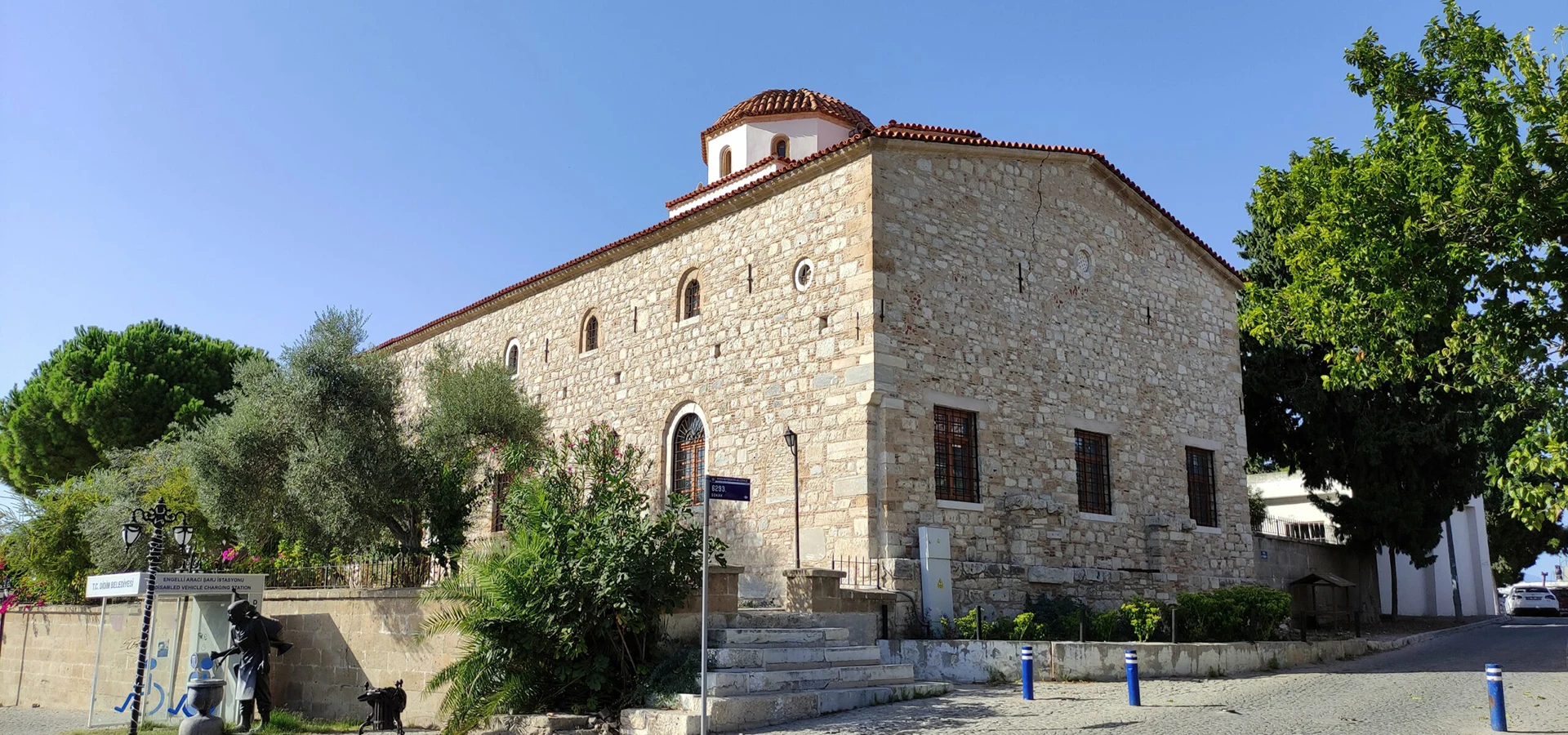
Private Historic Didim Heritage Tour
Discover the Temple of Apollo, the old streets of Hisar and the story of Hisarbey Church-Mosque on a customized route. Interior access to the mosque depends on its restoration status.
Request a Custom Tour





In the historic Hisar neighborhood of Didim, Aydın, just a short distance from the monumental Temple of Apollo, stands one of the district's most meaningful reminders of its multicultural past: Hisar Mosque, commonly known as Hisarbey Kilise Camii or Hisarbey Church-Mosque.
Originally constructed during the 1830s as a Greek Orthodox church, the building belonged to the Christian community that inhabited the old settlement of Yoran, also historically known as Yeronda. Its architecture preserves elements of a traditional church, including stone walls, arched openings, interior columns and a three-aisled arrangement.
Following the 1923 Convention Concerning the Exchange of Greek and Turkish Populations and the population movements implemented in 1924, the local Greek Orthodox community departed. The former church was subsequently adapted for Muslim worship, becoming part of the religious and social life of the new community.
The building has undergone several architectural alterations and conservation projects. Although it was restored and reopened for worship in 2021, structural problems caused its closure in July 2022. A further restoration allocation was announced in 2026, making advance verification essential for anyone hoping to enter.
Today, even when viewed only from its surroundings, Hisar Mosque offers an opportunity to understand Didim beyond its beaches and ancient temples. Its walls tell a story of Christianity, Islam, migration, village life and changing identities across the Aegean.
Discover a historic building originally constructed for the Greek Orthodox community.
Explore the architectural and cultural transition from church to mosque.
Experience the traditional neighborhood surrounding the Temple of Apollo.
Understand how the population exchange reshaped Didim's communities.
Essential information about this historic church-mosque in Didim's old Hisar neighborhood.
Hisar Mahallesi, Didim, Aydın, Türkiye, near the Temple of Apollo.
Open on Google Maps1830s, as a Greek Orthodox church serving the historic Yoran community.
Converted into a mosque following the 1924 population exchange.
Stone construction, arched openings, columns and a three-aisled church layout.
Closed for structural safety reasons in 2022. Verify reopening before planning an interior visit.
Allow approximately 15–30 minutes for exterior viewing and photography, subject to access restrictions.
Hisar Mosque is a valuable witness to Didim's transformation from a Greek Orthodox village into a modern Turkish town.
Although Didim is internationally famous for the Temple of Apollo, its more recent history is equally significant. The modern district grew around settlements that passed through Byzantine, Turkish, Ottoman and Republican periods, with communities leaving their marks on the local architecture.
Hisar Mosque represents an especially visible part of this layered history. Constructed as a Christian place of worship and later adapted for Muslim prayer, the building embodies the demographic, religious and architectural changes that followed the dissolution of the Ottoman Empire.
Its significance lies not in monumental size but in the historical continuity contained within its surviving fabric. The stone walls and arched interior recall the former Orthodox church, while later adaptations reflect its use as a mosque.
The building is also important for understanding the 1923–1924 population exchange between Greece and Türkiye, a process that profoundly affected families, villages, religious buildings and cultural traditions on both sides of the Aegean.
For visitors following our Didim travel guide, Hisar Mosque adds an important human dimension to the archaeological history of the region.
The origins of Hisar Mosque belong to the 19th-century settlement of Yoran, the village that developed around the ancient sanctuary of Didyma. During the late Ottoman period, the surrounding area was inhabited by a Greek Orthodox community whose everyday life was connected with agriculture, local trade and religious traditions.
In the 1830s, the community constructed a stone church that would eventually become the present Hisar Mosque. The building followed a church plan with a central nave, two side aisles, supporting columns and a series of arches.
Following the end of the Ottoman Empire and the Greek-Turkish population exchange, the area's demographic character changed dramatically. The departing Orthodox community left behind homes, religious buildings and other elements of village life.
New residents settled in the region, including Muslim families who had left Greece under the exchange arrangements. The former church was adapted for Islamic worship during the years following these movements, with some accounts placing its established use as a mosque around 1930.
Over the following decades, the building experienced repairs and alterations. Particularly significant changes occurred in the 1980s, when the former apse was removed, the corresponding exterior wall was straightened and three windows were introduced.
On 29 April 1998, the building received formal protection as a registered cultural property through a decision of the İzmir II Regional Conservation Board.
A major restoration was undertaken beginning in 2020. After reopening for worship in 2021, however, the building developed structural concerns and was closed again in July 2022.
In January 2026, reports confirmed the inclusion of 7 million Turkish lira in Aydın's 2026 investment program for further restoration and structural strengthening. This allocation should not be interpreted as confirmation that the building has reopened.
A Greek Orthodox church is constructed in the historic settlement of Yoran.
The population exchange transforms the communities living in the Didim area.
The former church is adapted for Muslim worship.
Architectural changes include the removal of the original apse.
The building receives formal cultural heritage protection.
Restoration is undertaken and the mosque reopens for worship.
Structural safety concerns result in the building's closure.
Funding is allocated for additional restoration and strengthening.
The architecture of Hisar Mosque is particularly interesting because much of its original organization reflects its earlier use as a Greek Orthodox church, rather than the conventional arrangement of a purpose-built Ottoman mosque.
The exterior is characterized by substantial stone masonry, a relatively restrained appearance, arched openings and a pitched roof covered with traditional tiles. These details connect the building with local Aegean construction traditions.
Historically, the interior was divided into three longitudinal aisles: a wider central nave and two narrower side aisles. Columns and connecting arches supported the upper structure, producing a spacious interior organized around repeated architectural bays.
The building's later adaptation for Islamic worship involved changes to the arrangement and furnishings of the interior. Such alterations illustrate how an existing religious structure could acquire a new function without completely losing its earlier architectural identity.
Traditional stone construction forms the principal exterior walls and gives the building its distinctive historic character.
A central nave and two side aisles preserve the essential spatial organization of the former church.
Stone columns divide the interior and provide structural support for the arches above.
Arches and windows reflect architectural features associated with the original church building.
The roof incorporates traditional tiles characteristic of historic buildings in western Anatolia.
Later Islamic furnishings and alterations illustrate the transformation from church to mosque.
The transformation of Hisarbey Church into a mosque reflects the larger history of population movements across the Aegean during the early 20th century.
Before the exchange, the building served the Greek Orthodox population of Yoran. Its religious function was closely connected with the village community, its traditions and its collective identity.
The compulsory population exchange agreed between Greece and Türkiye in 1923 resulted in large-scale displacement and resettlement. Most Orthodox Christians living in the exchange areas of Türkiye were required to relocate to Greece, while Muslims from designated areas of Greece moved to Türkiye, subject to specific treaty exemptions.
In Didim, these events changed the population of the old village and the role of its religious buildings. With the original congregation gone, the church was adapted to serve the religious needs of the Muslim community.
Some architectural features were retained, while others were modified or removed during subsequent decades. The most notable documented alteration was the removal of the former apse during 1980s interventions.
The result is a building that represents both continuity and change. Its preservation is important not only to Islamic heritage but also to the remembrance of the Greek Orthodox community and the broader shared history of the Aegean.
To understand Hisar Mosque, visitors should also understand the setting in which it was constructed.
The present Hisar neighborhood occupies an area closely associated with the ancient sanctuary of Didyma, one of the most important oracular centers of the ancient Greek world. Long after the sanctuary declined, settlement continued around its monumental ruins.
During the Ottoman centuries, the village was commonly known as Yoran or Yeronda. Homes and village streets developed around the remains of the Temple of Apollo, gradually creating a settlement in which ancient architectural fragments, traditional houses and community buildings stood close together.
The historical relationship between the ancient sanctuary and the later village is particularly striking. Where ancient pilgrims once sought guidance from Apollo's oracle, later generations built homes, churches, mosques and agricultural communities.
After the population exchange and the development of modern Didim, the old village remained an important historical quarter. The devastating regional earthquake of 1955 contributed to later settlement changes, and housing development shifted southward toward the area that became Yenihisar and subsequently modern Didim.
Walking through Hisar therefore provides a different experience from visiting the modern resort districts. The neighborhood offers a closer connection with the village history that developed around the ancient sanctuary.
Hisar Mosque is best appreciated as part of its historic surroundings. Even if interior access remains restricted, visitors can study its exterior architecture from permitted public areas and explore the character of the neighboring streets.
Observe the traditional masonry that gives the former church its distinctive appearance.
Look for the building's historic window forms, which contribute to its church-derived architectural character.
Notice the building's broad roof and relatively restrained massing compared with monumental Ottoman mosques.
Understand the historical three-aisled arrangement through documented architectural descriptions and photographs.
Explore the old village setting and the relationship between its houses, streets and religious landmarks.
Continue to the neighboring ancient sanctuary for a remarkable comparison across different historical periods.
Like many historic buildings in earthquake-prone western Türkiye, Hisar Mosque has faced the difficult challenge of preserving architectural authenticity while maintaining structural safety.
Restoration work undertaken during 2020 addressed elements of the building's historic fabric, including its masonry and architectural features. The mosque subsequently reopened for worship in 2021.
However, the appearance of structural separation in part of the building resulted in its closure in July 2022. This demonstrated that further investigation and strengthening were necessary before the interior could safely return to regular use.
In January 2026, local news reports stated that Aydın Governorate had included 7 million Turkish lira in its 2026 investment program for additional restoration and structural strengthening.
Future conservation needs to balance several priorities: the safety of visitors and worshippers, the protection of surviving 19th-century architecture, and respect for the building's later adaptations as a mosque.
Preserving original stonework, columns, arches and surviving architectural details.
Investigating cracks and wall movement before authorizing renewed public access.
Maintaining the building's recognized cultural heritage value.
Recognizing the mosque's role in local religious life and neighborhood identity.
Hisar Mosque is a historic religious building rather than a conventional museum. Access restrictions, preservation requirements and its continuing importance to the community should guide your visit.
Confirm whether the building has reopened before planning an interior visit.
Do not enter closed sections or move around conservation barriers.
Choose modest clothing, especially if the building has reopened as an active mosque.
Natural daylight helps reveal exterior stonework and architectural details.
Keep neighborhood entrances clear and avoid intrusive photography.
Visit the Temple of Apollo and the historic streets of Hisar during the same outing.
Begin in the historic heart of Hisar Mahallesi, where the monumental Temple of Apollo dominates the surrounding settlement. Take time to appreciate the enormous ancient columns and the archaeological remains that made Didyma one of the most celebrated sacred places in ancient Anatolia.
Continue through the neighboring streets toward Hisarbey Church-Mosque. From accessible public spaces, observe the stone exterior and consider how the building formed part of the Greek Orthodox village before becoming a mosque in the 20th century.
Continue through the old neighborhood, where the character of the streets reveals a different side of Didim from the modern beach resorts. If open, the Yoran Population Exchange Memorial and Culture House provides additional context for the population movements that reshaped the district.
Finish with a relaxing stop at a nearby café or restaurant around the temple area. This compact itinerary brings together ancient religion, village history and modern cultural change without requiring extensive transport.
Hisar Mosque stands within Didim's historic Hisar neighborhood close to the Temple of Apollo. It is not a separately managed archaeological museum, and access depends on the building's conservation and safety status.
The most recent documented closure information available for this guide concerns the structural problems that led to the mosque's closure in July 2022. January 2026 reporting confirmed financial provision for additional work but did not establish a reopening date.
Visitors should therefore plan primarily for an exterior view from permitted public areas unless updated local information confirms that the building is open.
The old Hisar neighborhood can be explored throughout the year. Since visiting the mosque may be limited to exterior viewing, comfortable walking conditions and good daylight are especially useful.
Mild temperatures make walking around Hisar and the Temple of Apollo particularly enjoyable.
Comfortable weather and softer light suit heritage photography and relaxed exploration.
Visit early to avoid strong midday heat in Didim's exposed streets and archaeological areas.
The neighborhood is generally quieter, although rain and wind may affect outdoor exploration.
Good natural light can reveal stone textures and architectural details.
Enjoy a slower walk through historic Hisar when temperatures are cooler.
A brief exterior view and a few photographs from permitted public areas.
Time to study the building's historical background and exterior architectural character.
Combine the mosque exterior with a short walk through the surrounding historic streets.
Add a focused exploration of the Temple of Apollo and nearby neighborhood landmarks.
Explore the temple in depth, visit heritage landmarks and enjoy a relaxed meal nearby.
Include additional time to discuss the population exchange and the settlement history of Yoran.
Hisar Mosque offers an interesting subject for visitors who appreciate understated historic architecture. Rather than monumental domes or elaborate minarets, its visual appeal lies in the surviving features of its original church construction and its setting within historic Didim.
Focus on the contrast between different masonry surfaces and repaired architectural elements.
Capture the proportions and repeated forms of the building's historic openings.
Include surrounding streets and greenery to show the mosque's village setting.
Photograph the surrounding neighborhood to illustrate the relationship between old Didim and modern life.
Morning or late-afternoon light can bring out subtle surface textures.
Never enter closed property, cross safety barriers or disturb nearby residents for photographs.
Accessibility at Hisar Mosque is affected by the historic character of the surrounding neighborhood and the building's conservation status.
Public streets may offer exterior views, but paving, gradients, curbs and pedestrian conditions vary. No current accessible interior visitor route has been confirmed.
Some views may be possible from surrounding public streets without entering the building.
Expect occasional uneven paving and narrow sections in the older neighborhood.
Confirm suitable access and current pedestrian conditions before visiting.
Do not plan an interior wheelchair visit without official reopening and accessibility confirmation.
Ask a local driver to identify the nearest safe and permitted stopping point.
Nearby cafés and seating areas around the temple neighborhood can make the visit more comfortable.
Hisar Mosque is situated in the historic district near the Temple of Apollo, making it easy to include in an itinerary focused on Didim's archaeological and cultural attractions.
Visitors arriving from modern Didim or the coast should use the Temple of Apollo area as a practical reference point. Local roads lead into Hisar Mahallesi, where the mosque lies within the old settlement.
Take a local taxi, public transport service or private vehicle toward the Temple of Apollo and Hisar Mahallesi.
Travel inland toward the Temple of Apollo, then continue to the historic neighborhood.
Drive or arrange a transfer toward central Didim and the ancient sanctuary area.
Ask for Hisarbey Kilise Camii or Hisar Camii near Apollon Tapınağı.
Use the temple neighborhood as your destination and follow local parking restrictions.
Once in historic Hisar, explore the temple surroundings and nearby streets on foot.
Didim combines outstanding ancient monuments, historic village neighborhoods and beautiful Aegean coastline. Hisar Mosque can form part of a wider itinerary that moves from archaeology and cultural heritage to beaches and coastal scenery.
Explore the monumental sanctuary of Didyma, one of the ancient world's most influential centers of prophecy.
Discover old village streets and remnants of the settlement that once surrounded the ancient sanctuary.
Learn about the communities and migrations that shaped modern Didim. Check its current opening arrangements.
Visit the celebrated Ionian city historically connected with the sacred sanctuary of Didyma.
Discover archaeological collections illuminating the history of Miletus, Didyma and the surrounding region.
Relax on Didim's famous sandy coastline after exploring the historic neighborhood.
Enjoy a quieter coastal atmosphere, scenic bays and relaxed seaside dining.
Discover a distinctive coastal landmark in the Akbük area, known for its narrow connection to the mainland.
Hisar Mosque is in Hisar Mahallesi, Didim, Aydın, Türkiye, within the historic neighborhood near the Temple of Apollo.
The building is commonly known as Hisar Camii, Hisarbey Camii or Hisarbey Kilise Camii, meaning Hisarbey Church-Mosque.
Yes. It was constructed as a Greek Orthodox church during the 1830s and later adapted for Muslim worship.
The original church is generally dated to the 1830s, making the building nearly two centuries old.
Following the Greek-Turkish population exchange of 1923–1924, the local Orthodox population departed and the building was adapted for the Muslim community.
The conversion occurred after the population exchange, with some historical accounts indicating that the building was established in mosque use around 1930.
The building is generally identified as Hisarbey Church-Mosque. The name Aya Yani Church also appears in heritage references, although its historical dedication is not fully established in this guide.
The building preserves elements of its three-aisled plan, stone construction, arched openings and interior columns, although subsequent modifications changed parts of the original design.
The former church apse was removed during alterations in the 1980s, and the affected exterior wall was modified with three windows.
The mosque reopened after restoration in 2021 but was closed for structural safety reasons in July 2022. A subsequent reopening has not been verified for this guide.
Interior visitor access is not currently confirmed. Visitors should check the latest restoration and safety announcements before planning to enter.
Structural problems, including separation in part of a wall, led to its closure in July 2022.
Restoration work was previously carried out in 2020. In January 2026, funding was announced for further restoration and structural strengthening, but the completion timetable was not confirmed.
No confirmed visitor ticket arrangement is available. Exterior views from permitted public areas do not normally require a museum ticket.
Exterior photography from public areas is generally possible, provided visitors respect safety barriers, residents and any posted restrictions.
The mosque stands in the same historic neighborhood as the Temple of Apollo, so both landmarks can conveniently be included in one walking itinerary.
Yoran was the name of the historic village that developed around the ancient sanctuary. Hisar Mosque was originally constructed for the village's Greek Orthodox community.
No. İzmir's Hisar Mosque is a different monument in the Kemeraltı district, associated with late 16th-century Ottoman architecture. Didim's Hisar Mosque originated as a 19th-century Greek Orthodox church.
Families can explore permitted exterior areas and the surrounding neighborhood. Children should remain away from any construction zones or structural safety barriers.
Yes, particularly for visitors interested in Greek Orthodox heritage, population-exchange history and the cultural transformation of the Aegean. It is best combined with a visit to the Temple of Apollo and old Hisar.
Historic religious buildings deserve particular sensitivity because they hold cultural significance for communities across different periods. Visitors can contribute to preservation through respectful and informed behavior.
Do not enter buildings or sections closed for structural safety or restoration.
Avoid touching fragile surfaces, carving names or leaning equipment against the masonry.
Recognize both the building's Greek Orthodox origins and its later use as a mosque.
Follow official visitor guidance and respect ongoing preservation activities.
Keep streets, entrances and private properties unobstructed during your visit.
Dispose of waste responsibly and leave the historic surroundings as you found them.
Explore the Temple of Apollo, historic Hisar, the story of Yoran and the remarkable ancient cities of the Aegean through a private itinerary tailored to your interests, without compulsory shopping stops.
Combine ancient history, local architecture and the multicultural heritage of the Aegean in a private sightseeing program.
Discover the Temple of Apollo, the old streets of Hisar and the story of Hisarbey Church-Mosque on a customized route. Interior access to the mosque depends on its restoration status.
Request a Custom Tour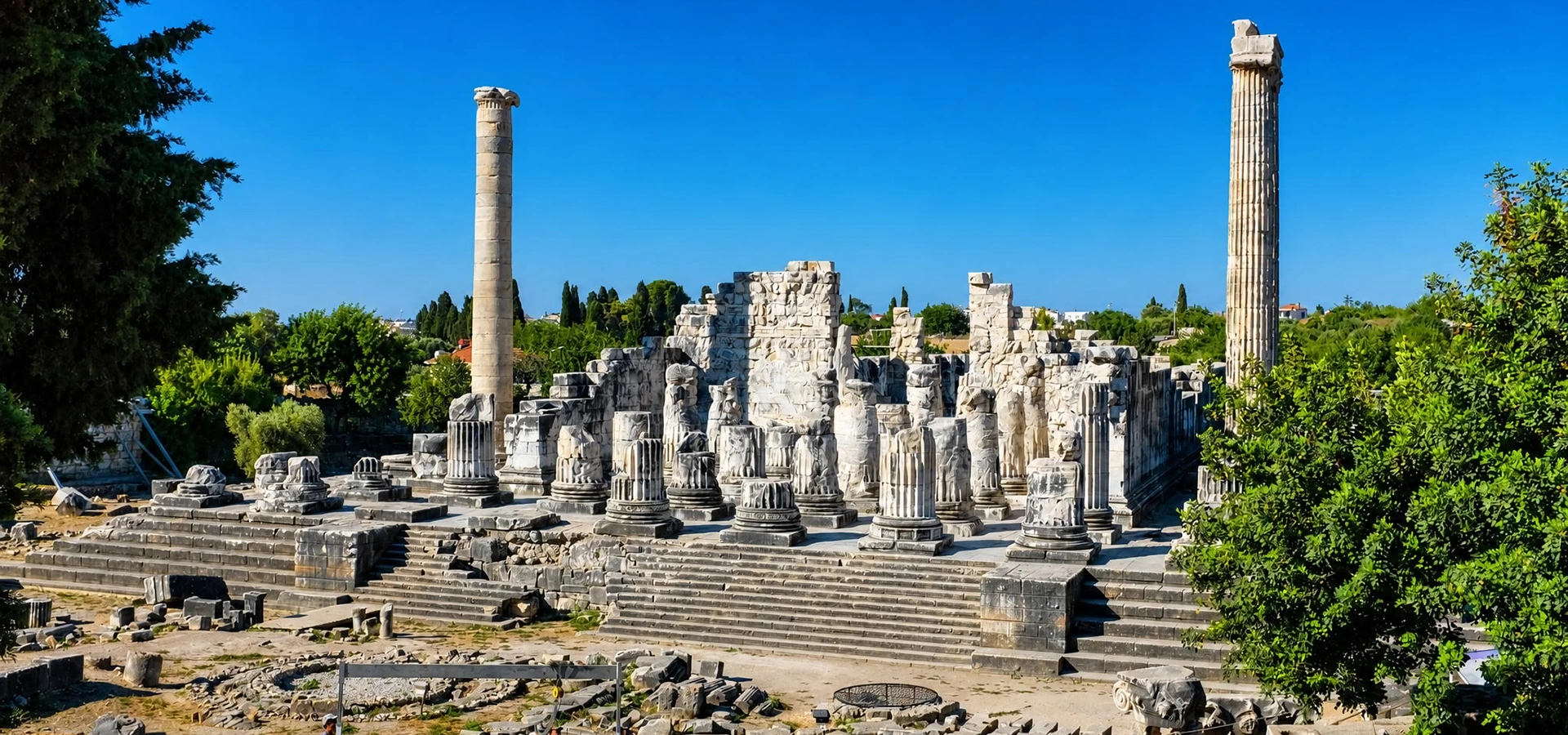
Explore one of the ancient world's great oracular sanctuaries, with monumental columns, fascinating mythology and a remarkable history spanning many centuries.
Explore the Temple of ApolloFrom ancient sanctuaries and Ionian cities to beautiful beaches and traditional coastal villages.
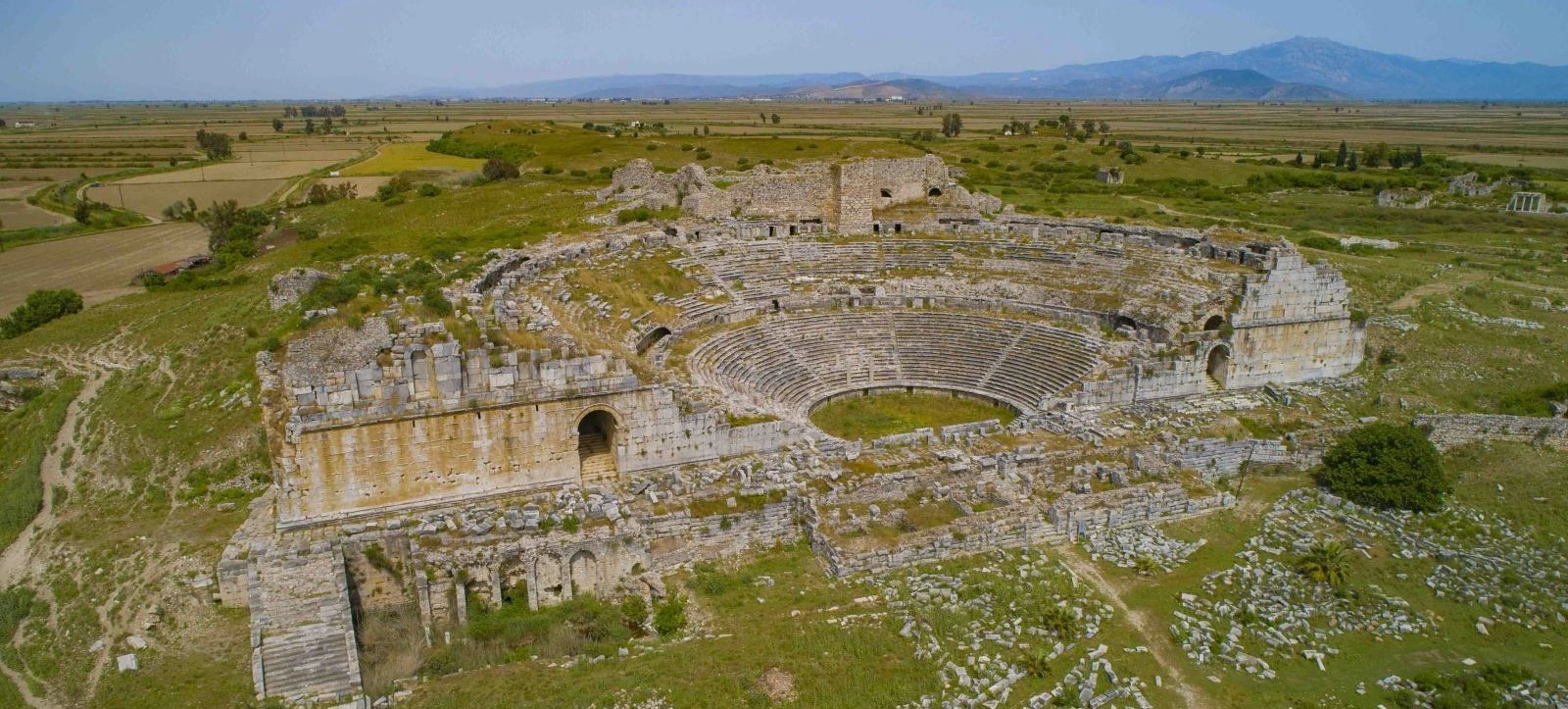
Discover the influential Ionian city renowned for philosophy, science, urban planning and its historical connection with Didyma.
Explore Miletus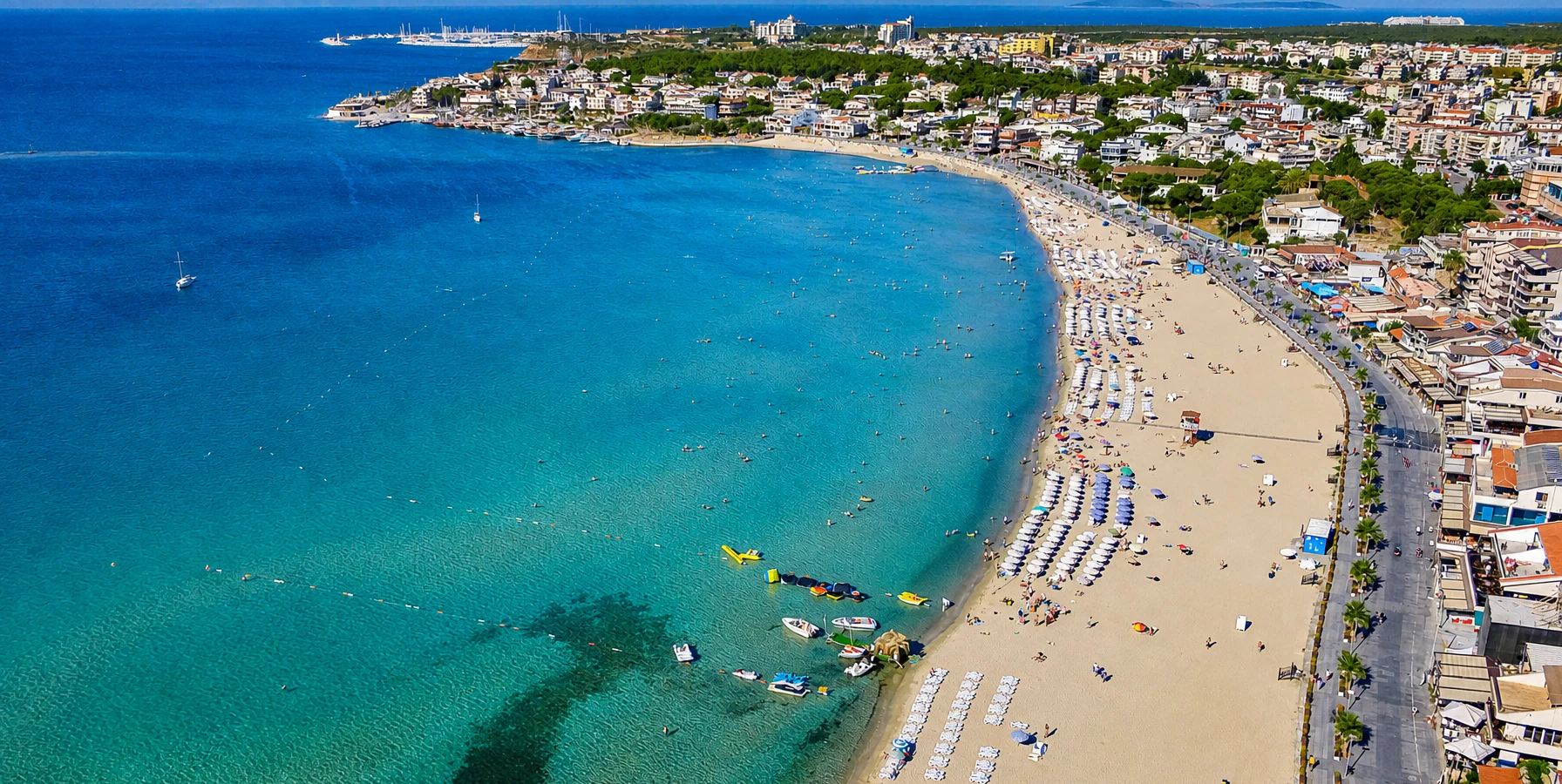
Combine a cultural discovery of Didim with time beside the Aegean Sea at the resort's best-known sandy beach.
Explore Altınkum
Plan your journey through Didim's ancient landmarks, historical neighborhoods, beautiful bays, beaches and cultural attractions.
View Didim Guide