Semolina Base
Semolina is the dominant ingredient and gives the dessert its characteristic granular structure.
- Main ingredient: Wheat semolina
- Texture: Dense and grainy
- Role: Defining feature






İzmir Şambalisi is one of İzmir’s most characteristic traditional desserts. Made primarily from semolina, sugar and milk or yogurt, the mixture is baked in a tray until deeply golden before being finished with sweet syrup and cut into distinctive rectangular portions.
At first glance, şambali can resemble other semolina-based syrup desserts, particularly revani. Its character, however, is quite different. Traditional İzmir Şambalisi has a firmer, denser and more substantial texture, with semolina playing the central role and no egg, flour or added fat required in the registered preparation.
For generations, şambali has been associated with İzmir’s street-food culture, especially around Kemeraltı. Portions were traditionally sold by street vendors and wrapped simply for customers to eat while walking through the city.
Coarse semolina gives İzmir Şambalisi its unmistakable grainy, substantial texture.
The baked dessert is finished with a fragrant sugar syrup that penetrates the semolina structure.
Şambali has long been closely associated with İzmir’s markets, streets and traditional sweet sellers.
İzmir Şambalisi is officially registered in Türkiye as a geographical indication.
Essential information about one of İzmir’s most distinctive traditional syrup desserts.
Strongly associated with İzmir Province in western Türkiye.
Open İzmir on Google MapsSemolina forms the foundation of the traditional İzmir Şambalisi mixture.
Tray-baked semolina dessert finished with a fragrant sugar syrup.
Registered in Türkiye as a Mahreç İşareti in 2016.
How a simple semolina dessert became one of İzmir’s most memorable street-food traditions.
Syrup-soaked semolina desserts belong to a broad culinary family stretching through Anatolia, the Balkans, the eastern Mediterranean and the Middle East. Over generations, İzmir developed its own particularly recognisable interpretation known as İzmir Şambalisi.
The İzmir version became strongly connected with the everyday life of the city. It was traditionally sold by street vendors and sweet sellers, making it a dessert that could be purchased quickly and eaten while walking through busy neighbourhoods and market streets.
Kemeraltı, İzmir’s historic commercial district, became particularly closely associated with şambali. The dessert fits naturally into the bazaar environment, alongside tea houses, traditional restaurants, coffee sellers and other characteristic İzmir foods.
Its preparation is remarkably simple in principle. Semolina, sugar, milk or yogurt, starch and baking powder are combined, spread evenly into a tray and baked until the upper surface becomes deeply golden.
The dessert is then cut into rectangular portions and finished with syrup. Almonds or pistachios may be placed on top before baking, giving each slice an immediately recognisable appearance.
Unlike many cake-like syrup desserts, traditional İzmir Şambalisi does not depend on eggs, flour or added butter or oil in its registered formulation. This gives the dessert a particularly direct semolina character and a firmer texture.
The relationship between the dessert and the city was formally recognised when İzmir Şambalisi received geographical-indication registration in 2016.
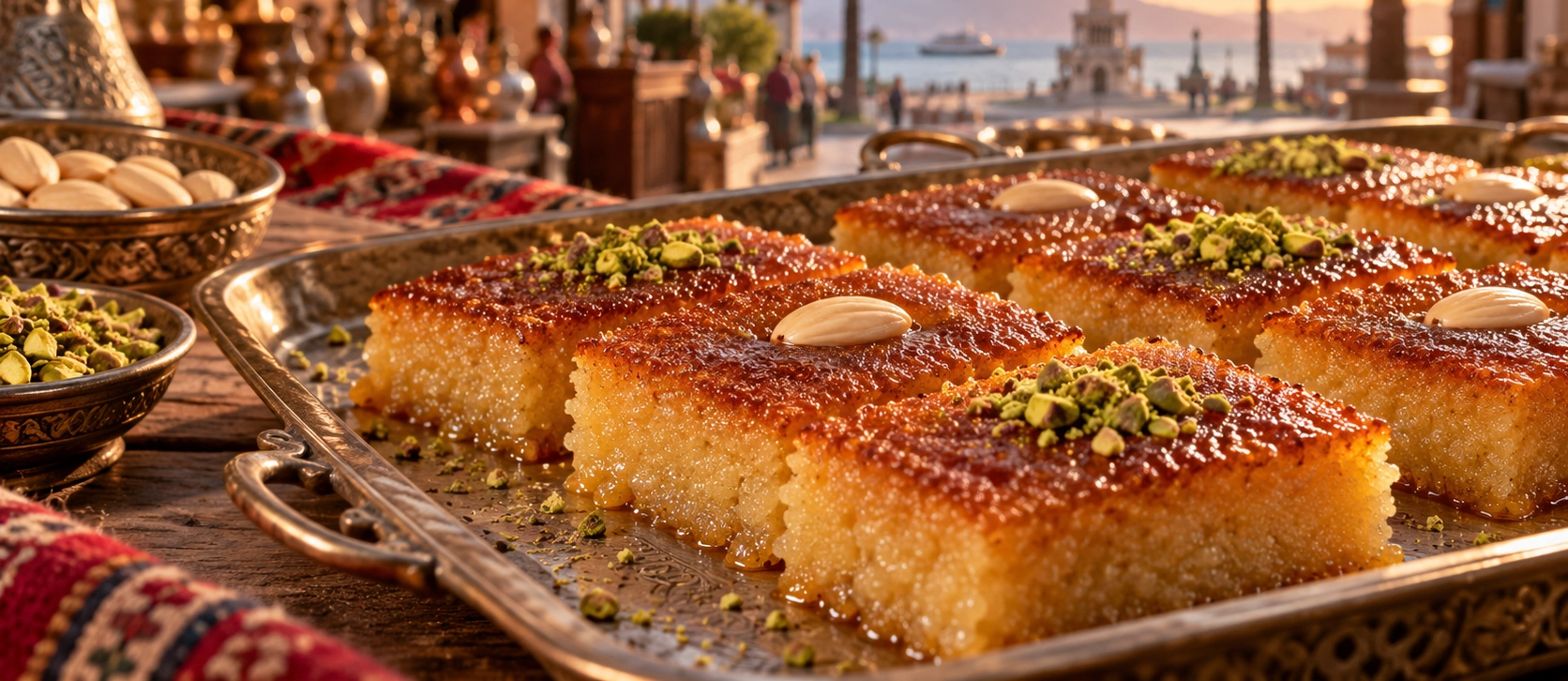
Its semolina-rich mixture, firm texture, caramelised surface and generous syrup distinguish this traditional İzmir speciality.
Semolina is the dominant ingredient and gives the dessert its characteristic granular structure.
Şambali is generally firmer and more substantial than softer semolina cakes such as revani.
Proper baking creates a distinctly darker upper crust above the yellow semolina interior.
Sugar syrup penetrates the baked semolina while the dessert retains enough structure to remain firm.
Traditional İzmir Şambalisi is baked in trays and normally presented as narrow rectangular portions.
Its connection with street vendors and traditional sweet shops is central to İzmir’s şambali culture.
İzmir Şambalisi is a traditional tray-baked dessert whose registered preparation is based on wheat semolina, granulated sugar, milk or yogurt, starch and baking powder. After baking, the dessert is finished with sugar syrup flavoured with ingredients such as lemon and vanilla.
The result is quite different from a soft sponge cake. Şambali has a firm semolina structure that remains clearly visible even after the syrup has been absorbed.
The dessert has become one of the traditional sweets most strongly identified with the city.
Its structure comes primarily from semolina rather than conventional cake flour.
The mixture is spread evenly into a tray before being baked until golden.
The finished dessert is traditionally divided into narrow rectangular servings.
Syrup is added after baking and allowed to distribute throughout the semolina structure.
Şambali has an especially strong connection with İzmir’s historic street-food culture.
İzmir Şambalisi is officially registered in Türkiye as a geographical indication, documenting both its relationship with İzmir and the preparation characteristics that define the traditional product.
The registered specification describes the ingredients, proportions, tray preparation, baking, cutting, syruping and physical characteristics expected from İzmir Şambalisi. Its protected identity therefore depends on both ingredients and traditional production technique.
One of the most interesting characteristics of İzmir Şambalisi is its relatively simple ingredient list. The dessert depends on the behaviour of semolina, careful mixing, baking and controlled syrup absorption rather than a long list of ingredients.
One of the easiest ways to understand şambali is to stop thinking of it as an ordinary cake. Its registered formulation relies on semolina rather than flour as the main structural ingredient.
Egg is not part of the registered İzmir Şambalisi formulation.
The dessert receives its body from wheat semolina rather than conventional wheat flour.
Butter is not required in the protected recipe.
Vegetable oil is also absent from the registered dessert mixture.
The grains absorb moisture and syrup while maintaining the dessert’s distinctive firmness.
Because the ingredient list is short, correct proportions, baking and syruping become especially important.
Traditional İzmir Şambalisi depends on careful control of thickness, baking and syrup absorption so the finished dessert becomes moist without losing its characteristic firm structure.
Baking creates one of şambali’s strongest visual contrasts: a rich golden-brown upper surface above a bright yellow or yellowish semolina interior.
The mixture should be spread uniformly so different parts of the tray cook at approximately the same rate.
The registered product is typically approximately 2.5–3.5 cm thick.
The upper layer should become caramelised in colour without becoming burnt.
A well-prepared surface should remain relatively even rather than developing major cracks.
Inside, the semolina retains a noticeably lighter yellow or yellowish appearance.
Overbaking can make the dessert excessively dry and interfere with even syrup absorption.
The long rectangular portion has become one of the most recognisable visual characteristics of İzmir Şambalisi. It also suits the dessert’s traditional role as an easily portioned street sweet.
The syrup stage transforms the baked semolina mixture into the finished dessert. The goal is not simply to make şambali sweet, but to allow moisture to penetrate the entire portion without destroying its characteristic structure.
The foundation of the syrup is a straightforward mixture of granulated sugar and water.
Lemon or citric acid can provide a small amount of acidity to balance the sweetness.
Vanilla contributes a gentle aromatic character to the syrup.
The syrup is made independently before being combined with the baked dessert.
A good şambali should absorb syrup throughout rather than becoming wet only at the surface.
The dessert should stay firm enough to hold a clean rectangular form after syruping.
Traditional İzmir Şambalisi may be decorated with almonds or pistachios placed on the surface before baking. The garnish adds colour, texture and a visual marker for individual slices.
A whole or split almond provides a clean contrast against the golden semolina surface.
Pistachios can provide both flavour and the familiar green colour associated with Turkish desserts.
The nuts may be arranged on the mixture before the tray enters the oven.
Placement can be aligned so each finished rectangular slice receives its own garnish.
The geographical-indication specification allows the upper decoration rather than making it essential to every serving.
The single nut on a golden rectangular slice has become one of şambali’s most familiar presentations.
Şambali is a wonderfully uncomplicated dessert to eat. A rectangular portion is cut from the tray and can be enjoyed exactly as it is, making it particularly well suited to İzmir’s traditional street-food culture.
The simplest version is served without additional toppings so the semolina and syrup remain the focus.
Some servings are paired with rich kaymak for a creamy contrast to the dense semolina.
A light dusting of cinnamon can add aromatic warmth to the syrupy dessert.
Traditional vendors may serve individual portions simply for convenient eating while walking.
The dessert is generally kept in its baking tray until portions are cut for customers.
Şambali does not depend on being served piping hot and is commonly enjoyed after the syrup has settled.
A good İzmir Şambalisi is rich and sweet without tasting like an ordinary cake. Its defining sensation comes from the coarse semolina structure combined with syrup and the lightly caramelised upper crust.
The grain itself remains noticeable and gives the dessert a particularly satisfying texture.
The finishing syrup gives şambali its unmistakably rich dessert character.
It should hold its shape well rather than behaving like a very soft sponge cake.
Correct syruping keeps the interior moist without turning the slice into a paste.
The darker baked surface adds deeper flavour against the sweeter interior.
Lemon and vanilla in the syrup provide subtle aromas behind the sweetness.
Because both desserts contain semolina and syrup, travellers sometimes assume şambali and revani are the same. Their texture and traditional composition, however, are noticeably different.
The connection between şambali and İzmir is not limited to recipes. Much of the dessert’s identity comes from the way generations of people encountered it in streets, bazaars and busy commercial neighbourhoods.
Şambali has traditionally been sold as a convenient individual sweet by mobile and street-based sellers.
The historic bazaar remains one of the strongest places to connect the dessert with its urban context.
A piece can be cut directly from the tray and served without complicated preparation.
Its character is rooted in everyday city life rather than formal dining alone.
For many İzmir residents, şambali belongs to memories of neighbourhoods, markets and childhood treats.
Today it remains available from traditional dessert specialists and businesses across İzmir.
The best place to understand İzmir Şambalisi is naturally İzmir itself, where the dessert remains part of the city’s traditional sweet culture.
The historic bazaar is the classic area to combine şambali with traditional İzmir food culture.
The streets around Hisar Mosque and Kemeraltı are particularly associated with traditional eating and sweet shops.
Central İzmir provides an easy starting point for travellers exploring both local foods and major landmarks.
Traditional dessert culture can also be explored on the northern side of the Gulf of İzmir.
Look for places where şambali is displayed in full trays and cut into portions as customers order.
Request the traditional İzmir version if you want to experience the protected regional speciality.
Traditional İzmir Şambalisi has a relatively straightforward recipe, but anyone with allergies or dietary restrictions should always confirm the actual preparation used by the individual producer.
Semolina is produced from wheat, so traditional şambali is not gluten-free.
The registered recipe uses either milk or yogurt as part of the semolina mixture.
Egg is not required by the registered İzmir Şambalisi formulation.
Butter and vegetable oil are not required ingredients in the registered mixture.
Almonds or pistachios may be used, making allergy checks especially important.
Anyone with serious allergies should ask about trays, utensils, surfaces and cross-contact in the kitchen.
The historic bazaar gives the dessert its strongest cultural and urban context.
Seeing a full tray before it is cut helps you understand şambali’s traditional presentation.
Good şambali should feel substantial and semolina-rich rather than soft like an ordinary cake.
A rich golden or gently caramelised upper surface is part of the dessert’s characteristic appearance.
A plain slice makes it easier to understand the balance between semolina, baked crust and syrup.
If available, kaymak creates a richer second version with a strong creamy contrast.
Turkish tea helps balance the syrup and makes an excellent companion during a market walk.
Combine şambali with boyoz, gevrek, kumru, lokma and other local specialities during your visit.
İzmir’s culinary identity reflects its Aegean geography, historic port, market culture, migrations, multicultural communities and strong tradition of foods eaten outside the home.
Şambali fits naturally into that story. It requires no formal dining room to make an impression: a simple rectangular slice eaten in the streets of Kemeraltı can communicate just as much about İzmir as an elaborate meal.
A layered pastry deeply associated with İzmir breakfast culture.
The city's especially crisp sesame-covered bread ring and a classic morning street food.
Distinctive sesame bread that forms the foundation of one of İzmir’s best-known sandwiches.
A highly distinctive cold meat speciality associated with İzmir’s street-food tradition.
A fried syrup dessert with an especially important role in public sharing and neighbourhood life.
İzmir’s dense semolina street dessert, combining simple ingredients with a strong sense of place.
Şambali makes an ideal sweet stop during a day exploring central İzmir, particularly when your route passes through Konak and the historic Kemeraltı Bazaar.
İzmir Şambalisi shows how an uncomplicated recipe can become a powerful part of a city’s identity. Its significance lies not only in what is in the tray, but also in where and how generations of people have eaten it.
Şambali is one of the sweets most closely connected with traditional İzmir food culture.
Its history as an easily served street sweet connects it directly with everyday urban life.
The historic bazaar provides one of the strongest settings in which to understand the dessert.
Semolina, controlled baking, rectangular cutting and syruping create a clearly recognisable product.
Traditional sweet sellers help carry the dessert from earlier street culture into modern İzmir.
Geographical-indication registration formally documents the connection between İzmir and Şambali.
İzmir Şambalisi is only one chapter in the city’s extraordinary culinary story. Explore these other specialities to experience the diversity of İzmir’s breakfast, street-food, meat, pastry and dessert traditions.
The city’s celebrated layered pastry and one of the defining flavours of an İzmir breakfast.
A crisp sesame-coated bread ring deeply connected with İzmir’s morning street-food culture.
Distinctive sesame-covered bread transformed into one of İzmir’s best-known sandwiches.
İzmir’s finely chopped interpretation of Türkiye’s famous charcoal-grilled offal speciality.
A distinctive cold preparation of cooked lamb-head meats with vegetables and seasoning.
Seasoned meatballs cooked with potatoes, peppers and rich tomato sauce.
Golden ring-shaped fermented dough, fried until crisp and finished in fragrant sugar syrup.
A modern İzmir favourite with a thin baked exterior surrounding a rich chocolate centre.
A traditional şambali stop around central İzmir can easily be combined with historic bazaars, Ottoman landmarks, Roman archaeology and the famous waterfront.
Explore İzmir’s historic commercial heart and one of the best areas for discovering traditional city flavours.
See one of the important historic landmarks within the Kemeraltı district.
Visit the symbolic centre of İzmir and its famous late-Ottoman Clock Tower.
Explore a historic Ottoman caravanserai now filled with traditional shops, crafts and coffee culture.
Discover important remains of ancient Smyrna within walking distance of the modern city centre.
Finish the day beside the Gulf of İzmir on one of the city’s most popular waterfront promenades.
İzmir Şambali is a traditional baked semolina dessert that is cut into rectangular pieces and finished with sugar syrup.
The registered preparation uses wheat semolina, granulated sugar, milk or yogurt, starch and baking powder, together with a sugar-based syrup.
Yes. İzmir Şambalisi is officially registered in Türkiye as a Mahreç İşareti geographical indication.
İzmir Şambalisi is registered under geographical-indication registration number 205.
Its geographical-indication registration date is 23 December 2016.
The geographical indication was registered by the İzmir Chamber of Commerce.
Conventional flour is not required in the registered İzmir Şambalisi recipe. Wheat semolina forms the principal structural ingredient.
Egg is not required by the registered traditional formulation.
Butter and vegetable oil are not required ingredients in the registered İzmir Şambalisi mixture.
No. Semolina is produced from wheat, so traditional İzmir Şambalisi contains gluten.
Not necessarily. The registered preparation uses milk or yogurt, so travellers following a vegan diet should ask the producer about the exact recipe.
It may. Almonds or pistachios can be placed on the dessert before baking, so anyone with nut allergies should confirm ingredients and preparation practices.
Şambali is generally firmer, denser and more strongly based on semolina, while revani usually has a softer and more cake-like texture.
The dessert is baked in a large tray and traditionally divided into narrow rectangular pieces for serving.
Good şambali should taste richly of semolina and syrup while remaining firm, moist and easy to cut, with a lightly caramelised baked surface.
It does not need to be served hot. It is commonly eaten after the syrup has had time to distribute through the dessert.
Yes. Although it can be enjoyed plain, kaymak is a popular accompaniment that adds a rich creamy contrast.
Kemeraltı and the surrounding historic centre are among the most characteristic areas to look for traditional şambali in İzmir.
The historic market district has a long tradition of street food, sweet sellers and traditional İzmir businesses, making it an important setting for the city’s şambali culture.
Turkish tea, unsweetened Turkish coffee, water and mineral water all provide good contrasts to the dessert’s syrupy sweetness.
The caramelised upper crust, yellow semolina interior, glossy syrup and geometric rows of rectangular slices make şambali especially attractive for food photography.
A complete tray shows the repetitive geometry and traditional style of the dessert beautifully.
A side view reveals the contrast between the dark golden surface and lighter semolina interior.
An almond or pistachio provides a strong focal point on the otherwise simple golden surface.
Soft side lighting can reveal the moisture and glossy finish without overwhelming the texture.
Photographing the dessert being cut from a traditional tray adds human and cultural context.
A market or historic-bazaar background immediately connects the dessert with İzmir.
When photographing vendors or customers, ask permission before taking close portraits and avoid disrupting busy service.
Discover İzmir Şambalisi as part of a private journey through Kemeraltı, historic neighbourhoods, ancient Smyrna and the city’s extraordinary culinary traditions.
Custom-designed private touring with professional guiding, comfortable transportation and flexible timing for travellers who want to understand İzmir through both its history and its food.
Explore Kemeraltı, central İzmir and local culinary traditions while tasting şambali and other characteristic foods of the city.
Request This Tour
Combine Konak, Kemeraltı, ancient Smyrna and the waterfront with a relaxed exploration of İzmir’s best-known foods and desserts.
Design Your ExperienceExtend your food journey beyond the city centre with private visits to historic towns, archaeological sites and regional culinary traditions across İzmir Province.

Combine one of Türkiye’s great archaeological sites with the urban history and distinctive culinary culture of İzmir.
Request This Tour
Create a personalised route through İzmir Province combining regional foods, traditional markets, historic towns and cultural landmarks.
Design Your Journey