Ring Shape
The classic İzmir version is formed as a small circular ring with a hole in the centre.
- Form: Round ring
- Centre: Open
- Identity: Defining feature






İzmir Lokması is one of the most recognisable traditional sweets of İzmir. Made from a soft fermented dough, shaped into small rings, fried in hot oil and briefly soaked in syrup, it combines a crisp golden exterior with a light, tender centre.
Lokma exists in many forms across Türkiye and the wider region, but the version specifically identified as İzmir Lokması is distinguished by its round ring shape with a hole in the middle. Small solid round pieces are generally known as saray lokması.
In İzmir, lokma is much more than a dessert-shop treat. It is deeply connected with community life and is often prepared and distributed free of charge for religious days, memorials, celebrations, fulfilled wishes and charitable occasions. This familiar practice is known as “lokma döktürmek”.
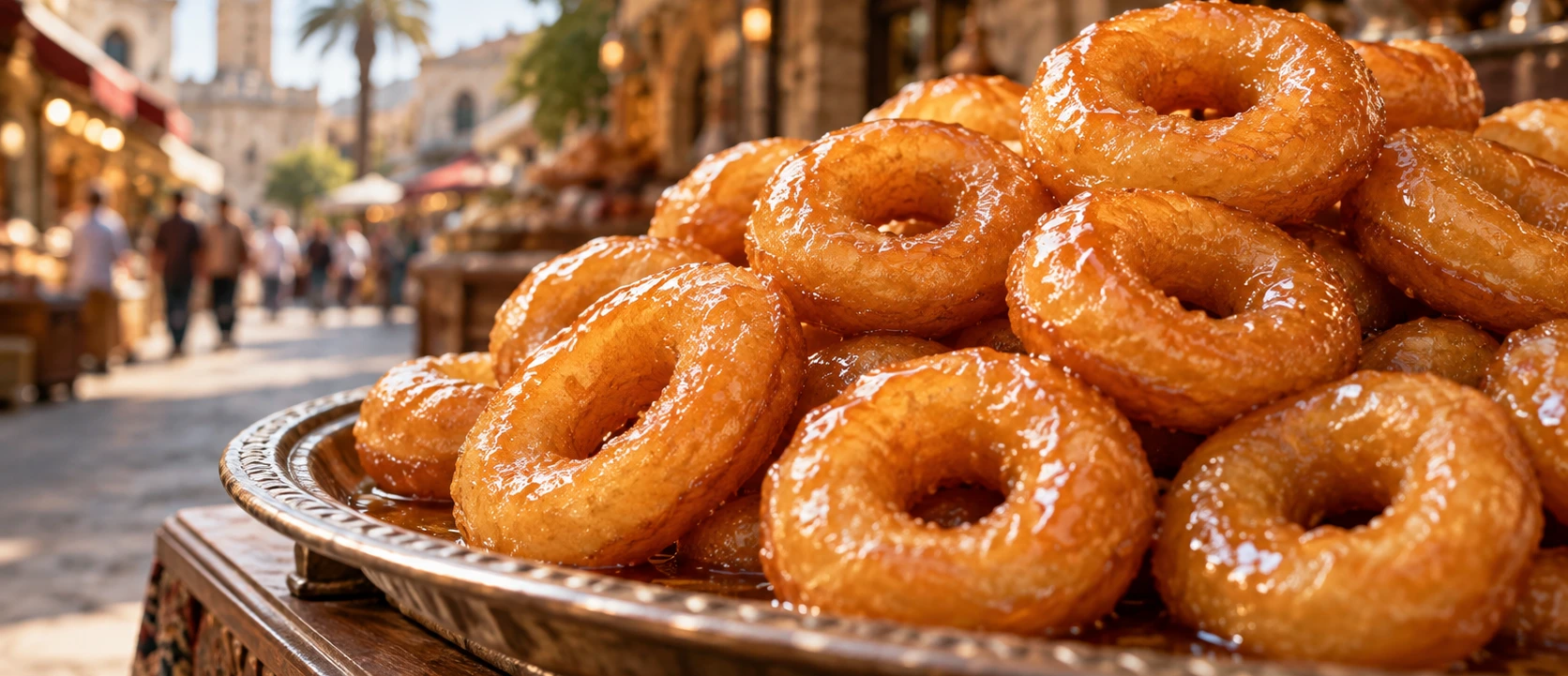
The central hole is the most recognisable visual feature of traditional İzmir Lokması.
Fermented dough is fried until golden, creating a crisp outer shell and soft interior.
The hot fried rings are briefly rested in a simple sugar-and-lemon syrup.
İzmir Lokması has been registered in Türkiye as a geographical indication since 2017.
Essential information about one of İzmir’s most characteristic traditional sweets.
Strongly associated with İzmir Province in western Türkiye.
Open İzmir on Google MapsA small round ring with a visible hole through the centre.
Fermented fried dough finished in a sugar syrup scented with lemon.
Registered in Türkiye as a Mahreç İşareti in 2017.
A simple fried dough that became one of the strongest edible symbols of İzmir.
Fried dough sweets related to lokma are known across a broad geography, from Anatolia to neighbouring Mediterranean and Middle Eastern culinary traditions. In İzmir, however, lokma developed an especially visible place in public and community life.
The dessert is based on an uncomplicated mixture of wheat flour, water, yeast, salt and sugar. After fermentation, the dough is shaped, fried until golden and placed briefly into syrup.
The characteristic İzmir version is easily recognised because the dough is shaped into a small ring with a hole in the centre. This form distinguishes İzmir Lokması from the solid round pieces commonly called saray lokması.
In the city, lokma has long been connected with acts of sharing. Mobile lokma stands can appear outside homes, workplaces, mosques, streets and neighbourhood gathering points, where freshly fried portions are distributed to passers-by.
People may sponsor lokma in memory of someone who has died, to mark a kandil or mevlüt, after a fulfilled wish, during a celebration, or simply as an act of charity. This practice gives lokma a social meaning that goes far beyond its role as a dessert.
Because the sweet is fried and served in front of the public, the experience is also highly sensory: the bubbling oil, the rhythmic shaping of the dough, the golden colour, the syrup and the warm smell all become part of the ritual.
The relationship between the dessert and the city was formally recognised when İzmir Lokması received geographical-indication registration in 2017.
The ring shape, fermented dough, careful frying and short syrup bath define the İzmir style.
The classic İzmir version is formed as a small circular ring with a hole in the centre.
Yeast gives the dough enough air and elasticity to create a light centre beneath the fried crust.
The shaped rings are dropped into hot vegetable oil and fried until evenly golden.
After frying, the lokma is rested briefly in sugar syrup rather than left soaking for a long period.
İzmir Lokması is at its best soon after frying, when the outside remains crisp beneath the syrup.
Community distribution is one of the most distinctive parts of İzmir’s lokma culture.
İzmir Lokması is a traditional syrup dessert made from a fermented dough of wheat flour, water, yeast, salt and sugar. The dough is shaped into small rings, fried in hot vegetable oil and then briefly rested in syrup made from sugar, water and lemon juice.
Its most important identifying feature is the hole in the centre. This ring shape is not simply decorative: it is the visual characteristic used to distinguish İzmir Lokması from other small round types of lokma.
The dessert has become one of the most widely recognised culinary symbols of the city.
The dough is fermented before frying, helping create its characteristic airy interior.
Traditional İzmir Lokması has a central opening and a rounded doughnut-like shape.
The rings are cooked in hot oil until the outside becomes evenly golden.
The fried dough is finished with a simple sugar syrup containing a small amount of lemon juice.
Lokma is frequently prepared for public distribution during meaningful religious and social occasions.
İzmir Lokması is officially registered in Türkiye as a geographical indication, recognising its established connection with İzmir and the preparation characteristics that distinguish the city’s version.
The registered specification defines not only the ingredients but also the dough fermentation, ring shape, frying conditions and syrup stage. The protected identity therefore depends on technique as much as on the basic recipe.
The ingredient list is remarkably simple. The character of the finished lokma comes from fermentation, shaping, oil temperature and the balance between frying and syrup.
The central hole is the feature most closely associated with the İzmir style. In the registered preparation, the fermented dough is shaped into a round ring before frying.
The ring form visually distinguishes İzmir Lokması from many other lokma styles.
The open centre allows hot oil to reach more of the dough surface during cooking.
A ring provides plenty of exterior surface for the golden fried crust.
The dough remains pleasantly soft and airy beneath the crisp outside.
For travellers, the hole in the centre is the quickest clue that they are looking at İzmir-style lokma.
The shape is part of the registered identity of İzmir Lokması rather than a modern presentation choice.
Good İzmir Lokması depends on controlling each stage carefully so the finished rings stay light, crisp and pleasantly syrupy rather than heavy.
Fermentation is essential to İzmir Lokması. The registered method describes a soft dough that is mixed thoroughly and then allowed to rise under warm conditions before shaping.
The dough contains a relatively high proportion of water, giving it a loose and elastic consistency.
Yeast produces the gas that creates the light interior visible after frying.
The registered method describes fermentation at approximately 28–32°C.
Fermentation is generally around 1 to 1.5 hours, depending on temperature and yeast activity.
Proper fermentation helps the dough stretch into the characteristic ring form.
Under-fermented dough can feel dense, while well-fermented dough produces a lighter lokma.
Frying is the stage that transforms the soft fermented dough into the crisp, golden shell that makes freshly prepared lokma so appealing.
İzmir Lokması is finished with a simple syrup rather than a complex sauce. Sugar and water create the base, while lemon juice provides a small amount of acidity and aroma.
The syrup begins with a straightforward combination of granulated sugar and water.
A limited amount of lemon juice balances the syrup and adds a clean aromatic note.
The registered preparation describes a short boiling stage for the syrup.
The fried lokma is held in syrup for only a limited time rather than being left to absorb indefinitely.
Correct syruping gives the fried rings their characteristic sheen.
The best result is sweet without sacrificing the crispness created during frying.
The classic way to enjoy İzmir Lokması is simple: freshly fried, syruped and served in small portions while the outside is still crisp.
Lokma is at its most distinctive soon after cooking, before the crust softens.
Several small rings are usually served together rather than as one large pastry.
A good serving has a shiny surface without sitting in a heavy pool of syrup.
During public distribution, portions may be handed directly to people waiting nearby.
Travellers can also buy freshly prepared lokma from specialist dessert shops and lokmacı businesses.
The protected specification treats İzmir Lokması as a product intended for fresh daily consumption.
Good İzmir Lokması is a study in contrasts: crisp outside, soft inside, warmly yeasty in the dough and brightened by a glossy sugar syrup.
The freshly fried exterior should have a delicate crunch when bitten.
The fermented centre remains tender and light beneath the crust.
The syrup gives the dessert an immediate sweetness without changing its simple character.
The fermented dough contributes a gentle bread-like aroma behind the syrup.
Much of lokma’s appeal comes from eating it while the fragrance of frying is still present.
A small amount of lemon in the syrup keeps the sweetness from feeling completely one-dimensional.
Visitors often see different fried dough shapes described simply as lokma. The easiest way to recognise the İzmir style is to look at the centre.
One of the most memorable aspects of lokma culture in İzmir is the practice of preparing and distributing it as an act of charity, remembrance or gratitude.
This common expression refers to arranging for lokma to be prepared and handed out to the public.
Families may distribute lokma in memory of a relative or loved one who has died.
Lokma may appear around kandils, mevlüts and other religiously meaningful occasions.
It can also accompany happy occasions, fulfilled wishes and personal milestones.
In these contexts, the lokma is offered to passers-by rather than sold as a commercial dessert.
The practice turns a simple sweet into an act of public generosity and shared memory.
The easiest place to experience authentic İzmir Lokması is naturally İzmir itself, where specialist lokma shops and public lokma stands remain part of the city’s food culture.
The historic city centre is a natural area to combine sightseeing with traditional İzmir foods and sweets.
İzmir’s historic bazaar district offers a dense mix of traditional food shops, cafés and street flavours.
A lively central district where dessert shops and modern interpretations can sit beside older food traditions.
Look for businesses that fry lokma continuously rather than serving pieces that have been sitting for a long time.
If you encounter a charitable lokma stand, follow the local queue and accept the serving respectfully.
If the shape matters to you, request the ring-shaped İzmir version specifically.
Traditional İzmir Lokması has a short ingredient list, but travellers with dietary restrictions should still confirm preparation practices directly with the producer.
The registered recipe is based on flour, water, yeast, salt, sugar, lemon juice and vegetable oil.
Milk and butter are not required by the registered İzmir Lokması specification.
Egg is not required in the protected preparation.
Traditional İzmir Lokması is made with wheat flour and is not gluten-free.
Travellers monitoring fried foods should remember that lokma is cooked by immersion in hot oil.
Anyone with serious allergies should ask about shared oil, utensils and production surfaces.
The difference between freshly fried lokma and a long-rested portion can be dramatic.
A central hole is the quickest visual clue that you are eating the İzmir form.
Fresh production is part of the experience, especially at a street stand or busy lokmacı.
Lokma is light in size but rich because it combines frying and syrup.
If lokma is being distributed publicly, join the queue calmly and follow the local flow.
Turkish tea is one of the simplest and most satisfying companions to the sweet syrup.
A lokma break fits naturally into a walk through İzmir’s historic market district.
Boyoz, gevrek, kumru and söğüş show completely different sides of the city’s food culture.
İzmir’s cuisine reflects the Aegean coast, port-city exchange, market culture, migration, olive-oil cooking and an unusually strong tradition of foods eaten outside the home.
Lokma belongs naturally within this environment. It can be bought from a specialist shop, encountered unexpectedly on a street corner or shared publicly during a meaningful community occasion.
The city’s celebrated layered pastry and one of the classic foods of an İzmir breakfast.
İzmir’s especially crisp sesame-coated bread ring, closely connected with morning street culture.
A distinctive sesame bread and sandwich tradition strongly associated with İzmir.
A cold meat speciality that gives İzmir’s street-food culture a completely different character.
A home-style dish of meatballs, potatoes, peppers and tomato sauce.
The sweet side of İzmir street culture, combining dessert, ritual and public generosity.
Lokma works beautifully as a short sweet stop during a day exploring central İzmir, especially around Konak, Kemeraltı and the waterfront.
İzmir Lokması is significant not because its ingredients are rare, but because a simple fried dough has become a powerful expression of place, memory, generosity and everyday urban culture.
The ring-shaped sweet is one of the foods most readily associated with İzmir.
Public lokma distribution often carries personal stories of remembrance and gratitude.
Free servings transform a dessert into a direct act of sharing with strangers.
The preparation can happen in full public view, making the cooking process part of city life.
The ring shape, fermentation, frying and syrup stage give İzmir Lokması a clearly defined form.
Geographical-indication registration formally documents the relationship between the product and İzmir.
İzmir Lokması is only one part of the city’s extraordinary food identity. These other specialities reveal the breadth of İzmir’s breakfast, street-food, meat and pastry traditions.
The city’s celebrated layered pastry and one of the defining flavours of an İzmir breakfast.
A crisp sesame-coated bread ring with a particularly strong connection to İzmir’s morning food culture.
Distinctive sesame-covered bread transformed into one of İzmir’s best-known sandwiches.
İzmir’s finely chopped interpretation of Türkiye’s famous charcoal-grilled offal speciality.
A distinctive cold preparation of cooked lamb-head meats with vegetables and seasoning.
Seasoned meatballs cooked with potatoes, peppers and tomato sauce.
Neighbouring Tire’s famous slender köfte, traditionally cooked on skewers and finished in butter.
Long cylindrical meatballs made with beef and semolina, grilled over charcoal and served with seasoned bread.
Central İzmir makes it easy to combine a quick lokma break with historic markets, archaeological remains, waterfront walks and some of the city’s most recognisable landmarks.
See the heart of central İzmir and the famous late-Ottoman Clock Tower.
Explore one of the city’s richest historic commercial areas, filled with shops, food and traditional urban life.
Discover major Roman-period remains in the centre of the modern city.
Visit one of Kemeraltı’s important historic religious landmarks.
Walk beside the Gulf of İzmir and experience one of the city’s best-loved public spaces.
Continue into a lively district of cafés, restaurants, historic streets and waterfront life.
İzmir Lokma is a traditional fried dough dessert made from fermented wheat-flour dough, shaped into small rings, fried and briefly soaked in sugar syrup.
Its most distinctive feature is the round ring shape with a hole in the centre.
Yes. İzmir Lokması is registered in Türkiye as a Mahreç İşareti geographical indication.
Its geographical-indication registration date is 21 March 2017 under registration number 210.
The geographical indication was registered by the İzmir Chamber of Commerce.
The registered preparation uses wheat flour, water, yeast, salt and sugar for the dough, plus vegetable oil for frying and a sugar-water syrup with lemon juice.
No. İzmir Lokması is ring shaped with a hole in the middle, while saray lokması is generally made as small solid round pieces.
Yes. The shaped dough is fried in hot vegetable oil until golden.
Yes. After frying, the lokma is briefly placed in a sugar syrup containing a small amount of lemon juice.
It means arranging for lokma to be cooked and distributed, often as an act of charity, remembrance, gratitude or celebration.
Free distribution is connected with community traditions including memorials, religious occasions, fulfilled wishes and charitable acts.
The registered recipe does not require dairy or eggs, but travellers should confirm the actual ingredients and frying practices used by each producer.
No. Traditional İzmir Lokması is made with wheat flour.
It should be crisp outside, soft and airy inside, freshly fried and sweetened with syrup without becoming excessively soggy.
It is best eaten fresh, ideally soon after frying and syruping while the outer surface still has some crispness.
Specialist lokma shops can be found around İzmir, and visitors may also encounter public lokma distribution stands in neighbourhoods and central districts.
Central areas such as Konak, Kemeraltı and Alsancak are convenient places to combine lokma with sightseeing and other İzmir food experiences.
Turkish tea, unsweetened Turkish coffee, water or mineral water all work well with the syrupy fried dough.
Golden rings, bubbling frying oil and glossy syrup make İzmir Lokması especially photogenic when it is captured fresh during preparation.
Photograph from above or at a slight angle so the central hole is clearly visible.
The bubbling oil and floating golden rings communicate freshness immediately.
Side lighting can reveal the glossy finish without making the lokma look heavy.
Many small rings together create a strong visual sense of abundance and sharing.
A street preparation setup gives the image context and connects the dessert with İzmir life.
Kemeraltı, Konak or another recognisable city setting can strengthen the sense of place.
When photographing public lokma distribution, be respectful of people receiving food and ask permission before clearly photographing individuals at close range.
Discover İzmir Lokması as part of a private journey through historic markets, waterfront neighbourhoods, ancient Smyrna and the city’s extraordinary food traditions.
Custom-designed private touring with professional guiding, comfortable transportation and flexible timing for travellers who want to explore İzmir through both its history and its food.
Explore Kemeraltı, central İzmir and local culinary traditions while tasting lokma and other characteristic foods of the city.
Request This Tour
Combine Konak, Kemeraltı, ancient Smyrna and the waterfront with a relaxed exploration of İzmir’s best-known foods.
Design Your ExperienceExtend your food journey beyond the city centre with private visits to historic towns, archaeological sites and regional culinary traditions across İzmir Province.

Combine one of Türkiye’s great archaeological sites with the urban history and distinctive food culture of İzmir.
Request This Tour
Create a personalised route through İzmir Province combining regional foods, markets, traditional towns and cultural landmarks.
Design Your Journey