From Raw Earth to Finished Earthenware
How Is Traditional Karacasu Pottery Made?
The production of traditional Karacasu pottery is a multi-stage process requiring careful preparation, experienced hands and controlled firing.
Although individual workshops may use different equipment, the established production tradition is based on transforming local clay into shaped and fired ceramic objects.
1. Collecting the Local Clay
The process begins with obtaining suitable clay-bearing earth from the traditional production area.
The registered specification identifies material from the Yazır locality and deposits associated with the Dandalaz stream.
After collection, the raw earth is transported to pottery workshops for preparation.
2. Removing Stones and Impurities
Raw earth can contain stones, roots, coarse particles and other unwanted materials.
These must be removed because they may interfere with shaping and produce weaknesses in the finished ceramic body.
Traditional preparation involves breaking down, sorting and sieving the material before further processing.
3. Mixing the Clay with Water
The prepared material is combined with water to create a workable mixture.
The official production specification describes a settling system in which clay and water pass through basins, allowing heavier particles to separate from finer material.
Careful settling helps produce a more consistent clay mixture.
4. Preparing the Fine Clay Slip
Some of the finely suspended clay material is separated for use as a surface coating, traditionally known as astar.
This fine clay slip may be applied to suitable vessels during finishing and decoration.
It is different from a modern glaze and should not automatically be understood as creating an impermeable or food-safe coating.
5. Resting and Kneading the Clay
After settling, the clay is allowed to rest until it reaches a suitable working consistency.
The registered production method describes a resting period of at least two days during clay preparation.
The material is then kneaded and may be processed using mechanical equipment to create consistent, workable clay masses.
Special preparation helps reduce irregularities and unwanted air pockets before shaping.
Locally prepared cylindrical clay portions are identified in the registration documentation by traditional terms such as künte and zehk.
6. Shaping the Clay on the Potter's Wheel
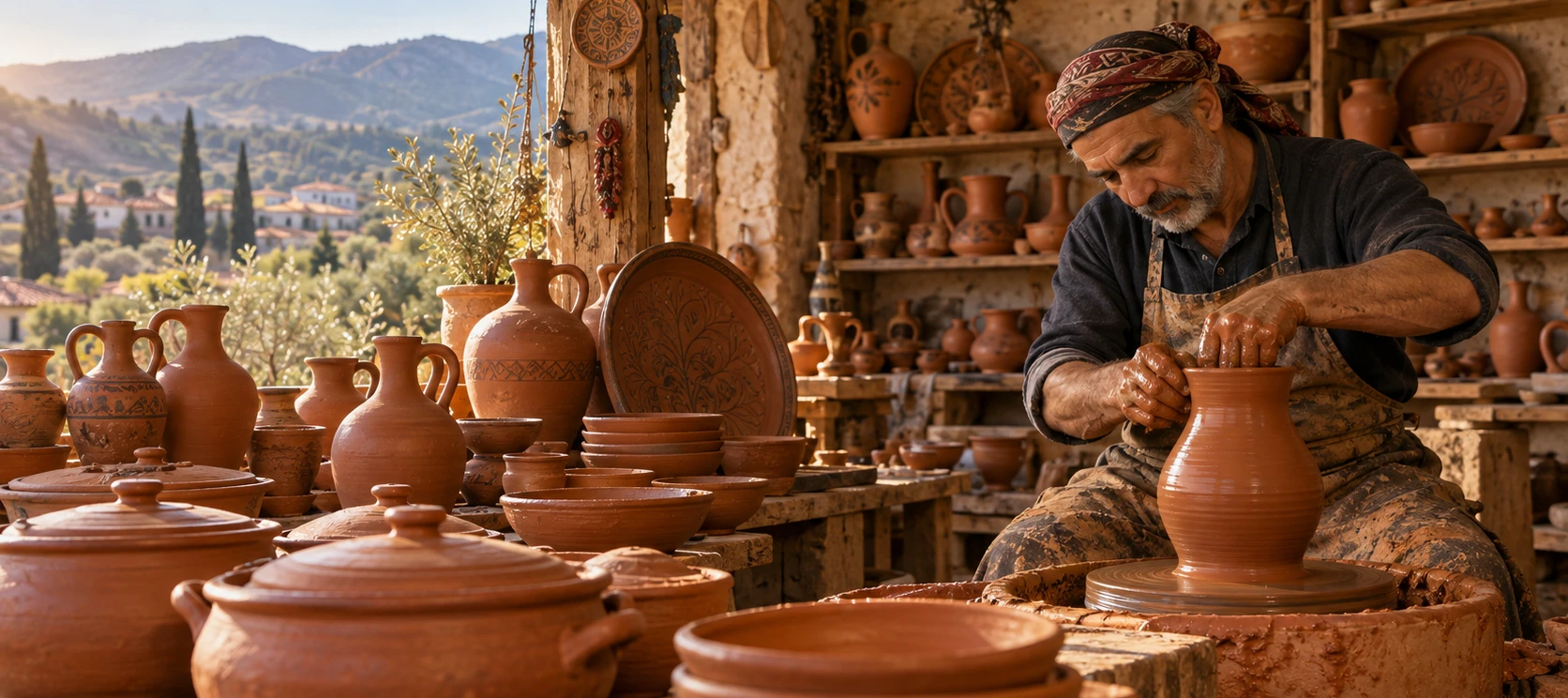
One of the most visually fascinating stages takes place at the potter's wheel, known in Turkish as the çömlekçi çarkı.
The artisan places a prepared mass of clay on the rotating wheel and carefully centers it.
Using pressure from the fingers and palms, the potter gradually raises, opens and shapes the clay.
Vessel forms are developed through movements that must remain carefully coordinated with the wheel's rotation.
A skilled artisan can transform an apparently shapeless mass into a beautifully proportioned jug, bowl or cooking vessel.
7. Finishing and Decorating
After the main form has been created, the vessel may require additional finishing.
Handles, spouts and other details are attached where appropriate.
Surfaces can be smoothed, refined, incised or decorated with carefully applied clay slip.
Some traditional Karacasu vessels display pale decorative bands, rings and simple geometric patterns that contrast with the darker red clay body.
8. Drying the Pottery
Freshly formed pottery contains moisture and cannot be placed directly into a hot kiln without appropriate preparation.
The vessels must dry sufficiently and relatively evenly.
Excessively rapid or uneven drying can contribute to cracking, warping and other defects.
The artisan assesses the condition of the pieces before proceeding to firing.
9. Firing in a Traditional Kiln
Karacasu is particularly associated with traditional wood-fired pottery kilns.
Once sufficiently dry, ceramic pieces are carefully arranged inside the kiln so that heat can circulate around them.
The controlled application of heat transforms fragile dried clay into hardened ceramic material.
The registered method describes traditional firing cycles of approximately eight hours in summer and twelve hours in winter, although this is not a fixed timetable for every workshop or every firing.
10. Cooling, Inspection and Sale
After firing, the kiln and its contents must cool appropriately before the pottery is removed.
The finished objects are examined for breakage, deformation and other defects.
Suitable pieces may then be offered for practical household use, decoration or sale to visitors.
Stage 1
Collecting traditional local clay
Stage 2
Cleaning, sorting and sieving
Stage 3
Mixing with water and settling
Stage 4
Preparing fine clay slip
Stage 5
Resting, kneading and preparing the clay
Stage 6
Wheel throwing and shaping
Stage 7
Finishing and decoration
Stage 8
Controlled drying
Stage 9
Traditional kiln firing
Stage 10
Cooling, inspection and sale
Craftsmanship matters:
Pottery-making is not simply a matter of putting clay on a spinning wheel. The preparation, shaping, drying and firing stages all affect the strength and quality of the finished piece.