Private İlyas Bey Mosque & Miletus Tour
Discover the marble architecture of the mosque, its historic complex and the ancient monuments of Miletus through a personalized cultural experience.
Request a Private Tour





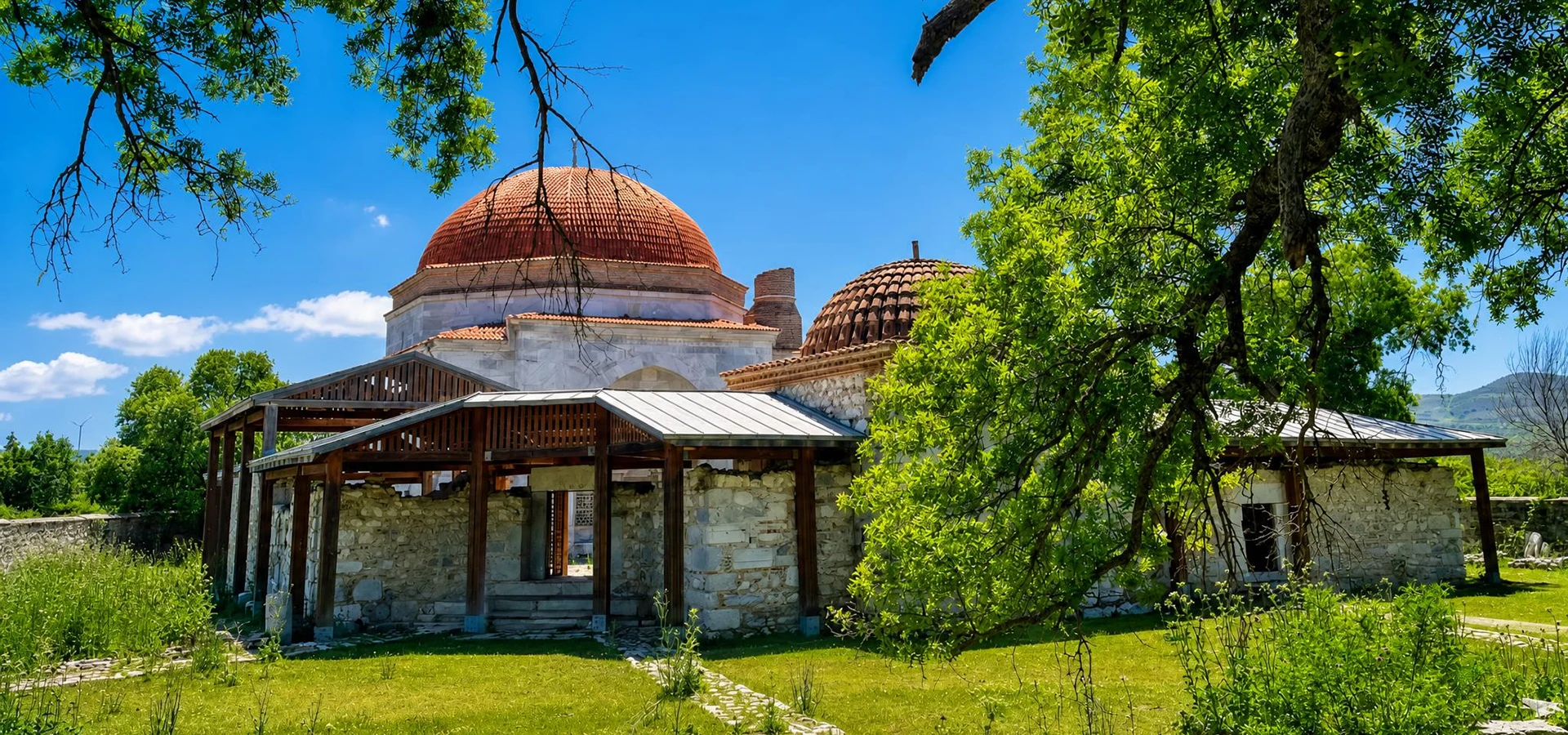
Standing near the ruins of ancient Miletus in Balat, Aydın, the İlyas Bey Mosque is among the most distinguished surviving monuments of the Anatolian Beyliks period. Commissioned in 1404 by Şücaeddin İlyas Bey, ruler of the Menteşe principality, the mosque combines monumental marble construction, elegant geometric ornamentation and an extraordinary historic setting.
The mosque occupies a landscape that had already witnessed centuries of Greek, Roman and Byzantine history. Its builders reused marble from the ancient city, incorporating architectural material from Miletus into a new Islamic monument. The result is a building that preserves the memory of several civilizations within its walls.
The mosque was originally the centerpiece of the İlyas Bey Complex (İlyas Bey Külliyesi), a religious and community foundation that included a madrasa, bathhouses and other supporting structures. Together, these buildings illustrate the importance of Balat during the final centuries of medieval Anatolian political independence.
After suffering earthquake damage and centuries of deterioration, the complex underwent a major conservation project that received a 2012 European Union Prize for Cultural Heritage / Europa Nostra Award. Today, the restored mosque and surrounding remains provide one of the most rewarding cultural stops in the Miletus archaeological landscape.
Discover the architectural legacy of Şücaeddin İlyas Bey and the Menteşe principality.
See carefully worked marble reused from the celebrated ancient city of Miletus.
Admire intricate carvings, inscriptions, decorative windows and an exceptional mihrab.
Explore a historic complex recognized for its outstanding conservation work in 2012.
Essential information about one of the most remarkable medieval monuments near Miletus.
Balat, near Miletus Ancient City, Didim district, Aydın Province, Türkiye.
Open on Google MapsBegun in 1404 during the reign of Şücaeddin İlyas Bey.
Anatolian Beyliks period, under the Menteşe principality.
Square prayer hall, monumental dome, marble façades and elaborate carved decoration.
2012 European Union Prize for Cultural Heritage / Europa Nostra Award.
Allow approximately 30–60 minutes, or longer when studying the entire complex.
A rare architectural monument connecting ancient Miletus with the political and cultural history of medieval Anatolia.
The importance of İlyas Bey Mosque extends far beyond its religious function. It represents the artistic achievements of the Menteşe principality, one of the regional Turkish states that emerged in western Anatolia following the decline of Seljuk authority.
Its construction came at a pivotal political moment. After the Ottoman defeat at the Battle of Ankara in 1402, several Anatolian principalities temporarily regained their autonomy. İlyas Bey's patronage of a monumental mosque and charitable complex expressed both political authority and cultural ambition.
Architecturally, the mosque is celebrated for its sophisticated treatment of marble. Its entrance portal, ornamental windows, calligraphic decoration and prayer niche demonstrate the skills of craftsmen working within the artistic traditions of medieval Anatolia.
The building is especially significant because it stands within the landscape of Miletus Ancient City. The same location that once contained temples, theatres, markets and Roman baths later became the setting for Turkish religious and educational institutions.
Rather than belonging to one isolated chapter of history, İlyas Bey Mosque reveals how urban sites were transformed, reused and reinterpreted across successive civilizations.
The story of İlyas Bey Mosque begins long before its construction. Ancient Miletus was an important Greek city known for maritime commerce, philosophy, urban planning and extensive cultural connections throughout the Mediterranean and Black Sea worlds.
During the Roman period, Miletus continued to flourish, with monumental public buildings and an impressive theatre. Over subsequent centuries, changing coastlines, the silting of former harbours, economic transformations and political developments gradually altered the city's character.
By the medieval period, the settlement was known as Balat. It became an important center of the Menteşe Beylik, a Turkish principality that controlled parts of southwestern Anatolia.
The region came under Ottoman authority during the reign of Bayezid I, but the Ottoman defeat by Timur at Ankara in 1402 changed the political situation. The Menteşe ruling family regained authority, and Şücaeddin İlyas Bey emerged as its ruler.
In May–June 1404, according to the mosque's foundation inscription, construction began on the monument commissioned by İlyas Bey. The project formed part of a broader religious and community complex intended to serve the settlement.
Over the following centuries, Balat's regional importance declined. The buildings experienced periods of neglect, environmental deterioration and earthquake damage, but the principal mosque survived as an outstanding architectural monument.
Modern conservation work eventually transformed the site's condition. Research, documentation, structural strengthening and restoration helped preserve the mosque and make the wider historical complex understandable to visitors.
Miletus develops into one of the most influential cities of the ancient Aegean world.
The settlement becomes known as Balat and develops under Turkish regional rule.
Following the Battle of Ankara, the Menteşe principality regains its autonomy.
İlyas Bey commissions the mosque, with its construction recorded in an inscription.
An earthquake causes the collapse of the mosque's historic minaret.
Extensive research, conservation and restoration work revives the complex.
The conservation project receives a prestigious European heritage award.
The restored complex remains an important cultural landmark within the Miletus landscape.
Şücaeddin İlyas Bey was a ruler of the Menteşe principality during the early 15th century. His period of rule followed the political instability caused by the confrontation between the Ottoman Empire and Timur.
The Menteşe principality was one of several regional states that shaped Anatolia between the Seljuk and Ottoman periods. Its territories included important Aegean settlements, agricultural lands, ports and commercial routes.
For rulers of this period, commissioning public architecture carried both religious and political importance. A mosque provided a center for communal worship, while associated schools, baths and charitable facilities contributed to the daily life of the settlement.
İlyas Bey's foundation at Balat therefore represented much more than a single building. It expressed the ruler's authority, piety and intention to establish a lasting institutional presence within the community.
The mosque is especially valuable because monuments of comparable quality from the smaller western Anatolian principalities have not all survived in such recognizable form.
İlyas Bey Mosque is an exceptional example of architecture from the Anatolian Beyliks period. Its design combines a relatively compact geometric plan with richly ornamented architectural details.
The mosque has an approximately 18-by-18-metre square plan, creating a unified interior prayer space beneath a broad dome. This dome, approximately 14 metres in diameter, is constructed of brick and supported by transitional architectural elements that connect the square room to the circular covering.
The exterior walls are faced with carefully fitted marble blocks, many reused from ancient Miletus. The contrast between the pale marble walls, decorative entrance and tiled dome gives the building its distinctive appearance.
Unlike many later Ottoman mosques with extensive entrance porticoes and multiple domed spaces, İlyas Bey Mosque concentrates much of its decorative richness around the principal entrance and interior prayer niche.
An approximately 18-by-18-metre prayer hall creates a balanced architectural composition.
A monumental brick dome roughly 14 metres across covers the main worship space.
Ancient architectural material was adapted into finely finished medieval façades.
A recessed northern entrance features arches, columns, inscriptions and carved ornament.
Ornamental marble screens, coloured materials and geometric patterns enrich the façades.
Faceted and stalactite-like decorative forms articulate architectural transitions.
An elaborately carved marble prayer niche forms the principal interior decorative focus.
The original minaret was destroyed in the 1955 earthquake, leaving a visible change in the historic silhouette.
One of the building's most impressive features is its monumental entrance on the northern façade. The portal is designed as a deep pointed-arch recess framing an arrangement of smaller arches and marble columns.
Two slender columns divide the composition into three openings. The wider central opening provides the main entrance, while decorative marble screens occupy the openings on either side.
The portal includes geometric patterns, floral ornament, contrasting colours and carefully worked inscriptions. These details demonstrate the sophistication of decorative stone carving in western Anatolia during the early 15th century.
The architectural decoration is not merely applied to the surface. It forms part of the entrance's overall design, integrating structure, proportion, light and ornament into a carefully balanced composition.
The monumental outer arch gives visual emphasis to the principal entrance.
Marble columns and smaller arches create a layered architectural rhythm.
Geometric marble latticework adds decorative richness to the flanking openings.
Historic writing records the patronage and early construction history of the monument.
Inside İlyas Bey Mosque, the most important decorative element is the mihrab, the prayer niche indicating the direction of Mecca.
The richly ornamented marble mihrab is widely regarded as one of the mosque's greatest artistic achievements. Its composition includes carved geometric designs, ornamental borders and carefully organized decorative surfaces.
The precision of the carving demonstrates the technical abilities of medieval Anatolian stoneworkers. Decorative traditions inherited from earlier Islamic architecture were adapted to local materials and regional artistic preferences.
Above the prayer hall, the dome is supported by architectural transition elements incorporating faceted forms, geometric compositions and muqarnas-like decoration.
Windows arranged at different heights introduce light into the interior. Decorative stonework, coloured inlays and patterned glazing contribute to the contrast between the monumental simplicity of the space and the richness of its details.
The mihrab identifies the qibla direction and forms the spiritual focus of the interior.
Interlacing patterns, carved borders and repeated motifs demonstrate refined craftsmanship.
Different window levels illuminate the marble surfaces and architectural forms.
Decorated structural elements connect the square walls with the great circular dome.
One of the most fascinating aspects of İlyas Bey Mosque is the use of architectural material recovered from the ancient city of Miletus.
For centuries, ruined classical cities provided readily available building stone for later settlements. Columns, blocks, inscriptions and other architectural components were frequently reused in new buildings, a practice known as spolia.
At İlyas Bey Mosque, ancient marble was not simply inserted into the building without modification. Many blocks were carefully reworked, arranged and integrated into a new architectural design.
The mosque's marble façades therefore illustrate both continuity and transformation. Materials originally associated with Greek or Roman monuments became components of a religious building serving a medieval Turkish community.
This reuse of stone does not mean the mosque was itself a converted ancient temple. The surviving building is an early 15th-century construction using materials obtained from the surrounding historic landscape.
Ancient blocks provided durable, high-quality construction material.
Craftsmen reshaped and finished older stone for the new building.
Material from ancient Miletus remained part of the region's architectural story.
The stonework illustrates the changing uses and meanings of the same landscape over time.
İlyas Bey Mosque was the principal building of a larger complex known as the İlyas Bey Külliyesi. Such complexes were important institutions in medieval Islamic societies, combining religious worship with education and practical community services.
The Balat foundation included a mosque, a madrasa and two bathhouses, together with additional buildings and spaces whose functions are not all securely identified.
Unlike the mosque, many secondary structures survive primarily as archaeological remains. Their foundations and restored wall sections nevertheless help visitors understand the original scale and organization of the foundation.
The principal religious monument and most architecturally elaborate surviving building.
An educational institution with rooms arranged around a courtyard for teaching and study.
A bath building with a series of rooms, heated spaces and surviving evidence of decorative plasterwork.
A more compact bath structure associated with the wider complex.
A central open space connecting the mosque with the surrounding educational and service buildings.
Archaeological remains reveal workshops, service spaces and other facilities linked with community life.
The complex was associated with the tradition of charitable foundations, or vakıf, through which resources could be dedicated to maintaining religious, educational and social institutions.
These foundations played an important role in the development of urban centers across medieval Anatolia. Their architecture reveals how rulers and wealthy patrons supported communal institutions while establishing enduring monuments to their patronage.
The remains of the madrasa provide important evidence of the educational role of the complex. Madrasas were institutions in which students could receive instruction in religious subjects and, depending on the institution, other branches of learning.
At Balat, architectural investigations identified rooms organized around a courtyard, together with evidence of different building phases.
Research suggests that the educational buildings may have developed or changed function over time. Not every surviving foundation can be assigned with certainty to the original construction campaign of 1404.
The remains are especially valuable because they show that İlyas Bey's foundation was intended to serve a broader community rather than functioning solely as a place of worship.
The two historic bathhouses are among the most informative secondary monuments at the site. They demonstrate the importance of bathing facilities and organized communal services within the medieval settlement.
The larger hammam contained a sequence of rooms associated with changing, heating and bathing. Archaeological research has identified elements of its heating arrangements and traces of interior decoration.
Particularly interesting are surviving fragments of moulded plaster decoration. Researchers have also documented historic drawings and graffiti, including representations of ships, within the bathhouse complex.
The smaller bath building had a simpler arrangement, consisting of a compact group of rooms.
Although these structures no longer operate as functioning bathhouses, their remains contribute greatly to understanding life in medieval Balat.
Archaeological remains help explain how historic bathing spaces were warmed.
Fragments of ornament reveal the artistic treatment of interior surfaces.
Drawings and marks offer unusual glimpses into the people who used these spaces.
Protective structures help preserve fragile archaeological remains from weathering.
A small domed structure near the mosque has traditionally been associated with the founder and is sometimes described as the tomb of İlyas Bey.
However, the interpretation requires some caution. Archaeological research indicates that the structure may have been intended as a founder's tomb, while historical accounts place İlyas Bey's actual burial at Beçin, another important center of the Menteşe principality.
The building remains an interesting component of the complex, but visitors should avoid assuming that every traditional identification reflects a securely established historical fact.
Its presence helps illustrate the close relationship between religious patronage, commemoration and architecture in medieval Anatolia.
By the late 20th century, the İlyas Bey Complex had experienced substantial deterioration. Earthquakes, environmental exposure and the loss of traditional functions had affected different parts of the site.
A comprehensive conservation initiative was undertaken during the 2000s, with major implementation work completed by 2011. The project combined historical research, architectural surveys, archaeological investigation, material analysis, structural strengthening and careful restoration.
Rather than treating the mosque as an isolated building, the project considered the entire historic complex and its surrounding cultural landscape.
The restoration sought to preserve original materials wherever possible, stabilize vulnerable structures and allow visitors to understand the relationship between the mosque, educational buildings, bathhouses and open spaces.
In 2012, the project received a European Union Prize for Cultural Heritage / Europa Nostra Award in the conservation category. The award recognized the quality of the documentation, sensitive treatment of the remains and successful approach to preserving the wider heritage complex.
Investigations established the history, construction phases and architectural significance of the buildings.
Strengthening measures addressed vulnerabilities caused by age and earthquake damage.
Specialist work protected original stone, brick and decorative surfaces.
The wider complex was organized to make its surviving structures easier to interpret.
The project emphasized the continuing relationship between the monument and its community.
The 2012 award acknowledged an outstanding contribution to architectural conservation.
Although the mosque is not a large monument compared with imperial Ottoman complexes, it contains an exceptional concentration of architectural and historical features.
Admire the carefully arranged stone blocks and polished surfaces of the main building.
Study the pointed arch, decorative columns and finely carved portal composition.
Look for the historic inscription recording İlyas Bey's patronage and the beginning of construction.
Observe the proportions of the single monumental dome rising above the square prayer hall.
Appreciate one of the finest decorative features of the mosque, where interior access is permitted.
Examine the geometric marble latticework and carved decoration surrounding the openings.
Explore the foundations and architectural remains associated with the educational complex.
View the preserved bathhouse structures and understand their role in community life.
Enjoy the contrast between the restored mosque, archaeological remains and surrounding vegetation.
Recognize how the medieval monument occupies a landscape shaped by earlier civilizations.
A visit to the mosque is usually straightforward, but a little preparation will help you appreciate both the monument and its archaeological surroundings.
Spend at least 30 minutes exploring the mosque and its immediate setting.
Combine the mosque with the ancient theatre and archaeological remains nearby.
Summer conditions around Miletus can be very hot, particularly at midday.
Expect stone paving, historic surfaces and some uneven paths around the complex.
Modest clothing is appropriate when visiting the mosque, especially if entering the prayer hall.
Interior visits may be limited during worship or religious events.
Avoid touching fragile decoration or leaning against historic architectural elements.
Confirm current visiting arrangements if interior access is essential to your plans.
The İlyas Bey Complex is located within the wider Miletus archaeological landscape, near Balat in Aydın Province. Visitors should distinguish between access to the historic mosque and admission arrangements for the separately managed archaeological site and museum.
The official Turkish Museums listing for Miletus Archaeological Site, consulted in October 2026, gives opening hours of 08:30–17:30, with the ticket office closing at 17:00 and the site listed as open every day. These are the published hours for the archaeological site, not independently confirmed opening hours for the mosque interior.
The mosque's grounds and interior may operate under different arrangements due to religious use, conservation requirements or site management decisions. No separately verified fixed admission charge or daily opening schedule for the mosque itself is provided here.
The mosque can be appreciated throughout the year, but weather conditions affect how comfortably visitors can explore the open courtyard and surrounding archaeological landscape.
Comfortable temperatures and fresh vegetation create an attractive setting for architecture and photography.
Milder weather and softer light make it an excellent season for visiting Miletus and Balat.
Visit early to avoid intense afternoon heat, especially when combining the mosque with the ancient city.
Quieter conditions can be atmospheric, although rain and uneven paving require greater care.
Warm side lighting can emphasize the marble surfaces and architectural relief.
Visiting outside busy tour periods may allow more time to appreciate the intricate decoration.
A short exterior visit to admire the entrance, dome and principal façade.
A comfortable visit covering the mosque, courtyard and main architectural highlights.
Allow extra time to examine the madrasa, bathhouses and restored historic landscape.
Combine a detailed visit with Milet Museum or a selected nearby archaeological landmark.
Explore the mosque, Milet Museum and major highlights of Miletus Ancient City.
Add other regional monuments such as Didyma or Priene with appropriate transport planning.
The mosque is particularly rewarding for architectural photography. Marble textures, carefully proportioned arches, decorative windows and the historic landscape create opportunities for both wide compositions and detailed studies.
Frame the entrance and great dome together to show the relationship between architectural detail and overall form.
Photograph the geometric screens, carved inscriptions, columns and contrasting marble.
Use directional light to reveal variations in the reused ancient stone.
Where photography is allowed, focus on the mihrab and architectural transitions supporting the dome.
Include the surrounding archaeological remains to communicate the complex's original scale.
Use the mosque's setting near Miletus to illustrate the continuity of the region's architectural history.
Accessibility at the mosque and surrounding historic complex depends on the specific areas being visited. The restored courtyard offers opportunities for exterior viewing, but original stone surfaces and archaeological sections can be uneven.
The mosque's main architectural features can be appreciated from the surrounding grounds where access is permitted.
Some paths and courtyard surfaces may be irregular or difficult for mobility aids.
Historic thresholds and visitor restrictions may affect entry to the prayer hall.
Confirm current step-free access and suitable routes with site management before visiting.
Bring drinking water and plan rest periods when exploring the open-air surroundings.
A private vehicle can make travel between the mosque, museum and distant archaeological sections more comfortable.
İlyas Bey Mosque is situated near Balat, within the historic landscape of Miletus in Aydın Province. The easiest way to reach the monument is generally by private vehicle or as part of a regional sightseeing tour.
The mosque stands between the Milet Museum area and the ancient theatre. Visitors exploring the archaeological site can include the mosque as part of the same general sightseeing itinerary, subject to available access routes.
Travel toward Balat and Miletus Ancient City, following local signs for the archaeological area and İlyas Bey Mosque.
Approach Miletus through the roads serving the Büyük Menderes plain and Balat.
A private vehicle makes it practical to combine the mosque with Priene, Miletus and Didyma.
The mosque lies nearby, making a combined visit particularly convenient.
Regional services may require changes and additional local travel; confirm connections before departure.
Combine several historic sites with a flexible itinerary and professional interpretation.
For visitors with half a day, begin at İlyas Bey Mosque. Explore the marble façade, entrance portal and visible remains of the complex before continuing to nearby Milet Museum.
The museum provides valuable archaeological context for the wider region, displaying material from Miletus, Didyma, Priene and the İlyas Bey Complex itself.
Continue to Miletus Ancient City, where the monumental Roman theatre and other archaeological remains reveal the scale of the classical settlement. This sequence offers a particularly meaningful opportunity to understand how the landscape changed between antiquity and the medieval period.
For a longer day, add Didyma, famous for its monumental Temple of Apollo, or extend the route to Priene, one of the best-known examples of ancient urban planning in the region.
The Miletus region contains an exceptional collection of ancient cities, medieval monuments and cultural landscapes. These nearby destinations complement a visit to İlyas Bey Mosque.
Explore the celebrated ancient city, including its monumental theatre, public spaces and archaeological remains.
Discover archaeological finds from Miletus, Didyma, Priene and the İlyas Bey Complex.
Visit one of the most impressive ancient oracular sanctuaries in the Mediterranean world.
Discover an outstanding example of Greek urban planning with dramatic views toward Mount Mycale.
Combine ancient ruins, remarkable landscapes and Byzantine religious heritage around Lake Bafa.
Explore the coastal town that serves as a popular starting point for regional archaeological excursions.
One of the most remarkable aspects of visiting İlyas Bey Mosque is the opportunity to explore several historical periods within a relatively small geographical area.
Ancient Miletus was associated with philosophers, mathematicians, merchants and urban planners. Its surviving monuments reflect Greek and Roman civic life, while later remains document the settlement's transformations during the Byzantine centuries.
İlyas Bey Mosque adds the perspective of medieval Turkish rule. It demonstrates how the region remained inhabited and culturally active long after the classical city's greatest period of prosperity.
The use of ancient marble in the mosque is a particularly visible expression of this continuity. A visitor can observe classical architectural material serving a completely different religious and architectural purpose.
The broader landscape therefore challenges the idea that archaeological cities belong to only one civilization. Miletus was repeatedly reshaped by the communities that lived within and around it.
Philosophy, trade, seafaring and the development of a major Ionian city.
Monumental public architecture, baths, theatres and urban infrastructure.
Changing settlement patterns and the continuation of the city's Christian history.
The creation of new religious, educational and community architecture in the medieval settlement.
New political structures and changing patterns of life across the surrounding region.
Archaeology and architectural restoration preserve the many historical layers of the landscape.
İlyas Bey Mosque is located near Balat and Miletus Ancient City in the Didim district of Aydın Province, western Türkiye.
The mosque's foundation inscription dates the beginning of construction to May–June 1404, during the reign of Şücaeddin İlyas Bey.
The mosque was commissioned by Şücaeddin İlyas Bey, a ruler of the Menteşe principality in southwestern Anatolia.
Construction began in 1404, making the mosque more than 620 years old in 2026.
It is particularly admired for its marble architecture, elaborate entrance portal, finely decorated mihrab and importance as a monument of the Anatolian Beyliks period.
It stands within the wider historical and archaeological landscape of Miletus, near the museum and ancient theatre.
Yes. Marble architectural material from ancient Miletus was reused in the mosque's construction, with many blocks reworked for their new architectural purpose.
No. It was constructed as a mosque in the early 15th century, although its builders reused stone from older monuments in Miletus.
The İlyas Bey Complex, or külliye, is a historic religious and community foundation consisting of the mosque, educational buildings, bathhouses and additional supporting structures.
The historic minaret collapsed during an earthquake in 1955. The mosque's present appearance therefore differs from its original silhouette.
A small domed building has been associated with the founder's tomb, but archaeological research reports that İlyas Bey was buried at Beçin. The traditional identification of the structure should therefore be treated cautiously.
The conservation project received a 2012 Europa Nostra Award for its careful documentation, sensitive restoration and successful preservation of the wider historic complex.
The restored complex is a recognized visitor destination. Current access to the courtyard, surrounding remains and prayer hall should be checked locally, especially during religious activities or maintenance.
A separate current admission fee for the mosque has not been independently verified. Ticketing arrangements for Miletus Archaeological Site and Milet Museum should not automatically be assumed to apply to the mosque.
A separate fixed schedule for the mosque interior has not been verified. The official Miletus Archaeological Site listing gives 08:30–17:30, but mosque access may differ.
Approximately 30–60 minutes is usually sufficient to appreciate the mosque and the main remains of its complex.
Modest, respectful clothing is appropriate. If entering an active prayer area, visitors should follow local guidance concerning shoes and head coverings.
Exterior photography is generally appropriate from permitted visitor areas. Interior photography depends on current rules, and worshippers should not be photographed without permission.
No. İlyas Bey Mosque is near Miletus in Aydın, while İsa Bey Mosque stands at Selçuk near Ephesus. They are distinct medieval monuments associated with different Turkish ruling dynasties.
Miletus Ancient City and Milet Museum are the most convenient combinations. Didyma, Priene and Lake Bafa can also be included in a longer regional itinerary.
Yes. Its exceptional marble decoration, medieval history, restored complex and location beside ancient Miletus make it one of the region's most rewarding architectural monuments.
İlyas Bey Mosque is both a monument of architectural importance and part of a historic religious landscape. Responsible visiting helps preserve its delicate decorative surfaces and the archaeological remains surrounding it.
Follow local expectations concerning clothing, footwear and behavior within prayer spaces.
Do not touch, scratch or lean against carved historic architectural surfaces.
Use permitted paths around archaeological foundations and conservation structures.
Maintain a quiet atmosphere and avoid disrupting prayer or religious gatherings.
Help protect the historic environment by carrying away all litter.
Observe temporary closures and follow instructions intended to protect fragile remains.
Explore the fascinating connection between ancient Miletus and medieval Balat with a private cultural itinerary featuring remarkable architecture, archaeological sites and the layered history of western Anatolia. Our experiences can be tailored to your interests, with no compulsory shopping stops.
Combine the exceptional marble architecture of İlyas Bey Mosque with the ancient theatre, archaeological monuments and museum collections of Miletus.
Discover the marble architecture of the mosque, its historic complex and the ancient monuments of Miletus through a personalized cultural experience.
Request a Private Tour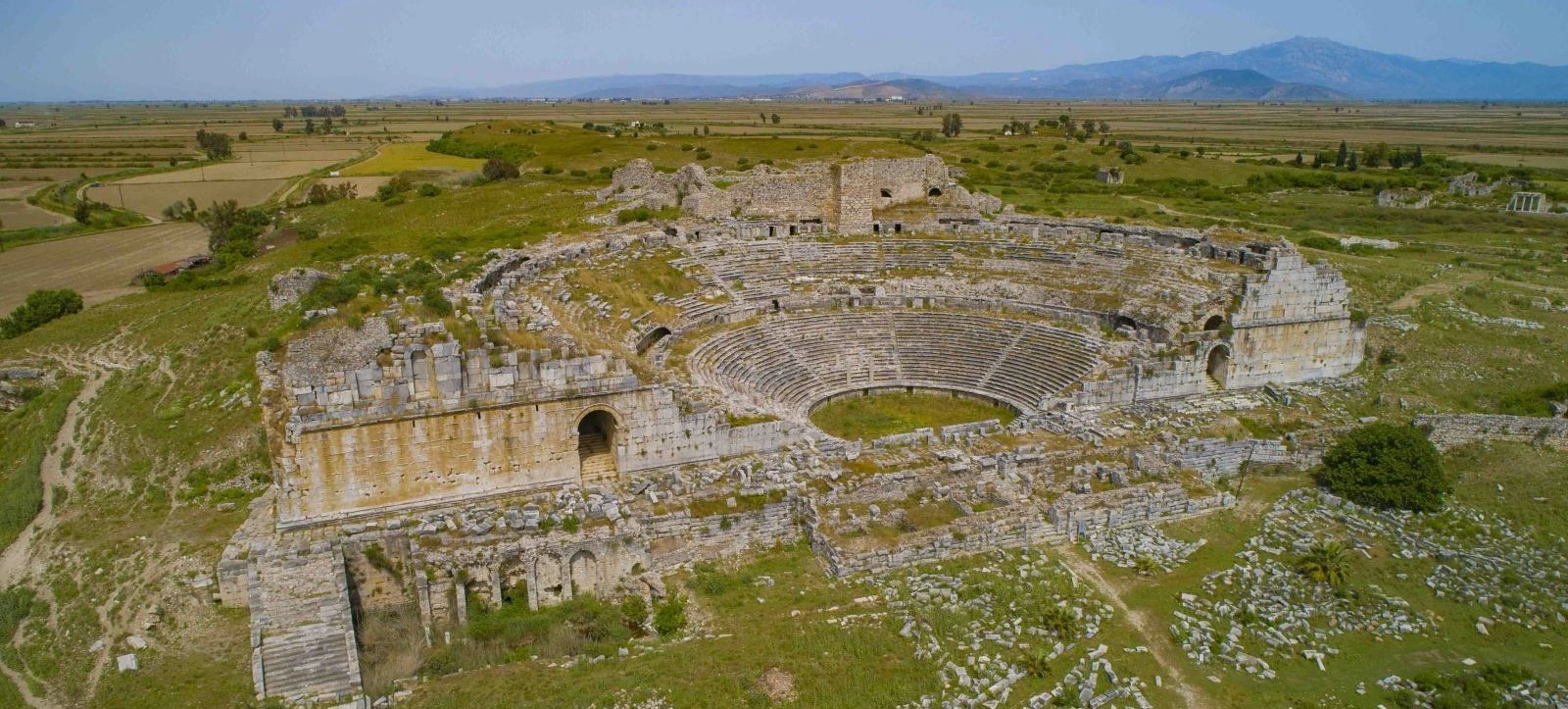
Explore one of the great cities of ancient Ionia, famous for its philosophers, maritime history, monumental theatre and enduring architectural heritage.
Explore Ancient MiletusDiscover nearby archaeological landmarks and museums that reveal the extraordinary history of the Aegean region.
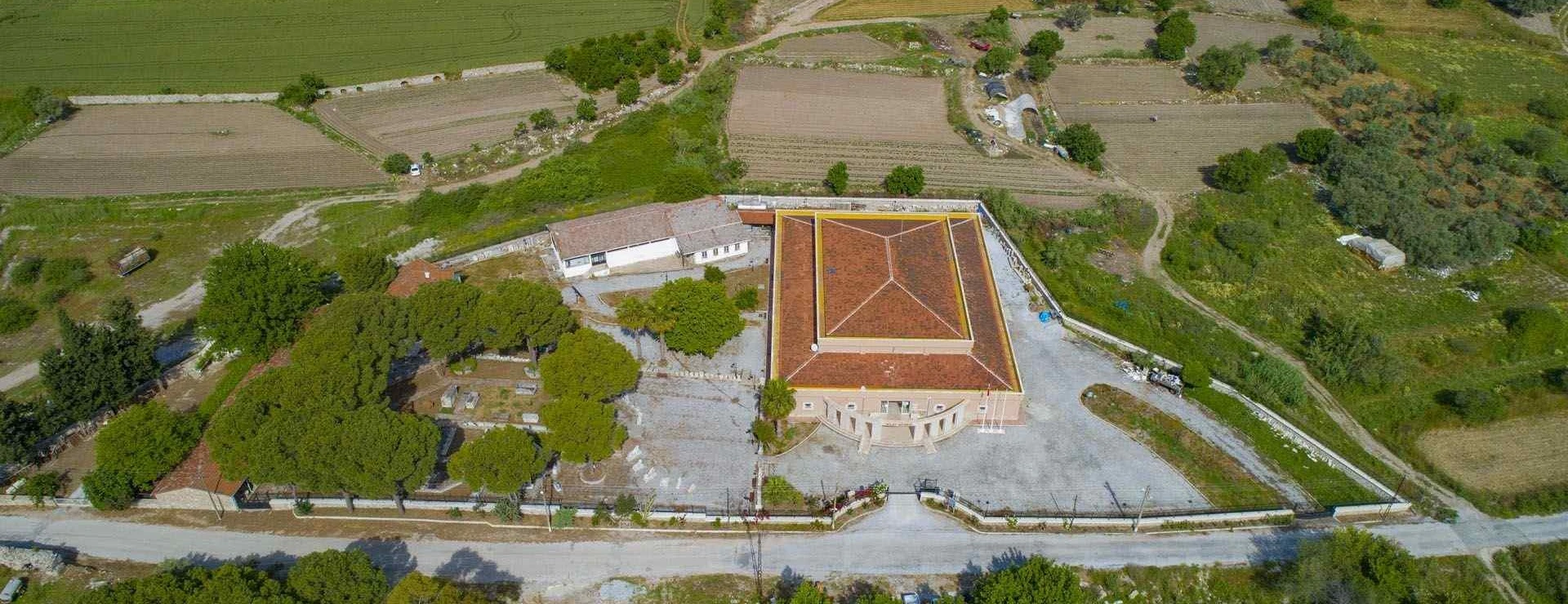
Discover archaeological collections illuminating the history of Miletus, Didyma, Priene and the medieval İlyas Bey Complex.
Explore Milet Museum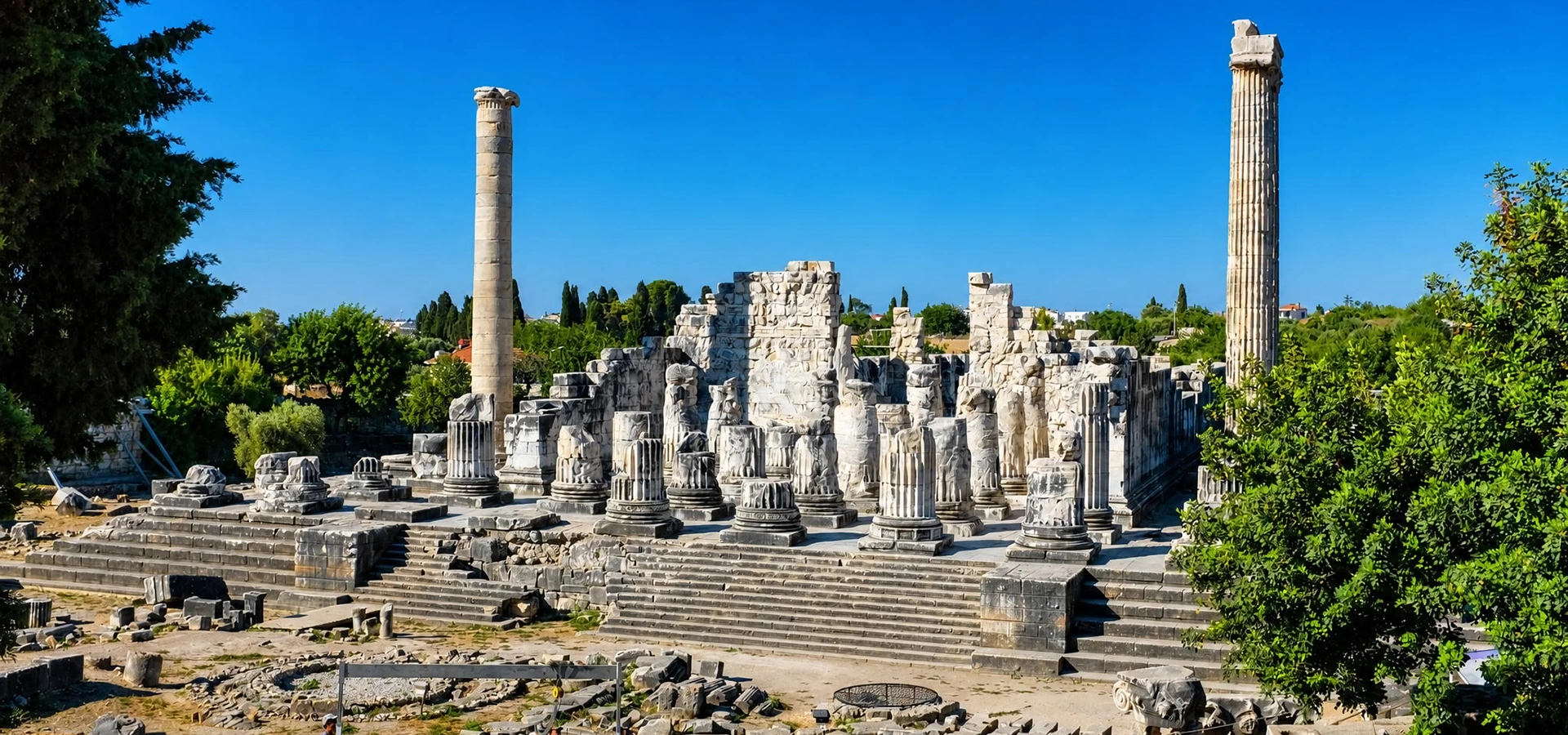
Explore the extraordinary ancient sanctuary connected to Miletus by its sacred road and famous oracle.
Discover Didyma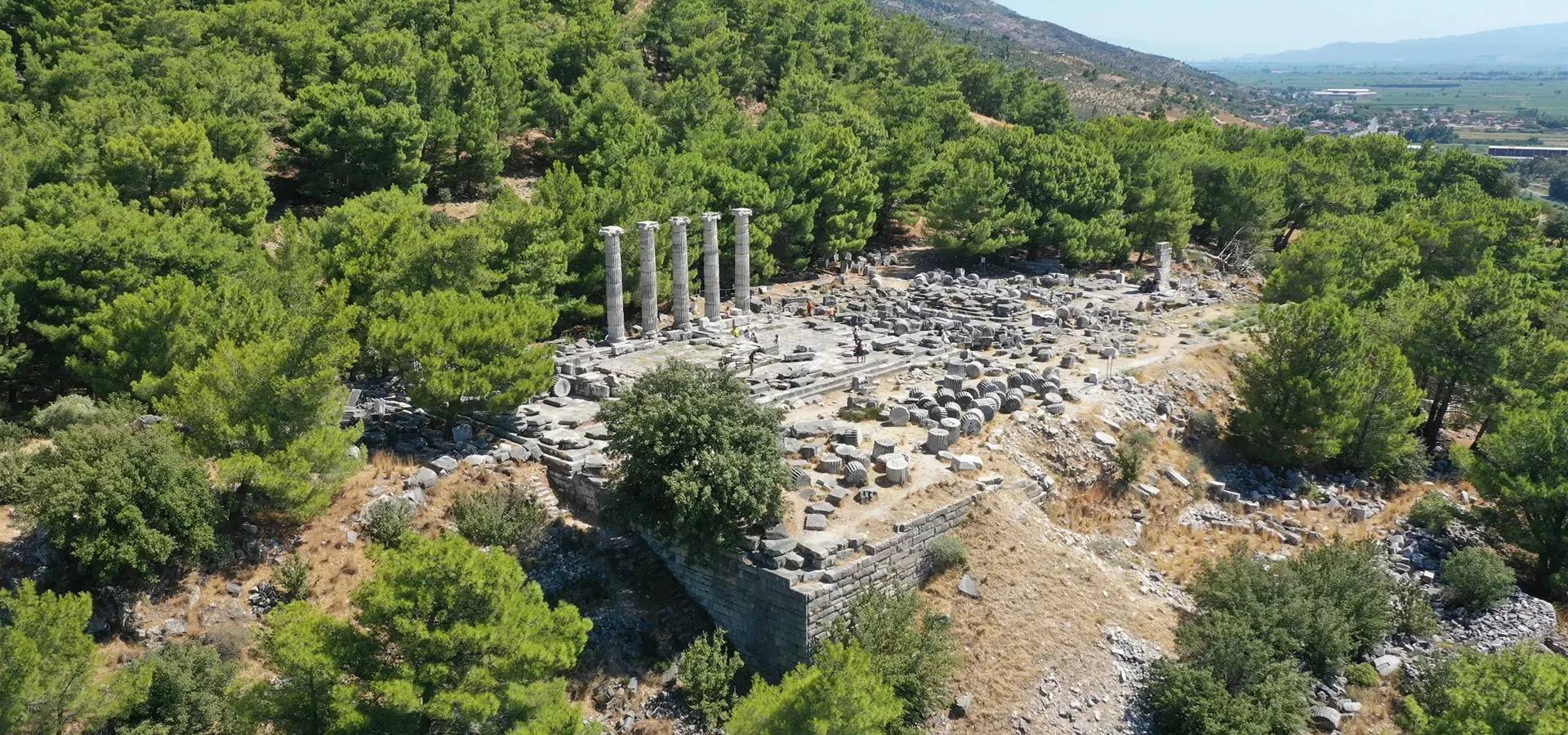
Walk through one of the finest surviving examples of ancient Greek urban planning in a dramatic mountain setting.
Explore Priene