Genoese Maritime Heritage & Ottoman Defences on the Aegean

Güvercinada Castle – The Historic Fortress of Kuşadası

Walk across the sea to one of Kuşadası's greatest landmarks,
where Genoese maritime history, Ottoman fortifications and Aegean views meet.

Explore Güvercinada

Güvercinada Castle – The Fortress Guarding Kuşadası Harbour

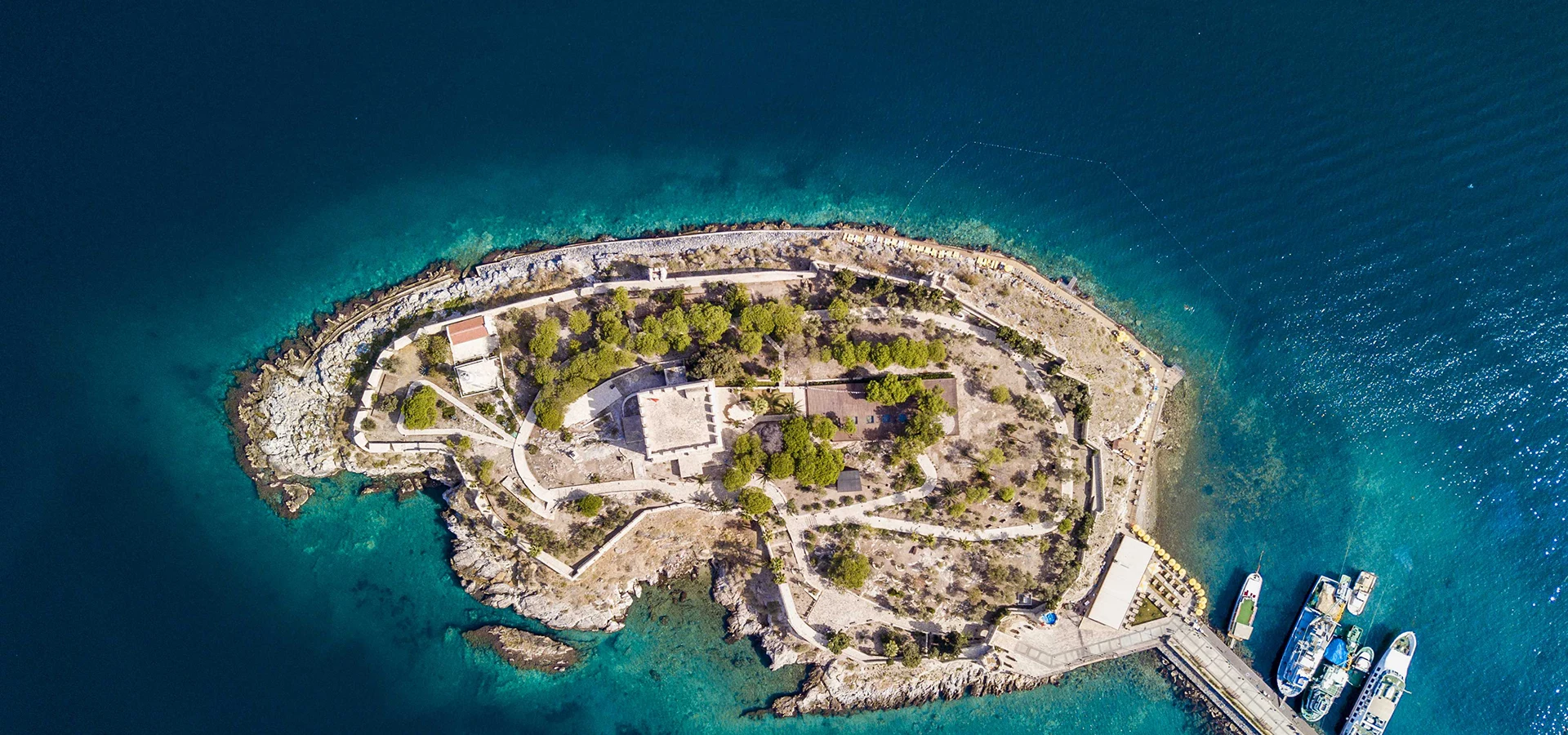
Rising from a small rocky island at the entrance to the harbour, Güvercinada Castle is one of the most recognisable landmarks of Kuşadası and one of the most atmospheric historic fortifications on Türkiye's Aegean coast.

Known in English as Pigeon Island Castle, the fortress occupies a strategically important position immediately offshore from the historic town.

For centuries, anyone approaching the harbour from the Aegean would have passed beneath the watch of this small fortified island.

Its history reflects the wider maritime story of Kuşadası itself: Byzantine strategic importance, Genoese commercial expansion, Ottoman control, piracy, naval defence and Mediterranean trade.

The visible fortifications represent several historical phases. Genoese activity around Kuşadası became particularly important during the late medieval period, while the Ottomans later strengthened the island dramatically as they developed Kuşadası into an important protected harbour.

The inner fortress is traditionally associated with the famous Ottoman admiral Barbaros Hayreddin Pasha, while the defensive walls surrounding the island are associated with İlyas Ağa.

Today the island is connected with the mainland by a breakwater, transforming what was once an offshore military position into one of the easiest and most enjoyable historic walks in Kuşadası.

Güvercinada is also part of the Genoese Maritime Network included on Türkiye's UNESCO World Heritage Tentative List, linking the fortress with other medieval maritime strongholds around the Turkish coast.

Genoese Heritage

Discover a maritime fortress connected with the commercial networks that once linked the Aegean, Mediterranean and Black Sea.

Ottoman Fortress

Explore walls and an inner castle strengthened to defend Kuşadası against maritime attacks and piracy.

UNESCO Tentative List

Güvercinada Castle and the historic walls of Kuşadası form part of Türkiye's Genoese Maritime Network nomination.

Aegean Views

Enjoy panoramas across Kuşadası harbour, the coastline and the waters historically travelled by merchants, sailors and naval fleets.


Know Before You Go

Güvercinada Castle – Quick Facts

Essential information about Kuşadası's historic island fortress and one of the town's most important cultural landmarks.

Location

Güvercinada, immediately beside central Kuşadası in Aydın Province.

Open on Google Maps

Fortress Type

A fortified maritime island containing surrounding defensive walls and a central inner castle.

Historic Purpose

Protection of Kuşadası harbour, maritime approaches and the coastal settlement.

Access

The island is connected with the Kuşadası waterfront by a pedestrian-accessible breakwater.

UNESCO Status

Part of the Genoese Maritime Network included on Türkiye's UNESCO World Heritage Tentative List.

Today

Historic monument, open-air heritage attraction and home to a Maritime Trade History exhibition.

A Small Island with an Enormous Maritime Story

Why Is Güvercinada Castle Important?

The fortress explains why Kuşadası developed where it did and how closely its history was connected with the sea.

To understand Güvercinada, it is essential to look toward the water rather than inland.

Kuşadası developed beside one of the natural maritime corridors of the eastern Aegean. Ships travelling between the Anatolian coast, Samos, the wider Aegean islands and Mediterranean ports passed through waters visible from the island.

Control of this harbour therefore meant much more than protecting a small coastal settlement.

It meant monitoring commerce, naval movement, piracy, military threats and access to the western Anatolian hinterland.

The fortress became part of a larger defensive landscape involving Kuşadası's city walls, harbour installations and routes leading inland toward important commercial and agricultural centres.

Its significance continued across different political periods because the geography itself never changed.

Whoever controlled Güvercinada controlled one of the principal approaches to the harbour.

The Strategic Location of Güvercinada

Güvercinada stands immediately offshore from the historic centre of Kuşadası.

Although small, the island occupies an ideal defensive position at the entrance to the bay.

From the fortress, guards could observe vessels approaching from the open Aegean while simultaneously watching the harbour, coastline and town.

This combination of maritime visibility and proximity to the shore explains why the island retained military importance over many centuries.

Harbour Entrance

The island stands where approaching vessels could be observed before reaching the protected waters of Kuşadası.

Aegean Sea

Its western outlook faces the maritime world linking western Anatolia with Samos and the wider Aegean.

Town Connection

The fortress remained close enough to the settlement to function as part of Kuşadası's wider defensive system.

Natural Observation Point

The elevated inner fortress allowed guards to monitor movement across a broad section of coastline and sea.

The History of Güvercinada Castle

The history of Güvercinada developed through several overlapping phases rather than a single moment of construction.

The island's strategic value was recognised long before the surviving Ottoman-period rebuilding.

Local historical tradition records its use as a military position during the Byzantine period, while the late medieval development of Kuşadası became strongly connected with the arrival of the Genoese.

From the late thirteenth and early fourteenth centuries, Genoese commercial activity expanded through the eastern Mediterranean and Aegean.

Kuşadası became known to European travellers as Scala Nova or Scalanova — the "new port" — reflecting the importance of its maritime role.

After the region passed firmly under Ottoman control, Kuşadası developed into an increasingly important harbour and coastal stronghold.

The island's fortifications were rebuilt, repaired and strengthened according to changing military needs.

Byzantine Context

The island occupied a naturally strategic position during the medieval struggle for control of western Anatolia and the Aegean coast.

Genoese Period

Late medieval Genoese maritime activity left important architectural and historical traces in Kuşadası and Güvercinada.

Ottoman Rule

The Ottomans transformed Kuşadası into a fortified port and strengthened the island as part of its maritime defence.

Modern Heritage

The military fortress has become one of the most visited cultural and photographic landmarks in modern Kuşadası.

The Genoese Heritage of Güvercinada

The medieval history of Kuşadası is closely connected with the extraordinary commercial expansion of the Republic of Genoa.

Between the thirteenth and fifteenth centuries, Genoese merchants created a network of ports, trading colonies, towers and fortified settlements extending from the Mediterranean through the Aegean and into the Black Sea.

Their success depended not simply on ships but on protected anchorages and strategically positioned fortifications.

Kuşadası belonged to this wider maritime environment.

Historical references to Scalanova appear during the fourteenth century, describing the development of a new coastal settlement and harbour in the region.

Güvercinada formed the maritime counterpart of this settlement.

Elements of the fortifications have been identified with characteristic Genoese building traditions, particularly parts of the wall system, towers, crenellations and inner fortress.

Think of Güvercinada as part of a network: The castle becomes much more meaningful when understood not as an isolated local fortress but as one point within a medieval commercial system stretching across several seas.

Scalanova and the Rise of Kuşadası

Before the name Kuşadası became established internationally, European maritime sources frequently referred to the port as Scala Nova or Scalanova.

The expression can be understood as the "new harbour" or "new landing place".

The name reflects an important transformation in the geography of trade.

Ancient ports around Ephesus had gradually become affected by silting and changing coastal conditions.

Maritime commerce therefore shifted toward alternative anchorages along the nearby Aegean coast.

Kuşadası's protected bay offered exactly the kind of location required by merchants and seafarers.

The development of Scalanova and the fortification of Güvercinada should therefore be seen as part of the same process: a new maritime gateway emerged where geography, commerce and defence came together.

Güvercinada during the Ottoman Period

Kuşadası came under Ottoman control during the early fifteenth century.

Under Ottoman rule, the settlement became an increasingly important commercial and military harbour.

Protecting the port required a combination of mainland fortifications and maritime observation points.

Güvercinada was ideally positioned for this role.

The Ottomans therefore repaired and expanded earlier defences while adapting the island to the military threats of their own period.

The surviving appearance of the fortress today owes much to these Ottoman interventions.

Harbour Defence

The island formed an advance defensive position protecting vessels and installations inside Kuşadası harbour.

Coastal Surveillance

Guards could identify suspicious ships before they approached the settlement.

Piracy

Aegean piracy was a serious concern, making fortified coastal observation points essential.

Military Renewal

Changes in warfare and regional instability repeatedly required the fortifications to be repaired and strengthened.

Barbaros Hayreddin Pasha and Güvercinada

The inner fortress standing near the highest point of Güvercinada is traditionally associated with Barbaros Hayreddin Pasha, one of the most famous naval commanders in Ottoman history.

Barbaros transformed Ottoman naval power during the sixteenth century and became one of the defining figures in the maritime history of the Mediterranean.

His association with Güvercinada reflects the strategic importance of Kuşadası within the Ottoman coastal defence network.

The small citadel provided a protected position from which guards could monitor the sea and coordinate the defence of the island.

Ottoman Admiral

Barbaros Hayreddin Pasha became Kapudan Pasha, the great admiral of the Ottoman fleet.

Maritime Strategy

His era represented one of the great periods of Ottoman naval expansion throughout the Mediterranean.

Inner Castle

The central fortified structure provided an additional defensive position inside the surrounding walls.

Sea Views

The elevated position demonstrates immediately why the island was valuable for observation and defence.

İlyas Ağa and the Fortification Walls

The defensive walls surrounding Güvercinada are associated with İlyas Ağa.

These fortifications were strengthened during a period when the Ottoman authorities faced serious instability in the Aegean connected with the Greek War of Independence and the Morea uprising.

The threat of attacks arriving from islands or by sea made the defence of Kuşadası particularly important.

The walls were therefore constructed to surround the island and create a continuous protective barrier around the inner fortress.

According to official cultural heritage information, much of the wall reaches approximately three metres in height.

Stone used in the construction was brought from the nearby Yılancı Burnu area.

Look at the walls from the breakwater: The sea-facing elevation provides one of the best opportunities to understand how completely the fortifications enclosed the small island.

The Architecture of Güvercinada Castle

The architecture of Güvercinada was shaped primarily by military function and the natural form of the island.

Instead of imposing a perfectly geometric fortress plan on the landscape, the defensive walls adapt to the rocky shoreline.

The result is a fortification whose irregular outline follows the topography while maintaining clear observation over the sea.

The principal architectural components are the surrounding defensive wall, fortified entrance, towers and central inner castle.

Outer Walls

A continuous defensive circuit encloses the island and protects approaches from the sea.

Entrance Gate

The principal gateway creates a controlled transition between the exposed shoreline and fortified interior.

Defensive Towers

Projecting towers provided wider fields of observation along vulnerable sections of wall.

Inner Fortress

The elevated citadel forms the final defensive core of the island.

Crenellations

Elements of the battlements preserve traces of medieval and later military architecture.

Stone Construction

Local stone gives the fortress the same warm Aegean character seen in other coastal fortifications of western Anatolia.

The Main Gate of Güvercinada Castle

The principal entrance lies on the southern side of the fortifications and faces toward the approach from Kuşadası.

Visitors enter through a round-arched gateway reached by steps and protected by towers.

The northern flanking tower has a polygonal form, while the southern tower is more cylindrical.

This defensive arrangement allowed guards to control movement through the narrow entrance and observe anyone approaching the fortress.

An empty inscription panel above the gateway indicates that another inscription once occupied this position.

An Ottoman construction inscription connected with the surrounding walls survives elsewhere on the fortifications.

Pause before walking through: The gateway is one of the best places to appreciate the difference between the peaceful visitor experience today and the controlled military entrance that originally existed here.

The Fortification Walls of Güvercinada

The outer walls are among the most visually impressive elements of the castle.

They follow the coastline closely, enclosing almost the entire rocky island.

From a military perspective, their purpose was straightforward: prevent attackers from landing directly beneath the inner fortress and create protected positions for defenders.

From an architectural perspective, however, the walls preserve evidence of several building and repair phases.

Medieval characteristics coexist with later Ottoman interventions, illustrating how strategic fortifications evolved rather than remaining frozen in a single historical period.

Sea-Facing Defence

The strongest visual impression comes from sections of wall directly exposed to maritime attack.

Adapted to the Rock

The irregular circuit follows the natural shoreline rather than a rigid geometric plan.

Multiple Periods

Repairs and rebuilding created a fortification containing medieval and Ottoman architectural elements.

Harbour Landmark

The same defensive walls that once discouraged attack now form one of Kuşadası's defining waterfront views.

Why Was Güvercinada Called the Pirate Castle?

Güvercinada is sometimes known locally as Korsan Kalesi, meaning the "Pirate Castle".

The name reflects an era when piracy and maritime raiding were genuine threats to settlements throughout the Aegean.

Merchant ships carrying valuable cargo were vulnerable, while lightly defended coastal communities could be attacked with little warning.

Observation from Güvercinada allowed guards to identify approaching ships and alert the town.

The fortress therefore functioned not only as a place where soldiers could resist an attack but also as an early-warning station.

Its position made it possible to watch the maritime horizon long before vessels entered the harbour itself.

Güvercinada Castle and the Historic Walls of Kuşadası

The island fortress should not be imagined as an isolated military structure.

Historic Kuşadası itself was surrounded by defensive walls and entered through fortified gates.

Together, the mainland walls and offshore fortress created a layered defence system.

A ship approaching from the Aegean first came within sight of Güvercinada before reaching the harbour and fortified settlement behind it.

Although much of Kuşadası's historic wall circuit disappeared as the town expanded, surviving elements continue to reveal its fortified past.

Güvercinada

The maritime outpost protected the harbour entrance and monitored approaching vessels.

City Walls

Defensive walls once enclosed the historic settlement on the mainland.

Kale Kapısı

A surviving historic gate preserves one of the clearest reminders of Kuşadası's former walled-town character.

Caravanserai

The Ottoman caravanserai beside the harbour demonstrates how commerce and defence developed side by side.

Güvercinada Castle and the UNESCO Tentative List

Güvercinada Castle is internationally significant because it forms part of The Genoese Maritime Network: Trading Posts and Fortifications from the Mediterranean to the Black Sea.

This serial property is included on Türkiye's UNESCO World Heritage Tentative List.

The nomination brings together fortified places that illustrate the enormous geographical reach of Genoese maritime commerce during the medieval period.

Güvercinada Fortress and the historic city walls of Kuşadası represent the Aydın component of this network.

Other components demonstrate how Genoese traders established protected commercial positions along strategic sections of the Turkish coastline.

Maritime Network

The nomination follows routes extending through the Mediterranean, Aegean, Bosphorus and Black Sea.

Trading Posts

Commerce depended on secure ports where merchants could store goods, negotiate and protect shipping.

Fortifications

Castles and fortified settlements protected the commercial network from military and maritime threats.

Kuşadası Component

Güvercinada and surviving elements of the old city walls demonstrate the fortified character of medieval Scalanova.

UNESCO Tentative List does not mean full World Heritage status: Güvercinada forms part of a property currently placed on Türkiye's Tentative List, an important stage that is distinct from inscription on the final UNESCO World Heritage List.

The Maritime Trade History Exhibition at Güvercinada

The historic role of Güvercinada has gained a new dimension through the creation of a Maritime Trade History exhibition inside the fortress.

Opened in 2024 through cooperation involving Kuşadası Municipality and the Haluk Perk collection and foundation, the exhibition uses archaeological and historical objects to explore the long relationship between people, commerce and the sea.

The setting is particularly appropriate.

Visitors are learning about maritime trade inside a fortress that once existed precisely because Kuşadası's prosperity depended upon ships, ports and secure sea routes.

Displays include objects associated with fishing, maritime commerce, commercial measurement, seals and different phases of Anatolian maritime history.

Maritime Commerce

Objects explain how goods moved through ports and maritime trading networks.

Fishing

Historical fishing equipment demonstrates the everyday relationship between coastal communities and the sea.

Trade Objects

Commercial objects reveal how merchants identified, measured and exchanged goods.

Weights & Measures

Historical weighing systems illustrate the practical organisation of commerce before modern standardisation.

Archaeological Material

Objects from different periods connect maritime history with the broader archaeology of Anatolia.

Historic Setting

The fortress itself becomes part of the museum experience rather than simply a container for exhibits.

Güvercinada as an Open-Air Museum

The visitor experience extends far beyond the interior exhibition.

The entire fortified island functions as an open-air historical environment.

Walking between the walls, towers, pathways and central fortress allows visitors to understand the relationship between military architecture and the natural landscape.

Unlike a conventional museum, much of what you are studying here remains in its original geographical context.

The harbour is still below you. The Aegean is still beyond the walls. Ships still approach Kuşadası from the same direction.

That continuity between past and present is one of Güvercinada's greatest strengths.

Tülüşah and the Natural Heritage of Güvercinada

Güvercinada is valuable not only for its architecture.

The island also participates in the protection of Tülüşah, a locally important plant associated with the Kuşadası area.

Conservation parcels have been established on Güvercinada as part of efforts to protect this distinctive element of the region's flora.

The presence of protected vegetation inside a historic fortress creates an unusual combination of cultural and natural heritage.

Look without disturbing: Plants growing within archaeological environments can be ecologically important as well as visually beautiful. Avoid entering protected planting areas or picking flowers.

What Is It Like to Visit Güvercinada Castle?

Güvercinada offers one of the most relaxed historic visits in the Kuşadası area.

The experience begins before reaching the fortress itself.

Walking along the breakwater gradually separates you from the busy waterfront while opening wider views across the bay.

Once through the castle gate, the atmosphere changes again.

Stone walls, coastal vegetation and the central fortress replace the modern town, while almost every opening in the defences reveals another view of the sea.

Walk the Breakwater

Approaching on foot provides increasingly impressive views back toward Kuşadası.

Enter the Fortress

Pass through the historic gateway and examine the defensive towers protecting the entrance.

Follow the Walls

Explore different angles over the harbour and open Aegean.

Visit the Inner Castle

Discover the strongest defensive point and explore the maritime history displays.

Enjoy the Views

Allow time simply to watch the harbour and understand why this position mattered strategically.

Return along the Waterfront

The walk back toward town provides some of the best exterior views of the walls.

The Views from Güvercinada Castle

Even without its historical importance, Güvercinada would be worth visiting for its views.

The island offers a perspective on Kuşadası that cannot be experienced from the town centre.

Looking east reveals the harbour and modern waterfront.

Looking west opens toward the Aegean Sea and the maritime routes that determined the history of the fortress.

Along the coast, promontories and bays demonstrate why this part of western Anatolia has always been so closely connected with maritime travel.

Kuşadası Harbour

Watch ferries, cruise ships and smaller vessels moving through the modern harbour below the old fortress.

Aegean Horizon

The open western view recreates the perspective once watched continuously by fortress guards.

Historic Town

Looking toward the mainland reveals how closely the island fortress was connected with Kuşadası itself.

Coastal Landscape

Rocky headlands, bays and distant hills create an excellent introduction to the geography of the Kuşadası coastline.

Photography at Güvercinada Castle

Few places in central Kuşadası offer such a variety of photographic compositions within such a small area.

The fortress combines architecture, sea, harbour activity, coastal vegetation and changing light.

The approach along the breakwater is particularly useful for photographing the entire fortified island.

Inside, towers, arches and rough stone surfaces provide strong foreground elements for wider Aegean views.

Castle from the Breakwater

The approach provides one of the clearest views of the walls surrounding the entire island.

Historic Gateway

Use the arched entrance and flanking towers to frame architectural compositions.

Harbour Panorama

Photograph Kuşadası from an angle that includes both historic fortifications and the modern waterfront.

Stone Details

Look for masonry, arches, battlements, tower forms and evidence of different construction phases.

Sunset

Late-afternoon light can produce particularly dramatic contrast between warm stone and the Aegean sky.

Night View

When illuminated after dark, Güvercinada becomes one of the defining elements of the Kuşadası waterfront.

Best photography is not always from inside: Walk part of the surrounding waterfront before or after your visit. Some of the strongest compositions show the complete island fortress against the sea.

Güvercinada at Sunset

Late afternoon changes the atmosphere of Güvercinada dramatically.

The strong midday brightness of the Aegean softens, textures in the fortress walls become more visible and the sea begins reflecting warmer colours.

Because the island projects into the bay, visitors can experience changing light across several directions without travelling outside central Kuşadası.

The breakwater is particularly pleasant during the transition from daylight into evening.

After dark, illumination across the walls gives the fortress an entirely different character and allows it to remain a visual landmark long after visiting hours have ended.

Visiting Güvercinada Castle with Children

Güvercinada can be an excellent historical stop for families because the scale is manageable and the military purpose of the site is easy to understand visually.

Children do not need extensive archaeological knowledge to recognise walls, towers, gates and lookout positions.

The surrounding harbour also provides constant activity, with boats and ships helping explain why the fortress existed.

Find the Towers

Ask younger visitors to identify the different shapes of the defensive towers.

Watch the Ships

Imagine how guards would have distinguished friendly merchant ships from potential threats.

Explore the Gate

Discuss why medieval and Ottoman fortresses needed narrow, easily defended entrances.

Maritime Displays

Fishing and trade-related objects provide a tangible way to explain life around historic ports.

Accessibility at Güvercinada Castle

Unlike many island fortresses, Güvercinada can be reached directly from the mainland without a boat.

The connecting breakwater makes the site considerably easier to approach than a conventional offshore castle.

Inside the historic area, however, visitors should expect surfaces and gradients associated with an old fortification.

Stone paving, steps, narrow sections and uneven historic surfaces may create difficulties for visitors with reduced mobility.

Mainland Connection

A breakwater links Güvercinada directly with the Kuşadası waterfront.

Historic Surfaces

Some parts of the fortress contain stone paving and irregular surfaces.

Steps

Elevated areas and defensive structures may require climbing steps.

Confirm Current Access

Visitors with specific mobility requirements should check current arrangements before travelling.

How Long Do You Need at Güvercinada Castle?

Güvercinada is compact, but the amount of time you need depends on whether you are visiting primarily for views or exploring the historical displays in detail.

30 Minutes

Suitable for walking to the island, seeing the principal fortifications and enjoying the harbour views.

45–60 Minutes

A comfortable visit allowing time for the walls, inner castle, photography and major viewpoints.

1–1.5 Hours

Recommended if you also want to study the Maritime Trade History exhibition carefully.

2 Hours

Ideal for history enthusiasts combining detailed exploration, photography and a relaxed waterfront walk.

Güvercinada Castle Visitor Information

The fortress lies immediately beside central Kuşadası and can easily be incorporated into a walking itinerary through the historic harbour district.

Because opening hours, admission arrangements, exhibition access and event schedules can change, visitors should confirm current information locally before travelling.

Site Güvercinada Castle / Pigeon Island Castle
Location Kuşadası, Aydın, Türkiye
Historic Function Harbour defence, coastal observation and maritime security
Principal Periods Medieval Genoese heritage and major Ottoman fortification phases
Principal Features Fortification walls, defensive towers, historic gateway and central inner castle
UNESCO Connection Genoese Maritime Network – Türkiye's UNESCO World Heritage Tentative List
Museum Experience Maritime Trade History exhibition within the historic fortress
Recommended Time Approximately 45–90 minutes
Best Combination Güvercinada + Kuşadası Old Town + harbour and historic caravanserai
Before visiting: Opening times, exhibition access and entrance arrangements may change because of seasonal schedules, cultural events, restoration or conservation work.

How to Get to Güvercinada Castle

Güvercinada lies immediately southwest of the central Kuşadası harbour area.

Its location makes it easily accessible on foot from much of the historic centre and waterfront.

The island itself is reached across a breakwater connecting it with the mainland.

From Kuşadası Harbour

Walk south along the waterfront toward the clearly visible island fortress.

From the Old Town

Güvercinada can easily be included in a walking route through the historic streets and harbour district.

From the Cruise Port

The fortress is close enough to central Kuşadası to form part of an independent shore visit.

By Taxi

Visitors staying farther along the Kuşadası coastline can take a short taxi journey to the waterfront approach.

By Private Vehicle

Driving is useful when combining Güvercinada with destinations outside central Kuşadası.

On Foot

Walking is the best way to experience the relationship between the fortress, harbour and historic town.

Places to Visit near Güvercinada Castle

Kuşadası

Explore the historic harbour, old streets, local markets and coastal atmosphere of one of Türkiye's best-known Aegean destinations.

Explore Kuşadası →

Zeus Cave

Discover a legendary natural pool hidden beneath trees near the entrance to Dilek Peninsula National Park.

Explore Zeus Cave →

Dilek Peninsula National Park

Combine Aegean beaches, mountains, forest trails and wildlife in one of western Türkiye's most spectacular protected landscapes.

Explore Dilek Peninsula →

Old Doğanbey Village

Walk through stone houses and narrow lanes in a beautifully preserved historic village on the southern side of the peninsula.

Explore Old Doğanbey →

Priene Ancient City

Discover one of the finest surviving examples of ancient Greek urban planning overlooking the Büyük Menderes landscape.

Explore Priene →

Miletus Ancient City

Explore the birthplace of major philosophers and one of the most influential cities of ancient Ionia.

Explore Miletus →

Güvercinada & Kuşadası Half-Day Walking Route

Güvercinada works particularly well as part of a relaxed half-day exploration of historic Kuşadası.

Begin at the harbour and walk toward the Ottoman caravanserai before continuing through the older streets of the town.

From there, follow the waterfront toward Güvercinada.

Visit the fortifications and maritime exhibition before returning along the coast.

Historic Harbour

Begin where merchant ships and travellers have arrived in Kuşadası for centuries.

Ottoman Caravanserai

See the monumental commercial building constructed beside the port during the Ottoman period.

Old Kuşadası

Explore surviving traces of the historic walled settlement and traditional urban fabric.

Güvercinada

Finish beside the sea with the castle, maritime museum and panoramic harbour views.

Güvercinada, Zeus Cave & Dilek Peninsula Full-Day Route

Travellers with a full day can combine the cultural history of central Kuşadası with the dramatic natural landscapes farther south.

Begin the morning at Güvercinada before the busiest part of the day.

After exploring the fortress, continue south toward Güzelçamlı.

Visit Zeus Cave before entering Dilek Peninsula National Park.

This creates an excellent combination of maritime history, mythology, forest landscapes and the Aegean coastline.

Morning – Güvercinada

Explore Kuşadası's maritime fortress while the waterfront is relatively quiet.

Historic Kuşadası

Spend additional time around the harbour and surviving Ottoman heritage.

Zeus Cave

Stop at the legendary freshwater cave near Güzelçamlı.

Dilek Peninsula

Continue into forests, bays and protected coastal landscapes.

Photography

The route combines architecture, sea views, forest scenery and mountain landscapes.

Private Vehicle

Private transportation makes it easy to connect central Kuşadası with the southern peninsula at a relaxed pace.

Güvercinada and the Identity of Kuşadası

Few historical monuments are as closely associated with their modern city as Güvercinada is with Kuşadası.

Its silhouette appears naturally in views of the harbour and has become inseparable from the town's visual identity.

This relationship is historically appropriate.

The island existed because Kuşadası was a port, and Kuşadası prospered because of its relationship with maritime trade.

The fortress therefore represents the same forces that shaped the town itself: shipping, defence, commerce, migration and the meeting of Anatolia with the Aegean world.

Aegean Harbour

Kuşadası grew around maritime connections linking western Anatolia with surrounding islands and distant ports.

Scalanova

The medieval "new port" developed into an important commercial settlement.

Ottoman Kuşadası

Fortifications, caravanserais and harbour infrastructure strengthened the town's commercial importance.

Modern Kuşadası

The old maritime gateway is now one of Türkiye's major cruise and tourism destinations.

Continue with our complete Kuşadası travel guide, or explore the wider region through Dilek Peninsula National Park, Priene, Miletus and Didyma.

Frequently Asked Questions about Güvercinada Castle

Practical answers about Pigeon Island, its Genoese and Ottoman history, UNESCO connection, maritime museum, photography and visiting Kuşadası.

Where is Güvercinada Castle?

Güvercinada Castle is located on a small fortified island immediately beside central Kuşadası in Aydın Province on Türkiye's Aegean coast.

What does Güvercinada mean?

Güvercinada means "Pigeon Island" in Turkish, which is why the site is frequently called Pigeon Island in English.

Is Güvercinada really an island?

Yes. It is a small natural island, although today it is connected directly with the Kuşadası waterfront by a breakwater.

Can you walk to Güvercinada?

Yes. Visitors can reach the island on foot across the breakwater connecting it with the mainland.

Who built Güvercinada Castle?

The fortress represents several historical phases. Important medieval elements are associated with Genoese activity, while the visible complex was substantially strengthened and rebuilt during the Ottoman period.

Was Güvercinada a Genoese castle?

Genoese maritime activity played an important role in the medieval development of Scalanova, and significant features of the fortification are associated with the Genoese period.

What was Scalanova?

Scalanova was the historical European name used for the developing medieval port of Kuşadası, reflecting its importance as a "new port" on the Aegean coast.

What is the connection with Barbaros Hayreddin Pasha?

The inner fortress on Güvercinada is traditionally associated with Barbaros Hayreddin Pasha, the famous sixteenth-century Ottoman admiral.

Who built the walls around Güvercinada?

The Ottoman-period outer walls surrounding the island are associated with İlyas Ağa and were strengthened against threats arriving from the Aegean.

Why was Güvercinada fortified?

Its location made it ideal for protecting Kuşadası harbour, observing approaching vessels and warning the town about maritime threats.

Why is Güvercinada called the Pirate Castle?

The island served as a defensive and observation position against piracy and maritime raiding, leading to the local name Korsan Kalesi or Pirate Castle.

Is Güvercinada a UNESCO World Heritage Site?

Not yet. Güvercinada Castle and the historic city walls of Kuşadası form part of the Genoese Maritime Network currently included on Türkiye's UNESCO World Heritage Tentative List.

What is the Genoese Maritime Network?

It is a group of fortified trading posts and maritime structures demonstrating the commercial network created by Genoese merchants between the Mediterranean and Black Sea during the medieval period.

Is there a museum inside Güvercinada Castle?

Yes. A Maritime Trade History exhibition has been created within the historic fortress, presenting objects related to maritime commerce, fishing and commercial life.

When did the maritime museum at Güvercinada open?

The Maritime Trade History exhibition and museum project opened to visitors in 2024.

What can I see inside the maritime exhibition?

Displays include historical objects connected with maritime trade, fishing, commercial seals, weighing and measurement and different periods of Anatolian maritime history.

How long should I spend at Güvercinada?

Around 45 to 90 minutes is comfortable for most visitors, although history enthusiasts may wish to remain longer.

Is Güvercinada good for sunset?

Yes. Its open maritime position makes the island and surrounding waterfront particularly atmospheric during late-afternoon and evening light.

Is Güvercinada good for photography?

Yes. The combination of fortress walls, historic towers, harbour views and the open Aegean makes it one of the best photography locations in central Kuşadası.

Can I see cruise ships from Güvercinada?

Yes. The fortress overlooks the modern harbour area, so large cruise vessels arriving in Kuşadası can often be seen clearly.

Is Güvercinada suitable for children?

Yes. The compact castle, defensive walls, ships and maritime displays make the history relatively easy for younger visitors to understand.

Is Güvercinada wheelchair accessible?

The island can be reached from the mainland without a boat, but historic paving, steps and uneven surfaces inside parts of the fortress may limit accessibility.

What else can I visit near Güvercinada?

The Kuşadası harbour, historic caravanserai, old town and surviving city-gate area can all be combined with the fortress on foot.

Can I combine Güvercinada with Dilek Peninsula?

Yes. Güvercinada, Zeus Cave and Dilek Peninsula National Park create an excellent full-day combination of cultural and natural attractions.

Is Güvercinada Castle worth visiting?

Absolutely. It combines Kuşadası's maritime history, Genoese and Ottoman heritage, panoramic Aegean views and one of the town's most distinctive landmarks in a compact and enjoyable visit.

Responsible Visiting at Güvercinada Castle

Protect the Walls

Do not climb on historic masonry or unstable sections of the fortification.

Respect Barriers

Restricted areas protect both visitors and vulnerable architectural remains.

Protect the Plants

Stay outside conservation parcels and never pick protected vegetation.

Keep the Island Clean

Take all rubbish with you and help protect the surrounding marine environment.

Respect Exhibits

Do not touch historical objects unless a display is specifically designed for interaction.

Follow Current Rules

Observe instructions concerning photography, museum spaces, events and conservation areas.

Güvercinada is both monument and landscape: Protecting the island means preserving its architecture, archaeological context, vegetation and relationship with the surrounding Aegean environment.

Private Kuşadası History & Aegean Tours

Discover Güvercinada, historic Kuşadası and the extraordinary archaeological and natural landscapes of the surrounding Aegean coast with a licensed guide and comfortable private transportation.

Your Private Journey through Kuşadası and the Southern Aegean

Combine maritime history, Ottoman heritage, ancient cities and protected coastal landscapes in a private itinerary designed around your interests and available time.