Classic Radika Salatası
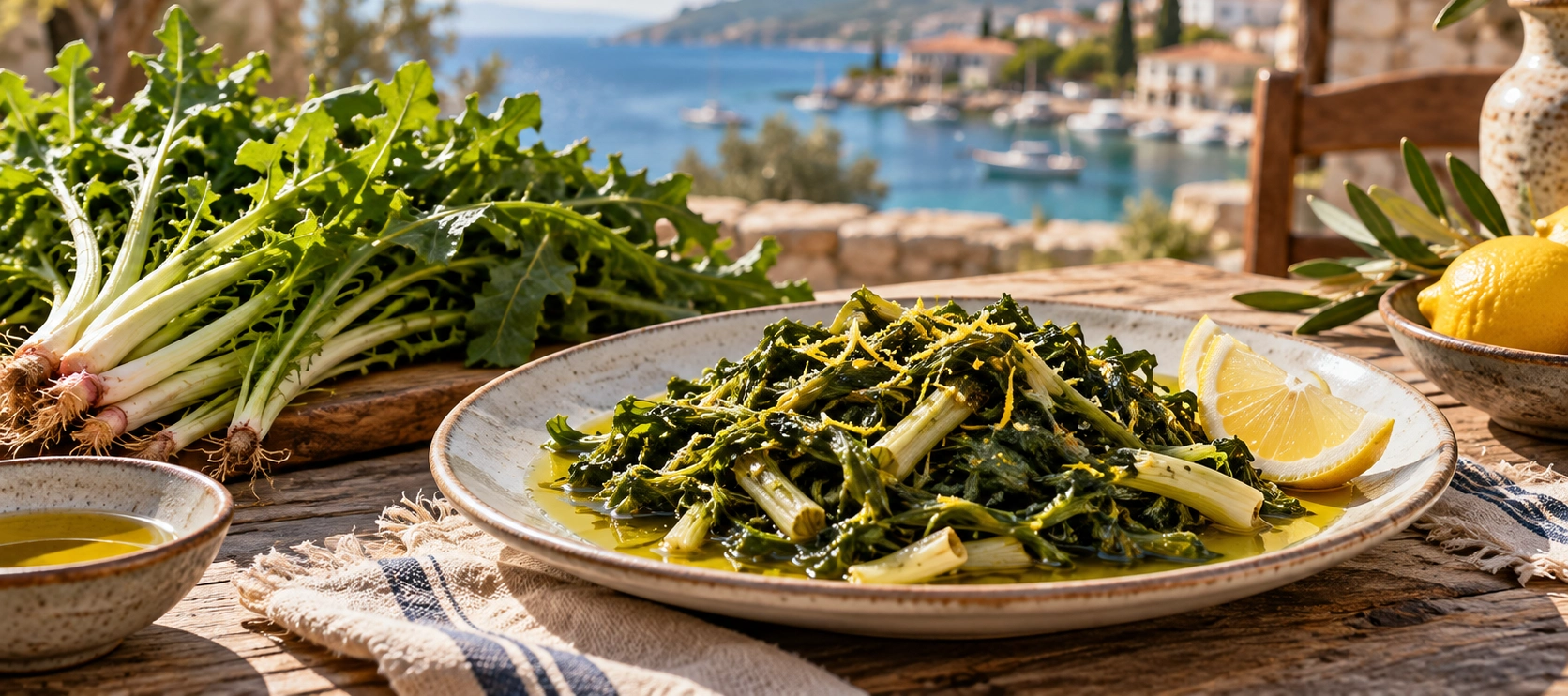
Tender cooked radika is dressed with olive oil and lemon for the essential Aegean version.
- Style: Cold or room-temperature meze
- Flavour: Bitter, fresh and lemony
- Essential: Good olive oil






Few ingredients express the character of Aegean herb cuisine as clearly as radika. Gathered or cultivated for its edible leaves, this pleasantly bitter green belongs to the remarkable family of wild herbs known collectively in western Türkiye as otlar.
Around İzmir, radika is most commonly prepared with extraordinary simplicity. The leaves are cleaned, boiled until tender and served with extra-virgin olive oil and fresh lemon. Depending on the kitchen, garlic or other subtle additions may also appear.
Its slight bitterness is not considered something to hide. It is precisely what makes radika special. Combined with fruity olive oil and bright citrus, the bitterness becomes refreshing, complex and deeply connected with the flavours of the Aegean landscape.
From neighbourhood markets in İzmir to the herb-rich traditions of Urla, Alaçatı, Çeşme, Seferihisar and the wider peninsula, radika represents a culinary culture based on seasonality, local knowledge and respect for ingredients that grow naturally in the surrounding countryside.
Radika belongs to the celebrated tradition of edible herbs and greens found throughout western Türkiye.
Its distinctive bitterness is balanced naturally by olive oil and fresh lemon.
Boiling or blanching followed by a simple dressing allows the flavour of the leaves to remain central.
Radika reflects a cuisine deeply influenced by the natural rhythm of fields, hillsides and local markets.
Essential information about one of İzmir's best-known Aegean wild greens.
Strongly associated with İzmir and the herb-rich culinary traditions of Türkiye's Aegean region.
Open İzmir on Google MapsKnown as radika, a name commonly used for edible wild chicory-type greens.
Traditionally boiled and dressed with olive oil and fresh lemon.
Fresh, green and characteristically bitter, with a flavour softened beautifully by good olive oil.
A humble wild green shaped by generations of knowledge about the Aegean landscape.
İzmir's cuisine has long been influenced by the extraordinary botanical diversity of western Anatolia. Fertile valleys, olive groves, fields, hillsides and coastal landscapes provide an enormous variety of edible plants.
Generations of local cooks learned how to identify, gather and prepare these seasonal greens. Collectively known as otlar, they became one of the defining characteristics of Aegean cooking.
Radika is among the best-known members of this tradition. Its slightly bitter leaves offered a flavour very different from mild cultivated vegetables and were valued precisely because of that distinctive character.
Rather than disguising the bitterness with complicated sauces, Aegean cooking developed a simple approach: cook the leaves until tender and serve them with excellent olive oil and lemon.
This preparation reflects a larger philosophy found throughout İzmir cuisine. The quality of the ingredient matters more than culinary complexity.
Radika therefore represents far more than one vegetable dish. It is part of a living tradition connecting seasonal cooking, local plant knowledge, olive cultivation and the shared meze tables of the Aegean.
The classic boiled version remains the most recognisable, but radika can appear in several styles across Aegean kitchens.
Tender cooked radika is dressed with olive oil and lemon for the essential Aegean version.
Some kitchens add finely chopped or crushed garlic to bring another aromatic layer to the greens.
Radika may appear beside cibez, arapsaçı, şevketi bostan and other seasonal wild greens.
Cooked greens can occasionally be finished briefly in olive oil for a warmer and richer interpretation.
Like several Aegean greens, radika can be incorporated into simple home-style preparations with eggs.
Contemporary chefs may incorporate radika into composed salads, vegetable plates and creative seasonal menus.
Radika is a culinary name widely used in Türkiye's Aegean region for edible bitter greens commonly associated with wild chicory and closely related chicory-type plants.
Local naming of wild plants can vary from one community to another, which means the word radika may not always refer to one perfectly uniform botanical form. In culinary terms, however, travellers can expect a leafy green valued for its pleasant bitterness and its suitability for simple olive-oil preparations.
The edible portion is primarily the tender leaves and stems gathered before they become excessively tough.
Radika is strongly associated with the chicory family of bitter edible greens.
In culinary culture it belongs to the extraordinary world of otlar for which western Türkiye is famous.
A pleasantly bitter flavour distinguishes radika from many ordinary cultivated vegetables.
Quality and availability change according to rainfall, temperature and local growing conditions.
Traditional preparation focuses on preserving the natural taste of the plant.
Radika is associated with the fields, uncultivated ground, roadsides, open countryside and Mediterranean landscapes where edible wild greens traditionally emerge during suitable seasons.
Its presence in Aegean cooking reflects an intimate knowledge of local vegetation and of the landscapes surrounding villages, farms and coastal towns.
Wild chicory-type greens can thrive in open sunny environments.
The borders of cultivated land historically provided opportunities for gathering useful edible plants.
Aegean hills support an extraordinary range of Mediterranean herbs and seasonal greens.
Knowledge of edible plants traditionally passed between generations in rural communities.
Urla, Çeşme, Alaçatı and surrounding districts are closely identified with Aegean herb culture.
The wider Aegean region provides the Mediterranean climate in which wild-green traditions flourished.
The availability of wild radika depends heavily on rainfall, temperature and local harvesting conditions. In the Aegean, tender wild greens are particularly associated with the cooler and wetter part of the year and the arrival of spring.
Young leaves generally provide a more delicate texture, while older plants tend to become increasingly firm and intensely flavoured.
One of the most important lessons of Aegean herb culture is that identifying wild plants requires genuine local knowledge. Numerous edible and non-edible plants may grow together, and common names can vary between districts.
Travellers interested in radika are therefore better introduced to the plant through reputable markets, experienced local cooks or knowledgeable guides rather than attempting independent wild harvesting based only on photographs.
The same or similar plants may have different names from village to village.
Young leaves, mature leaves and flowering plants can look considerably different.
Traditional herb collectors rely on practical knowledge developed over many seasons.
Local sellers are often an excellent source of information about regional herb names and preparation.
Never eat an unidentified wild plant simply because it resembles a familiar edible species.
Restaurants and organised food experiences provide a much safer way to explore unfamiliar Aegean herbs.
Traditional radika is remarkably straightforward, yet careful cleaning and cooking make an enormous difference to the finished dish.
The aim is to soften the leaves while preserving enough structure and flavour for the characteristic bitterness to remain enjoyable.
For a first taste of radika, the traditional preparation is difficult to improve upon: tender boiled greens, extra-virgin olive oil and freshly squeezed lemon.
The richness of olive oil rounds the bitterness while lemon provides enough acidity to make the dish lively and refreshing.
The slightly bitter green remains the unmistakable centre of the dish.
Fruitiness and richness soften the bitter edges of the cooked leaves.
Fresh citrus brings brightness and makes the greens taste remarkably refreshing.
Some kitchens add garlic, although it is not necessary for the simplest version.
A restrained preparation keeps attention firmly on the quality of the radika.
The finished greens fit naturally beside numerous other dishes on an Aegean table.
The defining characteristic of radika is its pleasant natural bitterness. Good radika tastes green, earthy and fresh rather than aggressively harsh.
The classic olive-oil-and-lemon dressing transforms this bitterness into something balanced and refreshing, demonstrating why bitter greens remain so important in Mediterranean food traditions.
A clear bitter note is the signature flavour of radika.
The leaves retain a fresh vegetal character after careful cooking.
A subtle rustic quality connects the dish with its wild-herb origins.
Fresh lemon brightens the greens and sharpens their refreshing side.
High-quality olive oil introduces soft fruit and peppery aromas.
Simple preparation leaves a surprisingly clear and refreshing finish.
Bitterness is a natural characteristic of chicory-type greens and an important part of radika's culinary identity. Traditional Aegean cooking does not necessarily try to eliminate it.
Instead, boiling, olive oil and lemon bring the bitterness into balance. The result is a flavour that becomes increasingly appealing once travellers begin exploring the wider world of Mediterranean wild herbs.
The bitterness comes from the plant itself rather than from cooking or seasoning.
Younger growth often has a gentler texture and can feel less assertive on the palate.
Boiling softens both the texture and some of the intensity of the raw green.
Richness creates an important counterweight to the natural bitter character.
Acidity makes the finished flavour brighter and more refreshing.
Enjoyment of bitter greens is an important part of the region's culinary identity.
Radika demonstrates how two simple ingredients can completely change the experience of a wild green. Olive oil provides richness while lemon introduces acidity and freshness.
Good oil coats the leaves and softens their sharper bitter notes.
Citrus brings brightness and prevents the dish from feeling heavy.
The natural bitter flavour remains present but becomes beautifully balanced.
Olive oil gives the cooked leaves a smooth and appealing finish.
Few ingredients allow the quality of the radika itself to remain obvious.
Wild greens, citrus and olive oil form one of the most recognisable combinations in regional cooking.
Although boiled radika with olive oil and lemon is the preparation travellers are most likely to encounter, the green can also move into warmer and more rustic home-style dishes.
Cooked radika may be finished briefly in olive oil with onion or other aromatics.
Wild greens and eggs create a simple, satisfying preparation familiar to many home kitchens.
Radika can be combined with other seasonal greens rather than served alone.
Garlic occasionally provides a stronger aromatic interpretation of the classic salad.
Modern restaurants may use bitter greens within more elaborate seasonal compositions.
Preparation changes according to household traditions, locality and what other herbs are available.
Radika is usually enjoyed as part of a broader Aegean meze or vegetable table rather than as a large standalone main course.
Its bitterness makes it particularly useful among richer, sweeter or creamier dishes because it brings contrast and freshness to the meal.
The classic preparation of radika using only greens, olive oil and lemon is naturally suitable for both vegetarian and vegan diets.
Variations containing eggs, yogurt or other ingredients are different, so travellers following a strict diet should confirm how a particular restaurant prepares the dish.
Boiled greens with olive oil and lemon contain no animal-derived ingredients.
The principal source of richness in the classic preparation is completely plant based.
Citrus provides freshness without changing the vegan character of the dish.
Garlic versions can remain fully vegan.
Home-style preparations containing egg are vegetarian but not vegan.
Ask the restaurant directly when dietary restrictions are important.
The slight bitterness of radika becomes particularly interesting when it is tasted beside other vegetable dishes, creamy mezes and seafood.
Salty samphire provides a fascinating contrast to radika's earthy bitterness.
Delicate olive-oil artichokes complement the stronger personality of bitter greens.
Fragrant rice-filled flowers offer a softer and slightly sweeter contrast.
Creamy broad-bean purée balances radika beautifully.
Lemon-dressed greens work naturally alongside simply prepared Aegean seafood.
Cibez, arapsaçı, şevketi bostan and mixed greens reveal the extraordinary range of Aegean herb cuisine.
Traditional markets are among the best places to understand why wild greens matter so much in İzmir cuisine.
During the appropriate season, bundles of radika may appear alongside numerous herbs whose names, shapes and uses would be unfamiliar to many visitors.
Markets and producer culture make Urla an excellent district for discovering seasonal Aegean ingredients.
The peninsula is famous for its close relationship with edible herbs and regional vegetable cooking.
Local producers and surrounding villages preserve a strong connection with seasonal food traditions.
Market culture offers travellers an accessible introduction to regional produce and homemade foods.
Neighbourhood bazaars reveal which vegetables and greens are currently in season.
Vendors can often explain the local name of a green and the simplest traditional way to prepare it.
A few simple Turkish expressions make exploring herb dishes in İzmir considerably easier.
Rather than searching for one famous radika restaurant, look for Aegean home-cooking restaurants, meze restaurants and kitchens specialising in seasonal herbs and olive-oil dishes.
A strong local food culture makes Urla particularly rewarding for seasonal vegetable and herb dishes.
The town and surrounding peninsula are strongly identified with Aegean herb cuisine.
Radika and other wild greens fit naturally beside the district's seafood and meze traditions.
Producer culture and surrounding villages provide excellent opportunities to discover seasonal ingredients.
Traditional restaurants and meze kitchens can offer a broad introduction to İzmir's vegetable cuisine.
Look for restaurants displaying several prepared olive-oil dishes and seasonal greens.
Because the classic recipe is so simple, the freshness of the greens and the quality of the olive oil are immediately noticeable.
The greens should be soft enough to eat comfortably without becoming completely mushy.
Proper washing is particularly important with leafy greens.
The dish should retain its characteristic bitter personality without becoming unpleasantly harsh.
Fresh, fruity oil dramatically improves such a minimalist dish.
Bright acidity should balance rather than overwhelm the radika.
The best versions allow the distinctive flavour of the greens to remain unmistakable.
The bitter character is part of radika's appeal and becomes beautifully balanced by olive oil and lemon.
Order radika together with other seasonal otlar to understand the diversity of Aegean herb cuisine.
The classic boiled version gives the clearest introduction to radika's natural flavour.
A minimalist dish makes the quality and character of the oil especially obvious.
The best herb selection may change from week to week according to weather and availability.
Seeing bundles of different greens helps reveal the extraordinary botanical diversity behind Aegean cuisine.
Wild plant identification requires expertise, so rely on knowledgeable local collectors rather than guessing.
Radika becomes even more interesting beside artichokes, fava, seafood and other vegetable dishes.
Radika captures several ideas central to İzmir cuisine: seasonality, wild plants, traditional knowledge, olive oil, simplicity and a willingness to appreciate naturally bitter flavours.
The ingredient connects the table directly with fields, hillsides and the Mediterranean environment.
Knowing which plants are edible represents generations of practical experience.
Wild-green cooking changes according to rainfall, temperature and the natural calendar.
Regional olive oil transforms a humble green into a memorable Aegean dish.
Radika demonstrates that traditional cuisine values a much wider spectrum of flavours than sweetness and richness alone.
The dish is designed to complement many other flavours rather than dominate the meal.
A day exploring İzmir's food culture can connect radika with traditional markets, historic neighbourhoods and the shared-table traditions that define Aegean cooking.
Travellers fascinated by radika can extend their culinary exploration west toward the İzmir Peninsula, where wild greens have become one of the region's most recognisable gastronomic signatures.
Radika can become one chapter in a much larger culinary journey through the districts of İzmir Province.
Begin with Kemeraltı, neighbourhood markets and traditional Aegean home cooking.
Explore seasonal produce, olive oil and one of Türkiye's most dynamic contemporary food regions.
Discover a destination particularly famous for herbs, vegetable dishes and Aegean flavours.
Combine herb dishes with mezes, seafood and the landscape of the peninsula.
Experience local producer traditions and the agricultural character of the southern coast.
Combine a beautiful fortified coastal town with local markets and regional food traditions.
Radika represents something much larger than a simple boiled vegetable. It demonstrates how closely Aegean cuisine remains connected with landscape, seasons, traditional plant knowledge and olive culture.
Radika preserves knowledge of useful plants growing beyond conventional cultivated crops.
The appearance of different greens marks changes in the natural calendar.
Identifying, gathering and preparing herbs has long required experience passed between generations.
Extra-virgin olive oil turns a humble bitter plant into a sophisticated regional dish.
Wild greens are among the clearest culinary signatures distinguishing western Türkiye.
Radika continues to appear in markets, homes, meze restaurants and contemporary kitchens.
Radika reveals the wild-herb side of İzmir cuisine. Continue exploring the region through its vegetables, olive-oil dishes, breads, street foods and desserts.
Explore cibez, arapsaçı, şevketi bostan and the wider world of İzmir's edible wild greens.
Discover the naturally salty coastal green known internationally as samphire or glasswort.
Explore İzmir's famous enginar traditions and the seasonal vegetable cuisine of Urla.
Discover delicate kabak çiçeği dolması filled with fragrant rice, herbs and olive oil.
Explore the zeytinyağlı tradition that defines so much of western Türkiye's vegetable cuisine.
The city's famous layered pastry and a defining flavour of a traditional İzmir breakfast.
A crisp sesame-covered bread ring deeply connected with İzmir's street-food culture.
Distinctive sesame bread transformed into one of the city's most famous sandwiches.
A beloved fried syrup dessert connected with neighbourhood celebrations and sharing.
Exploring radika can easily become part of a wider journey through İzmir's historic markets, coastal towns, agricultural landscapes and traditional food districts.
Explore İzmir's historic commercial centre together with traditional restaurants, cafés and food shops.
Discover the archaeological remains of ancient Smyrna in the centre of modern İzmir.
Combine regional gastronomy with olive groves, vineyards, markets and peninsula landscapes.
Explore historic stone streets alongside one of the Aegean's best-known herb cultures.
Combine herb dishes with coastal scenery, seafood and the relaxed rhythm of the peninsula.
Experience a charming fortified town together with Seferihisar's market and producer traditions.
Radika is a name widely used in Aegean cuisine for edible bitter greens commonly associated with wild chicory and related chicory-type plants.
Radika is commonly described in English as wild chicory or a chicory-type green. Local plant names can vary, so the culinary term does not always represent one completely uniform botanical form.
Not necessarily. Radika is sometimes loosely translated as dandelion greens, but it is more accurately associated with wild chicory-type bitter greens in Aegean culinary usage.
Radika has a fresh, vegetal and characteristically bitter flavour that becomes beautifully balanced with olive oil and lemon.
Bitterness is a natural characteristic of chicory-type greens and is considered an important part of the plant's culinary appeal.
The classic preparation involves thoroughly washing the greens, boiling them until tender, draining them and dressing them with extra-virgin olive oil and fresh lemon.
The classic salad is usually served cool or at room temperature, although warm sautéed preparations are also possible.
Yes. The classic version prepared with greens, olive oil and lemon is completely vegetarian.
The traditional olive-oil-and-lemon preparation is naturally vegan. Variations containing eggs or dairy are not.
It can be. Some kitchens add garlic, while others prefer the simpler combination of radika, olive oil and lemon.
Exact timing varies with rainfall and local growing conditions, but Aegean wild greens are particularly associated with the cooler rainy season and early spring.
Wild chicory-type greens are associated with fields, hillsides, uncultivated areas and Mediterranean landscapes throughout the Aegean region.
Wild plant identification requires experience. Travellers should not eat plants based only on visual similarity and are better introduced to radika through knowledgeable local sellers, cooks or guides.
Look for Aegean home-cooking restaurants and seasonal meze kitchens in İzmir city as well as Urla, Alaçatı, Çeşme and Seferihisar.
It works beautifully with artichokes, deniz börülcesi, fava, stuffed zucchini flowers, grilled fish and other seasonal Aegean greens.
Olive oil provides richness that softens radika's natural bitterness while preserving the distinctive flavour of the leaves.
Fresh acidity brightens the bitter greens and creates the clean, refreshing balance characteristic of the classic preparation.
Yes. Radika belongs to the much broader Aegean tradition of gathering and cooking edible wild greens known collectively as otlar.
Look for cibez, arapsaçı, şevketi bostan, deniz börülcesi and mixed seasonal herb plates while travelling around İzmir.
Try artichokes, stuffed zucchini flowers, boyoz, gevrek, kumru, İzmir köfte, kokoreç, lokma and the region's many olive-oil vegetable dishes.
The vivid leaves, colourful market displays and simple olive-oil presentation of radika provide excellent opportunities for food and travel photography.
Photograph uncooked bunches to show the texture, shape and natural character of the leaves.
Radika surrounded by other seasonal herbs tells the larger story of İzmir's wild-green culture.
The deep greens become especially attractive once dressed with glossy olive oil and fresh lemon.
Photograph radika beside cibez, deniz börülcesi and other dishes to show its culinary context.
A close view of the dressing helps communicate the ingredient's connection with Aegean olive culture.
Fields, olive groves and peninsula scenery provide a natural visual context for the story of wild herbs.
When photographing market sellers, herb collectors, cooks or restaurant staff, always ask permission before taking close portraits. The people who preserve İzmir's wild-herb knowledge are an essential part of the culinary story.
Discover İzmir through its wild greens, seasonal markets, olive oil, traditional neighbourhoods and beautiful Aegean landscapes.
Custom-designed private touring with professional guiding, comfortable transportation and flexible timing for travellers who want to understand the relationship between İzmir's food, landscape, history and culture.
Explore seasonal markets and traditional kitchens while discovering radika, cibez, deniz börülcesi, artichokes, olive-oil dishes and other distinctive flavours of western Türkiye.
Request This Tour
Combine Konak, Kemeraltı, ancient Smyrna and İzmir's waterfront with traditional markets, Aegean mezes and the city's remarkable herb and vegetable culture.
Design Your ExperienceExtend your culinary journey through İzmir Province with Urla, Alaçatı, Çeşme and Seferihisar, combining local markets, olive groves, wild herbs, seafood and spectacular Aegean scenery.

Combine one of Türkiye's greatest archaeological sites with İzmir's markets, coastal landscapes and distinctive Aegean culinary traditions.
Request This Tour
Create a personalised route through the İzmir Peninsula combining radika, seasonal wild greens, local markets, olive oil, regional cuisine and beautiful Aegean landscapes.
Design Your Journey