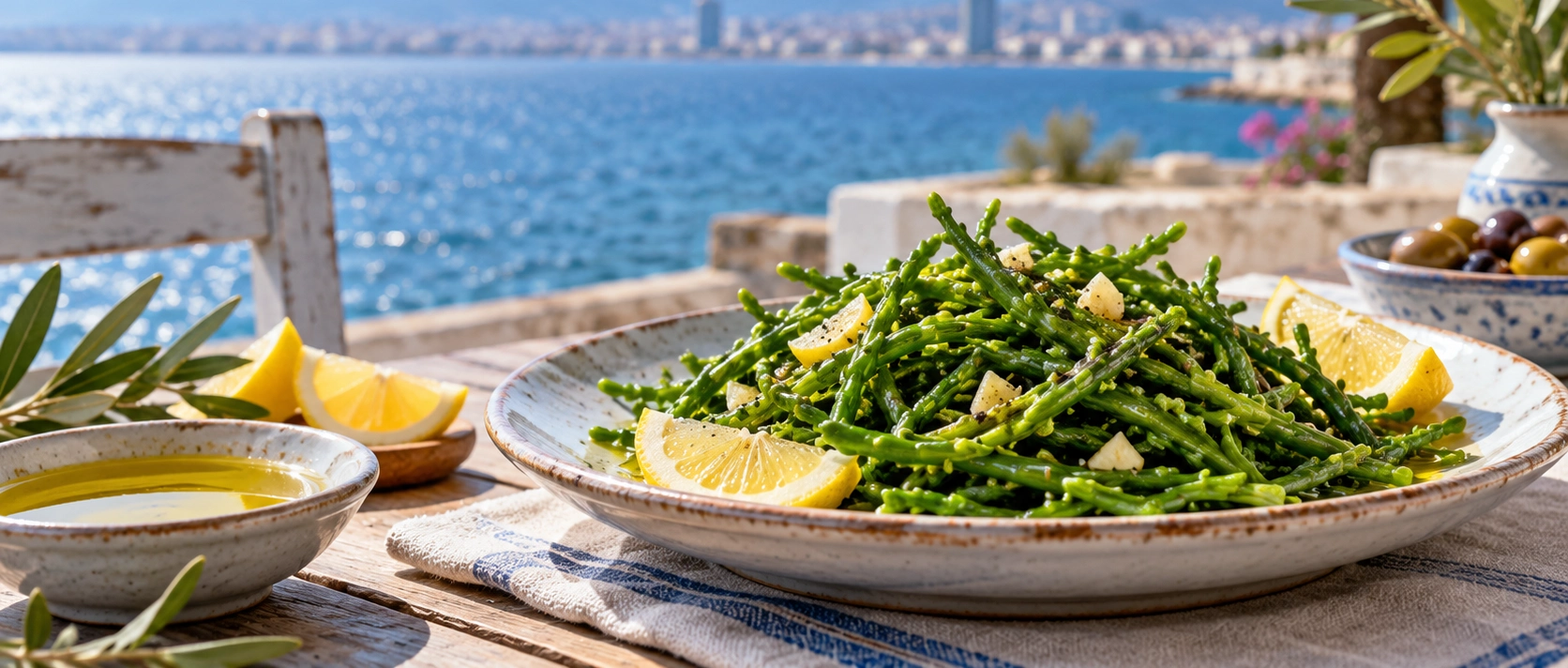
Classic Deniz Börülcesi Salatası
Cooked samphire is dressed simply with olive oil and lemon for the best-known version.
- Style: Cold meze
- Flavour: Salty and fresh
- Serving: Room temperature or chilled






Few ingredients connect İzmir's cuisine with the sea as directly as deniz börülcesi — samphire. This succulent coastal plant naturally thrives in salty environments and has become one of the most recognisable greens on Aegean meze tables.
Its flavour is fresh, mineral and naturally salty. Rather than requiring complicated preparation, deniz börülcesi is traditionally treated with restraint: cooked until tender, separated from its tougher central stems when necessary, and dressed with olive oil, lemon and often garlic.
Along İzmir's coastline — particularly around Çeşme, Alaçatı, Urla and Seferihisar — samphire belongs naturally beside seafood, wild herbs, olive-oil vegetables and the many small dishes that define a long Aegean meal.
Its appeal comes not only from its flavour but also from its story. Deniz börülcesi represents a cuisine shaped by coastal landscapes, seasonality, foraging traditions and an intimate knowledge of wild edible plants.
Deniz börülcesi grows naturally in saline environments close to the sea.
It is commonly served as a cold or room-temperature meze with olive oil and lemon.
Its distinctive flavour reflects the mineral-rich coastal environments in which it grows.
Its freshness and acidity make it a natural companion to fish and other Aegean seafood dishes.
Essential information about one of İzmir's most distinctive coastal greens.
Widely associated with the coastal cuisine of İzmir and Türkiye's Aegean region.
Open İzmir on Google MapsKnown as deniz börülcesi in Turkish.
A salt-tolerant succulent associated with coastal marshes, salt flats and saline ground.
Usually dressed simply with olive oil, lemon and sometimes garlic.
A wild coastal ingredient shaped by generations of seasonal knowledge.
The cuisine of western Türkiye has always been closely connected with the landscape. Olive groves, vineyards, fertile plains, mountain herbs and the Aegean Sea each contribute ingredients to the regional table.
Along the coast, communities also learned to recognise edible plants that thrive in environments unsuitable for ordinary vegetables. Deniz börülcesi is one of the most distinctive examples.
Growing in salty coastal environments, the plant naturally develops a flavour unlike ordinary garden greens. Its mineral character and succulent texture made it particularly suitable for simple preparations with olive oil and fresh acidity.
It consequently became part of the wider tradition of gathering and cooking otlar — edible wild greens — for which the Aegean region is especially celebrated.
The plant also illustrates an important principle of İzmir cuisine: ingredients do not need to be heavily altered to become memorable. Good olive oil, lemon and careful preparation are often enough.
Today deniz börülcesi remains familiar in homes, local markets, traditional meze restaurants and modern kitchens throughout İzmir's coastal districts.
The classic preparation is remarkably simple, but samphire can appear in several different forms across the Aegean table.
Cooked samphire is dressed simply with olive oil and lemon for the best-known version.
Crushed or finely chopped garlic can add a sharper aromatic note to the classic olive-oil dressing.
Some kitchens combine prepared deniz börülcesi with yogurt or garlic yogurt for a creamier interpretation.
Samphire's salty freshness makes it particularly well suited to grilled fish and seafood.
Deniz börülcesi may appear beside other boiled or sautéed wild greens dressed with olive oil and lemon.
Contemporary chefs may use samphire as a fresh salty accent in seafood dishes, salads and creative mezes.
Deniz börülcesi is the Turkish culinary name commonly used for an edible, salt-tolerant succulent plant known in English as samphire or glasswort.
Despite its Turkish name, it should not be confused with ordinary börülce — cowpea or black-eyed pea. Deniz börülcesi is a completely different coastal plant adapted to salty environments.
The plant consists of fleshy, jointed green stems that retain moisture.
It is adapted to soil and water conditions containing significant levels of salt.
Its natural environment helps explain why it is strongly associated with seaside cuisine.
In culinary culture it belongs naturally beside the many edible wild greens of the Aegean.
The plant has a naturally saline, vegetal and distinctly coastal character.
Traditional preparation emphasises the plant rather than covering it with heavy sauces.
The unusual flavour of deniz börülcesi begins with its habitat. Unlike ordinary leafy vegetables, it is adapted to saline soils and coastal wetland environments.
Salt marshes, estuaries, coastal flats and similar landscapes can provide the conditions in which these specialised plants survive.
Coastal wetlands with saline soil provide ideal environments for salt-tolerant plants.
Places where land, freshwater and the sea interact can support distinctive coastal vegetation.
Low-lying saline landscapes are closely associated with the plant's natural ecology.
Its growing conditions contribute to the plant's naturally salty character.
Türkiye's western coastline provides numerous habitats suitable for salt-loving vegetation.
The ingredient reminds diners that food can come from ecosystems beyond conventional farms.
Availability varies according to local conditions, weather and harvesting practices, but fresh deniz börülcesi is particularly associated with the warmer part of the year.
Young shoots tend to be more tender, while mature plants can become increasingly fibrous.
Deniz börülcesi may look simple on the plate, but preparing it properly is important because mature stems can contain a tougher inner core.
A common Aegean technique involves briefly cooking the plant before separating the tender green flesh from harder central portions.
For many travellers, the best introduction is the simplest: tender deniz börülcesi dressed with extra-virgin olive oil, lemon and garlic.
Because the plant already has a naturally salty flavour, the dressing is intended to provide richness and freshness rather than dominate the ingredient.
The coastal green remains the unmistakable centre of the dish.
Good olive oil softens the mineral character and adds fruitiness.
Fresh acidity gives the salad brightness and balance.
A small amount of garlic provides aromatic intensity.
The best-known preparation allows the natural flavour of the green to remain clear.
It fits naturally into the leisurely sequence of dishes on an Aegean table.
Deniz börülcesi has one of the most distinctive flavours among Aegean greens. It is naturally saline, fresh and vegetal, with a subtle mineral quality that immediately suggests its coastal habitat.
The plant's saline environment gives it a noticeably briny character.
Lemon reinforces its bright and refreshing qualities.
Behind the saltiness is a clean green flavour.
Its unusual habitat contributes to a distinctive coastal impression.
Properly prepared stems have a tender but slightly juicy texture.
Olive oil and citrus give the finished meze a clean, lively balance.
The salty taste is not simply the result of seasoning in the kitchen. Deniz börülcesi is adapted to environments where salt levels are much higher than those tolerated by most ordinary vegetables.
This natural characteristic is one reason cooks usually season the finished dish cautiously.
The plant survives in environments influenced by saltwater and saline soil.
Its flavour already contains a pronounced salty impression before dressing.
Additional salt may be unnecessary depending on preparation and individual taste.
Acidity provides contrast without needing heavier seasoning.
Oil rounds the flavour and provides richness.
Its saline quality creates a natural flavour bridge toward fish and shellfish.
The classic dressing used with deniz börülcesi demonstrates the simplicity of Aegean cuisine. Three ingredients are often enough to transform the cooked coastal green into a memorable meze.
Fruitiness and richness soften the natural saltiness of the greens.
Acidity creates freshness and lifts the vegetal flavours.
Used carefully, garlic contributes aroma without overwhelming the plant.
The dressing should complement rather than hide the deniz börülcesi.
Few ingredients allow the quality of each component to remain obvious.
Olive oil, wild greens and citrus are recurring elements throughout İzmir cuisine.
Although the olive-oil-and-lemon version is one of the most familiar preparations, some meze kitchens also pair deniz börülcesi with yogurt or garlic yogurt.
The cool creaminess of yogurt softens the saltiness of the plant and creates a richer alternative for a mixed meze table.
Provides acidity, richness and a creamy contrast.
Frequently accompanies yogurt in Turkish meze preparations.
The saline green prevents the dish from becoming excessively mild.
A drizzle may provide additional fruitiness and aroma.
This style works particularly well as a refreshing summer meze.
Ingredients and proportions differ considerably from one kitchen to another.
Like many vegetable and herb dishes from İzmir, deniz börülcesi depends heavily on the quality of its olive oil.
The oil provides body and softness while allowing the natural saline flavour of the coastal plant to remain recognisable.
Good olive oil adds fresh aromatic complexity.
Oil coats the tender greens and creates a smooth finish.
Richness helps soften the plant's intense saline character.
Olive cultivation is deeply rooted in the landscape of western Türkiye.
Olive oil unites many different vegetable dishes on the Aegean table.
When ingredients are few, the quality of the olive oil becomes especially noticeable.
Deniz börülcesi is generally encountered as part of a meze selection rather than as a large main course.
A small portion contributes freshness, salinity and colour to a table containing vegetables, seafood and numerous other dishes.
The most traditional olive-oil preparation can be extremely simple: deniz börülcesi, olive oil, lemon and garlic. Such versions are naturally suitable for both vegetarian and vegan diets.
However, restaurant variations can include yogurt or additional ingredients, so travellers with strict dietary requirements should always ask how the dish has been prepared.
Typically based entirely on the coastal green, olive oil and citrus.
The principal source of richness is plant based.
Fresh citrus provides acidity without animal-derived ingredients.
Frequently used to add aroma to vegan versions.
Some preparations include dairy and are therefore not vegan.
Ask the restaurant directly if dietary restrictions are important.
Samphire becomes most meaningful when enjoyed within a larger Aegean meal of vegetables, seafood, herbs, olive oil and shared mezes.
The natural salinity and lemon dressing complement simply grilled Aegean fish.
Delicate rice-filled flowers provide a softer contrast to salty samphire.
Creamy broad-bean purée balances the crisp mineral character of deniz börülcesi.
Zeytinyağlı enginar continues the seasonal vegetable character of an Aegean table.
A selection of radika, cibez and other greens reveals the extraordinary diversity of regional plant cuisine.
Octopus, calamari and other coastal dishes work naturally with samphire's fresh salinity.
Local markets are among the most interesting places to understand the role of wild greens in İzmir cuisine.
Depending on season and availability, deniz börülcesi may appear alongside bunches of cultivated vegetables, fresh herbs and other gathered Aegean greens.
Seasonal markets connect the district's celebrated food culture with nearby agricultural and coastal landscapes.
The peninsula is especially associated with herbs, vegetables and seasonal Aegean ingredients.
Coastal food culture creates a natural setting for samphire and seafood.
Producer traditions make the district rewarding for travellers interested in local ingredients.
Neighbourhood markets offer a window into the seasonal ingredients used in city kitchens.
Market vendors can often explain how a particular green is traditionally cleaned and prepared.
A few Turkish expressions make it easier to explore İzmir's meze counters and seafood restaurants.
The best strategy is not necessarily to search for one particular restaurant. Instead, look for meze restaurants, seafood restaurants and kitchens that work with seasonal Aegean ingredients.
Seafood culture makes the peninsula one of the most natural settings for enjoying deniz börülcesi.
A strong tradition of herbs and seasonal vegetable cuisine complements the coastal plant perfectly.
Traditional ingredients meet an increasingly sophisticated contemporary Aegean food scene.
Local produce and coastal villages create excellent opportunities for seasonal food exploration.
Meze and fish restaurants provide easy access to a broad range of Aegean flavours.
Seafood restaurants around the Gulf often provide the ideal context for traditional cold mezes.
Because the preparation is so simple, texture, freshness and the quality of the dressing are immediately noticeable.
The edible green portions should be tender rather than excessively fibrous.
Tough inner stems should not dominate the eating experience.
The natural salinity should remain enjoyable rather than overwhelming.
The dressing should taste fresh, fruity and clean.
Lemon should brighten the plant without masking its character.
The best preparations allow the deniz börülcesi itself to remain the main flavour.
Deniz börülcesi becomes much more interesting when compared with several other Aegean dishes.
Its salty, lemony freshness is particularly suited to grilled seafood.
Good preparation removes distracting fibrous portions while preserving the succulent greens.
The plant already has a naturally salty character, so taste it before seasoning.
Compare the classic lemon-and-olive-oil preparation with yogurt or modern interpretations.
Aegean meze selections often change according to what is fresh and locally available.
Deniz börülcesi is only one member of İzmir's extraordinary world of edible herbs and greens.
Eating the dish beside the Aegean Sea helps reveal the landscape from which its character comes.
Deniz börülcesi captures several themes that repeatedly appear in İzmir cuisine: seasonality, coastal geography, wild plants, olive oil, simplicity and shared meze tables.
The ingredient directly reflects the saline coastal environments where it grows.
Recognising useful wild plants represents generations of practical culinary knowledge.
Traditional kitchens adapt according to what the surrounding landscape provides.
Regional olive culture transforms a wild green into a classic Aegean meze.
Minimal preparation preserves the ingredient's distinctive character.
The dish is designed to sit among many flavours rather than dominate the meal alone.
A culinary day in İzmir can connect samphire with the markets, historic neighbourhoods and seafood traditions that define the city's relationship with the Aegean.
Travellers particularly interested in deniz börülcesi can extend their exploration west from İzmir toward the peninsula, where coastal cuisine, wild greens, olive oil and seafood naturally come together.
Deniz börülcesi can become one stop on a much wider culinary route connecting İzmir's city markets with agricultural districts and coastal towns.
Begin with Kemeraltı, neighbourhood restaurants and traditional meze culture.
Explore local ingredients, olive oil, seasonal produce and contemporary Aegean gastronomy.
Discover one of the peninsula's most celebrated destinations for herbs and vegetable cuisine.
Pair deniz börülcesi and other mezes with the peninsula's seafood traditions.
Experience producer culture, local markets and villages along the Aegean coast.
Combine a historic coastal setting with local food traditions and seafood.
Deniz börülcesi represents something larger than a single recipe. It demonstrates how strongly Aegean cuisine remains connected with place, ecology and traditional knowledge.
The plant creates a direct culinary connection between the dining table and the Aegean shoreline.
Its use preserves familiarity with edible plants growing outside conventional agriculture.
Availability reminds diners that traditional cuisine changes with the natural calendar.
Olive oil remains the fundamental ingredient transforming the green into a classic meze.
Its saline flavour immediately distinguishes it from ordinary cultivated vegetables.
Deniz börülcesi continues appearing in homes, markets, taverns and contemporary restaurants.
Deniz börülcesi reveals the coastal and wild-green side of İzmir cuisine. Continue exploring the city's remarkable food traditions through its vegetables, breads, street foods and desserts.
Discover radika, cibez, arapsaçı, şevketi bostan and the wider world of Aegean wild greens.
Explore İzmir's famous enginar traditions and the seasonal vegetable cuisine of Urla.
Discover delicate kabak çiçeği dolması filled with fragrant rice, herbs and olive oil.
Explore the zeytinyağlı tradition that defines so much of western Türkiye's vegetable cuisine.
The city's famous layered pastry and a defining flavour of a traditional İzmir breakfast.
A crisp sesame-covered bread ring deeply connected with İzmir's street-food culture.
Distinctive sesame bread transformed into one of the city's most famous sandwiches.
Seasoned meatballs cooked with potatoes, peppers and tomato sauce.
A beloved fried syrup dessert connected with neighbourhood celebrations and sharing.
Exploring deniz börülcesi can easily become part of a wider journey through İzmir's historic districts, coastal towns, traditional markets and Aegean landscapes.
Explore İzmir's historic commercial centre together with traditional restaurants, cafés and food shops.
Discover the archaeological remains of ancient Smyrna in the heart of modern İzmir.
Combine regional gastronomy with olive groves, vineyards and the landscapes of the peninsula.
Explore historic stone streets alongside one of the Aegean's most famous herb and vegetable cultures.
Experience coastal scenery and seafood cuisine where deniz börülcesi feels completely at home.
Combine a charming fortified coastal town with Seferihisar's producer and market traditions.
Deniz börülcesi is a salt-tolerant edible coastal plant commonly known in English as samphire or glasswort.
Deniz means “sea” in Turkish. Despite the word börülce appearing in its name, the plant is not the same as ordinary cowpea or black-eyed pea.
In culinary English, deniz börülcesi is commonly described as samphire or glasswort, particularly the succulent salt-marsh type used as an edible green.
It has a fresh, green and noticeably salty flavour with a distinctive mineral character.
The plant is adapted to saline soils and coastal environments, giving it a naturally briny character.
A traditional method involves boiling or blanching the stems, removing tougher inner portions and dressing the tender greens with olive oil, lemon and often garlic.
It is commonly enjoyed cool or at room temperature as part of an Aegean meze selection.
The classic olive-oil, lemon and garlic version is naturally vegetarian.
Traditional versions prepared only with the plant, olive oil, lemon and garlic can be vegan. Versions containing yogurt are not.
Yes. Garlic is a common addition, although individual recipes and restaurant preparations vary.
Some meze preparations combine it with yogurt or garlic yogurt, although the simple olive-oil-and-lemon version is also very common.
Availability varies with local growing conditions, but it is particularly associated with the warmer months and Aegean spring and summer cuisine.
It is adapted to saline environments such as coastal marshes, estuaries, salt flats and other salty ground.
Look for seasonal meze and seafood restaurants in İzmir city and coastal districts such as Urla, Çeşme, Alaçatı and Seferihisar.
It works particularly well with grilled fish, seafood, fava, artichokes, stuffed zucchini flowers and other Aegean wild greens.
Taste it first. The plant is naturally salty, so additional salt may not be necessary.
Mature plants can develop fibrous central portions, so traditional preparation often separates the tender green flesh from harder stems.
Yes. It belongs naturally to the broader Aegean tradition of wild greens, olive-oil dishes and coastal mezes.
Look for radika, cibez, arapsaçı, şevketi bostan and seasonal mixed herb dishes while travelling around İzmir.
Try artichokes, stuffed zucchini flowers, boyoz, gevrek, kumru, İzmir köfte, kokoreç, lokma and the region's many olive-oil dishes.
With its vivid green colour, delicate branching structure and connection with coastal landscapes, deniz börülcesi provides excellent opportunities for food and travel photography.
Photograph the uncooked stems to reveal the plant's unusual succulent structure.
Seasonal greens arranged at a local market create a strong connection with everyday Aegean food culture.
Olive oil and lemon give the cooked greens an attractive shine and freshness.
Place samphire beside artichokes, fava and other vegetable dishes to show its culinary context.
Deniz börülcesi beside grilled fish creates a particularly authentic visual story.
Combine food photography with coastal scenery to communicate the ingredient's relationship with the sea.
When photographing market sellers, fishermen, cooks or restaurant staff, always ask permission before taking close portraits. The people preserving İzmir's culinary traditions are as important to the story as the ingredient itself.
Discover İzmir through its wild greens, coastal cuisine, traditional markets, olive oil, historic neighbourhoods and beautiful Aegean landscapes.
Custom-designed private touring with professional guiding, comfortable transportation and flexible timing for travellers who want to understand the relationship between İzmir's food, landscape, history and culture.
Explore seasonal markets and traditional kitchens while tasting deniz börülcesi, wild herbs, artichokes, olive-oil dishes and other distinctive flavours of western Türkiye.
Request This Tour
Combine Konak, Kemeraltı, ancient Smyrna and İzmir's waterfront with traditional markets, Aegean mezes and the city's remarkable herb and vegetable culture.
Design Your ExperienceExtend your culinary journey through İzmir Province with Urla, Alaçatı, Çeşme and Seferihisar, combining coastal scenery, seafood, olive oil and seasonal Aegean ingredients.

Combine one of Türkiye's greatest archaeological sites with İzmir's markets, coastline and distinctive Aegean culinary traditions.
Request This Tour
Create a personalised route through İzmir's peninsula combining deniz börülcesi, wild herbs, local markets, olive oil, seafood and spectacular Aegean coastal scenery.
Design Your Journey