Kuzu Etli Şevketi Bostan
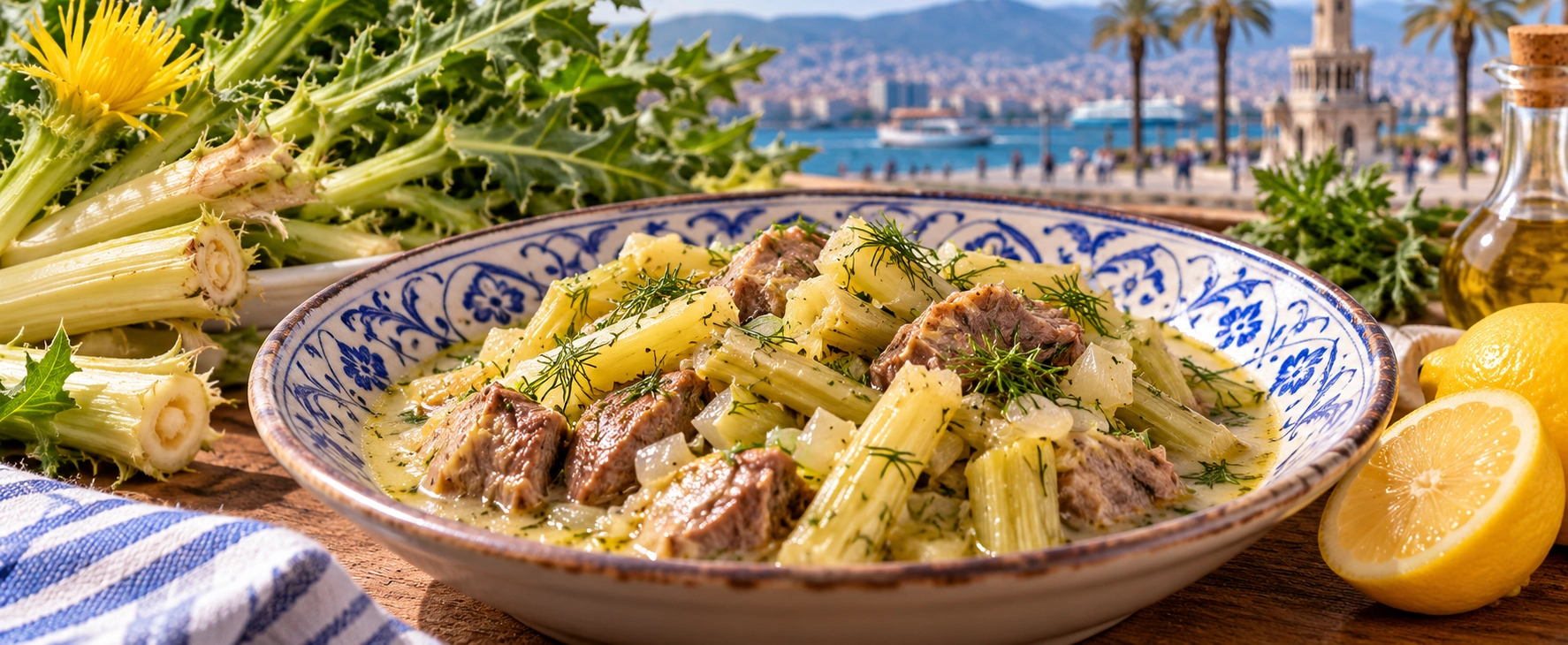
The İzmir classic combines şevketi bostan with tender lamb and a bright lemony cooking liquid.
- Style: Traditional stew
- Flavour: Savoury and lemony
- Signature: İzmir classic






Few ingredients tell the story of İzmir's Aegean cuisine quite like şevketi bostan. Thorny and rather intimidating in its natural form, this Mediterranean plant becomes one of the region's most distinctive dishes after careful cleaning and slow cooking.
Known botanically as Scolymus hispanicus and commonly called golden thistle in English, şevketi bostan belongs to the extraordinary world of edible wild and semi-cultivated plants that have shaped western Türkiye's seasonal cooking for generations.
Its most famous İzmir preparation combines cleaned şevketi bostan with tender lamb, onion and a bright lemon-and-flour terbiye. The result is a gently tart, deeply savoury stew in which the distinctive texture of the plant remains at the centre of the dish.
Şevketi bostan is also closely connected with the food traditions brought to İzmir by Cretan communities. Today it remains a familiar seasonal sight in markets, traditional restaurants and home kitchens throughout İzmir and the surrounding Aegean districts.
Şevketi bostan is one of the most recognisable seasonal plants associated with İzmir and western Türkiye.
The plant is Scolymus hispanicus, a thorny Mediterranean species known in English as golden thistle.
The classic İzmir dish combines şevketi bostan with tender lamb and a refreshing lemon-based sauce.
Şevketi bostan is particularly associated with the cooler months and the seasonal Aegean herb calendar.
Essential information about one of İzmir's most distinctive Aegean vegetables.
Strongly associated with İzmir and the wider culinary traditions of Türkiye's Aegean coast.
Open İzmir on Google MapsScolymus hispanicus, commonly known in English as golden thistle.
Traditionally cooked with lamb and finished with a bright lemon-and-flour terbiye.
Most strongly associated with winter and early spring, particularly around January to April.
A seasonal ingredient shaped by Mediterranean landscapes, migration and generations of Aegean cooking.
Şevketi bostan is a Mediterranean plant whose culinary story reaches far beyond one particular recipe. Its ability to grow in the climate of western Anatolia helped make it part of the extensive wild-herb tradition for which the Aegean coast is famous.
The plant belongs to the Asteraceae family and is botanically known as Scolymus hispanicus. Its thorny appearance hides tender edible portions that can become remarkably delicate after careful cleaning and cooking.
Around İzmir, şevketi bostan developed an especially strong culinary identity. One of its best-known preparations combines the plant with lamb and a lemon-based terbiye, creating a dish that is simultaneously earthy, savoury and refreshing.
The dish is also closely associated with Cretan culinary traditions carried to İzmir by families who migrated from Crete. Their influence remains visible throughout the city's cuisine in its affection for wild greens, olive oil, herbs and seasonal vegetables.
Over time, şevketi bostan became far more than a plant gathered from the landscape. Cultivation also developed, including around parts of İzmir such as Seferihisar, helping make the vegetable more accessible to markets and restaurants.
Today, a plate of şevketi bostan connects several layers of İzmir's identity: the Mediterranean environment, Aegean herb culture, migration history, seasonal cooking and the patient preparation of ingredients that initially appear difficult or unfamiliar.
Lamb may be the most famous partner, but this remarkable plant can appear in several traditional and contemporary preparations.
The İzmir classic combines şevketi bostan with tender lamb and a bright lemony cooking liquid.
A flour-and-lemon mixture gives the cooking liquid its characteristic smoothness and refreshing acidity.
Meat-free interpretations highlight the plant itself together with olive oil, onion and citrus.
Some home-style versions combine the vegetable with legumes for a hearty meat-free preparation.
Restaurants specialising in Aegean vegetables may serve şevketi bostan alongside radika, cibez and other seasonal greens.
Contemporary chefs increasingly use traditional regional ingredients in creative vegetable and tasting menus.
Şevketi bostan is the Turkish culinary name for Scolymus hispanicus, a thorny Mediterranean plant belonging to the daisy family, Asteraceae.
It is often translated into English as golden thistle or Spanish oyster thistle. Unlike many Aegean greens valued primarily for their leaves, şevketi bostan is particularly interesting because its cleaned stems and pale fleshy portions are central to the culinary experience.
Scolymus hispanicus is the accepted botanical name of the plant.
Golden thistle is one of the most widely used English common names.
The mature plant develops sharp leaves and requires careful preparation before cooking.
Tender stems, leaf bases and cleaned pale sections of the plant are used in regional cooking.
The plant naturally belongs to the landscapes and climate of the Mediterranean region.
In Türkiye it is especially strongly associated with vegetable cooking in the Aegean.
Şevketi bostan is naturally associated with Mediterranean environments, open ground, fields and disturbed landscapes.
In Türkiye it occurs across several western and coastal regions and is particularly important as an edible plant in the Aegean. It has also been brought into cultivation, reducing reliance on wild gathering alone.
Western Türkiye provides favourable conditions and a strong culinary tradition of using the plant.
Mild rainy winters and dry summers suit many plants associated with Aegean herb cuisine.
The species can occur in sunny, disturbed and uncultivated landscapes.
Agricultural landscapes and field margins have historically provided gathering areas for edible plants.
Şevketi bostan has also been cultivated commercially in this important agricultural district of İzmir.
Modern cultivation helps provide a more reliable supply for regional markets and restaurants.
Şevketi bostan is particularly associated with the winter and early-spring herb season in İzmir.
Traditional culinary references around İzmir commonly identify approximately January through April as an important period for enjoying the plant, although exact availability can change with weather, cultivation and local growing conditions.
Anyone seeing an unprepared şevketi bostan plant for the first time may wonder how such a thorny ingredient could become food.
The answer is patient cleaning. Tough and thorny portions are removed and the fibrous outer surface is carefully trimmed until the tender pale interior becomes accessible.
Sharp and excessively tough portions must be carefully removed before cooking.
The useful tender sections are separated from fibrous mature growth.
The outer fibrous layer may be trimmed away to expose the pale edible interior.
Prepared pieces are washed carefully to remove soil and plant debris.
The cleaned plant is generally divided into manageable sections for cooking.
İzmir markets frequently make life easier by offering cleaned şevketi bostan ready for the kitchen.
The famous İzmir version transforms a surprisingly rugged plant into a delicate stew through slow cooking with lamb and a lemon-based finish.
Individual household recipes differ, but the traditional method follows a recognisable sequence.
For travellers wanting to understand the ingredient, kuzu etli şevketi bostan is the classic place to begin.
The dish combines tender lamb, onion and cleaned şevketi bostan with a lemony terbiye. The lamb provides depth while the acidity prevents the stew from becoming heavy.
The distinctive plant contributes texture, freshness and the unmistakable identity of the dish.
Tender lamb gives the stew richness and savoury depth.
Onion forms a gentle aromatic base without overwhelming the vegetable.
Fresh lemon creates the characteristic bright and slightly tart flavour.
A small amount of flour gives the cooking liquid a lightly thickened, smooth consistency.
Gentle cooking allows both the lamb and the vegetable to become tender.
Şevketi bostan has a flavour quite unlike ordinary cultivated vegetables. It is green, earthy and slightly bitter, with a distinctive plant character that becomes gentler during cooking.
In the classic lamb dish, lemon provides brightness while the cooking juices create a rounded savoury flavour.
The plant retains a recognisable fresh vegetal character after cooking.
Its rustic personality reflects its origins as a Mediterranean field plant.
A mild bitter note contributes complexity without defining the dish completely.
The traditional terbiye gives the stew an unmistakable citrus brightness.
Lamb creates a rich background for the distinctive vegetable flavour.
The acidity makes the finished stew considerably lighter than its ingredients might suggest.
The character of traditional şevketi bostan depends on contrast. Lamb brings richness and depth while lemon introduces enough acidity to keep the finished dish lively.
The vegetable sits naturally between them, absorbing the savoury cooking liquid while retaining its own distinctive flavour and texture.
Richness and savoury flavour provide the foundation of the traditional stew.
Acidity cuts through the richness and creates a fresh finish.
Şevketi bostan remains substantial enough to stand beside slow-cooked meat.
The plant absorbs flavour while contributing its own vegetal character to the broth.
Flour and lemon gently bind the liquid without turning it into a heavy sauce.
The combination demonstrates the Aegean preference for freshness even in substantial dishes.
Although lamb is the best-known companion, şevketi bostan can also be prepared in ways that place greater emphasis on the vegetable itself.
Cooking with olive oil creates a lighter interpretation centred on the plant itself.
Onion, olive oil and lemon can create a satisfying vegetable preparation without lamb.
Legumes may be added in some home-style recipes to create a more substantial meal.
Seasonal kitchens occasionally combine şevketi bostan with other Aegean vegetables and greens.
Modern chefs may adapt the plant into creative plates while preserving its regional identity.
Exact methods vary according to family traditions and the culinary background of the cook.
Unlike radika or deniz börülcesi, which often appear as cold mezes, the classic lamb version of şevketi bostan is a warm cooked dish substantial enough to form an important part of a meal.
The most famous İzmir preparation is not vegetarian because it contains lamb.
However, şevketi bostan itself is a vegetable and can easily form the basis of vegetarian or vegan preparations using olive oil, onion, lemon and other plant-based ingredients.
Kuzu etli şevketi bostan contains meat and is therefore not vegetarian.
Olive-oil preparations can be completely plant based.
The characteristic citrus flavour works equally well in meat-free preparations.
Legumes can add substance to vegetarian versions of the dish.
Some recipes use only flour and lemon while others may contain additional ingredients.
Travellers with dietary restrictions should confirm the restaurant's exact recipe.
The bright, savoury character of şevketi bostan makes it an excellent centrepiece for a broader exploration of İzmir's seasonal vegetable cuisine.
Simple bitter greens dressed with olive oil and lemon provide a refreshing contrast.
Salty coastal samphire introduces another completely different expression of Aegean plants.
Delicate olive-oil artichokes pair beautifully with the more rustic character of şevketi bostan.
Fragrant rice-filled flowers add a softer texture and aromatic contrast.
Creamy broad-bean purée fits naturally into the same shared Aegean table.
Fresh herbs, greens and citrus-based salads help balance a warm lamb stew.
Markets are one of the best places to appreciate how dramatically şevketi bostan changes between its natural and kitchen-ready forms.
During the season, sellers may offer the plant already cleaned and trimmed, saving home cooks from the most time-consuming part of preparation.
Neighbourhood bazaars provide a useful introduction to the city's changing seasonal produce.
The historic commercial district is closely connected with traditional food culture and esnaf restaurants.
Local producer culture makes Urla especially rewarding for exploring Aegean vegetables and herbs.
The district combines traditional food culture with agricultural production of şevketi bostan.
One of the region's great market traditions offers an extraordinary introduction to western Anatolian produce.
Cleaned şevketi bostan is far more practical for travellers or cooks unfamiliar with handling the thorny plant.
A few Turkish expressions make it easier to identify exactly which version of the dish a restaurant is serving.
Şevketi bostan is seasonal, so the best strategy is not necessarily to search for one permanent specialist restaurant.
Instead, look for traditional esnaf lokantaları, Aegean home-cooking restaurants and kitchens specialising in seasonal vegetable dishes.
Traditional restaurants around İzmir's historic bazaar are particularly interesting during the winter herb season.
Central neighbourhoods provide access to long-established İzmir home-style cooking.
Restaurants range from traditional meze kitchens to contemporary interpretations of Aegean cuisine.
The district's celebrated food culture places strong emphasis on local and seasonal ingredients.
Agricultural traditions and nearby villages make this an excellent area for seasonal Aegean foods.
The dish is worth seeking when the vegetable is naturally at its best rather than expecting it year-round.
The difference between an ordinary and memorable plate comes from careful cleaning, good ingredients and patient cooking.
No unpleasantly tough or excessively fibrous sections should remain.
The vegetable should yield easily while still retaining its distinctive structure.
In the classic version, the meat should be soft and integrated into the cooking liquid.
Acidity should be clearly noticeable without overwhelming the other flavours.
The liquid should have body without becoming excessively thick or floury.
The vegetable, meat and citrus should remain individually recognisable while working together.
Winter and early spring provide the best opportunity to experience the ingredient as part of İzmir's natural food calendar.
The traditional kuzu etli preparation gives first-time visitors an excellent introduction to the dish.
The citrus flavour is not decoration; it is fundamental to the balance of the classic stew.
A zeytinyağlı interpretation allows the character of the plant itself to become more obvious.
Seeing the cleaned and uncleaned plant makes its transformation in the kitchen much easier to appreciate.
Try radika, cibez, arapsaçı and other seasonal greens during the same meal or journey.
Wild plant identification requires real expertise; unfamiliar plants should never be eaten based on photographs alone.
A good Aegean restaurant may have a completely different herb selection from one week to the next.
Şevketi bostan brings together several themes that define İzmir cuisine: seasonality, wild plants, migration, Mediterranean agriculture, patient preparation and a preference for bright flavours.
The ingredient connects the kitchen directly with the Mediterranean vegetation of western Anatolia.
Its appearance marks a particular moment in the winter and spring culinary calendar.
The famous lamb preparation reflects the lasting contribution of Cretan communities to İzmir's food culture.
Cleaning and preparing a thorny edible species demonstrates generations of practical experience.
Lemon prevents a substantial lamb stew from feeling excessively rich.
Şevketi bostan continues to move between markets, home kitchens, traditional restaurants and modern gastronomy.
A seasonal food day in İzmir can combine şevketi bostan with the historic districts, markets and waterfront that give the city its distinctive atmosphere.
Travellers particularly interested in İzmir's vegetable traditions can extend their exploration south and west into the agricultural districts surrounding the city.
Şevketi bostan can become one part of a much broader culinary journey through İzmir Province.
Begin with Kemeraltı, neighbourhood markets and traditional Aegean home cooking.
Explore olive oil, artichokes, herbs and one of Türkiye's most dynamic contemporary food regions.
Discover producer culture, agricultural landscapes and a district where şevketi bostan is cultivated.
Combine local food traditions with a beautiful fortified coastal town.
Experience one of the Aegean's most celebrated destinations for herbs and vegetable cuisine.
Finish the journey with seafood, mezes and seasonal Aegean vegetables beside the sea.
Şevketi bostan demonstrates how regional cuisine can transform a difficult-looking wild plant into a treasured seasonal dish through knowledge, patience and culinary tradition.
The plant belongs to the enormous repertoire of useful Mediterranean species known to local communities.
Its appearance marks winter and early spring rather than an artificial year-round menu.
Cleaning the plant correctly requires skills developed through practical experience.
The lamb preparation reflects migration and the blending of culinary traditions around the Aegean.
Şevketi bostan has become one of the ingredients frequently associated with the city's distinctive regional cuisine.
It continues to appear in farms, markets, restaurants and contemporary kitchens rather than surviving only as culinary history.
Şevketi bostan introduces the seasonal herb side of İzmir cuisine. Continue exploring the region through other greens, vegetables, street foods and desserts.
Explore the extraordinary variety of edible greens that define western Türkiye's seasonal cuisine.
Discover the pleasantly bitter Aegean green traditionally served with olive oil and lemon.
Taste the naturally salty coastal green known internationally as samphire or glasswort.
Explore İzmir's famous enginar traditions and the seasonal vegetable cuisine of Urla.
Discover delicate kabak çiçeği dolması filled with fragrant rice, herbs and olive oil.
The city's famous layered pastry and a defining flavour of a traditional İzmir breakfast.
A crisp sesame-covered bread ring deeply connected with İzmir's street-food culture.
Distinctive sesame bread transformed into one of the city's most famous sandwiches.
A beloved fried syrup dessert connected with neighbourhood celebrations and sharing.
Discovering şevketi bostan can easily become part of a wider journey through İzmir's historic markets, coastal towns and agricultural landscapes.
Explore İzmir's historic commercial centre together with traditional restaurants, food shops and market culture.
Discover the archaeological remains of ancient Smyrna in the centre of modern İzmir.
Combine regional gastronomy with olive groves, vineyards, markets and peninsula landscapes.
Explore a district strongly connected with agriculture, local producers and seasonal cuisine.
Experience a charming fortified coastal town together with local markets and regional food traditions.
Combine historic stone streets with one of the Aegean's best-known herb and vegetable cultures.
Şevketi bostan is an edible Mediterranean plant botanically known as Scolymus hispanicus and widely used in Aegean cuisine.
It is commonly known as golden thistle. Spanish oyster thistle and Spanish oysterplant are also used as English common names.
Yes. It is a thorny plant belonging to the Asteraceae family and develops sharp leaves as it matures.
The tender cleaned stems, leaf bases and pale fleshy portions are used in cooking after tough and thorny material has been removed.
It has a distinctive green, earthy and mildly bitter flavour with a firm but tender texture when properly cooked.
One of the classic İzmir preparations combines cleaned şevketi bostan with lamb, onion and a lemon-and-flour terbiye.
It is the traditional lamb version of the dish, in which pieces of lamb and şevketi bostan are slowly cooked together and finished with lemon.
In this dish, terbiye refers to the lemon-and-flour mixture used to give the cooking liquid brightness and a lightly thickened consistency.
The plant itself is vegetarian, but the famous İzmir version contains lamb. Meat-free olive-oil preparations are also possible.
A version prepared only with şevketi bostan, vegetables, olive oil and lemon can be vegan. Always confirm the restaurant's exact preparation.
In İzmir it is particularly associated with winter and early spring, traditionally around January through April depending on growing conditions.
Scolymus hispanicus is associated with Mediterranean environments and occurs naturally in open and disturbed landscapes. It is also cultivated.
Yes. In addition to wild populations, cultivation has been documented in İzmir Province, including Seferihisar.
The plant has thorny leaves and fibrous outer portions that must be carefully trimmed before the tender edible sections can be cooked.
Yes. During the season, İzmir markets commonly sell cleaned and prepared şevketi bostan, which greatly reduces preparation time.
Look for traditional Aegean home-cooking restaurants and esnaf lokantaları in central İzmir, Kemeraltı, Urla, Seferihisar and other districts during the season.
Yes. The lamb preparation is strongly associated with Cretan culinary traditions brought to İzmir by families who migrated from Crete.
Try it alongside radika, deniz börülcesi, artichokes, fava, stuffed zucchini flowers and other seasonal Aegean vegetable dishes.
Wild plant identification requires expertise. Travellers should not eat unfamiliar plants based only on photographs or general descriptions.
Look for radika, cibez, arapsaçı, deniz börülcesi and the many mixed herb dishes found throughout İzmir and the surrounding peninsula.
Try artichokes, stuffed zucchini flowers, boyoz, gevrek, kumru, İzmir köfte, Tire köfte, Ödemiş köfte, kokoreç, lokma and the region's many olive-oil dishes.
Few Aegean ingredients offer such an interesting visual transformation from thorny plant to refined regional dish.
Photograph the uncleaned plant to show its extraordinary thorny structure.
The pale trimmed pieces reveal how dramatically preparation changes the ingredient.
Bundles surrounded by seasonal greens provide the wider context of İzmir's herb culture.
Capture the vegetable and tender lamb together in the glossy lemony cooking liquid.
Hands cleaning and trimming the plant can tell the story of the skill required before cooking begins.
Fields, olive groves and agricultural landscapes provide a natural setting for the ingredient's story.
When photographing market sellers, farmers, cooks or restaurant staff, always ask permission before taking close portraits. The people preserving İzmir's knowledge of seasonal plants are an essential part of the culinary story.
Discover İzmir through seasonal markets, wild greens, olive oil, traditional neighbourhoods and the remarkable culinary heritage of the Aegean.
Custom-designed private touring with professional guiding, comfortable transportation and flexible timing for travellers who want to understand the relationship between İzmir's food, landscape, migration history and culture.
Explore seasonal markets and traditional kitchens while discovering şevketi bostan, radika, cibez, deniz börülcesi, artichokes, olive-oil dishes and other distinctive flavours of western Türkiye.
Request This Tour
Combine Konak, Kemeraltı, ancient Smyrna and İzmir's waterfront with traditional markets, Aegean dishes and the city's remarkable seasonal vegetable culture.
Design Your ExperienceExtend your culinary journey through İzmir Province with Urla, Seferihisar, Alaçatı and Çeşme, combining local markets, olive groves, seasonal herbs, seafood and spectacular Aegean scenery.

Combine one of Türkiye's greatest archaeological sites with İzmir's markets, coastal landscapes and distinctive Aegean culinary traditions.
Request This Tour
Create a personalised route through the İzmir countryside combining şevketi bostan, seasonal wild greens, local markets, olive oil, regional cuisine and beautiful Aegean landscapes.
Design Your Journey