Unripe Yediveren Grapes
The fundamental flavour comes from black Yediveren grapes harvested before full ripeness.
- Stage: Unripe
- Local Term: Koruk
- Character: Naturally tart






On the northern coast of İzmir Province, close to Dikili and the blue waters of the Aegean Sea, the village of Bademli preserves one of the region's most distinctive traditional drinks: Bademli Koruk Şerbeti.
The drink begins with koruk — grapes harvested while they are still unripe. In Bademli, the protected recipe specifically uses the unripe fruit of the black Yediveren grape, producing the naturally tart foundation of the sherbet.
The grape juice is slowly cooked with water and sugar before being perfumed with ıtır otu, the intensely aromatic rose-scented geranium traditionally used in many Aegean kitchens.
The result is not normally consumed as a thick syrup straight from the bottle. The concentrated sherbet is diluted with cold water before serving, creating a refreshing drink whose character combines sweetness, acidity, grape flavour and floral fragrance.
Its close association with Bademli was officially recognised in 2023, when Bademli Koruk Şerbeti was registered as a Mahreç İşareti geographical indication in Türkiye.
The distinctive sour foundation comes from koruk collected from black Yediveren grapevines.
Fresh ıtır leaves provide the beautifully perfumed aroma characteristic of the traditional recipe.
The concentrated sherbet is diluted with cold water for an intensely refreshing Aegean drink.
Bademli Koruk Şerbeti has been protected by a Turkish geographical indication since 2023.
Essential information about one of the most distinctive traditional drinks of northern İzmir.
Bademli Mahallesi in the Dikili district of İzmir Province on Türkiye's northern Aegean coast.
Open Bademli on Google MapsUnripe grapes from the black Yediveren grape variety grown in the Bademli geographical area.
Fresh ıtır otu — rose-scented geranium — gives the sherbet its characteristic floral fragrance.
Registered as a Mahreç İşareti geographical indication under registration number 1352.
A village drink born from vineyards, summer heat and the traditional preservation of seasonal produce.
The story of Bademli Koruk Şerbeti is inseparable from the vineyards and household food traditions of Bademli. For generations, local families have transformed unripe grapes into a concentrated drink that could capture the sharp freshness of early-season fruit.
Koruk has long held an important place in western Anatolian cooking. Because grapes harvested before ripening contain pronounced natural acidity, their juice could be used wherever a refreshing sour flavour was required.
In Bademli, that sour grape character developed into something more elaborate: a cooked sherbet balanced with sugar and perfumed with fresh ıtır leaves.
Large batches were traditionally prepared in substantial cooking vessels, making the production of koruk sherbet part of the seasonal rhythm of village life.
The drink became particularly associated with hot weather. Once diluted with cold water, the sweet-and-sour concentrate produced an intensely refreshing drink ideally suited to an Aegean summer.
Its reputation eventually extended beyond Bademli itself, attracting visitors interested not only in the area's beaches and coastal scenery but also in its local food traditions.
The relationship between the drink and the village was formally recognised when Bademli Koruk Şerbeti received Turkish geographical-indication registration on 8 May 2023.
Its character comes from the interaction of only a handful of ingredients, each playing a very specific role.
The fundamental flavour comes from black Yediveren grapes harvested before full ripeness.
Sugar softens the natural sharpness of the grapes without eliminating their refreshing acidity.
Rose-scented geranium leaves are added near the end of cooking to perfume the syrup.
The grapes and extracted liquid are cooked for several hours, concentrating flavour and developing colour.
Cooking transforms the pale grape liquid into a richer colour as the sherbet gradually concentrates.
The traditional method and reputation of the drink are strongly associated with Bademli village.
The Turkish word koruk refers to grapes picked before they reach full ripeness. At this stage the fruit is still firm, green or partially coloured and considerably more acidic than mature table grapes.
That acidity makes koruk valuable in traditional cooking. Its juice has historically provided a souring ingredient for dishes and drinks, particularly in places where vineyards form part of everyday agricultural life.
Koruk is harvested before the grapes accumulate the sweetness associated with ripe fruit.
The pronounced sourness of young grapes is exactly what gives koruk its culinary value.
Koruk and koruk juice appear in several regional culinary traditions across western Anatolia.
The ingredient belongs naturally to the period between grape formation and complete ripening.
Unripe grape juice can be used in drinks, sauces and dishes requiring fresh fruit acidity.
Koruk obtains its sourness directly from young grapes rather than from fermented vinegar.
The protected specification keeps the ingredient list remarkably simple. The distinctive character comes from the quality of the grapes and the traditional cooking method rather than from a complicated collection of flavourings.
Unripe grapes of the black Yediveren variety grown within the Bademli geographical area.
Water allows the grapes to soften during the first stage of cooking and later dilutes the finished sherbet for serving.
Sugar balances the high natural acidity of the young grapes and helps create the concentrated syrup.
Rose geranium leaves are introduced toward the end of cooking to release their characteristic fragrance.
The geographical-indication specification provides a reference formula for traditional production. It demonstrates both the large quantities traditionally prepared and the importance of grape fruit as the dominant ingredient.
These proportions describe the traditional registered production method rather than a small household recipe. They also explain why the finished product is a concentrated sherbet that must be diluted before drinking.
The registered production method is a patient process in which the grapes are first softened, then strained and finally cooked again until the liquid develops the required concentration, colour and flavour.
Unripe black Yediveren grapes are collected and carefully sorted before cooking.
The prepared grapes are placed into traditional copper cooking vessels and water is added.
The grapes are cooked for approximately two to three hours until the fruit becomes soft.
The softened grapes are transferred to cloth and pressed so that their juice can be separated.
The extracted grape liquid is returned to the heat and white sugar is added.
Particles and foam rising to the surface during cooking are carefully removed.
The liquid continues cooking until it develops the characteristic concentration and deep reddish colour.
Fresh rose geranium is introduced near the end of cooking so its perfume infuses the syrup.
After cooking, the fragrant sherbet is left to cool and the ıtır leaves are removed.
The finished concentrate is transferred into bottles ready for storage and later dilution.
One of the most visually memorable parts of traditional Bademli Koruk Şerbeti production is the use of large copper cauldrons.
The process is not instantaneous. The grapes must first soften and release their juice, after which the strained liquid undergoes a second extended cooking stage.
Traditional preparation is well suited to producing substantial quantities during grape season.
The liquid develops gradually rather than being reduced through an excessively aggressive boil.
Foam and particles appearing on the surface are removed as the sherbet cooks.
The grape liquid becomes increasingly concentrated and develops a richer colour during cooking.
The ıtır is introduced near the end so that its distinctive perfume remains part of the finished drink.
Only after the cooking process has finished is the concentrate cooled and prepared for storage.
The defining character of the drink is ekşi ve mayhoş — sour and pleasantly tart — but that description tells only part of the story.
Sugar rounds the acidity, while ıtır adds a floral perfume that lifts the grape flavour and makes the drink particularly aromatic when served cold.
Unripe grapes provide an unmistakably bright natural acidity.
Sugar balances the sharpness of the koruk and creates the concentrated syrup.
Itır contributes a rose-like, herbal fragrance unlike an ordinary grape drink.
Despite the floral aroma, grape remains at the heart of the sherbet's flavour.
Cold water transforms the concentrated syrup into a particularly refreshing summer drink.
The combination of unripe grape acidity and rose geranium makes the flavour immediately recognisable.
Bademli Koruk Şerbeti is produced as a concentrated syrup rather than as a ready-to-drink beverage. The registered serving method calls for dilution with cold water.
The exact amount can naturally be adjusted when drinking at home, but the traditional ratio gives an excellent idea of how concentrated the original syrup is.
Served chilled, the drink becomes lighter and more refreshing while still retaining the unmistakable acidity of koruk and fragrance of ıtır.
Bademli Koruk Şerbeti is officially recognised by the Turkish Patent and Trademark Office as a protected geographical indication.
The registration protects the reputation and established production tradition associated with Bademli and sets out the ingredients and methods that define the authentic product.
Bademli lies south-west of Dikili on one of the most attractive stretches of northern İzmir's Aegean coastline.
Today many visitors know the area for clear water, coves, beaches and coastal scenery. Yet behind that seaside identity lies a long-established agricultural landscape shaped by olives, vineyards, seasonal produce and village food traditions.
Bademli combines agricultural traditions with the relaxed atmosphere of the northern İzmir coast.
Local grape cultivation provides the essential raw material for the protected koruk sherbet.
Olive trees are another defining element of the agricultural landscape around Dikili and Bademli.
Nearby coves and beaches make Bademli particularly popular during the warmest months of the year.
Koruk sherbet demonstrates that the area's culinary identity extends far beyond seafood and seaside restaurants.
The geographical indication formally connects the sherbet's reputation with Bademli.
Koruk exists only during a particular stage in the vineyard calendar: after the grapes have formed but before they have fully ripened.
Exact timing changes from year to year according to grape development, weather and vineyard conditions.
Vines begin their seasonal growth and flowering before young grape clusters develop.
Young grapes grow while remaining firm, highly acidic and relatively low in sugar.
Fruit intended for sherbet is collected before complete ripening transforms its flavour.
Freshly harvested koruk is processed into concentrated syrup while the seasonal fruit is available.
The finished sherbet is especially associated with hot weather and cold serving.
Concentrating and bottling the fruit allows the character of koruk season to be enjoyed later.
One ingredient gives Bademli Koruk Şerbeti an aroma that immediately distinguishes it from ordinary grape juice: ıtır otu.
The plant identified in the protected recipe is Pelargonium graveolens, a scented geranium whose leaves release an intense floral perfume when handled or heated.
The leaves contain aromatic compounds responsible for their distinctive perfume.
Its fragrance is often described as floral and reminiscent of rose.
Only a relatively small amount is needed because the leaves are intensely aromatic.
In the traditional method, ıtır enters the sherbet during the final stage of cooking.
Once the sherbet has cooled and absorbed the fragrance, the leaves are removed.
Scented geranium belongs to a wider tradition of using highly aromatic plants in regional sweets and drinks.
Long before modern bottled soft drinks became widespread, şerbet occupied an important place in Ottoman and Anatolian food culture.
Fruits, flowers, herbs and spices could all provide the basis for refreshing drinks. Recipes varied enormously according to geography and season.
Grapes, sour cherries, pomegranates and other fruits could provide sweetness, acidity and colour.
Highly aromatic blossoms offered another route to creating perfumed drinks.
Herbs and scented leaves could add an additional layer of fragrance.
Traditional recipes often reflected what was available in local orchards, gardens and fields.
Sherbets became especially appealing in warm weather because they combined flavour with refreshment.
Explore the wider tradition of fruit, herb, spice and flower-based sherbets in İzmir.
Bademli Koruk Şerbeti is a wonderful example of a principle that appears repeatedly in Aegean cooking: use seasonal ingredients when they are at their most distinctive.
The drink begins with grapes at one precise stage in their annual development.
The identity of the beverage is tied directly to the vineyards surrounding Bademli.
Concentrating fresh produce into syrup allows seasonal flavours to last beyond harvest.
The recipe relies on only grapes, water, sugar and fragrant ıtır.
Aegean cuisine frequently combines acidity, herbs and freshness rather than relying solely on sweetness.
A once highly local household tradition has become one of Bademli's most recognisable culinary products.
Visitors interested in authentic Bademli Koruk Şerbeti should remember that the protected name refers to a specific local tradition rather than every bottle of generic koruk syrup.
Look specifically for products identified as Bademli Koruk Şerbeti.
Authentic production is associated with Bademli Mahallesi in Dikili.
The protected recipe is based on Yediveren koruk, water, sugar and ıtır.
Traditional koruk sherbet should normally be diluted rather than consumed straight from the bottle.
Drinking the sherbet in Bademli provides the strongest connection between flavour and place.
The traditional refreshing character becomes particularly apparent when the drink is chilled.
Bademli's location makes it easy to combine a traditional food experience with one of the most beautiful coastal landscapes of northern İzmir.
Bademli Koruk Şerbeti becomes even more interesting when explored alongside the extraordinary ingredients and dishes found throughout İzmir Province.
Begin with the sweet, tart and floral drink produced from unripe Yediveren grapes.
Explore the wider tradition of cooling fruit, flower and herb-based drinks.
Discover the extraordinary greens that form one of the foundations of İzmir cuisine.
Experience the vegetables, olive oil, herbs and shared plates of the Aegean table.
Connect the agricultural landscape with the seafood traditions of İzmir's long coastline.
Discover another geographically protected product shaped by the İzmir Peninsula.
The importance of Bademli Koruk Şerbeti lies not simply in its flavour. It connects agriculture, seasonal knowledge, village cooking and local identity in a single glass.
The drink preserves a use for grapes long before they reach normal table-grape maturity.
Producing the sherbet requires knowledge of harvesting, cooking, straining and concentration.
Its name now connects Bademli directly with a distinctive culinary tradition.
Each bottle captures a particular moment in the annual life of the vineyard.
Registration helps preserve the relationship between the product, its traditional method and its place of origin.
Koruk sherbet remains something that can be produced, served and enjoyed rather than merely remembered.
Continue your journey through one of Türkiye's richest regional food cultures.
Discover the historical culture of fruit, flower, spice and herbal drinks.
Explore the famous pine nuts harvested from the forests of the Kozak Plateau.
Discover a traditional matured cheese connected with Bergama and the Kozak Plateau.
Explore one of the best-known seasonal vegetables of the İzmir Peninsula.
Taste the distinctive soft dairy speciality of Seferihisar and its village traditions.
Discover the salty coastal green that appears across the Aegean meze table.
Explore one of the most delicate seasonal dishes of western Anatolia.
Discover İzmir's famous fried dough tradition and its unique social meaning.
A search for this traditional drink can easily become part of a wider journey through the landscapes of Dikili and the northern Aegean.
Explore the village where the protected sherbet is produced and discover its agricultural surroundings.
Enjoy the district centre, waterfront, restaurants and relaxed northern Aegean atmosphere.
Discover beautiful stretches of coastline and clear Aegean water surrounding the village.
Admire one of the best-known island landscapes immediately offshore from the Bademli area.
Another small island forms part of the spectacular coastal scenery opposite Bademli.
Combine the Dikili coast with the archaeology, history and regional food culture of ancient Pergamon.
Koruk sherbet is at its most refreshing when properly chilled.
Bottled traditional sherbet is normally diluted with water before drinking.
Generic koruk drinks are not necessarily produced according to the protected Bademli tradition.
The perfume of ıtır is one of the characteristics that makes this sherbet unusual.
Koruk is naturally acidic, so the drink should retain a refreshing sweet-and-sour character.
The sherbet makes far more sense when experienced within the agricultural landscape that created it.
Try the drink alongside a wider exploration of Aegean vegetables, olive oil, herbs and seafood.
Vineyards and orchards are working private properties unless access has specifically been permitted.
Bademli Koruk Şerbeti is a traditional concentrated non-alcoholic grape sherbet produced in Bademli, Dikili, using unripe black Yediveren grapes, water, white sugar and ıtır otu.
Koruk is the Turkish name for grapes harvested before they become fully ripe. They have a pronounced natural acidity and are used in several traditional foods and drinks.
Bademli is a coastal neighbourhood in the Dikili district of İzmir Province on Türkiye's northern Aegean coast.
The registered Bademli Koruk Şerbeti specification requires unripe grapes from the black Yediveren variety grown in the geographical area.
Itır is an aromatic scented geranium. The registered specification identifies the plant as Pelargonium graveolens.
Its dominant character is sweet and tart, with the acidity of young grapes balanced by sugar and complemented by the floral fragrance of ıtır.
No. It is registered in the non-alcoholic beverage category and is made by cooking unripe grapes with water, sugar and ıtır.
No. Ordinary grape juice is usually produced from ripe grapes. Koruk sherbet begins with highly acidic unripe grapes and is prepared as a cooked, sweetened and aromatic concentrate.
Yes. It was registered in Türkiye as a Mahreç İşareti geographical indication on 8 May 2023.
Bademli Koruk Şerbeti is registered under geographical-indication number 1352.
The registered geographical indication is held by the Dikili District Directorate of Agriculture and Forestry.
The grapes are cooked with water until softened, strained and pressed. The resulting juice is cooked again with sugar until concentrated. Itır is added near the end for fragrance before the sherbet is cooled and bottled.
Yes. The registered traditional production method describes the unripe grapes being placed into copper cauldrons for cooking.
The first stage traditionally takes approximately two to three hours, until the unripe grapes have softened sufficiently for straining.
Traditionally, no. It is a concentrated syrup intended to be diluted with cold water.
The registered serving method uses approximately two parts koruk sherbet to three parts cold water.
It can be enjoyed whenever available, although its refreshing sweet-and-sour character makes it particularly associated with warm summer weather.
Koruk is harvested before full grape ripening. Exact timing varies according to weather, vineyard conditions and annual fruit development.
Vineyards are normally working agricultural properties. Enter only where the owner has explicitly permitted visitors.
Explore İzmir's Aegean herbs, seafood, mezes, artichokes, regional cheeses, olive-oil dishes, sherbets and geographically protected local products.
Koruk sherbet offers unusually rich visual possibilities: green grape clusters, copper cooking vessels, fragrant leaves and deep-coloured syrup all tell different parts of the story.
Photograph tight clusters of young grapes while they are still green and visibly immature.
Traditional cooking vessels create some of the strongest images of the production process.
The movement from cooked grape to extracted juice visually explains how the sherbet is created.
Fresh rose geranium beside the grape syrup tells the story of the drink's distinctive fragrance.
A cold glass against an Aegean summer background immediately communicates refreshment.
Place the drink within the village, vineyard or coastal environment that gives it cultural meaning.
When photographing production, vineyards or local producers, always ask permission before entering private property or photographing people at close range.
Explore the northern Aegean through ancient landscapes, coastal villages, local ingredients and the food traditions of İzmir.
Custom-designed private touring with professional guiding, comfortable transportation and flexible timing for travellers interested in archaeology, villages, regional food traditions and the landscapes of the Aegean.
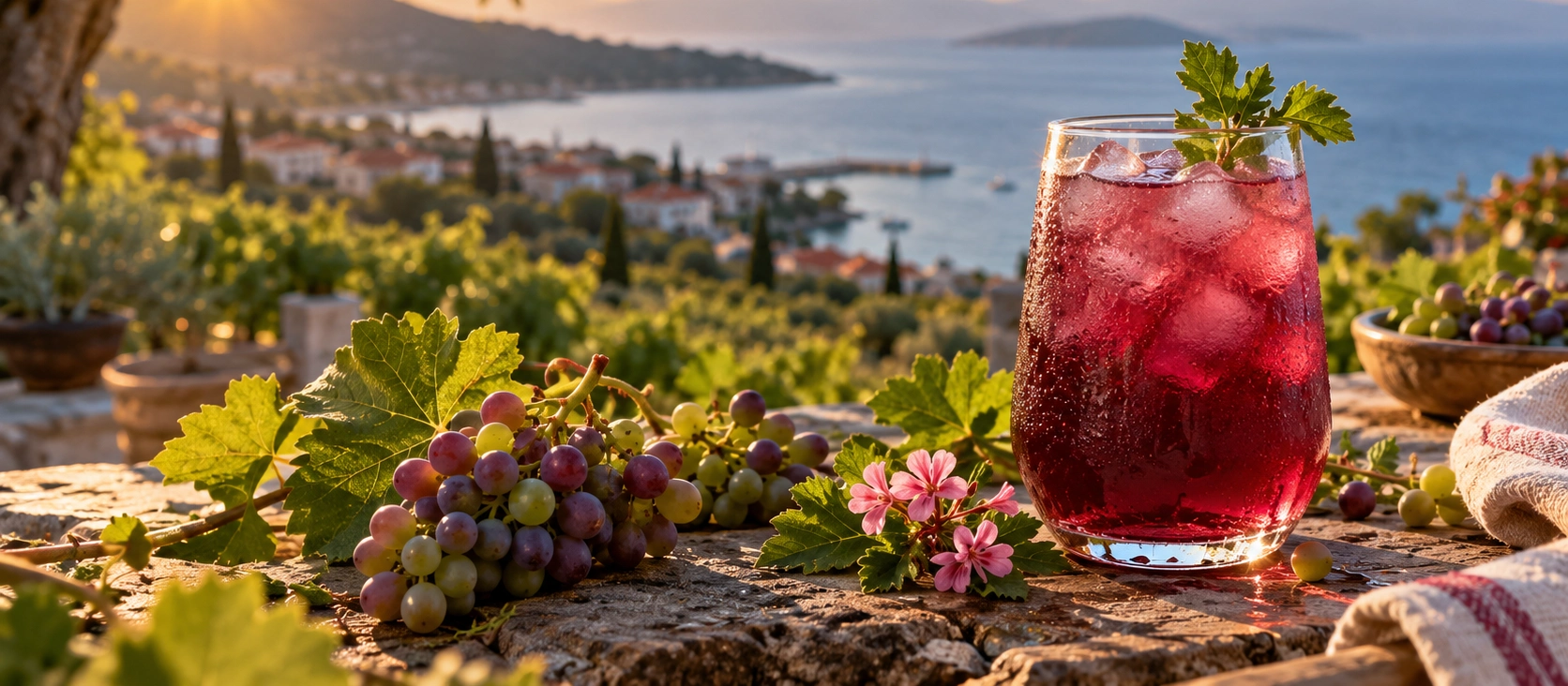
Discover Bademli's village landscape, traditional koruk sherbet, seasonal Aegean produce and the beautiful coastline around Dikili.
Request This Experience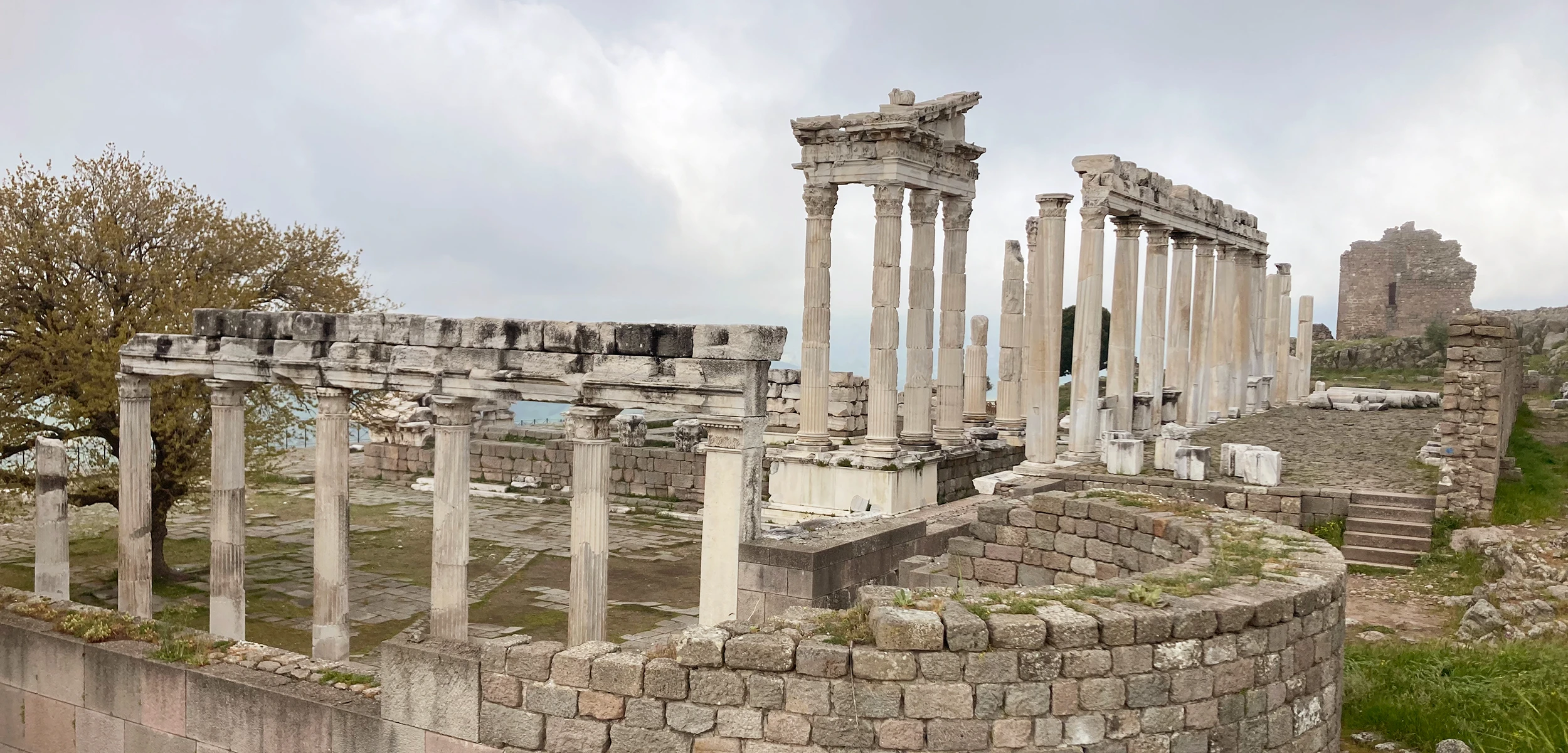
Combine the extraordinary archaeological heritage of ancient Pergamon with the villages, agricultural landscapes and coastline of northern İzmir.
Design Your ExperienceContinue your journey through Türkiye's Aegean region with private cultural, archaeological and culinary experiences designed around your interests.